What Is a Theoretical Framework in Research
What Is a Theoretical Framework in Research. Learn what a theoretical framework in research is, why it matters, and how to build one for your thesis

You've read the definitions, highlighted the key theories, and still can't explain what your theoretical framework does. Perhaps your methodology chapter is open on your screen, but you're unsure whether the framework should be a summary of everything you've read, a diagram of your variables, or a formal explanation of your chosen theory.
That confusion is common because the phrase sounds more abstract than the task really is. A theoretical framework gives your study a reasoned way to decide what matters, how ideas connect, what evidence to collect, and how to interpret the result. Once you see it as a working lens rather than a decorative chapter, the writing becomes much easier.
Table of Contents
- What a Theoretical Framework Really Does in a Study
- The Four Core Functions Every Framework Performs
- The Building Blocks of a Strong Theoretical Framework
- How to Choose Between Competing Theories
- Theoretical Framework vs Research Gap and Why the Difference Matters
- How to Write a Theoretical Framework Step by Step
- Two Worked Examples From a Real Thesis Chapter
- Common Mistakes and a Pre-Submission Checklist
What a Theoretical Framework Really Does in a Study
A theoretical framework is a connected set of concepts and premises, drawn from one or more established theories, that you use to scaffold a particular study. It determines which concepts you define, how you expect them to relate, and how those relationships will guide analysis and interpretation. This practical definition aligns with the explanation in Academic Medicine's discussion of theoretical frameworks.
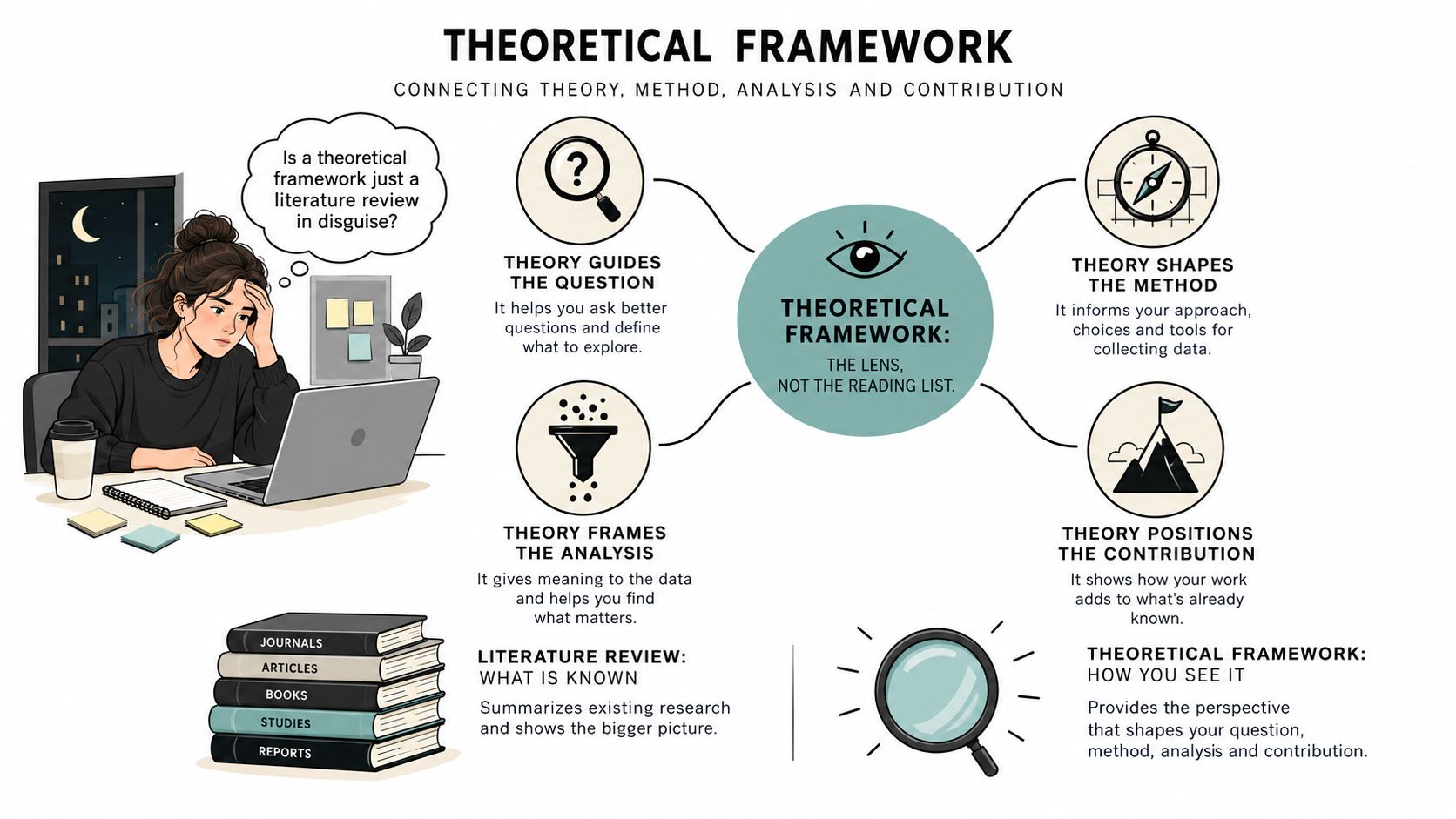
The framework isn't the same as a reading list. A literature review maps what other researchers have said about a field. Your theoretical framework selects the ideas that will help you answer your own research question. You can think of the literature review as a map of the territory and the framework as the lens you choose before examining one particular location.
The lens, the object, and the findings
The research question is the object under inspection. The theoretical framework is the lens. Your findings are what becomes visible when you examine that object through the lens.
Suppose your question asks why some students persist in online higher education while others withdraw. A motivation theory might direct your attention toward autonomy, competence, and relatedness. A behavioral-intention theory might instead focus on attitudes, social expectations, perceived control, and intention. The topic stays similar, but the concepts you investigate and the explanations you can offer change.
That's why your framework should appear throughout the thesis:
- It defines the concepts used in the research question.
- It influences the variables or themes you investigate.
- It supports your choice of interviews, surveys, observations, or another method.
- It gives you a disciplined way to interpret findings.
- It helps you explain what your study adds to existing knowledge.
The historical movement from an implicit lens to an explicit planning tool is described in this academic overview of theoretical framework development. In practical terms, your framework should make the logic of the project visible to a reader who hasn't followed every decision you made.
If your research problem still feels broad, clarify it before choosing a theory. A focused research problem statement gives you a much firmer basis for deciding which theoretical lens fits.
The Four Core Functions Every Framework Performs
A useful framework performs several jobs at once. If it only describes a theory but never changes what you ask, measure, or interpret, it's probably functioning as background reading rather than as a framework.
It gives you a precise vocabulary
Research problems often begin with ordinary language. You might say that online students feel disconnected, that teachers lack support, or that employees are overwhelmed. A theory helps you replace those broad impressions with defined concepts.
For an online learning study, “feeling disconnected” might become social presence, relatedness, belonging, or perceived isolation. You don't choose among these terms because one sounds more academic. You choose the term whose theoretical meaning matches the problem you're investigating, then use it consistently.
It narrows the research question
A theory also acts as a filter. It shows which factors belong at the centre of the study and which interesting issues need to remain outside its scope.
A broad question about online persistence could become a question about how perceived autonomy support influences students' motivation to continue. That narrower question is easier to operationalize, investigate, and defend because the framework tells you why those concepts matter.
Practical rule: If your theory cannot help you remove concepts from the project, you haven't used it as a boundary.
It justifies methodological choices
The framework should explain why your method suits the claims you want to make. A survey may fit a study that tests predicted relationships among measurable constructs. Interviews may fit a study that explores how participants experience those constructs in context.
The method still needs its own justification, but the theoretical framework should make the choice coherent. The design shouldn't look like a convenient technique selected after the fact.
It locates the contribution
Finally, the lens tells you what kind of contribution you can claim. Your study might apply an established theory in a new setting, explore how participants understand a theoretical concept, challenge an expected relationship, or show that a theory needs refinement in a particular context.
The National University research guide on theoretical frameworks similarly emphasizes the framework's role in aligning the problem, questions, variables, data, and analysis. Before drafting, ask whether your framework performs all four functions:
- Vocabulary: Can you define every central concept?
- Focus: Does the theory narrow the question?
- Method: Can you explain why the design follows from the framework?
- Interpretation: Can you state what the findings will and won't allow you to claim?
These functions depend on a small network of concepts, constructs, and relationships rather than on a stack of theory summaries.
The Building Blocks of a Strong Theoretical Framework
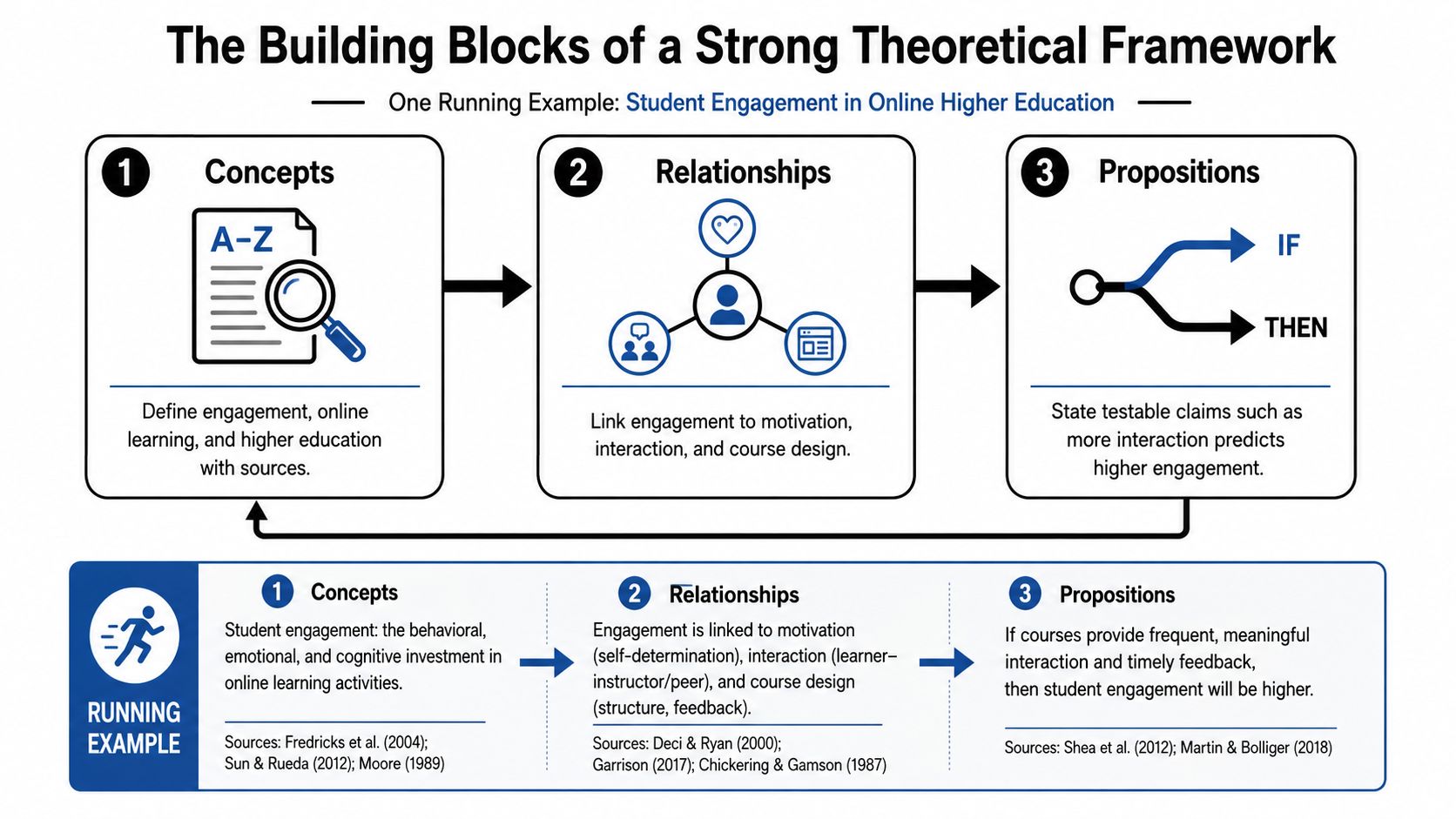
A strong framework has layers that connect. The following example uses student engagement in online higher education, but the same logic can apply to a study of workplace burnout, technology adoption, or public health behavior.
Concepts give the study its language
A concept is an idea that matters to the study. In the example, relevant concepts might include engagement, motivation, interaction, course design, and online higher education.
Your first task is to define these terms from the selected literature. Don't assume that “engagement” means the same thing to every researcher. One author may emphasize participation, another may emphasize emotional involvement, and another may include cognitive effort. Your framework must state which meaning your study adopts and why.
A construct is the form of an abstract concept that you will examine in the study. If engagement is a construct in a survey, you might represent it through responses about participation, attention, and persistence. If the study is qualitative, you might explore how students describe involvement, effort, and connection during their learning experience.
Relationships connect the concepts
A framework becomes useful when it explains how the constructs relate. You might argue that course design affects interaction, that interaction supports motivation, and that motivation is associated with engagement.
Those connections shouldn't appear as arrows just because they make a diagram look complete. Each relationship needs support from the selected theory and relevant literature. You should also state whether the relationship is expected, exploratory, conditional, or open to revision.
For help organizing the sources that support these connections, you can use a structured guide to literature review organization. The review supplies the evidence, while the framework arranges that evidence into an explanatory structure.
Propositions state what the relationships mean
A proposition expresses a theoretical claim about a relationship. For example, you might write: “Greater interaction is expected to support stronger student engagement in online higher education.”
In quantitative research, that proposition may become a hypothesis connected to measurable variables. In qualitative research, it may guide interview questions and sensitise you to patterns without forcing participants' accounts into a predetermined answer.
A clean framework avoids repeating definitions and vague connections. Each construct should be defined once, each relationship should have a reason, and each proposition should tell the reader what the analysis may confirm, extend, question, or reject.
How to Choose Between Competing Theories
Students often reach a difficult point after reviewing the literature. Two or more theories seem plausible, and each could explain part of the problem. Choosing the first theory you encounter is weak, but listing every plausible theory produces an unfocused framework.
Consider a study asking why students persist in online learning. Self-Determination Theory might direct attention to autonomy, competence, relatedness, and motivation. The Theory of Planned Behavior might direct attention to attitudes, perceived social expectations, perceived control, intention, and persistence-related behavior.
| Evaluation criterion | Self-Determination Theory | Theory of Planned Behavior |
|---|---|---|
| Core fit | Stronger when the problem centres on motivation and the quality of students' experience | Stronger when the problem centres on intention and a planned behavior |
| Likely variables | Autonomy, competence, relatedness, intrinsic motivation, persistence | Attitude, subjective norm, perceived behavioral control, intention, persistence |
| Methodological implications | May support questions about students' experiences and motivation, or measures of motivational conditions | Often supports a structured survey examining predicted relationships |
| Explanatory reach | Helps explain why students feel motivated to continue | Helps explain how beliefs and perceived control shape intention and action |
| Main boundary | May not fully explain social pressure or perceived behavioral control | May not fully explain the quality of students' underlying motivational experience |
Apply three decision rules.
First, test construct fit. Compare the theory's central constructs with the words in your problem statement and research questions. If your question is about belonging and meaningful participation, a theory centred on intention may leave important parts unexplained.
Second, test explanatory reach. Ask which theory can account for the specific context, population, and outcome. A theory may be strong in general but poorly matched to the setting you're studying.
Third, examine its use in the relevant literature. Look for research that applies the theory to a similar phenomenon and method. The point isn't to count studies. It's to see how researchers have defined constructs, handled limitations, and adapted the theory responsibly.
Your justification might read like this: “Self-Determination Theory was selected because the study examines how students' experience of autonomy, competence, and relatedness shapes their motivation to persist. The Theory of Planned Behavior was considered, but it places greater emphasis on intention and perceived control than on the motivational conditions central to this research question.”
A defense panel will likely ask why you rejected the alternative, whether your chosen theory fits the method, and what its limits are. Write those answers into the framework before the defense forces you to improvise.
Theoretical Framework vs Research Gap and Why the Difference Matters
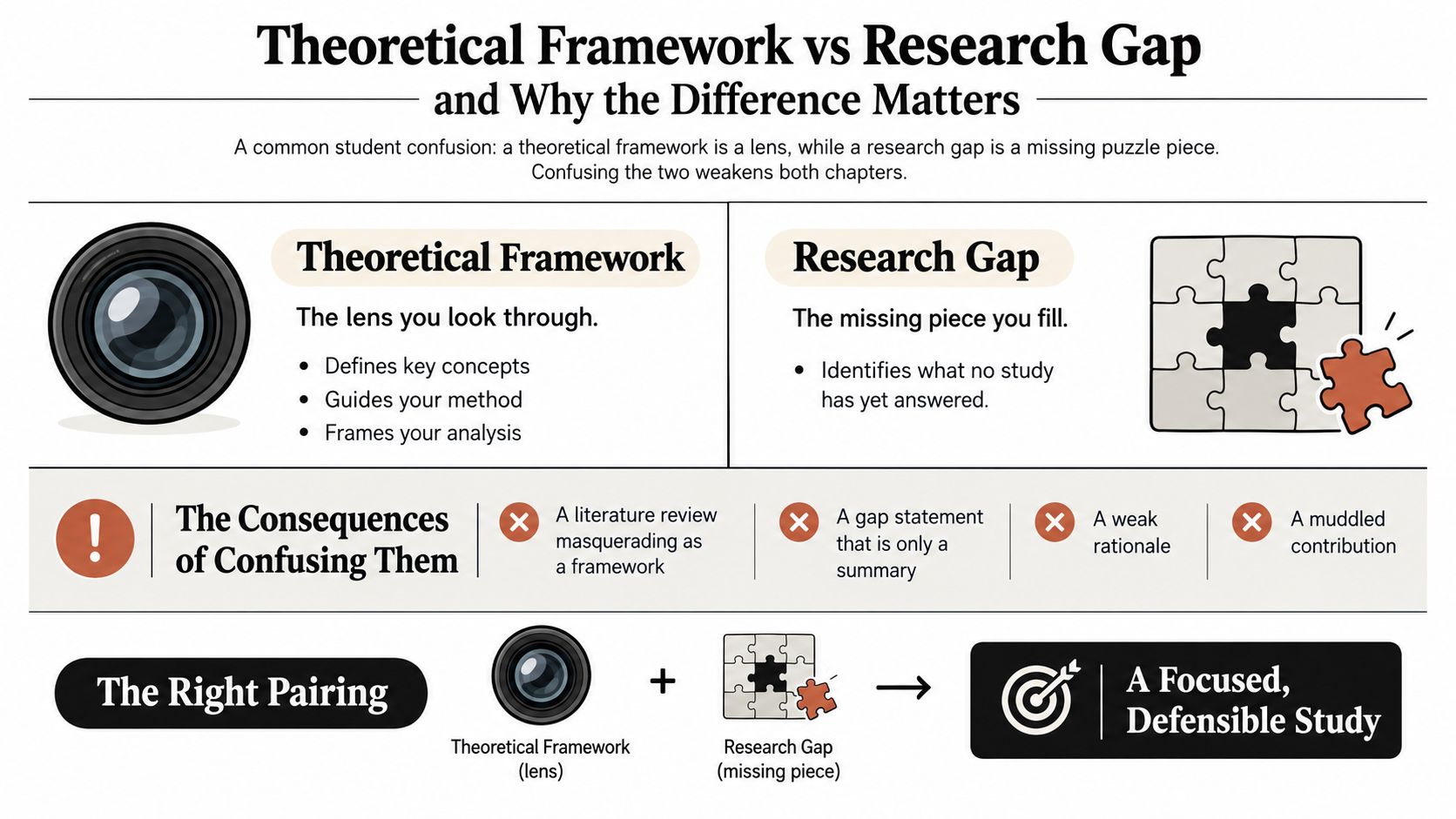
A theoretical framework is the lens you use to examine a problem. A research gap is the missing piece your study intends to address. They work together, but they don't perform the same job.
The framework organizes established knowledge. The gap identifies what remains unanswered, underexplored, or insufficiently explained. A study can have a strong framework even when the theory is contested or only partly applicable, provided the writer acknowledges those limits and explains how the study will examine them.
Four kinds of gap
A methodological gap exists when the question has mainly been studied through one method, but another method could reveal something different. A qualitative study might explore experiences that earlier surveys reduced to predefined responses.
An empirical gap concerns missing evidence. Researchers may have proposed a relationship, but the relationship hasn't been examined in your chosen population or setting. Your claim should remain limited to the evidence your design can provide.
A theoretical gap appears when existing theories explain the phenomenon incompletely, conflict with one another, or haven't been applied to the problem in a convincing way. This permits a more direct theoretical contribution, but it also demands careful argument.
A contextual gap concerns place, institution, culture, sector, or population. Applying a framework in a different context can be valuable, but a new setting alone doesn't automatically prove that the theory works there.
For the online persistence example, the framework might use Self-Determination Theory to explain why autonomy, competence, and relatedness could influence motivation. The gap might be that existing work hasn't adequately explored how those experiences shape persistence among a particular student population through qualitative interviews.
You can use a research gap guide to test whether your proposed gap is specific and defensible. A free RRL generator may also help you organize preliminary reading, but you still need to verify every source and write the analytical connection yourself.
When reviewing a gap statement, ask one question: does it point to a missing theory, method, evidence, context, or population? If it only says that “more research is needed,” it hasn't yet identified a gap.
How to Write a Theoretical Framework Step by Step
Treat the framework as a sequence of decisions rather than a chapter you write from the first page to the last. Each milestone should leave you with an output that supports the next one.
Begin with the objectives
Restate your research objectives and questions in plain language. Underline the concepts that must appear in the framework. If the objective concerns persistence, don't let the chapter drift into every aspect of online learning.
Set aside a short working session for this step. The output is a focused list of concepts and the relationships your study needs to examine.
Screen candidate theories
List the theories that could plausibly explain those concepts. Compare them using construct fit, explanatory reach, and relevant literature, rather than choosing the theory with the most familiar name.
Many students stall at this point. Ask your supervisor for feedback on the comparison, but don't ask only, “Which theory should I use?” Bring a table that shows what each candidate would make you investigate.
Define constructs and operational meanings
Extract only the concepts and constructs that will appear in your study. Find authoritative sources for each definition, then explain how your study will recognize or examine the construct.
For a quantitative project, this may lead to a measure or instrument. For qualitative work, it may lead to sensitising concepts and interview prompts. Allow substantial reading time here because weak definitions create confusion later in the methodology and analysis chapters.
Map relationships
Draw the framework before writing several pages of prose. Place the main constructs on the page and connect only relationships that your theory and literature support.
Then write a short propositional explanation underneath the diagram. The reader should understand the logic without having to decode the visual.
Draft the narrative
Open with the selected theory and its relevance to the research problem. Define the constructs in the order they appear in the model, explain the relationships, acknowledge assumptions and limits, and close by showing how the framework leads into the conceptual framework or methodology.
A practical schedule might allocate a brief session for objectives, a longer block for theory comparison, several reading sessions for definitions, a focused session for the diagram, and another sustained period for drafting and revision. The exact time depends on the project and your source base. The important point is to give theory selection and operational definitions their own milestones instead of treating them as quick tasks.
Two Worked Examples From a Real Thesis Chapter
The following mini-frameworks are model passages, not claims about completed studies. They show how the same basic logic changes when the research design changes.
Qualitative example on teacher burnout
A qualitative case study could use Self-Determination Theory to examine how teachers describe the conditions associated with emotional exhaustion. The framework would begin by explaining that autonomy, competence, and relatedness provide a way to interpret teachers' accounts of control, capability, and connection at work.
The study might define autonomy as teachers' perceived ability to exercise meaningful judgment, competence as their sense of effectiveness in meeting professional demands, and relatedness as their experience of connection with colleagues and students. Interviews would invite participants to describe moments when these needs were supported or frustrated.
The proposition would be exploratory rather than a statistical prediction: when teachers experience sustained frustration of these needs, they may describe emotional exhaustion as more intense or persistent. The analysis could compare accounts across cases, looking for how participants connect workplace conditions with exhaustion. The framework guides coding, but it doesn't prevent unexpected explanations from emerging.
Quantitative example on remote-work productivity
A quantitative survey could use the Job Demands-Resources Model to study whether technostress helps explain the relationship between digital workload and output quality.
The framework might define digital workload as the perceived volume and intensity of technology-mediated work, technostress as strain associated with using workplace technologies, and output quality as the employee's reported assessment of work quality. The model would propose that digital workload is associated with technostress, technostress is associated with output quality, and technostress helps explain part of the relationship between workload and quality.
Those propositions could become hypotheses linked to survey measures and a planned mediation analysis. The framework therefore needs clear operational definitions and a logical connection between each construct and the analysis.
| Feature | Qualitative example, teacher burnout | Quantitative example, remote-work productivity |
|---|---|---|
| Purpose | Explore how teachers understand and describe burnout | Test predicted relationships among measured constructs |
| Framework role | Sensitises interviews and supports thematic interpretation | Supplies constructs, propositions, and hypotheses |
| Core concepts | Autonomy, competence, relatedness, emotional exhaustion | Digital workload, technostress, output quality |
| Evidence | Interview accounts and contextual descriptions | Structured survey responses |
| Claim style | Interpretive and context-sensitive | Directional and testable |
| Main risk | Forcing participants' experiences into fixed categories | Including unsupported paths or poorly defined measures |
The qualitative framework prioritizes depth and context. The quantitative framework prioritizes measurement and prediction. Neither is automatically more rigorous. The framework must match the question and the kind of evidence the method can produce.
Common Mistakes and a Pre-Submission Checklist
The most frequent error is describing a theory instead of applying it. A history of a theory's development won't show why it belongs in your study. After explaining the theory, connect its constructs directly to your question, design, and interpretation.
Another problem is listing unrelated theories. Several theories can be used together, but each must have a distinct role and a clearly explained point of integration. If the theories make incompatible assumptions, acknowledge the tension or choose a narrower framework.
Students also create a literature dump by arranging source summaries one after another. Group literature around constructs and relationships, then explain what the combined evidence means for your study.
A fourth mistake is confusing the theoretical and conceptual frameworks. The theoretical framework supplies the established logic. The conceptual framework applies that logic to your specific population, variables, setting, and design.
Finally, writers often leave the connection to the research question implicit. A reader shouldn't have to guess why a construct appears in the model or how the framework will return in the analysis and discussion.
Pre-submission check
- Definitions: Is every central construct defined with an appropriate scholarly source?
- Selection: Have you explained why this theory fits better than plausible alternatives?
- Relationships: Does every connection in the model have theoretical or empirical support?
- Propositions: Can each proposition be tested, explored, confirmed, questioned, or refined?
- Method alignment: Does the framework suit your qualitative, quantitative, or mixed-method design?
- Analysis return: Will the framework appear again when you code, test, or interpret the data?
- Boundaries: Have you stated where the theory may not apply?
- Citation quality: Have you checked that your citations support the claims you attach to them?
A theoretical framework is a living argument. It should remain understandable and defensible when your supervisor questions it, when your findings surprise you, and when you reach the viva.
Thesis Book Project helps students turn a dissertation into trackable chapters, milestones, sources, and supervisor check-ins, which can make a complex framework easier to plan and revise. Visit Thesis Book Project to organize your research workflow from proposal through submission.
Related Articles
7 Literature Review Paper Example Sources
The most useful literature review paper example isn't a polished document to imitate. It should...
Research MethodsHow to Write a Dissertation Abstract That Gets Read
You've finished the dissertation, and now the last page is staring back at you. The abstract fee...
Research MethodsLiterature Review vs Research Paper: Key Differences
You're halfway through a thesis when your supervisor writes, “Add a stronger literature review.”...
Comments (0)
No comments yet. Be the first to share your thoughts.