Literature Review Organization Methods
Master literature review organization with proven thematic, chronological, and methodological structures. Build a synthesis workflow that supports your thesis.
Most advice about literature review organization starts in the wrong place. It tells students to pick chronological, thematic, or methodological structure as if the chapter were a filing system, when the actual task is to build a defensible synthesis that matches the research question and the pattern of evidence, not the order in which you happened to find papers. Major university guidance treats the literature review as an essay with introduction, body, and conclusion, and the body is typically arranged chronologically, thematically, or methodologically, because the chapter has to compare studies, surface differences, and identify the strongest contributions, not just list what you read USC Libraries guidance on literature reviews.
A weak review often starts as an annotated bibliography in disguise. The author opens PDF after PDF, writes a paragraph per source, and hopes the structure will appear later. It usually doesn't, because the argument was never mapped to begin with, and the chapter ends up as a stack of summaries that are hard to defend in front of a supervisor or examiner.
Table of Contents
- Why Most Literature Reviews Fail Before Drafting
- Choosing the Right Structural Approach
- Building a Synthesis Matrix for Extraction
- Combining Structures for Complex Thesis Chapters
- Maintaining an Audit-Ready Workflow Over Time
- Finalizing Your Chapter Architecture
Why Most Literature Reviews Fail Before Drafting
Confusing collection with synthesis can derail a literature review before the first polished paragraph. A folder full of papers does not establish an argument, reveal a disagreement, or show why one line of evidence matters more than another. The chapter needs an organizing logic that turns reading into a defensible account of the field. Academic guidance recommends dividing the body into themes or categories, comparing similarities and differences, and identifying the works that contribute most strongly to the field. The Illinois State University writing guide offers a useful reference for that approach.
The wrong mental model
A larger source list does not automatically produce a stronger chapter. It can increase duplication, obscure the research question, and make later restructuring harder. Illinois State's guidance distinguishes a literature review from both an annotated bibliography and a simple timeline: sources must be connected to one another and to the paper's argument Illinois State University writing guide.
That distinction shapes the work before drafting begins. The review should establish what the field knows, where findings or methods diverge, and where an unresolved gap supports your study. A reading-order structure usually produces repeated points, abrupt transitions, and a conclusion that feels detached from the evidence. Use a practical explanation of what a research gap looks like to test whether the gap is specific enough to organize a thesis chapter.
Practical rule: if a source can only be described on its own, the synthesis is not ready.
What strong organization actually does
Strong organization gives the reader a working map of the debate. It shows where theories align, where methods generate different results, and which tensions remain unresolved. For a thesis, that map must serve two purposes at once: guide the reader through the literature and preserve a record of why each source belongs in a particular section.
Create that record while reading. Note the source's research question, method, principal finding, limitation, and relationship to other studies. Mark the theme or debate it supports, challenges, or qualifies. Keep those decisions in a matrix or dated research log so revisions do not erase the reasoning behind the chapter's architecture.
Test each drafted section without its citation details. Can the reader still follow the claim, comparison, and implication? If removing the references makes the logic collapse, the passage is still a source list. If the reasoning remains clear, the review is beginning to function as synthesis.
Choosing the Right Structural Approach
Chronological, thematic, and methodological structures solve different problems. The right choice depends on what the literature is doing around your topic. A chapter tracing a theory's development needs a different architecture from one comparing measures or explaining conflicting findings across subfields.
Comparing the core options
Chronological organization fits a field where change is part of the argument. Use it when assumptions, concepts, or research priorities develop through identifiable stages. The risk is producing a history lesson that ends without explaining how the development shapes your research question.
Thematic organization suits broad topics with several debates or sub-questions. Grouping studies by concept lets you compare findings across papers and build an argument rather than narrate sources one at a time. Define each theme narrowly enough to support a clear claim. Otherwise, sections become storage bins for loosely related studies.
Methodological organization works when research design helps explain divergent results. Separating qualitative, quantitative, mixed-methods, or experimental studies can reveal how evidence changes with the method used. Keep the comparison analytical: describe what each design allows you to see, where it limits interpretation, and how those limits affect the debate.
| Structure Type | Best Used When | Common Pitfall to Avoid |
|---|---|---|
| Chronological | You need to trace how a theory, field, or debate developed over time | Treating the chapter like a timeline instead of a synthesis |
| Thematic | The topic has multiple concepts, debates, or sub-questions | Making themes so broad that the analysis gets vague |
| Methodological | Study design explains why findings differ | Describing methods without comparing what they reveal |
For a practical model of how a review can be arranged around different organizing logics, consult the literature review sample PDF guide. Adapt its structure to your research question rather than copying its surface format.
A quick decision rule
Use chronology when change explains the present debate. Use themes when relationships among concepts or findings carry the argument. Use methodology when design differences account for competing conclusions.
Many thesis chapters need a combination. Establish one dominant structure so the reader knows how the chapter progresses, then use secondary structures inside individual sections. A thematic chapter might open with a brief chronological account of the field, while one theme separates qualitative and quantitative evidence to explain a disagreement. A methodological chapter might close each design group by tracing how its findings changed over time.
Keep the hierarchy visible in headings and topic sentences. If the organizing logic changes without warning, readers spend effort reconstructing the chapter instead of evaluating the synthesis. Record the reason for each structural choice in your research log, especially after major revisions, so the final architecture remains defensible months later.
If the structure does not answer the research question faster than a source list, choose a different structure.
Building a Synthesis Matrix for Extraction
You can't organize what you haven't extracted consistently. A synthesis matrix forces discipline at the reading stage, before memory and intuition start filling in gaps. That's why it's one of the most practical tools for literature review organization, especially when the source list is large enough that patterns stop being obvious.
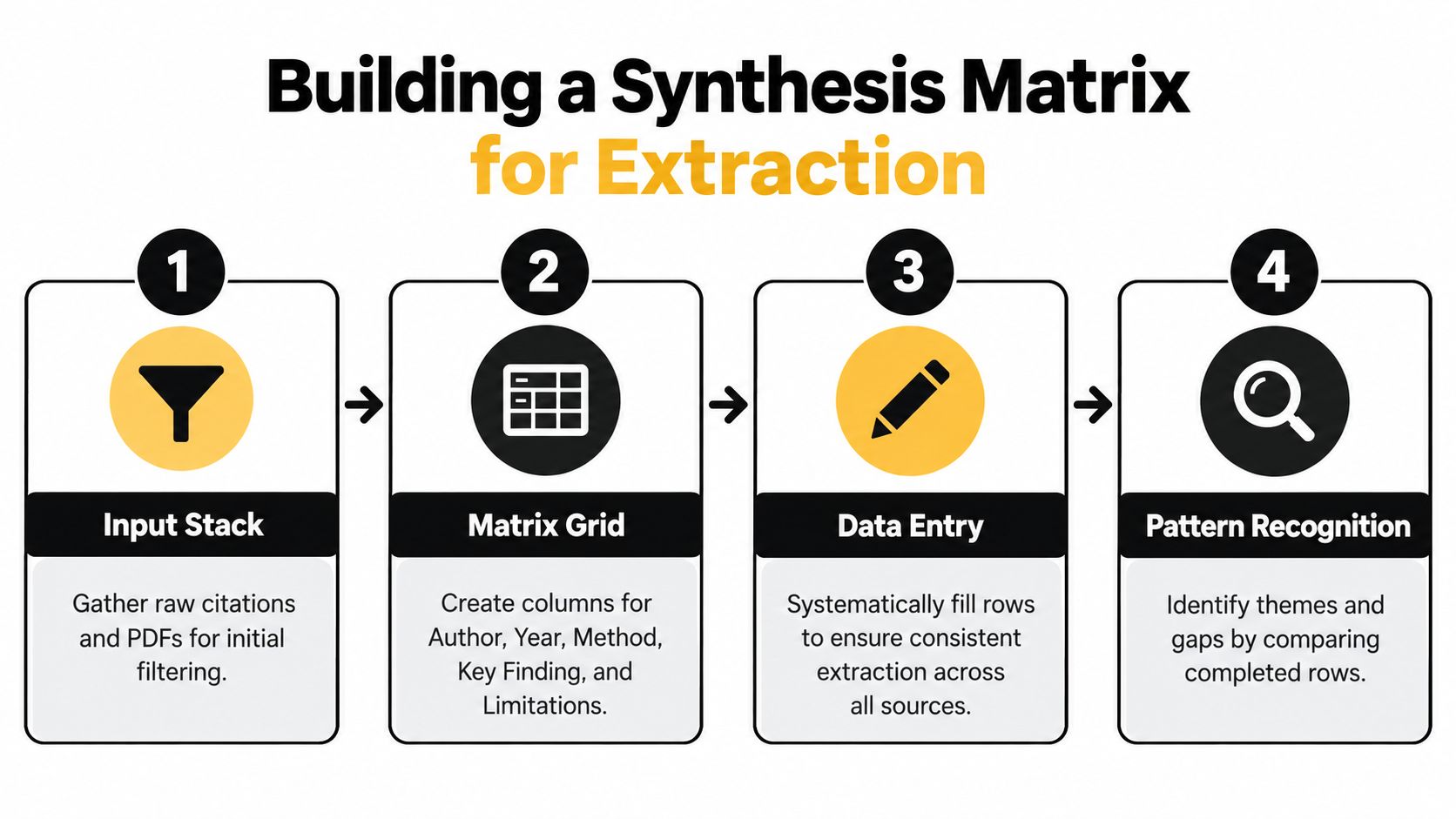
Start with a grid that captures the same fields for every paper. At minimum, those fields should cover the author, year, design, core findings, and limitations, because without consistent extraction you can't compare studies fairly. A matrix also reduces the risk of selective remembering, where the papers that felt most persuasive during reading end up dominating the chapter even if they aren't the strongest fit.
How to set it up
Use a spreadsheet or table with one row per source and one column per field. Keep the fields stable across the whole project so the matrix becomes comparable instead of decorative. If you need a practical reference for designing the table itself, the literature review table guide shows the kind of structure that makes cross-study comparison easier.
Fill the matrix after each reading session, not weeks later. That habit matters because the details that distinguish one paper from another, sample characteristics, analytic choices, boundary conditions, tend to blur quickly once you've moved on to the next batch of articles. When the matrix is current, thematic grouping becomes much easier because the similarities and contradictions are already visible.
What the matrix helps you see
A good matrix does more than store notes. It exposes recurring findings, conflicting claims, and missing angles in a way that your memory won't. It also makes it easier to spot when several studies are answering different questions, even if they use similar keywords.
Useful habit: write one sentence in the matrix column for “so what does this paper add to the chapter?” If you can't answer that, the paper may not belong in the main synthesis.
The point isn't perfection. The point is traceability. Once the matrix is solid, drafting becomes a matter of grouping evidence rather than reconstructing your reading history.
Combining Structures for Complex Thesis Chapters
Real dissertation topics rarely sit neatly inside one organizing logic. A theory may need to be traced historically, then evaluated thematically across competing positions, then compared by method to show why the evidence still doesn't settle the question. That kind of chapter needs a hybrid architecture, not a forced choice between boxes.
Use strand outlines instead of one rigid frame
A strand outline works by separating the chapter into distinct lines of development, then weaving them together with clear transitions. One strand can handle theoretical evolution, another can track empirical findings, and a third can compare methodological approaches. This is especially useful when the literature spans multiple evidence types and the chapter has to support both the research gap and the eventual method chapter.
The key is not to treat strands like isolated mini-chapters. Each strand should answer a different part of the same research problem. If one section maps how a concept developed, the next section should explain how later studies tested it, and the following section should show where the findings remain inconsistent.
Keep the reader oriented
Hybrid structures only work when the signposting is obvious. Readers need to know why the chapter just shifted from theory to evidence, or from evidence to method. The transitions don't need to be flashy, they need to be explicit enough that the logic is never ambiguous.
One practical way to keep the thread intact is to end each major subsection with a synthesis sentence that identifies what the studies collectively show and what they still don't resolve. That move keeps the review from feeling segmented, and it prepares the final gap statement without sounding abrupt.

A useful rule for mixed evidence
If the evidence types are uneven, let the research question decide the order, not the volume of material. The loudest literature doesn't always deserve the lead position. The strongest chapter is the one where theory, method, and empirical findings all point toward the same unresolved issue.
Maintaining an Audit-Ready Workflow Over Time
A literature review keeps changing as supervisors comment, new papers appear, and the thesis shifts under pressure from the evidence. Reproducibility keeps that moving target defensible. Without a traceable process, revisions can alter which studies were included, how findings were interpreted, and why the chapter reached its conclusions.
Research-methodology guidance treats review work as a planned workflow: define the question, search multiple databases and grey literature sources, screen against inclusion criteria, assess quality, extract data, then collate and compare the evidence before drawing conclusions NCBI review methods guidance. Record those decisions as you work. Otherwise, convenience takes over, and the sources easiest to remember become the sources cited most often.
Where reviews lose control
Stale searching is a common failure. A chapter may look organized while remaining outdated because the last search update occurred early in a long thesis cycle. Guidance discussed in the Cambridge review-quality article warns that a lengthy gap between the final search update and submission can leave a review out of date BJPsych Open article on review quality. Set a planned update point before submission, and record the date, databases, search terms, and screening decisions.
Methodological slippage creates a second problem. Vote-counting can reduce complex evidence to a tally of significant and non-significant results, hiding differences in study quality, design, and effect size. Treat that tally as a warning sign, not as synthesis. Compare the evidence on the dimensions that determine whether the findings can reasonably be combined.
What a durable workflow looks like
A durable process uses version control for reading lists, consistent chapter naming, and scheduled review updates. A practical workflow standardization guide can help establish repeatable steps without turning the project into bureaucracy.
Use shared conventions for file names, date stamps, and section labels. Track each source as “read,” “extracted,” “drafted,” or “cited,” and keep a short decision log for exclusions, merged themes, and changes to the research question. During supervisor revisions, these records show whether a comment requires a structural change, a citation update, or a full reworking of the synthesis.
Practical rule: if you cannot identify what changed since the last draft, the workflow is not yet auditable.
Finalizing Your Chapter Architecture
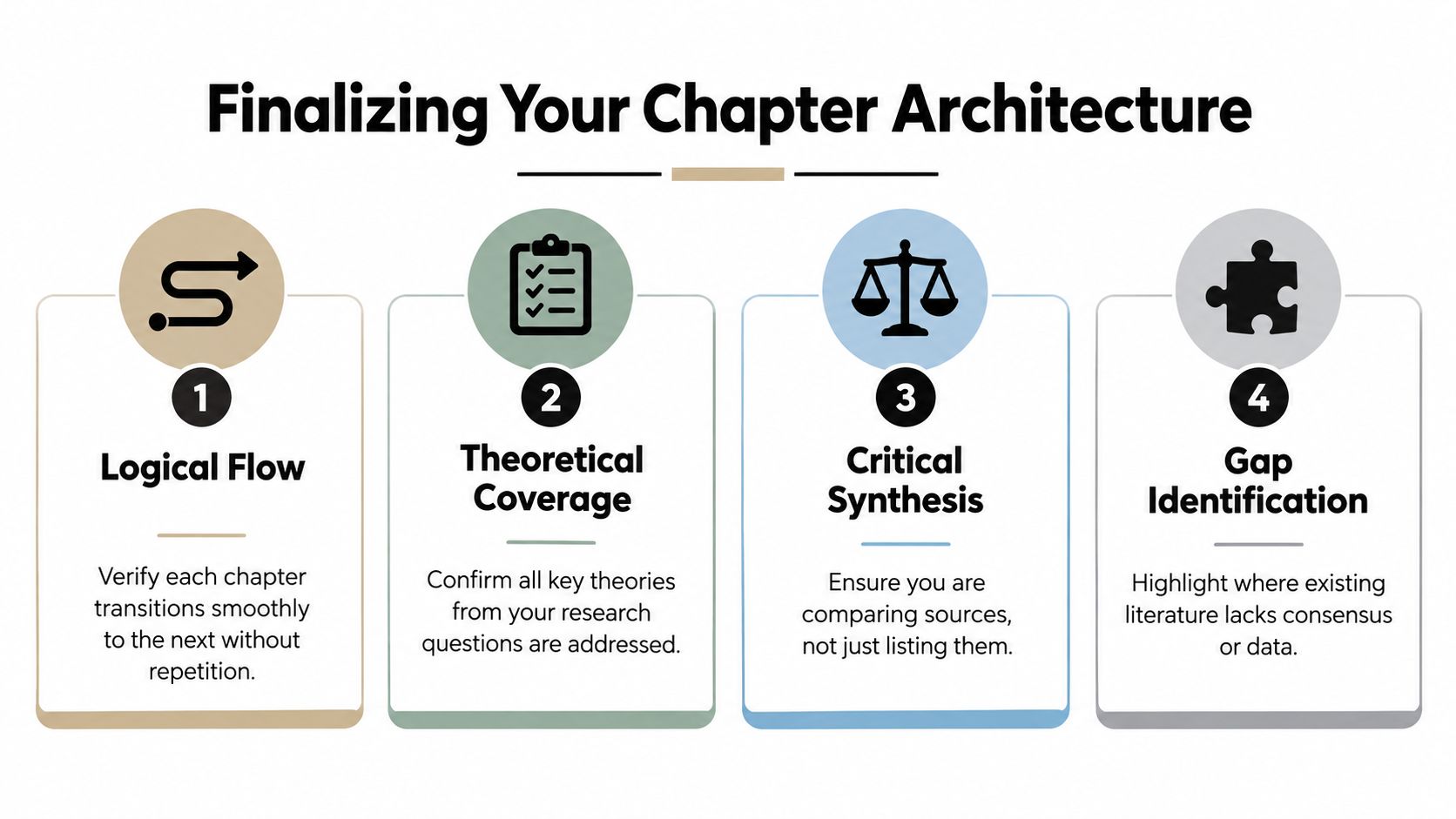
A defensible chapter architecture should answer four questions before you write the first full draft. Does the structure follow the research question, do the sections connect without repetition, are the key theories covered, and does the chapter clearly identify the gap your study will address? If any one of those fails, the outline still needs work.
A final checklist
Check the flow first. Read the outline aloud and see whether each section leads naturally into the next, or whether the chapter jumps between ideas without a reason. If you have to keep explaining the sequence to yourself, the reader will struggle too.
Then test coverage. Every major theme in your question should appear somewhere in the chapter, but only if it supports the argument. Irrelevant literature weakens the chapter faster than a thin section does.
After that, inspect synthesis. The outline should show where sources are being compared, where disagreement is being resolved, and where the literature remains incomplete. If most sections still sound like “study A says this, study B says that,” the chapter is not ready.
Finally, map the gap. The ending of the literature review should not feel like an accident. It should lead directly into why the current study is needed and how the next chapter will answer that need.
What to hand your supervisor
Bring the outline, not just the draft. A well-structured chapter plan gives supervisors something concrete to react to, and early feedback on architecture saves far more time than line edits later. It also keeps the literature review aligned with the method chapter, so the thesis feels like one argument rather than separate documents stitched together.
Treat the outline as a milestone, not a sketch. Once it holds up under that standard, the drafting stage becomes much less fragile, and the finished chapter is far more likely to survive revision without major structural surgery.
Thesis Book Project gives you a practical way to turn a literature review plan into a tracked chapter workflow, with source organization, chapter status, and milestone visibility built around the thesis process. If you're trying to keep your literature review organized across months of revision and supervisor feedback, visit Thesis Book Project and see how the roadmap and chapter tracker can keep your structure audit-ready from outline to submission.
Related Articles
What Is a Research Problem Statement: A Practical Guide
A research problem statement is a structured explanation of a specific gap or issue in existing know...
Research MethodsHow to Write a Dissertation Proposal Guide
You're staring at a blank document, a deadline, and a supervisor who wants something “focused” b...
Research Methods10 Literature Review Sample PDFs to Use
A literature review sample PDF is most useful when you ignore its sentences. The underlying lesson s...
Comments (0)
No comments yet. Be the first to share your thoughts.