Literature Review for Dissertation: A Step-by-Step Guide
Learn how to plan, search, screen and synthesize sources for a literature review for dissertation, with a stage table, checkpoints and an audit trail.
You've read the papers. The Zotero library has 214 entries, the folder of highlighted PDFs is sorted by author, and the chapter file has been open on a second monitor for three weeks. The draft runs to 4,000 words. Your supervisor's written comment is one line long: "This is a list of what other people found. Where's your argument?"
That comment is not a complaint about your reading. It's a complaint about evidence you can't trace. Sixty papers summarized one after another produce a chapter that any other student could have written from the same search results, because nothing in it records the decisions you made: why this study and not that one, why this date range, why this definition of the population, why this gap and not a better-known one.
A literature review for dissertation work is a decision trail that happens to be written in prose. Examiners follow the trail backwards. They check whether the claim on page 40 is supported by the study you cited, whether that study survived your own inclusion rules, and whether your search could plausibly have found the study that would have contradicted you. When the trail breaks, the argument collapses no matter how elegant the sentences are.
What follows is the sequence I walk students through, stage by stage, with the records, logs and checkpoints that make each stage provable.
Table of Contents
- What a Literature Review Must Achieve in Your Dissertation
- Review Stages, Outputs and Checkpoints at a Glance
- How to Run the Search and Build a Source Log
- How to Screen, Appraise and Extract Sources
- How to Turn Sources into an Argument and a Gap
- Structure Chapter Two and Draft the Synthesis
- Using AI Without Outsourcing Scholarly Judgment
- Confirm the Gap Before You Write Chapter Two
What a Literature Review Must Achieve in Your Dissertation
Picture a second-year candidate with sixty papers read and no answer to the simplest question a supervisor can ask: where does your study fit? The reading is rarely the problem. The problem is that the review has been treated as a reading log rather than as a research activity with a method of its own.
That distinction has a history. Review practice moved from a largely narrative scholarly craft toward systematic evidence organization across the second half of the twentieth century, and a historical overview in Frontiers in Education divides the shift into a foundation period from 1970 to 1989, an institutionalization period from 1990 to 2000, and a diversification period from 2001 onward, when meta-syntheses, scoping reviews, rapid reviews and integrative reviews joined the intervention-focused quantitative synthesis that came first.
For your chapter, that history settles an argument you may already be having with yourself. Four review types are legitimate in a dissertation:
- Narrative and conceptual. You build an argument from a reasoned selection of sources. Common in history, education, law and much of the humanities.
- Systematic and reproducible. You follow a protocol, log every decision, and report the flow from records found to studies included.
- Scoping and exploratory. You map the size and shape of a literature that hasn't been mapped, without appraising effect sizes.
- Integrative and multidisciplinary. You combine quantitative and qualitative evidence across fields and synthesize both.
The choice follows your research question and the evidence base, not the word count your department suggests for Chapter Two. A question about how a policy was implemented usually calls for a conceptual review; a question about whether an intervention works calls for a systematic one.
Whichever you choose, the chapter does three jobs. It shows what is established and on what evidence. It exposes where knowledge is missing or contested. And it justifies the study you're about to conduct, in terms your methods chapter can pick up.
Do this today: write one sentence at the top of your review plan naming the review type and the disciplinary norm your supervisor expects. Everything downstream is measured against it.
Review Stages, Outputs and Checkpoints at a Glance
| Stage | What you produce | Checkpoint question |
|---|---|---|
| 1. Define the question | One-sentence question and scope note | Can a supervisor see what is out of scope? |
| 2. Map concepts and criteria | Concept list, eligibility rules, date and language limits | Would two readers apply the rules the same way? |
| 3. Search databases | Search strings and a log of platform, date and filters | Could another person rerun the search and get the same records? |
| 4. Screen records | Screening log with one primary exclusion reason per excluded full text | Is every exclusion traceable to a rule? |
| 5. Extract and appraise | Source matrix with theory, method, findings and limitations | Does every included source have a quality judgment? |
| 6. Synthesize | Themes, contradictions and gap statements | Does each theme answer a chapter question? |
| 7. Write and integrate | Chapter sections linked to the research question | Does every subsection advance the question? |
Keep this table in your project file and mark a row complete only when the output in the middle column exists. "I've done the search" is not a completed row. A completed row has a string, a platform, a date and a record count attached to it.
The stages are not a one-way pipeline. When screening produces a case your eligibility rules can't classify, the fix belongs in row two, not in an improvised note beside record 1,438. Patch the rule, re-pilot it, then return to screening. The same applies when the source matrix reveals that a whole theme rests on one method: the answer is often a targeted second search, which sends you back to row three.
Standard systematic-review guidance sets out six core stages behind this map, from formulating the review question through searching, screening, quality assessment, data extraction, and analysis and presentation of findings (PMC review methodology). A dissertation can adapt that logic proportionately, but it can't skip the outputs.
Budget time by stage rather than by papers read. Search design and screening decisions consume the weeks that students expect to spend drafting, and drafting is usually the fastest part once the trail exists. Set your submission date first and work backwards into dated milestones. In Thesis Book Project step one, users set their deadline and break the whole thesis project into chapters and milestones in minutes, which makes those dated checkpoints visible before the review starts to drift.
How to Run the Search and Build a Source Log
A defensible review is a reproducible evidence-mapping process, not a sequence of summaries, and the PRISMA 2020 statement is the reporting frame most examiners now recognize even outside the health sciences. It supplies a 27-item checklist and flow-diagram templates, and a dissertation can borrow its transparency without adopting a full clinical protocol.
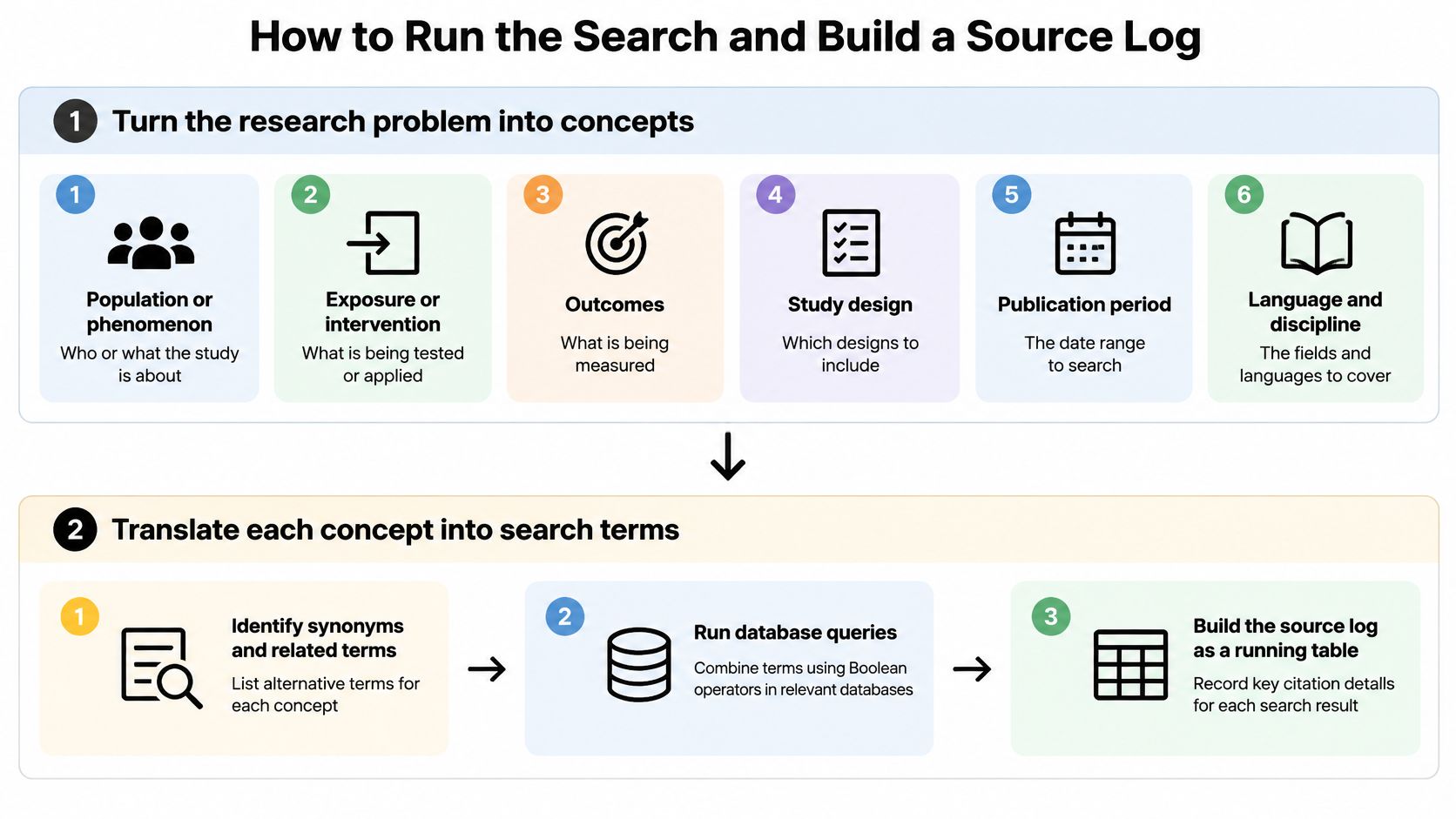
1. Turn the research problem into concepts. Write down population or phenomenon, exposure or intervention, outcomes, study design, publication period, language and disciplinary scope. The common slip is leaving the discipline boundary implicit and importing ten years of work from an adjacent field that uses the same word for a different thing.
2. Translate each concept into database-specific strings. Combine controlled vocabulary, the thesaurus terms the database itself assigns, with free-text synonyms. The common slip is writing one query and pasting it unchanged into every platform, where the thesaurus structure differs.
3. Search widely, then follow the citations. Cover several major databases, then work backward through reference lists and forward through citing articles. Add grey literature only where your field uses it. The common slip is describing a single-database search as broad.
4. Log everything as you go. Record the platform, search date, fields searched, Boolean syntax, filters applied, duplicates removed and numbers retained at each stage. The common slip is reconstructing the log from memory in month four, which produces a log no one can audit.
5. Build the source matrix. For each included study, record theory, sample, method, measures, findings, limitations and relevance to each dissertation chapter. A reference manager with tagged notes handles this well, and source management tools that keep notes attached to references save the rereading cycle that otherwise eats a fortnight.
6. Pilot the eligibility rules. Apply them to a small set of about twenty records, revise every ambiguous definition, then screen in full. The common slip is discovering at full-text stage that "adult learners" meant three different things across your own rule and your sources.
The usability test: hand your search log to another doctoral student. If they can rerun the search and land within a handful of records of your count, the stage is finished. If they can't, you don't yet have a searchable method.
How to Screen, Appraise and Extract Sources
Screen in two stages. Title and abstract first, then full-text assessment, and at full text every excluded record gets one primary exclusion reason. One reason, recorded in a fixed vocabulary, because "not relevant" repeated 300 times tells your examiner nothing and tells you less.
Consistency matters more than volume. With a second reviewer, the PRISMA 2020 checklist expects you to report how many reviewers assessed records, whether they worked independently and whether automation was used, with disagreements resolved by discussion or a third adjudicator.
Working alone, as most doctoral students do, means substituting for that independence rather than pretending it happened. Pilot the codebook, re-screen a random subset after several days, and record how often you agreed with yourself. Cohen's kappa corrects observed agreement for agreement expected by chance, which makes it useful for categorical inclusion decisions. It also reads low when almost every record falls into one category, so report raw agreement and the number of disagreements beside it instead of treating a single threshold as proof of rigor.
Extraction and the pitfalls that survive into the draft
Move each included study into a structured table, choose a risk-of-bias tool that matches the design (randomized, observational or qualitative), and write down the tool version. A table built for this purpose, with a column per theme rather than a row per paper, is what turns extraction into synthesis. A literature review table organized by theme is worth setting up before the fortieth paper, not after.
Check these five before drafting:
- Adjusted and unadjusted estimates mixed. They answer different questions and can't sit in one sentence as if interchangeable.
- Different measures treated as equivalent. Completion rate, retention rate and persistence are not the same construct.
- Papers counted instead of independent samples. Two publications from one dataset are one piece of evidence.
- Missing data ignored. Attrition is a finding about the study, not a rounding error.
- Statistical significance read as practical importance. A detectable effect can still be too small to change practice.
The benchmark: every included study traces from a search source, to an eligibility decision, to an extracted claim, to a quality judgment, to its role in your identified gap. Break any link and the claim is unsupported.
How to Turn Sources into an Argument and a Gap
A summary says three studies found X. A synthesis says the three disagree, and the disagreement tracks sample type. That shift, from reporting to explaining, is the whole job of Chapter Two.
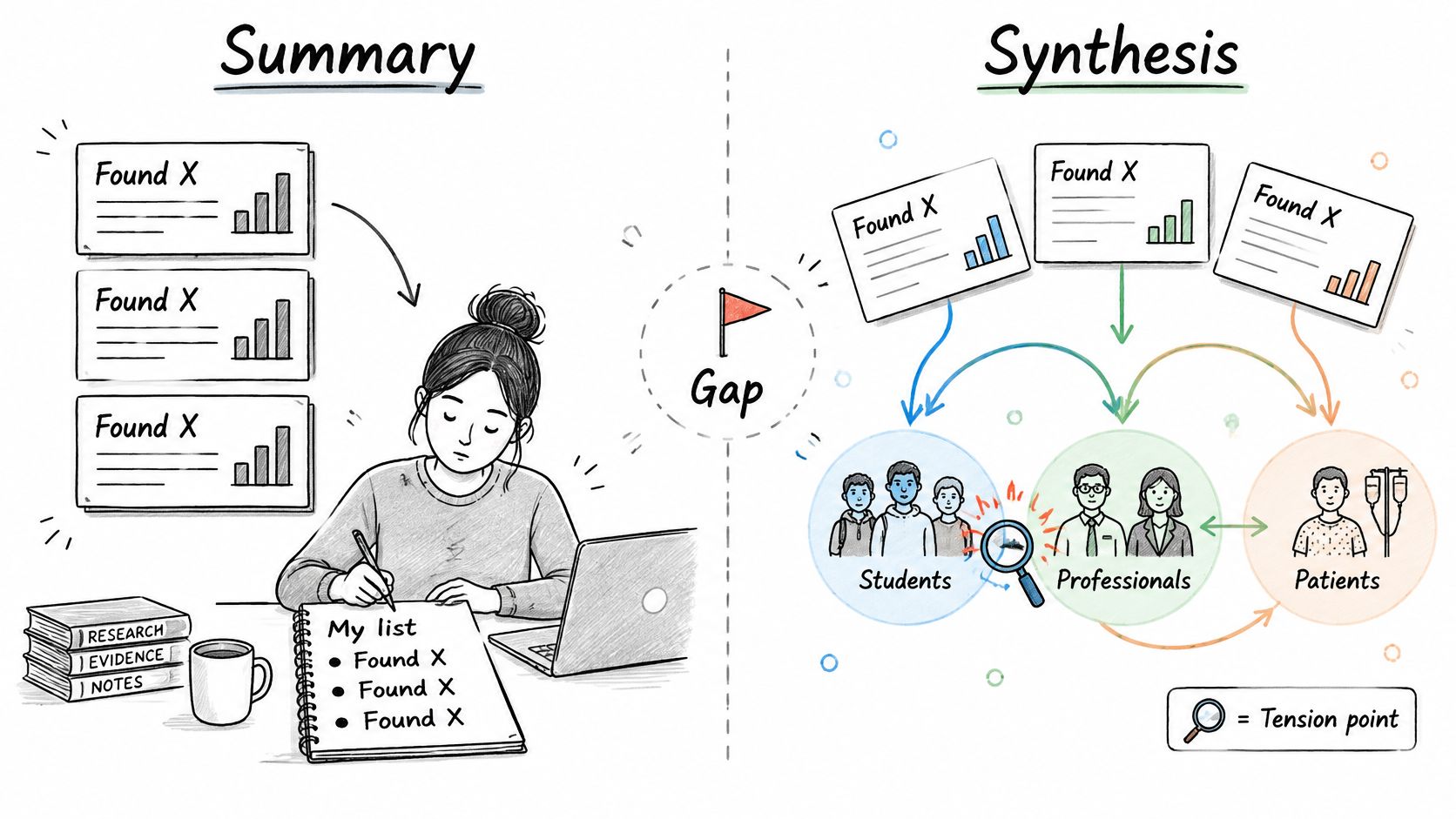
Group sources by concept, mechanism, method or contradiction. Chronological order is almost always the wrong default because it turns the chapter into a diary of who published when, and it hides the fact that two studies from the same year contradict each other.
A worked case. Say three studies of part-time learner retention report completion rates of 62%, 48% and 55%. Averaging them produces a number nobody can act on. Reading the samples shows both low results come from institutions serving commuting students, so the synthesis states the disagreement and names the variable that tracks it. That sentence is a finding. The average is decoration.
Validate the gap before you claim it
Most chapters fail at this point, and the evidence says so. A study of Moroccan doctoral students reported in the International Journal of Language and Literacy Studies found 27.0% always struggling to find relevant references and a further 31.0% struggling frequently, with constructing arguments, synthesizing information and identifying literature gaps among the most frequent and severe difficulties.
Before you claim a gap, test it. Search the same question across databases and disciplines, map the competing explanations, and check whether it has been answered under a different name. A gap produced by your own search limits, by incompatible definitions or by weak synthesis is not a gap in the literature. It's a gap in your reading, and an examiner who knows the field will spot it in the discussion.
| Gap type | Test before claiming it | Example question |
|---|---|---|
| Empirical | Search the same outcome across databases and disciplines | Does retention differ for part-time learners in this system? |
| Theoretical | Check whether competing frameworks already explain the phenomenon | Does the mechanism hold outside the setting where it was first tested? |
| Methodological | Compare the designs used so far | Is there longitudinal data, or only cross-sectional surveys? |
| Contextual | Check whether findings transfer across countries or institutions | Have the findings been tested beyond one national system? |
| Practical | Confirm that practitioners report the problem | Do schools report this issue with no evaluation of what works? |
Label each gap with one type, write down the test you ran, and put the gap statement in the final subsection of the review where it can lead straight into your research question.
Here's the process laid out visually.
On the question every student asks, how many sources are enough: stop when new sources start repeating claims you already have and contradictions you've already explained. That's saturation, and it's a property of your argument, not a target number.
Structure Chapter Two and Draft the Synthesis
Open with three things in one paragraph: the review type, the scope you fixed at stage one, and the research question the chapter serves. A reader who doesn't know why the chapter exists by the end of that paragraph will read the rest as background.
Order the body by the grouping you reached in synthesis. Each theme gets its own subsection, and each heading states a claim rather than a topic label. "Retention drops for commuting students" tells the reader what you concluded. "Retention" tells them what you read.
The three-move paragraph
Every substantive paragraph does the same three things in order. It states the shared finding, names where the sources diverge and what tracks that divergence, then says what it means for your study.
Three studies link evaluation design to completion; the two that report lower completion used only commuting students, so the effect may depend on sample type rather than on the intervention itself.
Notice what that sentence does. It reports, it discriminates, and it hands the methods chapter a variable worth controlling for. A paragraph that stops after the first clause is the one your supervisor will circle.
Place the gap statement as a single paragraph in the final subsection. Give it its type label and the test you ran to validate it, in one or two sentences. Then close the chapter by linking that gap to the research question and saying what Chapter Three will do about it.
The most common structural failure is a chapter that ends on a list of studies. If the last thing on the page is another author's findings, the reader has no reason to turn to your methodology.
Using AI Without Outsourcing Scholarly Judgment
Treat AI as a verification problem, not a productivity shortcut and not a banned object. The interesting question isn't whether students use it. It's what they can prove about how.
In one study of 25 Chinese doctoral students, every participant used AI in at least one literature-review or writing phase, including understanding literature, synthesis, drafting or editing, and most recognized the ethical concerns while often disclosing use only partially, a gap between stated principles and actual behavior reported in Applied Linguistics. The same body of work warns that references still require verification because of hallucinations and fabricated citations.
The dividing line is judgment. Anything that shapes your conclusion stays yours. Anything that only accelerates a mechanical step can be delegated, provided you check the output.
| Task | Status | Verification step |
|---|---|---|
| Query expansion and synonyms for search strings | AI-assisted | Test every term against the database thesaurus |
| Clarifying unfamiliar terminology | AI-assisted | Confirm each definition in two primary sources |
| Comparison prompts for a study table | AI-assisted | Check every cell against the original paper |
| Judging relevance and applying eligibility rules | Human-led | Record the rule and the reason for each decision |
| Weighing evidence and writing the synthesis | Human-led | Your argument, checked against the extracted table |
| Any AI-suggested reference | Verify before use | Find it in a database, check page and author-date, reject if not found |
The citation rule needs to be absolute. No reference enters your bibliography until you have opened it in a database, checked the page numbers where the claim appears, and confirmed the author and date match what you're citing. A reference you can't find is not a reference. It's a liability with a plausible-looking DOI.
Keep an audit log with the date, the tool, the prompt, a summary of the output and the correction you made. That log is your defense in a viva, because it shows precisely where your own judgment entered the argument and where a tool merely sped up a clerical step. AI literacy, in a doctoral review, is verification literacy.
Confirm the Gap Before You Write Chapter Two
Run a readiness check before the first paragraph. Four items, and any failure sends you back a stage rather than into the prose.
- Every included source traces to a search log entry, an eligibility decision, an extracted claim and a quality judgment.
- Every subsection maps to a question in your research question list. Any subsection that doesn't belong to a question gets cut or merged, however much work it took to write.
- Every gap carries one type label and the test that supports it.
- The AI audit log lists prompts, outputs and corrections for every use.
If an item fails, the fault usually sits in the screening log or the concept map, not in the drafting. Returning to the matching row of the stage table costs a day. Rewriting a 5,000-word chapter around a gap that doesn't survive scrutiny costs a month.
Then use your supervisor properly. Share a progress view so the meeting starts from what's finished rather than from what you remember, and spend the time on blockers and on which gap your study addresses. Supervisor check-ins in Thesis Book Project let users share their progress with their supervisor, which keeps the conversation on decisions instead of status. Agree the next action in writing before you leave the room, because a verbal agreement is the one thing in this process with no audit trail.
Before you draft, state three things in a single sentence: the review type, the validated gap, and the research question. If that sentence doesn't hold together, the chapter won't either. For help getting the gap statement right, this guide to what a research gap is and how to prove one walks through the same validation tests at more length.
Thesis Book Project is built for exactly this stage of a doctorate or master's, where the work is real but the trail is scattered across search logs, source matrices, prompt logs and supervisor emails. The Thesis roadmap and Chapter tracker keep each review stage visible from outline to final draft, and the source manager keeps references attached to the chapter they support, so the gap statement you write in month six can still be traced back to a search you ran in month two. If your Chapter Two has become a list rather than an argument, start a project on Thesis Book Project, set your submission date, and rebuild the trail one stage at a time.
Related Articles
Literature Review Plan Example with a Timeline
Forty-seven PDFs sit in your downloads folder. You've opened three. The chapter is due in eight...
Research MethodsGoals of Planning: Why Every Research Project Needs One
You have a folder called thesis_stuff, forty open tabs, and a supervision meeting on Thursday. When...
Research MethodsWhat Is Progress Monitoring in a Thesis Project
Progress monitoring is a repeated, structured measurement of whether work is moving toward a goal, u...
Comments (0)
No comments yet. Be the first to share your thoughts.