Literature Review Plan Example with a Timeline
Use this literature review plan example to map questions, themes, sources, and writing milestones before you search.
Forty-seven PDFs sit in your downloads folder. You've opened three. The chapter is due in eight weeks, and your supervisor's latest email asks for "a plan for the literature review" without explaining what she expects to see on the page.
A plan isn't a reading list, and it isn't a promise to read everything ever published. It's a short document that records the decisions you made before you started reading: the question, the rules for what counts, the databases, the dates, and what you'll do when the results come back thin. Get those decisions out of your head and onto one page, and the chapter stops being a source of dread and starts being a schedule.
What follows is a filled example you can copy. It belongs to a master's student in education writing about remote supervision, and every column swaps cleanly to another topic. Around it you'll find the design choices behind it, the order to build it in, and the parts most templates skip: limited database access, stopping rules, and where AI is allowed to touch the work.
Table of Contents
- A Worked Literature Review Plan
- Choose the Review Design First
- How to Build the Plan in Order
- Search Coverage and Screening Checks
- What to Do When Sources Are Hard to Find
- Lock the Plan Before You Read
A Worked Literature Review Plan
A master's student in education is planning a chapter on remote supervision and timely completion. She doesn't start with a blank form full of empty boxes. She writes one sentence first: how remote supervision relates to timely completion among master's students in education, using English-language empirical studies published between 2016 and 2026.
That sentence already rules out most of the library. The 2016 start date keeps out survey work describing a different supervision model. The language limit is a screening decision she can defend out loud, not a quiet filter she forgets to mention. Master's students in education stops undergraduate samples from wandering in, and empirical studies excludes the opinion columns that would pad the reading list without answering anything.
Three themes carry the chapter's argument: communication frequency, feedback quality, and student isolation. Themes aren't headings you add at the end. They're the three claims the chapter has to answer, and every source gets tagged to one of them on the day it's read. A source manager helps precisely here, because each reference is stored against the theme and the claim it supports instead of drifting into a downloads folder.
Her sources are named before the first search runs. ERIC and Education Source are the core, Scopus covers cross-disciplinary work on online learning, and eight papers she already trusts anchor the citation chasing in both directions.
Here is the plan as one page, with a finish week against every row.
| Plan element | What to record | Worked example | Finish by |
|---|---|---|---|
| Research question | One focused, bounded question | How remote supervision relates to timely completion among master's students in education, English-language empirical studies 2016 to 2026 | Week 1 |
| Eligibility rules | Inclusion and exclusion before screening | Include master's students in education, remote or online supervision, 2016 to 2026, English; exclude opinion pieces and studies of school-age learners | Week 1 |
| Themes | Three claims the chapter must answer | Communication frequency; feedback quality; student isolation | Week 1 |
| Core sources | Databases plus a seed set | ERIC, Education Source, Scopus, and 8 known papers for citation chasing | Week 2 |
| Search test | Proof the strings work | Every seed paper retrieved; query date and exact string saved per database | Week 2 |
| Screening | Two stages with a decision log | Title-abstract then full text; reason recorded for every full-text exclusion | Week 5 |
| Extraction | Fields that feed the synthesis | Claim, method, sample, finding, limitation, theme tag | Week 6 |
| Writing milestones | Draft then supervisor check | Theme synthesis draft, then a one-page gap note before expanding prose | Week 8 |
Two rows do most of the quality control. Search test is finished when the exact Boolean string, filters and query date sit in the same row as the database name, because a search you can't reproduce is a search you can't defend. Screening is finished when every full-text exclusion carries a written reason, which turns "didn't quite fit" into a record your supervisor can audit.
The week 8 milestone matters more than it looks. Sending the matrix and a one-page gap note before the prose expands keeps the synthesis honest, and it stops a chapter from growing around sources that were never strong enough to carry the argument.
Swapping In Your Own Topic
Keep the columns and replace the values. A nursing student trades ERIC for CINAHL and MEDLINE; a law student adds HeinOnline and drops the empirical-only rule if doctrinal sources answer the question. What doesn't change is the shape: question and rules first, sources and search test second, screening and extraction third, writing last.
Choose the Review Design First
Design comes first, because the label on the plan decides what you're obliged to document. Four options cover almost every thesis chapter, and they differ in search breadth, records and synthesis rather than in prestige.
| Design | Search breadth | Records to keep | Synthesis | Typical use |
|---|---|---|---|---|
| Narrative chapter | Purposive, multi-database, citation chasing | Databases, dates, eligibility, exclusion reasons | Themes tied to an argument | Most master's and PhD literature chapters |
| Scoping review | Broad within a map question | Protocol, sources, charting form | Characteristics and gaps, light appraisal | "What exists" questions |
| Systematic review | Exhaustive within criteria | Full strategies, dual screening, bias method, flow diagram | Findings weighed by validity | Programme-required or clinical questions |
| PRISMA-reported review | Same as the chosen design | 27-item checklist plus abstract checklist and flow diagram | Transparent report of an existing review | When the chapter claims a systematic or updated review |
Read the first column before the rest. A narrative chapter isn't a failed systematic review; it's a different instrument. It selects sources purposefully around an argument, and it still logs databases, dates and exclusion reasons, then synthesises by theme. The difference is that it never claims to have found everything.
The benchmark for the last row arrived in stages. The PRISMA statement was published in 2009 to make systematic reviews transparent, and its original reporting checklist contained 27 items. In 2021 the PRISMA 2020 statement replaced it, retaining a 27-item checklist while reorganizing and expanding the guidance, adding an abstract checklist, and introducing revised flow diagrams for original and updated reviews. It remains a reporting guideline rather than a research design, which is why a narrative chapter can borrow the habit without borrowing the label.
The design rule: move to systematic methods when the question asks about effectiveness or about all the evidence, when the timeline allows two people to screen independently, and when your supervisor expects a flow diagram. If any one of those is missing, keep the narrative label and keep the records anyway.
That last clause is the whole trick. Documenting a narrative search to systematic standards costs a few hours and protects you in the viva. Claiming systematic status without duplicate screening costs you the chapter. If you're still weighing the labels, this comparison of literature review methods sets out what each one lets you claim.
How to Build the Plan in Order
Order matters because each decision constrains the next. The PRISMA 2020 explanation and elaboration paper lays the sequence out as a reproducible chain: a focused question and eligibility criteria, a timestamped protocol, database-specific search strings, multiple bibliographic databases plus citation trails and grey literature, deduplication, title and abstract screening followed by full-text screening, a piloted extraction form, a risk-of-bias assessment, and a synthesis matched to the evidence.
Two of those steps decide everything after them, and both happen before a single record is screened.
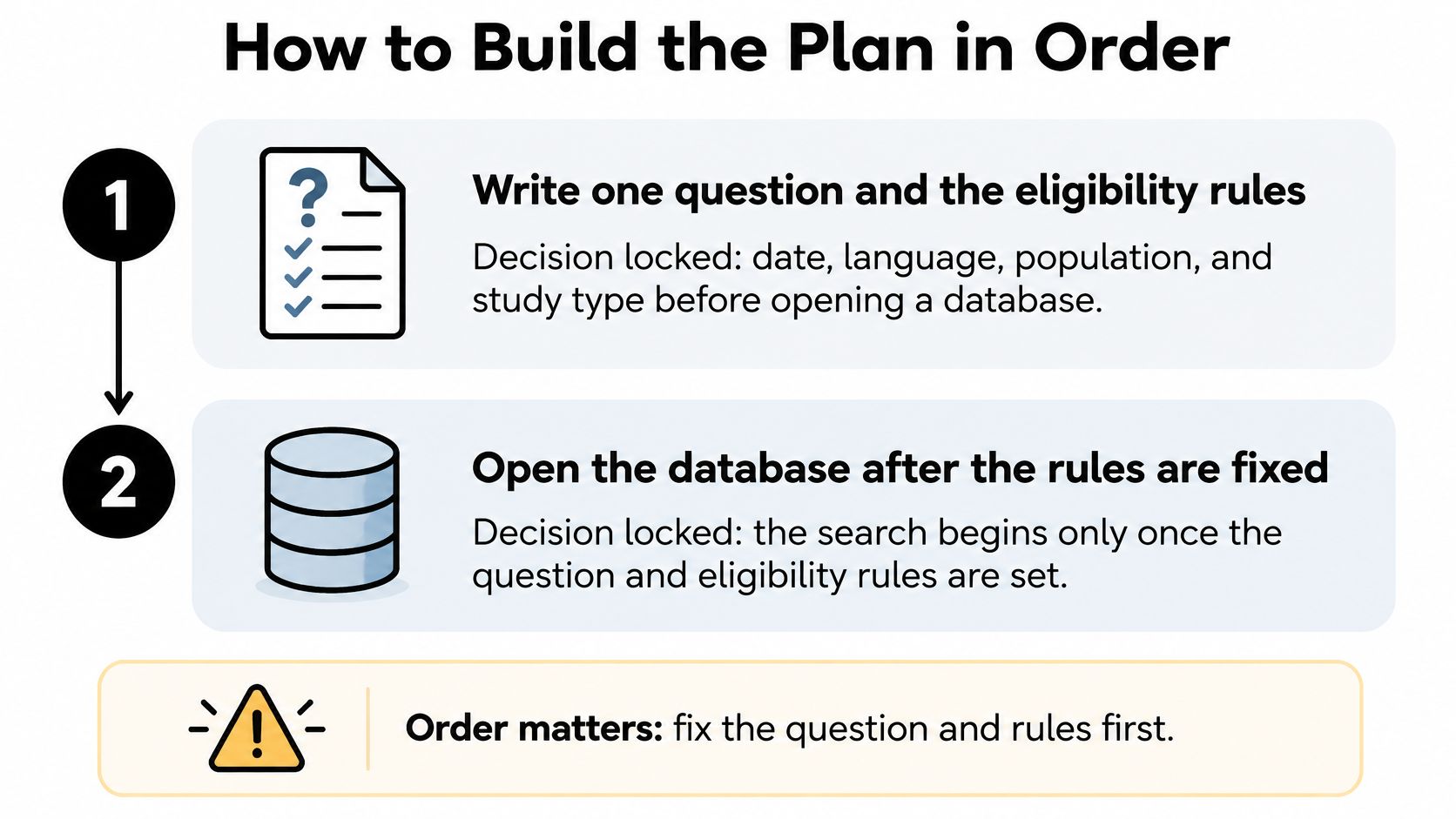
- Write the question and eligibility rules before opening a database. Date, language, population, study type. Fix them now and a borderline paper takes thirty seconds instead of an evening.
- Timestamp the protocol. Email it to your supervisor or preregister it. Later changes then read as amendments rather than silent scope drift.
- Build database-specific strings. Each index has its own syntax, subject headings and truncation rules. One keyword list pasted everywhere is how a search becomes opaque.
- Search more than one index, then chase citations. Bibliographic databases first, then backward and forward citation trails, then grey literature such as theses and funder reports.
- Deduplicate and record how. Name the tool or describe the method, because "duplicates removed" tells a reader nothing they can repeat.
- Screen in two stages. Titles and abstracts, then full texts. Systematic designs use two independent reviewers; a solo chapter pilots the rules on a sample and asks a supervisor to spot-check the disagreements.
- Pilot the extraction form on two papers. Claim, method, sample, finding, limitation. The test run shows which fields you need and which you invented.
- Match the synthesis to the design. Compare findings and study limits. Vote-counting how many papers reached statistical significance isn't synthesis, yet it's the most common shortcut in student chapters.
- Keep a decision log. Every rule change, every full-text exclusion reason. This is what lets you draw a study-selection flow diagram later without reconstructing your own thinking from memory.
PRISMA 2020 asks for the same record in the end: every source searched, the last search date, the complete strategy including filters, who screened and whether they worked independently, and how quality or bias was judged. Write the label, narrative or scoping or systematic, on the first page, and say why the synthesis you chose fits that label.
Common slip: leaving the search strategy in a document you'll never reopen. Keep the string, the filters and the date in the same row as the database name.
Set the submission date before anything else. Step one in our platform is exactly that, and it takes minutes: you enter the deadline and the whole thesis breaks into chapters and milestones, which turns a vague "literature chapter" into dated rows like the table above. Mapping the rest of your research timeline the same way keeps the review from expanding past its question.
Search Coverage and Screening Checks
Search quality is an engineering trade-off between recall and precision, not a target number of papers. A benchmark of systematic-review searches found that Embase, MEDLINE, Web of Science Core Collection and Google Scholar together reached 98.3% overall recall and 100% recall in 72% of reviews, as reported in this study of recall and precision in database combinations.
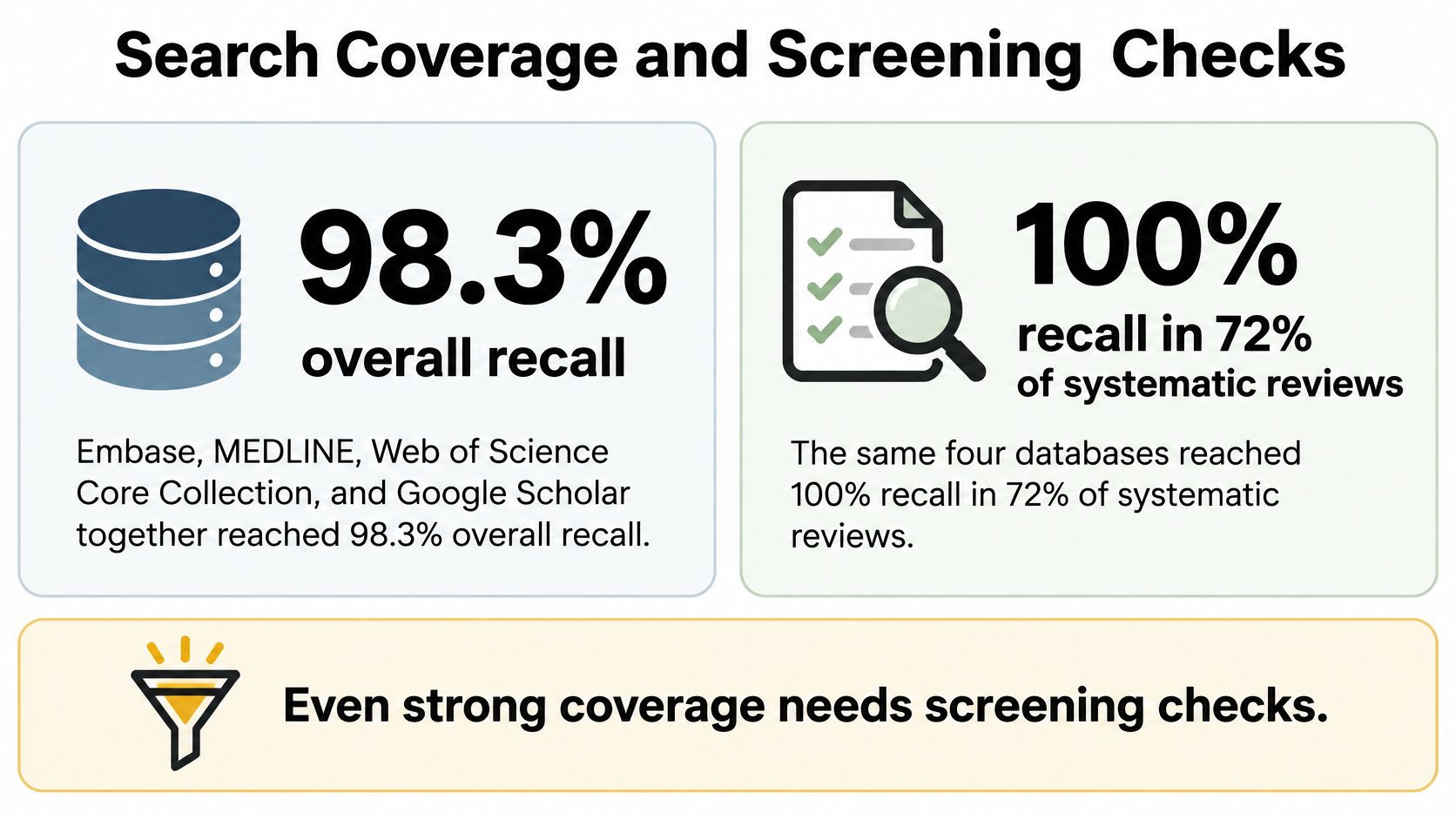
Those are the figures to keep in view while you choose databases. They come with a caveat worth writing beside your source list: even strong combinations had a 30 to 33% probability of missing more than 5% of included references in an individual review. That's the reason a plan needs citation chasing rather than a longer keyword list.
Google Scholar shows the other edge. One example returned 36,630 records for 36 included studies, roughly 0.1% precision. Use it to chase known papers and to catch grey literature, not as your only search.
Build the search backwards from work you already trust:
- Assemble a seed set of eight or so papers you know belong in the review.
- Run the draft Boolean string and check that every seed paper comes back.
- Save the details for each database, meaning the exact string, the filters and the query date.
If a seed paper surfaces only through citation chasing, that's an indexing gap. Writing it down is scholarship, not failure.
Database choice also follows disciplinary convention. The Cochrane Handbook recommends that Cochrane reviews search CENTRAL and MEDLINE as a minimum, adding EMBASE when it's available to the review group or author. An education chapter names ERIC and Education Source and justifies every addition the same way.
| Benchmark | Figure | What to write in the plan |
|---|---|---|
| Four-database recall | 98.3% overall; 100% in 72% of reviews | Name the core databases and don't rely on one index |
| Residual miss risk | 30 to 33% chance of missing more than 5% of included references | Add citation chasing and record gaps |
| Google Scholar burden | 36,630 records for 36 studies; about 0.1% precision | Use it for chasing, not as the only search |
| Post-abstract screening error | 10.76% combined false inclusions and exclusions | Pilot the rules and dual-screen at least the pilot |
| Cochrane minimum for health reviews | CENTRAL and MEDLINE, plus EMBASE when available | List core databases before screening starts |
Screening needs its own check. That 10.76% post-abstract error rate combines false inclusions and false exclusions, and it comes from a single empirical study of the screening stage. Calibrate on a pilot batch, write include and exclude examples, dual-screen at least the pilot, and monitor agreement as you go.
Then put a stopping rule in the plan: stop when new databases and citation trails stop producing eligible studies, and record the date you stopped. That one sentence converts "I read a lot" into a method, and it's the difference between sound literature review practice and an open-ended reading habit.
What to Do When Sources Are Hard to Find
Almost 90% of 300 doctoral candidates reported at least occasional difficulty locating relevant references, and that study of doctoral literature searching names database access, search training, synthesis, argument construction and software use as the recurring barriers. If your plan assumes an unlimited institutional library, it describes someone else's campus.
Give every source an access path in writing, because the route is part of the method:
- Campus login. The default, listed against the database name and the date used.
- A librarian appointment. One focused hour replaces a week of guessing; ask for subject headings and database recommendations for your field.
- Open repositories. Institutional repositories, subject preprint servers, and author copies on departmental pages.
- Interlibrary loan. Request the four or five papers that carry the argument instead of dropping them.
- Citation chaining. Everything cited by a paper you can already open is a free next step.
If a database is unavailable to you, write the substitute and the date rather than implying a complete search. Language limits belong in the eligibility rules, visible, not in a filter nobody else can see.
Two Problems That Look Like One
Not finding studies and not being able to group them feel identical at eleven at night and need opposite fixes. If studies can't be found, the fix is a librarian, a different index, and citation chasing. If they can be found but won't group, the fix is the extraction matrix and permission for one theme to stay thin for now. Neither problem is solved by switching to a heavier review design.
If you'd rather watch the walkthrough before you start your own, this one is clear and short.
Log access limits in the decision log as constraints, not confessions. One line saying which databases you could reach, which you substituted, and the date you stopped gives your supervisor something workable. A stated constraint can be discussed in a meeting; a silent one surfaces as a thin chapter three months later.
Lock the Plan Before You Read
Freeze the plan before deep reading begins. Eligibility rules, databases, seed-set results and the week-by-week milestones stay fixed once the reading starts, and any later change is logged as an amendment with a reason. Without that freeze, a plan edited after every inconvenient paper stops being a plan and becomes a description of whatever you happened to read.
Generative AI sits inside that freeze, not outside it. Evidence on AI use in scholarship is already concrete: a 2023 Nature survey reported that 30% of 1,600 scientists had used generative AI for academic writing, literature reviews or grant applications, according to this review of generative AI in research workflows. The same body of work reports a study of 26 doctoral students who saw AI as complementary to database searching only for users who already had information-literacy and research skills, and who still flagged inaccuracies, privacy concerns, usability problems and the continuing need for human review.
That finding points at the right question. Not which tool to use, but where a tool belongs in a defensible plan.
Where AI Is Allowed, and Where It Isn't
Write the permissions into the plan itself so nobody has to guess later:
- Allowed, brainstorming synonyms and candidate keywords. Useful when you're stuck on how your field phrases a concept.
- Allowed, testing Boolean variants. Run any AI-suggested string against your seed set; if it doesn't retrieve the eight known papers, it's wrong.
- Allowed, language editing of your own prose. Your sentences, cleaned up.
- Prohibited, an uncited AI summary used as evidence. A summary isn't a study, and it has no page numbers you can check.
- Prohibited, citing references you haven't opened. Fabricated or misattributed entries are the fastest way to lose a supervisor's trust.
Then keep an audit trail: database searches, inclusion decisions, source files, page-level notes, and a short record of any AI assistance, naming the tool, what you asked it and what you used from the answer. The test is simple enough to apply at speed.
One-line check: if you can't show where a source came from, what it claims and why it's in the review, it isn't evidence yet.
Work the eight weeks backwards from the submission date so screening can't swallow the drafting months. Our milestones and deadlines are built to run that way, with reminders before each checkpoint slips, and supervisor check-ins let you share the audit trail before a meeting rather than describing it from memory. Above that sits the Thesis roadmap, which turns proposal to submission into a single sequence so the literature chapter has a fixed place instead of an elastic one.
Thesis Book Project gives this plan somewhere to live after the notebook closes: a Thesis roadmap that runs from proposal to submission, a Chapter tracker that follows each section from outline to final draft, and a Source manager that keeps every reference tied to the theme and claim it supports. Set your submission date first, then let the weekly milestones and supervisor check-ins keep the literature chapter inside its eight weeks rather than stretching into the drafting months. Start on the free Starter plan at Thesis Book Project and build the plan this week, while the question is still the hardest thing on your desk.
Related Articles
Goals of Planning: Why Every Research Project Needs One
You have a folder called thesis_stuff, forty open tabs, and a supervision meeting on Thursday. When...
Research MethodsLiterature Review for Dissertation: A Step-by-Step Guide
You've read the papers. The Zotero library has 214 entries, the folder of highlighted PDFs is so...
Research MethodsWhat Is Progress Monitoring in a Thesis Project
Progress monitoring is a repeated, structured measurement of whether work is moving toward a goal, u...
Comments (0)
No comments yet. Be the first to share your thoughts.