Goals of Planning: Why Every Research Project Needs One
Learn the goals of planning for research projects: scope, deadlines, milestones, risk control and supervisor alignment, with practical steps for students.

You have a folder called thesis_stuff, forty open tabs, and a supervision meeting on Thursday. When your supervisor asks how it's going, you say you're still reading, which is honest and useless, because neither of you can tell whether you're three weeks or four months from a usable chapter.
That's not a discipline problem. It's a planning problem, and the misunderstanding starts with what a plan is for. Most advice frames planning as a task list with dates attached. The goals of planning are more useful than that: they protect scope, pace and honest expectations, so the work you finish is the work that answers your question.
A plan is mostly a set of decisions about what you won't do, plus a schedule for finding out early when something has gone wrong. Get those decisions onto one page and the project turns into a sequence of checkable steps instead of a mood.
Table of Contents
- Five Goals Planning Serves in a Research Project
- Setting Scope Limits Before Work Drifts
- Anchoring Your Work to a Fixed Deadline
- Milestones That Make Progress Visible
- Reducing Risk Without False Precision
- Keeping the Plan Realistic for You and Your Supervisor
- Decide This Week Whether the Plan Is Live
Five Goals Planning Serves in a Research Project
A methods chapter can look finished in month one and still be unusable by month nine. Ethics approval was never submitted, recruitment has closed for the year, and the draft has to be rebuilt around secondary data. Nothing dramatic happened in any single week. The plan never forced that dependency into view while there was still time to change course.
The five goals of planning in a research project arrive in a fixed order, because each one depends on the one before it. Clear scope comes first, since a question with no boundary cannot be scheduled, and part of setting that boundary is deciding what you will leave out. An anchored deadline turns the remaining scope into a quantity of time. Visible milestones break the time into checkpoints someone else can inspect. Lower risk follows when those checkpoints arrive early enough to react. Supervisor alignment comes last only because the other four give you something concrete to agree on.
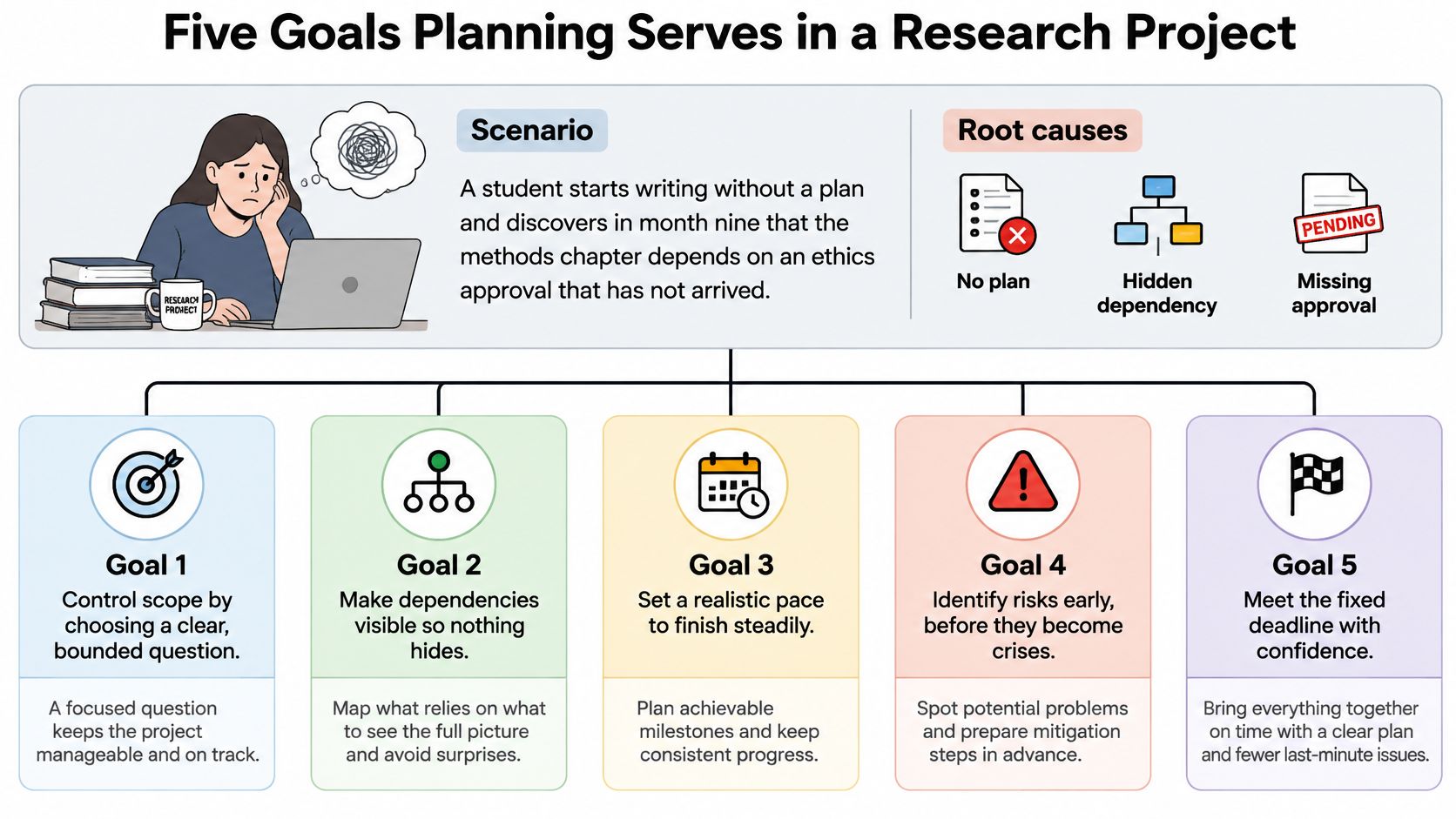
Each goal secures something slightly different. Drop one and you do not merely slow the project. You remove a specific protection.
| Goal | What It Secures | Thesis Example |
|---|---|---|
| Clear scope | A boundary around what the project must answer | One research question, with two topics explicitly excluded |
| Anchored deadline | A fixed end date that all work is scheduled back from | Submit 1 June; subtract six weeks for viva prep before chapter dates |
| Visible milestones | Checkpoints that show progress before the end | Chapter 2 full draft in your supervisor's inbox by 14 March |
| Lower risk | Early warning when tasks slip, with time to respond | Six-week buffer added before ethics approval |
| Supervisor alignment | Shared agreement on priorities and review points | Feedback dates agreed before fieldwork begins |
A plan works like a map with one fixed destination. It does not predict every turn, and a good map does not try. It shows where you stand, what still sits between you and the finish, and which road has to be cleared before the others matter. As a forecast, any thesis plan is usually wrong within a fortnight. As a position report, it stays useful to the last week.
A plan written once and never reopened only secures the first goal, the boundary. Pace and honest expectations need the other four, and those four only work if you compare the plan with what happened and adjust it. That is a habit, not a document you file.
No scope means months of reading that never narrows the question. No deadline means rewriting in the last fortnight. No milestones means the delay arrives as a surprise. No shared expectations means every supervision meeting reopens the same argument about priorities.
Self-check for today: Can you state your research question, your submission date and your next checkpoint without looking anything up? Whichever of the three you can't say out loud is the goal you haven't set yet.
Bench work adds one more dependency worth scheduling. If your data comes from a lab, the equipment and surfaces you rely on should be booked before collection starts, and suppliers such as heavy-duty and mobile lab tables from Labs USA belong in the risk column rather than in a panicked email in month seven.
Setting Scope Limits Before Work Drifts
Scope creeps in one reasonable suggestion at a time. A second interview round, one more dataset, an extra theoretical lens a reviewer mentioned. Each addition looks small on the day it's proposed and costs weeks by the time it's finished, and nobody ever decides to expand the project. It just expands.
The cost shows up in project data. The Project Management Institute's 2017 Pulse of the Profession, based on a survey of 3,234 project professionals, found that scope creep affected 28% of projects at organisations completing at least 80% of projects on time and on budget, against 68% of projects at underperformers. Finishing and scope discipline travel together.
Four moves fix the boundary, and they take about twenty minutes. If your question isn't settled yet, the guide to choosing a thesis topic covers the narrowing decision that has to happen first.
- Write the question in one sentence. If it needs a semicolon, it's two projects.
- List three to five inclusions. The data, the period, the population, the method.
- List two to four exclusions, in writing. A second country, a comparison group, a follow-up wave, a qualitative strand. Naming them now is what makes them exclusions rather than omissions.
- Open a parking lot. One note titled future work where good ideas go with a date. Nothing is deleted; things are deferred.
For any new idea, ask one question: does this change the answer to the research question? If it sharpens the wording of the answer, park it. If it changes what the answer is, it's a new project and it needs a supervisor conversation, not a quiet addition.
Change rule: Every addition costs a subtraction. Add an analysis and remove a section of similar size, or ask your supervisor for a revised date, then write the new date down the same day.
Picture a student proposing a second survey wave to test whether an effect persists. The estimate is four months, which is the entire analysis window. It goes into the parking lot with one line of rationale, because it tests durability of a claim the thesis doesn't make. A viva examiner may well ask about it; the answer is a limitation paragraph, not a fifth chapter.
Scope limits aren't modesty. They're what keeps milestones realistic, because the work those milestones describe stays the same size from approval to submission.
Anchoring Your Work to a Fixed Deadline
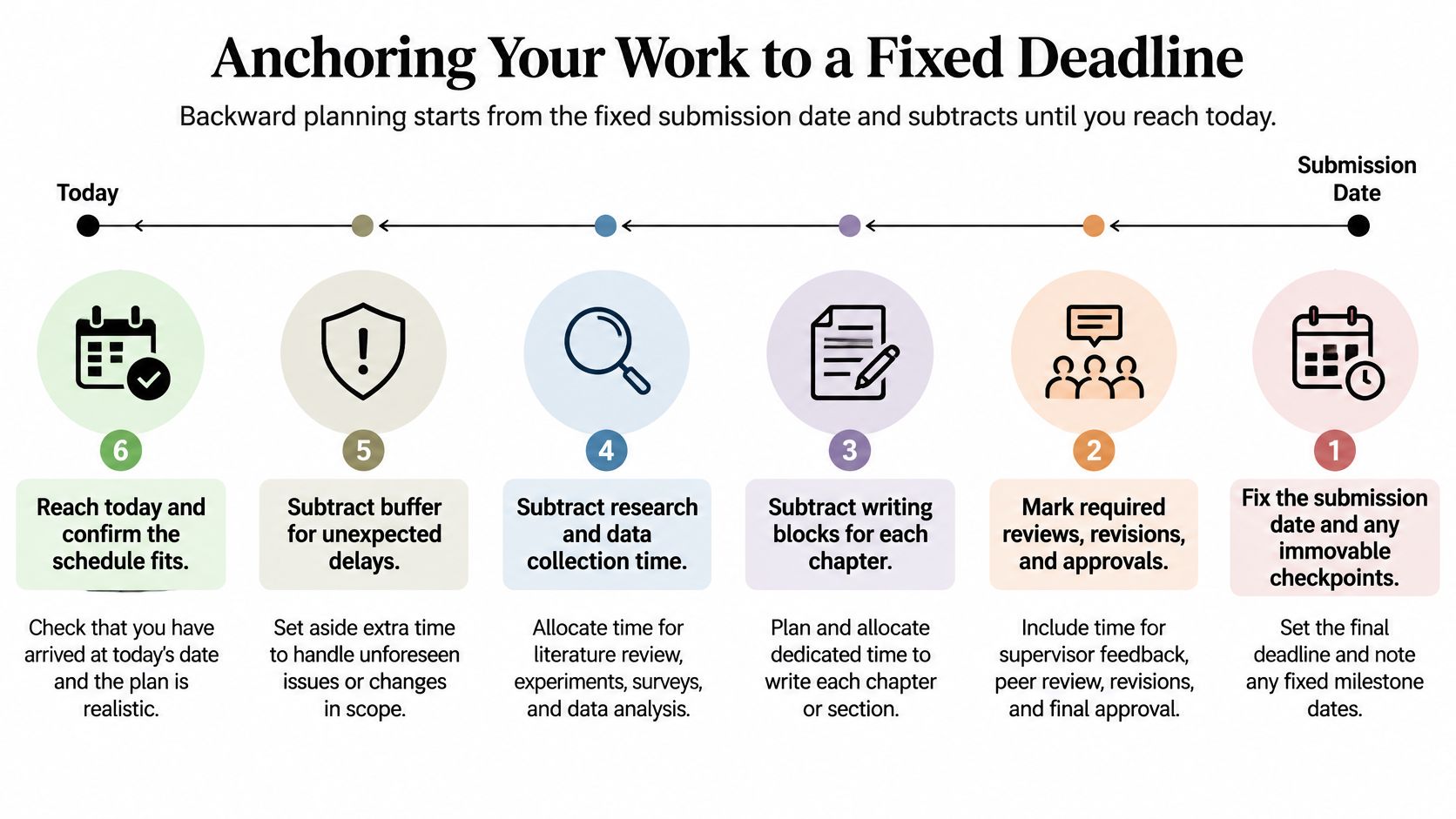
Backward planning is the only method that survives contact with a real submission date. You start at the date and subtract until you reach today, and every subtraction is a decision you're making in advance rather than in a panic. A worked timeline for research shows what that chain looks like across a full thesis year.
- Fix the submission date and every immovable checkpoint. Graduate school format checks, ethics board submission windows, scholarship end dates. These aren't movable, so they anchor the chain. The common slip is treating them as paperwork that happens at the end.
- Subtract defence or viva preparation and final formatting. Four to six weeks is realistic for a thesis. The slip here is budgeting the hours of reading rather than the calendar weeks that formatting, printing and rehearsal consume.
- Subtract a full supervisor review round. Two to three weeks, because your draft sits in a queue behind other students' drafts and your supervisor's teaching. The slip is assuming review time equals reading time.
- Subtract the writing of each chapter, starting with the chapter that depends on the most data. Results and methods first, because they constrain everything else. The slip is writing the easy conceptual chapter first and discovering in month ten that the findings don't support it.
- Subtract data collection or fieldwork, including recruitment. Recruitment can't be compressed by working weekends, because it depends on other people replying. The slip is estimating analysis time accurately and recruitment time optimistically.
Deadlines get stretched more often than students admit. A 2024 study reported by Inside Higher Ed found that 41% of students in a large-course study used a no-penalty extended deadline for one assignment, and 37% used the extension for more than one. That isn't laziness. It's what happens when a date is set without a chain behind it.
Turn the chain into dated checkpoints
The output of all this subtraction is a list, not a feeling: each checkpoint with the date it must be finished by. "Literature review done by 11 April" is checkable. "Make good progress on the literature this term" isn't, and it can't warn you.
This is the one part of planning worth handing to software. In Thesis Book Project, you set your submission date and the whole project breaks into chapters and milestones in minutes, with reminders before each checkpoint slips.
If the chain ends in the past, the plan isn't ambitious, it's impossible, and the honest response is to cut scope in month two rather than in month eight.
Milestones That Make Progress Visible
A milestone is a checkpoint tied to evidence. The evidence column matters: without something observable, it is hard to tell whether work is complete or merely underway.
| Phase | Milestone | Evidence It Is Done |
|---|---|---|
| Months 1-2 | Research question and scope approved | Signed-off one-page proposal |
| Months 3-4 | Literature review outline complete | Source list organized by theme |
| Months 5-7 | Data collection or experiments finished | Dataset cleaned and logged |
| Months 8-9 | Analysis and results chapter drafted | Full draft shared with supervisor |
| Months 10-12 | Revisions complete and thesis submitted | Supervisor sign-off and formatted file |
The difference between an activity and a milestone
“Write chapter 2” describes an activity. “Chapter 2 full draft in my supervisor's inbox by 14 March” describes a milestone: another person can check whether it happened. An activity can remain unfinished for months without showing what has changed; a milestone makes progress visible.
Track each checkpoint with four states: not started, outline, draft, final. This is enough detail to show movement without making updates burdensome. For a one-year project, two-month intervals give you time to produce work worth reviewing while still leaving room to adjust the plan.
Indicators serve a similar purpose at national scale. The Millennium Development Goals framework, adopted in 2000, paired 8 goals with 21 targets and 60 indicators so progress could be counted rather than asserted, and by 2015, 147 countries had met the MDG drinking-water target, according to the UN Millennium Development Goals Report 2015. A thesis needs no such large set of measures. It needs one clear piece of evidence for each milestone, such as an outline, a cleaned dataset or a draft shared with a supervisor.
That evidence also helps protect scope. If a milestone keeps slipping because it requires more work than the project can support, the plan gives you a reason to narrow the task or decide what to leave out. A missed checkpoint in month four leaves time to respond. A missed submission date does not.
Keep the checkpoints active with a weekly review. Choose the two or three tasks that would move the next milestone, then record what happened in a line or two. A week of reading that produces no notes for the literature outline is useful information, not proof of failure: it may mean the reading needs a specific question. A progress monitoring routine for a thesis can help you compare planned work with what you complete and decide what to adjust.
Copy the table into your calendar, replace the phases with your own chapters, and identify the milestone you would notice slipping first. Treat it as an early warning and put it somewhere you review each week.
Reducing Risk Without False Precision
A single promised completion date feels like the safest plan you can write. It's usually the riskiest, because it folds every assumption into one number nobody can inspect until it's too late.
The bias behind that is well documented. People underestimate task duration and overlook risks even when they know comparable projects overrun. A review of behavioural biases for the UK government reports that across 258 international transport projects, actual costs averaged 28% above estimates, and 9 in 10 projects experienced a cost overrun. Transport megaprojects are not a thesis, but the pattern is the same optimism with a bigger budget: the first estimate you write is the flattering one.
The gap between a clean plan and a real one usually looks like this.
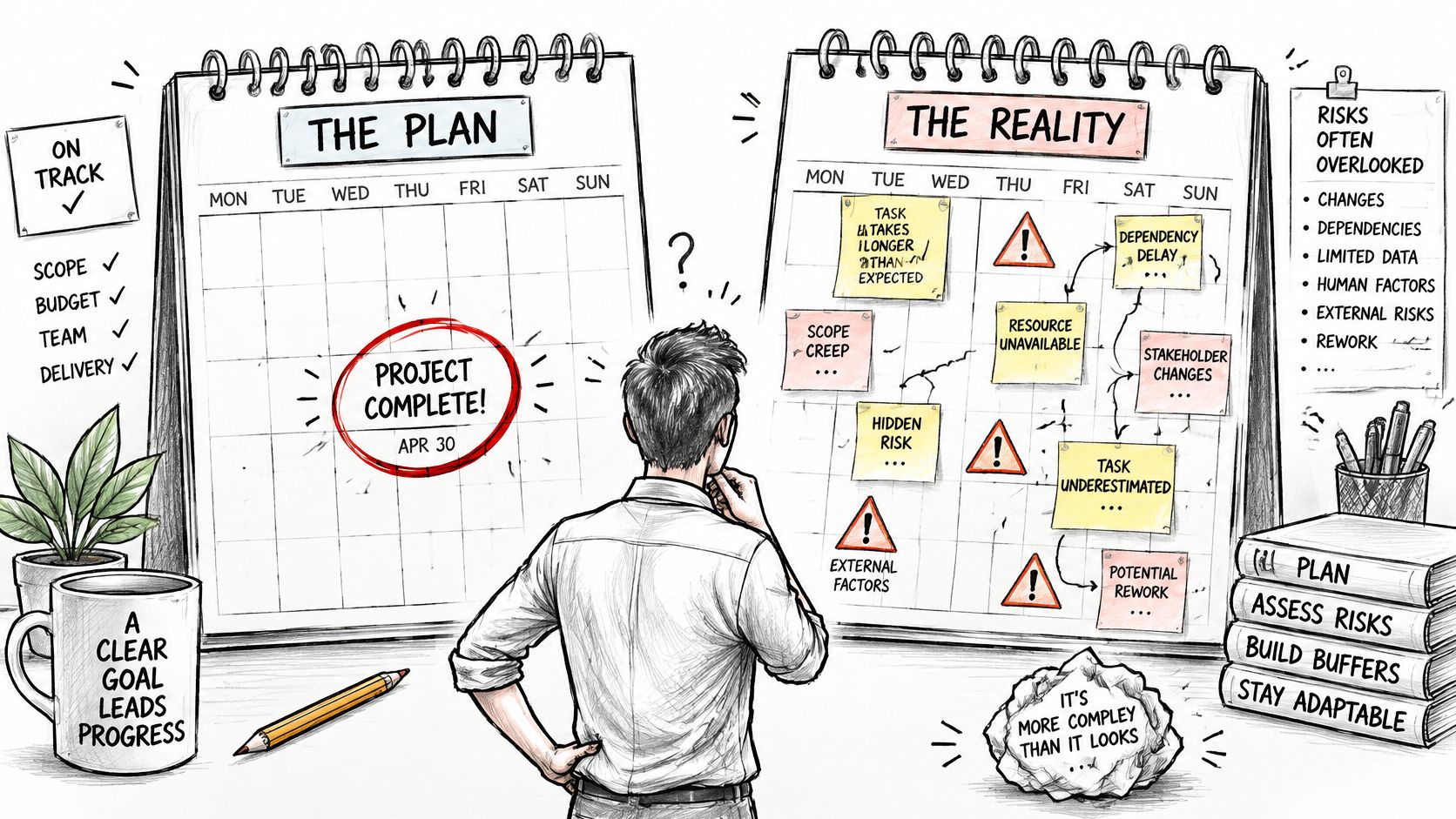
- Name the five risks most likely to delay you. Ethics approval, participant recruitment, equipment access, supervisor availability, an unexpectedly crowded literature area. An unnamed risk can't be planned for.
- Give each large task three estimates. Best case, likely case, worst case. The spread matters more than the number: a task ranging from two weeks to five months is a different planning problem from one ranging from two to three.
- Plan to the likely case and buffer the widest spread. Put contingency on the two or three tasks with the biggest range, not evenly across the plan, where it disappears.
- Write the assumption behind each estimate. Ethics approval in eight weeks assumes a full board review with no revisions. Recruitment in ten weeks assumes the response rate you saw in the pilot. When an assumption breaks, you know which milestone moves.
- Set a trigger. A milestone slipping by two weeks forces a decision: cut scope, reorder tasks, or ask for a deadline change.
Why the trigger matters more than the buffer
A buffer absorbs small surprises. A trigger stops a large one from consuming the year without anyone deciding to accept it. A plan that only holds contingency time delays the argument rather than settling it, and the settling is the whole point.
When a plan meets a real week, it stops looking like a schedule and starts looking like a series of decisions. This walkthrough is a useful reminder of what that means.
Intermediate milestones are the part you revise. The submission date is the part you don't. As evidence accumulates, worst cases become measured ranges, and the plan should get sharper rather than more hopeful. Rewrite an estimate the week you learn something, not the week it fails.
Keeping the Plan Realistic for You and Your Supervisor
A 2025 doctoral-student survey at Mid Sweden University reported average individual research-study time of 34 hours per week in one faculty and 40 hours in another, and more than 30% of respondents reported substantial negative consequences from stress or workload, according to the survey summary. Those are working hours, not hobbies.
A plan that counts only finished tasks gives you no way to notice when the price of finishing is climbing. The uncomfortable version of this argument is that an apparently productive plan can be a bad plan. If it encourages overtime, hides a dependency you haven't resolved, or leaves no room for feedback and recovery, it will produce pages and a crisis in the same term.
What to bring to a supervision meeting
Meetings drift when neither side knows what a good outcome looks like. Three lines fix that.
Meeting agenda, three lines: what's blocking the work, what decision you need from your supervisor, and what will be finished before the next review.
That agenda does more for alignment than a status report, because it puts decisions in front of the person who can make them. Shared visibility helps too: when both of you can see which chapters sit at draft and which haven't started, the conversation moves from how it's going to what's blocking what.
Protect three things inside the plan itself. A fixed block of deep work each week that doesn't move for meetings. Recovery time after each push, scheduled rather than hoped for. And feedback time inside every milestone, so a chapter review happens mid-chapter rather than after you've committed to an argument.
Write the escalation rule before you need it. Two milestones slipping in a row triggers a meeting request within a week, a decision about reduced scope or a revised date, and a written note of what was decided. The rule removes the hardest part of asking for help, which is deciding whether you've earned the right to ask.
This month, agree three things with your supervisor: meeting frequency, review dates for the next two chapters, and that escalation rule. Put them in the shared plan rather than in an email thread.
Decide This Week Whether the Plan Is Live
Everything above collapses into one page and one hour. Do this before your next supervision meeting, not after.
- Top of the page, three lines. Submission date, research question in one sentence, and the two to four exclusions you committed to.
- Copy only the milestones you've already chosen. A date and the evidence of done for each. Don't invent a second schedule that competes with the first.
- Book the reviews. Every milestone that needs feedback gets a date and the three-line agenda attached to it.
- One escalation rule, written down. Two slips in a row means a meeting within a week and a recorded decision, either less scope or a later date.
- A monthly comparison. Planned progress against actual progress, plus one line on the reason for any gap. The reason is the part that improves your next estimate.
- Expect an hour of imperfection. Some dates will be wrong on the first pass, and that's the design working. Intermediate milestones get revised; the submission date doesn't.
Don't rebuild the backward chain of viva time, review rounds, chapter writing and fieldwork. Those subtractions already sit in your deadline plan, and redoing them is the most popular way to spend a weekend and start nothing.
The decision this week is whether that page becomes your working plan now or waits until after the next meeting. Waiting costs almost nothing in a quiet month and a great deal in the month a dependency finally lands. If you can't name a date for the milestone you'd notice slipping first, the plan isn't live yet.
Thesis Book Project exists for exactly this sequence: you set your submission date, the roadmap breaks the thesis into chapters and milestones, and the weekly plan keeps you moving toward the date rather than guessing at it. Start on the free Starter plan with one project, or move to Pro when you want milestone reminders and progress insights across multiple projects, and watch the whole thing fit on one page. Visit Thesis Book Project this week and walk into your next supervision meeting with a decision instead of a status update.
Related Articles
Literature Review Plan Example with a Timeline
Forty-seven PDFs sit in your downloads folder. You've opened three. The chapter is due in eight...
Research MethodsLiterature Review for Dissertation: A Step-by-Step Guide
You've read the papers. The Zotero library has 214 entries, the folder of highlighted PDFs is so...
Research MethodsWhat Is Progress Monitoring in a Thesis Project
Progress monitoring is a repeated, structured measurement of whether work is moving toward a goal, u...
Comments (0)
No comments yet. Be the first to share your thoughts.