What Is a Research Gap and How to Find It Fast
Learn what is a research gap, its types, how to spot it in literature, and how to write a strong gap statement for your thesis.
A research gap is a defensible absence in prior scholarship where evidence is missing, insufficient, biased, inconsistent, or outdated, shown through published literature rather than intuition. It's the reason a new study needs to exist, not merely a topic you'd like to explore.
You may be facing this problem right now. You've collected papers, highlighted repeated arguments, saved promising articles, and still can't explain what your thesis will add. When your supervisor asks, “What's the gap?” the answer may come out as, “Not many people have studied this,” even though you know that statement isn't precise enough.
That uncertainty is common because gap-spotting isn't the same as finding an untouched subject. A well-studied topic can still contain a methodological weakness, conflicting findings, an overlooked population, or evidence that no longer fits the setting you want to investigate. Your task is to diagnose that weakness carefully and connect it to a researchable response.
This guide shows you how to do that. You'll move from the basic meaning of a research gap to the main gap types, then use systematic-review signals and the PICOS framework to identify a defensible opening in the literature. You'll also see how to turn your diagnosis into a concise gap statement and a focused thesis plan.
Gap-spotting is a learnable academic skill. Once you stop treating it as a hunt for a magical untouched topic, your literature review becomes a structured investigation. By the end, you'll have practical steps you can apply to your own sources immediately.
Table of Contents
- Introduction Why Every Thesis Needs a Clear Research Gap
- What a Research Gap Really Means in Academic Writing
- The Main Types of Research Gaps You Will Encounter
- Why Identifying a Research Gap Strengthens Your Thesis
- How to Identify a Research Gap in the Literature Step by Step
- Research Gap Examples and How to Write a Strong Gap Statement
- Turning Your Gap Into a Focused Thesis Plan
Introduction Why Every Thesis Needs a Clear Research Gap
A student sits in front of a literature-review document with dozens of tabs open. One paper says online learning improves student engagement. Another reports mixed results. A third studies a different age group, while a fourth uses a measurement tool the student can't apply in the intended setting. The student senses an opportunity but can't yet name it.
That moment matters. A thesis isn't justified because its subject interests you. It needs a reasoned explanation of what existing scholarship hasn't adequately resolved and why your proposed study is an appropriate way to address that deficiency.
The gap is your thesis's justification
A clear gap helps connect four parts of a research project:
- Existing knowledge: What have researchers already examined?
- Unresolved issue: What remains uncertain, limited, contradictory, or outdated?
- Research question: What specific question follows from that issue?
- Contribution: What will your study add, test, compare, or clarify?
Without this chain, a thesis can become a collection of interesting reading rather than an argument. You may collect more sources, expand the topic, and keep revising the introduction without getting closer to a feasible study.
A defensible gap also helps you avoid claiming originality too broadly. You don't need to prove that nobody has ever studied your topic. You need to show that prior work leaves a particular question or evidence problem unresolved. University guidance describes research gaps as conceptual, methodological, or empirical spaces where issues remain unexplored, under-explored, or outdated, as outlined in the University of Chicago's research-gap guidance.
Examiners look for an evidence-based contribution
Examiners usually want to understand why the study deserves attention. They'll examine whether the literature review supports your problem, whether the research question follows logically, and whether the method can address the stated gap.
That means your gap should guide scope as well as originality. If the literature lacks evidence for a particular population, you might need a population-specific study. If findings conflict because researchers use different measures, a methodological comparison may be more suitable. If evidence is outdated, your contribution may involve examining the issue in a changed context.
A strong research gap doesn't promise to solve everything. It identifies one evidence problem your thesis can address credibly.
What a Research Gap Really Means in Academic Writing
Start with the simplest version: a research gap is an unanswered question or unresolved problem in existing literature. That definition is useful, but it's incomplete. Not every topic that hasn't been studied qualifies as a meaningful gap, and not every personal curiosity deserves a thesis.
Think of published research as a puzzle. Each study contributes a piece by examining a population, concept, method, setting, or relationship. A gap is the clear missing or unreliable part of the picture that prevents readers from understanding the whole problem. The empty space must be visible after you examine the pieces already on the table.
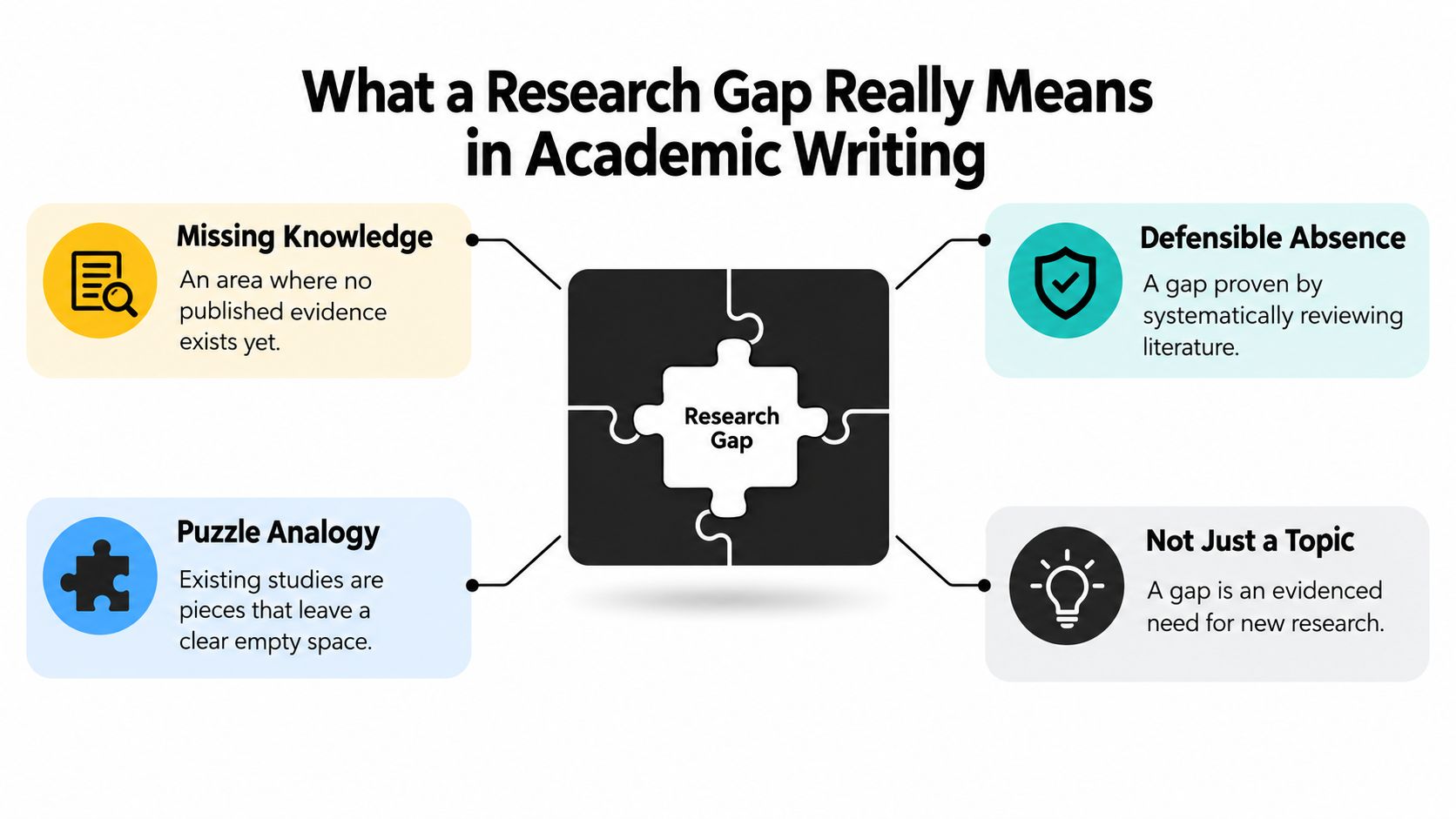
From an interesting topic to a defensible absence
Academic guidance commonly places gaps in a conceptual, methodological, or empirical space. A conceptual gap concerns ideas, definitions, or relationships that scholars haven't adequately developed. A methodological gap concerns how researchers have investigated an issue, including limitations in design, measurement, sampling, or analysis. An empirical gap concerns missing, limited, inconsistent, or outdated observations.
Systematic-review methodology makes the idea more precise. A gap can exist when missing or inadequate information prevents reviewers from drawing a firm conclusion. The systematic-review methods guidance from the National Center for Biotechnology Information recommends characterizing the question through PICOS elements plus setting, then identifying why the evidence is inadequate.
PICOS refers to:
- Population: Who is being studied?
- Intervention or exposure: What action, condition, or experience matters?
- Comparison: What is it being compared with?
- Outcome: What result is being measured?
- Study design: What kind of evidence is available?
- Setting: Where does the issue occur?
This lens turns “something is missing” into a structured diagnosis. You may discover that evidence exists for one population but not another, or that studies measure the outcome but use incompatible designs.
What a research gap is not
A research gap isn't the same as a research problem. The problem is the broader issue that motivates investigation. The gap is the specific weakness in prior knowledge that your study will address.
It also isn't a topic, such as “social media and student wellbeing.” That topic becomes a gap only when your review shows a defensible absence, such as limited evidence about a defined population, inconsistent findings across methods, or outdated evidence in a relevant setting.
Personal curiosity can start a project, but it can't prove scholarly need. Published literature must do that work.
The Main Types of Research Gaps You Will Encounter
Naming a gap type helps you move from vague dissatisfaction to a research decision. The categories often overlap, so don't force a paper into only one box. A study may reveal an empirical gap in a specific population and a methodological gap in how that population has been measured.
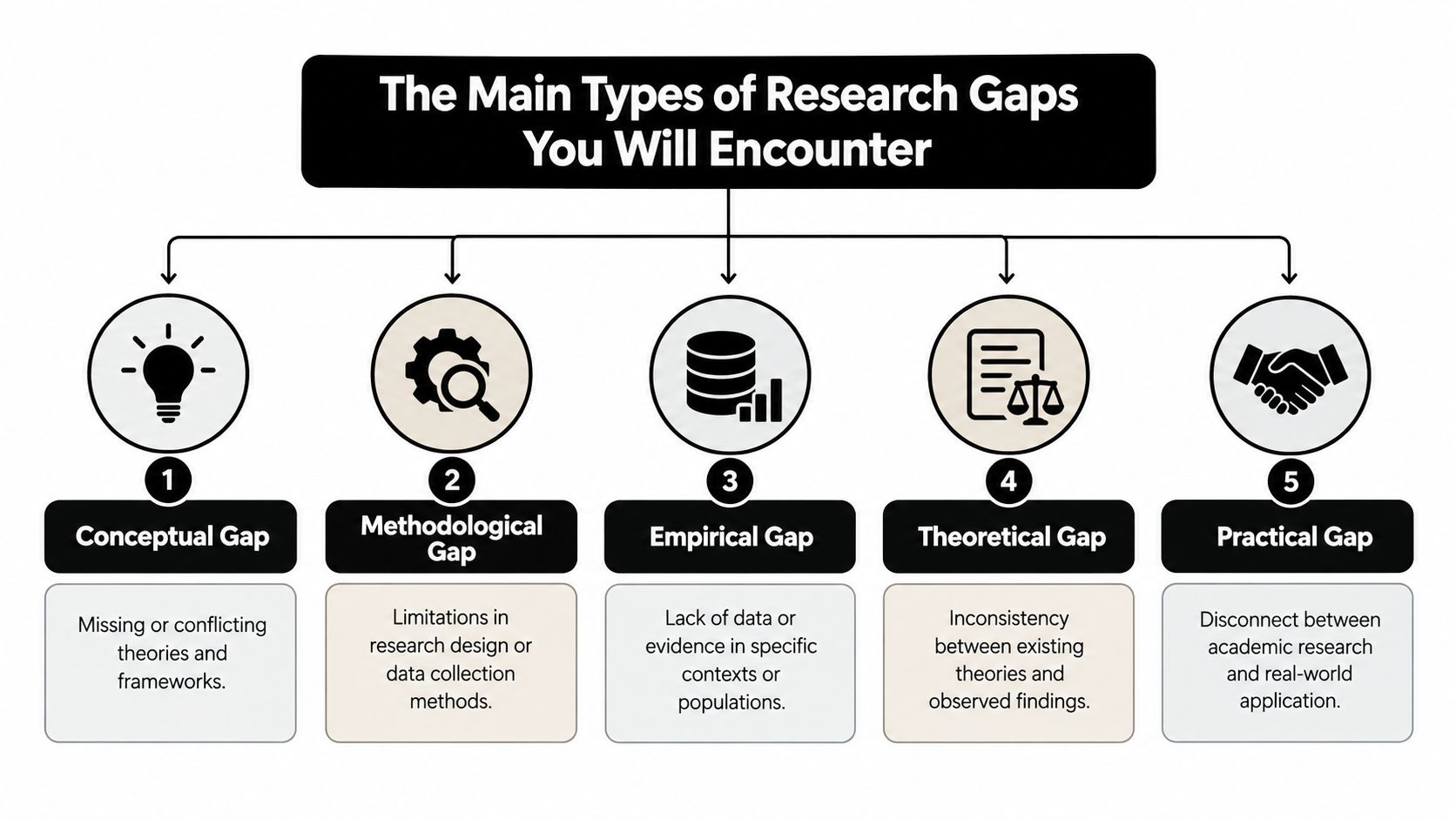
A comparison table for quick classification
| Gap Type | What Is Missing | Example Signal |
|---|---|---|
| Conceptual | A clear definition, model, or relationship between ideas | Authors use the same term in different ways |
| Methodological | A stronger design, measure, sample, or analytical approach | Existing studies rely on one narrow method |
| Empirical | Evidence about a phenomenon, outcome, or relationship | Findings are absent, limited, or outdated |
| Population | Evidence from a particular group | Research focuses on one group while another remains overlooked |
| Geographic | Evidence from a particular location or context | Findings come from one region and may not transfer |
| Comparative | Direct comparison between interventions, groups, or settings | Studies examine alternatives separately but never compare them |
A conceptual gap might appear when researchers discuss “engagement” without agreeing whether it means attendance, participation, attention, or emotional involvement. Your study could clarify the concept or test a framework that connects its dimensions.
A methodological gap might arise when prior studies use self-report surveys but don't examine how participants behave in practice. Your project could combine methods, improve the measure, or use a design that addresses the limitation.
An empirical gap is more direct. Researchers may have theorized about a relationship but gathered little evidence about it in the setting you care about. A population or geographic gap narrows that absence further.
A practical gap concerns the distance between academic findings and real-world use. If research recommends an approach but doesn't explain how practitioners can implement it, a study may investigate application conditions rather than repeat the original question.
For a more specialized way to inspect missing support between claims and citations, you can review AI citation gap analysis. It can complement, but not replace, your own reading of methods, findings, and limitations.
Why Identifying a Research Gap Strengthens Your Thesis
A gap gives your thesis a defensible purpose. It tells the reader why another study is needed even when the general subject already has an established literature.
A 2023 higher-education paper distinguishes a research gap from an evidence gap and describes a framework in which reviewers can draw only limited conclusions because evidence is insufficient or imprecise, biased, inconsistent or of unknown consistency, or not the right information. The distinction is discussed in the paper on research and evidence gaps in higher-education scholarship.
Originality doesn't require an untouched topic
Many students think originality means discovering a subject no one has ever examined. That standard is usually unrealistic and can lead you toward obscure, poorly supported projects.
A stronger form of originality comes from addressing a specific unresolved condition. You might test an established claim with a better design, examine an overlooked population, compare settings, resolve conflicting findings, or update evidence that no longer reflects current circumstances. Your contribution becomes credible because it responds directly to a documented weakness.
The gap also protects feasibility
A broad gap produces a broad thesis. A precise gap helps you decide what to include and what to leave out.
Suppose your literature review shows that studies examine a teaching approach but use inconsistent outcome measures. You don't need to investigate every possible effect. You could focus on how two measures represent engagement in a defined population and setting. The diagnosis limits the project while preserving its contribution.
Examiners can trace your reasoning
An examiner should be able to follow the path from literature to research question without filling in missing steps. Your review should establish what scholars know, identify the evidence condition that prevents confidence, and show how your method responds.

A gap based on inconsistent evidence may justify comparison or replication. A gap based on bias may require a different sample or more careful design. A gap based on missing information may call for a new study. The point isn't to use the most impressive method. It's to choose the method that matches the diagnosed deficiency.
How to Identify a Research Gap in the Literature Step by Step
A literature review can resemble a map with several roads ending abruptly. Your task is to check whether those endings represent missing evidence, conflicting findings, or merely a question outside your study. Gap-spotting therefore works as evidence diagnosis. You compare sources systematically until a defensible pattern appears.
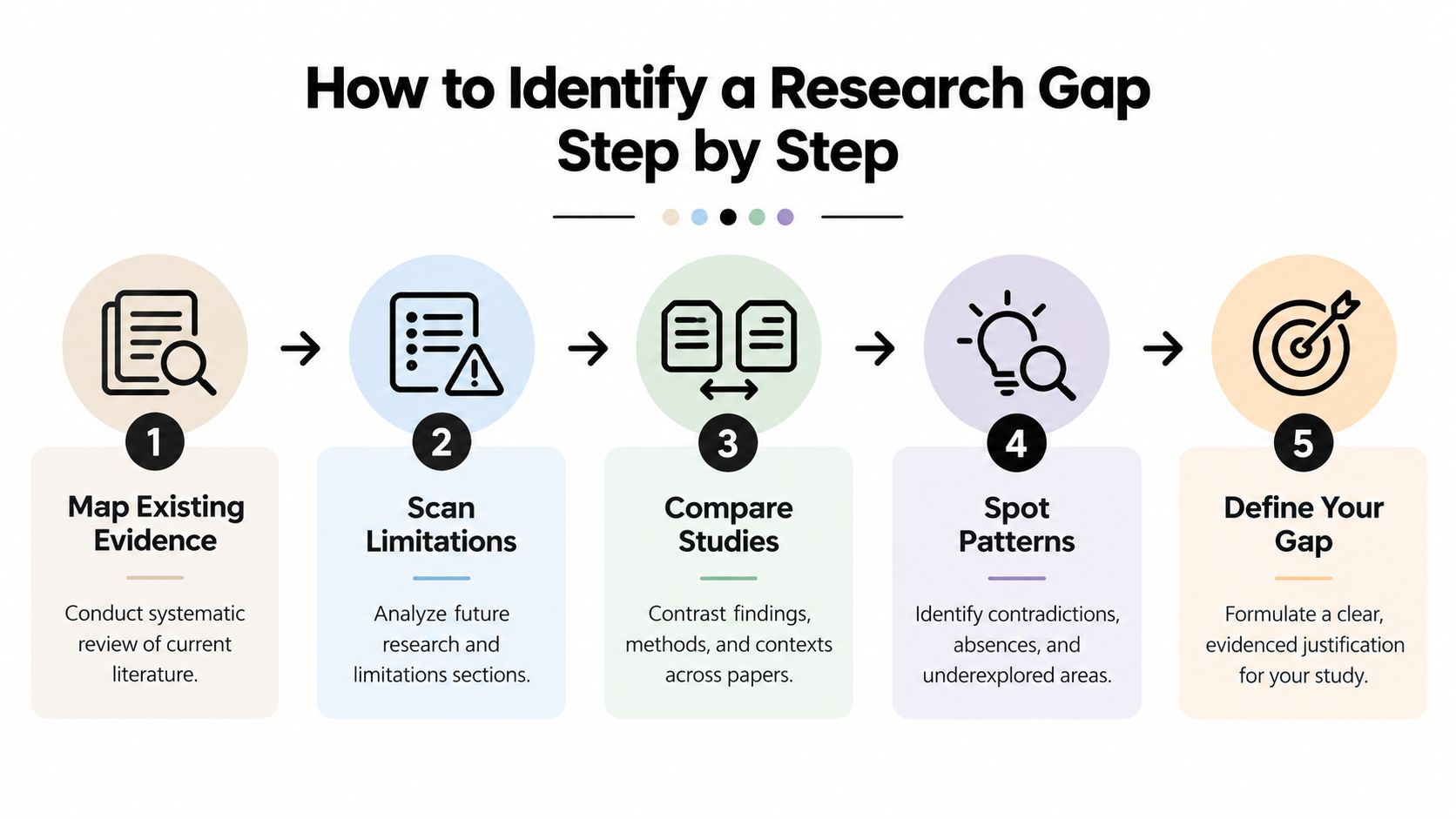
Build an evidence map
Start with a manageable group of relevant studies. Record the features that shape your question in a spreadsheet: population, intervention or exposure, comparison, outcome, study design, setting, main finding, limitation, and suggested future work. These columns turn a pile of articles into a comparable evidence map.
Read across the studies, not only down each article. Citation analysis shows which works or ideas dominate discussion. Content analysis reveals repeated concepts, definitions, and outcomes. Reviewing limitations systematically can show whether authors identify the same weakness again and again.
Future-work sections provide leads, not proof. Check later publications before treating a recommendation as an unresolved gap. A proposed study may already have been completed, or its question may have changed.
Look for unstable evidence
Compare results that do not align. In meta-analysis, wide confidence intervals may indicate imprecision, while non-overlapping effect estimates can signal inconsistency. A small body of relevant trials can also leave conclusions unstable. For a paper on citation analysis and limitations review for gap identification, see a paper on citation analysis and limitations review for gap identification.
Conflicting results do not automatically show that a study is wrong. Differences in populations, measures, settings, or designs may explain the disagreement. Ask whether the explanation is already established. If it is not, the disagreement may support a focused research question.
Diagnose the gap with PICOS and setting
Once a pattern emerges, describe it with PICOS plus setting:
- Population: Which participants or cases have been studied, and who is absent?
- Intervention or exposure: What condition or activity has been examined?
- Comparison: Which alternative or baseline is missing?
- Outcome: What has been measured, and what remains unclear?
- Study design: Which methods dominate, and what limitation follows?
- Setting: Where were studies conducted, and can their conclusions transfer?
Then classify the evidence problem. Is information missing, imprecise, biased, inconsistent, or poorly matched to your question? Use that diagnosis to choose the gap type. Missing populations point toward a population gap. Conflicting estimates may support a replication or comparison. Dominant self-report methods may justify a methodological gap. The matrix is simple: identify the deficiency, match it to a feasible response, and reject methods that do not address the deficiency.
For more structured examples, review LLMrefs gap analysis examples. For guidance on organizing the wider review, consult the complete guide to writing a literature review.
Research Gap Examples and How to Write a Strong Gap Statement
A strong gap statement guides the reader through three steps: what the literature has established, what evidence remains inadequate, and what your study will do in response. It should read like a diagnosis, not a broad declaration that a topic has been ignored.
Match the claim to the evidence you reviewed. Avoid saying “no one has studied this” unless your search can support such an exhaustive conclusion. A narrower statement is usually more accurate because it identifies the population, method, setting, or outcome that limits the existing evidence.
Example one, a population gap
Weak: “Little research examines online learning.”
Stronger: “Existing studies have examined online learning primarily among university students, while evidence about how adult vocational learners experience instructor feedback remains limited. This study will investigate that experience in a defined training setting.”
The stronger version names the studied group, the absent group, the unresolved question, and the proposed response. It treats the gap like a missing piece in a map, rather than claiming that the entire subject is unexplored.
Example two, a methodological gap
Weak: “Previous research uses poor methods.”
Stronger: “Prior studies of workplace wellbeing rely mainly on self-report measures, making it difficult to compare reported wellbeing with observed working conditions. A mixed-method design will examine how these forms of evidence correspond in the selected setting.”
The statement evaluates the evidence, not the researchers. Self-reports may describe participants' perceptions, but they cannot by themselves show how those perceptions align with observed conditions. The proposed design therefore follows from the diagnosed limitation.
Example three, an inconsistency gap
Weak: “Researchers disagree about student engagement.”
Stronger: “Studies report inconsistent relationships between classroom technology and student engagement, and the findings use different definitions and outcome measures. A comparative analysis using a clearly specified engagement measure will examine whether the disagreement reflects conceptual or methodological differences.”
Disagreement alone is not yet a useful gap. The sharper problem is that differing concepts and measures make the findings difficult to compare. Your statement should identify that source of instability and show how the study will examine it.
Example four, a geographic gap
Weak: “This study will explore the issue in a new country.”
Stronger: “Existing evidence on community health communication comes from settings with different institutional and linguistic conditions. Evidence from the selected region is limited, so this study will examine how local organizations adapt the communication approach within that context.”
A new location matters when its institutional or linguistic conditions could change how the claim operates. Changing the setting alone does not establish a contribution. Explain what the context may alter and what evidence your study will provide.
After drafting, use this guide to writing a problem statement for research to check that the practical problem, evidence gap, and proposed study remain connected. Ask whether a reader can identify what is missing, why it matters, and what your research will do about it. If one answer is unclear, revise the statement before treating the gap as settled.
Turning Your Gap Into a Focused Thesis Plan
A diagnosed gap becomes useful when it controls your next decisions. Convert it into a research question, then map that question onto objectives, methods, data, and chapters. Every planned section should help explain the evidence deficiency or show how your study addresses it.
Use a simple decision matrix:
| Evidence diagnosis | Likely thesis response |
|---|---|
| Missing population or setting | Conduct a focused study with that population or in that setting |
| Inconsistent findings | Compare studies, measures, contexts, or samples |
| Imprecise evidence | Improve measurement, sampling, or analytical design |
| Biased evidence | Use a design that addresses the identified source of bias |
| Outdated evidence | Examine the question in the relevant current context |
Then work backward from your submission date. Set milestones for the proposal, literature review, method, data collection, analysis, discussion, and final revision. Track each chapter from outline to draft to reviewed version, and bring unresolved blockers to supervisor meetings instead of reporting only that you're “still reading.”
If your topic remains too broad, use this guide to choosing a thesis topic you can actually finish. Your immediate checklist is straightforward:
- Map the literature: Record PICOS elements, setting, findings, and limitations.
- Name the evidence condition: Decide whether the problem is absence, imprecision, bias, inconsistency, or mismatch.
- Choose the gap type: Select the category that best describes the pattern.
- Draft the statement: Connect prior evidence, unresolved issue, and proposed response.
- Test feasibility: Confirm that your population, method, data, and timeline fit the gap.
Thesis Book Project helps you turn a diagnosed research gap into a structured path from proposal to submission, with chapter tracking, milestones, source organization, and progress visibility. Visit Thesis Book Project to organize your literature review, keep your gap aligned with each chapter, and make supervisor meetings focus on concrete next actions.
Related Articles
How to Write a Problem Statement for Research That Works
You've probably seen this supervisor comment already: “Interesting topic, but the problem isn...
Research MethodsQualitative vs Quantitative Research: Which Is Right for Your Thesis
Few decisions shape your thesis more than the choice between qualitative and quantitative research....
Research MethodsThe Methodology Chapter Explained for Beginners
The methodology chapter is where many otherwise strong dissertations lose marks, usually because stu...
Comments (0)
No comments yet. Be the first to share your thoughts.