What Is a Research Problem Statement: A Practical Guide
What Is a Research Problem Statement. Learn what a research problem statement is, its key components, and how to write one that strengthens your thesis.
A research problem statement is a structured explanation of a specific gap or issue in existing knowledge, supported by evidence, that your study aims to address. It also does the practical work of anchoring your research questions, setting the study's boundaries, and giving you a framework for reporting results.
You've probably got a topic, but the page still feels too wide open. That's where most first-time researchers get stuck, not because the idea is bad, but because it hasn't been turned into a defensible problem yet.
Table of Contents
- What a Research Problem Statement Actually Is
- The Four Components of a Strong Problem Statement
- Why Each Component Matters
- Problem Statements Across Disciplines
- Common Misconceptions About Problem Statements
- How to Evaluate and Improve Your Draft
What a Research Problem Statement Actually Is
The blank page problem usually starts with a broad interest. You know what area matters to you, maybe education, health, marketing, engineering, or public policy, but you can't yet say what exactly is wrong, missing, or unresolved. A research problem statement is the sentence or short passage that changes that vague interest into something you can investigate.
A useful way to think about it is this, the topic is the terrain, and the problem statement is the path through it. The University of Southern California describes it as the part that should anchor the research questions, define the study's context and boundaries, and provide the framework for reporting results (USC research problem guidance). MIT's writing guide trims the idea down even further into problem, method, and purpose, which shows how the concept has become a planning tool, not just a paragraph of background (MIT writing guide as summarized in the USC resource set).
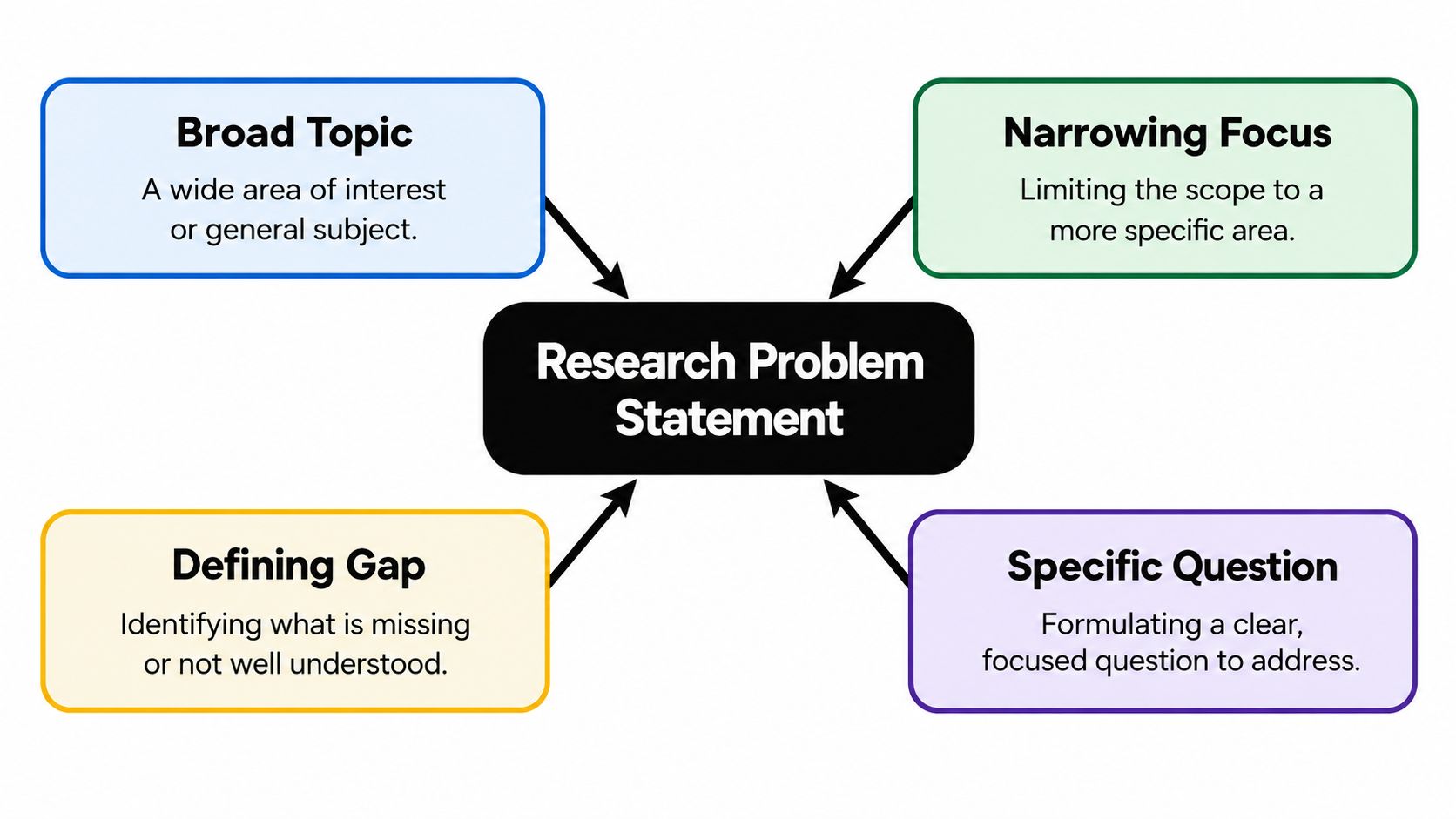
A student writing about survey fatigue, for example, might begin with “employee feedback” as a topic. That's too broad to guide a thesis. The problem statement forces a sharper move, such as identifying that a specific group isn't responding to a certain kind of survey, that this weakens the data, and that it still isn't clear what makes the survey design difficult to complete.
Where students usually get confused
The confusion often comes from treating the problem statement like a thesis claim. It isn't that. It sits earlier in the process and helps you justify why the study should exist at all. If you want a related example of how researchers turn user behavior into a focused inquiry, the structure used in user research methods for product teams can help show how broad questions become observable patterns.
Practical rule: if you can't point to the problem in a real setting, you probably don't have a problem statement yet.
A strong version doesn't just name a concern. It narrows the concern, identifies who or what is affected, and gives you a starting point for evidence. That's why supervisors push students to make the problem concrete instead of decorative.
The Four Components of a Strong Problem Statement
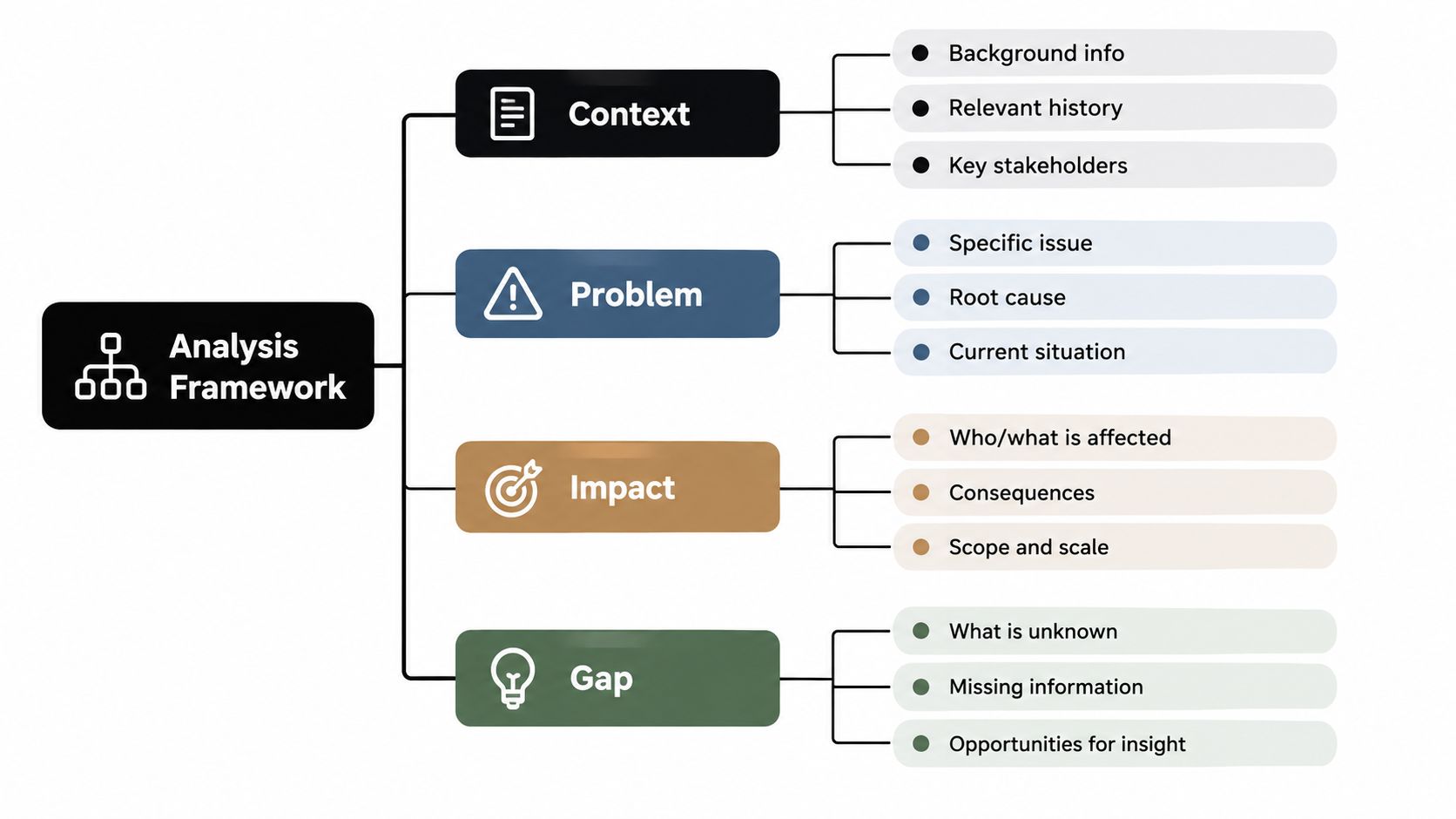
A problem statement often falls apart because a student starts with the topic and stops there. A better draft works in layers. First comes the context, then the problem, then the impact, and finally the gap. Each piece answers a different question, so the reader can see why the study belongs in the thesis at all.
1. Context
Context tells the reader where the problem lives. A nursing student might narrow it to one ward, one patient group, or one care routine. A business student might focus on one department, one workflow, or one customer segment. Without that frame, the statement feels like a topic list instead of a research problem.
2. Problem
The problem is the exact issue, not the whole background story. Say what is happening, what is not working, or where the tension shows up in practice. The aim is clarity, so another researcher could recognize the issue without guessing.
3. Impact
A problem matters more when the effects are visible. Who feels them? What gets worse if nothing changes? In a thesis proposal, this is the point where you show that the issue affects practice, decisions, or outcomes, not just your personal interest.
4. Gap
The gap is the missing piece, such as knowing that survey response rates drop for remote workers but not knowing which design features cause the drop. ResearchMethodology.org on research problems treats a problem statement as bounded and researchable, which means you need to show what is already known and what still needs evidence (ResearchMethodology.org on research problems). That evidence gap should be stated clearly, not left as a hunch. What counts as a research gap helps students see the difference between a broad concern and a researchable opening.
Good drafting habit: write each component in one sentence first, then combine them only after each part feels precise.
A lot of students try to write the whole thing at once, then end up with a paragraph that sounds academic but does not explain enough. The structure keeps the draft honest and makes the missing evidence easier to defend in supervisor review.
Why Each Component Matters
A strong problem statement works like a set of labeled parts. If one part is weak, the whole draft becomes harder to defend. Context tells the reader whether the study is narrow enough to be realistic. The problem shows what is unresolved. The impact explains why the issue matters. The gap shows where your study fits in the discussion.
Evidence separates a claim from a research problem
A problem statement needs support, not just confidence. Without evidence, it is only an assertion. Supervisors look for justification because they need to see that the issue is already visible in prior studies, records, or professional sources. If the claim cannot be supported, the reader has no reason to treat it as a real research problem.
Scope keeps the project doable
A problem can be genuine and still be too large for a thesis. Scope sets the boundary. A good statement should be bounded enough that you can name the data you would need to examine it. If you cannot say what would count as evidence, the problem is still too loose.
Missing one part creates predictable problems
Skip context, and the statement starts to sound universal, even though it fits no specific study. Skip impact, and the topic may seem interesting but not pressing. Skip the gap, and the draft turns into a summary of existing knowledge rather than a thesis that adds something new. Students often meet the same supervisor comments for this reason, too broad, too vague, or not yet researchable.
Watch for this: if the statement could fit almost any study in your field, it is not specific enough to defend.
The four-part structure matters because it gives reviewers a clear path through the draft. It helps them judge the literature review, the research questions, and the method without guessing how the pieces connect. That is why the best problem statements read like evidence-backed decisions, not just polished prose.
Problem Statements Across Disciplines
The same logic works across fields, but the evidence changes. A social science project may lean on survey behavior, an experimental study may rely on observed outcomes, and a professional-practice project may focus on workflow or decision-making. The structure stays stable even when the subject matter changes.
| Discipline | Problem | Evidence | Consequences |
|---|---|---|---|
| Social sciences | A student may identify that a specific group is underrepresented in a local decision-making process. | Prior studies, policy reports, or recent field observations can show the pattern. | Decisions may reflect only part of the community's needs. |
| Natural sciences | A researcher may find that a measurable process behaves inconsistently under certain conditions. | Experimental observations and prior lab findings can establish the inconsistency. | Results become harder to predict or reproduce. |
| Professional practice | A team may struggle with a recurring workflow bottleneck in a real workplace setting. | Internal records, performance observations, or practitioner accounts can document the issue. | Time gets lost, and the process becomes harder to manage. |
In social sciences, the language often sounds like a population problem, a policy problem, or a behavioral pattern. In natural sciences, it often becomes a measurable anomaly or unresolved mechanism. In professional settings, the problem usually shows up as a process failure, a service gap, or a recurring operational issue. The form changes, but the logic does not.
A useful comparison comes from internal user research, where teams often have to define a tension between two real needs before they can study it properly. That kind of framing shows how a problem statement can be practical and evidence-based at the same time, without sounding inflated or theoretical. For a nearby example of how a tightly written academic claim is structured, writing a strong thesis statement shows the difference between a broad idea and a defensible position.
Why the table matters
The point of comparing disciplines isn't to make them identical. It's to show that good problem statements always do the same underlying work, they name a real issue, support it with evidence, and point toward something unknown or unresolved. Once students see that pattern, they can adapt it to almost any thesis topic.
Common Misconceptions About Problem Statements
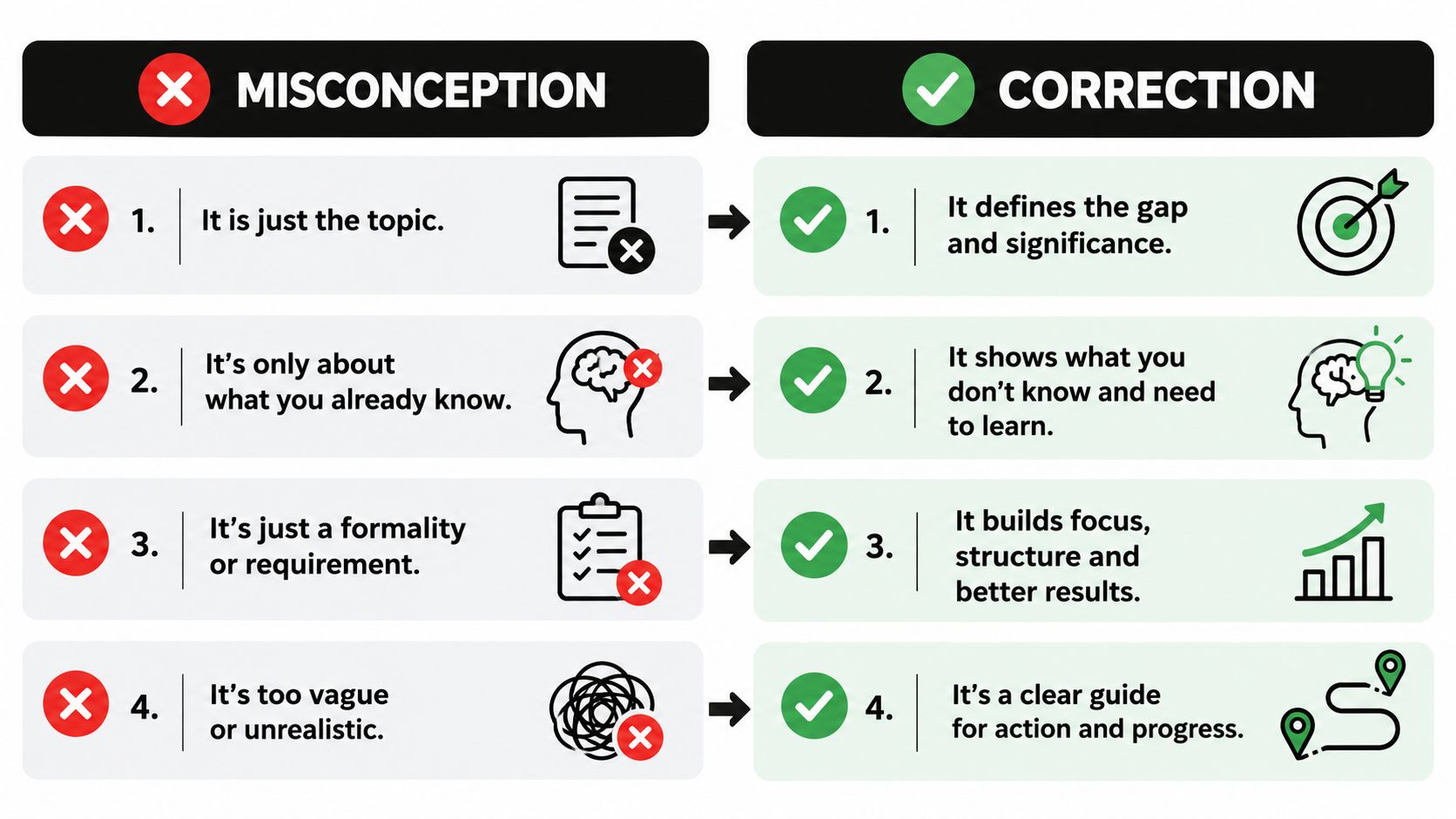
A weak draft often starts with the wrong assumption. Students sometimes treat the problem statement as a topic dressed up in academic language. That creates a sentence about the field, but it still does not explain what is broken, missing, or unresolved in that field.
Misconception 1 It only restates the topic
A topic such as “online learning” points to an area of interest, but it does not tell a supervisor what is uncertain, what is affected, or why the study matters. A research problem needs a narrower target. It should name a bounded issue and show, with evidence, why that issue deserves study.
Misconception 2 It has to be groundbreaking
Students often assume the problem must sound large to count. That pressure leads to inflated claims that are hard to defend. A thesis problem can be local, modest, or very specific, as long as it is real and supported. Many strong dissertations begin with a small but clear tension in a defined setting, the kind of tension that can be tested rather than merely described. For a nearby example of how a tightly written academic claim is structured, writing a strong thesis statement shows the difference between a broad idea and a defensible position.
Misconception 3 It needs a giant literature base
A large literature can help, but the statement itself does not depend on volume. What matters is whether the sources you do have show that the issue exists and that something remains unresolved. A focused body of recent research can be enough if it is specific and relevant.
Misconception 4 It can't change
Early drafts usually change as students read more, talk to supervisors, and narrow the scope. That is normal. The first version is a working draft, not a final verdict. The goal is to keep the statement researchable while you refine it, not to protect every early phrase.
The challenge is the part many guides skip. They tell students to “find a gap,” but a gap only matters if it can be measured, bounded, and defended with evidence. Without that proof, the draft is still just a claim.
How to Evaluate and Improve Your Draft
A draft improves fast when you test it against the same five questions a supervisor would ask. Is the context clear? Is the problem stated without drifting into background? Is the impact concrete? Is the gap supported by evidence? Does the statement match the study aim you can realistically carry out?
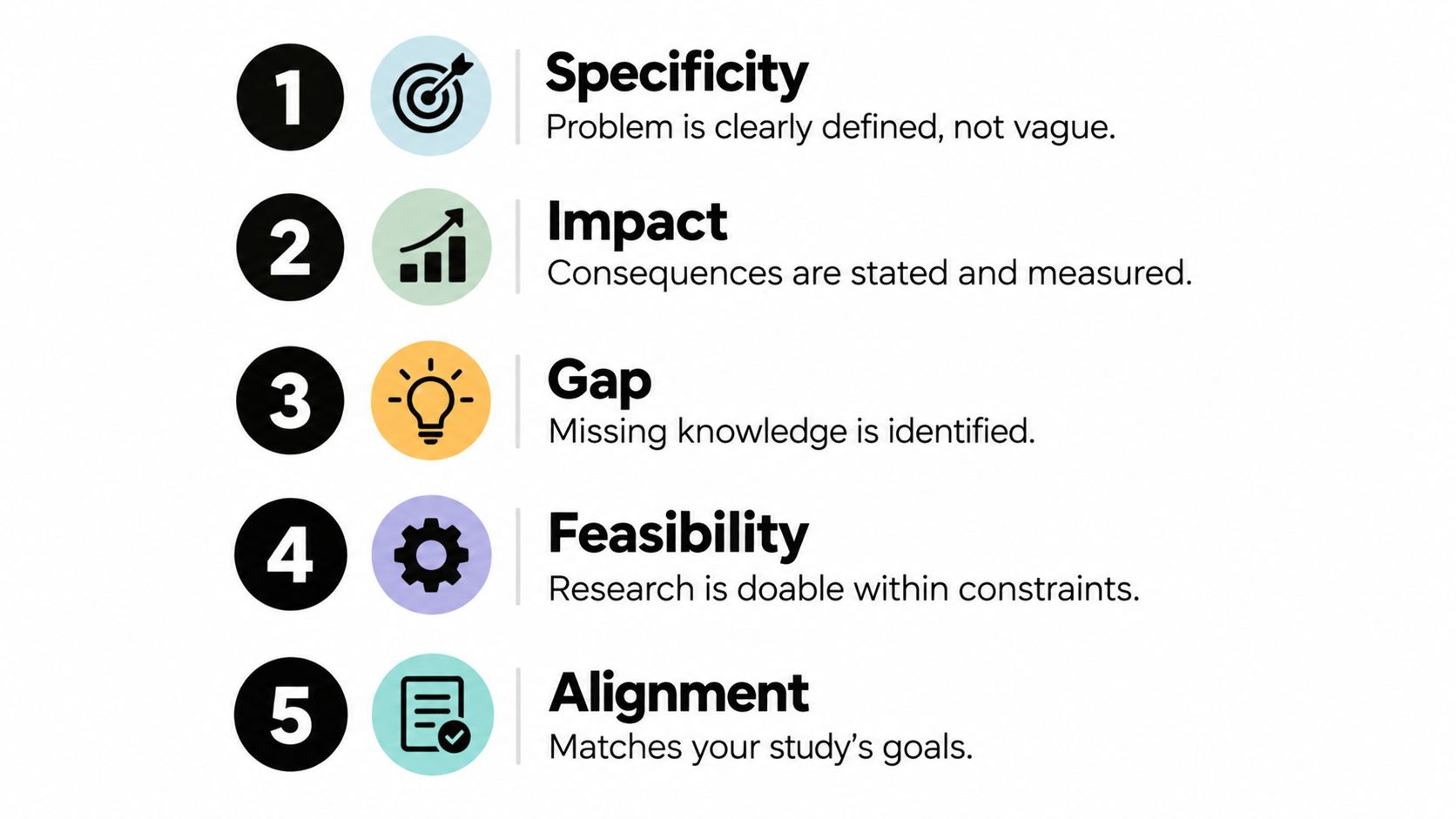
One useful way to review the draft is to read it as if you had never seen the topic before. If the wording sounds broad enough to fit many projects, narrow the setting, the people involved, or the process under study. If the wording sounds abstract, replace it with something a reader can observe or verify. If the claim is not backed by evidence, it is still a concern, not yet a research problem.
Three red flags to fix fast
- Too broad: the statement could apply to an entire field, so it needs a tighter setting, population, or process.
- Too vague: the reader cannot tell what is happening, so swap abstract language for observable terms.
- Unsupported: there is no evidence yet, so do not present it as a problem.
A strong draft also needs to survive the skeptical reading a thesis advisor gives it. That means checking every sentence for two things, proof and precision. If a line feels like opinion, find a source or rewrite it as a limited claim. If a line feels important but fuzzy, make it measurable. A dissertation proposal guide becomes useful at this stage, because the proposal has to turn a problem statement into a workable plan.
A good problem statement does not need drama. It needs a clear setting, evidence that the issue exists, and a gap you can defend. If you can say what is known, what is missing, and why that missing piece matters, your draft is in much stronger shape.
Related Articles
How to Write a Dissertation Proposal Guide
You're staring at a blank document, a deadline, and a supervisor who wants something “focused” b...
Research Methods10 Literature Review Sample PDFs to Use
A literature review sample PDF is most useful when you ignore its sentences. The underlying lesson s...
Research MethodsHow to Write a Dissertation Conclusion: A Practical Guide
You're down to the last chapter, the argument is already built, and the deadline is uncomfortabl...
Comments (0)
No comments yet. Be the first to share your thoughts.