Timeline for Research: A Step-by-Step Backward Plan
Build a timeline for research backward from your submission date, with templates, thesis examples and tips to stay on schedule.
A peer-reviewed study found that doctoral projects planned for three to five years took an average of about 59.8 months for women and 59.67 months for men, with actual completion running roughly ten months beyond plan, according to the study of PhD completion timelines. That gap changes how you should plan: a timeline for research isn't just a list of tasks leading to one deadline. It's a risk model that makes waiting time, approvals, feedback, and schedule buffers visible before they squeeze your writing.
Table of Contents
- Typical Thesis Phases and How Long Each Takes
- Place Every Task Backward From Your Deadline
- Fill-In Template for Your Backward Timeline
- Worked Examples for a Master's and a Three-Year PhD
- When Feedback or Approvals Stall the Schedule
- Commit to a Credible Submission Date This Week
Typical Thesis Phases and How Long Each Takes
| Phase | Typical duration | Main dependency | Buffer to add |
|---|---|---|---|
| Topic and proposal | 2–4 months | Supervisor approval | 2–4 weeks |
| Literature review | 3–6 months, continuous | Library access and reading load | 2 weeks |
| Ethics or institutional approval | 1–4 months | Committee meeting schedule | 4–6 weeks |
| Data collection | 3–9 months | Participants, fieldwork, equipment | 1–2 months |
| Analysis | 2–4 months | Data quality and software skills | 3–4 weeks |
| Drafting chapters | 3–6 months | Feedback turnaround | 2–3 weeks per chapter |
| Revision after supervisor review | 1–3 months | Number of review rounds | 4 weeks |
| Final formatting and submission | 2–6 weeks | Graduate school format rules | 1 week |
These are planning ranges, not promises. The widest ranges appear where your progress relies on other people or institutions: recruiting participants, completing fieldwork, reaching a committee meeting, or getting supervisor feedback. A phase can be well planned and still wait on something you don't control.
The PhD completion study measured average timelines close to five years, despite a nominal three-to-five-year trajectory. It also found that planned and actual durations differed by 9.52 months for women and 10.11 months for men. A single submission date hides where that time goes. Breaking work into phase-level checkpoints lets you see whether the proposal, approvals, data, or reviews are creating the delay while there's still room to respond.
Read the phases as a sequence, not a sum
The table's rows don't add up to a total. The literature review often continues while you refine the method or collect data, so overlapping work can shorten the overall calendar time. But that overlap only helps when the tasks can run together. You can't finalize a results chapter before the data are ready, and you shouldn't treat a pending ethics decision as permission to begin recruitment.
The buffer column is where optimistic plans often break. If your approval process needs a committee decision, allow time for the meeting schedule and for follow-up questions. If a supervisor needs to review a chapter, don't assign that same period to your next chapter's final polish. For another perspective on writing time specifically, use this guide to how long it takes to write a dissertation, while keeping research and approval tasks in your own timeline.
Before moving on, write your estimate for each phase. Compare it with your program's actual milestones, not just its nominal completion date. The aim isn't to predict every delay; it's to expose the parts of your schedule most likely to need a decision or adjustment.
Place Every Task Backward From Your Deadline
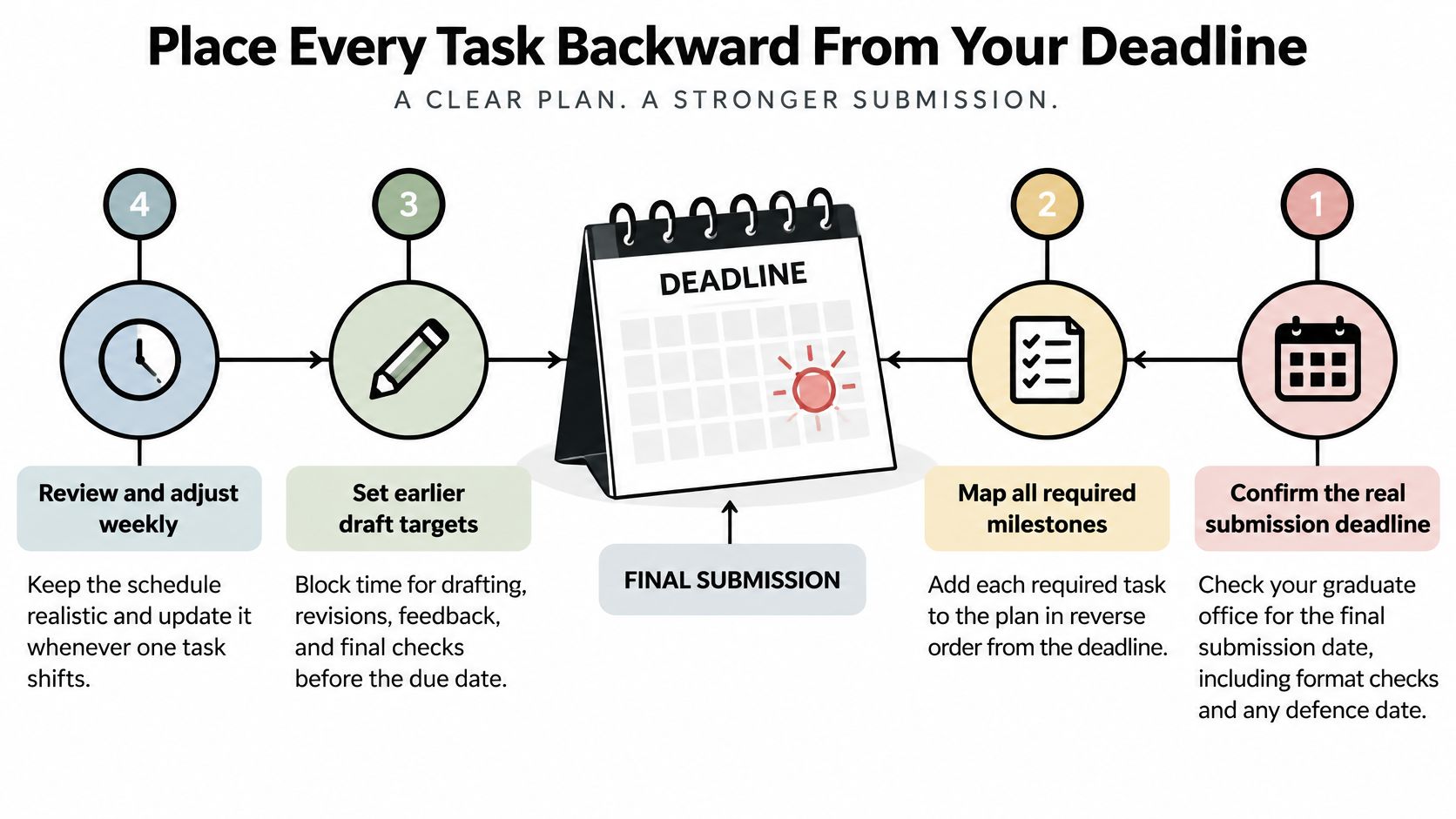
Open a calendar and start at the submission date. Backward planning works because it forces you to reserve time for the last steps before filling the middle with research tasks.
- Confirm the deadline. Ask your graduate office to verify the final submission date, format-check deadline, and any defence date. These dates may not be interchangeable.
- Mark fixed external dates. Add committee meetings, ethics sittings, funding end dates, fieldwork windows, and examiner availability. These are the constraints your work has to fit around.
- Reserve the final checks. Hold the last four to six weeks for formatting, references, and a final revision pass. Small format errors can delay an otherwise complete submission.
- Set a full-draft date. Aim to send a complete draft six to eight weeks before submission, leaving space for one supervisor review and your response.
- Schedule earlier phases in reverse. Place analysis, data collection, proposal approval, and literature work on the calendar, then add the relevant buffers.
- Test the start date. If the schedule says you needed to begin before today, reduce the research scope or change the deadline. Don't solve a timing problem by deleting every buffer.
For example, a master's student with a 1 October submission date who starts in March has seven months. If analysis must begin by June, the student needs to protect the earlier months for approvals and data collection; otherwise, drafting time disappears. Put each date into a calendar and review the next actions every week. A roadmap can also make the sequence concrete: in step one of Thesis Book Project, users set a deadline and break a thesis into chapters and milestones in minutes.
Use milestone tests, not just dates
A milestone is complete when its output passes a clear test, not merely when its due date arrives. The example below is a twelve-month thesis plan. Adjust the earlier checkpoints to fit your methods, but keep the final draft and submission checks visible.
| Milestone | Output | Due (weeks before submission) | Done when |
|---|---|---|---|
| Literature map | Annotated source list | 40 | Every source tagged to a chapter |
| Methods locked | Protocol or design memo | 32 | No change without supervisor sign-off |
| Data collection complete | Clean dataset | 20 | Missing data documented |
| Results chapter draft | Chapter 4 draft | 16 | Every table and figure captioned |
| Discussion draft | Chapter 5 draft | 12 | Each claim linked to a result |
| Full draft to supervisor | Complete thesis | 8 | Sent with a list of open questions |
| Revisions round | Revised draft | 4 | Comments addressed or logged |
| Format check and submit | Submission file | 1 | Graduate school checklist passed |
Convert the week offsets into calendar dates once you know your deadline. If you're still deciding how chapters should be arranged, this practical guide to planning your paper's writing order can help you connect the writing sequence to the work that comes before it. Then use a weekly plan to track progress and stay ahead of the submission date, rather than checking the calendar only when a deadline is close.
Fill-In Template for Your Backward Timeline
Build your schedule in a spreadsheet so each task, dependency, and delay has a place. Start with the dates that aren't yours to move, then work toward the tasks you can control.
| Phase | Start date | End date | Buffer (weeks) | Dependency | Done-when test | Status |
|---|---|---|---|---|---|---|
| Fixed external dates | Committee, ethics, funding, submission | Date confirmed; cannot-move flag recorded | ||||
| Ethics approval | 1 March | 30 April | 6 | Committee meeting schedule | Approval letter filed | On track |
| Literature review | Library access and reading load | Chapter source map completed | ||||
| Data collection | Participants, fieldwork, equipment | Clean dataset stored | ||||
| Analysis | Data quality and software skills | Analysis decisions documented | ||||
| Draft chapter | Data and supervisor feedback | Full draft meets chapter checklist | ||||
| Feedback cycle | Draft sent: | Comments due: | Supervisor availability | Comments received or follow-up sent | ||
| Escalation point | Follow-up date: | Named contact in escalation chain | Follow-up sent if response is overdue | |||
| Final revision and submission | Graduate school format rules | Submission checklist passed |
The fixed-dates row should record each external date separately, with a clear cannot-move flag. For every feedback cycle, enter both the date the draft leaves your desk and the date you expect comments back. This makes waiting visible, rather than treating it as productive writing time.
Fill the sheet in order: fixed dates, buffers, tasks, then the start-date check. Keep one baseline copy and one working copy. Whenever a milestone moves, log the change and date so you can see when the plan changed and why.
Review the Status column every Friday. If a task has slipped by more than its buffer, decide whether to rebaseline the schedule, reduce scope, or escalate a dependency. An online progress tracker for thesis work can help you keep milestones and current status in view, but the critical habit is checking the plan regularly and acting on the first sign of a slip.
Worked Examples for a Master's and a Three-Year PhD
A sociology master's student has a twelve-month window, with interviews planned in one city. The proposal is approved by month two, but ethics approval arrives late in month three. Rather than waiting idle, the student begins the literature chapter and organizes the source map. That parallel work absorbs a two-week ethics delay without pretending that interviews can begin before approval.
A PhD candidate has a three-year schedule and must recruit participants around term breaks across two academic years. The candidate treats the fieldwork window as a fixed constraint, not an open-ended task. At month twelve, they check whether recruitment and access remain on track; if the data window has slipped, they can discuss a scope adjustment before analysis and drafting are squeezed.
| Element | Master's (12 months) | PhD (36 months) |
|---|---|---|
| Proposal approved | Month 2 | Month 6 |
| Ethics approval | Month 3 | Month 8 |
| Data collection | Months 4–6 | Months 9–24 |
| Analysis | Months 7–8 | Months 25–28 |
| Drafting | Months 10–11 | Months 29–33 |
| Final review and submission | Month 12 | Months 34–36 |
These placements are examples to adapt, not standard schedules. The master's student has a compressed data and analysis sequence, so the literature work begins early and overlaps with approval waiting. The PhD candidate has a longer data window, but the month-twelve checkpoint prevents a two-academic-year plan from drifting without a decision.
The shared pattern matters more than the exact month labels: the longest phase sits in the middle, while the final drafting window is short. Protect that writing time by resolving questions about access, methods, and scope early. Compare your own schedule with the nearer example, then shift the dates to match your research design and institutional requirements.
When Feedback or Approvals Stall the Schedule
A missed milestone doesn't automatically mean poor personal time management. A 2025 study of 176 doctoral candidates across 10 public and private universities in Punjab identified bureaucratic inefficiencies, delayed evaluations, and inadequate supervisory feedback as major contributors to delay; negative supervisory practices were significantly associated with delayed completion, according to the study of doctoral research delays in Punjab. Your timeline should therefore show who needs to act, how long you'll wait, and what work can continue while you wait.
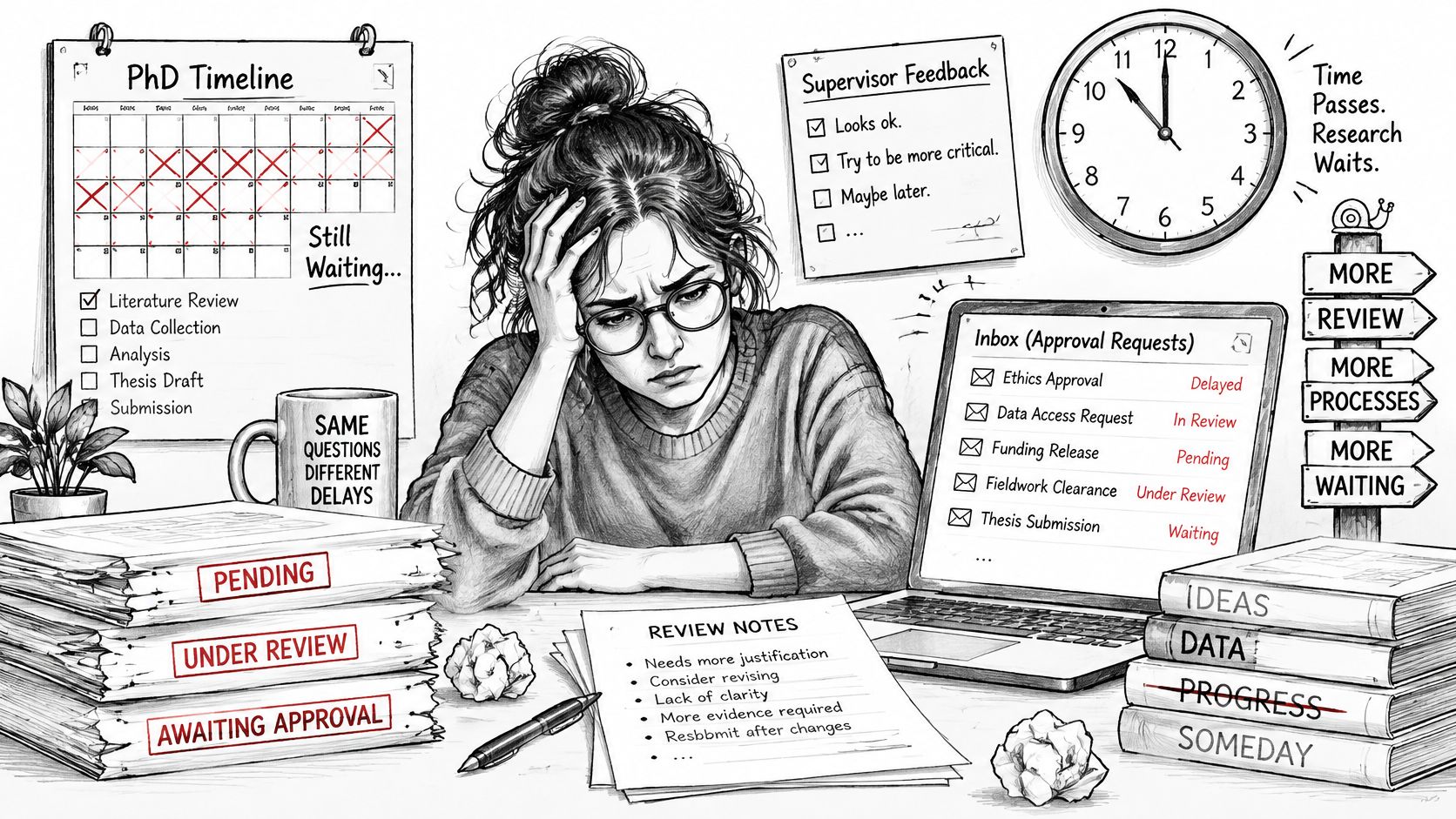
Agree on a feedback turnaround with your supervisor and put it in writing. A practical planning assumption is three to four weeks. If the agreed window passes without a reply, send a concise follow-up that names the draft, the decision you need, and the next date affected. If you're preparing for a later defence, keep that work on its own checklist with this guide to preparing for a dissertation defense.
Practical rule: While ethics review is pending, write the literature chapter, refine interview questions without starting recruitment, or prepare a data-management plan. Keep the tasks that require approval clearly blocked.
Set escalation triggers before a delay
Use a simple escalation chain: first follow up with the person responsible, then contact the next named person if the unresolved decision threatens a fixed milestone. Keep your message factual and specific.
- No response after two working weeks: Send a brief follow-up and copy the next person in the agreed chain.
- Approval misses its committee date: Ask when the next decision point is and whether any material is incomplete.
- Feedback changes the method or scope: Record the decision and its effect on downstream tasks before accepting a new deadline.
- A delay uses the full buffer: Rebaseline the affected milestones rather than compressing the writing and review window.
Maintain three schedule paths: a normal path with feedback on time, a delayed-feedback path that uses the relevant buffer, and a major-revision path with a full extra month reserved. If the delayed path becomes reality, update the submission estimate and explain which dependency changed. A credible revision is more useful than keeping an old date by cutting the time needed to write well.
Commit to a Credible Submission Date This Week
Choose a submission date you can defend, not the fastest date you can imagine. A Utrecht University 2025 PhD survey found that 22% of candidates did not expect to finish on time, rising to 30% among candidates in their final year; perceived workload also became less manageable as overtime increased, according to the Utrecht University PhD survey. More hours on the calendar don't automatically create more usable research time.
First, add a 15–20% buffer to your best estimate from the phase table. Treat it as protection against uncertainty, not permission to delay every task. If you have no room for review, approvals, or data problems, your proposed date is an aspiration rather than a schedule you can explain.
Next, write stop-go rules before expanding the project. A new dataset or chapter should have a clear reason tied to the research question and an agreed place in the timeline. If it doesn't strengthen the answer, don't add it just because the material is available.
Estimate deep-work hours, not the number of hours you could theoretically sit at a desk. Limit yourself to two active chapter commitments at a time, and schedule recovery after demanding fieldwork or examinations. Set a fixed number of review rounds: productive critical review addresses a defined issue, while avoidable perfectionism keeps changing already-sound passages without improving the answer.
The Thesis Book Project roadmap turns a thesis into a step-by-step path from proposal to submission. Its Starter plan is free and includes the Thesis roadmap, Chapter tracker, one project, and community support. To begin without overthinking the whole project, enter your submission date and your first three milestones in your calendar today, then bring that timeline to your next supervisor meeting.
Use Thesis Book Project to turn your research deadline into a roadmap with chapter milestones and visible progress. Set your submission date, add the first checkpoints, and make the next step clear before your schedule starts to slip.
Related Articles
8 Types of Conflicts in Academic Research and Thesis Work
A supervisor meeting can stall for weeks when you and your supervisor are arguing about different pr...
Research Methods8 Examples of Themes for Literature Theses in 2026
You have three months left, a folder full of criticism, and a supervisor asking what your thesis arg...
Research MethodsHow to Cite Articles in a Research Paper
You've done the hard part. You've found a journal article that supports your argument, you&#...
Comments (0)
No comments yet. Be the first to share your thoughts.