How to Cite Articles in a Research Paper
Learn how to cite articles in a research paper with clear steps for APA, MLA, and Chicago styles, in-text citations, reference entries, and common mistakes
You've done the hard part. You've found a journal article that supports your argument, you've written a paragraph you're proud of, and now you're staring at the end of the sentence wondering what goes in the parentheses, whether the year comes before the page number, and why your reference list never quite matches your text. You're not alone, and you don't need to memorize three style manuals to fix it. Learning how to cite articles in a research paper is mostly a matter of building a reliable sequence, then checking it once before you submit.
Table of Contents
- Why Getting Citations Right Matters
- Choosing Between APA, MLA, and Chicago
- Formatting In-Text Citations and Reference Entries
- Using Citation Managers and Integrating Sources into Prose
- Verifying Citations Before You Submit
- Understanding Discipline-Specific and Local Expectations
- Common Citation Mistakes and How to Fix Them
Why Getting Citations Right Matters
A student I worked with once lost marks on an otherwise strong essay for one reason. Her argument was clear and her evidence was relevant, but several paraphrased ideas had no citation at all. She had assumed only direct quotes needed credit. Her instructor couldn't tell where her thinking ended and her sources began, and that uncertainty hurt her grade more than any weak sentence would have.
That confusion is common. Surveys summarized in an ERIC-hosted paper drawing on Donald McCabe's surveys of more than 65,700 undergraduate and 9,250 graduate students between 2001 and 2005 found that 36% of undergraduates said they had paraphrased or copied a few sentences from an Internet source without a footnote, compared with 24% of graduate students. For written sources, the figures were 38% and 25% respectively. These numbers don't prove most students set out to cheat. They show how easily attribution slips when you're focused on writing.
What a citation actually does
A citation does three jobs at once. It credits the original author, it shows your reader how to find the source, and it protects you by making borrowed material visible. When any one of those jobs fails, your reader has to guess, and guessing readers rarely guess in your favor.
- Credit: You signal that an idea, finding, or wording belongs to someone else, even when you've rewritten it in your own words.
- Traceability: You give enough structured detail for a reader to locate the exact article, not just a similar one.
- Credibility: You show that your claims rest on identifiable evidence rather than assertion.
Think of citation as part of communication, not decoration added at the end. If you track sources as you research, format them as you write, and verify them before submission, the task stays small. If you leave everything until the final hour, you're reconstructing author names, page ranges, and DOIs from memory and browser history. A steady workflow saves time, reduces stress, and prevents the most avoidable marks you can lose.
A citation isn't proof that you read a source uncritically. It's a map that lets your reader check what you read and judge how you used it.
Choosing Between APA, MLA, and Chicago
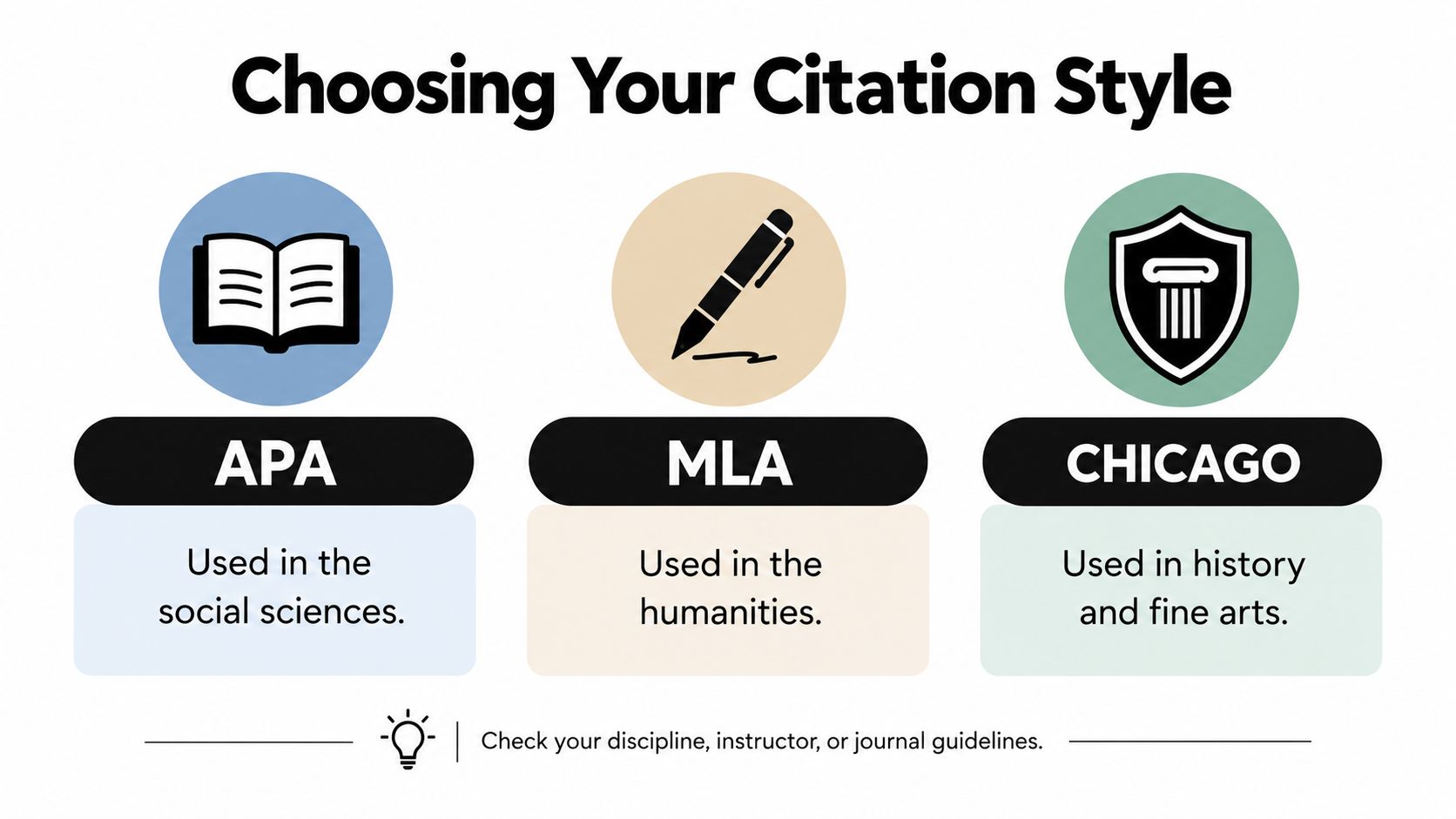
Your first decision isn't punctuation. It's which style you're required to use, and that choice usually isn't yours. Your discipline, instructor, department, or target journal sets it. If the assignment brief names a style, follow it even if you used a different one last term. If it doesn't, ask before you draft your reference list, because reformatting a finished paper is slow and error prone.
The three styles you'll meet most often answer the same question in different ways. They all identify the author, the article, and where it appeared. They differ in what they foreground. APA foregrounds the author and date, which suits fields where recency matters. MLA foregrounds the author and page, which suits close reading of texts. Chicago offers two systems, notes and bibliography for history and the arts, and author-date for sciences and social sciences.
The comparison below helps you see the core difference at a glance before you commit to one.
Journal Article Citation Formats at a Glance
| Style | In-Text Format | Reference Entry Format |
|---|---|---|
| APA | (Lee, 2022) or Lee (2022) | Lee, J. (2022). Article title in sentence case. Journal Title, 14(2), 101-118. DOI |
| MLA | (Lee 105) | Lee, June. "Article Title in Title Case." Journal Title, vol. 14, no. 2, 2022, pp. 101-118. |
| Chicago author-date | (Lee 2022, 105) | Lee, June. 2022. "Article Title in Title Case." Journal Title 14 (2): 101-118. |
| Chicago notes | Footnote with full details first, shortened later | Lee, June. "Article Title in Title Case." Journal Title 14, no. 2 (2022): 101-118. |
A brief history worth knowing
Styles aren't personal preferences. They're standardized frameworks that have been revised as publishing changed. MLA guidance began with a 28-page MLA Style Sheet in 1951, and the first MLA Handbook appeared in 1977, followed by editions through to the ninth in 2021, as detailed in the publication history of the MLA Handbook. The eighth edition in 2015 reorganized documentation around core elements such as author, title, container, publication date, and location. That change made MLA more adaptable to websites and databases, and it reminds you to check which edition your instructor expects.
Before you write a single entry, confirm three things. Check the style and edition, check any departmental guide that modifies it, and look at a supervisor or journal example if one's available. Local instructions override general rules, and five minutes spent confirming them now prevents a full reformatting later.
Formatting In-Text Citations and Reference Entries
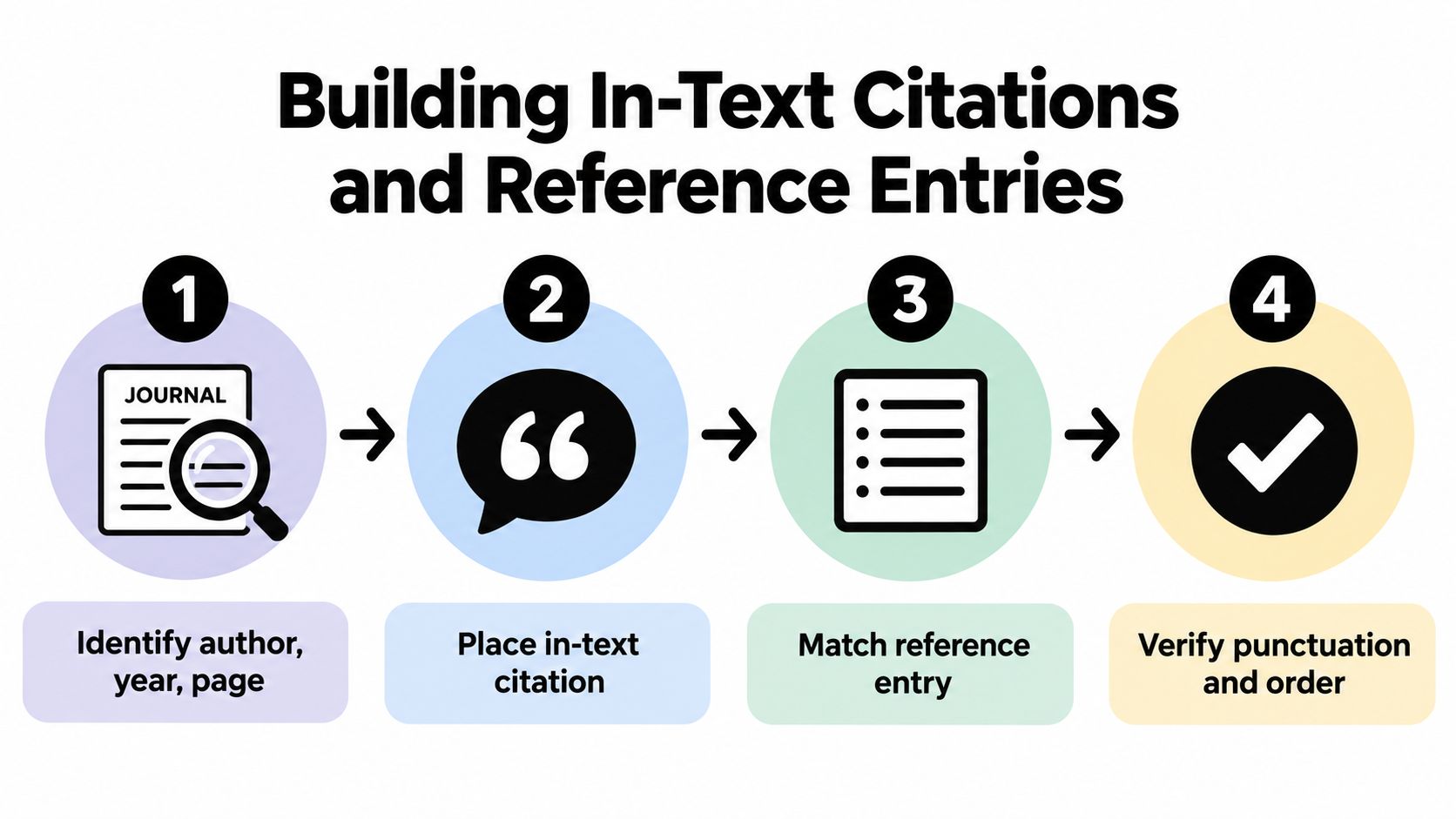
Let's build one citation from start to finish, then you can repeat the pattern. Suppose you're citing a journal article by June Lee, published in 2022, in volume 14, issue 2, pages 101-118. You need two matching pieces every time. The in-text citation appears where you use the source, and the reference entry appears in your list at the end. If one exists without the other, your citation is incomplete.
The four-step process below shows how those two pieces connect.
Step 1 Capture the fields accurately
Record these fields exactly as they appear on the article's first page or publisher record, in this order of checking. Don't rely on memory and don't reorder authors because one name looks more senior.
- Authors: Copy surnames, initials, and order exactly as published.
- Year and title: Note the publication year and the full article title, including any subtitle.
- Journal details: Record the journal title, volume, issue, and page range or article number.
- DOI: Copy the DOI carefully, without trailing punctuation from the surrounding sentence.
Step 2 Write the in-text citation
For a paraphrase in APA, you normally need the author and year, as in (Lee, 2022). For a direct quotation, you also add a page number or another precise locator when pages aren't available, following Purdue OWL guidance on APA in-text citations. In MLA, a paraphrase or quote typically uses the author and page, as in (Lee 105). The principle is the same in both styles. Tell the reader who is responsible and where in the source to look.
Watch this short demonstration if you want to see the in-text and reference pieces built side by side.
Step 3 Build the reference entry field by field
In APA, Lee's entry would read: Lee, J. (2022). Article title in sentence case. Journal Title, 14(2), 101-118, followed by the DOI. Notice the details that trip students up. The article title uses sentence case, the journal title and volume are italicized, and the issue sits in parentheses without italics. If an article has no DOI and you read it online, you use a URL instead. If it has a DOI, you don't add a long database address.
You'll use the same field-by-field discipline whatever you cite. For example, if you were referencing a practical health source such as an evidence-based anti aging program guide in a paper about evaluating non-journal sources, you'd still capture the author or organization, date, title, and stable location before formatting anything. The format changes by source type, but the capture habit doesn't.
Step 4 Match the pair
Read your in-text citation, then find its entry in the list. The surname and year must match exactly, including spelling. If you later expand your work, learning how an annotated bibliography pairs each entry with a short evaluative note can help you keep track of why you cited each article, not just how it's formatted.
Practical rule: Build the reference entry when you first save the article, not when you finish the draft. Your future self won't remember the issue number.
Using Citation Managers and Integrating Sources into Prose
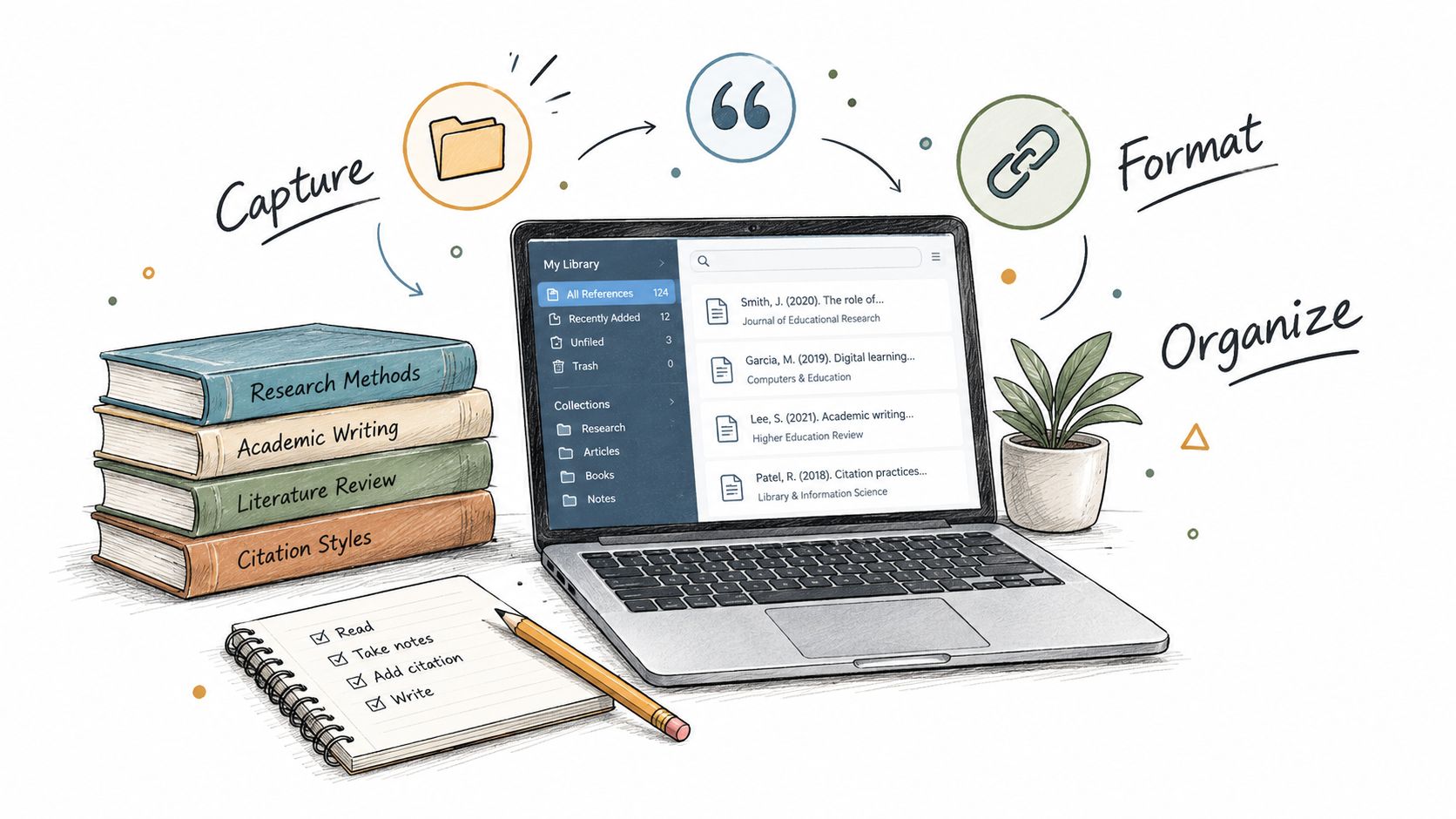
Tools such as Zotero, Mendeley, and EndNote can save you hours. They capture article metadata from a browser, store PDFs, insert in-text citations while you write, and generate a reference list in the style you select. Used well, they remove repetitive typing and keep your library searchable. Used blindly, they reproduce bad metadata at speed.
Treat every imported record as a draft. Check the author order, capitalization, journal title, and DOI against the article itself before you cite it. Databases sometimes abbreviate journal names, drop subtitles, or place an article number in a page field. Your manager doesn't know your instructor's local rules either, so you still need to compare its output with the required style. If you're choosing software, this overview of reference software options and what they handle well gives a useful starting point for comparing features.
The workflow image below shows the capture, organize, and format sequence that keeps tools under your control.
Writing citations into sentences, not onto them
Formatting alone won't make your prose read well. New writers often produce a list in paragraph form. Lee says this. Patel says that. Kim says something else. Your own argument disappears between the summaries, and the reader can't tell why these sources appear together.
Try leading with your point, then bringing in the source as support. Instead of writing that Lee (2022) studied feedback and found it helped revision, you might write that timely feedback supports revision because students can act on specific comments while the draft is still fresh (Lee, 2022). The citation hasn't changed. The sentence now makes your claim first and uses Lee to back it.
- Narrative citation: Use the author's name in your sentence when the researcher matters, as in Lee (2022) compares two feedback methods.
- Parenthetical citation: Place the author in parentheses when the finding matters more than who reported it.
- Multiple sources: Group sources that support the same point in one parenthetical citation, in the order your style requires.
- Secondary source: If you only read about Lee's study in Patel's article, say so and cite Patel as the source you consulted. Don't present Lee as if you read the original.
Writers who plan longer projects often benefit from structured support beyond a single paper. A program such as the Expert Author Community's book program is one example of guided writing support for authors developing sustained work, and Thesis Book Project offers a source manager alongside chapter tracking for students organizing references across a thesis. Whatever system you choose, keep one home for your sources. Scattered downloads and screenshots create duplicates, and duplicates create mismatched citations.
Verifying Citations Before You Submit
A perfectly punctuated citation can still be wrong. It might point to the wrong article, carry an invalid DOI, or describe a source that doesn't exist. That risk has grown with AI-assisted writing. A 2025 analysis discussed in Nature's reporting on potentially hallucinated citations in nearly 18,000 computer-science papers found potentially hallucinated citations in 2.6% of papers, compared with about 0.3% in 2024. Experimental testing in the same reporting found that nearly 20% of references generated in AI-written literature reviews were fabricated, while 45% of genuine references contained errors such as incorrect or invalid DOIs.
Human copying creates errors too. A 2025 descriptive study synthesizing verification data from 105 studies and 1,486 references found that 21.2% of references contained at least one error, with author names and article titles the most frequent categories, according to the study synthesis published in the Journal of Information Science. Roughly one reference in five needs correction. Verification isn't paranoia. It's quality control.
The checklist below summarizes the two-pass audit that follows.
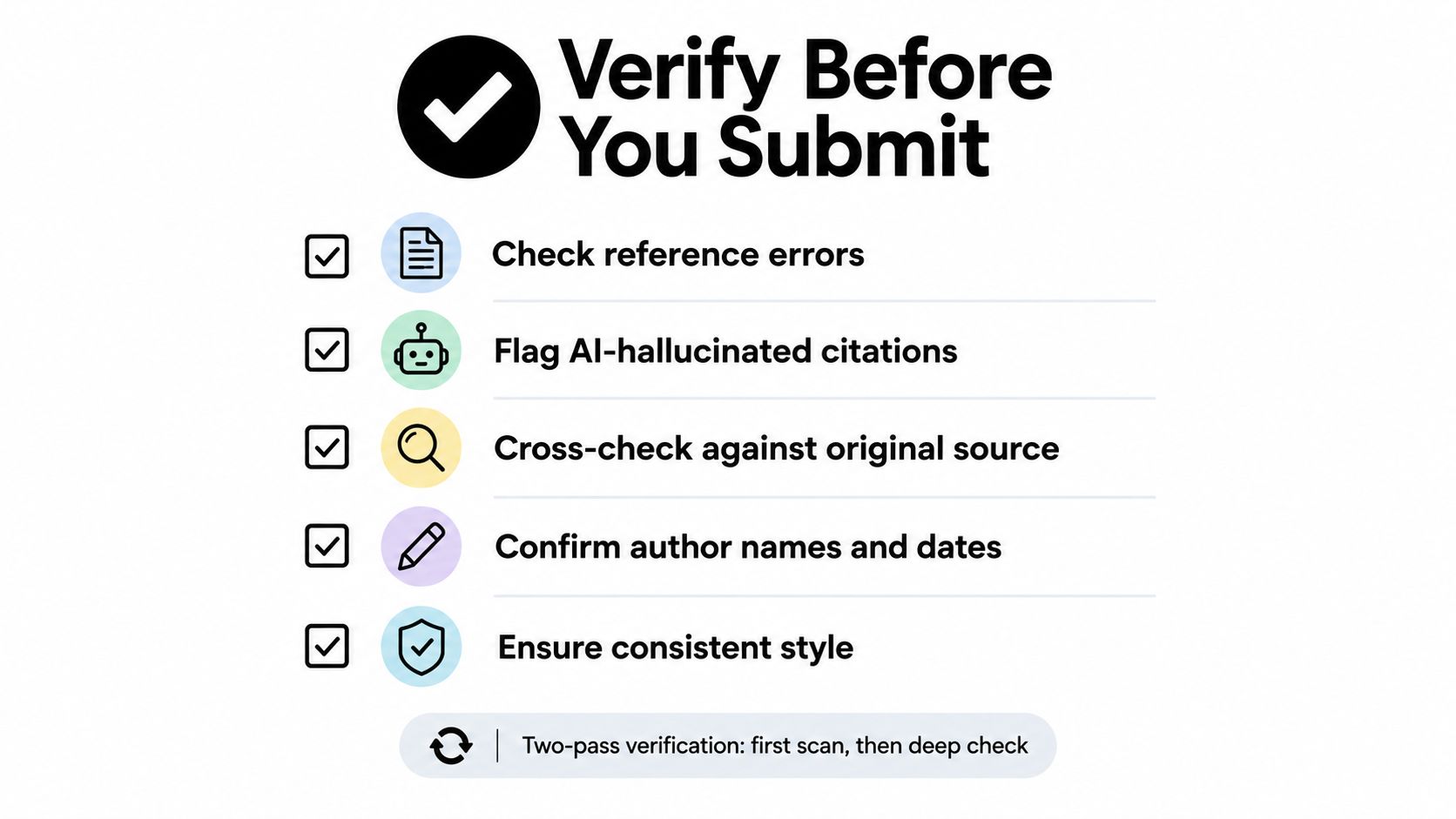
Pass one Check bibliographic identity
Compare each entry against the publisher page or Crossref record, field by field. Confirm the authors, year, article title, journal title, volume, issue, and pages or article number. Search the exact title if anything looks unfamiliar. Open the source itself, not just an abstract, and confirm it supports the precise sentence you're citing. A related habit from general source checking is to use a spot misinformation checklist when you're assessing whether a source says what a secondary summary claims it says.
Pass two Check retrieval and matching
Click every DOI and confirm it resolves to the article you intended. Remove database session URLs, which expire and often block other readers. Then reconcile the whole manuscript. List your in-text citations beside your reference entries and mark each as matched, unmatched, or duplicated. Inspect every et al. case closely, because abbreviated author lists can hide two different papers from the same year.
For a short paper, audit every reference. For a long thesis chapter, a full audit is still safest, but a careful spot check of every tenth reference can reveal systematic problems, such as a manager consistently dropping issue numbers. Fix the pattern once, then regenerate and recheck.
If a DOI doesn't resolve or a title search finds nothing, don't keep the citation and hope. Replace it with a source you can open and verify.
Understanding Discipline-Specific and Local Expectations
It's tempting to believe there's one correct way to cite and that everyone else is doing it wrong. That belief causes real trouble. A history instructor may expect Chicago footnotes so readers can follow archival detail without breaking the narrative. A psychology instructor may expect APA author-date citations so the recency of evidence is visible at a glance. Neither is more scholarly. They reflect different reading habits.
Brown University's guidance makes a helpful point here. Discussing why a discipline prefers a particular style helps students understand citation as a communication practice rather than a set of mechanical rules, as explained in Brown's inclusive practices for addressing academic integrity. The same guidance reports that nearly one-third of international students surveyed across 23 U.S. institutions wanted faculty to provide completed-assignment examples. Style rules alone often don't show what good citation looks like in a real paragraph.
Universal principles and local conventions
Separate what never changes from what varies. The universal principles are traceability, attribution, consistency, and accurate representation. Every style expects you to credit ideas, identify sources precisely, apply one system throughout, and avoid claiming a source says more than it does.
Local conventions sit on top of those principles. They include whether you use author-date citations or notes, whether URLs are required alongside DOIs, how you cite translated works, and how you handle preprints or online-first articles. A preprint isn't yet the version of record, so you should label it as your style requires and update it if the journal version appears before submission. For a translated article, follow your style's rule for naming the translator and, where required, the original publication details.
This distinction matters for multilingual writers in particular. You may follow a familiar convention correctly and still miss your instructor's expectations about page numbers for paraphrases or the treatment of non-English titles. That isn't an integrity failure. It's a mismatch between two legitimate systems, and it can be fixed by asking for an example.
- Compare sources of guidance: Read the style manual alongside departmental instructions and any supervisor examples.
- Ask specific questions: Instead of asking how citations work, ask whether DOIs are required for print articles in this course.
- Keep a local style sheet: Write down decisions for recurring cases so you apply them consistently across chapters.
Asking early is diligence, not weakness. Instructors would rather answer a two-line question in week three than correct forty references in your final draft.
Common Citation Mistakes and How to Fix Them
Most citation errors aren't mysterious. They repeat across cohorts because they happen at predictable moments, usually when you're tired, editing quickly, or trusting a tool. Work through the fixes below and you'll remove the majority of problems before your reader sees them.
- Changed author order: Copy names in the published order and never promote the author you know best to first position.
- Volume and issue confused: Check the journal header carefully. The volume is the larger sequence and the issue sits within it.
- Database session URL retained: Replace long search-session links with the DOI or a stable publisher URL.
- DOI omitted or broken: Add the DOI when one exists, and remove any full stop you have copied at the end.
- Secondary source cited as primary: Cite the work you read and make the indirect route clear in your sentence.
- Stale citations after editing: When you delete or move a paragraph, check whether its citations and entries still belong in the paper.
- Paraphrase without credit: Add a citation whenever the idea, evidence, or structure comes from a source, even in your own words.
Your final pre-submission check
Print this sequence or copy it into your notes. Confirm the required style and edition, then run a bidirectional check so every in-text citation has one matching entry and every entry is cited somewhere. Verify the bibliographic fields, click the DOIs, inspect et al. cases, and read one paragraph aloud to confirm your sentences still make sense around the citations. If you want a fuller refresher on the integrity side, this guide to avoiding plagiarism in thesis writing connects citation habits with paraphrasing and patchwriting.
If you're still unsure about a case, consult your supervisor, a librarian, or your writing center with the article open in front of you. Bring the source, your attempted citation, and the exact rule you're unsure about. You'll get a faster, more useful answer, and you'll learn the reasoning you can reuse next time. That's how citation stops feeling like a test and starts working as a skill you control.
When you're ready to keep your sources, chapters, and deadlines in one organized plan instead of rebuilding your reference list from scattered files, visit Thesis Book Project to use its thesis roadmap, chapter tracker, and source manager from proposal to submission. Start with your current paper's references, build the verification habit into your next milestone, and let a structured system carry the routine tracking while you focus on the argument.
Related Articles
Thesis Strategy and Roadmap: A Practical Guide for Students
Your submission deadline is approaching, your reading folder keeps growing, and you've worked ha...
Research MethodsLiterature Review Process: From Search to Synthesis
You're staring at a folder full of PDFs, half-finished notes, and a supervisor who wants a “clea...
Research MethodsHow to Write a Research Question: A Practical Guide
You may be staring at a topic that feels promising and impossible at the same time. The idea is inte...
Comments (0)
No comments yet. Be the first to share your thoughts.