How Long Does It Take to Write a Dissertation
How long does it take to write a dissertation? Honest timelines by degree, field, and stage, plus proven planning strategies to submit on schedule.
Dissertation writing itself usually takes 9 to 18 months of focused work for a full-time PhD candidate, while the full doctoral journey from coursework to defense typically spans 4 to 6 years. The exact pace depends on field, research type, and how many hours you can write each week.
You can feel the gap the first time you say, “I'll finish in a year.” The proposal is still changing, your data isn't ready, and a supervisor comment arrives just when you thought you were done. That's why the question isn't just how long does it take to write a dissertation, it's how long it takes to move from a topic, to research, to a defended manuscript without fooling yourself about the calendar.
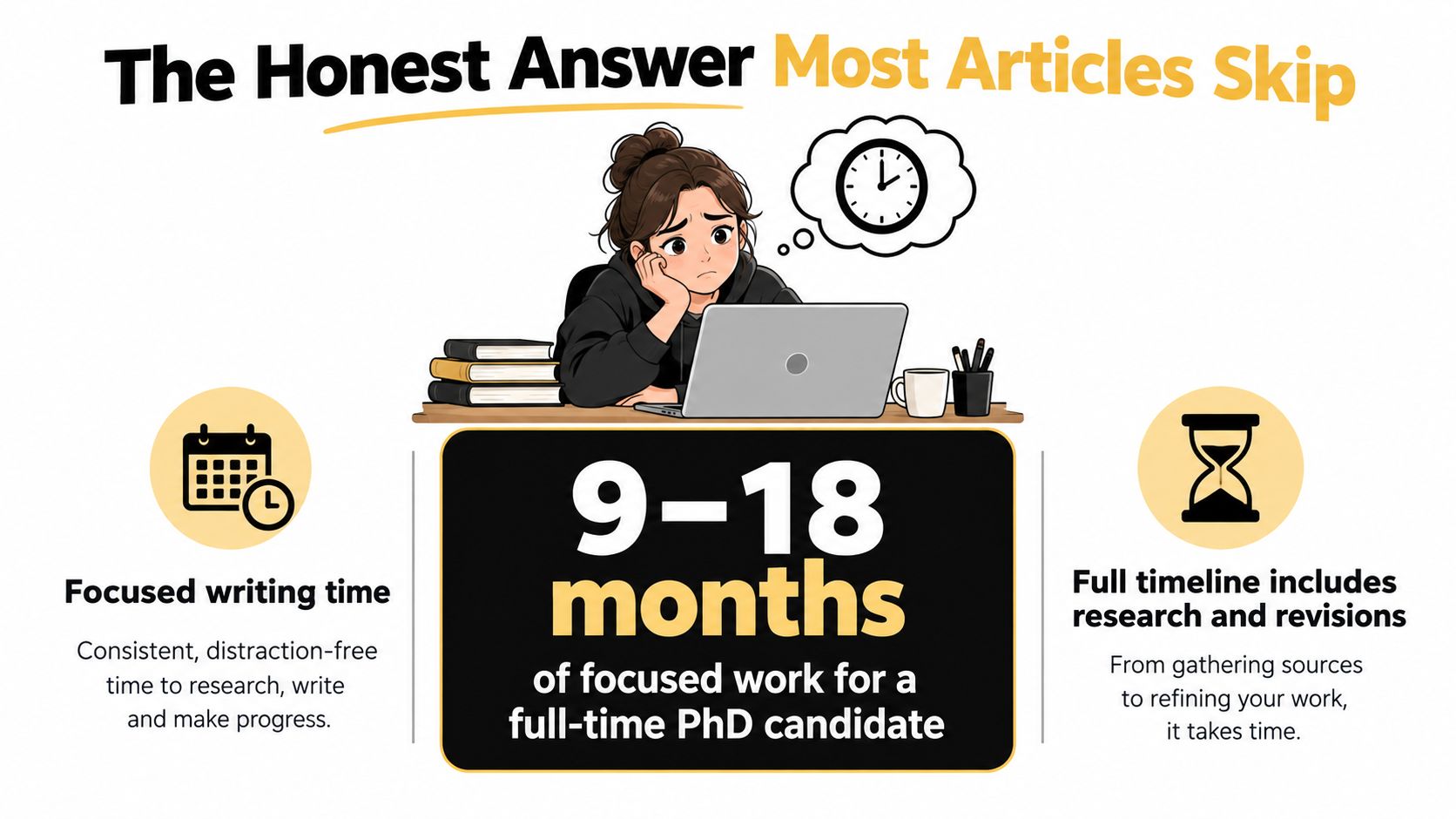
Table of Contents
- The Honest Answer Most Articles Skip
- What a Real Dissertation Timeline Looks Like
- Typical Timelines by Degree and Field
- Calculating Your Personal Writing Forecast
- Backward Planning From Your Submission Date
- How Life Circumstances Change the Estimate
- The Habits That Quietly Add Months
- Your Submission Date Planning Checklist
The Honest Answer Most Articles Skip
A student often starts with a neat estimate, maybe one year of writing, maybe one summer, maybe “just the last chapter and revisions.” Then the proposal stalls, the analysis takes longer than expected, and the draft is still waiting when the semester changes again. That's the point where generic advice stops helping and the calendar starts arguing back.
The cleaner baseline is this, dissertation writing itself usually takes 9 to 18 months of focused work for a full-time PhD candidate, but the full doctoral path usually takes 4 to 6 years once coursework, qualifying exams, research, revisions, and defense are all counted. That distinction matters because the dissertation is one phase inside a longer research doctorate, not the whole degree. NCSES also shows why simple year-counting can be misleading, it tracks time in months, counts time from different starting points, and includes periods when a student may not have been enrolled NCSES doctoral duration data.
Practical rule: if someone gives you a single number without separating research time from writing time, the estimate is probably too neat to trust.
The fastest way to get confused is to treat “writing” as if it begins on day one of the doctorate. In reality, the writing phase usually starts only after a proposal is approved or candidacy is in place, and the work before that stage can absorb a surprising amount of time. Once you separate those phases, your own forecast becomes much more believable.
What a Real Dissertation Timeline Looks Like
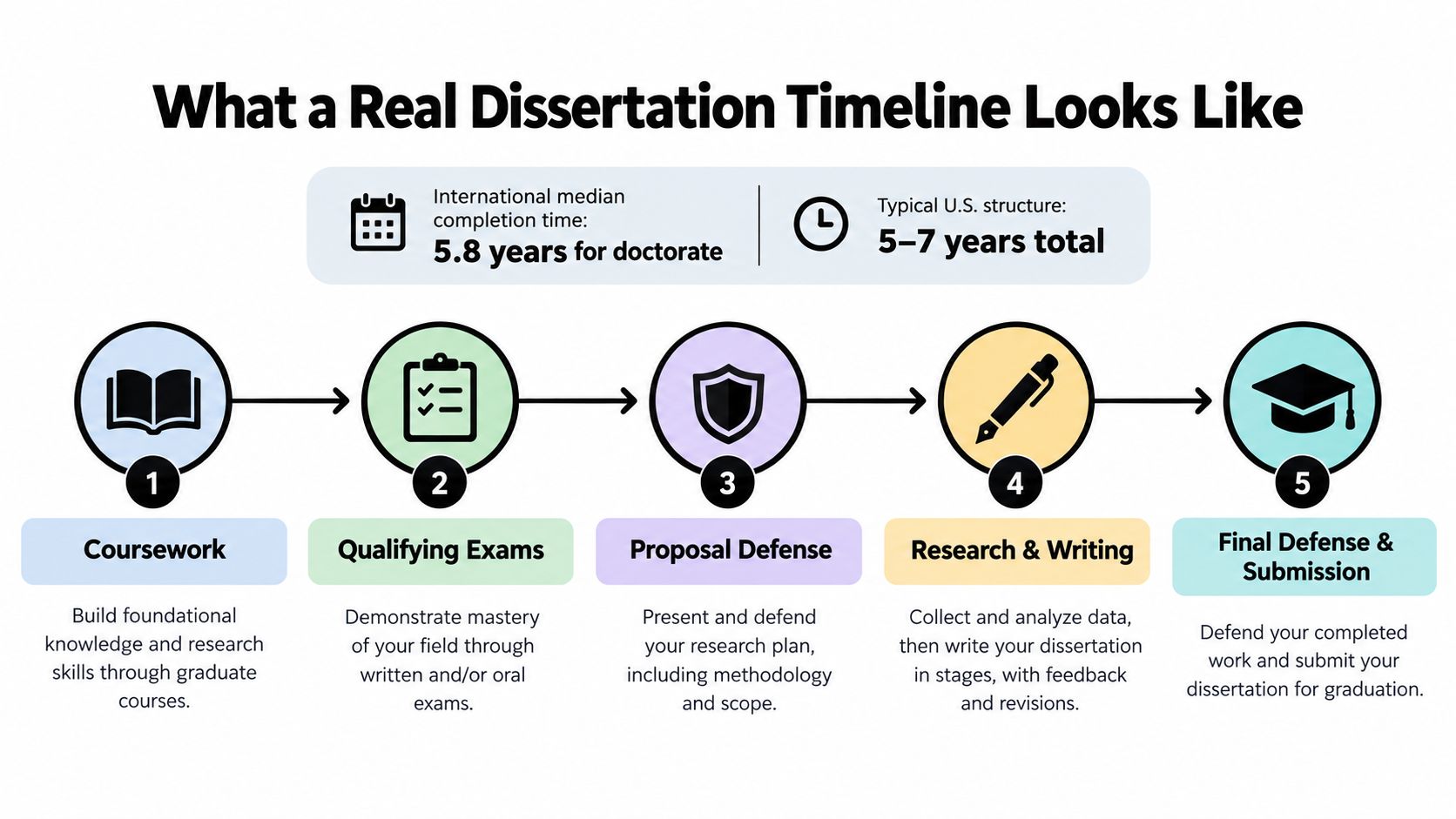
International completion data makes one thing clear, dissertations rarely follow the tidy calendar people hope for. A German Research Foundation analysis of doctorates completed in 2018 found a median duration of 51 months, about 4 years and 3 months, measured to the oral doctoral examination DFG doctoral duration analysis. That's not a writing sprint, it's a long sequence of academic gates.
The dissertation is a chain, not a block
A typical doctoral path moves through coursework, qualifying exams, proposal approval, data collection, analysis, drafting, defense, and revisions. If the research is empirical, a late ethics review or slow recruitment pushes the writing back. If the project depends on archives, lab access, or human-participant approval, the writing can't move cleanly ahead of the research.
The same logic appears in U.S. doctoral structures, where coursework and qualifying examinations often come before the dissertation stage, and where institutional timelines stretch over several years rather than a single writing period U.S. doctoral timing and structure. The practical lesson is simple, later chapters depend on earlier decisions. If the methods are still changing, the results chapter can't settle. If the results aren't settled, the discussion stays provisional.
That's why I ask students to stop thinking in terms of one big writing phase and start thinking in terms of dependent gates. Proposal approved. Data complete. Analysis locked. First draft done. Revisions finished. Defense scheduled. Each gate has to open before the next one can close.
If you want a clear starting point for proposal stage planning, this dissertation proposal guide gives the kind of structure that helps prevent the rest of the timeline from drifting.
Typical Timelines by Degree and Field
The phrase “dissertation” hides a lot of variation. A humanities project built on archival reading and argument may move differently from a lab-based science dissertation, and both differ from the kind of undergraduate or master's dissertation that is shaped by shorter program expectations. So the useful comparison isn't only how long does it take to write a dissertation, it's what kind of dissertation you mean.
| Degree and Field | Typical Writing Phase | Main Driver of Variation |
|---|---|---|
| Undergraduate dissertation | Shorter, often measured in months | Smaller scope, tighter word count, more supervision |
| Master's dissertation | Moderate, usually a single academic cycle | Research design, access to sources, and university deadlines |
| PhD in the humanities | Often longer drafting and revision cycles | Argument development, chapter structure, and archival depth |
| PhD in the sciences | Often slower in the research phase, then faster drafting | Experiments, data validation, and lab or field logistics |
| Professional doctorate | Variable, depending on applied research structure | Program rules, workplace access, and practitioner demands |
The pattern behind the table is more important than the labels. Humanities students may spend more time turning ideas into a tight argument. Science students may spend more time waiting on data, but once the evidence is stable, the chapter structure can move quickly. Professional doctorates add another layer, because work-based research depends on access, scheduling, and institutional approval outside the university.
A good way to think about it is this, the same word count can represent very different workloads. A chapter built on interviews, a chapter built on lab results, and a chapter built on close textual analysis all ask for different kinds of time. That's why fixed “one size fits all” estimates fail so often.
Calculating Your Personal Writing Forecast
A personal forecast begins with the hours you can protect each week. One academic writing resource gives a range of 10 to 50 hours for weekly writing and suggests that an average chapter may take roughly three months writing time and scheduling. Treat those figures as reference points, then replace them with your own working capacity.

Start with chapters, not feelings
Count the chapters or major sections that remain. Give each one a time allowance based on your actual week. A student with two quiet mornings has a different writing capacity from someone with a full-time fellowship. An ambitious estimate does not create extra hours.
Use this model:
- List the remaining chapters or major sections.
- Estimate the writing hours you can protect each week.
- Add time for feedback and revision after every draft.
- Convert the total into calendar months.
For example, multiply your available weekly hours by the weeks you can sustain, then compare that capacity with the work remaining across your chapters. Add a revision allowance before treating the result as a submission forecast. A chapter can look complete on the page while still needing restructuring, supervisor feedback, citations, and proofreading.
Drafting speed and submission readiness are separate measures. Pages produced show progress, but they do not show whether the argument holds together or whether your supervisor has reviewed it. When you record video notes for chapters, check caption accuracy pitfalls to avoid before sharing transcripts or draft material.
A time-management guide for PhD students can help you test whether your weekly estimate fits your other commitments.
A steady two-hour writing block each day usually beats waiting for one perfect free weekend. Repeated contact with the argument keeps drafting active and exposes problems earlier. Add your protected weekly hours and revision allowance to the chapter list to convert the total into calendar months.
Backward Planning From Your Submission Date
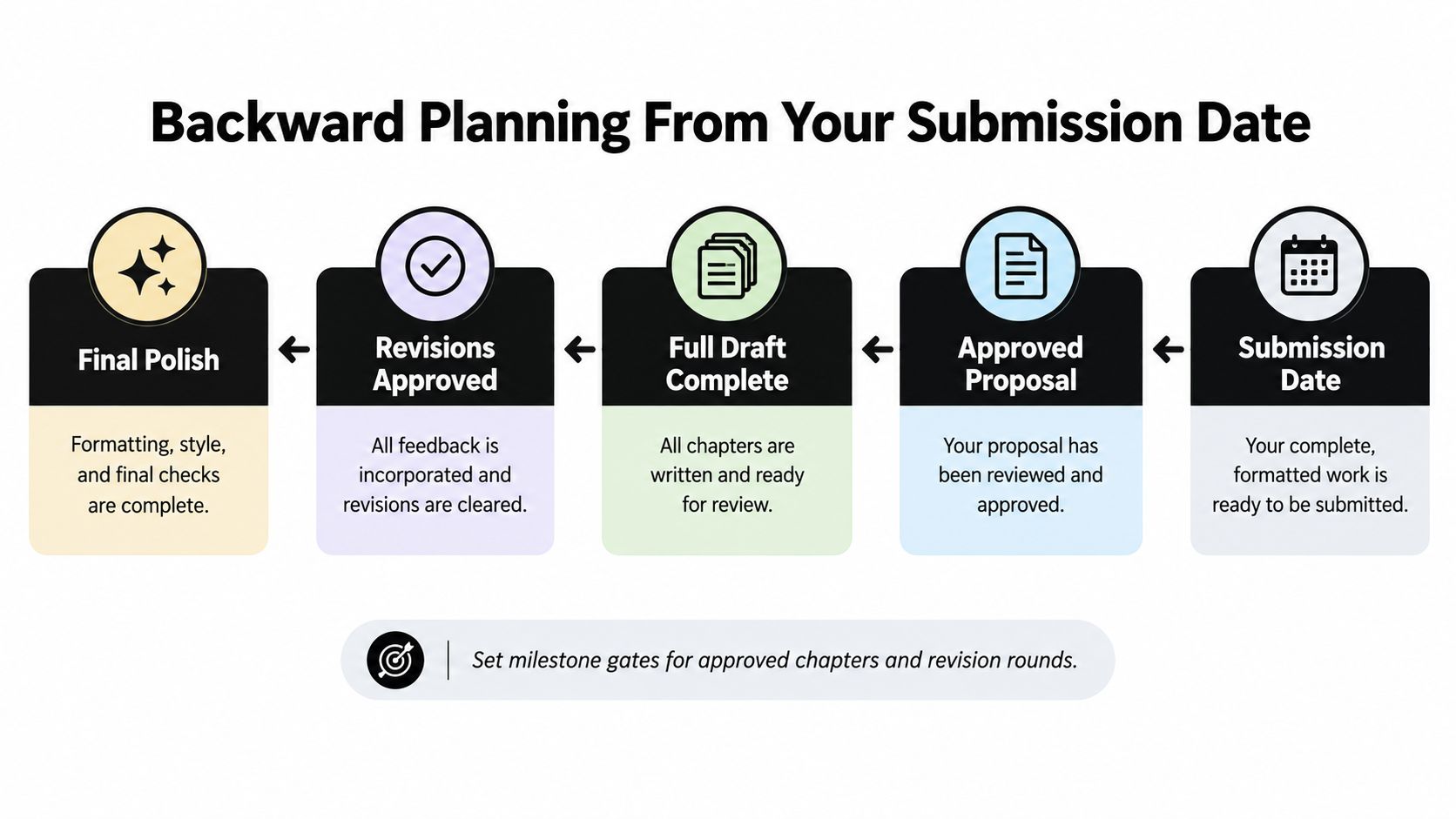
A fixed submission date only works if you build backward from it. If you begin with “I want to submit in June,” then the schedule has to include approved proposal, completed dataset, locked analysis, complete first draft, supervisor revisions, formatting, and defense. Leaving out any of those gates is how optimistic plans collapse.
Build the schedule from the end point
Start with the submission date and mark the final polish window first. Then work one step back to revisions, then to the complete draft, then to analysis, then to the proposal and data milestones. That order matters because each earlier stage determines whether the later stage is even possible.
Backward planning works because it forces dependencies into the open. A draft date that ignores data collection is not a plan, it's a wish.
A simple rule helps here, never schedule isolated writing time without slack for upstream work. If your analysis is late, the results chapter slips. If the results chapter slips, the discussion slips. If supervisor feedback takes longer than expected, every following gate shifts too.
The most useful schedules name each gate clearly. Approved chapter outline. Full draft sent. Comments returned. Revision round completed. Final formatting checked. Defense date confirmed. When those gates are visible, you can see where your timeline is realistic and where it is just optimistic.
How Life Circumstances Change the Estimate
A dissertation timeline changes when life outside research claims time. Paid work, teaching, family care, childcare, illness, and mental-health strain can slow progress, and doctoral research links these conditions with longer completion times and lower completion likelihood life circumstances and doctoral timing. This is not evidence of failure. It is a reason to base a writing forecast on available hours, not on a full-time ideal.
Risk-adjusted planning is more honest
Risk-adjusted planning starts with a baseline, then adds room for interruption. A student working part time or caring for children may have fewer dependable writing hours each week. Slow supervisor responses create another delay between submission and revision. Health problems may require protected, shorter writing windows that can survive a difficult week.
A four-year full-time target also deserves caution. Older UK cohort data has reported high rates of doctoral students finishing later than the expected four-year full-time period or its part-time equivalent. That pattern makes lateness a structural possibility, not a moral verdict. Research has to fit inside lives that do not pause.
Test the schedule against a disrupted month. If one illness, care demand, or delayed response destroys the submission date, the forecast has no recovery capacity. Add time before the pressure arrives, rather than treating every open week as writing time.
The Habits That Quietly Add Months
Three habits add time without looking dramatic at first. Perfectionism, scope creep, and supervisor silence all slow dissertation work in different ways, and each one needs a specific response.
Finish the rough draft before polishing
Perfectionism is the habit of revising a paragraph before the chapter exists. The fix is to separate drafting from editing and to keep the rough draft moving until the whole section is complete. That approach is harder emotionally, but it protects momentum.
Tie every new idea back to the research question
Scope creep starts when a promising side topic gets treated like a must-have chapter. If a new idea does not answer the central research question, it belongs in a note file, not in the outline. That discipline keeps the dissertation from expanding every time you learn something interesting.
Make supervisor contact predictable
Supervisor silence often becomes a hidden delay because students wait too long to ask for feedback. Scheduled check-ins and shareable progress views keep meetings focused on blockers, not catch-up. A clear tracker also makes it easier to see where the draft is stalled before the delay gets expensive.
If you want a concise reminder of the traps that slow completion, common mistakes that delay thesis submission is worth keeping open while you work.
Your Submission Date Planning Checklist
Before you pick a date, write down your approved proposal date, your draft chapters, your weekly writing hours, and the next feedback checkpoint. Then work backward from submission and add buffer time for analysis, revisions, and formatting. If you want a system that can hold all of that in one place, use a timeline tool, a chapter tracker, and a reminder system together.
- Map the gates: proposal, data, draft, revisions, defense.
- Count your chapters or sections.
- Set your weekly writing capacity in hours, not in good intentions.
- Add contingency time for work, health, or family disruption.
- Review progress every week, not only when panic starts.
If you do those five things this week, you'll have a much more defensible answer to how long does it take to write a dissertation, and it'll be your answer, not someone else's generic estimate.
Thesis Book Project helps students turn a dissertation into a tracked sequence of chapters, milestones, and deadlines instead of a vague long-term goal. If you want a practical roadmap for planning backward from submission, visit Thesis Book Project and see how the timeline and chapter tracking tools can support your draft through revision.
Related Articles
Literature Review Introduction Example: 6 Annotated Models
A weak literature review introduction does more than look unpolished. It changes how examiners read...
Thesis WritingWhat Is a Dissertation Abstract? a Simple Guide
A dissertation abstract is a 200 to 300 word self-contained summary that compresses your problem, me...
Thesis WritingLiterature Review Table: Templates and Examples
You can have a folder full of PDFs, a half-finished chapter, and still not know what the literature...
Comments (0)
No comments yet. Be the first to share your thoughts.