How to Prepare for a Dissertation Defense: Full Roadmap
Learn how to prepare for a dissertation defense with a practical roadmap covering scheduling, slides, mock questions, logistics, revisions, and submission.
You've polished the slides, practiced the opening, and can explain your main finding. Then you check the graduate school's instructions and discover that the committee needs the dissertation earlier than you expected, the final submission has a separate deadline, and the defense may lead to required corrections. The presentation is ready, but the project around it isn't.
That's why how to prepare for a dissertation defense means planning more than a talk. You need to manage the manuscript, committee review, rehearsal, defense-day procedures, corrections, and final submission as connected stages. Strong preparation gives you time to explain your work clearly and respond when an examiner raises something you haven't rehearsed.
Table of Contents
- Why Defense Preparation Starts Before Slide Design
- Build a Backward Defense Preparation Timeline
- Turn the Dissertation Into a Clear Defense Story
- Prepare for Difficult Examiner Questions
- Run Mock Defenses and Focused Supervisor Check-Ins
- Verify Defense Rules Logistics and Technical Rehearsal
- Complete the Final Defense and Submission Checklist
Why Defense Preparation Starts Before Slide Design
A candidate can spend days refining a slide deck and still be unprepared for the defense. Slides don't tell you when committee members need the manuscript, whether a form must be filed before the oral examination, or who approves corrections afterward. Those are parts of the same academic project, and ignoring them can turn a manageable final stretch into a scramble.
A dissertation defense is better treated as a staged process: writing and revision, committee review, rehearsal, oral examination, correction, and final submission. Institutional deadlines make the sequence concrete. The University of South Carolina requires a proposal to reach the committee at least two weeks before its defense. The University of Georgia requires the dissertation to reach the advisory committee at least five weeks before the final submission deadline, with the oral defense at least one week before the final copy is due. Augusta University's preparation booklet sets out a longer sequence, with the draft going to the major advisor nine weeks before the final oral examination, to the advisory committee five weeks before, and required faculty agreements submitted two weeks beforehand.
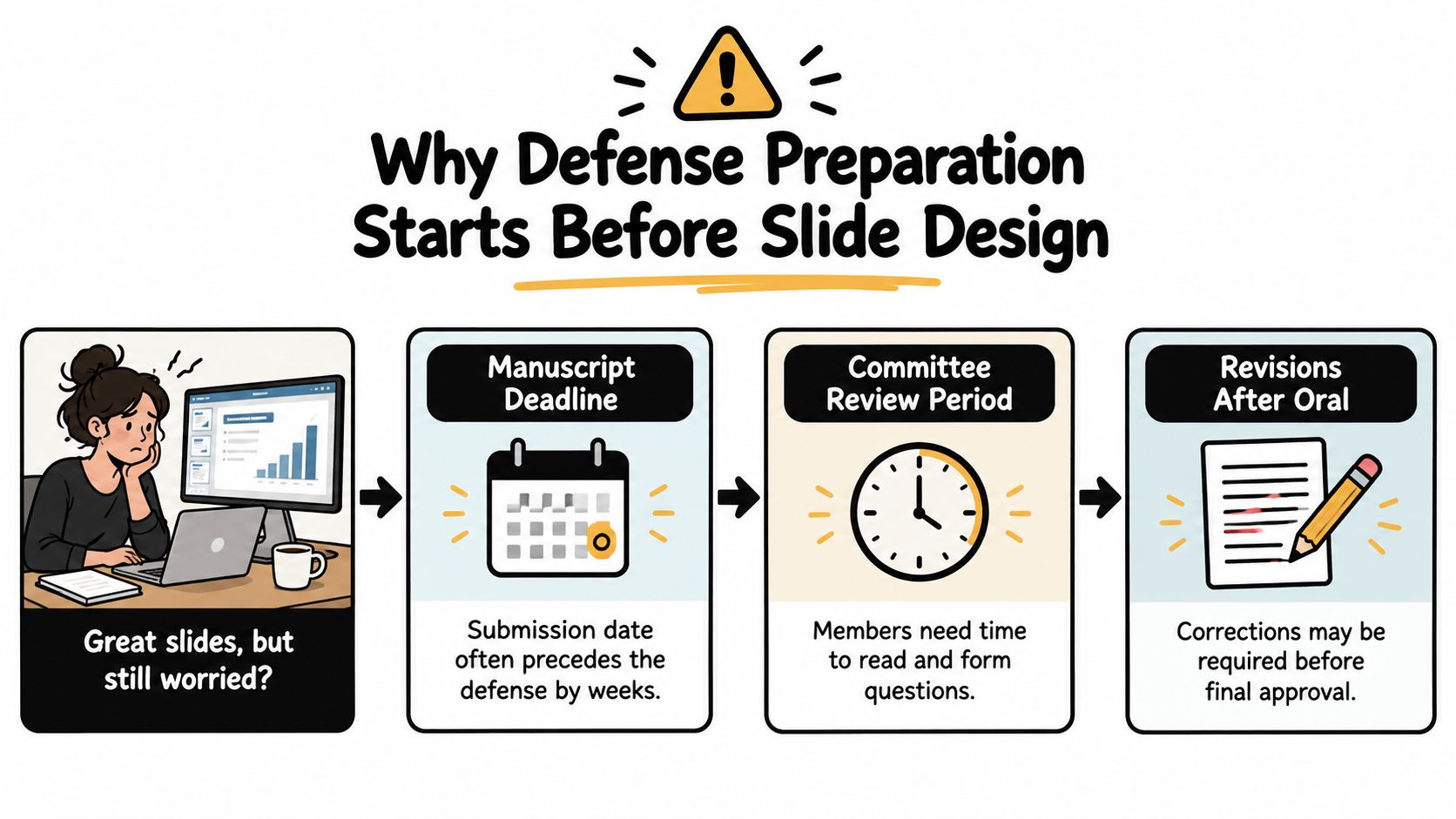
This sequence has two sides. Intellectual preparation means understanding your question, methods, findings, contribution, and limitations well enough to discuss them without relying on a memorized script. Procedural preparation means confirming the institution's requirements, committee arrangements, paperwork, presentation format, and submission process. You need both. A candidate may know the research inside out and still lose time to an avoidable administrative problem.
Make a simple list of what must happen, who is responsible, and what depends on something else. Then plan backward from the dates your department confirms. If nerves are already distracting you from this work, use a practical resource on how to calm nerves before a speech, and pair it with rehearsal that reflects your actual defense. A clear sequence won't remove every surprise, but it will protect time for careful scholarship instead of last-minute rescue work.
Build a Backward Defense Preparation Timeline
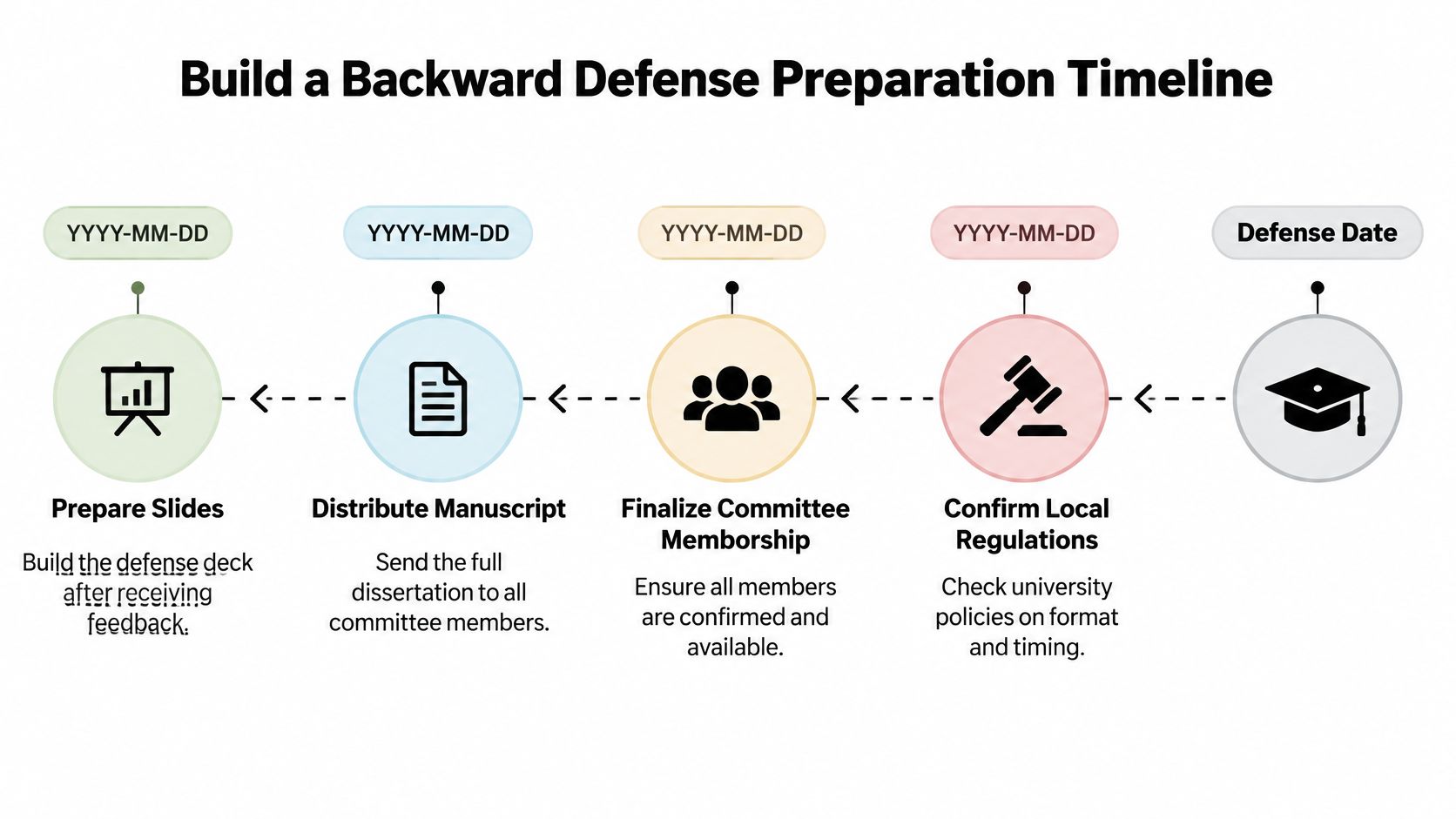
Don't start by asking, “When should I make my slides?” Start with the fixed dates: the oral examination, the final dissertation submission, and any earlier deadline for sending the manuscript to examiners. Then ask your graduate office and supervisor to confirm what the rules mean for your specific defense. Policies differ, and a date that works for a presentation may not leave enough time for committee review or required revisions.
The timeline should distinguish time you need to revise from time your committee needs to read. These are different tasks. If you use the committee's review period as your own final editing window, you're asking examiners to assess a document that may still change substantially.
Confirm the rules before assigning dates
Write down the defense date and final-copy deadline first. Then verify the manuscript distribution date, committee membership, presentation length, required forms, format rules, and who signs off on the final version. Don't rely on what a student in another department remembers; ask the office responsible for your degree requirements and get important instructions in writing.
Use the University of South Carolina, University of Georgia, and Augusta University schedules as evidence that formal lead times can be substantial, not as a template for your own program. Their requirements differ, so your department's rules must determine your calendar. This guide to building a thesis and dissertation roadmap can help you think through how separate work stages fit together, but it doesn't replace local regulations.
Turn fixed dates into working milestones
Once you've confirmed the rules, assign a date to each dependency. Give yourself a defined period to revise the complete manuscript before sending it to the committee. Allow examiners the required reading time. Reserve separate sessions for a complete reread, presentation preparation, spoken rehearsal, and technical checks. Keep post-defense corrections and final submission visible on the same plan rather than treating them as an afterthought.
A chapter tracker makes the plan more useful than a calendar full of broad labels. For each chapter, record whether it's structurally complete, fully drafted, under review, revised, or ready for final formatting. Add the next action beside each status. “Discussion incomplete” is too vague to manage; “revise the alternative interpretation paragraph in the discussion” tells you what to do next.
Practical rule: If a task has no owner, no date, or no clear definition of done, it isn't a reliable milestone.
Review the plan with your supervisor before the final stretch. If a chapter is behind, decide whether it needs substantive revision or a limited correction. Don't reopen settled sections without a reason. A visible schedule helps you spot risks while you can still respond, instead of discovering them when there's no room left to make a thoughtful change.
Turn the Dissertation Into a Clear Defense Story
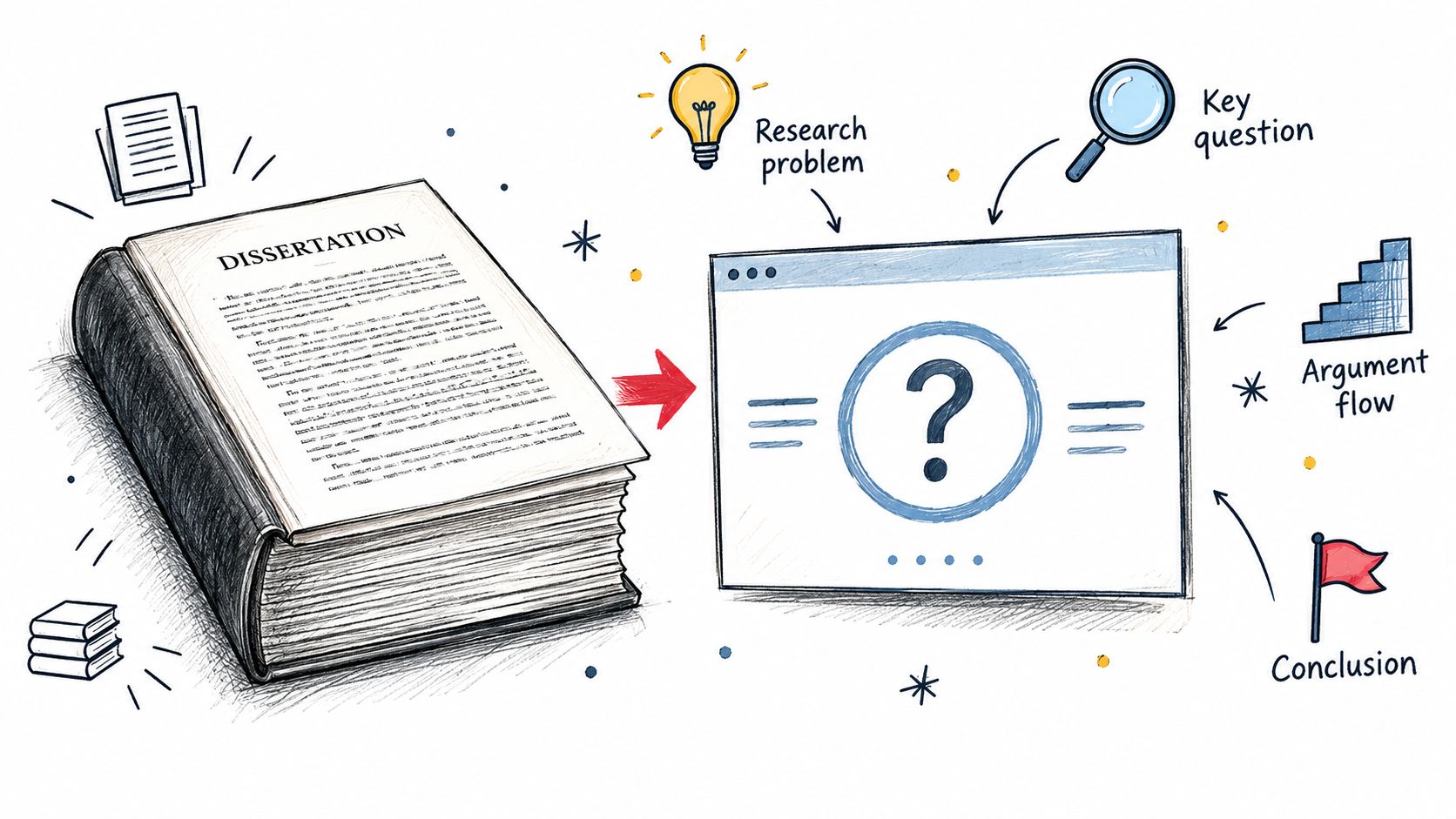
Your presentation isn't a smaller copy of your dissertation. It's a guided argument: here's the research problem, here's how I investigated it, here's what the evidence supports, and here's what the work contributes. The committee can read the manuscript. Your task in the room is to make the logic easy to follow and give examiners a sound basis for discussion.
Build the argument, not a chapter-by-chapter recap
Start with the problem and research question. Establish the conceptual framework only to the extent that it helps the audience understand your choices. Explain the methods, present the principal findings, then state the contribution, limitations, and conclusion. Follow your department's presentation length and format rather than borrowing a slide count from a generic guide.
Give each slide a job. A methods slide should help the committee understand what you did and why; a findings slide should make a result and its relevance legible. If you're explaining participant perceptions, don't leave the headline at “Participants had varied views.” State the specific pattern your analysis supports, then point to the relevant theme, excerpt, or analysis in the dissertation. That lets listeners see the connection between the evidence and the claim.
A useful editing test is to ask: What should an examiner remember from this slide, and where can they find its support in the manuscript? If you can't answer both, revise the slide or remove it. Keep the narrative direct, and use transitions to explain why the next part follows from the previous one. A chapter-by-chapter dissertation outline can help you locate the core logic; this chapter-by-chapter guide to dissertation structure can also help you distinguish the manuscript's structure from the presentation's argument.
Connect claims to evidence
For every main claim, make a private evidence map. Note the chapter, figure, table, result, or source that supports it. This isn't busywork. It shows where your argument is solid, where a slide may overstate the findings, and which details you should be ready to retrieve in discussion.
Build backup slides for details that matter but would slow the main narrative: definitions, methodological decisions, data summaries, supplementary results, or an alternative analysis already addressed in your work. Use them to answer follow-up questions, not to sneak in a new claim that the dissertation can't support.
Before the defense, rehearse the presentation aloud in the allotted format. A slide deck that reads well on your laptop may be dense on a room display, and a concise sentence may sound confusing when spoken. The short video below can offer another perspective on shaping your presentation.
Prepare for Difficult Examiner Questions
A question you can't answer instantly isn't proof that you've failed to prepare. The actual problem is pretending that every question has a neat answer in the dissertation. Examiners may ask for a direct explanation, invite an inference beyond your evidence, or expose a boundary your study can't resolve. Treat those situations differently.
The key is calibrated judgment: make the strongest claim your evidence supports, and no stronger. A defense isn't a quiz in which confidence can substitute for a defensible answer.
Classify the question before answering
If the dissertation answers the question directly, state the answer and identify its support. For example, if an examiner asks why you selected a particular method, explain the research question it addressed and where the dissertation describes that decision. Keep your response focused. You don't need to recite an entire chapter to demonstrate command of it.
If the question asks you to infer beyond what the study directly establishes, name that boundary before explaining your reasoning. An examiner might ask whether a pattern in your findings would hold in a different setting. You can explain what the evidence suggests, clarify what your design can't establish, and identify the kind of further inquiry that would test the possibility. Don't turn a plausible interpretation into a reported result.
When a question identifies a genuine limitation, acknowledge it plainly. In qualitative work, an examiner might ask how researcher positionality shaped interpretation or whether findings transfer to another context. In other fields, the challenge may concern assumptions, alternative explanations, or the scope of a conclusion. State what your study can support, what remains uncertain, and the smallest defensible next step. That may mean additional data, a different comparison, or a clearer qualification of your claim, not an improvised answer.
This overview of the methodology chapter can help you organize the reasoning behind research-design choices before examiners probe them.
Listen, pause, and recover
Use a simple response sequence: claim, evidence, boundary, next step. The order can change if the question calls for it, but the discipline matters. “The data support this interpretation because of the pattern described in the findings chapter. They don't establish that the same mechanism operates in every setting. A comparative study would be needed to examine that.” That answer is more credible than either bluffing or apologizing for work that has a clear scope.
If an examiner interrupts, stop and listen. Don't fight to finish the sentence you prepared. Ask for clarification if the question is ambiguous, or briefly restate what you think they're asking before you answer. A pause gives you time to identify the actual issue rather than reacting to the tone of the question.
A sharp question can sound hostile even when the examiner is testing an assumption. Respond to the substance. If you don't know, say so, then explain what evidence you'd need to answer responsibly. Mock defenses should include unfamiliar questions, alternative interpretations, and prompts from outside your strongest chapter. Rehearsing uncertainty is more useful than memorizing polished responses that collapse when the question changes.
Run Mock Defenses and Focused Supervisor Check-Ins
A friendly conversation with your supervisor can reassure you, but it isn't the same as an examination. Use different rehearsals for different purposes: supervisor check-ins to resolve decisions and expose problems, peer sessions to test whether your story is clear to listeners, and a formal mock defense to practice the actual questioning format.
A 2022 study of doctoral-defense preparation reported that candidates regarded a mock defense as the most effective intervention, followed by a preparatory course, and emphasized the importance of understanding the defense format. The study reported outcomes of 68.5% passing, 28.0% receiving minor corrections, and 3.5% receiving major corrections. These figures describe that study's participants, not a universal pass rate. Defense rules and the meaning of each outcome vary across institutions and disciplines. The results are still a useful reminder that preparation should cover both examination and correction. The study on doctoral-defense preparation supports treating rehearsal as a central part of the process, not a final polish.
Give each rehearsal a clear job
Ask mock participants to challenge your research question, theoretical framework, methods, evidence, limitations, and claims of originality. Have them follow the format your department uses. If your defense includes an open presentation followed by private questioning, rehearse that transition. If it's a viva or online examination, practice the corresponding interaction instead of borrowing a format that doesn't apply.
After each session, record questions you couldn't answer clearly, weak transitions, claims without an obvious evidence link, and revisions that participants requested. Sort those notes into tasks, not general impressions. “Clarify why these cases answer the research question” is actionable; “make methods stronger” isn't.
Turn feedback into a specific revision
Suppose a peer asks how your analysis connects to the research question, and you find that your methods slide lists procedures but never explains why they fit the question. Don't respond by adding every methodological detail to the main deck. Rewrite the slide to make the connection explicit, prepare supporting detail in a backup slide, and ask your supervisor whether the explanation matches the dissertation.
Use a shared progress view or written checklist when you meet your supervisor. Bring the unresolved questions, the decisions you need, and the next action for each item. That keeps the conversation focused and lets your supervisor respond to the actual problem instead of reconstructing your progress from memory.
A formal mock defense should leave you with a short revision list and a clear plan for what you'll rehearse next. Don't keep repeating the whole presentation without incorporating feedback. Rehearsal is useful when it changes what you understand, what you say, or how you respond.
Verify Defense Rules Logistics and Technical Rehearsal
A defense can be intellectually rigorous and procedurally unfamiliar. Don't assume a viva, a public seminar followed by closed questioning, and a hybrid examination work alike. Your local rules determine who attends, who asks questions, how the committee reaches its decision, and what happens after the oral examination.
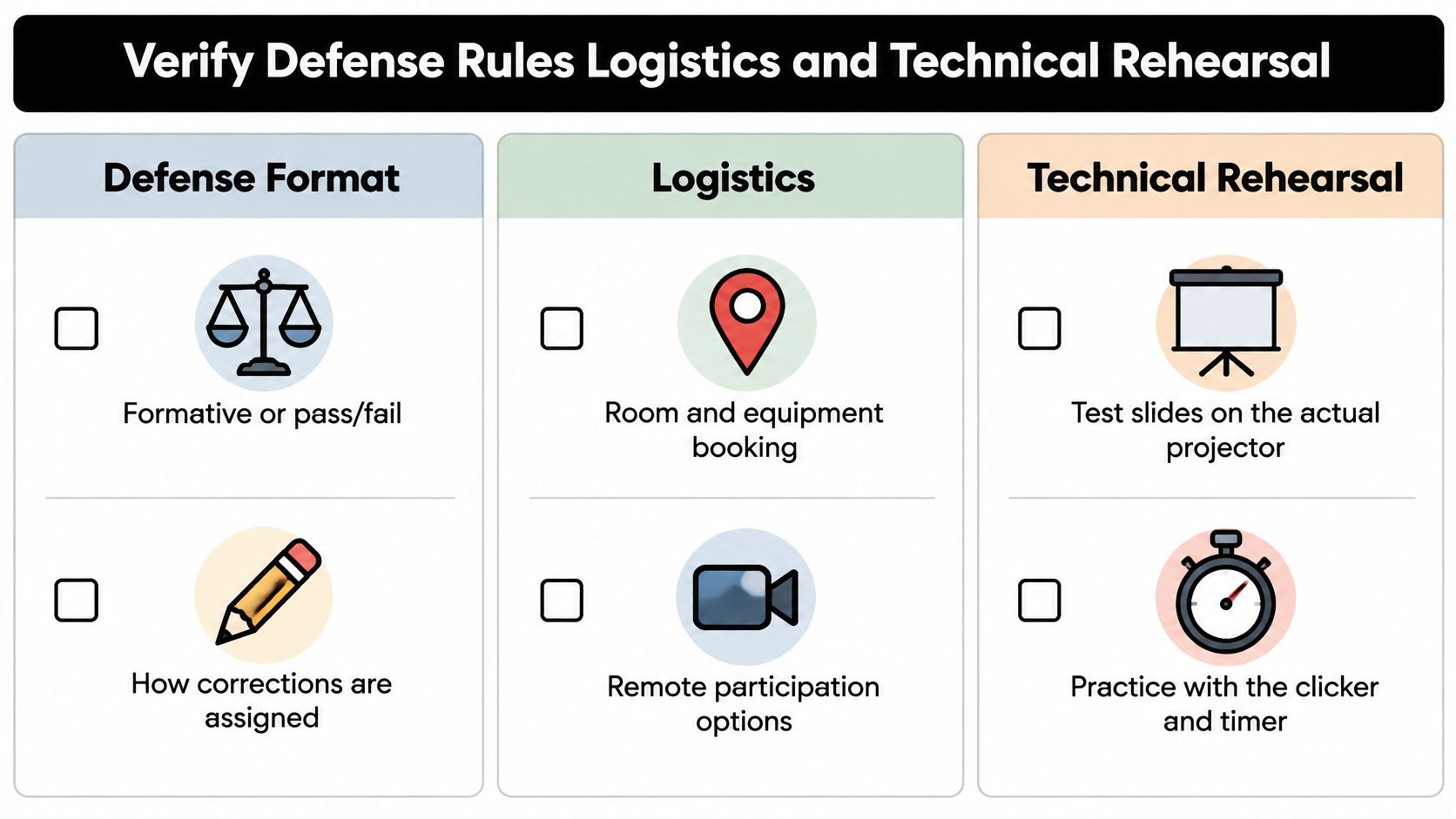
Confirm what the defense will ask of you
Read your institution's regulations and ask the graduate office or supervisor to clarify anything that's unclear. Speak with recent graduates from your department, too. They can describe how the published rules worked in practice, but treat their experience as a guide to questions, not a substitute for current instructions. The University of Rochester's PhD defense guidance is a reminder to verify local expectations rather than assume a universal procedure.
Confirm whether your defense is formative or pass/fail, whether the event is public or closed, how corrections are assigned, and who may ask questions. Ask how interruptions are handled, whether remote participants can speak, and what happens if a connection or other essential technology fails. Check committee availability, document format, forms, presentation timing, and the sequence for final approval.
Test the actual setup
Reserve or confirm the room and equipment, or check access to the online platform. Test the slide file on the display system you'll use, confirm fonts and figures appear correctly, and make sure you can open your backup material. If the defense is online or hybrid, test the camera, microphone, screen sharing, and the process for remote examiners to join the discussion. Keep a backup file available in a format your institution accepts.
Check the practical details that are easy to overlook: the final file version, room access, microphone placement, lighting, and a printed copy if it will help you handle the dissertation or is required. Confirm the committee's attendance and the route from presentation to questions, including who will manage the transition.
Finish with a full technical rehearsal. Open the exact presentation file, test the clicker and timer, deliver the opening, move through the slides, and practice switching to a backup slide when a question calls for it. Then rehearse the transition into questioning. You should be testing the procedure as well as the equipment.
Complete the Final Defense and Submission Checklist
In the final stretch, protect your attention. Don't spend your last preparation time making cosmetic slide changes while the approved manuscript, room, forms, or final submission process remain uncertain. Check the essentials, then rehearse enough to feel fluent without trying to memorize every sentence.
Before the defense
Use a short, prioritized check rather than relying on memory:
- Manuscript: Confirm that the committee has the correct version and that you have a clean copy you can work with.
- Presentation: Verify the final slide file, backup materials, display compatibility, and presentation timing.
- People and place: Confirm the committee details, schedule, room or online link, and access arrangements.
- Paperwork: Check that required forms are filed and that you know who must approve the final dissertation.
- Recovery plan: If a difficult question unsettles you, pause, identify the issue, answer only what the evidence supports, and offer a considered follow-up when appropriate.
After the oral examination
Write down the committee's decision and every required correction while the discussion is fresh. Record who is responsible, who must review each change, and the relevant deadline. Ask for clarification if a request is ambiguous, and confirm the department's sequence for revisions, formatting approval, signatures, and final submission.
Separate substantive revisions from formatting corrections. A change to an interpretation or argument may need supervisor or committee review; a pagination or layout fix may follow a different approval process. Don't treat all comments as equal or start editing from scattered notes. Turn them into an ordered task list and check each item against the written instructions.
After submission, keep the final approved version, the supporting evidence for your revisions, and the administrative records together. A successful defense matters, but it doesn't complete the degree until the institution accepts the final copy and required paperwork. Protect time for that last handoff.
Thesis Book Project offers a guided roadmap, chapter tracking, milestone scheduling, and progress views to help you manage the work from planning through submission. If you want a clearer way to organize your dissertation tasks and prepare for the defense, visit Thesis Book Project and build a plan around your department's deadlines.
Related Articles
Footnotes Examples MLA: Formatting Rules and Templates
You're halfway through a literature chapter, the sentence is already crowded, and your cursor is...
Thesis Writing7 Chapter Outline Example Templates for Theses
Why does a template that works perfectly for a nursing doctorate fail a history PhD or a software en...
Thesis Writing10 Best Progress Tracker Online Tools for Theses
A thesis can look well underway and still be difficult to manage. You've finished the research,...
Comments (0)
No comments yet. Be the first to share your thoughts.