8 Types of Conflicts in Academic Research and Thesis Work
Explore 8 types of conflicts in thesis work, from task and role conflict to intrapersonal struggles, with research examples and writing tips.
A supervisor meeting can stall for weeks when you and your supervisor are arguing about different problems. You may think the research question is unsettled; your supervisor may think the method is sound but the chapter schedule is slipping. If neither of you names the disagreement, the next meeting can repeat the same frustration without moving the thesis forward.
Conflict in thesis work isn't automatically harmful. A debate about how to interpret evidence can sharpen an argument, while tension about communication or competing deadlines can make progress harder. The problem is treating every disagreement as if it needs the same solution.
These types of conflicts offer a practical diagnostic lens. They help you tell whether the issue is about research content, values, workload, resources, or your own motivation, then connect it to decisions about topic selection, methodology, literature review framing, milestones, and supervisor expectations. Start by identifying the decision or relationship that's stuck. Then choose a response suited to that problem, using evidence-based techniques for managing disagreements when discussion alone isn't enough.
Table of Contents
- 1. Task Conflict
- 2. Relationship Conflict
- 3. Process Conflict
- 4. Value Conflict
- 5. Role Conflict
- 6. Resource Conflict
- 7. Intergroup Conflict
- 8. Intrapersonal Approach-Avoidance Conflict
- How the 8 Conflict Types Compare in a Thesis Context
- Turning Conflict Types Into a Clearer Thesis Plan
1. Task Conflict
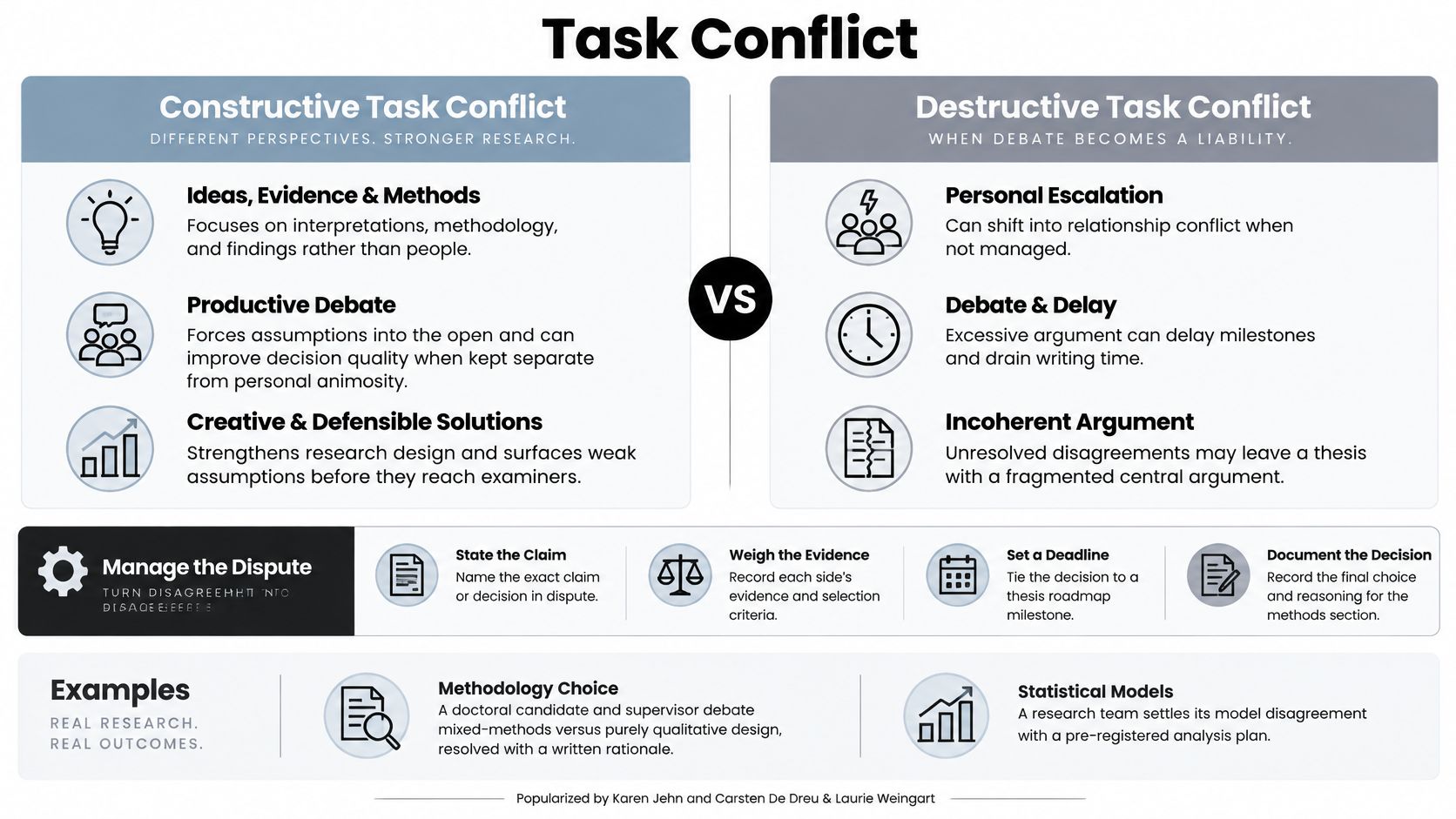
Task conflict is a disagreement about the research itself. You and your supervisor might interpret an interview differently, disagree about which statistical model fits the question, or argue over whether a chapter makes a defensible claim. It can be useful because it forces each person to explain the assumptions behind a research decision. It becomes damaging when criticism of an idea turns into criticism of the person presenting it.
Say you're deciding between a qualitative design and a mixed-methods approach. Instead of asking which method is better in general, write down what each option can answer, what evidence it requires, and what limitations it introduces. That comparison belongs in your methods planning, and the chosen rationale should be recorded so you can explain it consistently in the thesis.
Turn disagreement into a decision
Keep the discussion tied to one specific claim or choice. Ask each person to state the evidence they're relying on, then agree on criteria for choosing between options. A decision deadline linked to a proposal or chapter milestone keeps the debate from expanding indefinitely.
Practical rule: Record the decision and why you made it. A short note can prevent the same argument from reopening during drafting or revision.
The same approach works when a research team disputes its analysis plan. List the candidate models, explain what each tests, and settle the choice before interpreting results. A clear plan can protect the project from shifting analytical decisions made to fit emerging findings.
If the disagreement keeps delaying a chapter, check whether a separate planning issue is also involved. A decision log won't fix unclear deadlines or missing responsibilities, so diagnose those separately. Review common mistakes that delay thesis submission to spot project habits that can turn a manageable research debate into a submission risk.
2. Relationship Conflict
A feedback problem can look like a research problem. You send a draft, receive brief or vague comments, and start to wonder whether your supervisor has lost confidence in the project. The underlying issue may be interpersonal tension, mismatched communication styles, or a pattern that leaves you unsure what to do next.
Relationship conflict concerns how people interact, not whether the evidence supports a particular argument. It can occur between a student and supervisor, among co-authors, or within a research group. If it's left unaddressed, the student may avoid asking questions and the supervisor may interpret silence as a lack of progress.
Address patterns, not personalities
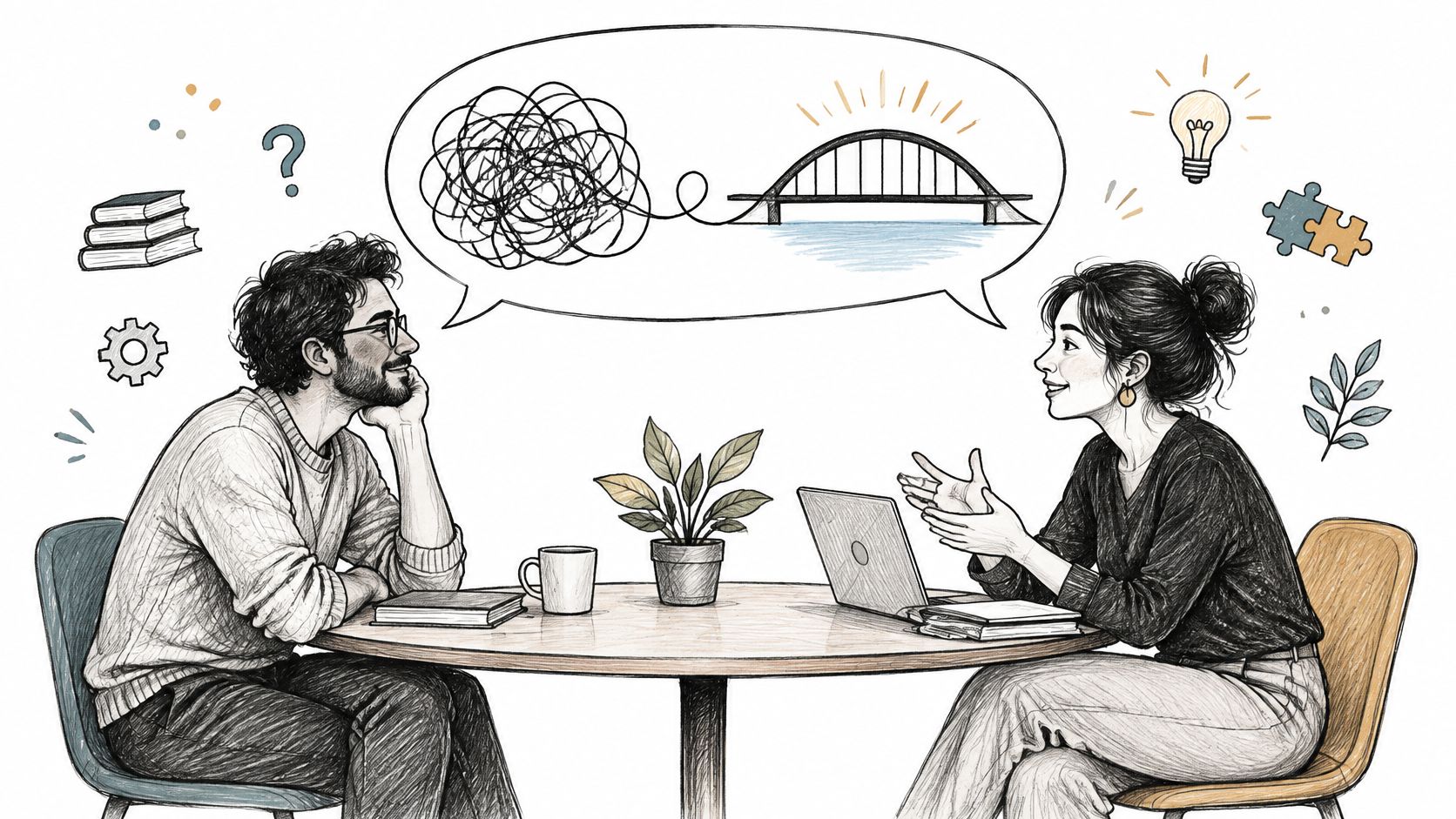
Describe what's happening and how it affects the work. For example: “I'm having trouble revising when comments identify problems but don't indicate which issue matters most. Could we agree on how to flag the main revision priorities?” This names a behavior and a practical impact without assigning a motive.
Set communication expectations that match the project. Agree on how often you'll meet, which channel to use for quick questions, and what kind of feedback you need on drafts. If a thesis-based paper involves multiple authors, discuss contribution and credit early, then put the agreement in writing.
Shared progress views can also change the tone of meetings. When both people can see the current chapter status, open questions, and next actions, the conversation can focus on work that needs attention rather than a general argument about whether enough has been done. If tension continues despite a clear agreement, ask a program coordinator or graduate office about neutral support. Early help can keep a strained working relationship from becoming a project-wide delay.
3. Process Conflict
A team agrees on its research question but still misses progress because nobody knows who owns the next step. One student thinks the supervisor will approve a chapter before revision; the supervisor expects a revised draft first. That's process conflict, a disagreement about workflow, responsibilities, review stages, or deadlines.
Process problems often hide inside apparently personal complaints. “You never send feedback on time” may turn out to mean that no one agreed on when feedback was due or which draft the supervisor was reviewing. Clarify the route a piece of work follows before assigning blame.
Make the workflow visible
Map the project from proposal to submission. For each deliverable, record one owner, the next reviewer, and what counts as ready for review. A shared task tracker is useful when several people contribute to a literature review or when a committee must approve revisions.
For example, a cohort writing a joint review can assign each person a section, set a common citation format, and give one editor responsibility for combining the drafts. A student facing unclear committee procedures should check the graduate handbook and confirm any uncertain approval step in writing. Don't rely on a verbal assumption when an institutional rule could change the order of work.
Backward scheduling exposes conflicts before they become urgent. Start with the submission date, then place review, revision, formatting, and approval milestones in the sequence the institution requires. If the schedule depends on supervisor feedback, make that dependency visible instead of treating the student's drafting date as the only deadline. For practical ways to turn team tensions into constructive conversations, keep the discussion focused on the workflow and the change needed to unblock it.
4. Value Conflict
A student wants to understand how participants make meaning of an experience, while a supervisor expects variables to be measured and compared. The disagreement may not be about competence or evidence. It may reflect different assumptions about what counts as knowledge and what the study should accomplish.
Value conflict arises when people hold different beliefs about research priorities, ethical obligations, disciplinary standards, or the purpose of a project. In a thesis, it can surface in the research question, literature review, methodology, or interpretation of findings. Treating a philosophical difference as a simple technical choice usually makes the discussion harder.
Make the assumptions explicit
State your epistemological position in plain language and show how it shapes the design. If you're using an interpretivist framework, explain why participants' meanings matter to your question and how your methods support that aim. Then distinguish what you consider essential from what can change, such as the wording of an interview prompt or the order of sections in a chapter.
Ethical differences need a different route. If an ethics committee questions a consent procedure for vulnerable participants, respond to the concern in the protocol. Explain how the revised process protects participants and preserves the study's purpose. Don't treat safeguards as a barrier to work around.
A methodologist or ethics advisor can help separate a genuine design incompatibility from a difference in preference. Their role isn't to choose a side. It's to clarify the assumptions and standards that apply, so you can document your rationale and give examiners a transparent account of how your values shaped the study.
5. Role Conflict
You're trying to draft a findings chapter while teaching, meeting departmental duties, working for pay, and responding to family responsibilities. Each obligation may be legitimate, but together they can leave too little time for sustained research. Role conflict occurs when expectations attached to different responsibilities compete or cannot all be met as stated.
It also arises when two academic authorities ask for incompatible outcomes. A supervisor may prioritize a full draft; a department may require teaching preparation; a project lead may expect data work on the same day. The student often feels caught between commitments rather than disorganized.

Negotiate from a real schedule
Put your active roles into one weekly view. Mark fixed commitments first, then identify the writing and research blocks that remain. Bring that schedule to your supervisor or department instead of making a vague request for “more time.” Concrete milestones make it easier to discuss a reduced teaching load, a changed task deadline, or a revised thesis schedule.
Protect focused writing time where possible, but don't pretend every week will follow the ideal plan. Build a schedule that includes review and revision, not only drafting. If your paid work or family responsibilities change, raise the impact before a deadline slips and propose a new sequence of deliverables.
Role expectations can also differ in urgency. Ask each stakeholder which outcome must happen first and which can move. Revisit those priorities at supervisor check-ins, especially when a new responsibility appears. A realistic plan is more useful than a demanding schedule you can't sustain.
6. Resource Conflict
Two students need the same lab instrument during the same collection window. A research group shares one software licence, or several candidates rely on a supervisor whose available meeting time is limited. These are resource conflicts: disputes over access to scarce time, equipment, funding, datasets, participants, or recognition for work.
Competition becomes more personal when allocation rules are unclear. If one student receives access first because they asked informally, others may see the decision as favoritism. A transparent process won't create more resources, but it can make decisions easier to understand and challenge fairly.
Set allocation rules before the rush
Use a shared booking calendar for equipment and facilities. Define how far ahead people can reserve time, how cancellations work, and who resolves competing requests. For a limited participant pool, agree on a rotation or another allocation rule with the program coordinator before recruitment begins.
Discuss authorship and credit early, especially when several people contribute to a thesis-based publication. Write down how contributions will be recognized and revisit the agreement if the work changes. This is easier than negotiating credit after the paper is complete.
Resource access affects the thesis timeline. If data collection depends on a shared facility, plan around other users and identify a backup method where possible. If supervisor availability is the bottleneck, send a focused agenda and the relevant pages in advance so the meeting can address decisions rather than recover project history. Use a realistic dissertation writing timeline to think through how access limits may affect the schedule.
7. Intergroup Conflict
A thesis that spans two departments can inherit two sets of expectations. One supervisor may prioritize disciplinary theory; the other may emphasize applied outcomes. Their students may also use different terminology, citation conventions, or standards for what counts as a strong argument. The conflict sits between groups, even when individual working relationships remain respectful.
Intergroup conflict can emerge between research labs, cohorts, departments, or students and faculty. Perceived unfairness and competition over facilities can deepen it. Asking everyone to “work together” won't resolve a disagreement about standards or decision authority.
Give both groups a shared task
For interdisciplinary supervision, define the joint research question and agree on who advises which part of the thesis. Set shared milestones, then write down any discipline-specific expectations that differ. That gives you a way to reconcile competing comments instead of trying to satisfy incompatible standards in every chapter.
Structured contact helps when groups have few chances to understand each other's priorities. A joint seminar, co-supervision meeting, or shared review of a proposal can surface disagreements early. Keep decisions about resources and evaluation criteria visible to everyone affected.
Cooperation works best when both groups need to contribute to a clear outcome. For example, a project might require one department's subject expertise and another's methodological guidance. Give each group a named responsibility and an agreed route for resolving disagreements. The thesis writer shouldn't have to act as the sole mediator between authorities who haven't aligned their expectations.
8. Intrapersonal Approach-Avoidance Conflict
You want to finish the thesis, but opening the literature review brings dread. You care about the research, yet you're avoiding the revision work that would bring it closer to submission. That pull toward a goal and reluctance to face its demands is approach-avoidance conflict.
Intrapersonal conflict happens within one person, often when motivations, values, or emotions point in different directions. A student may also face an approach-approach choice between two attractive topics, or an avoidance-avoidance choice between two difficult options. Name the specific choice before trying to solve it. A vague feeling of being stuck doesn't tell you what action to take.
Turn avoidance into a defined task
Write down what you want and what you're resisting. If the literature review feels overwhelming, replace “write the literature review” with a small task such as organizing sources for one subsection or drafting its opening paragraph. Mark that task complete when it's done. Visible progress gives you a concrete stopping point and a next action.
Backward planning can make a dreaded revision stage feel finite. Start with the submission date, then schedule review, editing, and supervisor feedback as separate steps. Don't pack them into one vague block called “finish thesis.”
A writing group can add structure and company, while a supervisor can help you break an ambiguous chapter into manageable decisions. If anxiety keeps blocking work, consider speaking with a counselor or other appropriate support professional. You can also use practical time-management strategies during a PhD to build a routine that respects both focused writing and recovery. If every option feels impossible, pause and consider choices that feel impossible with someone who can help you think them through.
How the 8 Conflict Types Compare in a Thesis Context
| Item | Level | Core Focus | Typical Thesis Trigger | Main Fix |
|---|---|---|---|---|
| Task Conflict | Work-related disagreement | Ideas, evidence, methods, and interpretations | Disagreement over research design or analysis | Compare evidence and criteria, then document the decision |
| Relationship Conflict | Interpersonal | Trust, respect, communication, and working styles | Feedback cycles stall amid miscommunication | Agree on communication norms and address behavior respectfully |
| Process Conflict | Workflow-related | Roles, procedures, deadlines, and task order | Unclear responsibilities or approval steps | Set written roles, procedures, and timelines |
| Value Conflict | Belief- or ethics-based | Principles, worldviews, and research priorities | Disagreement over research philosophy or ethics | Clarify the underlying stance and document its rationale |
| Role Conflict | Individual and stakeholder-related | Competing expectations across roles | Thesis demands clash with teaching, work, or family duties | Negotiate priorities and realistic expectations |
| Resource Conflict | Between resource users | Competition for limited assets, time, or credit | Shared equipment, participants, funding, or supervisor time | Use transparent allocation rules and plan access early |
| Intergroup Conflict | Between groups | Group identity, competition, and perceived fairness | Departments or cohorts compete over goals or resources | Establish shared goals and transparent procedures |
| Intrapersonal (Approach-Avoidance) Conflict | Within the individual | Competing motivations toward the same goal | Wanting to finish while dreading writing or revision | Break work into small, scheduled milestones |
Turning Conflict Types Into a Clearer Thesis Plan
Start with the decision or interaction that's stuck. Ask whether you're disputing the content of the research, the way work is organized, the relationship between people, or the time and resources available. If the problem is internal, name the competing motivations. A precise diagnosis stops you from using the wrong remedy, such as trying to fix a communication pattern with a new statistical model.
Then decide whether the conflict is helping the work or damaging it. A focused debate about how to interpret evidence may reveal assumptions that need testing. By contrast, repeated arguments about feedback, credit, or deadlines can drain time without clarifying the research. Keep disagreement productive by making the next decision explicit and setting a point at which discussion ends and action begins.
Choose a next step that fits the conflict. For task conflict, write down the options, criteria, and decision. For process conflict, assign owners and make review stages visible. For role conflict, bring a realistic schedule to the supervisor meeting and negotiate priorities. When values or interpersonal tension are central, state the issue without attributing motives and involve a suitable neutral adviser if direct discussion stalls.
A thesis roadmap, chapter tracker, and shared progress view can make those conversations more concrete. Thesis Book Project provides a guided path from proposal to submission, tracks chapter and section status, and supports milestone planning around a fixed deadline. Progress visibility and supervisor sharing can help meetings focus on blockers, decisions, and the work due next, while source organization keeps reading connected to chapter development.
Bring one live conflict to your next check-in. Write down what decision is stuck, what evidence or expectation matters, and what specific outcome you need from the meeting. Leave with a named action, an owner, and a date. That's how a vague dispute becomes a manageable part of the thesis plan.
Use Thesis Book Project to map your thesis, track chapter progress, and set milestones that make the next decision clear. Share progress with your supervisor so check-ins can focus on blockers, feedback, and agreed actions.
Related Articles
8 Examples of Themes for Literature Theses in 2026
You have three months left, a folder full of criticism, and a supervisor asking what your thesis arg...
Research MethodsHow to Cite Articles in a Research Paper
You've done the hard part. You've found a journal article that supports your argument, you&#...
Research MethodsThesis Strategy and Roadmap: A Practical Guide for Students
Your submission deadline is approaching, your reading folder keeps growing, and you've worked ha...
Comments (0)
No comments yet. Be the first to share your thoughts.