8 Examples of Themes for Literature Theses in 2026
Explore 8 examples of themes for literature theses, each with key texts, theory links, research questions, and planning tips for your dissertation.

You have three months left, a folder full of criticism, and a supervisor asking what your thesis argues. Your answer is still something about war in novels. You've chosen a subject, but you haven't yet identified the particular relationship, tension, or contradiction you can defend through close reading.
That distinction matters because your theme determines nearly everything downstream: which texts belong in the project, which theory helps explain them, and why the chapters need to appear in a particular order. A theme is an interpretive lens, not merely a label for what happens. War is a topic; the conflict between public heroism and private guilt gives you a thematic problem.
A workable theme lets you explain both what you're studying and what remains uncertain about it.
The examples of themes below connect literary works with theoretical approaches, narrow focus questions, and chapter-level decisions. Treat each question as a starting point rather than a ready-made original contribution. You'll still need to check existing criticism, test the question against passages, and adjust the scope to your degree requirements.
The immediate priority isn't finding an impressive label. It's choosing a problem you can investigate with the texts, time, and scholarly resources you have.
Table of Contents
- 1. Identity and the Search for Self
- 2. Power and Corruption
- 3. Mortality and the Passage of Time
- 4. Alienation and Isolation
- 5. Colonialism and Postcolonial Identity
- 6. Memory and the Past
- 7. Justice and Morality
- 8. Ambition and the American Dream
- How the eight literary themes compare for thesis planning
- Turn a Theme Into a Thesis You Can Finish
1. Identity and the Search for Self

A character's search for identity becomes researchable when you specify who controls recognition. In Ralph Ellison's Invisible Man, you might examine the gap between the narrator's self-understanding and the roles others assign him. In Mary Shelley's Frankenstein, you could investigate how the creature's exclusion complicates the relationship between selfhood and recognition.
For a thesis on James Joyce's A Portrait of the Artist as a Young Man, the bildungsroman offers a useful framework, but development alone isn't an argument. Ask whether Stephen's artistic independence depends on rejecting inherited identities or rearranging them into a new performance.
Narrow identity to a contested relationship
Focus question: How does institutional recognition shape the narrator's attempts at self-definition in Invisible Man?
Connect this question to theories of racialized subjectivity or recognition, then identify the scenes where public acceptance requires self-distortion. Keep the theoretical vocabulary subordinate to what the narration does.
- Chapter structure: Organize analytical chapters around imposed roles, attempted belonging, and retrospective self-definition rather than merely retelling the plot.
- Early milestone: Build a passage file that records who names the narrator, what role they assign him, and how his narration responds.
- Reading organization: Separate identity theory from criticism on Ellison so you can distinguish conceptual borrowing from your contribution to the literary debate.
The main risk is treating every change in the character as evidence of identity formation. Your argument becomes stronger when you identify a mechanism, such as naming or public performance, and explain the passages that resist your interpretation.
2. Power and Corruption
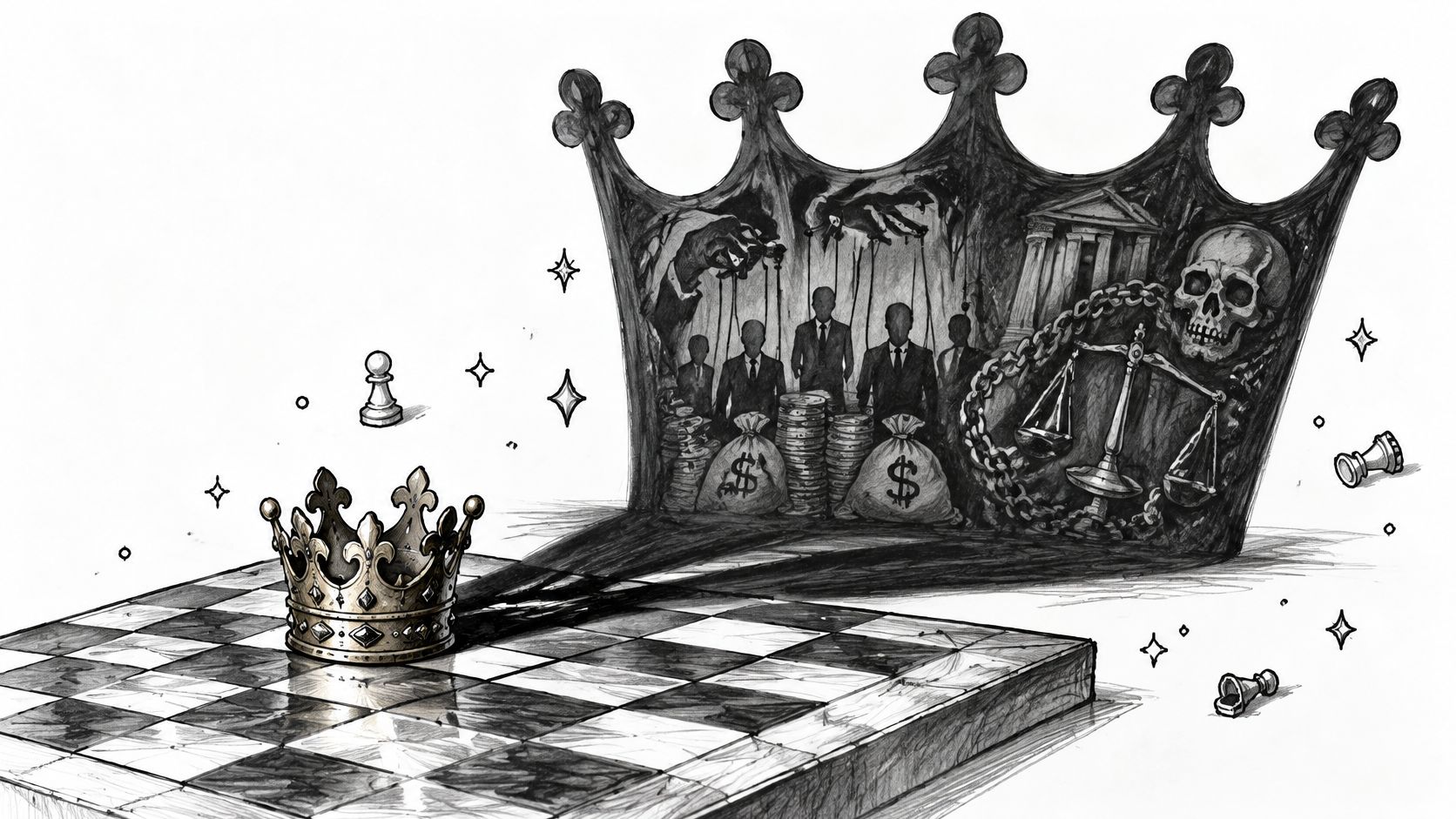
Start with a decision, not a verdict. Saying that Macbeth becomes corrupt tells your examiner little; analyzing how he converts uncertainty into permission for violence gives you something to defend. Likewise, Animal Farm supports a sharper inquiry into changing political language than a general claim that leaders abuse authority.
Political philosophy can help you distinguish legitimacy, coercion, consent, and domination. Choose the distinction your passages require rather than importing a complete account of government into a short literary project.
Practical rule: If your political claim would remain unchanged after removing the novel's language, you probably haven't done enough literary analysis.
Focus question: How do revisions to public rules normalize unequal authority in George Orwell's Animal Farm?
This question makes wording, repetition, and narrative presentation central evidence. Nineteen Eighty-Four is another possible text, particularly for a project on surveillance and self-policing, but adding it means defending the comparison rather than merely collecting similar examples.
Plan around mechanisms of authority
Begin with a chapter establishing the revolution's promises, follow with analysis of how leaders reinterpret them, and finish by examining how other animals accommodate or challenge those changes. Each chapter should establish a different part of the explanation.
The project-sinking risk is using fictional events as straightforward proof of a historical regime's behavior. If you want a historically framed argument, set an early milestone for contextual reading and distinguish historical evidence from literary representation. Otherwise, keep the claim focused on how Orwell constructs political obedience.
3. Mortality and the Passage of Time

Mortality works especially well when you enjoy analyzing small formal details. A pause, a tense shift, or a change in rhythm can alter how a speaker experiences finite time. You don't need a large corpus to make a substantial argument.
Leo Tolstoy's The Death of Ivan Ilyich offers a sustained narrative of dying and retrospective judgment. Emily Dickinson's death poems and Dylan Thomas's Do not go gentle into that good night allow more concentrated work on personification, address, repetition, and resistance.
Make the formal problem explicit
Focus question: How does the carriage journey in Dickinson's Because I could not stop for Death complicate the speaker's apparent acceptance of dying?
Connect the question to lyric temporality or phenomenological approaches to lived time. Then test whether the poem's movement, pauses, and retrospective perspective support acceptance, unease, or an unresolved combination.
- Evidence task: Annotate shifts in motion, tense, spatial scale, and the speaker's apparent knowledge.
- Chapter sequence: Move from the personified encounter to the journey's temporal disturbances, then to the ending's retrospective perspective.
- Scope decision: Confirm with your supervisor whether the poem can sustain the required thesis length or needs a tightly justified companion corpus.
The biggest trap is turning the thesis into a philosophical essay about whether death gives life meaning. That may be your motivating concern, but your literary claim needs to explain a textual construction of mortality.
Reserve space in your schedule for rereading after drafting. An interpretation that sounded persuasive in notes may fail when you account for the poem's ending or a contradictory image.
4. Alienation and Isolation

Isolation describes a condition; alienation requires you to explain a relationship. A character might live among relatives yet feel estranged from meaningful work, social recognition, or their own desires. If you use these terms interchangeably, your analysis will drift.
Franz Kafka's The Metamorphosis offers a focused case because Gregor's employment, bodily transformation, and family obligations can be examined together. Arthur Miller's Death of a Salesman supports a related inquiry into work and self-worth, while Albert Camus's The Stranger requires careful attention to social judgment rather than an automatic diagnosis of loneliness.
Focus question: How does the family's valuation of Gregor's usefulness shape his exclusion in The Metamorphosis?
A Marxist account of alienated labor can clarify the relationship between economic function and personhood. An existentialist approach would ask different questions about meaning and estrangement; don't combine them without explaining what each contributes.
Separate the dimensions before drafting
Create an evidence map for paid work, household obligation, bodily access, and communication. Note where these categories overlap and where they don't, especially when a family member's response complicates a purely economic explanation.
Your analytical chapters could move from Gregor's internalized work discipline to household judgments and finally to the narration of his exclusion. Set a milestone for testing that sequence against contrary passages before drafting the introduction.
The main risk is treating a theoretical definition as a diagnosis that settles everything. Use theory to sharpen distinctions, then let Kafka's narrative expose what the framework cannot fully explain.
5. Colonialism and Postcolonial Identity
In Chinua Achebe's Things Fall Apart, cultural conflict cannot be reduced to a simple opposition between an unchanged community and outside intrusion. In Jean Rhys's Wide Sargasso Sea, questions of belonging also involve unequal racial positions, gender, property, and narrative authority. These differences matter when you choose your corpus.
Postcolonial theory gives you ways to examine representation and power, but the theorists aren't interchangeable. Edward Said's Orientalism is a critical framework, not another fictional case study; Bhabha's account of hybridity or Spivak's questions about representation would require different analytical commitments.
Don't use a character's marginalization to erase the power they hold over someone else.
Choose a specific struggle over representation
Focus question: How do competing acts of naming in Wide Sargasso Sea restrict Antoinette's ability to define her belonging?
This connects narrative voice with colonial and gendered authority. You can draw on postcolonial and feminist criticism while keeping the central evidence manageable: names, refusals, descriptions, and changes in who controls the account.
- Historical preparation: Build a contextual timeline using sources appropriate to the novel's setting, and keep it separate from the sequence of narrated events.
- Chapter plan: Establish the competing claims to belonging, analyze naming and narrative control, then examine the limits of resistance.
- Milestone: Draft a positionality paragraph explaining whose perspectives your argument foregrounds and whose it cannot adequately recover.
The major risk is making sweeping claims about the colonized experience from a text whose characters occupy unequal positions. Keep your conclusions specific to the novel's construction of colonial relationships, and distinguish your interpretation from a thorough historical account.
6. Memory and the Past
A memory thesis should ask how remembering works, not merely identify events from a character's past. Toni Morrison's Beloved, William Faulkner's Absalom, Absalom!, and Art Spiegelman's Maus offer different problems of recollection, mediation, and narrative authority. Choose according to the formal problem you want to investigate.
The video below can serve as a discussion prompt, but it shouldn't replace reading the primary text or checking scholarly criticism.
Focus question: How does the separation between interview scenes and reconstructed events in Maus complicate the narrator's authority over inherited memory?
Marianne Hirsch's concept of postmemory offers a relevant connection. Narratology can help you distinguish who experienced an event, who recounts it, and who arranges its presentation.
Map chronology separately from narration
Before drafting, create parallel records of event chronology and order of disclosure. For a graphic narrative, include panel layout, transitions, and visual framing rather than extracting dialogue as though you were analyzing a prose novel.
A thematic-analysis case study in the International Journal of Qualitative Methods demonstrates how code definitions, inclusion and exclusion boundaries, and examples can make interpretive decisions traceable. Adapt that principle to an annotation log, without treating literary interpretation as interchangeable with participant-data coding.
Plan chapters around transmission, mediation, and the limits of reconstruction. Your early milestone is a complete narrative map with representative passages attached.
The central risk is diagnosing every narrative gap as trauma. Explain what the text establishes, consider alternative formal explanations, and discuss the ethics of representing testimony with your supervisor before your argument hardens.
7. Justice and Morality
Legal judgment and moral judgment don't necessarily coincide. That tension gives you a stronger starting point than asking whether a character is good or bad. Sophocles' Antigone, Victor Hugo's Les Misérables, and Harper Lee's To Kill a Mockingbird each allow you to investigate who can claim legitimate authority to judge.
For Antigone, you might examine competing obligations rather than deciding in advance that individual conscience must defeat state law. For Les Misérables, a focused project could investigate how encounters with mercy alter the relationship between legal identity and moral responsibility.
Make your ethical standard visible
Focus question: How does Antigone distribute moral responsibility when family obligation conflicts with civic authority?
Choose an ethical approach that clarifies the conflict. Virtue ethics can help examine judgment and character, while duty-based ethics directs attention to competing obligations; neither should become a device for grading characters against an unexplained modern standard.
- Distinguish claims: Record what a character argues, what the dramatic action reveals, and what you conclude. Those aren't necessarily the same.
- Organize chapters: Establish the rival obligations, examine how characters justify action, then analyze the consequences and unresolved tensions.
- Set a review point: Ask your supervisor to challenge your ethical assumptions before you draft the evaluative chapter.
The project-sinking risk is reducing literature to an illustration of a moral theory you already accept. Preserve the difficulty that made the text worth studying. If every scene merely confirms your initial judgment, look harder at the strongest opposing interpretation.
8. Ambition and the American Dream
Gatsby's parties, Willy Loman's salesmanship, and Clyde Griffiths's pursuit of status offer related but distinct routes into ambition. Don't assume that The Great Gatsby, Death of a Salesman, and An American Tragedy express an identical national promise. Identify what success means within your chosen work and who gets to define it.
Class analysis, ideology critique, and theories of distinction can help connect personal desire with social recognition. The useful question isn't whether ambition is destructive, but how characters learn to desire a particular kind of success.
Focus question: How does Nick's narration make Gatsby's pursuit of elite recognition appear both admirable and self-deceiving?
This keeps narrative mediation central. Instead of treating Gatsby as direct evidence about social mobility, you would examine descriptions of taste, belonging, inherited status, and the judgments Nick asks readers to share.
Scope test: If your argument requires proving what all Americans believe about success, narrow it to what your narrator or dramatic structure makes credible.
Build chapters around changing judgments
Start with the construction of Gatsby's appeal, move to the social boundaries his performance cannot overcome, and finish with Nick's retrospective evaluation. Set an early milestone for finding passages that complicate Nick's reliability rather than accepting his judgments as the novel's settled position.
The main risk is making historical claims from fictional examples alone. A social-history chapter needs appropriate historical sources; without them, keep the argument focused on literary representations of aspiration. A contemporary comparison can be productive, but only if you can explain what the comparison reveals beyond recurring disappointment.
How the eight literary themes compare for thesis planning
| Item | Core Theoretical Lens | Best Discipline Fit | Main Risk |
|---|---|---|---|
| Identity and the Search for Self | Subjectivity, feminist, or race theory | Literary studies and cultural studies | Too broad without a focused scope |
| Power and Corruption | Political theory and power studies | Political literature and history | Drifting into political commentary |
| Mortality and the Passage of Time | Existentialism and Stoicism | Literary studies and philosophy | Generalizing without close textual evidence |
| Alienation and Isolation | Marxist and existentialist theory | Literary studies and sociology | Treating distinct experiences as interchangeable |
| Colonialism and Postcolonial Identity | Postcolonial theory | Comparative and world literature | Demanding historical and theoretical preparation |
| Memory and the Past | Trauma and memory studies | Literary studies and cultural history | Ethical sensitivity and complex narrative structure |
| Justice and Morality | Ethical theory and legal philosophy | Literature, law, and philosophy | Moral judgment without a clear ethical framework |
| Ambition and the American Dream | Cultural criticism and social history | American studies | Requiring historical context and a fresh angle |
Turn a Theme Into a Thesis You Can Finish
Choose the theme that produces the clearest textual problem, not the one that sounds most important. Identity, justice, and memory are all substantial subjects, but their importance won't compensate for an undefined corpus or an unanswerable question. You need a relationship you can examine and a plausible reason the answer isn't already obvious.
Before reading further, draft your focus question and list your candidate texts. Explain why each text belongs, what evidence it offers, and what you would lose by excluding it. Then identify the conceptual distinction your argument needs, such as recognition versus self-definition, legality versus justice, or recollection versus reconstruction.
Test the question against actual passages
Choose a passage that appears to support your emerging claim and another that complicates it. Write a short interpretation of each without relying on plot summary. If you can't explain the wording, form, or narrative arrangement that makes the passage relevant, your question probably needs further narrowing.
- Check the scholarly conversation: Identify whether critics disagree about your specific problem, not merely whether they discuss the same broad theme.
- Write a provisional answer: Use that answer to develop a clearer central argument for your essay, then revise it as your evidence develops.
- Assign chapter jobs: Describe what each chapter must establish before the next chapter can make its claim.
- Schedule visible outputs: Plan for an annotated passage file, a literature-review outline, a chapter draft, and a revised argument rather than vague periods labeled reading.
Build backward from submission, leaving room for supervisor feedback, revision, references, and formatting. Match the reading load to the available drafting time. If your plan requires mastering an unfamiliar theoretical field before you can analyze a passage, reduce the conceptual scope or reconsider the deadline.
Thesis Book Project's roadmap and chapter tracker offer a way to translate these decisions into a sequenced plan. Use the roadmap to identify dependencies and the chapter tracker to distinguish an outlined section from a drafted or revised one. Progress should mean that a specific piece of the argument is ready for scrutiny, not that you've merely spent time working.
Your next move is concrete: write the question, test it against passages, and attach a deliverable to your next supervisor meeting. A defensible theme is one you can turn into evidence, argument, and finished chapters.
Thesis Book Project combines a guided thesis roadmap with chapter tracking and milestone scheduling to help you organize work from proposal to submission. Visit Thesis Book Project to turn your chosen theme and focus question into a chapter plan with visible deadlines and progress.
Related Articles
How to Cite Articles in a Research Paper
You've done the hard part. You've found a journal article that supports your argument, you&#...
Research MethodsThesis Strategy and Roadmap: A Practical Guide for Students
Your submission deadline is approaching, your reading folder keeps growing, and you've worked ha...
Research MethodsLiterature Review Process: From Search to Synthesis
You're staring at a folder full of PDFs, half-finished notes, and a supervisor who wants a “clea...
Comments (0)
No comments yet. Be the first to share your thoughts.