Thesis Outline Example: A Chapter-by-Chapter Sample
Thesis outline example: see a chapter-by-chapter sample with word targets, a research-question map and a backward timeline you can adapt.
You've opened a document, typed Introduction, Literature Review and Methodology, and stopped. The headings look familiar, but you're still unsure what belongs beneath them, how much space to reserve, or whether they'll add up to a defensible argument.
A useful thesis outline example should help you make those decisions. Treat the outline as a logic test: every question needs evidence, every analytical chapter needs a purpose, and your final answer must stay within what your research can support.
Table of Contents
- The Standard Thesis Outline at a Glance
- A Chapter-by-Chapter Sample Outline Annotated
- Which Outline Shape Fits Your Thesis Type
- Checking Your Outline Logic Before You Draft
- How to Build a Backward Timeline From Submission
- Where AI Use Belongs in Your Outline
- Lock Your Outline and Schedule Your First Draft
The Standard Thesis Outline at a Glance
A thesis outline is a map of your research argument, not merely a list of headings. It should show what you're investigating, how you'll investigate it, and how readers will move from the problem to your contribution.
The University of Melbourne's thesis-structuring guidance distinguishes lead-in, core and lead-out material, describing around five core chapters, one or two lead-out chapters, roughly 10% each for the introduction and conclusion, and core chapters often 8,000–12,000 words long. The table translates that guidance into planning functions, not compulsory allocations.
Chapter functions and planning shares in a conventional thesis
| Part | Job in the argument | Planning share or length |
|---|---|---|
| Lead-in front matter | Title page, table of contents, list of figures, acknowledgements | Before the main text |
| Introduction | Problem, purpose, scope and research questions | About 10% of the thesis |
| Core | Literature or framework, methodology and findings, about five chapters | Often 8,000–12,000 words per chapter at doctoral level |
| Discussion | Links findings to prior work, limits and implications | Sits in the core or the lead-out, by discipline |
| Lead-out | One or two chapters answering the question through contribution, limits and implications | About 10% for the conclusion; introduction and conclusion together about 20% |
| Back matter | References and appendices | After the main text |
The lead-in material helps readers follow the document. Follow your institution's template for its order and required declarations, rather than borrowing another university's formatting.
The core carries the work needed to justify your answer. A literature chapter establishes the scholarly problem; a methods chapter explains your approach; analytical chapters present and examine the evidence.
Use proportions without forcing the structure
The lead-out material makes the answer explicit. Don't leave readers to infer your contribution from a collection of findings, and don't spend your entire word allowance before explaining their significance.
These planning ranges aren't universal requirements. A shorter master's thesis shouldn't inherit doctoral chapter lengths, and a humanities argument may need a different distribution from an empirical study.
Readiness test: Describe each chapter's job in a sentence beginning with a verb, such as establishes, justifies, demonstrates or qualifies.
“Discusses the topic” isn't specific enough. “Establishes why existing wellbeing measures may miss work-intensification effects” gives you a usable boundary for drafting.
A Chapter-by-Chapter Sample Outline Annotated
Consider a hypothetical mixed-methods master's study asking whether a four-day working week changes staff wellbeing in mid-sized firms. The design details and allocations below are illustrative placeholders, not findings, recommended sample sizes or doctoral word targets.
Before the main chapters, include the title page, table of contents, list of figures and acknowledgements, subject to your university's requirements. Reserve an integrity entry in the front matter or methodology: tool; purpose; extent of influence; verification; supervisor sign-off. Complete that entry only after checking the local AI rule.
Annotated sample outline for a mixed-methods master's thesis
| Chapter | What it must do | Placeholder share | Annotation |
|---|---|---|---|
| 1 Introduction | Establish the burnout concern, purpose, research questions and scope | About 10% | Questions later chapters must answer |
| 2 Literature review | Working-time research, wellbeing measures, gap in mid-sized firms, conceptual framework | About 20% | Stop at the gap and the framework |
| 3 Methodology | Hypothetical 12-month survey in six firms, 15 interviews, analysis plan, ethics, design limits | About 15% | Name the evidence for each question |
| 4 Results | One subsection per question, survey change scores followed by interview themes | About 25% | Report findings with no interpretation |
| 5 Discussion | Comparison with the literature, proposed mechanisms, limits | About 20% | Interpretation belongs here |
| 6 Conclusion | Direct answer, contribution, implications for HR practice | About 10% | One sentence answers each research question |
Establish the problem and the research design
Chapter 1 introduces the investigation, not its eventual success story. Present burnout reports as the problem motivating investigation, without assuming that reduced working time solves it. For this hypothetical project, define the scope as participating firms with 50 to 250 staff.
Use these research questions:
- Wellbeing change: How does reported staff wellbeing change after the participating firms introduce a four-day working week?
- Employee experience: How do employees explain the relationship between the new schedule, workload and wellbeing?
The wording matters. Without a suitable comparison design, don't promise to establish that the schedule caused any observed change.
Chapter 2 builds the justification. Organise the review around working-time reduction, definitions and measures of wellbeing, and organisational conditions that might influence outcomes. Treat the proposed gap in mid-sized firms as something your reading must substantiate, not something the example has already established.
End with a conceptual framework connecting the concepts you'll examine. For instance, distinguish reduced hours from compressed hours, then explain why workload intensity could matter to either arrangement.
Chapter 3 explains how you'll produce a credible answer. In this scenario, staff surveys over the proposed study period provide change scores, while follow-up interviews explore employees' explanations. Specify recruitment, measurement timing, missing-data handling, analysis procedures, consent and confidentiality.
Separate reporting from interpretation
Chapter 4 gives each question an identifiable home. A wellbeing-change subsection would report survey patterns, uncertainty and missing responses. An employee-experience subsection would present interview themes with supporting extracts, including accounts that don't fit the dominant pattern.
Chapter 5 interprets those findings together. Ask whether employees' accounts help explain the survey patterns, where the evidence conflicts, and how the findings compare with your conceptual framework. Proposed mechanisms remain interpretations unless your design directly tests them.
Chapter 6 states the answer and contribution. Explain what the study supports, what remains uncertain, and what HR practitioners should consider before applying it elsewhere. Don't invent positive results while outlining; use prompts for the answers until analysis is complete.
After the conclusion, place references and relevant appendices, such as the survey, interview guide and supplementary analysis. Appendices support the argument, but shouldn't contain evidence readers need to understand its central claims.
Which Outline Shape Fits Your Thesis Type
A thesis outline works like a floor plan: the room labels matter less than whether each space connects logically to the next. The familiar sequence of introduction, literature review, methods, results, discussion and conclusion is one useful default among several. The University of Wollongong's academic-literacy guide notes that a literature review can sit within the introduction or stand alone, and that results and discussion may be combined.
Choose the shape that keeps your reasoning inspectable. Whichever structure you adopt, each research question should keep a visible path to a method, a results location and a discussion point. Chapter labels borrowed from another thesis tell you nothing on their own.
Thesis shapes and where their argument sits
| Thesis type | Typical chapter sequence | Where the argument lives | Best fit |
|---|---|---|---|
| Empirical | Introduction, literature review, methodology, results, discussion, conclusion | Findings and their interpretation | Experiments, surveys, interviews |
| Humanities | Introduction, chapters by theme, period or case, conclusion | Close reading within each chapter | History, literature, philosophy |
| Article-based | Introduction, papers, integrating discussion, conclusion | Each paper, linked by the framing chapters | Fields with strong publication norms |
| Systematic review | Introduction, protocol and search, study selection, synthesis, discussion | Synthesis of evidence across studies | Evidence-based fields |
| Creative practice | Context, documentation of the practice, reflection, conclusion | The artefact plus its written contextualisation | Art, design, music, performance |
Match the structure to the intellectual work
An empirical thesis separates what you found from what you think it means, so examiners can evaluate the evidence independently of the interpretation built on it. A humanities thesis often needs evidence and interpretation inside the same chapter, because close analysis of a text, archive or philosophical position is the chapter's argument. Splitting them would leave claims with no support and material with no purpose.
An article-based thesis needs more than papers placed in sequence. Plan framing chapters that explain the shared problem and an integrating discussion that establishes the collective contribution.
For a systematic review, make the route from search and selection to synthesis inspectable, since the conclusion rests on how studies were found and filtered. For creative practice, explain how the artefact and the written contextualisation work together; the writing earns its place by interpreting the work rather than describing it at exhibition length.
Use these criteria when choosing:
- Evidence: Will you generate observations, analyse existing texts, synthesise studies or develop an artefact?
- Traceability: Inside this shape, can each research question reach a method, a results location and a discussion point?
- Disciplinary expectations: Which structures will your examiners recognise as appropriate?
- Publication plans: Will papers form assessed components, or will publications develop separately?
Programme purpose matters as well. Ministry-oriented and academic pathways can weight a thesis differently, and a resource such as The Bible Seminary's degree comparison shows how degree types frame their expectations for prospective students. Your own department's regulations settle the actual thesis requirements.
Before fixing your structure, examine recent departmental theses and discuss your choice with your supervisor. If the literature chapter is the part that still resists organisation, a literature review outline can turn your reading topics into a gap-focused argument.
Checking Your Outline Logic Before You Draft
Run a traceability check before expanding your headings into prose. Each research question should connect to a method, an evidence source, a results location and an interpretive destination.
The University of British Columbia's thesis-preparation guide makes the methodological foundations explicit through sampling, measurement, data collection, analysis, ethics and limitations. Turn those categories into decisions within your outline, rather than leaving them as empty subheadings.
For the hypothetical wellbeing study, the mapping would look like this:
- Wellbeing-change question: Methodology, survey design and change-score analysis; evidence, linked survey responses; results, wellbeing-change subsection; discussion, meaning and alternative explanations of observed change.
- Employee-experience question: Methodology, interview sampling and thematic analysis; evidence, interview transcripts; results, employee-experience subsection; discussion, workload mechanisms and differences between accounts.
Diagnose gaps before they become draft problems
If a question has no feasible evidence source, improve the design or narrow the question. A clearer guide to writing a research question can help when the problem is an overbroad claim rather than a missing heading.
Common outline problems, causes and fixes
| Symptom | Likely cause | Fix |
|---|---|---|
| A chapter links to no research question | Chapter added by habit or scope drift | Remove it, move it to future work or tie it to a question |
| A research question has no method or data source | Design gap | Add the method and evidence source before drafting |
| The results chapter interprets its findings | Chapter roles are mixed | Move interpretation to the discussion |
| The literature review keeps growing | No defined gap or framework | Limit it to the gap and the framework that answers it |
| The conclusion repeats the introduction | No contribution stated | Write what the evidence changes in the field |
For structures that intentionally combine results and discussion, interpretation isn't misplaced. The repair is to make reporting and interpretation distinguishable within the chapter.
Limitations need different treatment in different locations. In methodology, identify design constraints, such as recruitment through participating employers. In discussion, explain how those constraints affect interpretation, including whether dissatisfied employees might be underrepresented.
A tidy document can still contain an unanswerable question. Test the proposed answer, not the appearance of the headings.
For a quick final check, point from each question to a provisional conclusion sentence. Before analysis, write the form of the answer rather than a result: “The evidence will establish whether reported wellbeing changed among participating respondents, with these qualifications.” If you can't describe the answer your evidence could support, drafting won't repair the mismatch.
How to Build a Backward Timeline From Submission
A chapter outline tells you what to produce. A backward schedule tells you what must happen before you can produce it.
Lucen Software's research-planning guidance describes working backward from the end goal through the required research phases. Apply that approach to deliverables and dependencies, not just dates beside chapter titles.
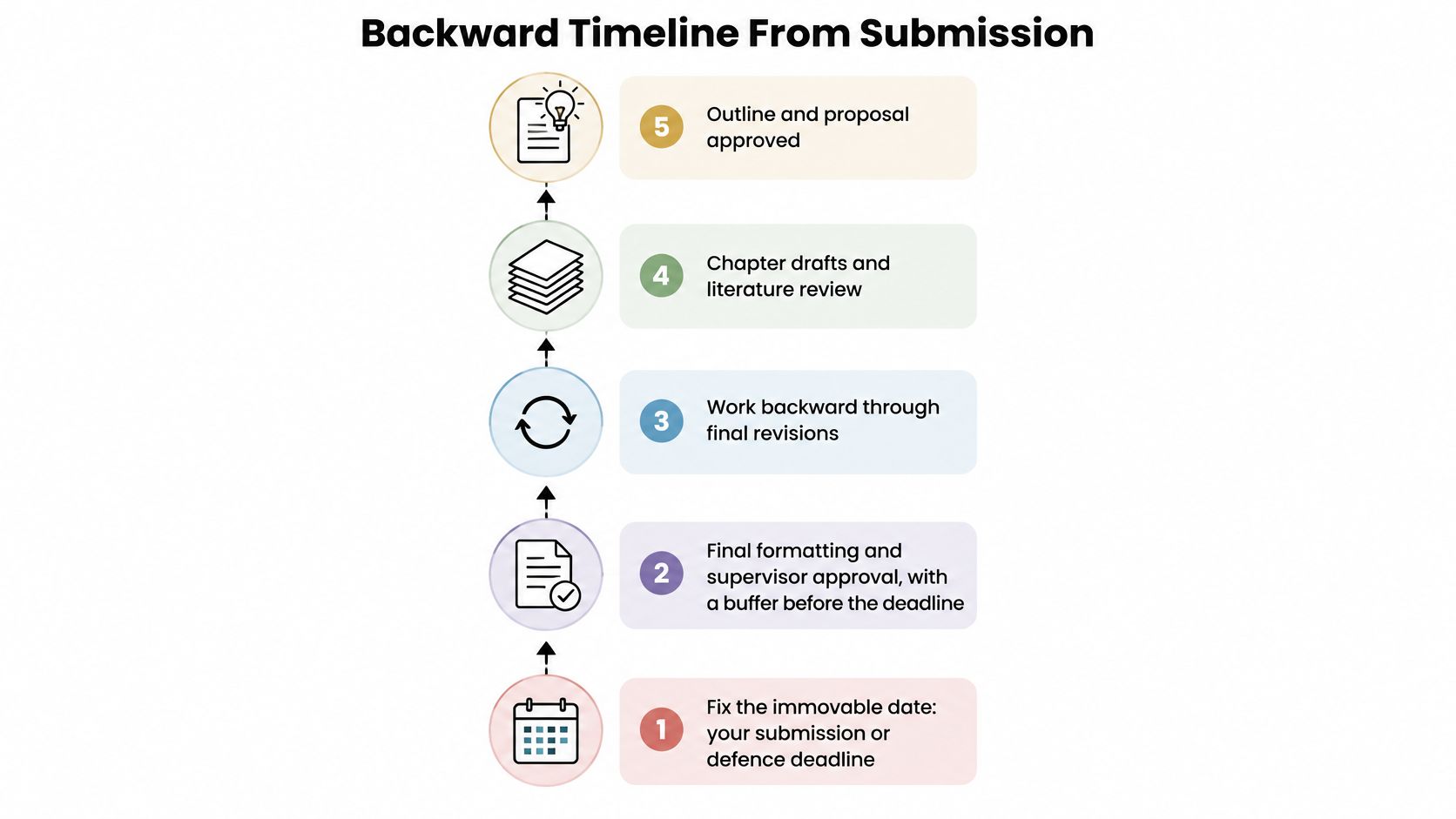
Use the diagram to visualise the direction of planning.
Build a schedule you can actually review
- Fix the immovable deadline. Confirm whether submission, defence and administrative paperwork have separate requirements, so you're planning toward the correct endpoint.
- Reserve the final approval window. Put formatting checks and supervisor review before submission, with room to resolve problems rather than merely identify them.
- Work backward through deliverables. Place final revisions, the complete draft, interpretation, analysis, data collection and literature development in reverse order, while allowing reading and writing to continue alongside research.
- Assign responsibility and dependencies. Record a predecessor, owner, deliverable and review buffer for each milestone, so you know who must act before the next task can begin.
- Protect externally dependent work. Add contingency around participant recruitment, archive access, laboratory bookings and supervisor feedback because you can't control those schedules alone.
- Track chapter status separately. Distinguish outlined, drafted, reviewed and finalised chapters from completed research tasks, since finished interviews don't mean the findings chapter is ready.
A useful milestone is “analysis dataset checked and ready for review,” not “work on results.” The former gives you a visible completion condition and a specific item to discuss with your supervisor.
For a concrete planning example, the University of Sheffield's dissertation guidance allocates 3 weeks to background reading, 2 weeks to the literature review, 1 week to methodology and 2 weeks to data analysis. Treat that as an example to rescale, not a forecast for a project with different access, methods or degree requirements.
This video offers a supplementary planning resource.
Use a research timeline to connect those deliverables to calendar dates. Check the dependencies before accepting the schedule: final analysis requires cleaned data, and data collection must wait for required ethics approval and ready instruments.
Also distinguish an activity's start from its completion. You can prepare an analysis script before collection ends, but you can't claim the final analysis is complete while responses remain unprocessed.
Where AI Use Belongs in Your Outline
There's no universal AI permission rule for thesis work. Permission for brainstorming doesn't automatically permit substantive rewriting, data analysis or uploading participant material.
The University of Auckland's doctoral-research AI guidelines provide an institutional policy reference, not permission that transfers to another university. Check your institution, programme and supervisor's requirements before deciding how AI fits your workflow.
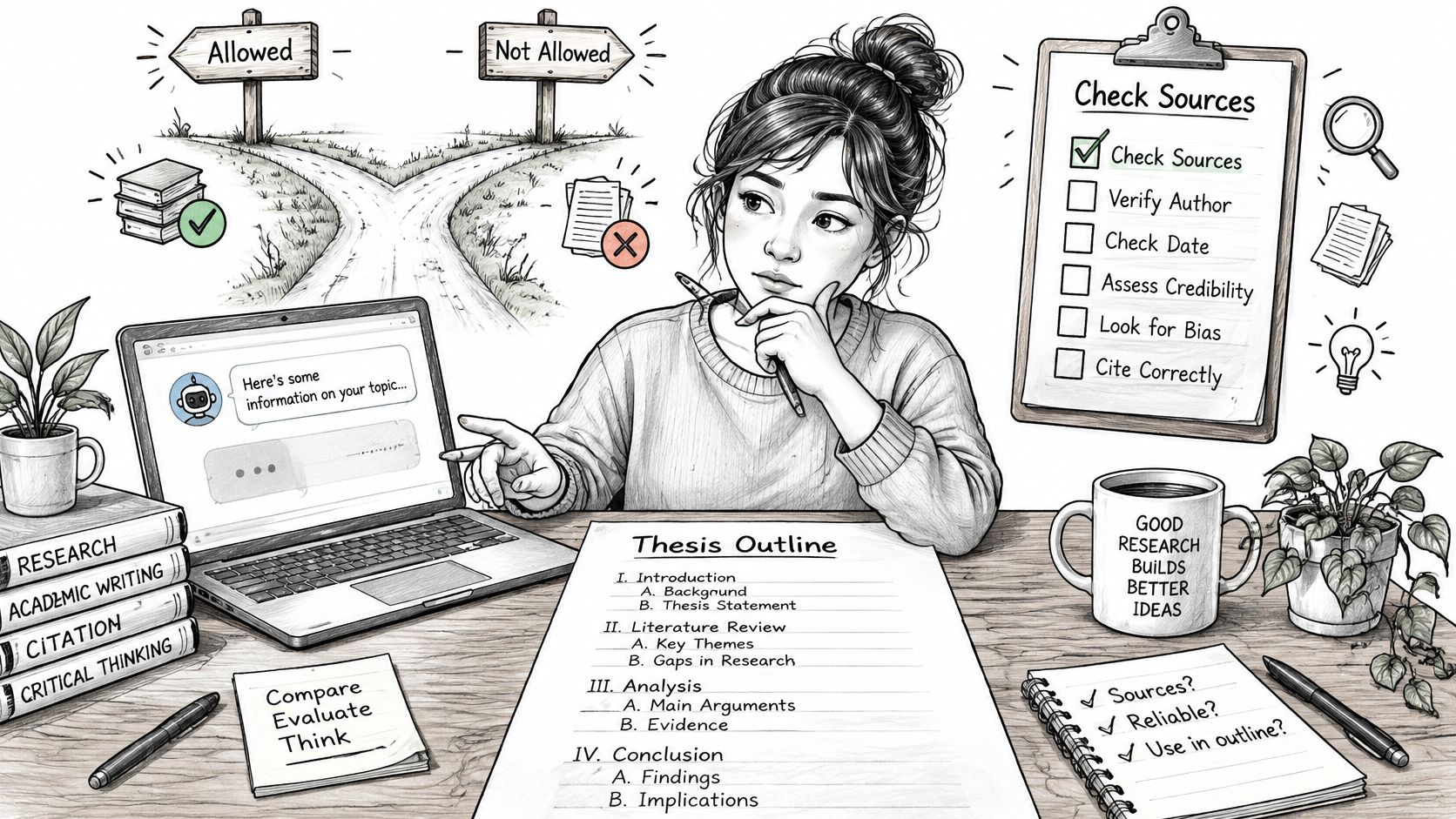
Source evaluation and integrity decisions belong alongside outline development.
Keep an auditable integrity plan
Reserve space in the front matter or methods for an AI-use and integrity plan, with the final disclosure placed wherever your institution requires. If use is allowed, keep a session log containing:
- Date and tool: Record the session and tool identity.
- Purpose and influence: Distinguish proofreading, brainstorming, coding and substantive rewriting, noting what you retained.
- Verification: Save relevant prompts and outputs, identify checks, and record changes after checking.
- Approval: Record supervisor guidance and any required sign-off.
Can AI help create the outline? Only where planning use is permitted. You still need to choose the argument, justify the structure and defend every retained suggestion.
Do I disclose grammar correction? Yes, when the applicable rule covers light editing or any tool use. Don't assume that proofreading and substantive rewriting receive identical treatment.
Verify outputs and handle policy changes
How do I record prompts and verification? Link saved prompts and outputs to the relevant log entry. Open every suggested reference, confirm it exists, and check that the original supports the claim you intend to make.
What if a ban arrives after I've used AI? Stop using it, tell your supervisor what occurred and preserve the record. Ask how the rule applies to completed work and what disclosure or remediation is required.
Integrity safeguard: Never upload confidential research material unless the applicable ethics, privacy and institutional rules explicitly permit it.
Confirm the rule and your intended uses with your supervisor before drafting. A blank integrity entry is better than an inaccurate declaration.
Lock Your Outline and Schedule Your First Draft
You don't need an unchangeable outline. You need a version that's clear enough for your supervisor to evaluate and practical enough to guide your next writing session.
Make these moves this week:
- Compress the structure. Put the front matter, chosen chapter sequence and back matter on a page, with a purpose statement beneath each chapter.
- Audit the connections. Mark where each question connects to evidence, analysis, interpretation and an eventual answer; flag unresolved decisions rather than hiding them.
- Commit the schedule. Assign deliverables, owners, predecessors and review buffers against the actual deadline, allowing extra room for approvals and access.
- Confirm the integrity requirements. Obtain guidance on permitted AI use and prepare the appropriate record before using a tool.
Make the first task small and definite
Send your supervisor an outline that identifies decisions you need help making. “Is this evidence sufficient for the question?” will produce a more useful conversation than “Does this look okay?”
Today, write your submission date at the top of the planning document. Then draft only the introduction outline: problem, purpose, scope and research questions, with a provisional space allowance. Stop before writing polished paragraphs and check that those questions match the study you can complete.
Our Thesis roadmap turns the project into a step-by-step path from proposal to submission, while the Chapter tracker records each chapter and section from outline to final draft. Visit Thesis Book Project to organise your outline and set milestones backward from submission, with reminders before deadlines slip.
Related Articles
What Is a Dissertation Prospectus? Purpose and Parts
A dissertation prospectus is a forward-looking research plan that shows your proposed dissertation a...
Research MethodsLiterature Review Plan Example with a Timeline
Forty-seven PDFs sit in your downloads folder. You've opened three. The chapter is due in eight...
Research MethodsGoals of Planning: Why Every Research Project Needs One
You have a folder called thesis_stuff, forty open tabs, and a supervision meeting on Thursday. When...
Comments (0)
No comments yet. Be the first to share your thoughts.