What Is a Dissertation Prospectus? Purpose and Parts
Wondering what is a dissertation prospectus? Learn its purpose, core parts, and how it differs from a proposal.
A dissertation prospectus is a forward-looking research plan that shows your proposed dissertation addresses a meaningful question, is grounded in existing scholarship, and can be completed using an appropriate method. It explains what you intend to investigate and gives your committee a reason to approve the work.
If an interesting topic were enough, why would your committee need a prospectus? Because intellectual promise and an executable research project aren't the same thing. Your committee needs to understand not just what interests you, but what evidence you can obtain, how you'll interpret it, and where the project will stop.
Table of Contents
- What a Dissertation Prospectus Is
- Core Components and How Committees Check Them
- Prospectus, Proposal and Dissertation Compared
- A Worked Example of a Strong Prospectus
- Why Format Changes by Field and Institution
- Confirm Your Local Requirements Before Drafting
What a Dissertation Prospectus Is
A dissertation prospectus turns a scholarly interest into a bounded project. It identifies a contribution you intend to make, explains the research strategy, and shows how the eventual chapters will support an argument.
Think of it as an architect's drawing and budget, approved before construction starts. The dissertation is the finished building. Your committee isn't asking you to present the finished structure early, but it does need to know whether your design can stand up and whether you have the resources to build it.
For example, an interest in how coastal cities plan for flooding isn't yet a dissertation plan. A prospectus might narrow that interest to how selected municipal planning documents justify different flood-protection priorities. That change identifies material you can examine and a question you can answer.
A feasibility argument, not a preview of findings
The Yale economics prospectus guidance identifies six elements, covering the research problem, significance, contribution to the literature, methods, data sources, and tentative chapter titles. Together, these elements let a committee judge the relationship between your intellectual ambition and your practical plan.
An abstract usually condenses a larger document, including its argument or findings when the work is complete. An introductory chapter opens the dissertation itself. A prospectus has a different job: justify research that is still planned, rather than present a compressed version of finished work.
Your committee doesn't need you to know the answer already. It needs you to explain how you'll arrive at an answer worth defending.
The prospectus also creates a working agreement about scope and expectations. That doesn't make every detail permanent. It gives you and your supervisors a shared starting point for discussing changes rather than allowing the project to expand without a decision.
Keep these viability tests in view:
- Question quality: Is the question interesting, specific, and clearly defined?
- Methodological fit: Can the proposed approach answer it?
- Researcher readiness: Do you have the skills, access, and time to complete the work?
Core Components and How Committees Check Them
Committees read a prospectus as a connected argument, not merely a collection of required headings. A persuasive significance section can't compensate for inaccessible evidence, and an elaborate method won't rescue an unclear question.
Boston University's prospectus guidance organizes the task around why the question matters, how you'll investigate it, and whether you can achieve the goals within the available time. It also asks students to specify data, samples, and research tools.
Core components of a dissertation prospectus
Use the following questions to check whether each component does its job. Where no section length is specified, your department's instructions govern the allocation.
| Component | Question the committee asks | Typical length |
|---|---|---|
| Proposed title | Is the scope of the study clear from the title? | A concise title, following departmental rules |
| Research problem or question | What exactly must the study explain or test? | Department's problem-statement allocation |
| Significance | Why does the answer matter to the field? | Department's significance allocation |
| Critical literature review | Is the project situated in existing scholarship? | Department's literature-review allocation |
| Methodology or theoretical framework | How will evidence answer the question? | Enough detail to evaluate and justify the design |
| Data or primary sources | Can the evidence actually be obtained? | Enough detail to assess selection, access, and analysis |
| Provisional chapter outline | How does the argument become a sequence of chapters? | Department's chapter-outline requirement |
| Bibliography | Which sources anchor the plan? | Selected list in the required citation style |
The central relationship is problem → question → method → evidence. The problem establishes why the study matters. The question defines what you must explain or test, while the method explains how you'll use evidence to answer it.
Say you want to investigate whether scheduling flexibility reduces burnout. If your plan requires staff survey data that a hospital won't release, you've identified a feasibility problem before investing in data collection. You must secure access, change the evidence base, or revise the question.
Naming a method isn't enough. Explain what it enables you to establish, which participants or texts you'll select, what tools you'll use, and how you'll analyze the material.
Approval is a research checkpoint
The University of Massachusetts economics guide describes a 20–30-page proposal with a problem statement and literature survey, method, relevant data discussion, a one-page chapter outline, and a selected bibliography. Those are program-specific expectations, not a universal doctoral format.
Committee members use the components as practical checkpoints:
- Literature review: Show the scholarly debate your project enters, not just the publications you've read.
- Method: Explain why the evidence can support the kinds of claims you intend to make.
- Data section: Identify permissions, recruitment constraints, missing materials, and realistic alternatives.
- Chapter outline: Give each chapter a distinct task in developing the argument.
While reading, keep bibliographic records separate from your own interpretations. Quotabl's commonplace book guide offers a useful way to think about collecting passages and ideas; record source details alongside those notes so you can distinguish quotations from your analysis.
Make ethics requirements and access assumptions explicit, too. Committee approval isn't a substitute for any required institutional ethics review or permission to use restricted materials.
Committee-facing check: Can you trace every proposed research claim to an analytical procedure and an identifiable source of evidence?
Prospectus, Proposal and Dissertation Compared
| Document | Main question it answers | When it is written | Status |
|---|---|---|---|
| Dissertation prospectus | Is this study worth doing, and can it be completed? | Before full dissertation research proceeds | Planned work |
| Dissertation proposal | Often the same question as the prospectus; some programs use the term for a separate funding or ethics stage | At the stage specified by the institution | Planned work |
| Completed dissertation | What did the research find, and what does it contribute? | After research has produced findings, with drafting often occurring throughout | Completed work |
The most important distinction is planned investigation versus demonstrated findings. The difference between prospectus and proposal is less reliable because departments use those labels differently.
In many programs, they're interchangeable. Elsewhere, a department may distinguish an initial prospectus from a more detailed proposal. Don't assume you must produce separate documents unless your program says so.
Use tense to distinguish plans from findings
Write planned activities in future-oriented language: I will examine municipal planning records or The study will compare interview accounts. Existing scholarship and established conditions can still take the present or past tense. You don't need to force every sentence into the future.
This visual comparison illustrates the broad distinction, but its prospectus-then-proposal sequence isn't a requirement at every institution.
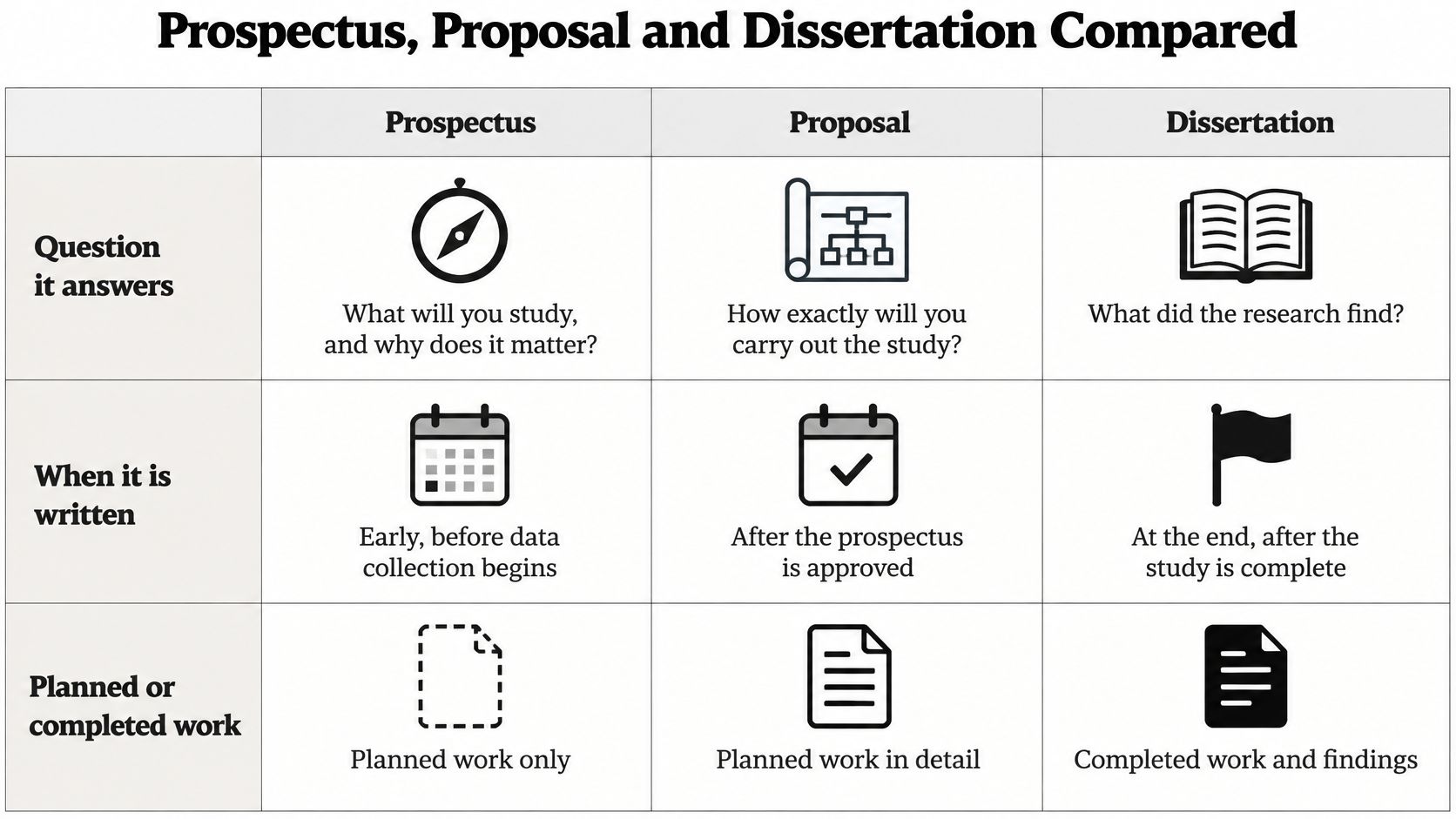
A useful sentence-level test is to ask whether you're describing an intended action or reporting an outcome. I will compare the policy documents describes a plan. The comparison revealed conflicting priorities reports a finding.
Our guide to what a thesis proposal is can help if your program uses proposal terminology. Follow your department's definition rather than inferring the document's purpose from its name.
You aren't expected to invent results to make a prospectus sound complete. If your program requests preliminary findings, distinguish them from the research you still plan to conduct. The approval decision concerns the value and credibility of the proposed investigation, not whether you've already proved your preferred conclusion.
A Worked Example of a Strong Prospectus
Consider a hypothetical working title: Remote work and employee wellbeing. It identifies an area of interest but leaves the population, working arrangement, and meaning of wellbeing unresolved.
The contrast below highlights the move from a broad topic toward a defined project.
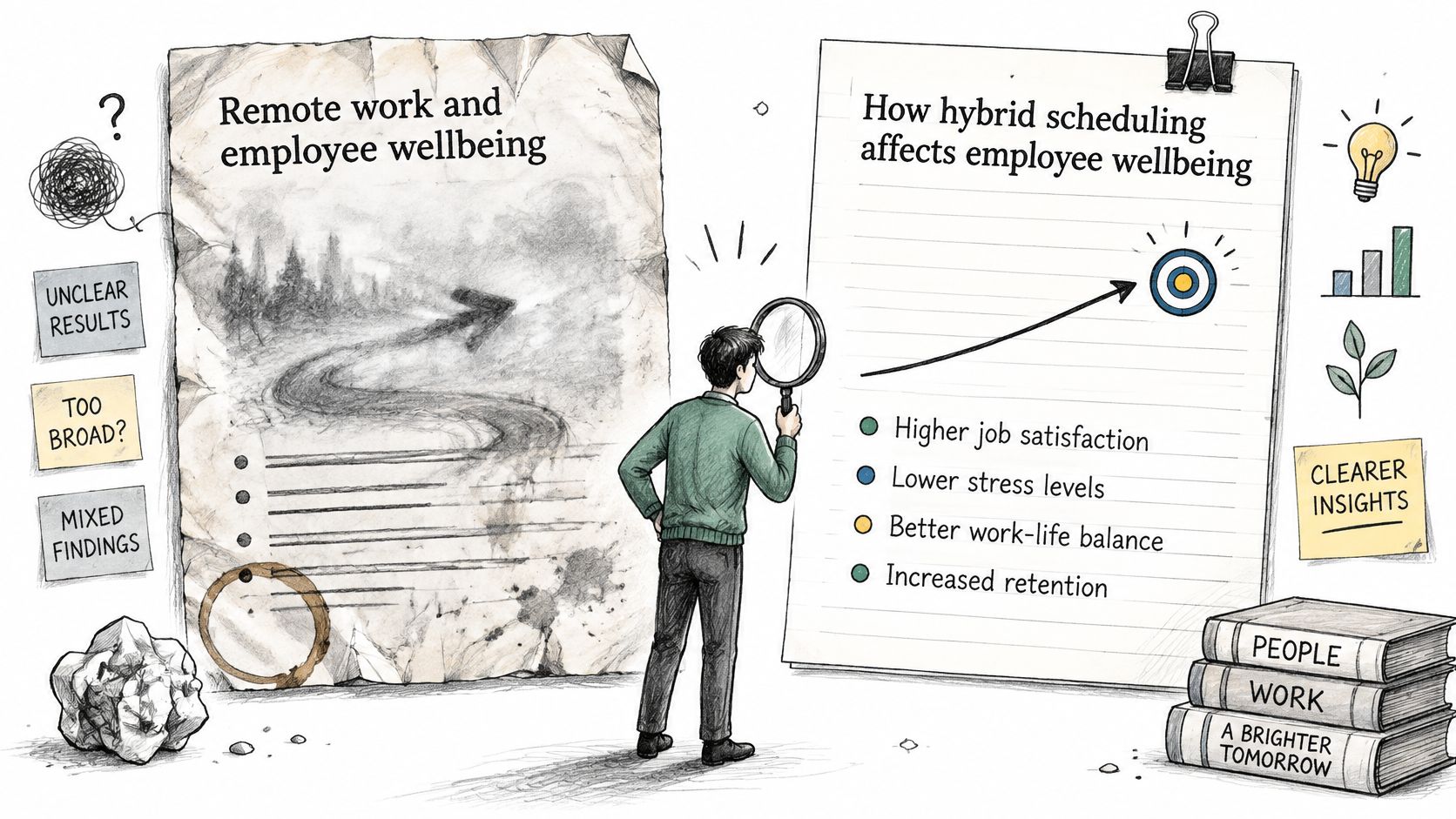
A sharper title might be Hybrid scheduling and burnout among hospital nurses in roles eligible for remote duties. This version identifies the population, working condition, and outcome without claiming that an observational design can establish causation.
Build the plan around answerable questions
Suppose the student proposes surveying 300 nurses across five hospitals, followed by 15 interviews. These numbers are illustrative design choices, not recommended sample sizes or evidence from an actual study. A real prospectus would justify them against the research question, analytical approach, recruitment conditions, and available resources.
Each part then needs a specific job:
- Problem and significance: Establish why scheduling and burnout deserve investigation using actual nursing scholarship, rather than asserting an unsupported trend.
- Literature review: Test whether existing hybrid-work studies adequately address these nursing roles. Don't declare a healthcare research gap before checking.
- Method: Compare scheduling patterns with burnout measures, then use interviews to investigate how participants describe their experiences.
- Access and ethics: Identify participating hospitals, eligibility rules, recruitment arrangements, confidentiality protections, and the required review process before collection begins.
A committee would ask whether eligible nursing roles allow hybrid work. It would also examine how workload, seniority, or role type might complicate the interpretation of any association.
Use the video as a supplementary resource while developing your own project explanation.
Give the chapters an argumentative purpose
A provisional outline could include an introduction, literature review, methods, survey findings, interview findings, and discussion. The findings chapters are planned destinations, not claims that results already exist.
For each chapter, write what it contributes to answering the question. Our thesis outline example can help you turn chapter labels into descriptions of the work each chapter must perform.
Why Format Changes by Field and Institution
There isn't a universal prospectus template. Students get into difficulty when they treat a successful example from another department as an instruction sheet for their own.
The University of Oklahoma's prospectus guidelines suggest 10–12 pages for the project summary and 8–10 pages for chapter outlines. That substantial chapter-level treatment illustrates why you shouldn't assume every department expects a brief outline.
Prospectus requirements by institution and guide
| Institution or guide | Required elements | Length guidance |
|---|---|---|
| Oklahoma | Project summary, chapter abstracts, bibliography | Summary and chapter-outline allocations specified in its guidelines |
| Economics guide | Problem, literature survey, method, data, chapter outline, selected bibliography | Follow the economics program's total and section limits |
| USC | Sources, theoretical or methodological framing, chapter organization, provisional timetable | Confirm with the relevant department |
| NYU | A template explicitly presented as flexible rather than a rigid formula | Confirm with the relevant program |
| Wayne State | Scope, materials or subjects, study design, method, projected results | Confirm with the relevant doctoral program |
Separate purpose from format. The purpose is to establish significance, contribution, feasibility, and a credible plan. Format determines where those arguments appear and how much space you give them.
An archival project may need substantial discussion of collections, missing records, and interpretive framing. A laboratory project may need closer attention to instruments, procedures, equipment access, and experimental design. Neither student should imitate the other's structure without adapting it.
Practical rule: Use your local rubric as the specification and an online template as a drafting aid, never the reverse.
Don't treat the prospectus as a long abstract. Committees need enough detail to evaluate decisions, not just a longer description of the topic. Ask your supervisor which elements are mandatory and which can be reorganized to suit your project.
Confirm Your Local Requirements Before Drafting
Before you write polished sections, assemble the instructions and decisions that will govern them. You'll make better progress if you resolve conflicting expectations before they become a full-draft problem.
Turn requirements into drafting actions
Find the department's current guidance. Record the page limit, required sections, citation style, submission process, and approval arrangements. Check whether general graduate-school rules supplement the departmental document.
Request a recently approved example. Ask your supervisor what makes it useful. An example shows how a committee accepted a particular project, but it doesn't override written requirements.
Map the required elements. Create a working outline and place each requirement under a heading. Flag missing information, such as an access agreement or an unexplained analytical procedure.
Draft the central design paragraph. Connect the problem, research question, method, and intended evidence. If you can't explain the relationship plainly, refine the design before expanding the prose.
Work backward from submission. Assign deadlines for the literature review, methods, chapter outline, supervisor feedback, and revision. Our guide to submission requirements can help you identify administrative checks to include.
Confirm the unresolved conditions. Ask which access permissions, ethics reviews, training needs, and contingency plans your committee expects you to address. Record who will resolve each issue.
A planning workspace can help you keep those decisions alongside the writing tasks they affect.
Ask for a decision, not just comments
When you send a draft, identify what you need your supervisor to evaluate: the scope, evidence access, methodological fit, or chapter logic. Focused questions make it easier to distinguish essential design revisions from stylistic preferences.
Your final check isn't whether the document sounds impressive. It's whether the committee can approve a clear, feasible project matched to local requirements, with the remaining uncertainties stated clearly.
Our Thesis roadmap turns the project into a step-by-step path from proposal to submission, while the Chapter tracker follows chapters and sections from outline to final draft. Visit Thesis Book Project to organize your prospectus tasks and subsequent dissertation work. Our free Starter plan includes both tools, one project, and community support.
Related Articles
Thesis Outline Example: A Chapter-by-Chapter Sample
You've opened a document, typed Introduction, Literature Review and Methodology, and stopped. Th...
Research MethodsLiterature Review Plan Example with a Timeline
Forty-seven PDFs sit in your downloads folder. You've opened three. The chapter is due in eight...
Research MethodsGoals of Planning: Why Every Research Project Needs One
You have a folder called thesis_stuff, forty open tabs, and a supervision meeting on Thursday. When...
Comments (0)
No comments yet. Be the first to share your thoughts.