Literature Review Outline: Template and Annotated Structure
Learn how to build a literature review outline with our annotated template. Includes synthesis matrices, PRISMA compliance, and actionable examples
What does your literature review outline prove? If it only lists authors, topics, or publication dates, it may organize information without explaining the state of knowledge. A defensible outline does more. It shows which claim each section develops, what evidence supports or challenges it, what remains unresolved, and why the gap matters to your study.
The most useful way to build that structure is to work from a synthesis matrix. Instead of treating each article as a separate item, you compare research questions, frameworks, methods, findings, limitations, and relevance, then convert those relationships into an argument map. The result is an outline that guides academic reasoning, not merely a table of contents.
Table of Contents
- The Evolution of the Literature Review Outline
- Choosing the Right Review Type for Your Outline
- Building a Synthesis Matrix for Structured Planning
- Annotated Literature Review Outline Template
- Constructing Claims and Evidence Within Sections
- Applying PRISMA Guidelines for Systematic Reviews
- Organizational Logics for Thematic Arrangement
- Avoiding Common Pitfalls in Outline Design
- Quick-Reference Outline Checklist
- Integrating the Outline with Thesis Management Tools
The Evolution of the Literature Review Outline
A literature review outline became increasingly associated with explicit, reproducible review stages as research synthesis developed from the 1970s onward. The historical development is commonly divided into a foundation period from 1970 to 1989, an institutionalization period from 1990 to 2000, and a diversification period beginning in 2001, a progression documented in this historical overview of research synthesis.
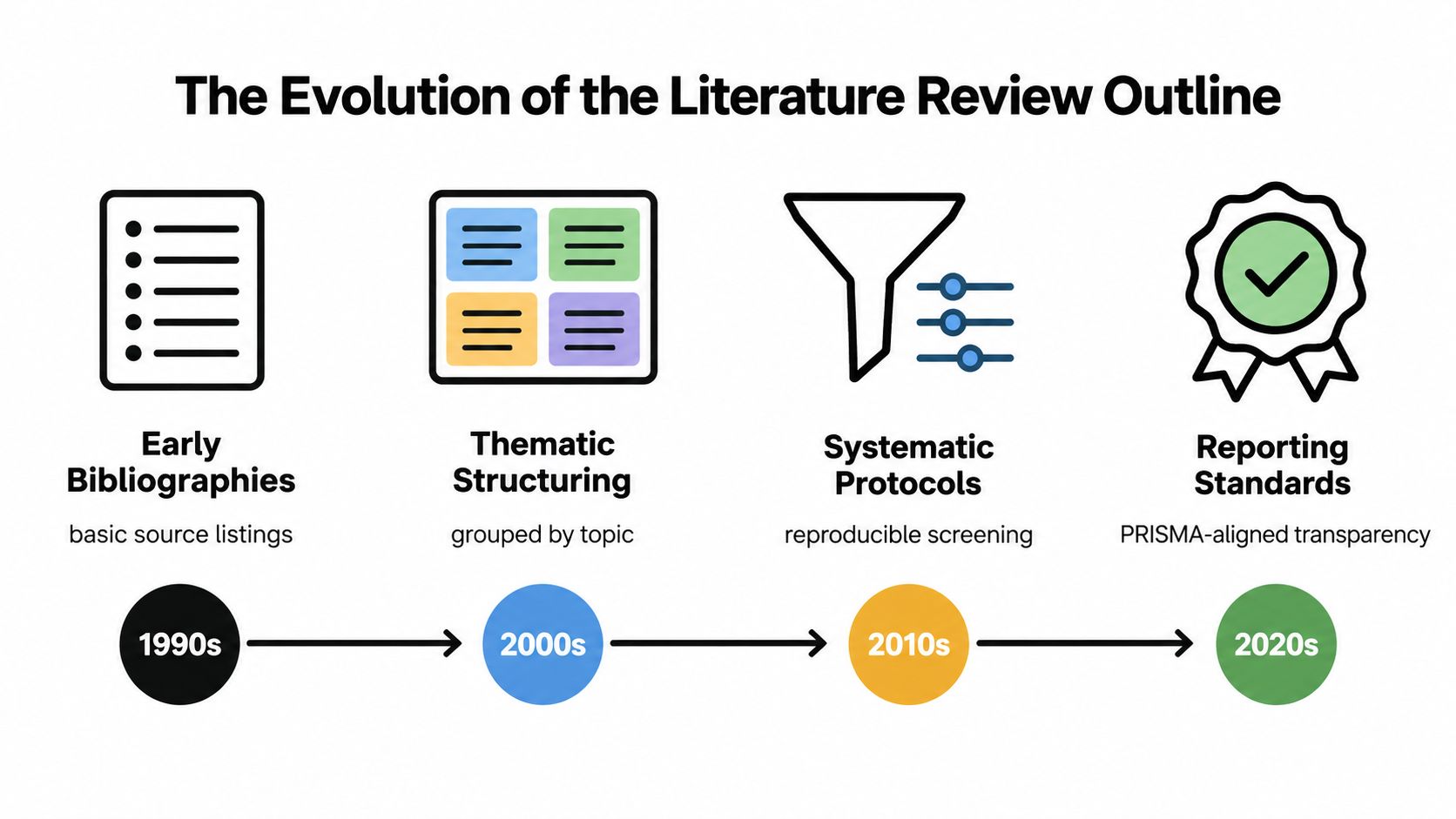
The reason for that shift was practical. Researchers needed to reduce bias when identifying, evaluating, and combining previous studies. Earlier milestones matter too. James Lind's 1757 work on scurvy is often treated as an early example of a thorough and impartial assessment of existing evidence, showing that the impulse toward organized synthesis predates modern review terminology.
A contemporary outline therefore needs more than source names. It should make the research question, search boundaries, inclusion and exclusion criteria, source-evaluation method, organizational logic, synthesis strategy, and motivating gap visible.
Practical rule: If a reader can't tell why a source belongs in a section, the outline is probably cataloguing literature rather than analysing it.
The historical lesson is straightforward. A literature review outline is not just a memory aid. It's a record of decisions that allows supervisors and readers to distinguish evidence-supported conclusions from your interpretation.
Choosing the Right Review Type for Your Outline
The correct outline depends on the kind of review you're conducting. A narrative review, a scoping review, a systematic review, an integrative review, and a dissertation literature chapter may all discuss related research, but they don't make the same claims about coverage, selection, or evidence.
A conventional thesis chapter often uses a thematic, conceptual, theoretical, or methodological structure. Its outline might include:
- Research problem and scope: Define the question and boundaries.
- Thematic body: Group studies according to meaningful relationships.
- Critical synthesis: Compare findings, methods, assumptions, and limitations.
- Research gap: Show what remains unresolved and how it leads to the study.
A systematic or scoping review requires a more explicit reporting plan. Guidance for systematic reviews calls for an explicit question, eligibility criteria, searched databases and other sources, reproducible methods, critical appraisal, and a synthesis plan, as described in this guide to literature review methods.
| Review approach | Appropriate outline emphasis |
|---|---|
| Narrative review | Themes, debates, concepts, and interpretive synthesis |
| Scoping review | Scope, eligibility, searching, screening, mapping, and evidence characteristics |
| Systematic review | Reproducible searching, selection, appraisal, extraction, and synthesis |
| Dissertation chapter | Theoretical framing, thematic analysis, gap, and connection to the research aims |
The common mistake is assuming that more methodological detail automatically makes a thesis chapter stronger. It doesn't. Rigor means making the chosen approach transparent and proportionate to the question. If you haven't designed an exhaustive, reproducible review, don't present a conventional chapter as though it were a systematic review.
Building a Synthesis Matrix for Structured Planning
A synthesis matrix turns scattered reading notes into a planning instrument. Create columns for each source's research question, theoretical or conceptual framework, research design, sample or context, findings, limitations, and relevance. This structure follows the matrix approach described in guidance on literature review planning.
Start with one row per source, but don't stop at bibliographic details. Record what the study contributes to your question. A limitation might concern context, method, theory, or interpretation. Relevance should answer a practical question: does this source establish background, support a claim, challenge another finding, expose a limitation, or help define the gap?
Then read across the columns rather than down the source list.
- Cluster related evidence. Mark studies that address the same concept, population, mechanism, or debate.
- Identify contrasts. Note where methods, assumptions, contexts, or findings differ.
- Name the emerging claim. Ask what the group of studies suggests when read together.
- Locate uncertainty. Record contradictions, blind spots, and underexamined relationships.
- Convert clusters into sections. Give each section a heading that expresses its analytical purpose.
For example, three sources may examine the same research problem but use different designs and reach different conclusions. Your outline shouldn't create three author-based subsections. It might create a section titled Methodological explanations for conflicting findings, followed by paragraphs comparing the designs and contexts.
A useful literature review table can support this work, but the tool matters less than the reasoning. The matrix becomes valuable when each row helps answer, “What does this source do in my argument?”
Annotated Literature Review Outline Template
A strong template has three structural movements: introduce the problem, synthesise the evidence, and establish the need for the study. The annotations below show what each part should accomplish.
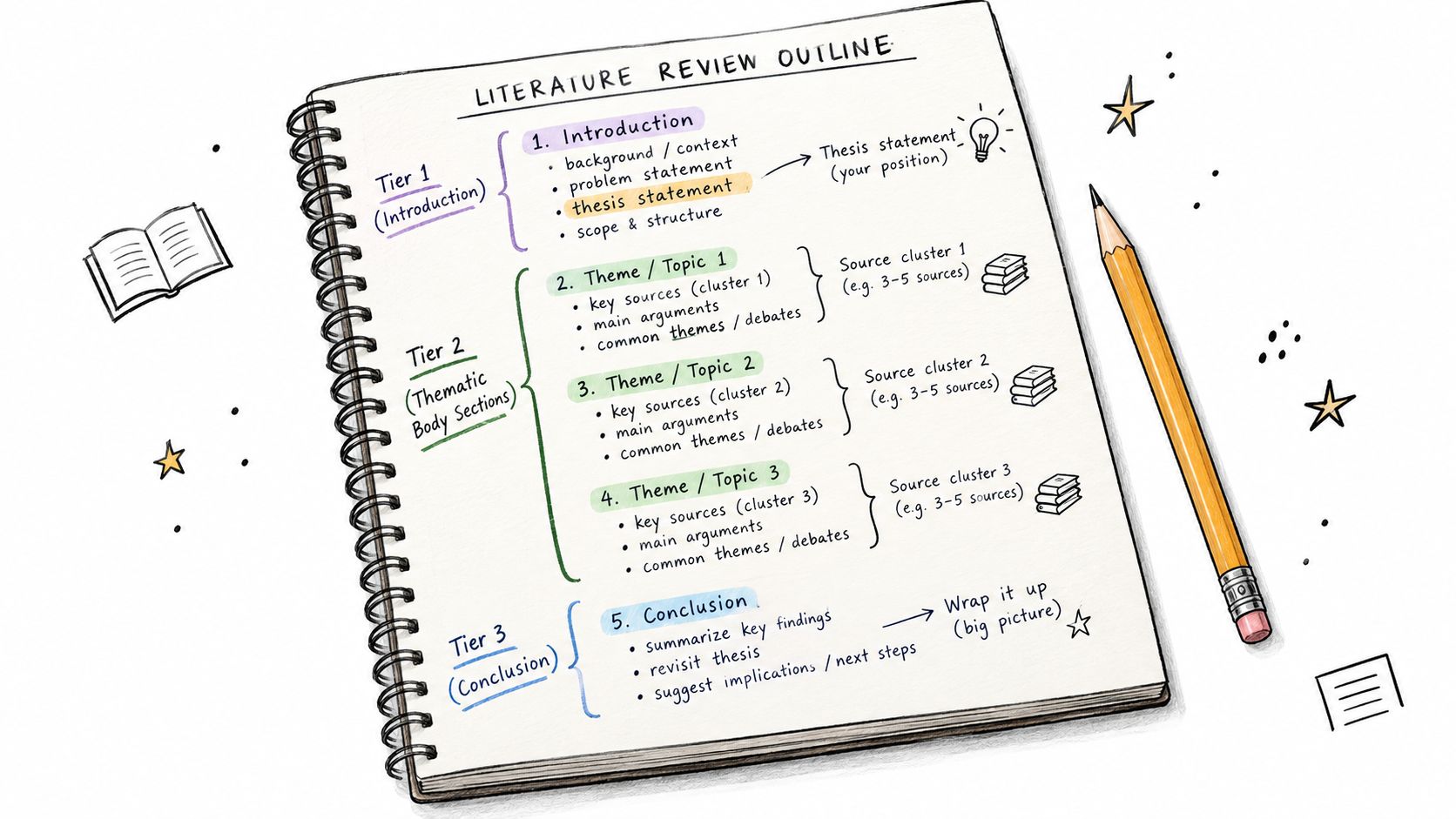
Introduction
- Research problem: Explain the issue that makes the review necessary.
- Scope: Define the concepts, population, context, or boundaries you'll include.
- Research question: State the question that controls source selection and interpretation.
- Organizing logic: Tell the reader whether the body is thematic, chronological, theoretical, methodological, or argument-based.
- Review purpose: Clarify whether you're mapping knowledge, evaluating debates, or establishing a foundation for a new study.
Thematic body
For each major theme, write an annotation that includes the section's claim, supporting evidence, counterevidence, and connection to the research question. Subsections should separate genuine analytical issues, not merely divide the page into smaller units.
A practical structure looks like this:
Theme one: State the main claim and identify the relevant studies.
- Compare agreements and differences.
- Explain whether methodological or contextual variation accounts for disagreement.
- End with the implication that leads to the next theme.
Theme two: Develop the next part of the argument.
- Introduce evidence that expands or challenges the earlier claim.
- Identify limitations across the studies.
- Explain what remains uncertain.
Theme three: Narrow the discussion toward the research gap.
- Connect the strongest patterns.
- Show where existing explanations are incomplete.
- State why the unresolved issue requires further investigation.
Synthesis and conclusion
The synthesis should consolidate what the literature establishes, where it conflicts, and which limitations matter most. The conclusion then links that assessment to the study's aims, without introducing an unrelated final topic.
For a more general planning framework, you can use a project outline format and adapt its hierarchy to academic claims, evidence, and transitions.
Constructing Claims and Evidence Within Sections
A heading such as “Previous research on student engagement” identifies a topic, but it doesn't tell you what the section will argue. Replace broad labels with an internal framework built around claim, evidence, counterevidence, implication.
Claim
Write one sentence stating what the section should establish. The claim must be specific enough to be challenged. “Researchers have studied engagement” isn't useful. “Engagement is explained through both interaction and course design, but studies disagree about which factor carries greater weight” gives the section an analytical direction.
Evidence and counterevidence
Place studies together according to the relationship you want to examine. Compare their findings, methods, assumptions, and limitations. Do not give each author an isolated paragraph unless the author's contribution is clearly distinct.
University guidance stresses that literature reviews should compare relationships, patterns, agreements, disagreements, strengths, weaknesses, and gaps, rather than merely summarise sources. This academic guidance on literature review analysis supports an outline in which every major section records both supporting and challenging evidence.
Implication
End the section plan by stating what the comparison means. The implication may qualify the original claim, reveal a methodological problem, or show why the next theme is necessary.
A useful paragraph plan doesn't ask only, “What did this study find?” It asks, “What becomes clearer when these studies are compared?”
This is how an outline becomes a defensible narrative. Each section advances a claim, tests it against evidence, acknowledges tension, and creates a reason for the next section.
Applying PRISMA Guidelines for Systematic Reviews
For systematic and scoping reviews, the outline should also function as a reporting-compliance plan. PRISMA was first published in 2009, and the 2020 update replaced the original framework with a 27-item checklist organised into seven sections, alongside a dedicated abstract checklist and revised flow diagrams, as explained in this PRISMA 2020 overview.
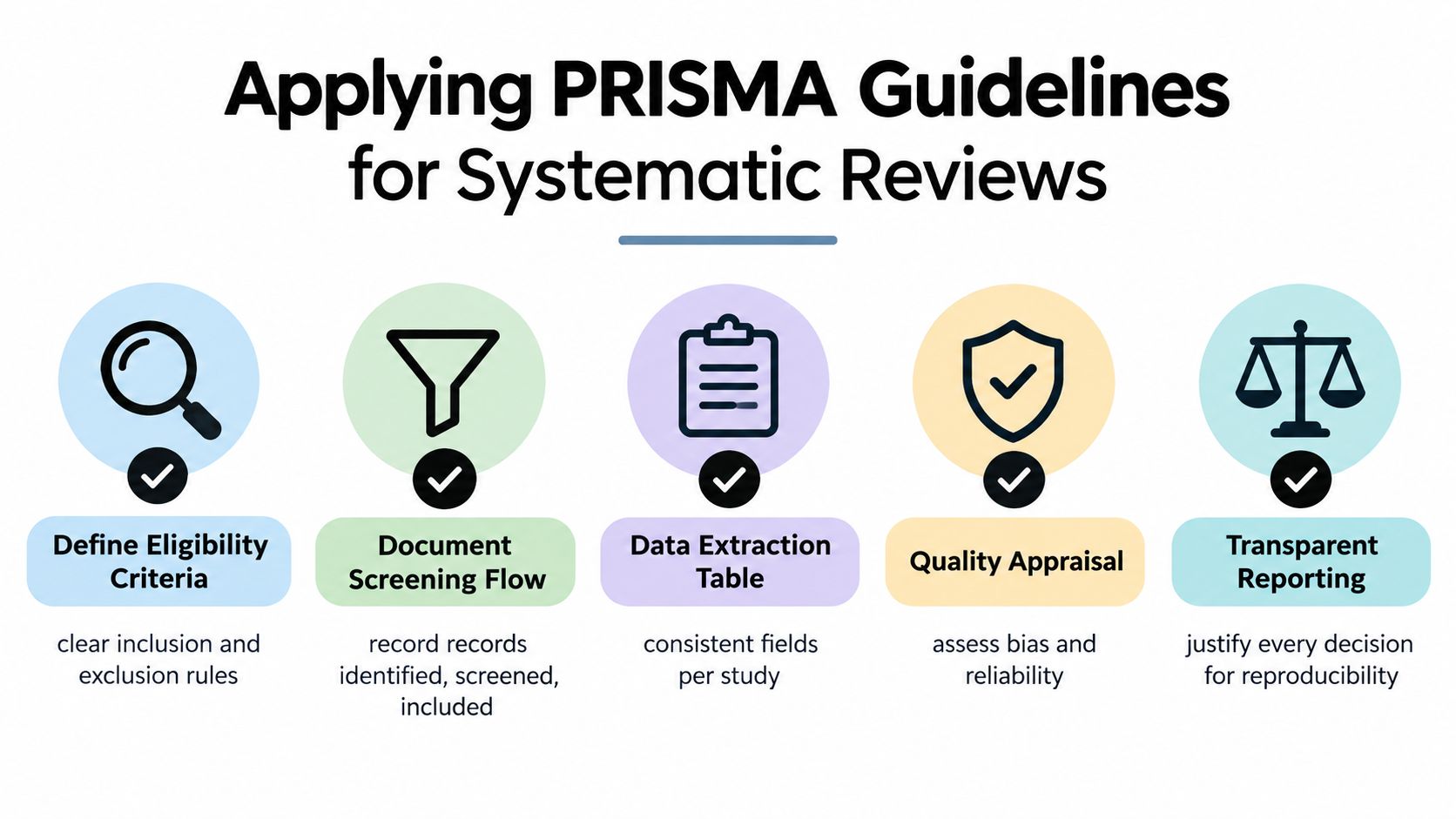
Your outline should identify the following components:
- Rationale and question: Explain why the review is needed and define its question.
- Eligibility criteria: State inclusion and exclusion rules before screening.
- Information sources: Record every database, register, website, organisation, reference list, or other source searched, together with the date last consulted.
- Search strategy: Preserve the complete strategy so another researcher can understand how evidence was retrieved.
- Screening process: Document identification, screening, eligibility assessment, and inclusion decisions.
- Data collection: Define the variables extracted from each included study.
- Appraisal: Specify the method used to assess quality or risk of bias.
- Synthesis: Name and justify the thematic, narrative, qualitative, or quantitative method used.
- Limitations: Record exclusions, deviations, and weaknesses in the evidence.
The results outline should distinguish search and screening information from included-study characteristics, appraisal findings, and the actual synthesis. PRISMA improves reporting transparency, but it doesn't choose the review methodology for you.
The framework is easier to apply when its requirements are planned before drafting. This short visual guide can reinforce the sequence.
Organizational Logics for Thematic Arrangement
The same sources can produce different narratives depending on how you arrange them. Choose the logic that makes the relationships most important to your research question visible.
Chronological organisation works when change over time is itself part of the argument. Use it to show how concepts, methods, theories, or findings developed. Don't turn it into a publication timeline without interpretation.
Thematic organisation groups studies around recurring issues. It's usually effective when researchers approach one broad problem through several concepts, populations, mechanisms, or debates. Each theme should contribute a distinct step in the argument.
Theoretical organisation places frameworks at the centre. It can compare how competing theories explain the same phenomenon, where their assumptions overlap, and where their predictions diverge.
| Logic | Best suited to questions about |
|---|---|
| Chronological | Development, change, or turning points |
| Thematic | Recurring concepts, issues, or relationships |
| Theoretical | Explanatory frameworks and competing interpretations |
You can combine logics when the transition has a clear purpose. For example, a thematic review might use a chronological subsection to explain why one debate changed. Keep the rationale visible in your outline. The practical guide to literature review organization can help you compare possible arrangements before committing to one.
Avoiding Common Pitfalls in Outline Design
More detail doesn't necessarily produce more analytical depth. A highly expanded outline can still fail if every bullet just names another author, finding, or topic. Detail helps only when it clarifies reasoning.
The most serious pitfalls are structural:
- Source-by-source planning: Separate author entries encourage summary instead of comparison.
- Premature headings: Creating categories before identifying relationships forces evidence into unsuitable sections.
- Overlapping themes: Similar headings create repetition and blur the argument.
- Mismatched methodology: A conventional thesis chapter shouldn't imitate a systematic review unless its search and reporting claims support that design.
- Excessive nesting: Too many subsection levels fragment ideas that belong together.
- Missing transitions: Sections may contain relevant studies but still fail to explain why one follows another.
A detailed outline should tell you what to argue, not merely what to mention.
Test every major section with one question: what claim will this section establish, challenge, or qualify? If you can't answer clearly, rename it, merge it, or remove it.
Quick-Reference Outline Checklist
Before drafting, inspect the outline as an argument rather than a list of headings. Confirm that each structural choice helps the reader follow the movement from research problem to evidence, synthesis, and gap.
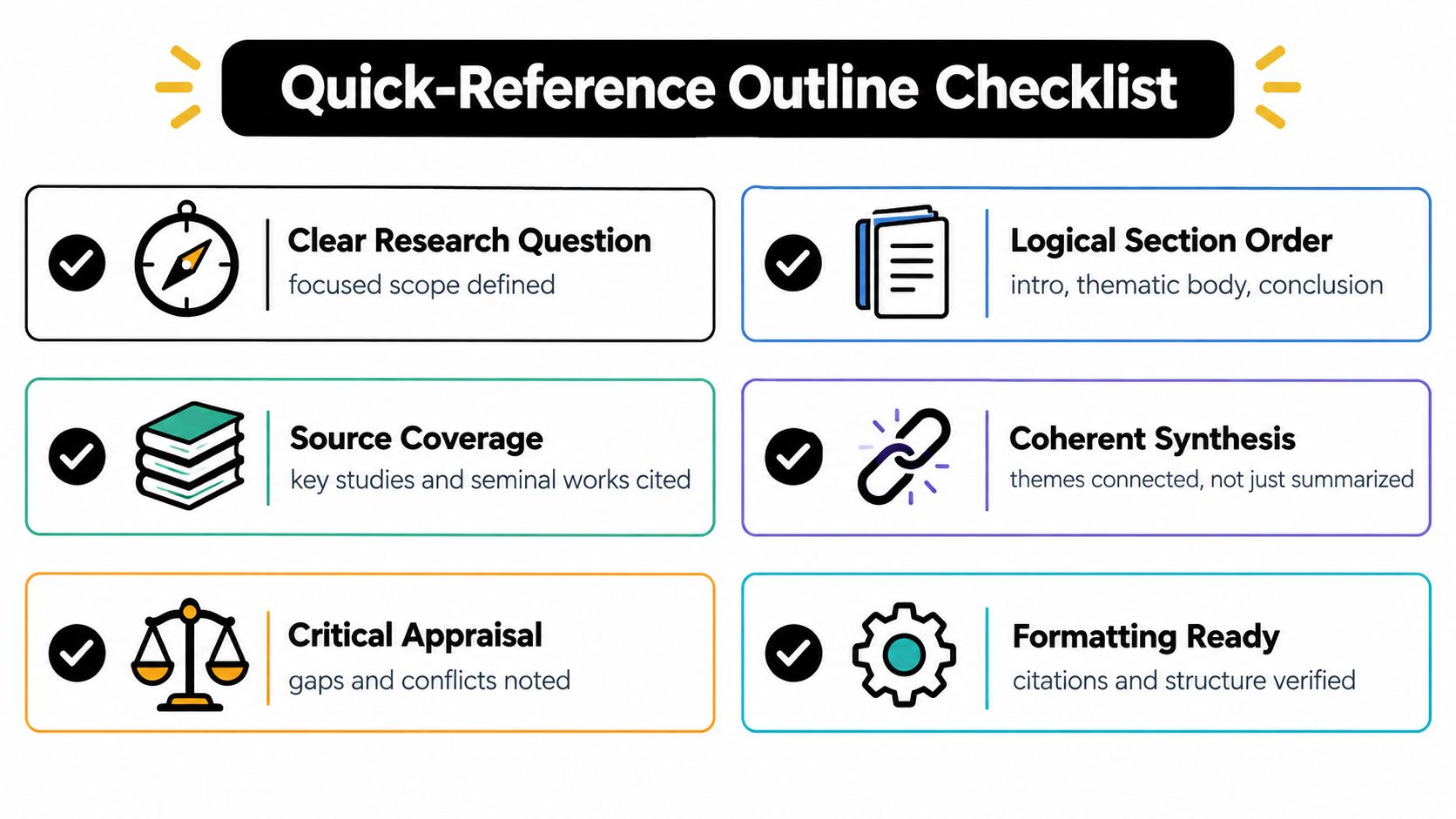
- Question: Is the research question focused and visible throughout the outline?
- Scope: Are the boundaries and selection principles clear?
- Structure: Does the introduction lead into a logically ordered thematic, chronological, theoretical, or methodological body?
- Evidence: Does each section identify supporting studies, counterevidence, methods, and limitations?
- Synthesis: Does every major theme end with an implication rather than a final summary of authors?
- Gap: Does the conclusion show what remains unresolved and connect it to the study's aims?
For systematic or scoping reviews, add the search sources, search dates, eligibility rules, screening process, extraction variables, appraisal method, synthesis plan, and deviations. For a narrative thesis chapter, include only the methodological detail your design can support.
Integrating the Outline with Thesis Management Tools
A literature review outline becomes easier to maintain when you connect it to the wider thesis workflow. Store each matrix row with its planned chapter or section, then update the assignment when themes merge, split, or change order.
Use a chapter tracker to record whether each component is at the outline, evidence-mapping, drafting, revision, or final stage. A source manager can keep reading notes and references attached to the relevant section, while milestone scheduling helps you work backward from the submission date. Supervisor sharing can also make meetings more concrete because you can discuss a specific unresolved claim, missing source, or transition rather than reporting general progress.
Thesis Book Project is one option for this workflow. Its roadmap, chapter tracker, source manager, milestone scheduling, progress views, and supervisor sharing features are designed to connect research planning with chapter development. The key principle applies regardless of software: keep your sources, claims, sections, and deadlines connected.
Thesis Book Project helps students and researchers organise sources, map chapters, track literature review sections, and manage thesis milestones from proposal through submission. Visit Thesis Book Project to turn your literature review outline into a traceable writing plan and keep each section aligned with the larger research project.
Related Articles
10 Software for References Compared in 2026
The most feature-rich reference manager isn't automatically the best one. A thesis writer who sp...
Research MethodsHow to Write a Thesis Introduction That Works
You're staring at a blank document with a dozen tabs open, a working title that keeps changing,...
Research Methods7 Literature Review Research Proposal Examples
A literature review can be the part of a proposal that proves a study is necessary, not merely the p...
Comments (0)
No comments yet. Be the first to share your thoughts.