How to Write a Research Question: A Practical Guide
Learn how to write a research question that guides your thesis. Master the PICO framework, FINER criteria, and common pitfalls
You may be staring at a topic that feels promising and impossible at the same time. The idea is interesting, your supervisor wants something sharper, and the submission date is already real enough to cause stress. That's exactly where how to write a research question stops being a writing exercise and becomes a project-design decision.
Table of Contents
- What a Research Question Actually Does
- Using the PICO Framework to Build Clarity
- A Two-Pass Method for Drafting Your Question
- Six Failure Modes That Ruin Research Questions
- Testing Feasibility Before You Commit
What a Research Question Actually Does
A research question is not a decorative sentence you place at the top of a proposal. It decides what evidence belongs in the study, which methods make sense, and how the final answer will be judged. The U.S. National Academies' Scientific Research in Education treats research questions as the mechanism that separates a real study from a loose topic, because a good question can describe what is happening, explain causes, examine processes, solve practical problems, fill gaps in knowledge, or test hypotheses. The report also says a scientifically useful question has to be empirically investigable, tied to relevant theory, and answerable with methods that allow direct investigation.
That is why weak questions fail so often. “Online learning” is a subject, not a question, because it does not tell you who, where, what aspect, or which outcome you are studying. A defensible version might name the population, setting, phenomenon, and outcome, such as weekly instructor feedback and course completion among first-year undergraduates in online courses.
Match the question to the kind of evidence you can actually collect
The National Academies' framework is useful because it makes the hidden choice visible. A descriptive question asks what is happening, a causal question asks whether there is a systematic effect, and a process question asks why or how something happens. Those are not stylistic variations, they imply different evidence, different sampling decisions, and different kinds of conclusions.
Practical rule: write the question before you fall in love with the method. If the wording demands causal proof, but your design can only observe patterns, the question is too ambitious.
That's also why a research question should act as a bridge from literature review to methodology. Once you know the exact gap, you can tell whether the evidence needs surveys, interviews, experiments, content analysis, or a mixed design. If you're still adjusting your topic and your reading pile is sprawling, a planning system such as how to reclaim hours weekly can help you protect time for the actual thinking, not just the reading.
For a sharper distinction between problem and question, this companion guide on what is a research problem statement helps anchor the larger issue before you sentence-by-sentence your way into wording.
Using the PICO Framework to Build Clarity
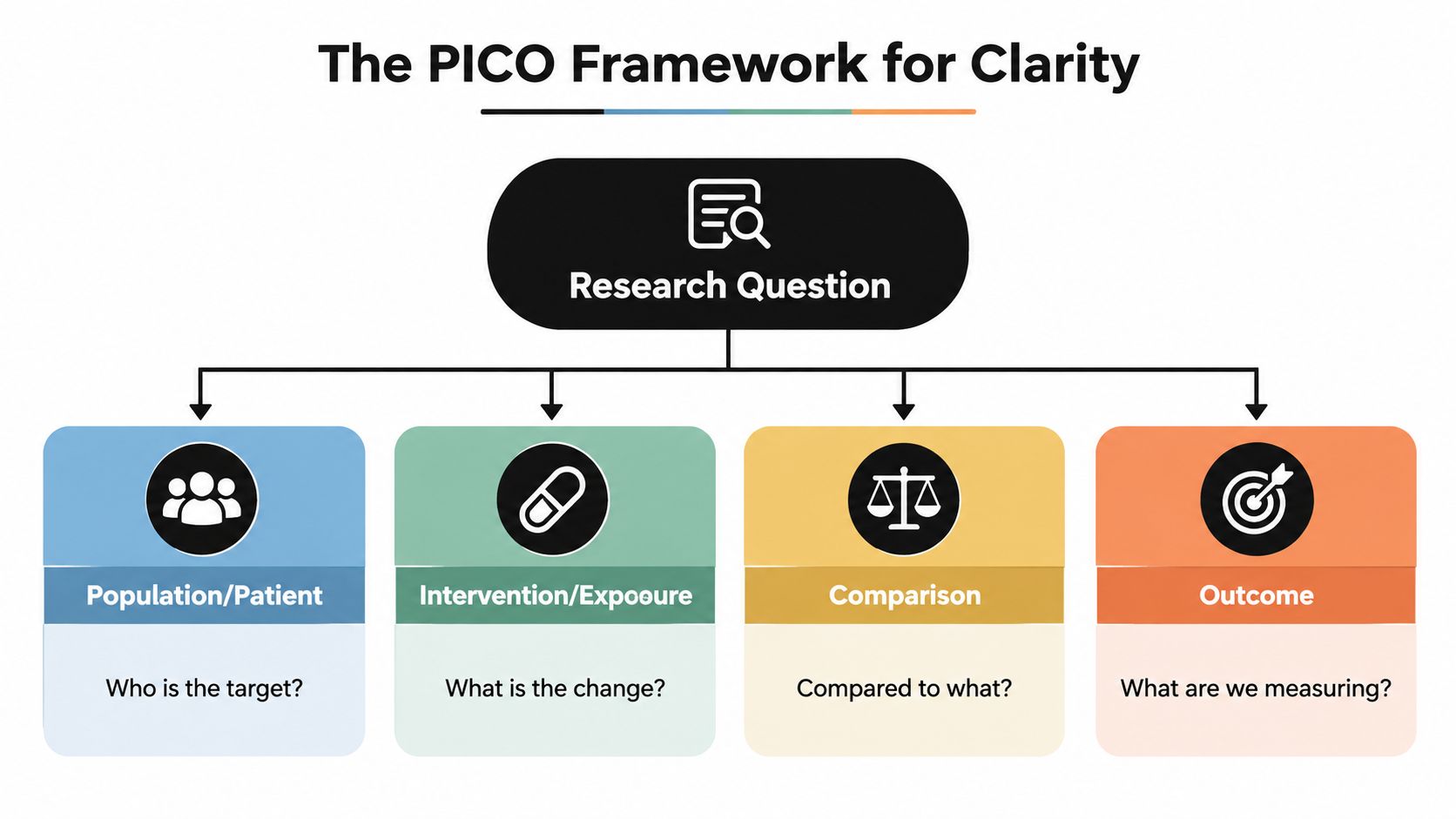
A research question often fails because it is too broad to test in the time and access you have. PICO tightens that problem by forcing you to name the Population or Patient, Intervention or exposure, Comparison, and Outcome. In practice, that means you move from a vague “does it work?” to a question you can search, sample, and defend without pretending resources are unlimited.
Build each element before you draft the sentence
Start with the population. Name the people, cases, or documents you can realistically reach, not the ideal universe you wish you had. If access is thin, say so early and narrow the scope before you commit to a design that will stall later.
Then define the intervention or exposure. That is the thing you are changing, observing, or comparing, and it should be specific enough that you could clearly identify it in your study setting.
The comparison comes next. “Compared to what?” is where many promising topics either become usable or collapse under their own vagueness. A clear comparator separates a paper-topic from a research question that can survive proposal review, ethics review, and the calendar.
The outcome closes the loop. Name the endpoint you care about, whether that is completion, performance, experience, behavior, or another measurable result that fits your access and methods.
PICO works best in quantitative intervention studies, because each part turns into a searchable concept and a design decision. It is less natural for qualitative work, where meanings, experiences, contexts, or processes usually carry more weight than intervention effects. The University of Louisville guide on developing your question also pairs PICO with FINER, a useful check when you need to narrow a topic without making it trivial.
A strong PICO question pays off twice. The literature search gets cleaner, and the sample definition gets sharper, which means fewer last-minute rewrites.
A practical example is the move from “Does a tutoring program help students?” to “Among first-year undergraduates, does weekly peer tutoring, compared with standard study support, improve course completion?” The second version is still readable, but the population, contrast, and outcome are visible, which makes the next decisions easier.
For a closer look at the gap you are trying to define, see what is a research gap. If the gap is fuzzy, the question usually is too.
Watch the 90-second walkthrough below to see the four PICO elements filled in for one example question.
A Two-Pass Method for Drafting Your Question
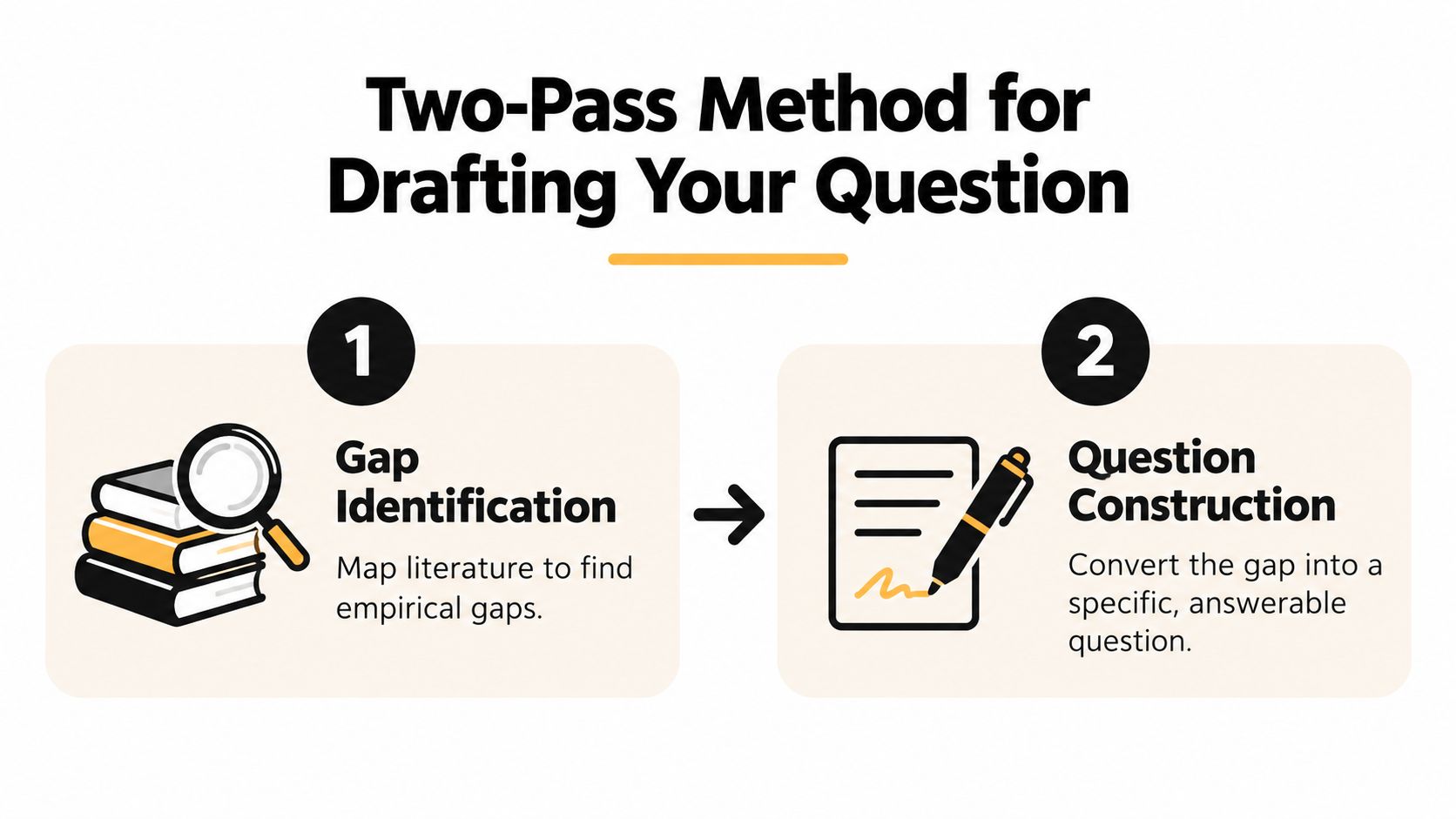
A lot of weak research questions come from starting with the sentence instead of starting with the gap. The better method is two-pass: first identify what the literature still leaves open, then convert that gap into a question with explicit boundaries. That keeps you from forcing a nice-sounding sentence onto a messy problem.
First pass, write the gap in one sentence
Don't begin by polishing wording. Read enough literature to answer one question for yourself, what is still unclear here? Write that gap in one sentence. If you can't do that yet, you're not ready to phrase the research question.
That gap sentence should be concrete. It should tell you what population, context, or mechanism is missing from prior work, or what comparison nobody has made cleanly. The study becomes yours at that moment, because the gap defines the contribution long before the proposal is formatted.
Second pass, turn the gap into a bounded question
Now translate the gap into a question with the right pieces in place. If the study is quantitative, name the population, intervention or exposure, comparator, outcome, and, when needed, the time frame. Rutgers' guidance recommends this kind of backward construction, then screening the draft with FINER so you can test feasibility, novelty, ethics, and relevance before you invest too much time. Their chapter on research questions also emphasizes that the question should be auditable before proposal writing.
That sequence matters because it forces a reality check. A question can be elegant and still be impossible if the participants are inaccessible, the outcome is hard to measure, or the timeline is unrealistic. Backward planning protects you from turning a useful idea into a semester-long detour.
Useful habit: write the question, then underline every term that would need an operational definition. If too many words need interpreting, the question is still too loose.
This is also where practical planning tools can help. Thesis Book Project, for example, supports a thesis roadmap, chapter tracking, milestone scheduling, progress visibility, and reference organization, which makes it easier to test whether the question fits the degree timeline before you commit to it. Its dissertation proposal guide is especially relevant because it frames a defensible question around a concrete problem, available data, and feasibility within the program schedule.
The result of a good two-pass process is not just a better sentence. It is a question that matches your evidence, your access, and your deadlines.
Six Failure Modes That Ruin Research Questions
The worst failures are rarely dramatic. They are small wording mistakes that make a question impossible to answer well. Breadth, vagueness, binary framing, unsupported causality, and infeasibility do most of the damage because they sound fine until you try to build a study around them.
The question is too broad or too narrow
“Does policy X work?” looks tidy, but it falls apart as soon as you ask for whom, compared with what, by what outcome, and over what period. A broad question produces a vague project. An overly narrow one can leave you with findings that are too thin to matter beyond a single case. The right size sits in the middle, bounded enough to study and wide enough to be useful.
The wording already assumes the answer
Questions that slip in words like “improve,” “damage,” or “increase” can build the conclusion into the question. That is a problem when the study might show no effect, a mixed effect, or the opposite effect. Guides such as the San José State University writing center checklist flag this as flawed because the wording presupposes the result instead of asking for it.
The design cannot support the claim
Causal language is a common trap. If your design is cross-sectional, “affect” is usually too strong, because it implies cause and effect that the data cannot establish on its own. In that case, “is associated with” is safer unless your design supports causal inference through temporal order, control of confounding, and an appropriate analytic approach.
A question can also fail by being only a yes/no prompt. That style is tempting because it sounds direct, but it often hides the problem rather than clarifying it. The stronger version names the outcome and the comparison so the answer can be interpreted instead of merely accepted or rejected.
Neutral wording matters more than polished grammar. A question can begin with “how” and still be biased if it quietly assumes the result.
The time frame is missing
A question that leaves timing vague is hard to research and harder to defend. If you do not define the period being studied, you may end up comparing cases that are not actually comparable, or drawing conclusions that stretch beyond the evidence. A clear time frame keeps the scope honest and makes the project easier to execute on schedule.
The point is simple. As the PICO section showed, the wording has to match the evidence you can collect. If the question asks for more than the design can deliver, it will stall before analysis ever starts.
Testing Feasibility Before You Commit
An interesting question is useless if you cannot finish it on time. Feasibility is the part students often postpone because it feels less theoretical than argument or wording, yet it usually decides whether a proposal moves ahead or stalls. A strong question has to survive access, ethics, timing, and workload as they exist in reality, not as you hope they will be.
Run a feasibility audit before approval
Start with access to the sample. If you cannot realistically reach enough participants, cases, or documents, narrow the question before you go further. Then check response or retention expectations, measurement validity, analysis workload, ethical constraints, and the submission date.
A recent 2025 study of 304 master's and doctoral students found persistent difficulty identifying research gaps and strengthening arguments across humanities, arts, social sciences, education, and business. The study is a useful reminder that topic choice often breaks down at the point where an interesting gap still has to become a workable study.
Narrow by constraints, not by panic
If the question depends on unavailable data or an unmeasurable construct, do not just rename it and hope the problem disappears. Narrow the population, reduce the geography, define a shorter time frame, or choose a method that fits the evidence you can gather. The question should bend toward the resources you have.
If the question only works with perfect access, it does not work.
The strongest move is to plan backward from the submission date. Check source availability, ethics review timing, recruitment delays, analysis time, and supervisor feedback before you commit. A dissertation proposal is easier to defend when every milestone already has a place on the calendar, and the same logic applies when you use how to write a dissertation proposal as a planning reference.
That backward-planned schedule is the gap Thesis Book Project is built to close. If your question survives the audit, the next step is putting the milestones on the calendar before you commit.
Related Articles
How to Create an Annotated Bibliography: A Practical Guide
You're staring at a stack of PDFs, half-finished notes, and a citation manager that's doing...
Research MethodsWhat Is a Systematic Literature Review: A Student Guide
You're staring at a pile of papers, each using different terms, methods, and conclusions. Your s...
Research MethodsWhat Is a Thesis Proposal: A Complete Guide for 2026
A thesis proposal is a formal planning document that argues a proposed study is intellectually worth...
Comments (0)
No comments yet. Be the first to share your thoughts.