Thesis and Roadmap: Plan Your Path to Submission
Learn how a thesis and roadmap keeps milestones, chapters and supervisor check-ins on track, from proposal stages to final submission.
You've got a submission date somewhere in a programme handbook, a folder of half read papers, and a supervisor meeting next week where you'll be asked a simple question. What have you finished, and what's next? If your answer is a list of things you've been working on, rather than things you can show, you're not behind because you're lazy. You're missing a plan that turns effort into evidence.
That's the job of a thesis and roadmap approach. Your thesis is the research. Your roadmap is the control system that shows when each stage must close, what proves it's closed, who's waiting on whom, and what you decide when something slips. Build it step by step, and the confusion lifts in a predictable order. You stop asking whether you're busy and start asking whether the next stage can start.
Table of Contents
- Thesis Roadmap Stages From Proposal to Submission
- What a Roadmap Contains and How It Works
- Benefits of a Thesis Roadmap
- Backward Plan a Thesis From Your Submission Date
- Track Chapter States and Run Blocker-Focused Check-Ins
- Decision Gates for Pivots, Delays and AI Use
Thesis Roadmap Stages From Proposal to Submission
A thesis roadmap is a dated sequence of stages from proposal approval to final submission, where each stage closes with evidence a supervisor can check. It's foundational because doctoral work is selective and risky. The OECD benchmarking report on higher education system performance notes that approximately 1.8% of young people across OECD countries were expected to graduate from a doctoral program during their lifetime in its 2016 data, and that non-completion has been estimated at up to 50% in many countries.
Those figures aren't there to frighten you. They explain why "I'll write it up at the end" fails. You have to move through approval, data, analysis, drafting, revision and examination preparation in order, and a delay in an early stage eats into the time available for later ones.
The Eight Stages in Order
| Stage | Evidence that closes the stage | Typical timing before submission |
|---|---|---|
| Proposal approved | Signed proposal and approved research question | Set by your programme enrolment or upgrade rule, before ethics |
| Ethics approval | Written approval from the ethics board | After proposal, before any recruitment or data access |
| Data collection complete | Locked dataset and cleaning log | About 8 months |
| Analysis drafted | Tables and figures for each results chapter | About 7 months |
| Framework and discussion drafted | Full draft of the framework and discussion chapter | About 6 months |
| Supervisor review and revision | Dated feedback log and revision tracker | About 5 months |
| Submission preparation | Formatted document and completed reference check | About 4 months |
| Final submission | Submission confirmation | 0 months, the deadline |
Read the timing column backward from your deadline. If you submit in May, data collection closes around the previous September, framework writing around November, and submission preparation around January. That surprises many students. They'd planned to collect data in January and still submit polished work in May.
How to Read the Table Without Misusing It
Proposal and ethics dates aren't universal. Replace them with your institution's actual rule, committee cycle and board meeting dates. If you're still shaping that first stage, our guide on what a thesis proposal contains helps you define the signed document you're aiming for.
Use the middle column as your test.
Practical rule: Any stage without a named piece of evidence isn't finished, only started.
"I've mostly done the analysis" doesn't close a stage. Tables and figures for each results chapter do. "My supervisor has seen it" doesn't close review. A dated feedback log with actions does. Once you accept that test, your roadmap stops being a wish list and starts telling the truth early enough for you to act.
What a Roadmap Contains and How It Works
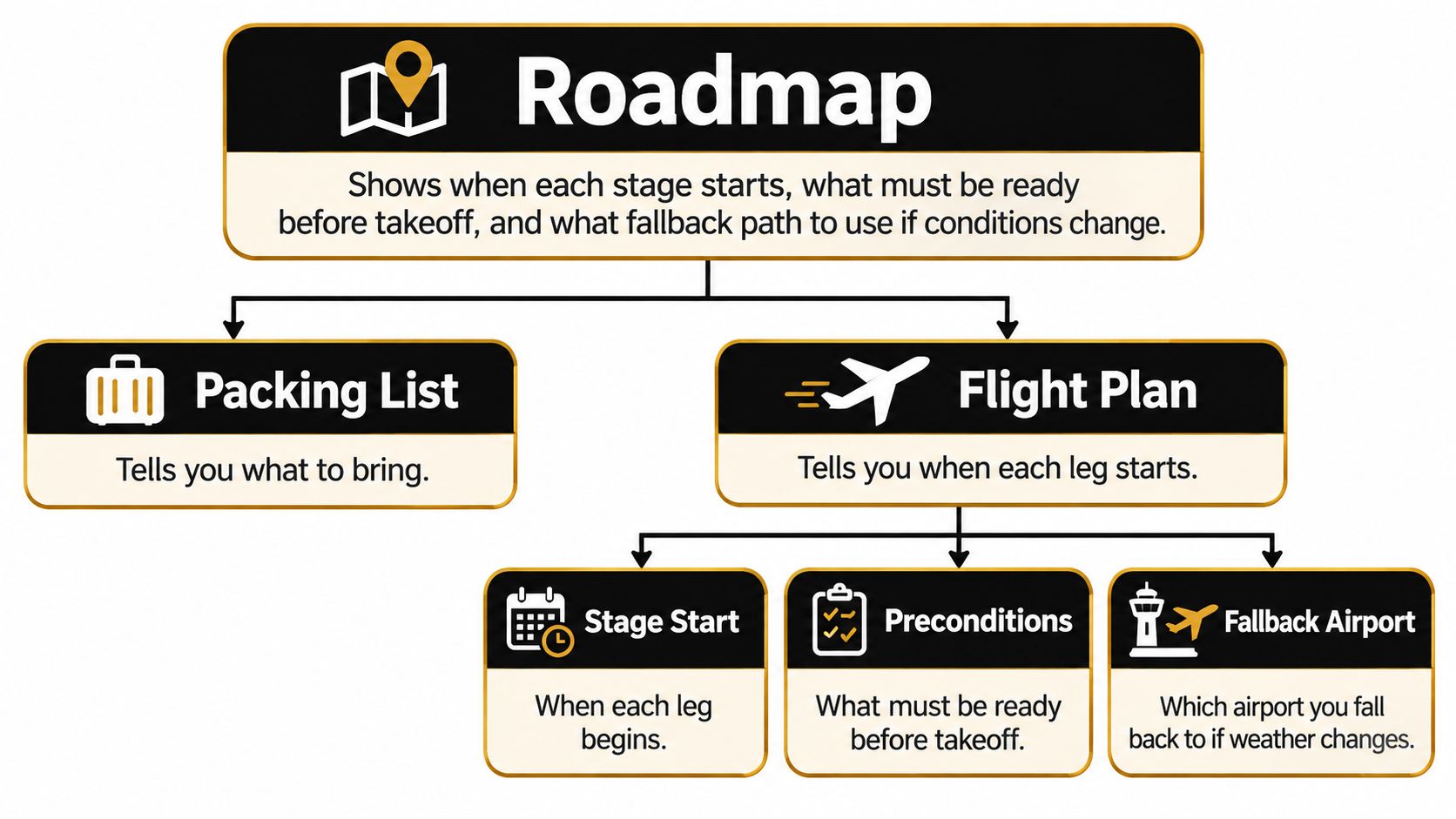
A packing list tells you what to bring. A flight plan tells you when each leg starts, what must be ready before takeoff, and which airport you fall back to if weather closes the runway. A thesis roadmap works like the flight plan, not the packing list.
This diagram sets out that distinction before we break the roadmap into its working parts.
The Working Parts
- Dated milestones: Each stage has a calendar date, not a vague season. "Spring" lets you drift for three months without noticing.
- Dependencies: Some work can't start until other work finishes. You can't write results before you've collected and cleaned data, and you can't finish discussion before results settle.
- Parallel work: Some tasks can run alongside blocked work. Reference cleaning, appendix assembly and early literature synthesis can move while you wait for ethics or data access.
- Owner and evidence: Every milestone names who acts next and what artifact proves completion. Sometimes the owner is you, sometimes it's your supervisor or an ethics board.
- Buffer time: Place spare time where delays usually happen, around ethics amendments, recruitment, data access and analysis rework, not evenly everywhere.
A roadmap is a control plan that links dates, dependencies, evidence and fallback decisions, so a slip in one place shows its cost everywhere else.
Why Outputs Beat Hours
Say data collection slips by six weeks because recruitment is slow. In a flight plan, that delay doesn't vanish. It shrinks the framework writing window by six weeks unless your buffer absorbs it or you move parallel work forward. You can see the trade and decide deliberately.
That's why progress should count finished outputs, not hours logged. You can read, code and annotate hard for a month and still have nothing your supervisor can review. Hours measure effort. Outputs measure whether the next leg can depart.
At any moment, a working roadmap answers three questions. What's next, what's blocked, and what changes if this slips? If you can't answer all three in a minute, you don't have a roadmap yet. You've got a list.
Benefits of a Thesis Roadmap
Drift is expensive because it's invisible for months. You feel busy, your notes grow, and then a deadline that once looked distant is suddenly the term you're in. A roadmap turns that distant endpoint into checkpoints where slippage shows up while you still have options.
Four Benefits You Can Actually Use
Early warning comes first. A missed dated milestone appears in weeks, not at submission. If your dataset isn't locked by its planned date, you know analysis and discussion are now squeezed, and you can cut scope, add help or renegotiate timing before the squeeze becomes a crisis.
Second, you get shared visibility. You and your supervisor read the same status before a meeting, so you don't spend twenty minutes reconstructing what happened. You spend the meeting on exceptions, the chapter that's stalled, the decision that's overdue, the source you can't access.
Third, a roadmap protects supervision time and makes regular contact easier to keep. In Nature's 2025 global PhD survey, 69% of PhD students who met their supervisors for less than one hour per week reported being at least moderately satisfied with their PhD, compared with approximately 82% of students who met supervisors more often. A shared plan gives those meetings a clear agenda, so short meetings still move the work.
Fourth comes decision discipline. Planned gates turn pivots into logged steps rather than quiet drift. You don't shrink a sample or change a question and hope nobody asks. You record the trigger, the decision and the effect on chapters and dates.
Run a quick test on your own history. List the last three milestones that slipped. Would a dated stage with named evidence have flagged each one before its deadline? If yes, your problem isn't motivation. It's that nobody could see the slip soon enough.
Backward Plan a Thesis From Your Submission Date
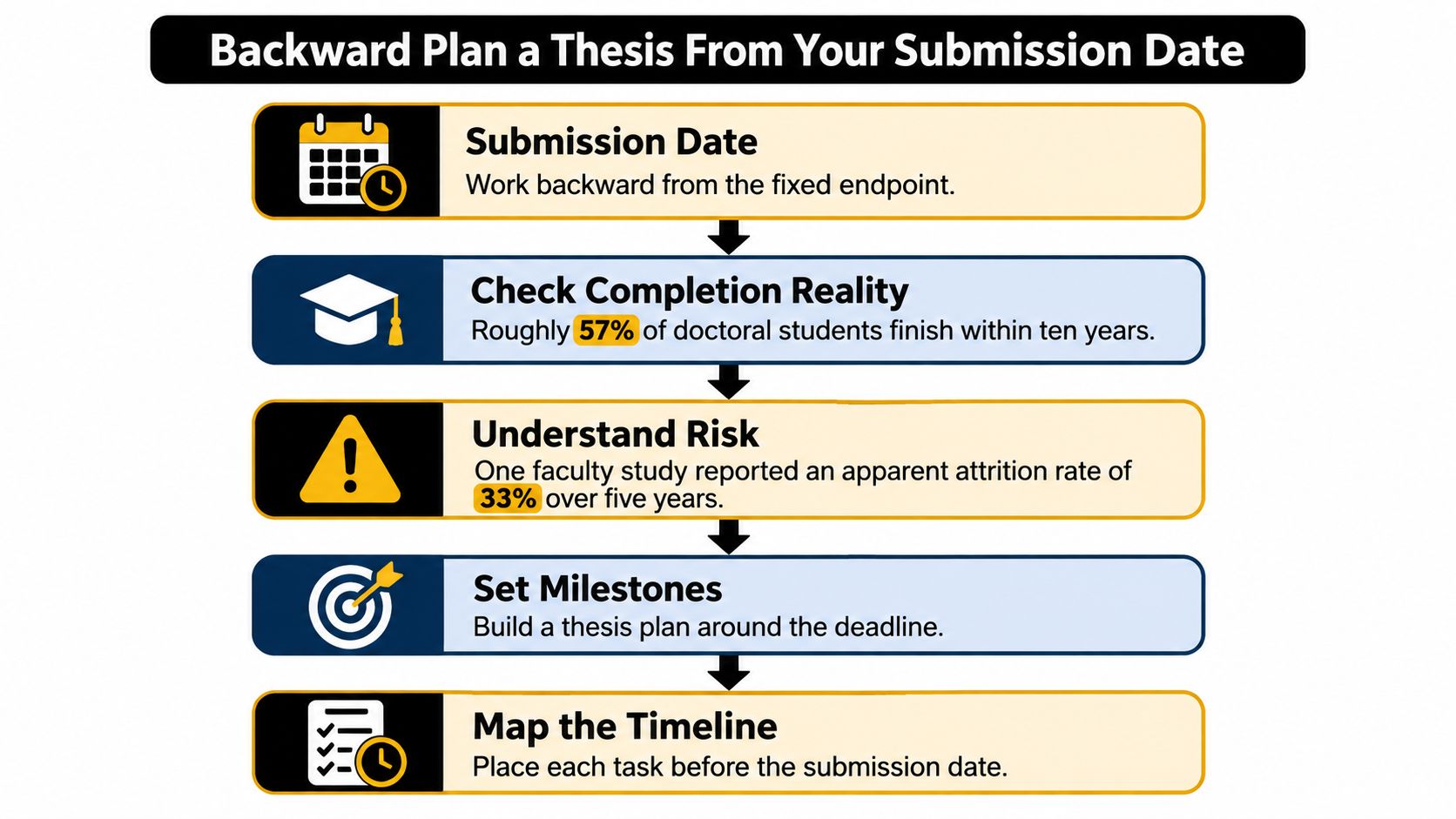
Forward planning feels natural and fails unnoticed. You start from today, add optimistic blocks, and discover at the end that revision and formatting have nowhere to go. Backward planning starts from the fixed endpoint and forces every earlier date to earn its place.
The need is practical, not theoretical. Research on doctoral students in a faculty of sciences reported an apparent attrition rate of 33%, meaning one third failed to complete within five years of commencement. That same body of time to degree evidence reports approximately 57% of doctoral students completed their degrees within 10 years in a Council of Graduate Schools longitudinal project.
This flow shows the backward logic you'll apply in the steps below.
Build the Plan in Eight Steps
- Write both end dates. Note the official submission date and the date a full draft must reach your supervisor. The gap is your revision and preparation window. Common slip: planning from a date you hope for instead of the official deadline. In Thesis Book Project, users set their deadline and break the whole thesis project into chapters and milestones in minutes at this first step.
- List every component separately. Write down each chapter, section, appendix and front matter item. Common slip: listing "thesis" as one item, which hides unfinished pieces.
- Work backward from the draft date. Place each chapter draft at a fixed interval before the next milestone, so drafting ends before review begins. Common slip: letting all chapters share one final drafting week.
- Mark dependencies and move parallel work. Data comes before results, results before discussion. Put references, methods detail and appendices into waiting gaps. Common slip: scheduling discussion before analysis is stable.
- Add buffer at each dependency. Protect ethics amendments, recruitment, data cleaning and analysis rework. Common slip: adding buffer only at the very end, where it's usually already spent.
- Name the evidence for each milestone. Write the artifact, not the activity. Common slip: writing "work on literature review" instead of "synthesis table and draft section sent."
- Set a reminder two weeks before each checkpoint. That warning gives you time to finish, ask for help or flag a blocker. Common slip: setting the reminder on the deadline itself.
- Break only the next four weeks into weekly tasks. Distant weeks stay as milestones until they approach. Common slip: planning every week for a year, then abandoning the plan after the first change.
Our guide to building a research timeline that holds up can help you sanity check the intervals you choose between those chapter drafts.
Don't try to perfect the whole year today. Set your first milestone now, the next stage that must close, with a date and a named artifact. Then take three things to your next supervisor meeting: your stage table with actual dates, your chapter status list, and one blocker that needs a decision. That packet turns a general update into a working session.
Track Chapter States and Run Blocker-Focused Check-Ins
A done or not done tick hides where work is stuck. A chapter marked "in progress" for four months could be an outline with no sources, a full draft waiting for feedback, or a revision you haven't opened since comments arrived. Each situation needs a different next action, and a binary tracker can't tell them apart.
That's why you track chapter states. A best practice review of doctoral supervision recommends forward planning, explicit supervisory checkpoints, and detailed and timely feedback on drafts. The useful loop is simple. You report the current state, your supervisor spots deviation or a blocker, and the next checkpoint defines corrective action.
Six States and the Decision Each One Triggers
| Status | Evidence that proves it | Decision it triggers |
|---|---|---|
| Outline | Agreed section headings and key questions | Confirm scope with the supervisor |
| Evidence assembled | Sources and data tables gathered for the chapter | Decide whether the argument is ready to draft |
| Draft | Complete text, even if rough | Send to the supervisor with one specific question |
| Supervisor review | Dated feedback received | Sort each comment into accept, discuss or defer |
| Revision | Tracked changes that address the feedback | Flag as stalled if revision runs past its planned duration |
| Final | Version locked for examination | Move to the reference and formatting check |
Read a stalled state as a blocker to raise, not a private lag to hide. Pick a margin in advance. If a chapter stays in one state past its planned duration by that margin, it goes on the next supervisor agenda automatically. You don't have to decide each time whether it's "bad enough" to mention. The rule decides.
That distinction also protects you from unfair self blame. A student who hasn't started a revision is behind schedule. A student waiting in an ethics board queue is blocked by an institutional dependency. The first needs a work plan. The second needs a status note, an expected date and parallel work to do while waiting.
Two Metrics Worth Checking Monthly
- Feedback turnaround: Count the time from draft submission to the first actionable comment. You're not scoring your supervisor. You're learning how much review time your plan must allow.
- Unresolved blockers carried forward: Count blockers that enter a second checkpoint without a decision. A rising number means meetings are discussing problems without closing them.
Use an online progress tracker structured by chapter states or a simple table, but keep those two numbers visible. They tell you whether delay sits in drafting, in review, or in decisions nobody has made.
Send a Packet Before Each Meeting
Students often ask what to send, how much feedback to request, and what to do when feedback is late or conflicting. Those aren't minor etiquette questions. A 2025 study of 229 graduate students found that supervisor support for competence, relatedness, and autonomy was associated with better well being and lower depression and anxiety, and students valued clear goals, appropriate feedback, compassion, trust, and autonomy.
Make clear goals easy with a short pre meeting packet.
- One page status: Each chapter, its current state, and its next date.
- Changes since last time: Only chapters that changed state, so your supervisor doesn't reread stable material.
- Three specific questions: For example, "Is this operational definition defensible," not "What do you think of chapter two."
- Blockers with owner and date: Who must act, by when, and what happens if they don't.
- Last decision log: What you agreed previously, so you don't relitigate settled choices.
Ask for feedback in defined units. Request comments on one named section, of a stated length, by a stated date, answering one stated question. "Please read my draft" invites delay because the task looks enormous and unbounded. A defined unit fits into a busy week and tells your supervisor where to focus.
When Feedback Conflicts or Doesn't Arrive
Conflicting comments are normal when you have co supervisors or committee members. Don't silently pick the comment you like. Log both positions, note the effect of each on your chapter, and request a decision at the next meeting. Your job is to make the conflict visible and decidable.
If supervision is late, keep your response calm and written. Send one short question that can be answered without reading forty pages. Set a date when you'll use a fallback route, such as a co supervisor, graduate coordinator or written programme policy. Log the delay and the effect on your milestone. You're not escalating a complaint. You're protecting a deadline that won't move just because feedback didn't arrive.
Don't bring a chapter list to a meeting and hope discussion finds the problem. Bring exceptions, decisions needed and blockers with owners.
Close every meeting by updating a decision log with four fields. Date, decision, who decided and why. Add the milestone or chapter affected when it matters. That small record prevents the most exhausting form of thesis delay, redoing work because nobody can remember what was agreed, or discovering months later that you and your supervisor left the same meeting with different plans.
Over time, this changes the feel of supervision. You arrive less anxious because the status is already shared. Your supervisor spends less time diagnosing where things stand and more time on academic judgment. And when capacity is unpredictable, your roadmap doesn't collapse into guilt. It shows what moved, what's waiting, and which decision will open the next leg.
Decision Gates for Pivots, Delays and AI Use
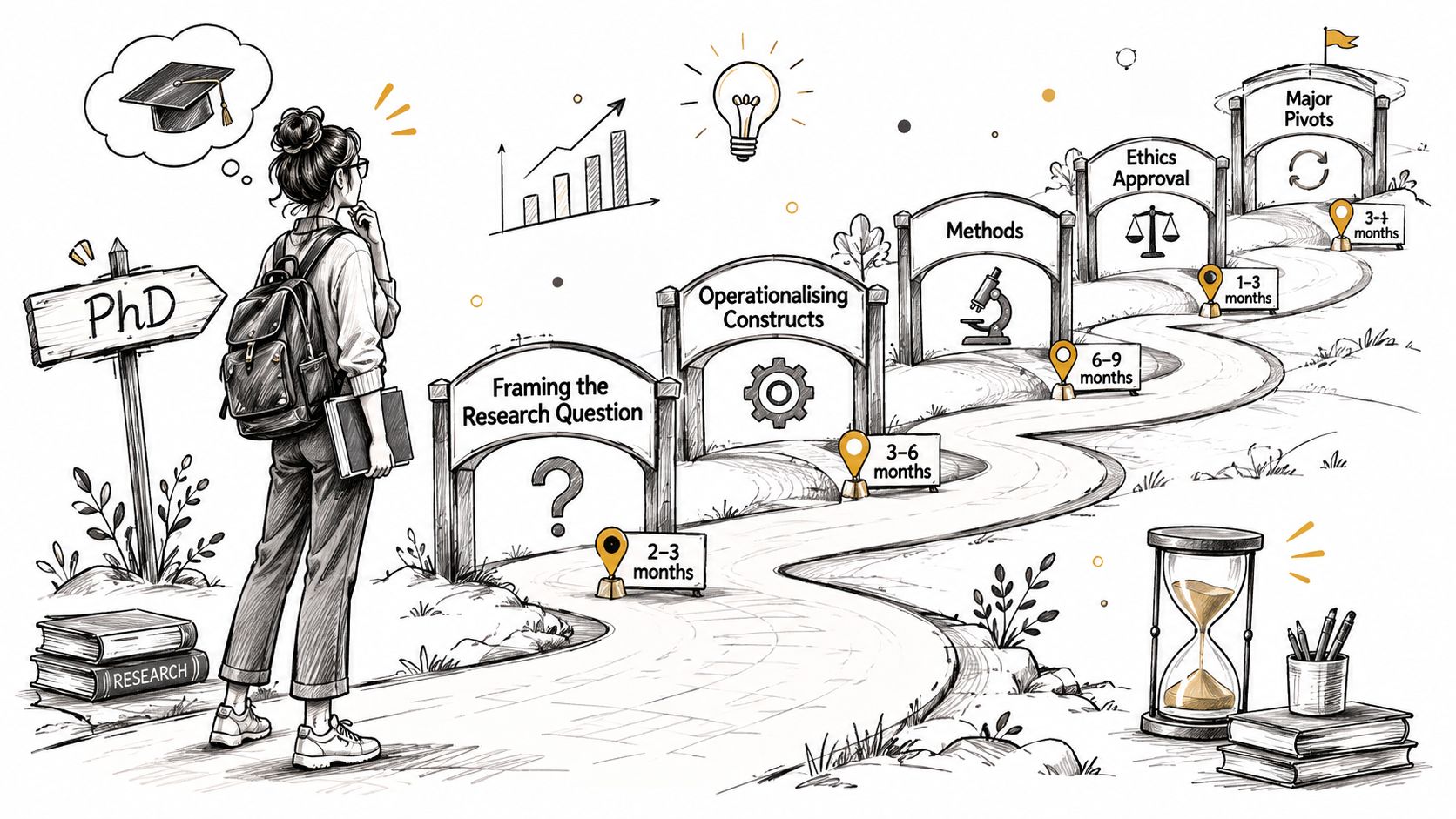
Doctoral work doesn't progress evenly, and pretending it does makes your plan fragile. A 2026 design science paper on doctoral project effort describes effort as concentrating around framing, operationalising constructs, methods, ethics pathways, and major pivots rather than progressing evenly through a project. You need planned points where you can change direction without pretending the original plan still holds.
The image below captures that starting point, a path with milestones ahead and choices built into the route.
Five Gates to Plan in Advance
| Gate | Trigger | Record needed | Check before proceeding |
|---|---|---|---|
| Continue | Milestone met with evidence | Status update in the tracker | Confirm the next dependency is unblocked |
| Narrow | Scope too large for the remaining time | Revised research question and cut list | Supervisor sign off and chapter impact review |
| Redesign | Method fails or data access is lost | Rationale for the new method | Ethics check and recalculated timeline |
| Pause | Health, funding or access problem | Dated pause note and restart date | Confirm institutional leave rules |
| Seek approval | Pivot changes the research question or ethics scope | Written request to the board or committee | Impact on chapters, sources and submission date |
Say recruitment halves your planned sample. That's a redesign trigger, not a quiet edit to the methods chapter. You write a short rationale, check whether ethics approval still covers the change, recalculate the timeline, and note which chapters and analyses change. Your supervisor signs off before you invest months in the new direction.
Put AI Use Through a Gate Too
This short video is a useful pause point before you set your own rules for tools and disclosure.
Treat AI as a planning variable, not a secret. Depending on your programme policy, acceptable help may include brainstorming search terms, testing an outline structure or editing your own prose for clarity. It doesn't replace your analysis, your source reading or your academic decisions. Check your institution's disclosure rule and follow it exactly, because policies differ and they're still changing.
Keep an auditable record. Note the date, tool, task, what you accepted or rejected, and the human decision you made. Save your own draft before and after editing help. If questions arise about how generated text can carry hidden signals, you can explore watermarks in AI-generated writing to understand why keeping your own version history matters. A gate turns an unplanned pivot into a logged, supervised step. That's not bureaucracy. It's how a roadmap stays honest when research refuses to be linear.
Turn your submission date into dated stages, chapter states and decision gates you can share before your next meeting, instead of reconstructing progress from memory. Thesis Book Project gives you a guided roadmap, chapter tracker and milestone reminders built for that exact sequence from proposal to submission. Set your deadline today, name the evidence for your next milestone, and bring a clearer plan to your supervisor this week.
Related Articles
10 Source Management Tools for Thesis Writers in 2026
A few days before a supervisor meeting, you open a folder called “Research” and find PDFs named down...
Thesis WritingAcademic Writing Guidelines for Theses in 2026
The most popular advice about academic writing is to choose a style guide and follow it consistently...
Thesis WritingMilestone Schedule Example: 7 Formats Worth Copying
A milestone schedule works only when each checkpoint marks a decision or accepted result. A 2025 PhD...
Comments (0)
No comments yet. Be the first to share your thoughts.