What Is a Thesis Proposal: A Complete Guide for 2026
Learn what is a thesis proposal, its definition, purpose, and essential components to get your research project off to a strong start.
A thesis proposal is a formal planning document that argues a proposed study is intellectually worthwhile, methodologically appropriate, and feasible within available time and resources. Its core structure commonly includes a title, abstract, introduction, problem statement, research questions, literature review, methodology, significance, chapter outline, work plan, and bibliography.
You may be facing the familiar blank document now, with an interesting topic in mind but no clear way to turn it into an approved research project. The difficult part isn't filling pages. It's proving that the question, evidence, methods, resources, ethics requirements, and schedule fit together well enough for the study to be completed.
That distinction changes how you write. A proposal can sound persuasive and still fail because the sample is inaccessible, the method can't answer the question, or the timeline ignores approval and recruitment. Treating the document as a feasibility audit and risk-management plan gives you a more reliable way to make decisions before problems become expensive.
Table of Contents
- The Proposal as a Research Roadmap
- Core Components That Every Proposal Needs
- Writing a Methodology That Proves Feasibility
- Understanding Length Requirements Across Institutions
- Navigating Supervisor Feedback and Revisions
- Building Confidence Through Structured Planning
The Proposal as a Research Roadmap
A proposal usually starts at the moment a student has an interesting area and too little proof that it can become a finished study. A topic like social media and mental health can sound promising in conversation, yet approval depends on narrower questions. Can you reach the right participants, get permission, gather usable evidence, and complete the work within the available time? A good proposal gives those questions a place to be tested before the project becomes expensive to fix.
The University of Texas at San Antonio proposal guidance describes a proposal as an overview of a project's scope, research questions, methodology, and significance. In practice, that overview also works as a feasibility check. Reviewers are not only asking whether the idea is interesting. They are checking whether the evidence, method, and schedule fit together closely enough for the study to be completed.
Practical rule: Every important promise in your introduction should have a corresponding decision in your methodology or work plan.
That is why the proposal has two jobs at once. It explains the academic value of the study, and it shows the project can be carried out under real constraints. Supervisors read for gaps between ambition and execution. If the question requires interviews, they will look for access. If the design depends on a dataset, they will want to know that the dataset exists, is usable, and answers the question being asked.
Topic selection is where this usually succeeds or fails. A student who uses this guide to choosing a thesis topic should narrow a broad interest into a question tied to an identifiable population, dataset, archive, experiment, or textual corpus. For example, a student interested in social media and mental health should check whether a specific school district will grant access to a manageable participant group within one semester before committing to that population. A strong topic is one you can reach, study ethically, and complete with the resources available.

Writing the proposal early exposes risks while options are still open. You may find that recruitment is harder than expected, a key archive is closed, an instrument does not measure the intended construct, or the proposed analysis does not match the evidence. Discovering those problems at proposal stage gives you time to adjust the design, scope, or source base before the project stalls.
Core Components That Every Proposal Needs
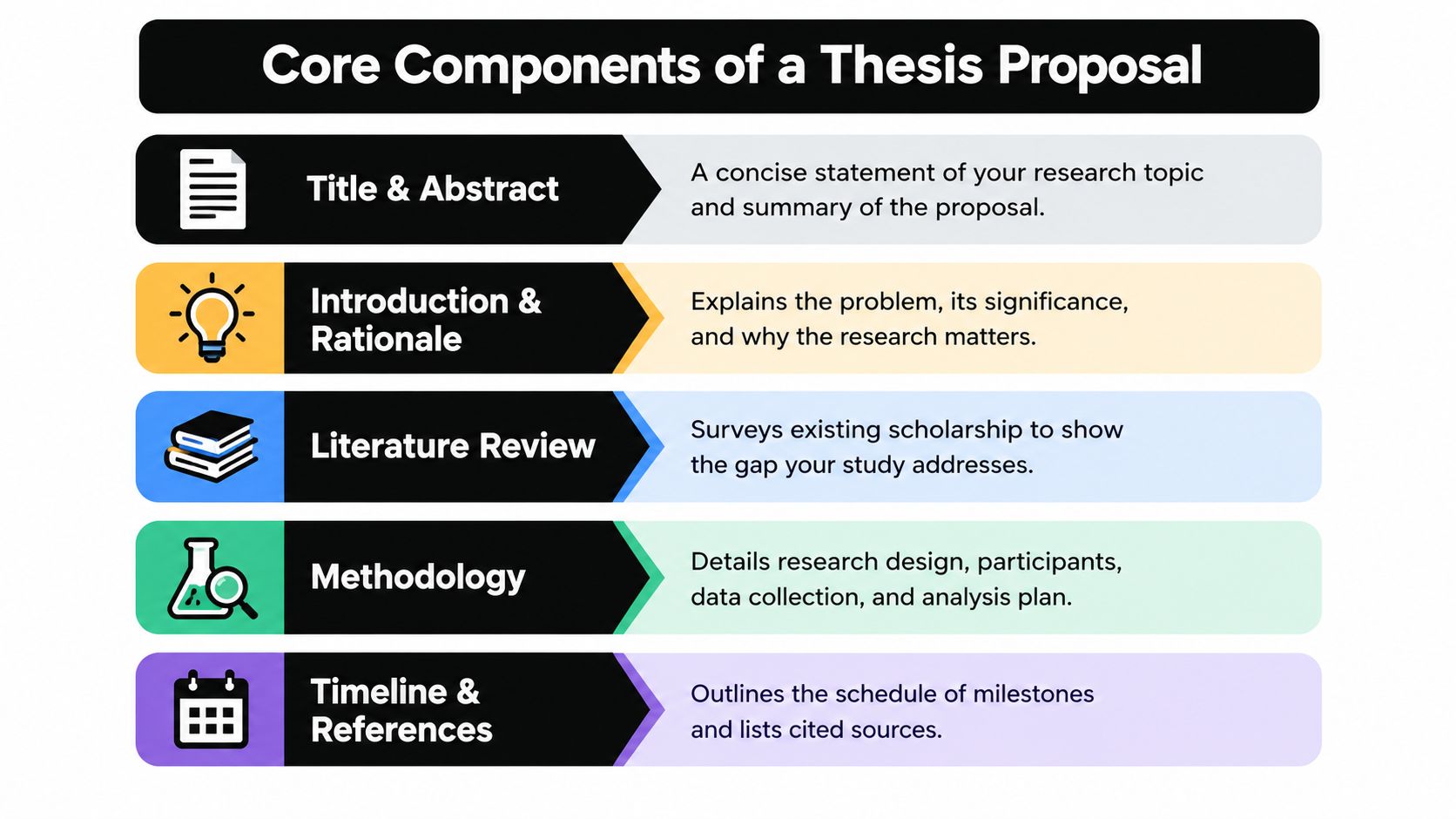
A proposal gets approved when each section answers a practical risk question. Reviewers are not only asking whether the topic sounds worthwhile. They are checking whether the study can be carried out with the time, access, evidence, and methods available. Proposal guidance from UTSA and the University of Wollongong points to the same foundation: a small set of recurring parts that work together as a feasibility check, not a stack of isolated summaries.
The opening establishes the case
The title should identify the subject clearly and, where possible, indicate the setting, population, or relationship under study. A vague title often signals a vague project. The abstract then condenses the proposal into a short account of the topic, problem, questions, method, and significance so a supervisor can grasp the design without hunting through later sections.
The introduction sets the context, but the problem statement does the sharper work. It identifies the specific issue the study will address and turns a general interest into a researchable case. If that distinction is still fuzzy, a research problem statement guide can help define what exactly needs investigating.
Research questions or aims should follow directly from that problem. Feasibility often becomes visible at this point. If the problem is broad but the questions are narrow, the study can feel disconnected. If the questions ask for evidence the student cannot realistically collect or analyze, reviewers will spot the gap quickly.
The literature review demonstrates the gap
The literature review shows more than familiarity with sources. It maps how other researchers have approached the issue, where interpretations or findings remain incomplete, and where the proposed study can make a clear contribution. Done well, it prevents a common mistake: proposing a project that sounds interesting but repeats work already done.
It also gives the proposal structural discipline. A strong review helps establish the theoretical framework, supports the research design, and guides choices about variables, sampling, evidence, and analysis. Weak synthesis creates problems later because the method starts floating free from the scholarship it is supposed to build on.
The method and plan make the project testable
The methodology should explain the research design, the participants or data, how material will be collected, how it will be analyzed, what resources are needed, and any ethical considerations or limitations. In practice, this section tells a reviewer whether the proposal is executable. A significance section then explains who may benefit from the findings or how the study contributes to knowledge.
Other components help reduce delivery risk. A chapter outline shows how the final thesis may be organized. A work plan sets out the major stages. A bibliography demonstrates that the proposal is grounded in relevant sources rather than general interest alone.
| Proposal element | Reviewer's practical question |
|---|---|
| Research questions | What exactly will the study answer? |
| Literature review | What gap does the project address? |
| Methodology | Can the proposed evidence answer the questions? |
| Significance | Why does the study deserve to be done? |
| Work plan | Can the project be completed in the available period? |
Students who need help turning these components into a coherent document can consult this guide to academic proposal writing help for additional writing support. The useful test is alignment. Each research question should point to evidence, that evidence should support a method of analysis, and the analysis should justify the claimed contribution.
Writing a Methodology That Proves Feasibility
A methodology section fails when it lists techniques without showing how they will work in this particular study. “Interviews will be conducted and the data will be thematically analyzed” may identify a method, but it doesn't establish who will be interviewed, how they can be reached, what the interviews will address, how consent will be handled, or why thematic analysis fits the research questions.
The UNSW proposal toolkit treats methodology as a practical specification. Your section should identify the information required, its source, the investigation procedure, necessary resources, the rationale for selecting the method, ethical or safety issues, and a schedule with start and finish dates.
Build a traceability matrix
A simple traceability matrix turns general confidence into an auditable design. Create one row for each research question and add columns for the following:
- Construct or concept: Define what the question is examining.
- Evidence: Specify the measure, document, observation, interview material, or dataset that will represent it.
- Collection procedure: Explain where the evidence comes from and how you'll obtain it.
- Analysis technique: State how you'll interpret or test the evidence.
- Anticipated limitation: Record what could weaken the answer or restrict the conclusion.
This exercise often reveals problems faster than prose drafting. A proposed question may require data you can't access. A survey may not capture the construct described in the literature review. A qualitative design may be appropriate for participants' experiences but not for estimating a population-wide relationship. A complex analytical method may require software, skills, or sample characteristics that aren't available.
You should also test dependencies. If ethics approval must come before recruitment, place that dependency in the schedule. If access to an archive depends on an external organization, identify a fallback source. If a key participant group can't be recruited, decide whether the question will be narrowed, the population changed, or the method revised.
A credible methodology doesn't promise that nothing will go wrong. It shows what you'll do when a foreseeable problem occurs.
The beginner's guide to the methodology chapter can help with section-level organization, but feasibility requires project-specific decisions. Explain not only what you intend to do, but also why the design is suitable, what it depends on, and how its limitations affect the claims you expect to make.
Understanding Length Requirements Across Institutions
There isn't one correct thesis proposal length. Requirements differ by degree level, discipline, department, and supervisory committee, so a generic template can mislead you if it encourages either unnecessary expansion or dangerous omission.
At doctoral level, the proposal is often a formal checkpoint before dissertation research begins. Ohio University's doctoral requirements describe the proposal as a basis for formal evaluation of the research purpose or hypotheses, research design, and supporting literature review.
Institutional examples show how specific the rules can be:
- University of Koblenz: A dissertation-project description is limited to 5,000 words, excluding the title, references, index, tables of figures, and appendices, according to its doctoral proposal requirements.
- Columbia University Computer Science: The proposal core is limited to 30 pages and must address the problem, background, claims, relation to prior work, an initial result, and a completion plan. The committee must receive it at least 14 days before the presentation, as specified in the PhD proposal requirements.
- Other departments: May use a different word limit, page limit, format, or approval sequence.
These aren't competing definitions of a proposal. They reflect different expectations about disciplinary argument, technical detail, prior results, and review procedures. A laboratory science proposal may need precise experimental specifications, while a humanities proposal may devote more space to sources, interpretation, and archival access.
Before drafting, obtain the current departmental handbook, template, assessment rubric, and submission instructions. Confirm what counts toward the limit, which appendices are allowed, whether a presentation is required, and how far in advance reviewers need the document. If your supervisor's expectations differ from an old template, ask which institutional rule governs and record the answer.
Length should follow the work required to establish feasibility. Don't stretch a short limit with background that doesn't support a decision, and don't compress essential methodological information just to meet an informal preference.
Navigating Supervisor Feedback and Revisions
Approval doesn't make a proposal permanent. Research questions, methods, timelines, and literature often change as supervisors identify weaknesses or as access conditions become clearer. The mistake is not revising. The mistake is revising informally until the approved plan and the actual project no longer match.
A proposal should be treated as provisional, but changes still need control. When feedback arrives, don't respond by rewriting the entire document from memory. Create a comment log that preserves the original criticism, your interpretation, the action required, and the effect on the rest of the project.
Use a change-control workflow
Process each comment through a short decision sequence:
- Record the issue: Copy the feedback accurately and identify the affected section.
- Classify the request: Mark it as mandatory, recommended, or optional.
- Assess the impact: Check whether it changes the research question, sample, method, ethics application, resources, or deadline.
- Confirm the decision: Discuss consequential changes with the supervisor and obtain written agreement.
- Update the alignment: Revise the question, literature rationale, methodology, limitations, and work plan wherever the change has an effect.
- Keep a version record: Save dated drafts and a brief note explaining why significant decisions changed.
A request to narrow the population may be a sensible refinement, but it can also affect recruitment, the literature review, the significance claim, and ethics documents. A request to add another method may improve the evidence, yet create new training, data management, or scheduling requirements. Treat each suggestion as a potential dependency, not as a local sentence edit.

Revision discipline: If a change affects what you will study or how you will study it, update the plan, not just the paragraph.
This approach also protects professional communication. You can return to your supervisor with a focused question: “If we narrow the study to this participant group, should the second research question be removed, and does the revised recruitment plan still fit the proposed schedule?” Specific questions produce better decisions than broad requests for reassurance.
Building Confidence Through Structured Planning
A strong thesis proposal creates confidence by making the project inspectable. The title and problem statement define the target, the literature review establishes the gap, the questions specify what must be answered, and the methodology shows how evidence will be collected and interpreted. The work plan then tests whether the sequence is realistic.
That structure turns an abstract idea into a research system with visible dependencies, resources, risks, and decision points. It also gives you a way to distinguish a problem that requires redesign from one that only requires clarification. Without that structure, students often continue drafting around an obstacle instead of addressing it.
Treat the document as a living control system
Use the proposal to track decisions such as:
- Scope: What the study will include and exclude.
- Access: Which participants, records, instruments, or datasets are obtainable.
- Ethics: Which approvals, consent procedures, privacy protections, or safety measures are required.
- Analysis: How each question will be answered by the available evidence.
- Schedule: Which activities depend on earlier approvals or access decisions.
- Fallbacks: What will change if a critical resource becomes unavailable.
The proposal shouldn't be a hurdle you clear and forget. It should protect the thesis timeline by forcing difficult questions into the open while changes are still manageable. A polished introduction cannot compensate for an inaccessible sample, and an ambitious method cannot rescue a question that remains too broad to answer.
Before submission, read the proposal as a reviewer would. For every research question, locate the evidence, procedure, analysis, limitation, and scheduled activity that support it. If one of those links is missing, revise the design before refining the prose. That investment in planning gives the completed thesis a much stronger foundation.
Thesis Book Project helps students and researchers turn a proposal into a step-by-step path toward submission with a thesis roadmap, chapter tracking, milestone scheduling, source organization, and progress visibility. Visit Thesis Book Project to organize your research plan, monitor dependencies, and keep supervisor discussions focused on the next practical decision.
Related Articles
How to Choose a Thesis Topic: A Practical Guide
The best thesis topics are the ones you can finish, and feasibility beats originality when the clock...
Research MethodsLiterature Review Outline: Template and Annotated Structure
What does your literature review outline prove? If it only lists authors, topics, or publication dat...
Research Methods10 Software for References Compared in 2026
The most feature-rich reference manager isn't automatically the best one. A thesis writer who sp...
Comments (0)
No comments yet. Be the first to share your thoughts.