Academic Writing Guidelines for Theses in 2026
Academic writing guidelines for theses: pick the right style, cite traceably, avoid plagiarism, and run the checks that matter before you submit.
The most popular advice about academic writing is to choose a style guide and follow it consistently. That's useful, but incomplete. A perfectly formatted thesis can still have an unclear argument, an untraceable claim, an incomplete methods chapter, or an authorship problem.
Academic writing guidelines are living, discipline-specific standards, not one frozen checklist. Your task is to identify which rules govern your degree, understand what each rule protects, and apply them without confusing academic precision with a requirement to erase your voice.
Table of Contents
- What Academic Writing Guidelines Control
- Categories of Rules Inside a Thesis
- Citation Conventions That Keep Claims Traceable
- Plagiarism Rules Beyond Copying Text
- Reporting Checklists for Methods and Results
- Authorship Rules for Generative AI Help
- Clarity and Multilingual Voice in Practice
- Run the Submission Checklist and Plan the Rest
What Academic Writing Guidelines Control
There's no single universal rulebook for academic writing. The controlling requirements are those your university, department, degree, or target journal has adopted. Choosing APA because you've used it before isn't enough if your department requires Chicago.
Start with the current institutional handbook. It establishes the submission requirements and identifies where a disciplinary style manual applies. When the handbook explicitly departs from the manual, follow the local requirement rather than trying to make the documents agree.
Identify the controlling system
The comparison below is a lookup tool, not permission to choose whichever system looks easiest. Kean University's citation guide identifies the established traditions and their editions, including MLA's 9th edition, published in 2021, APA's 7th edition, published in 2019, and Chicago's 18th edition, published in 2024.
Which writing system governs your thesis
| System | Typical disciplines | Documentation pattern | Edition or authority |
|---|---|---|---|
| MLA | Language and literature | Author-page in-text citation plus Works Cited | Required MLA edition |
| APA | Psychology and social sciences | Author-date in-text citation plus reference list | Required APA edition |
| Chicago notes-bibliography | History and many humanities fields | Footnotes or endnotes plus bibliography | Required Chicago edition |
| Chicago author-date | Sciences and social sciences using Chicago | Author-date in-text citation plus reference list | Required Chicago edition |
| Harvard | Many UK and Commonwealth universities | Author-date; punctuation set locally | University handbook, not one global edition |
| Institutional handbook | Your department or degree | Overrides style choice, layout, word limit, and front matter | Current local regulations |
Harvard deserves particular attention. Treating it as a single globally standardized manual can lead you to follow examples that conflict with your university's version. Save the local guide rather than relying on a search result labelled Harvard referencing.
Chicago also requires a choice within the system. Notes-bibliography and author-date aren't interchangeable decorations. Confirm which one your department expects before building your references.
Set the rules before drafting
Create a short requirements note at the top of your working folder. Record these controls:
- Citation style and edition. Name the required manual and any local exceptions.
- Thesis structure. Record compulsory chapters, front matter, word limits, and submission format.
- Reporting requirements. Identify whether your research design requires a reporting checklist.
- Integrity and assistance rules. Record what your institution permits for editing, collaboration, translation, and AI assistance.
For example, a psychology thesis might use APA documentation while following a university-specific title page and declaration. That isn't inconsistent. The documents govern different parts of the submission.
Practical rule: Resolve competing requirements before you format the thesis, not after you've built every chapter around the wrong template.
Repeated editions demonstrate why an old thesis is a useful example but a poor final authority. Its author may have followed a superseded manual or different degree regulations. Use previous theses to understand disciplinary expectations, then verify your own requirements in the documents that govern your submission.
Categories of Rules Inside a Thesis
A supervisor's comment about headings is not the same kind of problem as a comment about an unsupported conclusion. Treating both as general writing issues makes revision slower and less focused.
Separate academic writing guidelines into presentation, argument structure, documentation, evidence reporting, and integrity. Each family answers a different reader question.
Separate appearance from argument
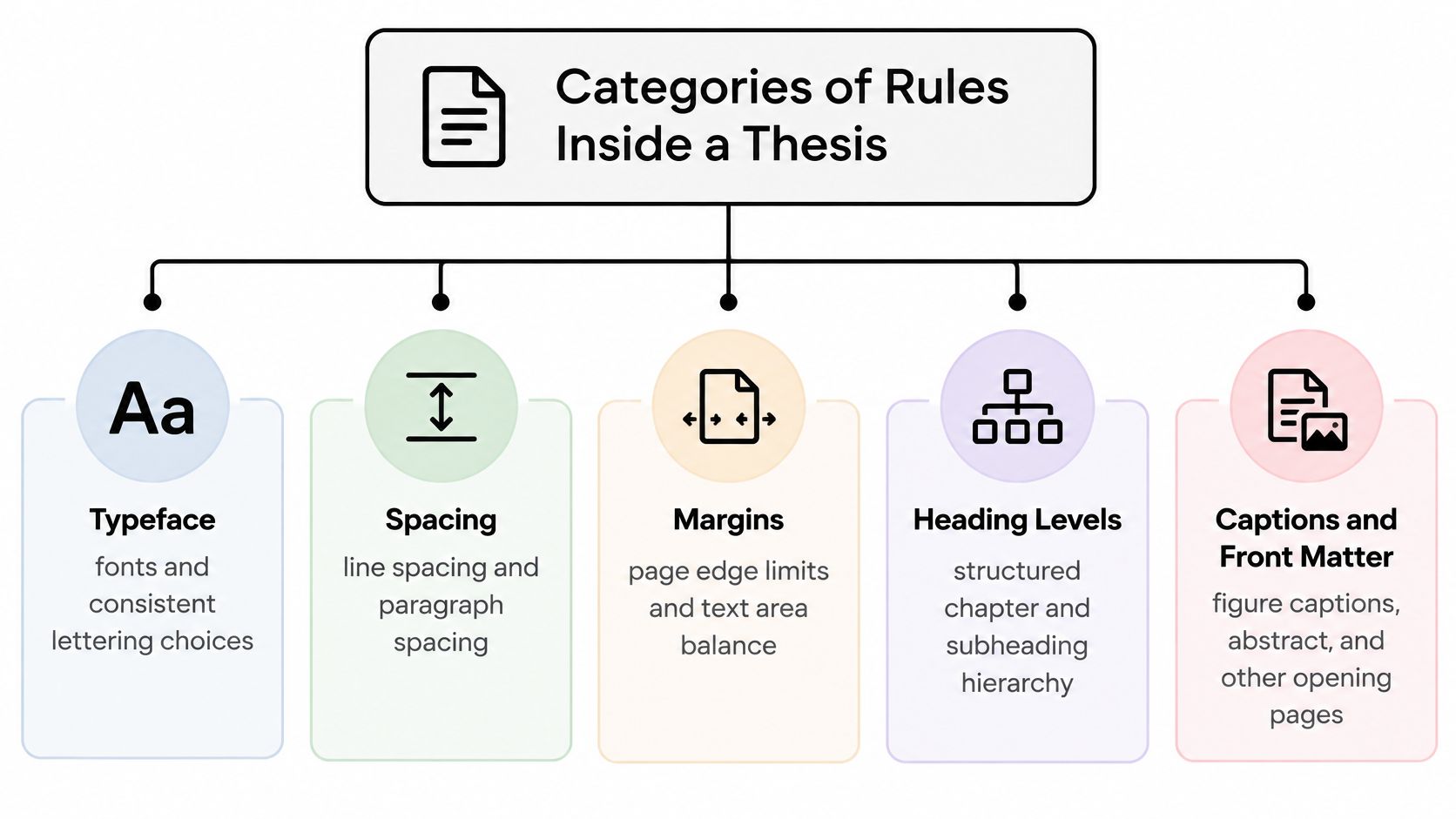
Presentation asks how the document must look. It covers typeface, spacing, margins, heading levels, captions, and opening pages. If the abstract is missing from the required location, that's a presentation problem, even if the abstract itself is excellent.
The visual below isolates the main presentation categories. These sit inside presentation, rather than replacing the broader families of thesis rules.
Argument structure asks what you're arguing and how the chapters establish it. An empirical thesis commonly separates the introduction, literature review, methods, results, discussion, and conclusion. A humanities thesis may instead develop its argument through thematic chapters where departmental rules allow that approach.
The chapter title alone doesn't establish its function. A literature review should do more than describe publications individually. It needs to explain the scholarly problem your project addresses and why the selected literature matters to that problem.
Diagnose the remaining rule families
Use the reader's question to identify what needs revision:
| Rule family | Reader's question | Thesis example |
|---|---|---|
| Documentation | Where did this idea come from? | A borrowed definition needs a source marker and retrievable entry. |
| Evidence reporting | Could someone audit this study? | The methods chapter must explain how participants were selected. |
| Integrity | Whose words and work are these? | A passage must distinguish borrowed wording from your own explanation. |
A sentence can have problems in more than one family. Suppose a discussion paragraph claims that an intervention caused improvement, but the study only compared existing groups. Adding a citation won't repair the interpretation. You need to revise the claim and explain what the design permits you to conclude.
Likewise, shortening a paragraph won't necessarily improve its argument. The missing element may be an explanation of why the evidence supports the chapter's central claim.
Before revising a marked draft, tag each comment with its rule family:
- Presentation. Fix the document setting or structural convention.
- Argument. Reconsider the claim, sequence, or reasoning.
- Documentation. Repair the evidence trail.
- Reporting. Supply information needed to evaluate the work.
- Integrity. Clarify ownership, attribution, or disclosure.
This classification prevents a common waste of effort: polishing sentences when the supervisor is asking you to rethink the conclusion. Start with the changes that affect the validity and completeness of the thesis, then finish the surface corrections.
Citation Conventions That Keep Claims Traceable
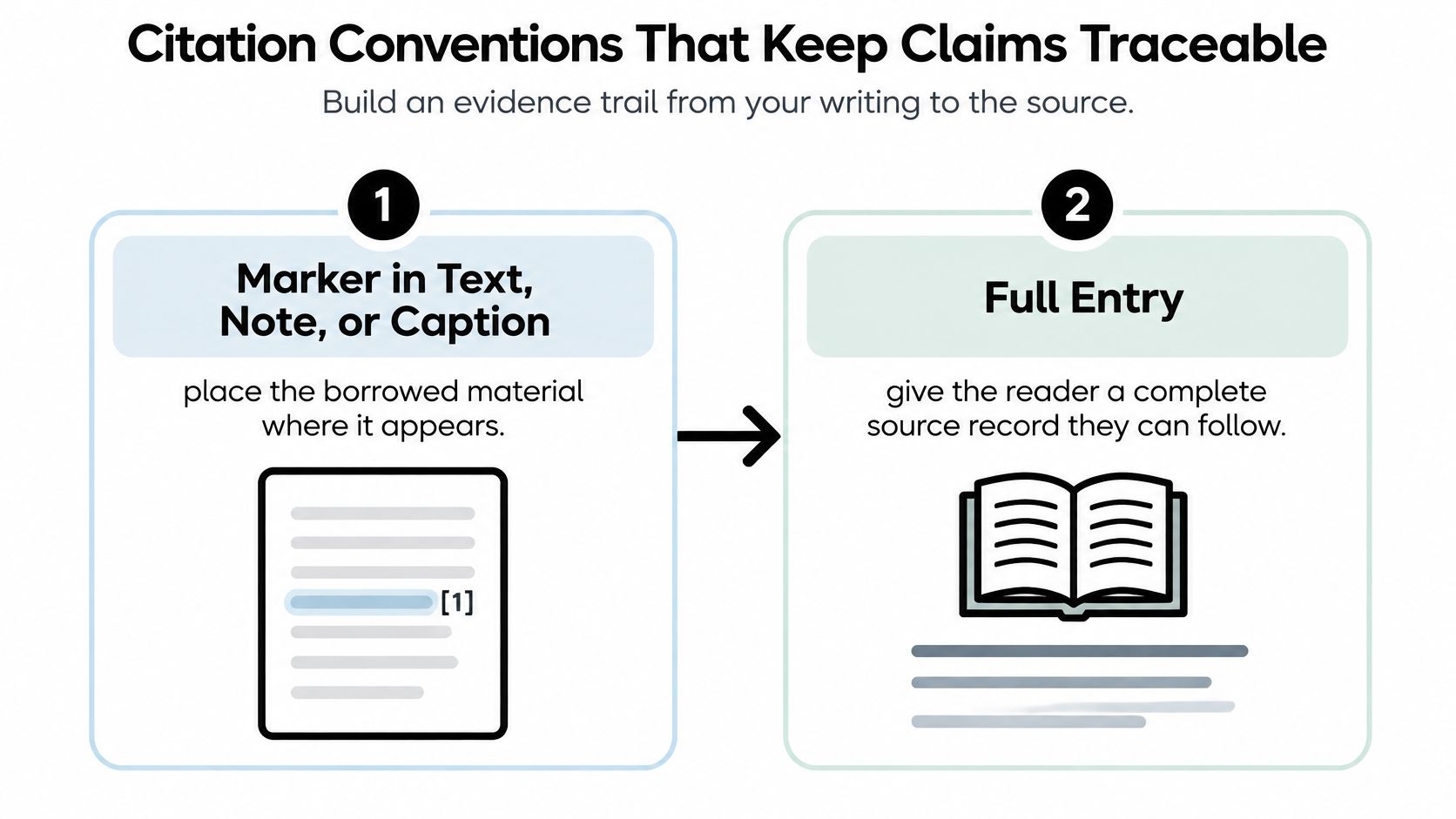
A citation is an evidence trail. The reader encounters a claim, finds the source marker, and follows it to a complete source record. If any part is missing, the reader has to guess.
The ICMJE recommendations emphasize accurate references, verification against original sources, and responsibility for ensuring that references support the associated statements. Treat that responsibility as part of drafting, not a bibliography task delegated entirely to software.
The basic relationship is simple:
Put the marker beside the borrowed material
Use the documentation pattern your handbook requires. APA's author-date approach illustrates the relationship clearly, while MLA and Chicago express it differently.
These are templates, not real references:
- Paraphrase. Explain the source's finding in your own sentence, followed by
(Author, year). - Short quotation. Insert the source's exact wording with quotation marks, followed by
(Author, year, p. [page]), or the required paragraph locator. - Figure note. State that the figure is adapted or reproduced from the named work, provide its source information, and address permission or licensing where applicable.
Cite paraphrases as well as quotations. Statistics, specific findings, and facts that aren't common knowledge also need documentation. Common knowledge depends partly on the audience, so a highly specialized proposition shouldn't be treated as obvious merely because you've encountered it repeatedly.
A citation at the end of a long paragraph may leave its scope unclear. Place it where readers can tell which proposition it supports. If different sources support different clauses, split the sentence rather than attaching an unreadable string of references.
For a complementary explanation of citation mechanics, use the video below alongside your required handbook.
Verify support before formatting
While drafting, add a nearby source placeholder to each substantive evidence-based claim. Then open the original work and check:
- Scope. Does the sentence describe the population and setting studied?
- Method. Does the design support comparison, association, or a causal interpretation?
- Strength. Have you turned a tentative conclusion into a certainty?
- Source access. Have you read the work you're citing, rather than only another author's summary?
A survey conducted in a single city cannot establish what people worldwide believe. Narrow the sentence to the evidence instead of searching for stronger wording.
Prefer the primary study when it's available and relevant. If you need a secondary citation, follow your required system's convention rather than implying you read the original.
Finally, synchronize the manuscript and bibliography. Author spellings and publication details must agree, and entries must correspond to material used, including figures or appendices. Our guide to creating a reference list can help organize that final pass.
Zotero, EndNote, and Mendeley can organize records, but their exports still need inspection for capitalization, missing page ranges, incorrect item types, and DOI details. Read the draft for supported claims, then read the list for complete, retrievable records.
Plagiarism Rules Beyond Copying Text
Plagiarism concerns ownership, not just matching words. The Purdue Global academic style guidelines, drawing on the U.S. Office of Research Integrity, describe plagiarism as appropriating another person's ideas, processes, results, or words without appropriate credit.
An accidental omission can still produce an attribution problem. Your institution determines how intent affects its misconduct process, but an honest mistake doesn't make the source unnecessary.
Recognize the forms that survive superficial rewriting
Use these distinctions when reviewing a draft:
- Verbatim copying. You lift a methods sentence from a paper. Even ordinary technical prose needs quotation marks and attribution when reproduced word for word, unless an applicable convention provides otherwise.
- Patchwriting. You replace scattered words but retain the source's phrasing and sequence. A citation alone doesn't identify the borrowed wording.
- Overly close paraphrase. You swap synonyms while preserving the original sentence structure. The passage still needs substantial rewriting or treatment as a quotation.
- Uncredited ideas. You rebuild an explanation entirely in your own language but omit its origin. The wording is yours; the intellectual contribution isn't.
- Undisclosed reuse of your own work. You submit material from an earlier assignment or publication without the disclosure your institution requires. Reuse rules need checking even when you own the text.
Consider a source that explains a relationship in this order: recruitment difficulty, selective participation, then limited generalizability. Keeping that sequence and merely replacing difficult with challenging is not an independent paraphrase.
A better approach is to close the source, identify the point your argument needs, and explain that point from understanding. Reopen the source afterward to check accuracy and add the citation.
Attribution identifies the owner of an idea. Quotation marks identify the owner of the wording. Sometimes you need both.
Keep integrity visible in the working process
Data, images, and code deserve the same attention as prose. Record their provenance, licensing conditions, and any changes you make. Don't assume that something available to download is free to reproduce without acknowledgment.
Your own analysis doesn't need an external citation to exist. However, the evidence you analyze and any borrowed analytical framework still need clear attribution. Our guide to avoiding plagiarism offers a practical companion for checking these boundaries.
Integrity also concerns how you present research decisions. Acknowledge weaknesses in evidence you rely on, and explain consequential changes such as excluding outliers or switching an analytical method. Don't write a revised analysis as though it had always been planned.
Keep exact quotations visibly separate from paraphrase notes. Save page locators when reading, and distinguish your reactions from the author's conclusions. A final cleanup is a poor time to discover that you can't tell which sentences came from a source.
Generated prose introduces an additional disclosure problem. Treat permission, authorship, and acknowledgment as separate questions rather than assuming that text without an identifiable human author is automatically yours to submit.
Reporting Checklists for Methods and Results
Choose the reporting guideline that matches your study design, not the one whose checklist looks shortest. A citation manual can tell you how to format a reference, but it won't tell you everything a reader needs to evaluate an empirical study.
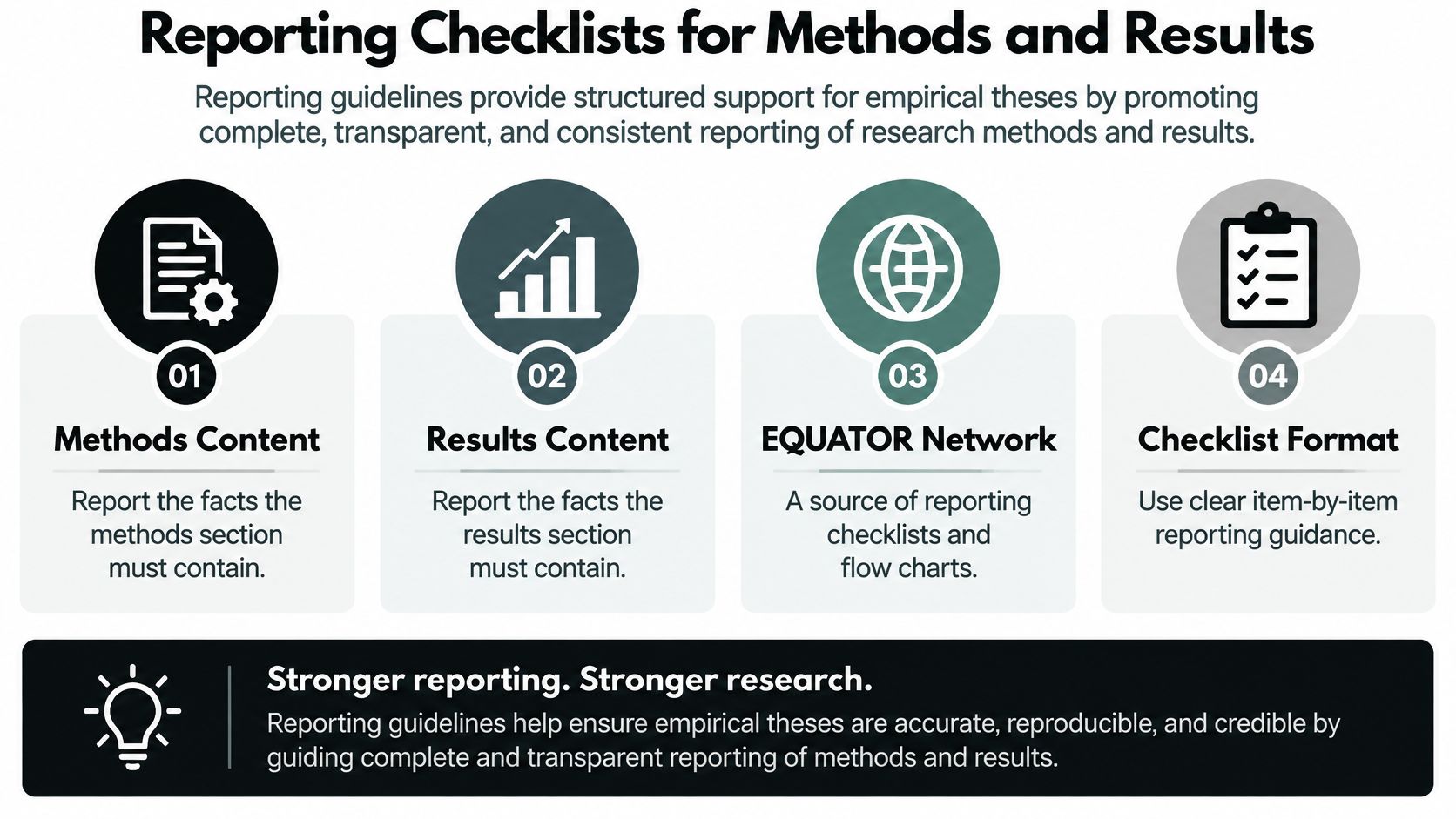
The EQUATOR Network's explanation of reporting guidelines describes structured recommendations, including checklists and flow diagrams, intended to make research understandable, reproducible, evaluable, applicable, and suitable for synthesis.
Match the design before drafting
Reporting guideline by study design
| Study design | Guideline | Information the checklist requires |
|---|---|---|
| Randomised trial | CONSORT | Enrolment, allocation, prespecified outcomes, and protocol deviations |
| Observational study | STROBE | Setting, participants, variables, bias, and missing data |
| Systematic review or meta-analysis | PRISMA | Search, screening, eligibility, and method of synthesis |
| Diagnostic-accuracy study | STARD | Index test, reference standard, and flow of participants |
These are established examples, not a complete catalogue. Other designs have other guidance, and a theoretical or literary thesis may not have a directly applicable empirical reporting checklist.
If you're deciding whether your project is a systematic review, establish that before selecting PRISMA. Our explanation of what a systematic literature review involves can help distinguish that design from a broader narrative review.
Use the following visual as a reminder of the checklist's role.
Turn each requirement into an auditable task
Keep a working copy of the checklist beside the methods and results drafts. For every applicable item, record where the manuscript addresses it. If an item isn't applicable, write a reason rather than leaving an unexplained blank.
A useful audit record contains:
- Requirement. Identify what must be reported, such as participant selection.
- Location. Record the chapter and subsection where the information appears.
- Status. Mark it complete, incomplete, or not applicable with an explanation.
For example, writing that participants were recruited online leaves important questions unanswered. Explain the recruitment route, eligibility criteria, selection process, and relevant exclusions so readers can judge who entered the study.
Missing-data handling needs similar precision. Don't stop at saying that incomplete responses were removed. Explain what counted as incomplete, what you did with those records, and how that decision affected the analysis.
Keep planned outcomes separate from findings that emerged during exploration. Exploratory analysis can be valuable, but readers need to know which questions you specified before examining the results.
Audit completeness without flattening the prose
A checklist isn't a chapter outline. Your department and supervisor may require an order different from the checklist's sequence, and related requirements may belong together in a coherent paragraph.
Run the audit while drafting so missing information can still be recovered. Repeat it before submission to catch omissions introduced during revision. If a required detail was never recorded, discuss the limitation rather than filling the gap with an unsupported reconstruction.
Complete reporting doesn't repair a weak design. It allows the reader to understand that design and judge its strengths and limitations fairly.
Authorship Rules for Generative AI Help
Read your institution's current misconduct and AI-use policies before using a tool on assessed work. Permission is task-specific: approval for language feedback doesn't automatically authorize generated interpretation, references, or submitted prose.
A simple permitted-or-banned conversation misses these distinctions. UK evidence summarized in an ERIC-indexed report on student AI use found that 92% of undergraduates used AI in some form in 2025, while 18% inserted AI-generated text directly into submitted work. Widespread use doesn't establish permission, but it makes a clear decision process necessary.
Judge the task rather than the tool
Task risk for generative-AI help
| Task | Risk level | Condition |
|---|---|---|
| Brainstorming topics | Lower | Allowed if the department permits; disclose the tool |
| Outlining questions to ask a supervisor | Lower | Allowed if disclosed; check advice against the handbook |
| Language feedback on student-written prose | Lower | Allowed if permitted; the student keeps final wording |
| Generating analysis, results, or interpretation | Higher | Needs explicit permission and disclosure |
| Generating citations or references | Higher | Every source must be read and verified before use |
| Generating paragraphs submitted as own work | Higher | Counts as unacknowledged generated prose |
Lower risk does not mean unrestricted. Uploading interview transcripts for language assistance, for example, introduces confidentiality and consent questions even if proofreading is permitted.
Higher-risk tasks concern the intellectual work an examiner expects you to perform. A fluent interpretation isn't acceptable merely because you agree with it. You need to understand the analytical steps, evaluate alternatives, and defend the conclusion.
For a related discussion of personal authorship in another assessed context, Mrs. College Counselor's college application essay guidance for students offers a useful comparison. Application rules don't govern theses, but the distinction between assistance and substitution remains worth considering.
Make disclosure specific enough to evaluate
Put disclosure where your handbook requires it, whether that's an AI-use statement, methods note, or acknowledgements. Follow the required citation convention for generated content, and record the tool, task, and date.
A disclosure template might explain:
Disclosure example: I used [tool and version] on [date] to identify unclear sentences in my own draft. I reviewed each suggestion, retained responsibility for the final wording, and checked that revisions preserved the intended claims.
That statement is appropriate only if it describes what happened. Don't describe generated paragraphs as proofreading or omit analytical assistance because the final prose was later edited.
Before each proposed use, record your answers to these questions:
- Permission. Is this task allowed under the rules governing this submission?
- Verification. Have I checked every factual claim and source I intend to retain?
- Authorship. Could I reproduce and defend the reasoning without relying on the conversation?
If the answer is uncertain, pause that use and ask your supervisor a concrete question about the task. Naming the proposed input and output produces a more useful answer than asking whether AI is allowed in general.
Clarity and Multilingual Voice in Practice
Concise, linear English is an expectation in many disciplines. It isn't a neutral measure of intelligence, and it doesn't make every unfamiliar rhetorical pattern wrong.
Scholarship in World Englishes challenges narrow views of English that undervalue multilingual writers' linguistic and cultural resources. Multilingual writers are legitimate users of academic English, not incomplete versions of an imagined ideal writer.
Distinguish clarity from conformity
When a supervisor marks a sentence as awkward, identify the actual problem before replacing it. The comment may concern an unclear referent, a local convention, or a stylistic preference.
Use these labels:
- Clarity problem. A knowledgeable reader can't identify the actor, relationship, or intended meaning.
- Local requirement. The handbook, assessment criteria, or agreed disciplinary convention specifies a form.
- Rhetorical difference. The passage uses an unfamiliar but intelligible way of developing an idea.
Suppose a paragraph moves from context to qualification and only then states its central claim. That order is not defective. However, if readers can't tell why the context matters, moving the claim earlier may make the reasoning easier to follow.
Similarly, a long sentence may accurately express a necessary relationship. Don't split it mechanically if doing so obscures which condition qualifies which conclusion. Revise the obstacle, not merely the visible length.
Preserve the distinction you're making. Change the wording that prevents readers from understanding it.
A supervisor's preference can be useful without being universal. Ask whether a requested change follows examination criteria, disciplinary expectations, or a personal recommendation. Don't dismiss preferences automatically, but don't mistake every preference for a rule applying to all academic English.
Build clarity through reading and reflection
Keep a reflective reading journal alongside your source notes. After reading a relevant article, explain its central claim, identify how the author moves between ideas, and note language you understand but wouldn't naturally use.
You can plan and explore concepts across your linguistic resources. When producing the submitted prose, make the relationships explicit enough for the intended audience and preserve necessary terms of art. Translation doesn't remove the obligation to credit a borrowed idea.
For supervisors designing feedback activities, Teacher Planner's overview of AI lesson planning and feedback tools can serve as an adjacent resource, subject to institutional permissions. Tool-assisted feedback should support discussion of meaning, not automatically standardize every student's voice.
When paraphrasing across languages, reconstruct the meaning rather than translating the source sentence word by word. Check that qualifications, uncertainty, and attribution survive the change.
Take a marked page and annotate each comment as clarity, requirement, or rhetorical difference. Revise definite obstacles first, then discuss the comments whose purpose remains unclear.
Run the Submission Checklist and Plan the Rest
The final pass should confirm that the thesis is complete and defensible. It shouldn't become an invitation to rewrite every sentence you no longer like.
Work through the submission checks in a fixed order. Keep a separate list for cosmetic improvements so they don't displace unresolved requirements.
Complete the pre-submission pass
- Confirm the handbook requirements. Verify the required style and edition, word limit, front matter, declarations, and submission format against the current rules.
- Check alignment. Read the title, research question, abstract, and conclusion together. Resolve any mismatch in the project they describe.
- Synchronize citations and references. Match source markers to entries, check material cited in tables and appendices, and remove orphan records.
- Inspect borrowed language. Recheck quotation marks and locators, then examine paraphrases for wording or structure retained too closely.
- Finish the reporting audit. For empirical work, complete applicable checklist items and explain why excluded items aren't relevant.
- Finalize assistance disclosures. Record permitted AI use accurately and confirm that every retained AI-suggested source was read and verified.
- Check document navigation. Scan headings, captions, table labels, numbering, cross-references, and the generated contents list after the final export.
- Escalate blockers. Give your supervisor specific unresolved questions about validity, compliance, or completeness rather than an undifferentiated request to check everything.
Use the visual below as a compact reminder during the final review.
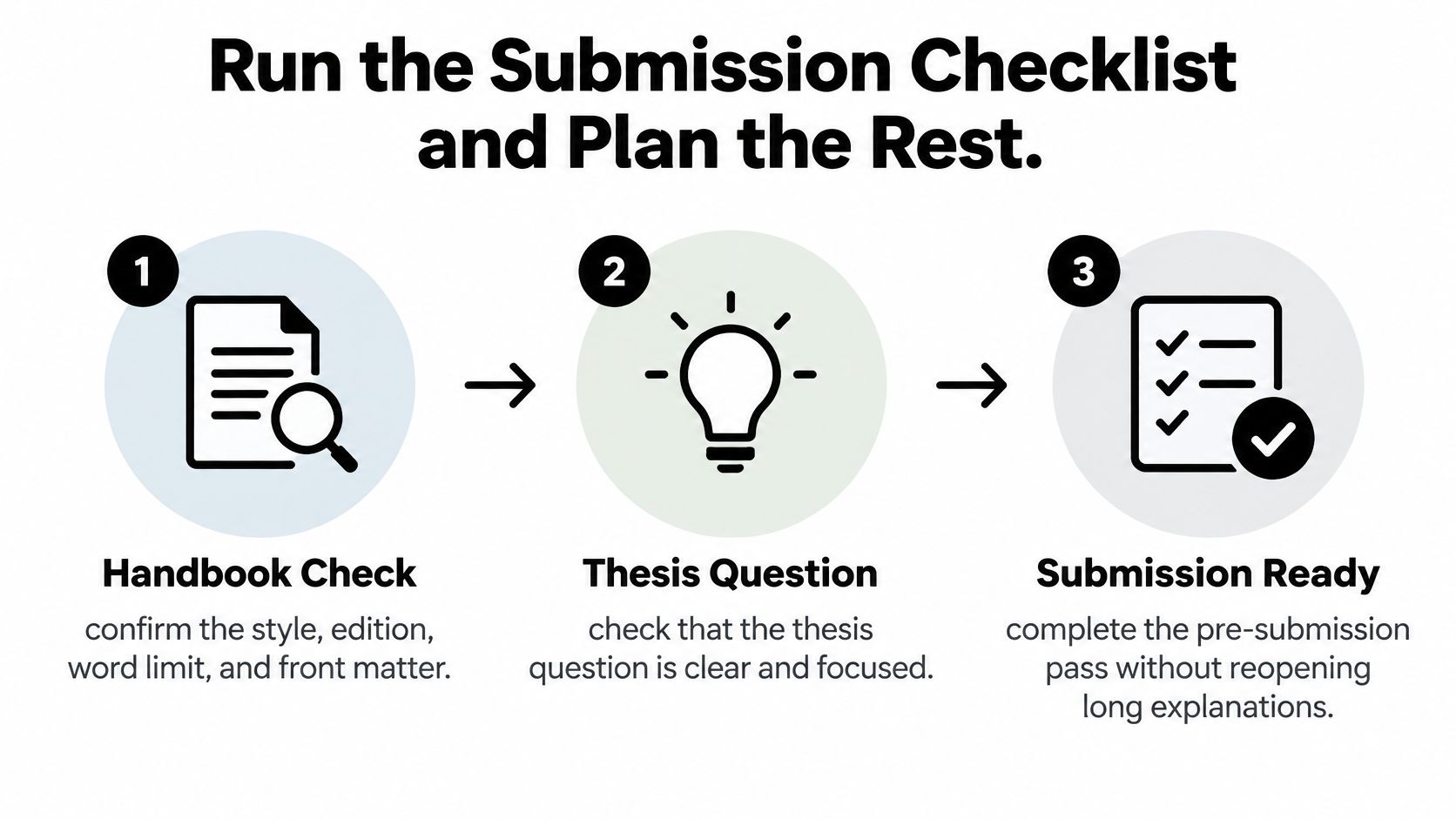
Done means a reader can locate the claim, assess the evidence, and retrieve the source without guessing. It also means the submission accurately represents what you did, what you found, and whose assistance you received.
Work backward from submission
Place the submission audit on your final milestone, then schedule the work it depends on. Allow for supervisor review before final formatting, and complete substantive revisions before refreshing cross-references and exporting the submission file.
Keep chapter status visible using labels such as outline, drafting, awaiting feedback, revising, and final. A polished introduction shouldn't conceal an unfinished discussion chapter. Add a next action and an agreed completion date to anything that isn't finished.
Our Thesis roadmap turns the project into a step-by-step plan from proposal to submission. In step 1, users set their deadline and break the thesis into chapters and milestones in minutes; in step 3, they watch their progress bar fill, keep their supervisor informed, and submit with confidence.
Any tracker is useful only if you update it accurately. Record unresolved decisions as tasks, not vague reminders to improve a chapter. Your next action might be to justify an exclusion criterion, reconcile conflicting references, or obtain approval for an assistance disclosure.
Before closing the project plan, assign each remaining blocker an owner and a decision date. That makes academic writing guidelines part of the work schedule rather than a document you remember only when submission is close.
Thesis Book Project combines a guided thesis roadmap with chapter tracking, milestones, and progress visibility to help you turn writing requirements into manageable work. Visit Thesis Book Project to set your submission deadline, map your remaining chapters, and schedule the checks your thesis still needs.
Related Articles
Milestone Schedule Example: 7 Formats Worth Copying
A milestone schedule works only when each checkpoint marks a decision or accepted result. A 2025 PhD...
Thesis WritingHow to Write a Discussion Chapter in a Thesis Step by Step
The most popular advice about the discussion chapter is to explain your results. That advice isn'...
Thesis WritingCorporate Profile Examples: 8 Formats Worth Copying
An examiner flips to the appendix for the company background and finds three vague paragraphs. The f...
Comments (0)
No comments yet. Be the first to share your thoughts.