Milestone Schedule Example: 7 Formats Worth Copying
Seven annotated milestone schedule example formats with backward planning tips, reminder cadences, and takeaways you can apply to your thesis timeline.
A milestone schedule works only when each checkpoint marks a decision or accepted result. A 2025 PhD survey found that 21% of candidates reported falling behind in their first year, compared with 59% in their final year (survey results). Early progress can conceal a schedule that leaves too little room for analysis, review, and submission.
For example: analysis approved | agreed review date | supervisor accepts the methods, results, and limitations. The milestone is the acceptance point; the analysis work belongs in the tasks that lead to it. Copy this format: milestone | target date | completion criterion.
A useful milestone states what must be true before the project proceeds.
Each schedule format exposes a different risk. A summary chart hides workload, a Gantt chart can hide uncertainty, and a release roadmap can hide unresolved quality problems. The examples that follow show what each format leaves out, where it can fail, and a tactic to adapt for an academic timeline.
Table of Contents
- 1. Milestone Chart (Milestone Schedule Summary)
- 2. Backward-Scheduled Milestone Plan
- 3. Gantt Chart with Milestone Markers
- 4. Stage-Gate (Phase-Gate) Milestone Schedule
- 5. Agile Release Milestone Roadmap
- 6. Apollo Program Milestone Schedule
- 7. Dissertation Milestone Schedule with Supervisor Checkpoints
- Milestone Schedule Formats at a Glance
- Pick One Format and Schedule It Backward
1. Milestone Chart (Milestone Schedule Summary)
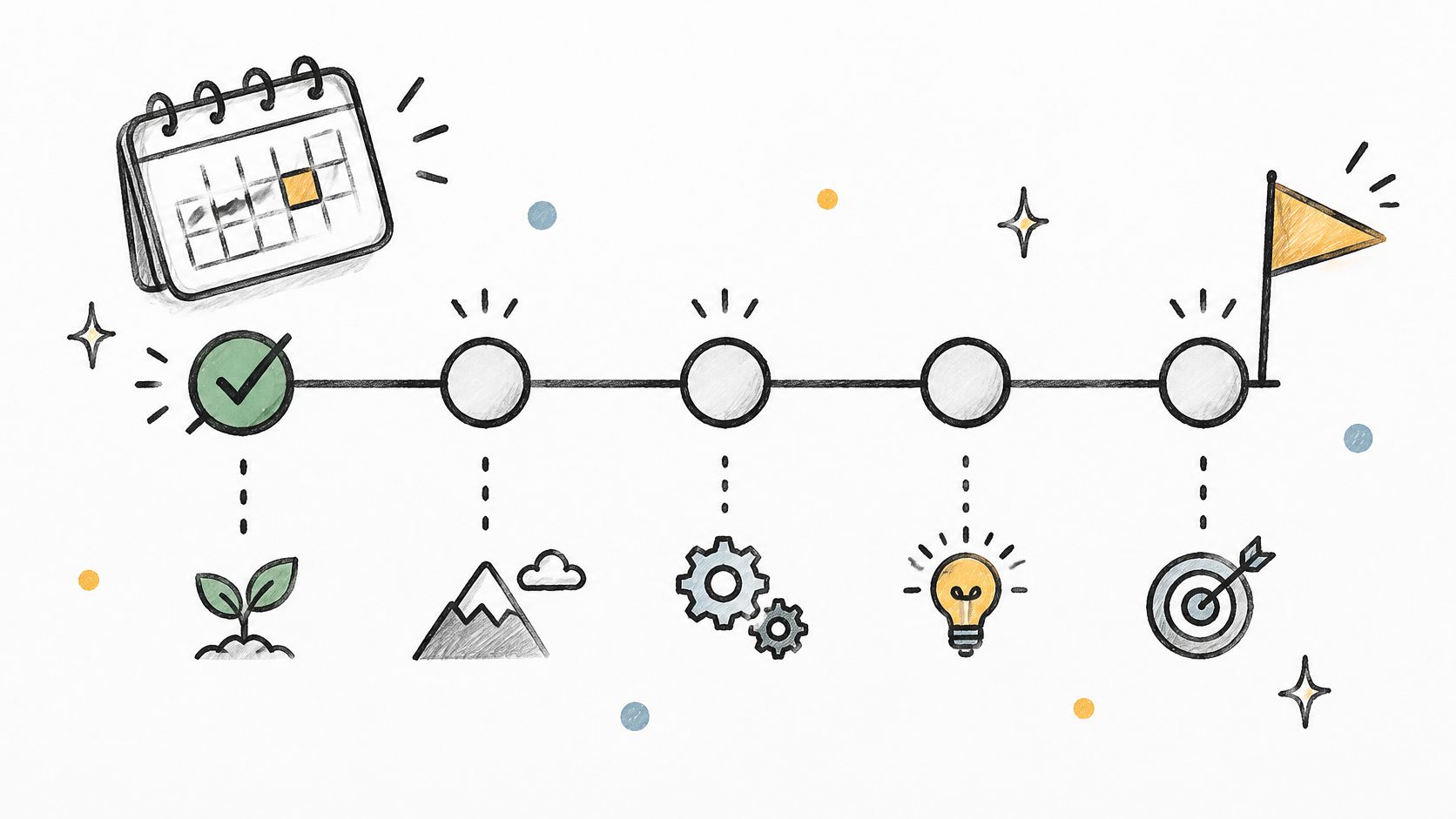
Your supervisor shouldn't need to inspect every reading task to tell whether your dissertation is on track. A milestone chart gives them the headline commitments: proposal approved, ethics cleared, collection complete, full draft reviewed, and submission accepted.
Keep the chart in Excel, Google Sheets, or your project platform. Give each checkpoint a target date, completion criterion, accountable person, and current forecast. Preserve the original target when the forecast changes, otherwise nobody can distinguish an agreed deadline from a revised estimate.
What It Hides and Where It Breaks
The chart omits the work between checkpoints. That makes it useful for reporting, but unreliable as your only planning document: data collection complete could depend on recruitment, equipment access, participant availability, and permissions.
It breaks when you label effort as achievement. Literature review underway isn't a milestone; review accepted as sufficient to justify the research question is. In construction, the equivalent distinction is between working on foundations and having foundations completed and approved.
- Keep the summary selective: Include approvals, major deliverables, and decisions that change what can happen next.
- Make acceptance visible: Record the evidence, such as an approval email or reviewed manuscript.
- Connect to working detail: Use an online progress tracker to keep chapter tasks separate from the supervisor-facing summary.
Copy this entry: Proposal approved | target: agreed proposal-review date | owner: candidate | acceptance: supervisor confirms scope and methods | forecast: current expected approval date.
2. Backward-Scheduled Milestone Plan
Start with the deadline you can't move, then calculate when its prerequisites must finish. For a dissertation, that means working backward through submission administration, final checks, revisions, supervisor feedback, an integrated draft, analysis, and data collection.
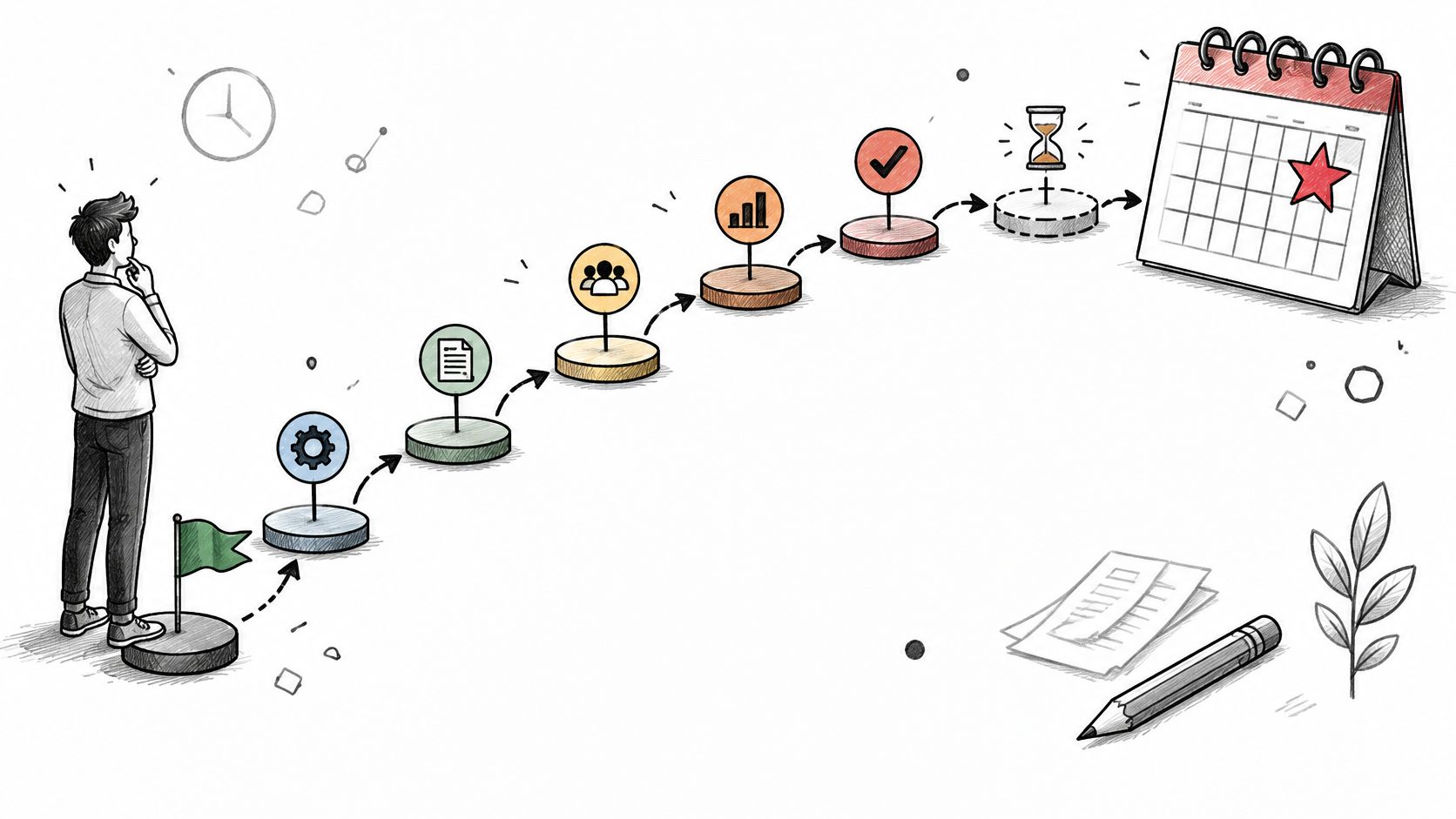
Say your graduate school has a fixed submission date. Before assigning chapter deadlines, confirm whether formatting approval, committee signatures, or repository registration must happen earlier. Those requirements belong in the plan even though they don't produce thesis content.
The Trade-Off Between Ambition and Capacity
Backward scheduling exposes the available time; it doesn't prove the work fits. If recruitment and analysis require more time than remains, shrinking their calendar blocks won't make them faster. Reduce scope with your supervisor, change the research approach where appropriate, or discuss the deadline.
It also hides resource conflicts unless you account for teaching, employment, caring responsibilities, and leave. Estimate active work time separately from elapsed calendar time, then check whether the required effort fits your actual availability.
Planning rule: Protect time for revision before allocating the remaining time to drafting.
Use a strategy and roadmap to distinguish the fixed submission constraint from adjustable internal targets. Place buffers around uncertain dependencies rather than distributing spare time evenly.
Copy this sequence: Submission deadline ← submission checks ← revised manuscript accepted ← supervisor feedback received ← integrated draft delivered ← analysis approved. Assign dates only after confirming the work and waiting time between each checkpoint.
3. Gantt Chart with Milestone Markers
A methods chapter can progress while you await ethics approval. Participant recruitment usually can't. A Gantt chart makes that distinction visible by showing work as timeline bars and milestones as diamond markers.
In Microsoft Project, Excel, or another scheduling tool, group tasks by research phase or chapter. Connect dependent activities rather than placing bars where they look tidy. Treat supervisor review as a scheduled activity, with feedback received as its completion milestone.
What the Bars Don't Tell You
A long bar doesn't establish how much effort a task needs, and a partly filled bar doesn't prove that its output is usable. The chart breaks when you update completion percentages but leave dependencies and forecast dates unchanged.
A port-construction case study reported average critical-path Percent Plan Complete of 72% across 25 weeks, while critical activities fell toward 50% at several points. For thesis planning, the transferable lesson is to inspect deadline-driving work separately from peripheral accomplishments.
- Show dependencies: Link ethics clearance to recruitment and accepted analysis to results interpretation.
- Separate review from revision: Don't hide both inside a bar labelled writing.
- Inspect the critical chain: Ask which unfinished activity can move submission, rather than counting every completed task equally.
Copy this dependency chain: Ethics application prepared → ethics clearance received → recruitment completed → dataset validated → analysis approved. Add parallel writing tasks only where they do not depend on those outcomes.
4. Stage-Gate (Phase-Gate) Milestone Schedule
A stage-gate schedule asks a harder question than whether you finished the work: should you proceed? Each phase ends with a review that produces approval, revision, or redirection.

For doctoral research, useful gates include proposal approval, confirmation of candidacy, readiness for data collection, and acceptance of the analysis approach. A gate should prevent expensive downstream work when a foundational decision remains unresolved.
A research-to-commercialization program article describes projects that used measurable pass/fail criteria and target dates, with most designed as two-year efforts containing only two or three major milestones. The useful principle isn't to copy that duration; it's to concentrate formal reviews on decisive outcomes.
Where Formal Approval Becomes Friction
Stage gates hide the exploratory work inside each phase. They break when reviewers introduce new criteria at the meeting, or when every small decision requires formal approval. Define the acceptance test before work starts and reserve gates for consequential commitments.
For example, a data-collection gate might require an approved protocol, permitted recruitment materials, tested instruments, and an agreed analysis plan. The reviewer can then assess readiness rather than offer an open-ended reaction.
Copy this gate record: Gate: ready for data collection | reviewer: named supervisor or committee | review date: agreed date | evidence: protocol, approvals, pilot findings | outcome: proceed, revise, or redirect | next action: named owner and due date.
5. Agile Release Milestone Roadmap
Instead of waiting until a whole chapter feels finished, deliver a reviewable section on an agreed cadence. Keep the review appointments predictable, but adjust the amount of work you commit to between them.
This borrows from software release planning without pretending a thesis is a software product. An academic release might be a methods rationale, an interpreted results figure, or a revised argument supported by references. Each delivery must be useful enough for someone to assess.
What It Hides and Where It Breaks
Short cycles can hide whole-document problems. You may deliver polished sections while leaving contradictions between the research question, methods, and discussion unresolved. Include integration milestones alongside section-level deliveries.
The approach also breaks when a candidate trims quality to preserve cadence. You can postpone an optional illustration or narrow a section's scope; you can't omit necessary evidence, ethics requirements, or essential analysis.
- Fix the review rhythm: Agree when your supervisor will receive work and whether they'll respond in writing or discuss it.
- Vary scope responsibly: Choose a smaller complete argument rather than sending a larger fragment without context.
- Maintain an integration target: Schedule a manuscript-wide review of terminology, claims, structure, and cross-references.
A useful delivery includes the text, its purpose, and the decision you need. Don't ask for general feedback when you're trying to resolve a particular methodological choice.
Copy this release note: Delivered: methods rationale | acceptance: approach and limitations are explicit | feedback requested: is the justification defensible? | deferred: optional illustration | next release: revised rationale and analysis outline.
6. Apollo Program Milestone Schedule
Apollo is useful because its checkpoints demonstrated readiness, not just activity. According to NASA's Apollo program history, Kennedy announced the lunar landing and safe-return goal in 1961, and Apollo 11 landed on July 20, 1969. The intervening missions tested capabilities needed for that final outcome.
For a thesis, translate the pattern into increasingly demanding demonstrations: a defensible question, a workable design, usable evidence, reproducible analysis, and an integrated argument. Each milestone should resolve an uncertainty that would otherwise threaten the next phase.
The Blind Spot Is the Recovery Path
A sequence of successful tests can make the schedule look more predictable than it is. The NASA Space Science Data Coordinated Archive's Apollo chronology records six successful lunar landings among seven missions intended to land humans on the Moon; Apollo 13's planned landing was cancelled after a spacecraft malfunction.
You can't transfer Apollo's resources to a dissertation, but you can transfer its test-and-verify logic. A pilot study should answer whether recruitment and instruments work, not merely record that you conducted a pilot.
Don't advance because the checkpoint date arrived. Advance because the evidence supports the next commitment.
Define a recovery decision before each risky phase. If recruitment proves infeasible, agree whether to revise recruitment, narrow the question, or seek approval for an alternative dataset.
Copy this validation milestone: Pilot accepted | evidence: recruitment feasibility and instrument usability demonstrated | decision: proceed or revise | fallback: supervisor-approved alternative approach | downstream work released: full data collection.
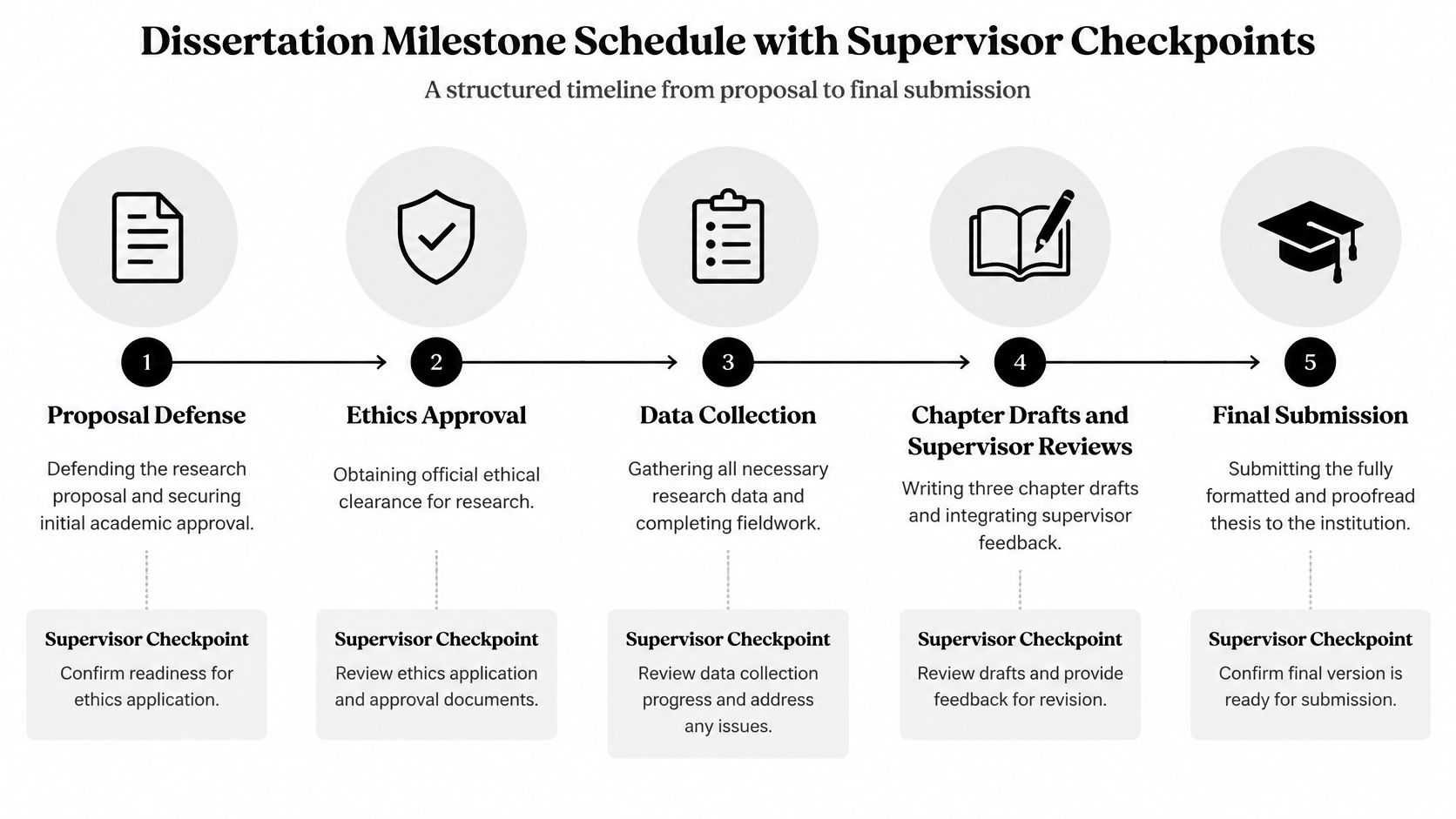
7. Dissertation Milestone Schedule with Supervisor Checkpoints
Your draft delivery date and your supervisor's feedback date are different commitments. A dissertation schedule that records only the former assigns you control over waiting time you don't have.
A 2025 study of doctoral research delays published in Dialogues Review examined 176 doctoral candidates across 10 universities and identified delayed evaluations, inadequate feedback, institutional inefficiencies, and negative supervisory practices as significant contributors to delays. Your schedule should therefore make external review dependencies explicit.
Build a Normal Path and a Delayed Path
For every substantial draft, agree on a delivery date, expected feedback date, revision window, and follow-up date. Tell the reviewer what decision you need and identify which later tasks depend on it.
The format hides supervisory workload unless you discuss availability. It breaks when you assume immediate responses or continue polishing a chapter whose basic argument hasn't been accepted. Ask about leave, committee commitments, and preferred review formats before finalizing dates.
If feedback is late, continue independent work such as reference checks or already-approved chapter revisions. Follow up on the agreed date, then use your program's support route if the delay threatens submission.
Use guidance on how long it takes to write a dissertation alongside your own workload estimate, not as a substitute for agreement with your supervisor.
Copy this review cycle: Draft delivered → feedback expected → revisions completed → acceptance confirmed. Attach a follow-up date and a delayed-feedback action to the cycle, including work you can safely continue.
Milestone Schedule Formats at a Glance
| Format | Best For | Key Strength | Main Weakness |
|---|---|---|---|
| Milestone Chart | Giving stakeholders a quick view of key checkpoints | Easy to scan and makes slippage visible | Omits tasks, dependencies, and work between milestones |
| Backward-Scheduled Milestone Plan | Projects with a fixed, non-negotiable deadline | Anchors milestones to the final date and exposes unrealistic plans | Can leave too little slack if buffers are overlooked |
| Gantt Chart with Milestone Markers | Tracking tasks, durations, dependencies, and checkpoints together | Makes overlapping work and dependencies clear | Can become cluttered and needs frequent updates |
| Stage-Gate Milestone Schedule | Projects that need formal reviews and approval decisions | Builds accountability and quality checks into the schedule | Can add bureaucracy and slow progress |
| Agile Release Milestone Roadmap | Teams delivering work on a regular release cadence | Supports predictable delivery and frequent feedback | Scope may shrink to meet fixed dates |
| Apollo Program Milestone Schedule | Breaking an ambitious, long-term goal into staged steps | Uses progressive milestones to reduce risk | Resource-intensive and can create pressure around fixed deadlines |
| Dissertation Milestone Schedule with Supervisor Checkpoints | Academic projects requiring supervisor reviews and institutional approvals | Aligns milestones with feedback cycles and formal deadlines | Depends on supervisor availability and program-specific rules |
Pick One Format and Schedule It Backward
Choose the format that matches how your project gets reviewed. A milestone chart suits supervisors who want a concise accountability view. Stage gates suit committees that formally authorize progression, while a release roadmap suits collaborators who can review smaller outputs regularly.
Use a Gantt chart when overlapping work and dependencies are difficult to understand. You can pair it with a summary chart, but don't maintain separate versions of the same dates by hand. Keep one working schedule and derive the simpler reporting view from it.
Make Every Checkpoint Actionable
Anchor the plan to the official submission date, then work backward through acceptance, revision, review, and production. Confirm institutional requirements before allocating the remaining time to research and writing. If the work doesn't fit, resolve scope or capacity rather than compressing every activity until the diagram looks feasible.
- Name the evidence: Specify what proves the milestone is complete.
- Name the reviewer: Identify who can accept the output or authorize progression.
- Protect revision time: Leave space to act on feedback, not merely receive it.
- Define the response to delay: State which tasks move, which continue, and when you'll seek help.
Broader schedule optimization strategies for 2026 can help organize competing commitments, but your academic plan still needs acceptance criteria and realistic review dependencies. Calendar organization can't resolve an unapproved method or an unanswered supervisory decision.
Thesis Book Project combines milestone scheduling, chapter tracking, and supervisor sharing within a thesis-focused workflow. Its free Starter tier offers a way to begin organizing the project, with additional capabilities available through other plans.
The best milestone schedule example is the one you can use at your next review meeting. Bring the current forecast, the evidence completed, the unresolved decision, and the next action. That's enough to turn a schedule from a display of intentions into a practical agreement about progress.
Thesis Book Project offers a guided thesis roadmap, chapter tracking, and milestone planning anchored to your submission deadline. Visit Thesis Book Project to organize your next checkpoint and connect it to the drafting, review, and revision work needed to reach it.
Related Articles
How to Write a Discussion Chapter in a Thesis Step by Step
The most popular advice about the discussion chapter is to explain your results. That advice isn'...
Thesis WritingCorporate Profile Examples: 8 Formats Worth Copying
An examiner flips to the appendix for the company background and finds three vague paragraphs. The f...
Thesis WritingFootnotes Examples MLA: Formatting Rules and Templates
You're halfway through a literature chapter, the sentence is already crowded, and your cursor is...
Comments (0)
No comments yet. Be the first to share your thoughts.