Source One Management Services: Thesis Reference Guide
Source One Management Services is a procurement firm, not a thesis tool. Learn how to centralize references for your thesis, step by step.
You search for a way to keep your thesis references straight, and the results talk about supplier negotiations and spend analysis. That gap isn't a search engine glitch, and it isn't proof that the tool you want doesn't exist. Three different things answer to the name Source One Management Services, and only one of them has anything to do with your footnotes.
Table of Contents
- Which Source One Management Services You Are Looking For
- What Source Management Means for Your Thesis
- How to Centralize Your References Step by Step
- Which Source Details Each Thesis Stage Needs
- Mistakes That Scatter Your References Again
- Sharing and Protecting Your Source Library
- Choose a Source Library and Start This Week
Which Source One Management Services You Are Looking For
The phrase points to three separate things, and if you're writing a thesis, you almost certainly want the third.
Source One Management Services was a procurement business. A public company profile dates its founding to 1992 and records its rebrand as Corcentric on 25 January 2021. It built its name on strategic sourcing, spend analysis, supplier negotiation and cost reduction for large organisations in manufacturing, finance, life sciences, retail and consumer packaged goods, and Corcentric's acquisition announcement describes the deal as expanding its procurement and spend-management capabilities. Published accounts don't agree on the timing, though: a 2018 Corcentric release announced the acquisition that year, while the later announcement points to May 2024, so check the date against the company's own statement before you repeat it anywhere.
| Name | What it does | Status | Relevant to your thesis? |
|---|---|---|---|
| Source One Management Services | Strategic sourcing, spend analysis and procurement support for businesses | Founded 1992; acquired by Corcentric, with accounts giving 2018 or 2024 | No |
| Corcentric | Procurement and finance services, including spend management | Current owner of the former Source One business | No |
| Academic source management | Stores, tags and cites references for a thesis | Active category of research tools | Yes |
None of that belongs in your thesis. It matters only because the phrase is what people search, and because an old proposal, contract or reading list may still name the company as though it were independent. If you meet the name in a legacy document, confirm three things before you rely on it: the contracting entity, the scope of the service described, and who owns the business now. A merger can add capability without making accountability any clearer for an existing agreement.
So which one did you arrive for? If it's the third row of that table, the useful work starts with one record and a rule about where it lives.
What Source Management Means for Your Thesis
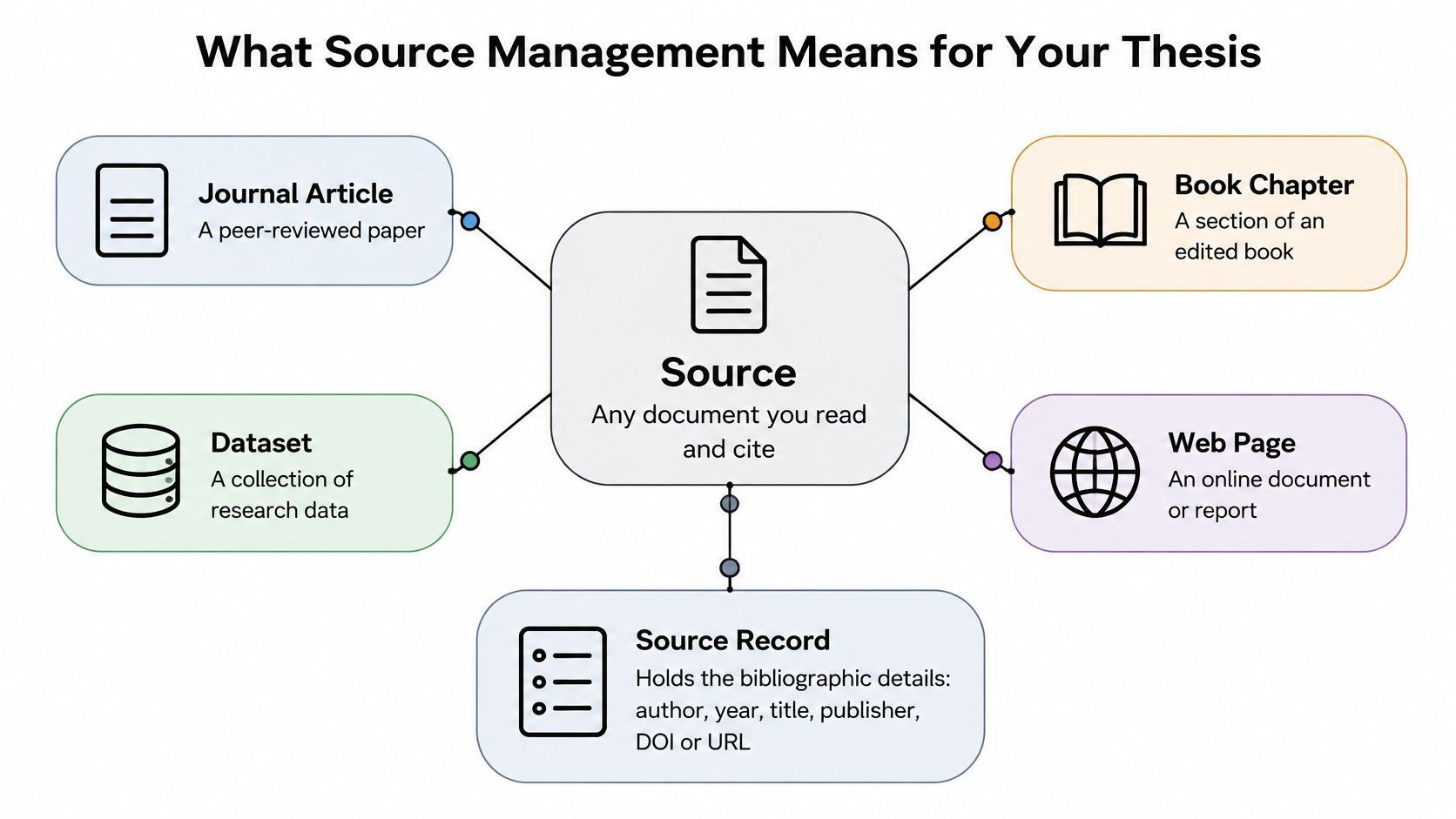
A source is any document you read and cite. A journal article, a chapter in an edited book, a dataset you pulled from a repository, a regulator's report, a company page you quoted one line from. Many researchers begin with a folder of PDFs and a separate list of references they retype at the end, and that arrangement holds up until the reading gets heavy.
Think of a library catalogue card beside a pile of photocopies on the floor. The photocopies are the documents themselves. The card is the record: who wrote it, when, what it's called, who published it, and where a reader can find it. Source management means keeping the card and the document together in one catalogue that every chapter draws from, instead of rebuilding the card from memory each time you cite.
What goes inside one record
- The bibliographic core. Author, year, title, publisher, and a DOI or stable URL. That's what the bibliography needs, and it's the part people shortcut.
- The file. The PDF, the spreadsheet, the saved web page, attached to the record rather than sitting in a downloads folder.
- Your reading notes. Two or three lines on the argument, the method, and the limitation you'd challenge in a viva.
- Tags. The chapter and section that will cite it, so you can pull a working reference list for chapter three without scrolling through everything.
Take a paper you cite in chapter two and again in chapter four. Without a shared record, you retype the citation twice, the page numbers drift apart, and a corrected year gets fixed in one place and missed in the other. With one record, one edit reaches every use, including the final bibliography.
A tool counts as source management when it holds the file, the record and your notes in one place, and can export a bibliography in the style your department requires. If it only does two of those, you'll be rebuilding the third by hand.
That export is the step many skip until the week before submission.
How to Centralize Your References Step by Step
Centralising is less about software than about a rule you follow every time you open a tab. This sequence survives a long project.
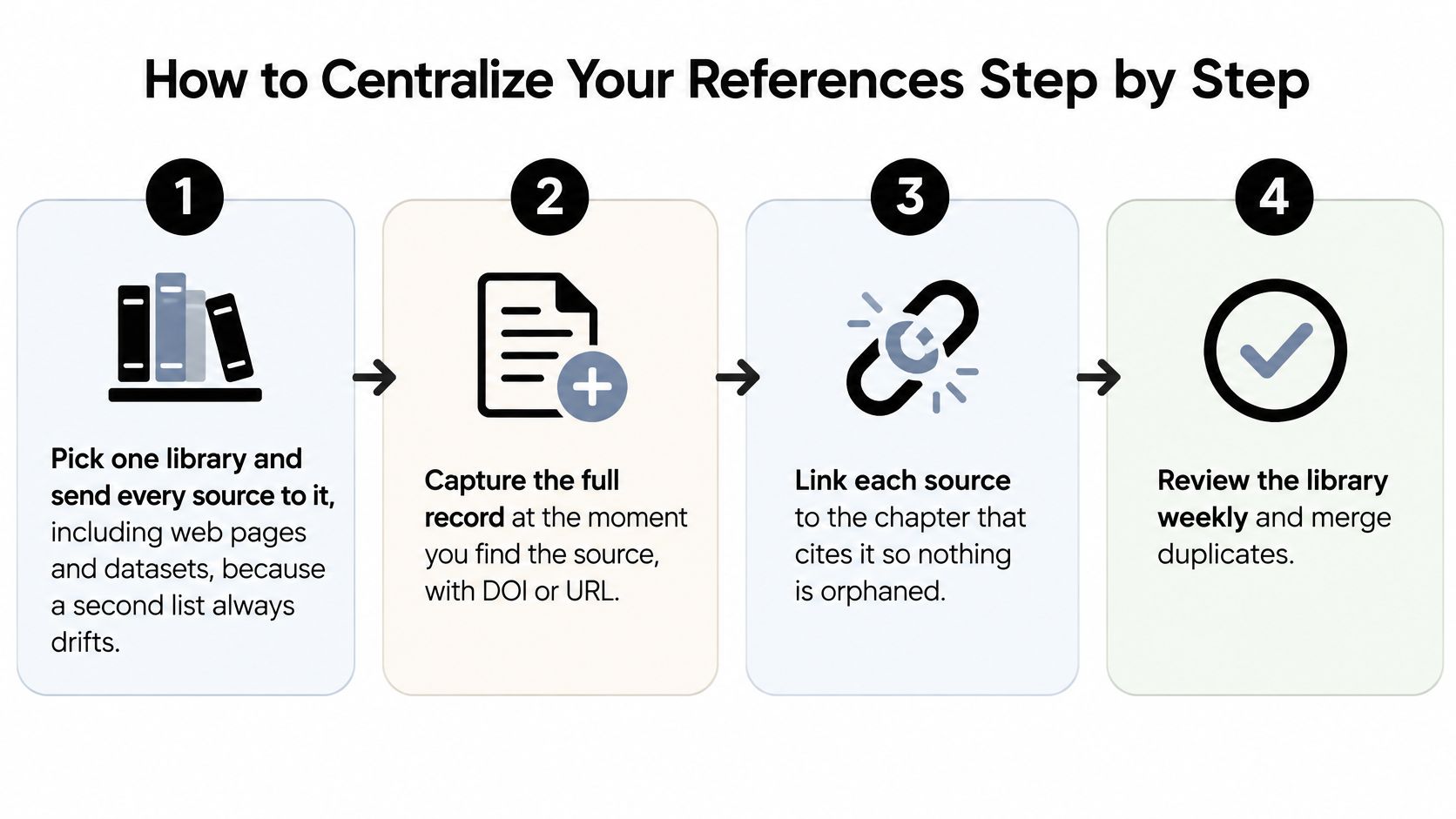
- Pick one library and send everything to it. Web pages, datasets, the report your supervisor emailed. The slip is keeping a second list "just for now"; two lists drift apart within weeks because you only ever update one of them.
- Capture the full record when you find the source. DOI or URL, volume, issue, page range, publisher, and the date you accessed a web page. Recovering a DOI six months later means hunting the publisher site or asking the library, and the details you half-remember are exactly the ones that turn out wrong.
- Attach the file and rename it. Author, year, three words of title:
Okonkwo-2019-institutional-logics.pdf. Leave it asdownload (3).pdfand you'll open four files to find the right one. - Write one line on why the source matters. Note the claim it supports and the chapter where you'd use it. A paper saved without a note becomes a reread in month six.
- Tag by chapter or section. Then link the source to your chapter tracker so a glance at chapter three shows both its progress and the evidence sitting behind it.
- Check the record against the publisher page before you cite it. Years, journal titles and author initials are the three fields that go wrong most often, and a wrong year in a bibliography is the kind of error an examiner circles.
- Export and back up once a month. Run the bibliography in your department's style, read it, and copy the library to a second location. Monthly catches drift and is rare enough that you'll keep doing it.
The usual slip: tagging everything as "Chapter 2". A tag that covers most of your library tells you nothing, so use the section you'd cite the source in, not the chapter you happen to be drafting.
When every chapter draws from the same list and the exported bibliography matches your reference section word for word, the system is working. Turning those records into an argument is the next job, and the literature review best practices guide covers how to group sources into themes rather than a string of summaries.
Which Source Details Each Thesis Stage Needs
A thesis moves through stages, and each one pulls different details out of the same set of records.
| Thesis stage | Source details to keep | Why it matters |
|---|---|---|
| Proposal | Core papers, DOIs and key claims | Shows the gap your research fills |
| Literature review | Reading notes, page numbers and direct quotes | Lets you compare studies without rereading |
| Methods | Method papers, software versions and data sources | Justifies each methodological choice |
| Results and discussion | Figure sources, permissions and links to original datasets | Keeps a clear permission and data trail |
| Final bibliography | Complete entries in one style, checked against DOIs | Prevents fixes on submission day |
Turning the table into a habit
When a stage asks for something your library doesn't hold, add that field at that moment. The methods chapter is the usual test, because it needs the method papers, the software version and the data source behind each choice. If a record says the analysis used a statistical package but not which release, you can't show why the choice was sound or help a reader reproduce it. Adding "R 4.4.1" or "SPSS 29" takes ten seconds while the output file is open, and an afternoon once the licence has lapsed and the machine is gone.
The bibliography is the stage that punishes shortcuts hardest, because every incomplete entry surfaces at once. When you reach that point, the guide to creating a reference list covers the formatting decisions in detail.
For a quick spot check, pick one source from the chapter you're writing now and open its record. If a field in the relevant row of that table is missing, you've found this week's job. Do it for one source and the habit spreads; do it for fifty on submission day and you'll be retyping entries from memory at midnight.
Mistakes That Scatter Your References Again
The mistake that costs the most work is also the quietest: duplicate records. Import the same paper twice from two databases and its notes and citations split across both copies. One copy gets the page numbers, the other gets the tag, and neither is complete. Search by DOI before you add anything, and merge duplicates once a week while there are only two or three.
- PDFs saved outside the library. A file on your laptop breaks its link the moment you switch machines or clear a folder. Store every file inside the library and keep one synced copy.
- Two devices editing at once. Sync conflicts overwrite notes, and you usually notice after the correction is gone. Choose one primary device, back up from it, and treat the second as read-only.
- Scope creep. A library full of papers you'll never cite is slower to search and harder to trust. Add a source when it supports a claim in your outline, and park the rest under a "maybe" tag you review.
Keeping page numbers and quoted lines in the record is also what makes the line between paraphrasing and plagiarism visible while you draft, rather than something you reconstruct afterwards.
Run a short check once a month. Count the duplicates, open three PDFs at random and confirm they load from the library, and clear anything from the "maybe" tag that has stopped looking useful. Each fix takes under an hour, and the habits matter more as the bibliography grows past a hundred entries.
Sharing and Protecting Your Source Library
Unpublished data, interview transcripts and draft findings usually sit in the same library as public papers, and that mixture changes the questions you need to ask. Before you upload anything restricted, find out where the files live: on your device, in a provider's cloud, or on an institutional server.
Decisions to make before term gets busy
- Storage location against your data policy. Your university's research data policy will say whether interview material can sit in a commercial cloud and whether it has to stay inside a named institutional system.
- Read-only sharing with a supervisor. Send an exported list or a read-only collection rather than edit access to the whole library, so records stay intact while your supervisor can see what you've read.
- One owner per field in co-authored work. Agree who updates DOIs, page numbers and years. Two people correcting the same record produces conflicting versions, and neither is authoritative.
- A licence you may already hold. Ask the library whether a reference manager is licensed for your department. That can remove the cost and the data question in a single answer.
Keep a one-page note of where the library lives, who can open it, and how it's backed up. Written down, it answers the supervisor question and the data audit question at the same time.
Once a term, restore a backup to a second machine and open a file from it. A backup you've never restored is a hope, not a copy.
Choose a Source Library and Start This Week
Three criteria separate a library you'll still trust in year three from one you abandon by month two.
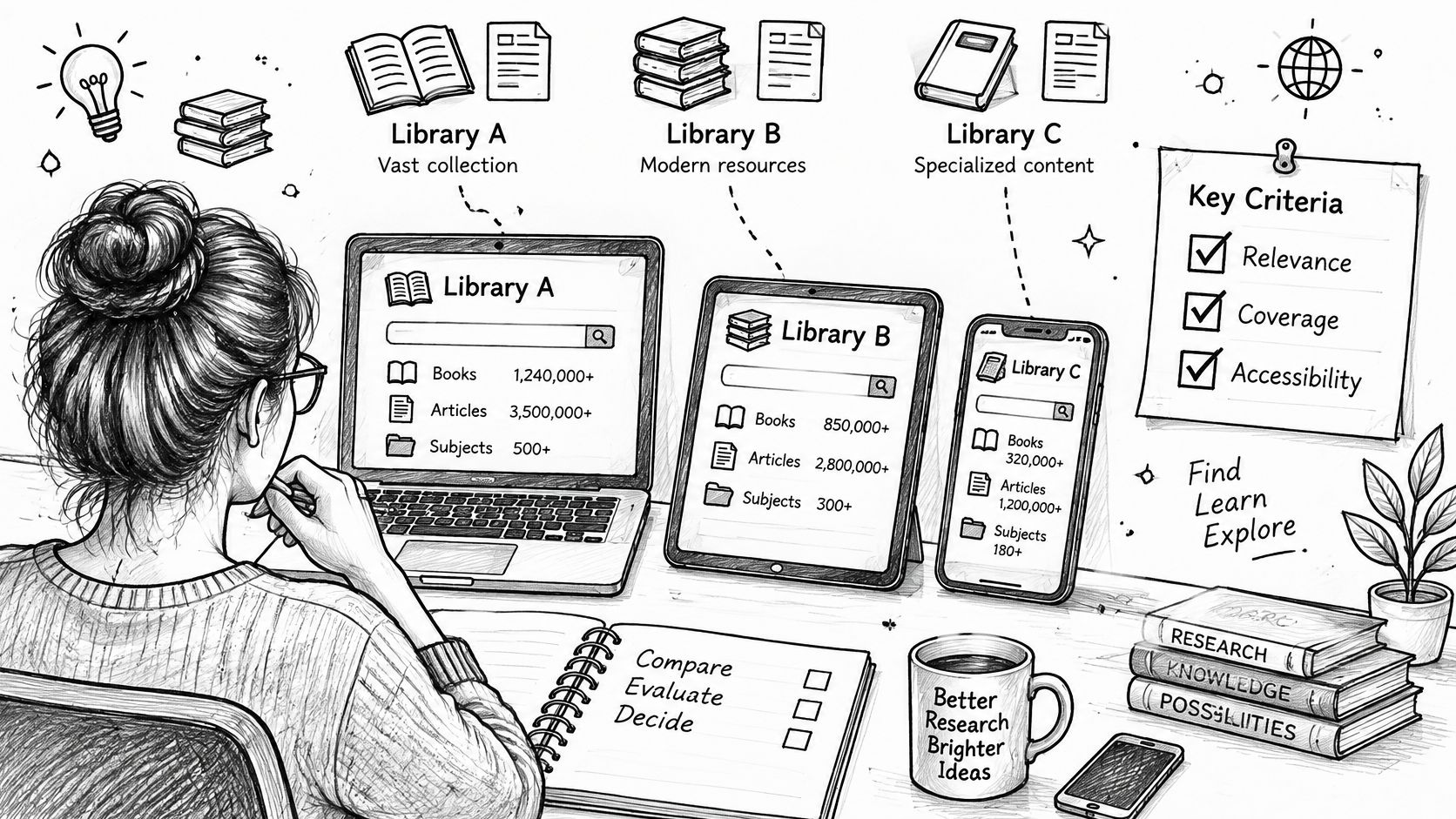
- It works across devices without conflict. You'll read on a laptop in the library, a phone on a train, a desktop in the lab. The library has to follow you and resolve edits without losing a note.
- It links each source to the chapter that cites it. A list sorted by author is fine for the bibliography and useless when you're drafting chapter four and need the five sources behind one claim.
- It keeps notes and reading status with the record. "Read", "skimmed", "to read", plus the two lines about why the paper matters, save you from reopening something you already decided was marginal.
The source manager in Thesis Book Project keeps references and reading organised alongside the rest of your planning, so a source and the chapter that cites it sit in the same place instead of in two separate tools. The free Starter plan includes the thesis roadmap, the chapter tracker, one project and community support, which is enough to test whether the workflow suits you before paying for anything. Pro costs $8 per month and adds unlimited projects, milestone reminders, the source manager and progress insights.
If you'd rather watch the setup before you build it, the walkthrough below is a sensible place to start.
Then this week: create one library, import the ten sources you cite most, and tag each to a chapter. Compare that list with your roadmap and you'll see immediately which chapters are short of evidence. Put the library on the agenda for your next supervisor meeting, attach a review date to it, and the habit will hold long after the novelty wears off.
Thesis Book Project keeps your references and reading in one place, linked to the chapters that use them, so the bibliography stops being a separate job at the end. Start free with the thesis roadmap and chapter tracker, or move to Pro for the source manager when your reading list grows past what a document can hold. Visit Thesis Book Project to set up your first project this week.
Related Articles
How to Respond to Supervisor Feedback: A Practical Guide
Your supervisor's comments are open in one window and your draft in the other. Some notes are bl...
Thesis WritingSubmission Requirements for Theses: A Complete Guide
You've finished the chapters, your supervisor has said the argument holds, and the only task lef...
Thesis WritingMap for Writing: How to Plan a Thesis Chapter by Chapter
You've got pages of reading notes, several half-drafted chapters, and a supervisor asking how th...
Comments (0)
No comments yet. Be the first to share your thoughts.