How to Respond to Supervisor Feedback: A Practical Guide
Learn how to respond to supervisor feedback: sort comments by priority, reply within 48 hours, handle vague or conflicting advice, and track every revision.
Your supervisor's comments are open in one window and your draft in the other. Some notes are blunt, two of them contradict each other, and the line you keep rereading is the one that stung rather than the one that matters most. The submission deadline is six weeks out and nothing in the email tells you what to fix first.
The reflex is to reply quickly with something agreeable, then work through the comments in the order they appear on the page. That order is almost always wrong, and it turns a manageable governance problem into an emotional one. Feedback isn't a verdict on whether you belong in the programme. It's a set of demands on a project, and demands can be sorted, costed and scheduled.
What follows is the process I'd use myself and the one I'd hand to any student who asked how to respond to supervisor feedback without losing either time or independence.
Table of Contents
- Sort Each Comment Before You Reply
- Reply Within 48 Hours and Send a Change Log
- Handling Vague or Harsh Comments Without Getting Defensive
- Handling Late, Contradictory or Conflicting Feedback
- Habits That Keep Feedback Meetings Productive
Sort Each Comment Before You Reply
A supervisor email rarely arrives sorted. Six kinds of comment sit in the same paragraph, in the order they occurred to the reader. Before you answer anything, put every comment into a table with four columns: what kind of comment it is, what it says, what it threatens, and what you'll do about it first.
| Comment type | Example wording | Priority | First response |
|---|---|---|---|
| Factual or citation error | "This citation doesn't match the source" | High, fix now | Correct it and cite the source |
| Argument or research question | "Your claim does not follow from the data" | High | Revise the claim or add evidence |
| Method or analysis | "Justify your sample size" | High | Add a justification or state the limitation |
| Structure | "This belongs in Chapter 2" | Medium | Propose a reorder and confirm it with your supervisor |
| Style or wording | "Shorten this paragraph" | Low | Batch these edits for the end |
| Personal preference | "I would use a different framework" | Clarify first | Ask whether the change is mandatory or optional |
Why Priority Follows Threat, Not Tone
A comment about your sample size isn't urgent because it was written in capitals. It's urgent because a weak sampling section can undermine the analysis in three chapters and the conclusion in a fourth. A blunt sentence about your abstract formatting is a five-minute fix dressed as a crisis.
That distinction is easier to hold when you treat feedback as structured academic input. A 2022 three-wave study of 374 matched postgraduate students and their supervisors found that academic supervisor developmental feedback was positively associated with students' intrinsic motivation and psychological safety climate. The study doesn't claim every comment is correct. It supports the practical habit of separating a comment's content from its emotional impact, then working on the content.
Practical rule: if you can't name what a comment threatens, it isn't a priority yet. It's a question to send back.
Then work the list in an order that protects the thesis: research question and claims first, theoretical framing next, then method and analysis, then limitations, then structure, and style last. Sentence-level edits belong at the end because a restructured chapter deletes them anyway.
Say a supervisor writes that section 3.4 reads as a list of studies rather than an argument. That's a structure comment at medium priority. The prose will need rewriting, but the rewrite depends on which method you land on, so it queues behind the method fix rather than jumping it.
Copy your most recent supervisor email into a spreadsheet, one row per comment, and tag each with a type and a priority before you write a single line of reply.
Reply Within 48 Hours and Send a Change Log
Timing matters less than sequence. A reply inside 24 to 48 hours that restates each comment in your own words buys you something a fast "thank you, will do" never does: the supervisor finds out now if you've misread the request, not three weeks later in a draft.
A realist review of feedback interventions screened 19,065 papers, assessed 375 full texts and included 58 studies, and its conclusion supports that caution: what makes feedback work is the conditions around it, not the label on it. Treat the exchange as a negotiation over decisions rather than a one-way correction.
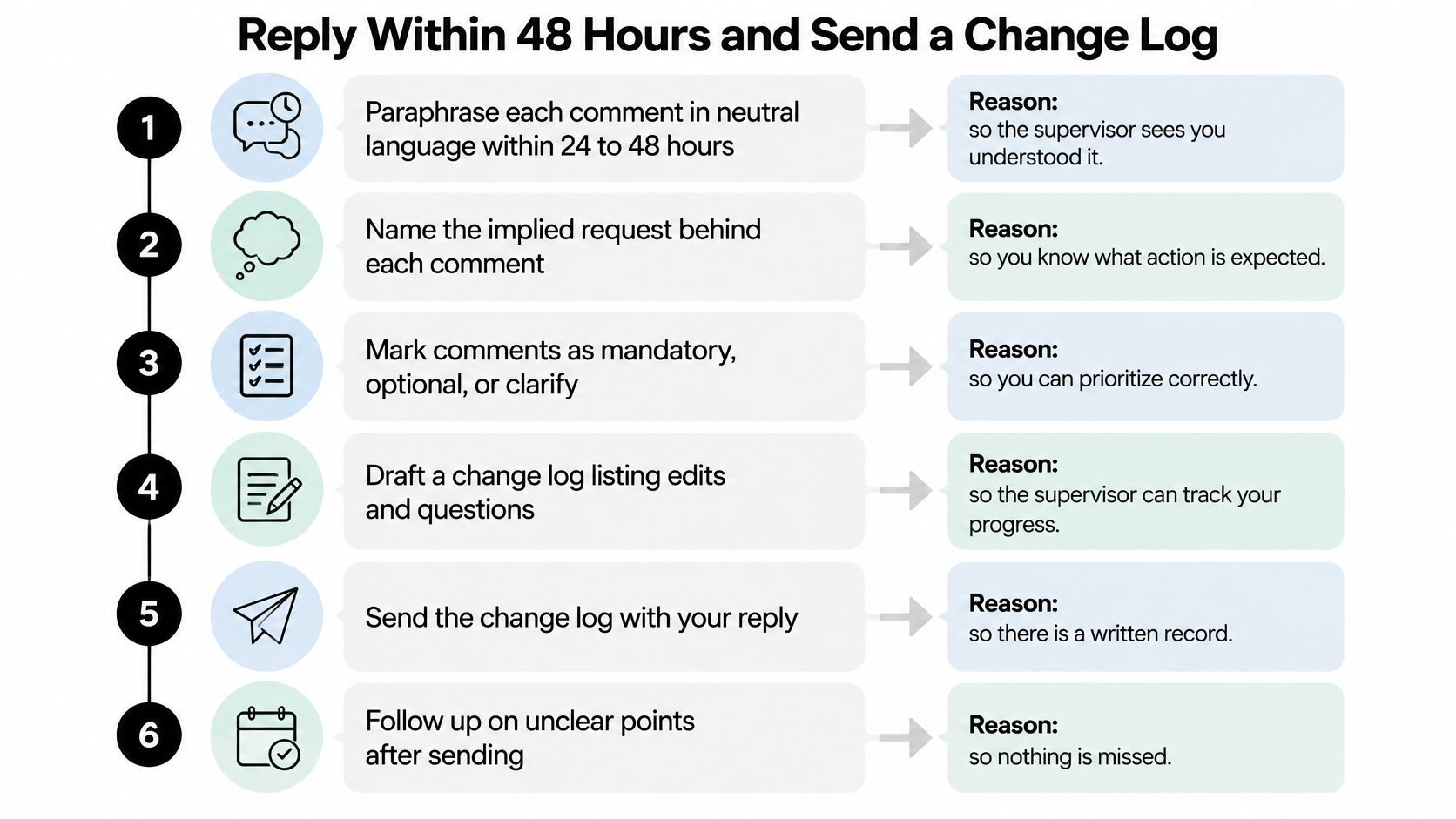
Here is the sequence, with the reason each step earns its place.
- Paraphrase in neutral language, inside 24 to 48 hours. Rewrite the comment plainly, stripped of its tone. The supervisor sees whether you understood it, and you find out early if you didn't.
- Name the implied problem and the standard behind it. "Needs more evidence" could mean a citation, a sensitivity check or a second dataset. Naming whether the standard is a disciplinary convention, a department rubric or a journal expectation turns a mood into a requirement.
- Test it against your argument. Does the change tighten the link between question, evidence, inference and conclusion? If it doesn't, that's information for step 4, not defiance.
- Draft two options. The minimal revision and the substantive revision, each with its consequences for scope, data, timeline and any chapter that depends on this one. Supervisors choose well between two concrete paths and badly between agreement and silence.
- Send the reply with a date. Acknowledge receipt, list the priorities in order, and ask one targeted question per genuine ambiguity. Two sentences do the job: "Chapter 3, section 3.2. I'll add the sampling justification and a response-rate caveat. Revised draft with tracked changes by Friday the 14th."
- Return the chapter with a change log. One row per comment: the supervisor's wording, your interpretation, the action taken, and the section or page where the change sits.
The three questions that structure a good change log come from a University of Melbourne synthesis of feedback research, which identifies where am I going, how am I going and where to next as the core architecture of effective feedback. The same report notes that feedback works best when it supplies cues tied to goals, while praise, punishment and generic evaluation are substantially less useful.
Three failure modes sink otherwise good replies.
- Silent omission. You skip a comment you disagree with and hope it drops. It doesn't, and the next meeting starts with a trust problem.
- Blanket acceptance. You agree to every suggestion without checking your design. Half the changes then conflict with each other and the chapter loses coherence.
- Wording debates before conceptual ones. Arguing about a phrase for two days while the research question stays unresolved.
Mark each log row accepted, partly done or declined, and give declined items a one-line rationale plus an alternative you can live with. Then attach an owner, a deadline and a completion test to every open item, and end with two or three decision questions the supervisor can answer in one sentence each.
The follow-through is where most students lose ground. Techniques for turning meeting decisions into owned actions transfer directly here: one owner, one date, one definition of done, agreed while both of you are still in the conversation.
Keeping the log next to your chapter plan makes the pattern visible across months, and steady progress monitoring against agreed dates stops the same comment returning in a new form. Thesis Book Project's supervisor check-ins let you share progress and open blockers before a meeting instead of reconstructing them from memory, and milestones are set to work backwards from the submission date with reminders before anything slips.
Pick the next meeting date now, and send the log at least 48 hours before it.
Handling Vague or Harsh Comments Without Getting Defensive
The comment that stalls a week of work is rarely the technical one. It's four words on the page, no verb, no criterion: "I'm not convinced." Or "this needs more depth." Or a reference to how your supervisor did it in their own thesis a decade ago.
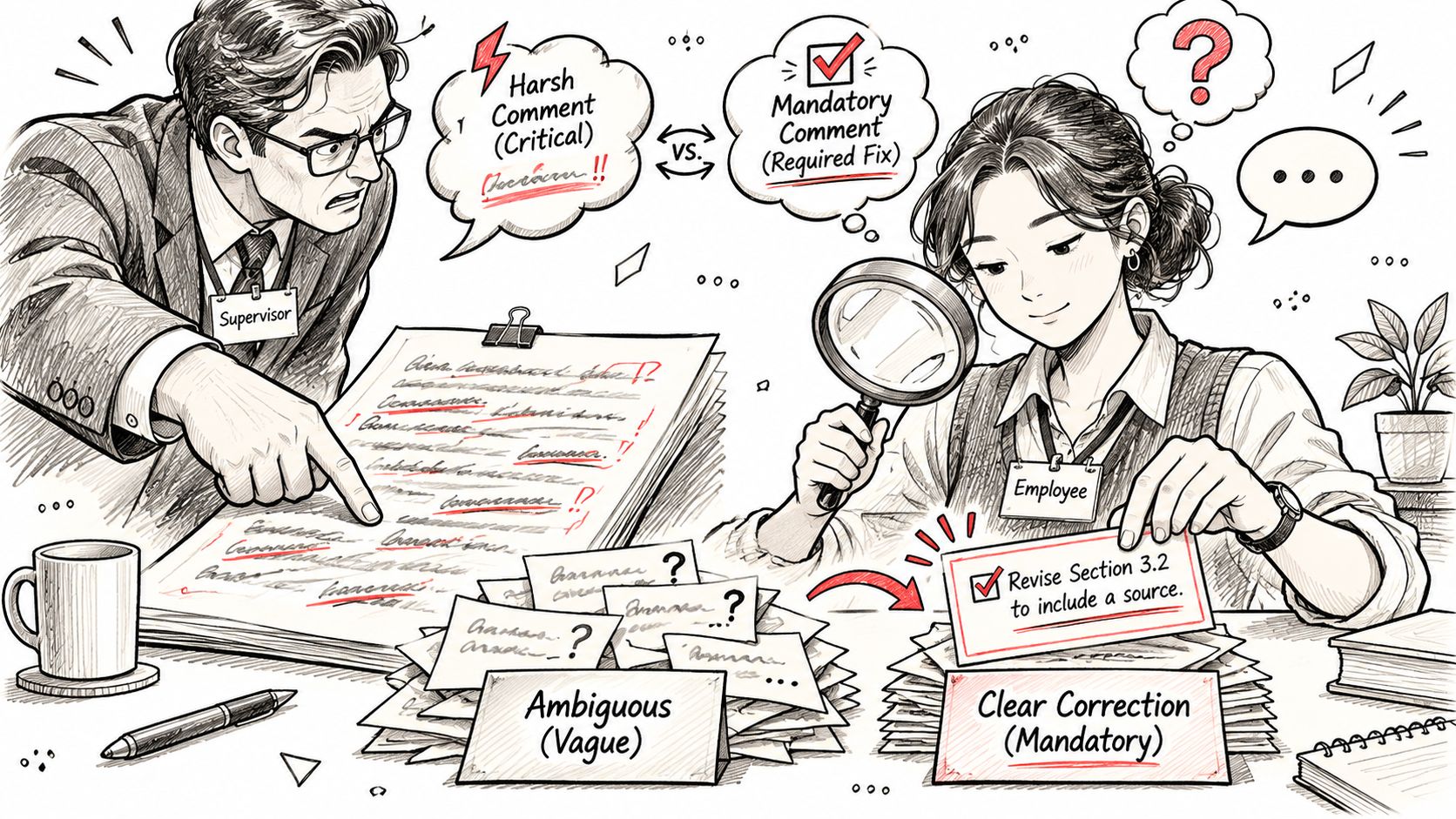
The standard advice, thank them, make the changes, ask a clarifying question, never explains how to tell a mandatory correction from a debatable scholarly preference, or how to push back without looking defensive. That gap has been documented. Research with Chinese master's students on supervisors' use of evaluative language found that directive, actionable comments tied to assessment criteria were seen as useful, while evaluative phrasing triggered mixed emotions and often carried an authoritative "definitive truth" that shut dialogue down.
The Question That Turns a Verdict Into a Decision
| Comment as written | Question to ask back | What the answer resolves |
|---|---|---|
| "This needs more depth" | Which claim needs more evidence, and how many pages do you expect? | Scope of the revision |
| "The argument is weak" | Which step fails: the question, the evidence or the inference? | Where the problem sits |
| "Rewrite the methods" | Is this a required change or a suggestion for clarity? | Mandatory versus optional |
| "I am not convinced" | What would convince you: a citation, a test or a narrower claim? | The evidence standard |
| "Do it the way I did in my thesis" | Is this a department standard or a personal preference? | Whether to accept or negotiate |
Challenging a comment with evidence sounds like this: name the step you believe is sound, cite the source or the design choice behind it, and ask what would change their view. That's a technical exchange. Defensiveness sounds like restating your position with more feeling.
The trade-off is real. Uncritical acceptance buys short-term alignment and costs independent judgement, and a 2024 interview study reported in the same body of work found that students who fully followed supervisors' instructions produced more academic output in the short term but developed less autonomy.
Say your supervisor asks you to replace your sampling approach. You run a short pilot, find the original approach holds for the main cohort but fails for one subgroup, and come back with a narrower revision that covers that subgroup. You get a smaller change, agreed in writing, and you keep the design.
Here is the exercise that gets easier with practice.
Take your vaguest comment, the one you've been avoiding, and write the single question you would ask back. Then send it.
Handling Late, Contradictory or Conflicting Feedback
Almost every guide on how to respond to supervisor feedback assumes one supervisor, prompt replies and a cooperative relationship. Real projects break all three. Comments land after a milestone, two supervisors want different things, or silence eats a fortnight you didn't have.
Power shapes this more than students expect. A synthesis of 86 studies on feedback in doctoral supervision found that supervisors control access to both explicit and tacit academic standards, that verbal feedback is temporary while written feedback is more concrete, and that supervisors' stated wish for student independence doesn't always show up in practice. Three cases follow from that.
| Situation | First move | Deadline |
|---|---|---|
| Late comment | Acknowledge receipt and propose a revised date for the milestone | Within 1 week |
| Contradictory comments from two supervisors | Summarise each instruction and ask for one ranked priority list | Within 3 working days of the second comment |
| Silence that threatens the schedule | Send a dated follow-up with a specific question and a proposed meeting slot | About 2 weeks after the last contact |
| Unclear process rules or a dispute that stops progress | Escalate through the graduate school or programme coordinator | When two follow-ups go unanswered, or a milestone is at risk |
The two-supervisor case is where projects stall hardest. Say one wants a new literature section and the other wants the methods chapter expanded, both inside six weeks, and neither has seen the other's note. Don't pick a side and don't try to do both badly. Send both a two-line summary of each instruction and one question: can you rank these two requests against each other, and confirm which one the milestone depends on. The ranking is a decision you're allowed to ask them to make.
Escalation isn't a betrayal. It's the right move when the process itself is unclear, when written rules about review cycles don't match what's happening, or when a disagreement is blocking work rather than improving it. Go in with dates, the log and the specific decisions you need, not a complaint about tone. Naming the types of conflict that stall thesis projects before you raise one makes the conversation about standards rather than personalities.
One habit protects you across all three cases: written feedback is more durable than what was said in a corridor. Summarise verbal instructions in a short email and ask for a yes or a correction.
Before the week ends, list every open late or conflicting comment in one place, and give each a date on which you'll send a written question.
Habits That Keep Feedback Meetings Productive
Meetings go wrong long before anyone sits down, usually because the student arrives with an apology instead of a status. Six habits fix most of that.
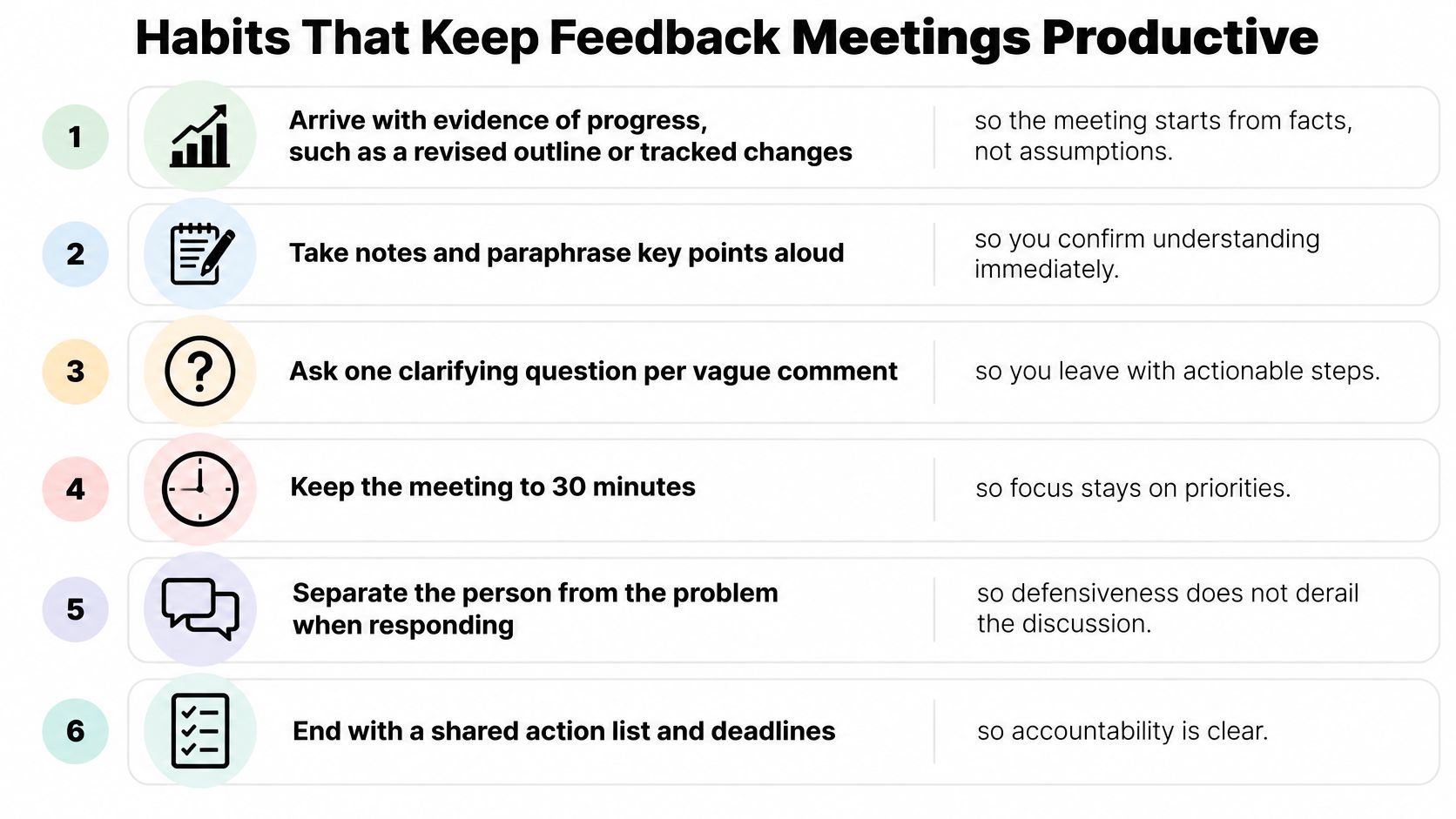
- Arrive with evidence. A revised outline, tracked changes, updated sources or a settled methods decision give the meeting something concrete to judge, so it doesn't repeat the same broad criticism.
- Paraphrase key points aloud. Two sentences of "so the issue is X, not Y" confirms understanding while you're still in the room.
- Ask one clarifying question per vague comment. You leave with actions rather than impressions.
- Separate the person from the problem. Discuss the chapter's weakness, not your competence, and the discussion stays technical.
- End with a shared action list. Names, dates, definitions of done, written down before anyone leaves.
Appraisal interviews are worth preparing for. In the 2018 AVETH survey of doctoral supervision at ETH Zurich, 1,594 doctoral students responded from a population of 4,444, and 66% rated appraisal interviews useful, while 7% considered them useless. The same survey shows expectations vary by department, which is why you should ask what chapter readiness, meeting frequency and acceptable independence mean locally rather than assuming.
Set the planning goals that keep a thesis on schedule once, at the start of a term, and check them weekly against what you finished. A short agenda of blockers beats a long update, and a weekly plan that works backwards from the submission date keeps meetings at 30 minutes instead of 90.
Send your supervisor a three-line agenda before the next meeting: what you've finished, what's blocked, and the two decisions you need from them.
Thesis Book Project turns the pile of supervisor comments into a workflow you can actually manage, with a chapter tracker that records each revision, milestone scheduling that works backwards from your submission date, and supervisor check-ins that show progress and blockers before the meeting starts. If you're tired of relitigating the same feedback every month, visit Thesis Book Project and set up your first project for free.
Related Articles
Source One Management Services: Thesis Reference Guide
You search for a way to keep your thesis references straight, and the results talk about supplier ne...
Thesis WritingSubmission Requirements for Theses: A Complete Guide
You've finished the chapters, your supervisor has said the argument holds, and the only task lef...
Thesis WritingMap for Writing: How to Plan a Thesis Chapter by Chapter
You've got pages of reading notes, several half-drafted chapters, and a supervisor asking how th...
Comments (0)
No comments yet. Be the first to share your thoughts.