Map for Writing: How to Plan a Thesis Chapter by Chapter
Learn what a map for writing is and how to use it to organize your thesis, chapters and key ideas before you draft.
You've got pages of reading notes, several half-drafted chapters, and a supervisor asking how the argument fits together. You can explain each chapter separately, but describing why the reader needs them in that order is harder. Before writing another page, you need a map for writing that connects your question, claims, and evidence.
Table of Contents
- What a Writing Map Is and Why Thesis Writers Need One
- The Fields Every Chapter Node Should Record
- How to Build Your Thesis Map Step by Step
- The Two-Stage Workflow
- A Worked Thesis Map, Chapter by Chapter
- When the Map Must Change and How to Recover
- Using AI Without Outsourcing Your Argument
- Build Your First Map Before the Next Supervisor Meeting
What a Writing Map Is and Why Thesis Writers Need One
A chapter list tells you where material belongs. It doesn't necessarily tell you what that material proves. You might have headings for literature, methods, and findings while still being unsure how the findings answer the problem introduced at the beginning.
A writing map is a structured record of the central claim, the sections that develop it, the evidence behind those sections, and the logical relationships between them.
Think of the difference between turn-by-turn directions and a road map. Directions tell you what comes next. A map lets you see connections, dead ends, and where a detour would take you.
An outline gives order, a map adds relationships
A linear outline arranges headings and subheadings in reading order. It's useful for deciding where a definition or explanation belongs.
A concept map connects ideas through labelled relationships such as causes, contrasts with, or depends on. Its purpose is to make those relationships visible, not necessarily to establish a chapter sequence.
A writing map combines these functions. It records both the order of the thesis and the reasoning that makes that order necessary.
- Outline: Literature review, methods, findings, discussion.
- Concept map: Feedback timing relates to revision quality, while feedback specificity may explain the relationship.
- Writing map: The literature review establishes the disagreement, the methods chapter explains how to investigate it, and the discussion judges which explanation the findings support.
The basic unit is a node, a box or record representing a chapter or section. You can make nodes in Word, PowerPoint, a spreadsheet, or on paper.
For a thesis, this matters because a change rarely stays inside a single chapter. Narrowing a claim in the discussion may require changing the introduction and conclusion too. A flat list won't show that dependency clearly.
Start with a rough map, not a polished diagram. You can sketch a usable first version during your next planning session without having every answer settled.
The Fields Every Chapter Node Should Record
Chapter node fields and what each one answers
The entries below illustrate possible fields for a remote-work project. They're planning examples, not findings from an actual study.
| Field | Question It Answers | Example Entry |
|---|---|---|
| Purpose | What job does this chapter do? | Test the sampling method against prior studies |
| Central claim | What must the reader accept after this chapter? | Remote work reduced turnover in mid-size firms |
| Evidence | Which sources or data support the claim? | Firm-level turnover records and verified comparison studies |
| Analysis | How will the evidence be interpreted? | Compare effect sizes across sectors |
| Transition | How does this node hand off to the next? | Limitations motivate the qualitative chapter |
Purpose names the chapter's job. Keep it distinct from its topic: examining remote work is a topic, while testing whether the sample permits a meaningful comparison is a purpose.
The central claim states the conclusion you intend to defend. During planning, mark it as provisional rather than treating your preferred answer as established.
Evidence identifies the material you'll examine. Name datasets, documents, passages, or individual studies rather than writing references.
Analysis explains the operation between evidence and conclusion. Comparing sectors, interpreting a passage's imagery, and testing an alternative explanation are analytical tasks. Merely presenting material isn't.
The transition records why the reader needs the next node. A limitation might require another method, or a disagreement might require closer examination.
Keep the reasoning visible
An experimental study indexed by APA PsycNet found that writers who prepared outlines produced higher-quality documents and needed less planning and reviewing during composition. Advance organization reduces competing planning demands, leaving more attention available for turning ideas into sentences.
Use these practical rules when building nodes:
- Give each major node a governing question. If it answers unrelated questions, split it into sections or separate nodes.
- Identify evidence before drafting a claim as established. If the evidence isn't available, record the gap and the action needed to resolve it.
- Make every connection meaningful. Label links with a relationship, not just an arrow.
Keep claim, evidence, and analysis as required fields. Tag background explanations, extra tables, and appendices as supporting material unless they're essential to the argument or required by your department.
For maintaining the map between writing sessions, Life Calendar's weekly planning and reflection template can help you record unresolved decisions alongside next actions. Keep that activity log separate from the node itself so scheduling notes don't obscure the reasoning.
Your reusable template is simple: purpose, claim, evidence, analysis, transition, followed by a short status note where needed.
How to Build Your Thesis Map Step by Step
Start with a blank page rather than your existing table of contents. A contents page tells you what the document looks like; a blank page forces you to decide what the argument is. If your structure only reproduces familiar chapter names, you want to find that out now, not after three chapters of drafting.
Establish the question and claims
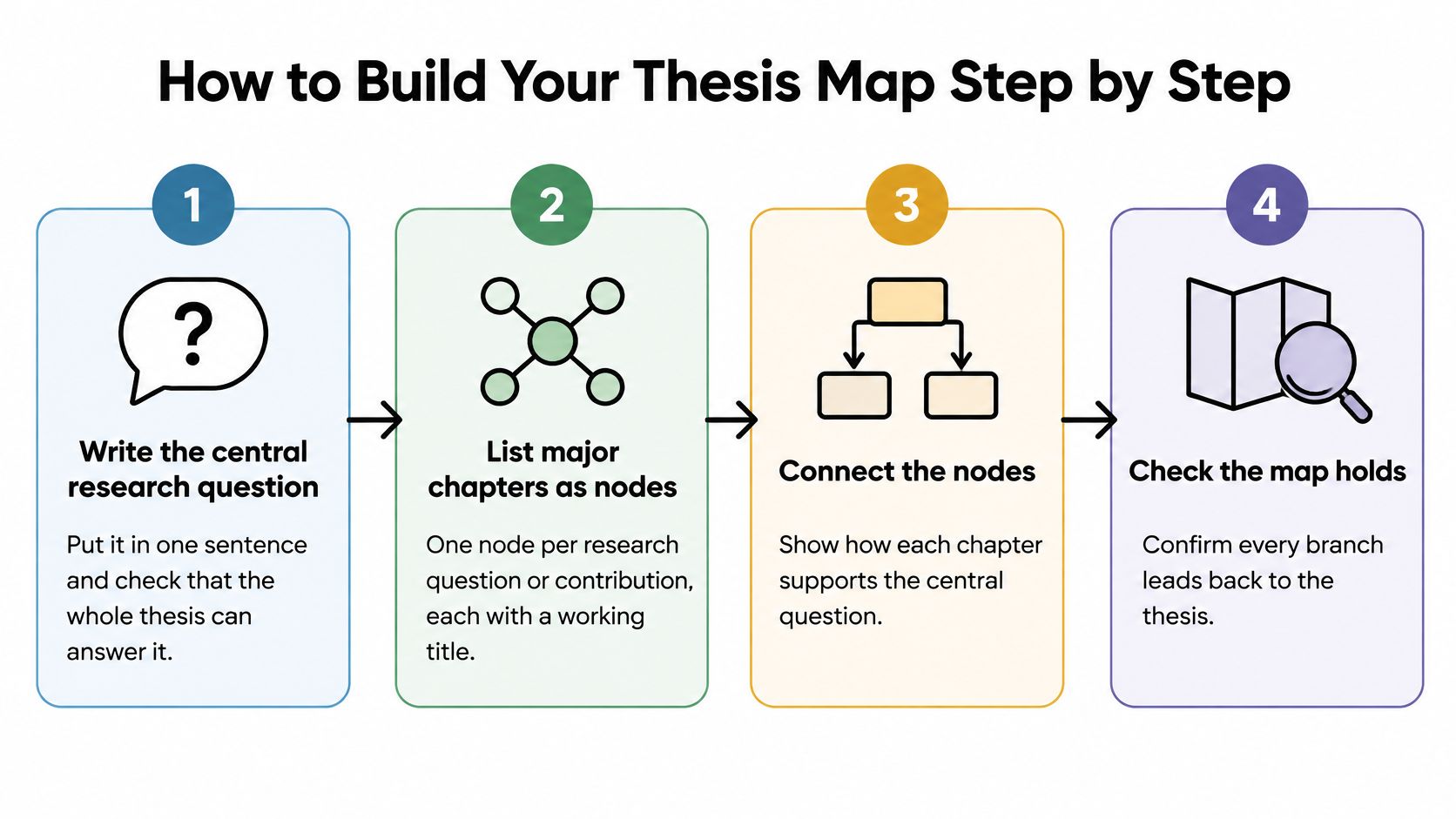
Write the central research question in one sentence. Check that your planned material could answer it. Record the submission deadline beside it and sketch rough chapter milestones. A broad topic such as classroom feedback only names a territory; the question identifies a specific relationship or problem inside it.
List major chapters as nodes. Give each a working title and one line describing its contribution to the argument. A literature-review node might exist to establish an unresolved disagreement between researchers. If a chapter earns its place only because theses usually contain it, name its argumentative job or mark it for a later decision.
Turn topic labels into claims. Replace Student responses to feedback with a provisional sentence such as Students used specific comments more consistently than general encouragement. A claim someone could dispute gives you a test; a label gives you nothing to check.
Add evidence and connections
Attach identifiable evidence to each claim. Record document titles, dataset names, case identifiers or source references, and leave an empty evidence field visible rather than filling it with a vague promise to read more. Choosing what to read is itself a selection problem. Students in reading-heavy fields face it early, and guides such as CliniRoo's on smarter resource choices for medical school describe how to narrow an overwhelming supply of material into a workable set; apply the same discipline when deciding which sources earn a node on your map.
Draw the links and write a relationship on each one. Use labels such as supports, contrasts with, depends on, leads to or revises. Then check the label: a study that shares your topic does not automatically support your claim.
Separate argument order from work order. The reader may need the literature review before the methods chapter, while you may need to draft the methods first. Keep a short adjacent list of reading and drafting priorities rather than rearranging the argument to fit your calendar.
Walk the route, then date the version. Follow each branch back to the central question and inspect disconnected nodes, unsupported conclusions and links you cannot explain aloud. Save a dated copy before you change anything. When later readings shift a claim, the dated map shows you exactly what moved and why, so it works as a record of decisions you can return to rather than a sketch you overwrite.
Practical rule: Keep the overview compact enough to inspect at a glance. Put detailed source notes inside linked documents or subordinate nodes.
The finished map should show connected claims and visible gaps. Its test is practical: you can use it to decide what to write, read or revise next.
The Two-Stage Workflow
Map the relationships first, then test them in prose. An outline orders topics; a map records why one claim earns its place. Keep those tasks separate so each can expose a different problem: the diagram shows whether the route connects, and the paragraph shows whether you can walk that route without looking at it.
Map before explaining
During stage one, connect theories, methods, findings, and gaps without drafting full paragraphs. Use propositions rather than isolated keywords: Teacher workload constrains feedback timing is more useful than separate bubbles labelled teachers, workload, and timing. If a relationship is still undecided, mark it as a decision node with the evidence required to settle it; that keeps the map usable when your reading changes.
During stage two, put the diagram aside and write a short explanation of a branch from memory or minimal notes. Then reopen the sources and check whether your explanation preserves their meaning, limitations, and evidentiary strength.
- For a literature review: Explain why apparently conflicting studies may reach different conclusions.
- For a theoretical framework: Explain how a concept changes what you'll examine.
- For a discussion chapter: Explain which interpretation your findings support and which alternative remains plausible.
The 2025 concept-mapping meta-analysis published in Asian-Pacific Journal of Second and Foreign Language Education synthesized 68 studies published from 2006 to 2024 and reported a large overall benefit for second-language learning, with map content related to writing quality in studies using mapping as prewriting. The sequence here is a planning discipline: organise relationships first, then check whether you can explain them without leaning on the diagram.
Diagnose the point of failure
If your map looks coherent but the explanation becomes vague, inspect the relationship label. Perhaps you wrote supports where the source merely illustrates. If the explanation introduces an important qualification missing from the map, add it before drafting further and give the revised node a date or version tag so later decisions stay traceable.
Give each proposition a source reference or a clearly marked evidence requirement. Schedule these map-to-prose checks alongside reading and drafting using a timeline for research. The meta-analysis concerned second-language learners, so treat it as support for self-testing rather than proof for every discipline.
A Worked Thesis Map, Chapter by Chapter
Suppose you're planning a thesis about feedback timing in secondary classrooms. The following is an illustrative scenario, including invented claims and a hypothetical evidence-gathering checklist. None of the entries should be read as established educational findings.
Illustrative thesis map for a feedback-timing study
| Chapter | Central Claim | Relationship Label | Source Needed |
|---|---|---|---|
| 1. Introduction | Feedback speed affects revision quality | Motivates | Institutional policy documents |
| 2. Literature review | Feedback research disagrees on timing | Contrasts with | Eight to twelve peer-reviewed timing studies |
| 3. Methods | A mixed design fits a question about timing and quality | Depends on | Ethics approval and survey instrument |
| 4. Findings | Same-day feedback improved revisions in the coded drafts | Supports | Coded drafts from two cohorts |
| 5. Discussion | Specificity matters more than timing | Revises | Findings plus two competing studies |
| 6. Conclusion | Schools should recommend specific same-day feedback where the evidence holds | Progresses to | Limitations and future work |
Follow the argument through the chapters
The introduction motivates the investigation by identifying a practical concern. Policy documents establish the institutional context, but they wouldn't, by themselves, prove that faster feedback improves revision.
The literature review contrasts explanations of timing. Its job is to establish what remains unresolved, not to count how many authors favour each position.
The methods chapter depends on approval and a suitable instrument. In a working diagram, draw the dependency arrow to an ethics-approval task node so you can distinguish a research prerequisite from an argumentative connection.
The findings chapter supports a deliberately bounded claim about the coded drafts. It shouldn't imply that the same outcome holds across schools, subjects, or feedback practices.
The discussion revises the initial emphasis. Perhaps the hypothetical analysis indicates that specific comments explain the improvement more convincingly than timing alone. That change requires checking the introduction's framing and the conclusion's recommendations.
The conclusion progresses toward a conditional recommendation. It preserves the study's limits instead of turning a local finding into a universal rule.
Read the evidence column as a work list
Before drafting, gather the policy material, relevant studies, approved instruments, and coded drafts named in the scenario. Replace broad labels with actual references as they become available.
A findings chapter without a clear supports connection may be reporting what happened without explaining what the reader should conclude.
In a humanities thesis, the same arrangement might connect an interpretive claim about narrative authority to quoted passages and then contrast it with another reading. The evidence changes, but you still need to explain why those passages warrant that interpretation.
Use this chapter outline example to think through presentation order. Adapt the table's columns to your project and retain the fuller node fields in your working notes.
When the Map Must Change and How to Recover
A fixed map isn't automatically a good map. If a literature search changes the question or data collection undermines a planned comparison, continuing with the original structure can mean drafting chapters you already know you'll need to replace.
Use decision gates to decide whether to continue, revise, or reduce scope.
Decision gates and recovery actions
The missed-milestone threshold below is an illustrative planning trigger, not a universal academic rule.
| Trigger | Decision Gate | Action |
|---|---|---|
| Literature search keeps returning the same sources | Stop reading when new sources add no new claim | Freeze the literature review and log open gaps |
| Data collection contradicts the planned outline | Revise the map before drafting the affected chapter | Rewrite the chapter node and its links |
| Supervisor asks for structural change | Decide whether the change is reversible | Version the map and note the reason |
| Milestone missed by two weeks or more | Reassess scope against the deadline | Separate essential from optional analyses and renegotiate the plan |
Distinguish easy changes from constrained decisions
Changing a heading or chart order is usually reversible. Changing a sample, an approved procedure, or a research question after collection may require new permissions, further work, or a substantial redesign. These decisions aren't irreversible, but they deserve a check before change tag.
For reading, don't confuse repetition with adequate coverage. Before freezing the literature review, check that you've considered relevant disagreements, methods, and contrary findings. Stop expanding the search when additional relevant sources no longer change the claim or its qualifications, while recording unresolved gaps.
Writing workflows also involve repeated exchanges with tools: the Journal of Academic Writing article reporting Estonian university survey results records writing-related AI use increasing from 44% in 2023 to 52% in 2024, including ideas, revision, and feedback. That context makes it useful to record which feedback prompted a structural change rather than replacing the plan.
Recover without hiding the trade-off
When a milestone slips, identify the blocked dependency first. More writing time won't resolve missing approval, inaccessible data, or an unanswered methodological question.
- Reduce scope: Narrow the comparison without abandoning the governing question.
- Protect essential analysis: Separate the work needed to defend the claim from interesting extensions.
- Renegotiate explicitly: Bring the revised map and submission implications to your supervisor.
Use progress monitoring to check completed decisions and resolved dependencies, not merely page counts. Save each map version with a date and a brief reason for the change. A documented revision is evidence of a decision, not a confession that the project failed.
Using AI Without Outsourcing Your Argument
AI doesn't remove your responsibility for the argument. It makes recording how you reached it more important. A writing map should distinguish help with expression from decisions about evidence and interpretation.
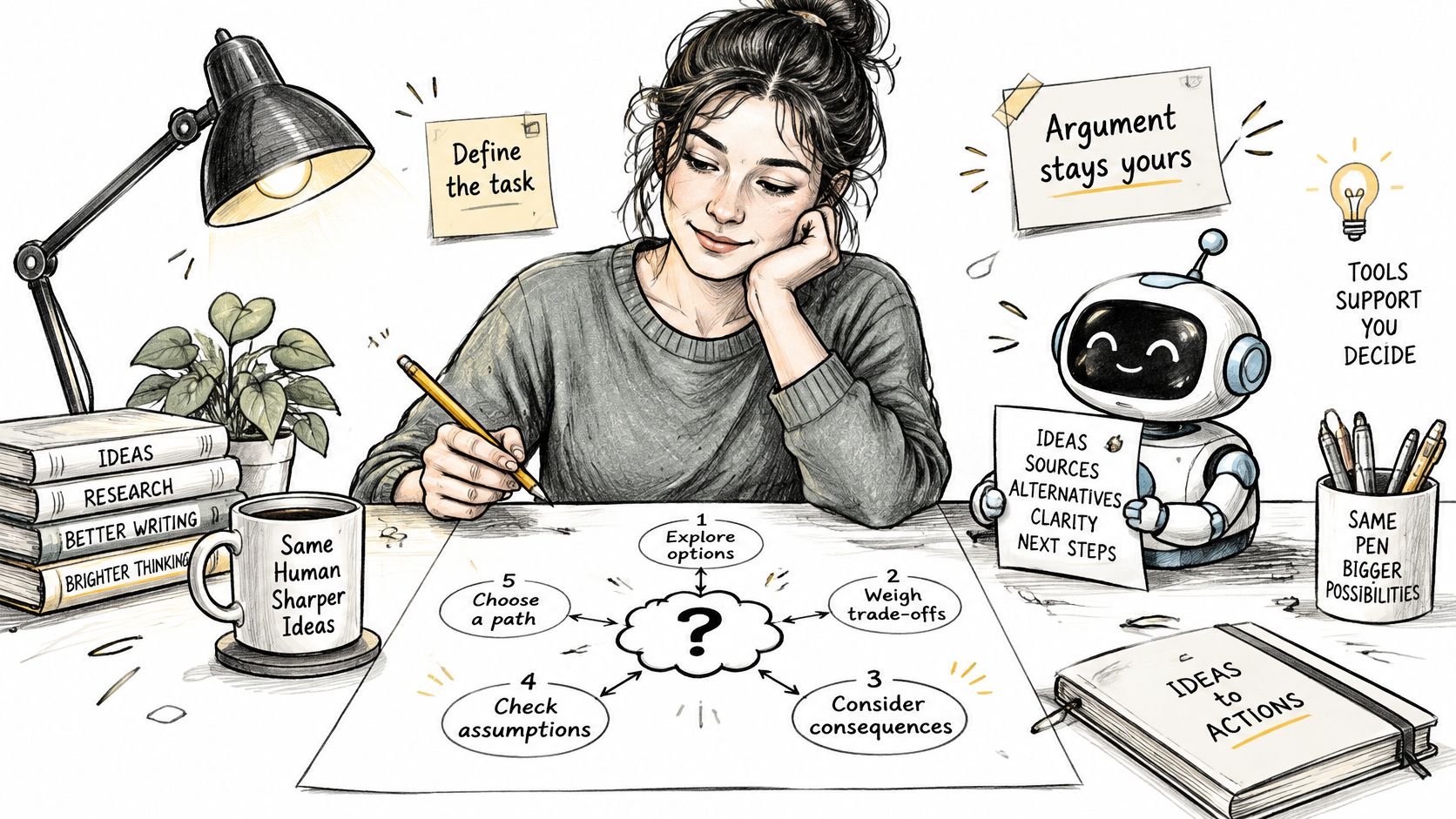
Keep the student's decisions central, as this illustration suggests.
The 2025 HEPI survey of 1,041 UK undergraduates found that 92% had used AI in some form, while 18% had inserted AI-generated text directly into their work. Those are undergraduate survey findings, not estimates for all thesis writers, but they make authorship decisions difficult to ignore.
Separate assistance from intellectual ownership
Where your institution permits it, you might ask AI to generate objections to your reasoning, explain a difficult concept for checking against authoritative sources, or identify unclear sentences. These tasks can support your work without deciding what your thesis should claim.
By contrast, accepting generated claims, citations, or source paraphrases without verification puts the evidentiary basis of the thesis at risk. Rewriting generated text doesn't make an unsupported proposition defensible.
Tag affected nodes AI use permitted, AI use restricted, or permission unresolved. Keep prompts, relevant outputs, verification notes, and required disclosures with the working record. Don't upload confidential participant material or restricted documents without appropriate authorization.
For multilingual writers, distinguish language feedback from substantive rewriting. Keep the original draft and note whether an accepted suggestion changed only expression or also changed the meaning.
Use the following video alongside your institution's own guidance, not as a substitute for it.
Before using an output, complete this checklist:
- Define the task: State what assistance you want.
- Check permission: Confirm institutional, departmental, and assessment rules.
- Document use: Preserve relevant prompts and outputs.
- Verify content: Open sources and check factual claims and citations.
- Own the analysis: Write the reasoning yourself and disclose assistance as required.
Build Your First Map Before the Next Supervisor Meeting
Don't wait until you have a complete draft to discover whether its chapters connect. Bring a small, inspectable piece of reasoning to your next meeting instead.
Make a single chapter discussable
Open a blank page and write a chapter's central claim as a sentence someone could accept or reject. Underneath it, name concrete evidence: a dataset, a relevant study, and a passage or document you'll analyze.
Draw connections to neighbouring chapters and label what each connection means. Leave missing evidence marked as a gap, with an action beside it. That gives your supervisor something more useful to discuss than a broad heading or an unfinished page count.
- Ask about the claim: Is it narrow enough to defend?
- Ask about the evidence: What would challenge this interpretation?
- Ask about the consequence: Which other chapter changes if this claim changes?
If your submission date is fixed, put the necessary decisions and drafting tasks on a calendar that works backward from it. Allow space for feedback and revisions rather than treating the first complete draft as the finish line.
Our roadmap is one optional place to hold that plan, connecting the project from proposal to submission with milestones scheduled backward from the deadline and reminders before checkpoints slip. A sheet of paper or whiteboard can hold the same argument.
Your immediate finish line is modest: a defensible chapter claim, named evidence, and labelled connections written down today. Take that node to the meeting and use its unresolved decisions as the agenda.
Thesis Book Project offers a guided roadmap, chapter tracking, and milestone scheduling to turn your writing map into manageable work from proposal to submission. Visit Thesis Book Project to organize your chapters around the claims, evidence, and next decisions your thesis needs.
Related Articles
How to Respond to Supervisor Feedback: A Practical Guide
Your supervisor's comments are open in one window and your draft in the other. Some notes are bl...
Thesis WritingSource One Management Services: Thesis Reference Guide
You search for a way to keep your thesis references straight, and the results talk about supplier ne...
Thesis WritingSubmission Requirements for Theses: A Complete Guide
You've finished the chapters, your supervisor has said the argument holds, and the only task lef...
Comments (0)
No comments yet. Be the first to share your thoughts.