8 Literature Review Best Practices for Thesis Writers
Master eight literature review best practices, from focused research questions and documented searches to thematic synthesis and citation management.

You've collected forty PDFs, your literature review chapter is due in six weeks, and you still can't state the question it needs to answer. Every paper introduces another useful concept. Your notes are growing, but your argument isn't. This is a hypothetical situation, but it captures a practical problem: collecting literature can feel productive long before you've decided what belongs in the review.
The solution usually isn't to read faster. It's to make the decisions you skipped before downloading those papers. You need boundaries, a repeatable search, defensible selection rules, and a way to turn individual findings into an argument.
A defensible review lets your supervisor trace a claim back to the evidence and understand why you selected that evidence.
These literature review best practices connect each decision to a concrete artifact, from a scope statement to a revision record. Those artifacts also feed specific thesis chapters, so your search notes become methods material, your appraisal notes support the discussion, and your synthesis justifies the research question. You don't need an elaborate system, but you do need one you can explain and maintain.
Table of Contents
- 1. Define a Focused Research Question and Scope
- 2. Design a Systematic and Documented Search Strategy
- 3. Set Explicit Inclusion and Exclusion Criteria and Screen Transparently
- 4. Organize and Manage Sources from the Start
- 5. Critically Appraise Sources Rather Than Only Summarizing Them
- 6. Synthesize Thematically Instead of Author by Author
- 7. Structure the Review Around an Argument and a Clear Research Gap
- 8. Keep the Review Current, Balanced, Clear, and Accurately Cited
- How the eight literature review practices compare at a glance
- Turn These Practices Into a Review You Can Defend
1. Define a Focused Research Question and Scope
Decide what your review must explain before deciding what to read. A topic names an area. A research question identifies the relationship, experience, mechanism, or disagreement you need to investigate.
For example, online learning is a topic. How does peer feedback support revision in asynchronous undergraduate writing courses? is a question you can use to select evidence. It identifies a practice, a population, a context, and an outcome without assuming the answer.
Leave behind a scope statement
Write your question in a sentence, then document its boundaries. Use PICO for an intervention-focused question or SPIDER when qualitative experiences and research designs need more attention. Treat these frameworks as prompts, not forms you must force every project into.
- Population and context: Identify whose experiences or outcomes matter and where they occur.
- Concept and evidence: Specify the phenomenon and the kinds of studies that can address it.
- Boundaries and rationale: Explain language, publication-period, and publication-type restrictions.
- Change record: Record revisions to the question and explain why you made them.
The PRISMA reporting statement emphasizes explicit review questions, eligibility criteria, information sources, and transparent reporting. It's principally intended for systematic reviews, but that reporting discipline is useful when planning a thesis review of another type.

Chapter connection: Put the question and rationale into your introduction or proposal. Preserve the scope decisions for the methods chapter or review-method appendix.
Pitfall: Narrowing too early can exclude useful concepts. Test your question against some relevant abstracts and discuss it with your supervisor before committing to an extensive search. A documented adjustment is better than changing direction halfway through drafting.
2. Design a Systematic and Documented Search Strategy
A search is defensible when you can explain where you looked, what you searched, and why those choices fit the question. Searching everywhere isn't a practical objective. Searching complementary sources with clear boundaries is.
The PRISMA reporting guidance published in The BMJ calls for transparent information sources, complete search strategies, search dates, and selection procedures. Preserve those details while searching, not after you've forgotten which filters you applied.
Build, test, and record the search
For the peer-feedback example, combine synonyms within concepts using OR, then connect concepts using AND. A starting query might combine peer feedback OR peer assessment with asynchronous learning and undergraduate writing. Adapt field codes, phrase searching, and controlled vocabulary to each database rather than copying syntax unchanged.
Search an education database such as ERIC alongside an appropriate broader index. Test whether your query retrieves relevant papers you already know, then inspect their reference lists and citing papers. The SAGE journal-coverage analysis illustrates why database comparisons depend on the literature sampled, not on which service appears largest.
Your search log should contain:
- Source and platform: Record the database and the interface used.
- Exact query: Save search strings, fields, filters, and restrictions.
- Execution record: Note the search date, returned-record count, and export filename.
- Coverage rationale: Explain what the source adds and any known gaps.
Use this walkthrough as a starting point for planning your search workflow.
Chapter connection: Your log supplies the methods chapter and search appendix. Follow a consistent approach to keeping research records clear and traceable.
Pitfall: More databases mean more duplicates and screening work. Add sources because they contribute relevant coverage, not because a longer list looks impressive.
3. Set Explicit Inclusion and Exclusion Criteria and Screen Transparently
Suppose your question concerns undergraduates, but a promising paper combines school pupils, university students, and workplace trainees. Do you include it? Without a rule for mixed populations, you'll make that decision differently depending on how useful the findings look.
Decide eligibility before evaluating whether a paper supports your argument. Write operational rules for population, context, publication type, language, research design, and any justified date restrictions. Specify whether mixed samples qualify when relevant subgroup findings are available.
Preserve decisions at record level
Screen titles and abstracts first, then examine potentially eligible full texts. Pilot your rules on a varied sample, discuss ambiguous cases with a peer or supervisor, and revise the wording before continuing. Don't exclude an unclear abstract merely because it doesn't report enough detail.
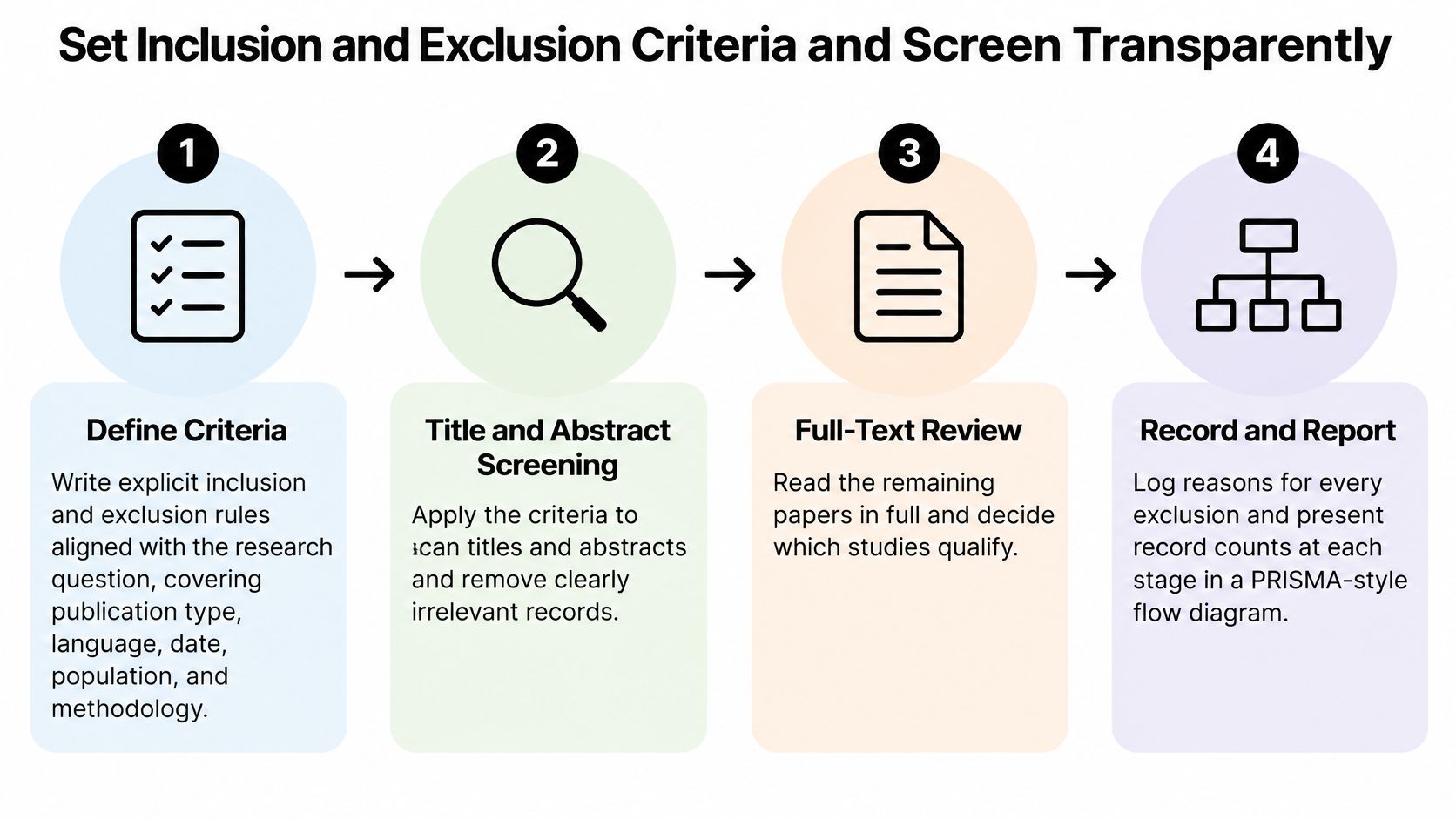
Maintain a screening register with a stable record identifier, screening status, decision, and specific full-text exclusion reason. For the mixed-population paper, the reason might be that undergraduate findings cannot be separated. Keep useful background literature in a separate category rather than treating it as eligible evidence.
The assessment of PRISMA use in systematic reviews distinguishes reporting compliance from review conduct. Your protocol defines the process; your audit trail records what happened; your final report describes it.
Chapter connection: Use the register to write the selection methods and reconcile any flow diagram with the underlying records. If you're choosing a review design, clarify what a systematic literature review involves before adopting its label.
Pitfall: Vague reasons such as irrelevant hide the decision. Record the eligibility rule the paper failed, not your general reaction to it.
4. Organize and Manage Sources from the Start
Choose the system you'll maintain, not the one with the longest feature list. Zotero, Mendeley, and EndNote can support reference storage and citation workflows. Test importing, correcting metadata, attaching documents, deduplicating, and exporting before settling on a manager.
The ACM study of reference-management workflows found that managers required different levels of effort and that participants generally preferred lower-effort workflows. That's a useful selection principle: unnecessary administration competes with reading and analysis.
Give every source a retrievable purpose
Create collections that reflect the thesis, such as Literature Review, Theoretical Framework, and Methods. Add tags for themes and study designs instead of building nested folders. A paper may belong to several arguments without needing multiple independently stored copies.
For the peer-feedback thesis, a source note might record:
- Relevance: Explains how students interpret feedback before revising.
- Design and context: Qualitative interviews in undergraduate writing courses.
- Contribution: Identifies differences between receiving feedback and using it.
- Limitations and location: Notes recruitment constraints and the pages supporting each observation.
Your documented artifact is a reference library linked to concise source notes. Verify author names, titles, publication details, and identifiers against the original document. Back up the library and attachments, and check that an exported copy remains usable.
Chapter connection: Collections support chapter drafting; source notes supply evidence for synthesis and discussion. Keep quotations visibly separate from paraphrases so you don't accidentally reuse source wording.
Pitfall: A neat PDF folder isn't a review system. Page-ordering tools used to arrange contract pages for signing solve a document-layout problem, not citation management or evidence retrieval. Keep each tool focused on its job, and don't spend more time perfecting tags than using them.
5. Critically Appraise Sources Rather Than Only Summarizing Them
A polished abstract doesn't establish that a study can support your claim. Appraisal means deciding what a source allows you to conclude, where it's informative, and where its design limits that conclusion.
Separate relevance from credibility. A study can address your exact question yet provide weak support for a causal claim. Another may use a strong design but investigate a context too different to transfer directly to your thesis.
Record the reasoning behind the weight you give evidence
Use design-appropriate prompts, such as CASP or Joanna Briggs Institute appraisal checklists. Examine recruitment, measurement, analysis, missing information, researcher interpretation, and the fit between results and conclusions. Avoid turning different methodological weaknesses into an unexplained overall score.
For example, an interview study might explain why students distrust peer feedback. It can support an argument about perceived credibility, but it cannot establish that peer feedback improves writing performance. Record that distinction in an appraisal matrix, alongside relevant passages and your intended use of the source.

Apply the same caution to automated extraction. A JMIR AI comparison of review tools reported that Elicit's extracted data were accurate in 51.40% of cases on average. If you use AI, preserve the tool name, available version details, prompts, dates, outputs, and human corrections; verify extracted claims against the paper.
Practical rule: Delegate assistance, not accountability. You remain responsible for every exclusion, interpretation, and citation.
Chapter connection: Appraisal supports the literature review's qualifications and the discussion chapter's treatment of uncertainty. Use an annotated bibliography to capture contribution and limitations before drafting.
Pitfall: Treating every published finding as equally persuasive turns disagreement into confusion instead of something you can explain.
6. Synthesize Thematically Instead of Author by Author
Author-by-author writing usually follows the order in which you read. Synthesis follows the question you're trying to answer. Decide which concepts or disagreements deserve comparison, then bring studies together around them.
Start with a concept matrix. Put studies in rows and themes in columns, then record findings, context, methods, and limitations in the relevant cells. Leave cells empty when a study doesn't address a theme rather than forcing every paper into every category.
Turn comparisons into qualified claims
In the peer-feedback example, useful themes might include feedback credibility, student participation, revision behavior, and instructor support. Compare what each study measured before grouping findings together. Positive attitudes toward feedback and improved writing are related questions, not interchangeable outcomes.
Use a paragraph sequence that makes your reasoning visible:
- Claim: State the pattern or disagreement across the literature.
- Comparison: Explain where studies converge and where they differ.
- Qualification: Identify differences in design, context, or definitions.
- Implication: Show what remains uncertain and why your thesis needs to address it.
A worked synthesis might argue that students' willingness to use peer feedback appears connected to how they judge its credibility. You'd then distinguish studies examining perceptions from studies examining revisions, and qualify the argument accordingly. Don't convert that plausible relationship into a demonstrated causal effect.

Chapter connection: Your concept matrix and synthesis memos become the literature review's thematic sections and the discussion chapter's comparison points. Choose a literature review organization that matches those analytical relationships.
Pitfall: Renaming author summaries as themes doesn't create synthesis. If removing author names leaves no clear claim, the paragraph probably needs more comparison and less description.
7. Structure the Review Around an Argument and a Clear Research Gap
Before drafting more prose, explain the chapter's argument aloud. You should be able to say what readers need to understand, what the evidence establishes, what remains uncertain, and why your study is an appropriate response.
Choose an organizing logic, not a set of headings. A thematic structure works when the contribution depends on relationships among concepts. A chronological structure works when changes over time explain the present problem; a methodological structure works when different research approaches help explain conflicting findings.
Build an argument map
Write a short purpose statement under every proposed heading. Then identify the claim that section must establish and the evidence it requires. Remove sections that are interesting but don't help readers understand the research problem.
For a peer-feedback thesis, the argument might move from definitions of feedback, to credibility judgments, to evidence of revision behavior, and finally to uncertainty about how those elements connect in asynchronous courses. That sequence explains the proposed study rather than merely surveying online education.
Your argument map should connect:
- Section purpose: What the reader must understand before moving on.
- Evidence base: Which synthesis themes support the section's claims.
- Unresolved issue: What the literature cannot yet establish.
- Thesis response: Which research question, method, or analysis addresses that uncertainty.
A research gap is an important uncertainty you can justify, not just a topic combination you haven't found in a database.
Chapter connection: The map links your introduction, literature review, research questions, and methods chapter. Check that the proposed method can address the gap you claim.
Pitfall: Claiming that nobody has studied a topic is harder to defend than identifying a bounded uncertainty. Explain whether the problem concerns context, measurement, theory, contradictory findings, or missing perspectives, and show why resolving it matters.
8. Keep the Review Current, Balanced, Clear, and Accurately Cited
Decide how you'll update and verify the chapter before submission pressure takes over. A review isn't current merely because its reference list contains recent publications. New evidence may require a changed argument, while older work may remain essential to the theoretical framework.
A study of living narrative-review practices identified empirical, structural, and interpretative updates. That distinction is useful for revision: you may need to add evidence, reorganize sections, or reconsider what the literature means.
Audit claims, not just formatting
Set a search-update date and rerun the relevant queries or inspect database alerts. Apply your existing eligibility criteria to new material. Record any deliberate changes rather than including a recent paper because it supports your conclusion.
For example, a newly located peer-feedback study might challenge your claim that credibility is the main barrier to participation. Add it to the extraction and appraisal records, then reconsider whether workload, assessment design, or instructor support needs greater attention.
Keep a revision and citation audit covering:
- Coverage: Check foundational work, newer evidence, and credible opposing findings.
- Claim accuracy: Match each substantive statement to what the cited source supports.
- Writing clarity: Define key terms consistently and replace vague transitions with explicit relationships.
- Reference integrity: Verify metadata, quotation wording, page references, and the required citation style.
Chapter connection: Update the literature review and any dependent claims in the introduction, methods rationale, and discussion. A changed interpretation should appear wherever the thesis relies on the earlier version.
Pitfall: Adding citations without revising the argument creates contradictions. Reserve separate passes for evidence and logic, then prose and referencing, and use supervisor feedback to test whether a reader can follow the reasoning without your verbal explanation.
How the eight literature review practices compare at a glance
| Item | Key Deliverable | Main Tool or Framework | Main Benefit | Main Drawback |
|---|---|---|---|---|
| Define a Focused Research Question and Scope | Answerable research question and written scope statement | PICO, PICOS, or SPIDER | Reduces wasted reading and scope creep | The question may need revision; a narrow scope can miss adjacent work |
| Design a Systematic and Documented Search Strategy | Repeatable search strings and search log | Discipline-specific databases, Boolean operators, and PRISMA-S | Improves reproducibility and reduces the risk of missing studies | Comprehensive searches take time and can produce noisy results |
| Set Explicit Inclusion and Exclusion Criteria and Screen Transparently | Screening criteria, exclusion reasons, and PRISMA-style flow diagram | PRISMA, Rayyan, or Covidence | Makes selection decisions transparent and defensible | Screening is labor-intensive; strict criteria may exclude useful studies |
| Organize and Manage Sources from the Start | Tagged, organized source library with notes and PDFs | Zotero, Mendeley, or EndNote | Prevents lost citations and speeds up citation formatting | Setup takes time, and metadata errors can affect bibliographies |
| Critically Appraise Sources Rather Than Only Summarizing Them | Evaluation of each source's quality, relevance, and limitations | CASP or Joanna Briggs Institute checklists | Identifies weak evidence and strengthens arguments | Appraisal is time-consuming and requires methodological expertise |
| Synthesize Thematically Instead of Author by Author | Thematic synthesis of patterns, debates, and gaps | Concept matrix or thematic synthesis | Builds a coherent argument and makes research gaps visible | Themes can be subjective and require conceptual work |
| Structure the Review Around an Argument and a Clear Research Gap | Logical chapter structure that leads to the research gap | Thematic, chronological, methodological, or theoretical organization | Shows how the thesis contributes to knowledge | The structure may require iteration, and poor organization can bury debates |
| Keep the Review Current, Balanced, Clear, and Accurately Cited | Balanced, revised review with accurate citations | Citation style guides, database alerts, and peer feedback | Strengthens credibility, readability, and awareness of current research | Updating and balancing evidence can lengthen the review |
Turn These Practices Into a Review You Can Defend
A defensible literature review comes from connected decisions. You define the scope, search within it, apply eligibility rules, organize the evidence, appraise its strengths and limits, synthesize relationships, structure an argument, and revise it against the sources. Each step produces something you can inspect rather than relying on memory.
Those artifacts should remain connected. A claim in your chapter should lead to a source note; that note should identify the paper and relevant passage; the screening record should explain why the paper belongs. The search log should show how you found it.
You don't need to complete the whole system before making progress. If you're stuck, find the earliest unresolved decision. Rewriting paragraphs won't resolve an undefined question, and downloading more papers won't fix inconsistent eligibility rules.
Your next week of work
Use the coming week to establish a small, functioning workflow rather than an ambitious administrative project.
- Write the scope statement: State the question, boundaries, and reasons for those boundaries. Send unresolved choices to your supervisor.
- Log a pilot search: Save the exact query, source, date, filters, and export. Check whether relevant seed papers appear.
- Test eligibility rules: Screen a varied sample and record which decisions were difficult. Clarify the rules before continuing.
- Build usable source records: Correct imported metadata and attach brief notes on relevance, methods, findings, and limitations.
- Draft a synthesis memo: Compare papers around a shared concept and identify what you can reasonably conclude.
- Map the chapter argument: Give each planned section a purpose and connect the final uncertainty to your research question.
- Schedule revision: Reserve time for an updated search, supervisor feedback, and a citation audit before submission.
The trade-off is straightforward. Documentation takes time while you're working, but reconstructing decisions later interrupts analysis and leaves avoidable uncertainty. Keep records detailed enough to explain the work, not so elaborate that maintaining them becomes a separate project.
The aim isn't the longest bibliography or the most elaborate review diagram. It's a chapter in which readers can distinguish evidence from interpretation, understand the limits of your search, and see why your research question follows. Examiners and supervisors should be able to trace your choices and evaluate the argument without guessing how you reached it.
Our Thesis Book Project platform offers a guided thesis roadmap, chapter tracking, milestone scheduling, and source organization to keep review decisions connected to the wider thesis. Visit Thesis Book Project to plan your literature review tasks, track chapter progress, and work backward from your submission deadline.
Related Articles
Timeline for Research: A Step-by-Step Backward Plan
A peer-reviewed study found that doctoral projects planned for three to five years took an average o...
Research Methods8 Types of Conflicts in Academic Research and Thesis Work
A supervisor meeting can stall for weeks when you and your supervisor are arguing about different pr...
Research Methods8 Examples of Themes for Literature Theses in 2026
You have three months left, a folder full of criticism, and a supervisor asking what your thesis arg...
Comments (0)
No comments yet. Be the first to share your thoughts.