Paraphrasing vs Plagiarism: How to Tell Them Apart
Paraphrasing vs plagiarism turns on credit and real rewriting, not a similarity score. See examples, detection limits, and a thesis-safe method.
A substantially rewritten, accurately cited passage is paraphrasing; copying, patchwriting, or using ideas without credit is plagiarism, even when no sentence is identical. Changing the language doesn't transfer ownership of the idea.
The distinction is easy to underestimate. Among Western Sydney University students who engaged in sham paraphrasing in 2024, 64.8% didn't believe the behavior constituted plagiarism, according to a study published by Springer in 2026.
For thesis writers, the challenge isn't avoiding copied sentences. You need to show where your evidence comes from, explain it independently, preserve the author's meaning, and make your own contribution visible.
Table of Contents
- Paraphrasing and Plagiarism Side by Side
- What Each Term Actually Covers
- A Good Paraphrase Beside a Failed One
- Why a Similarity Score Is Not a Verdict
- When a Citation Still Leaves the Passage Weak
- Where AI Rewriting Crosses the Line
- What Plagiarism Costs a Thesis
- Paraphrase the Source Before You Submit
Paraphrasing and Plagiarism Side by Side
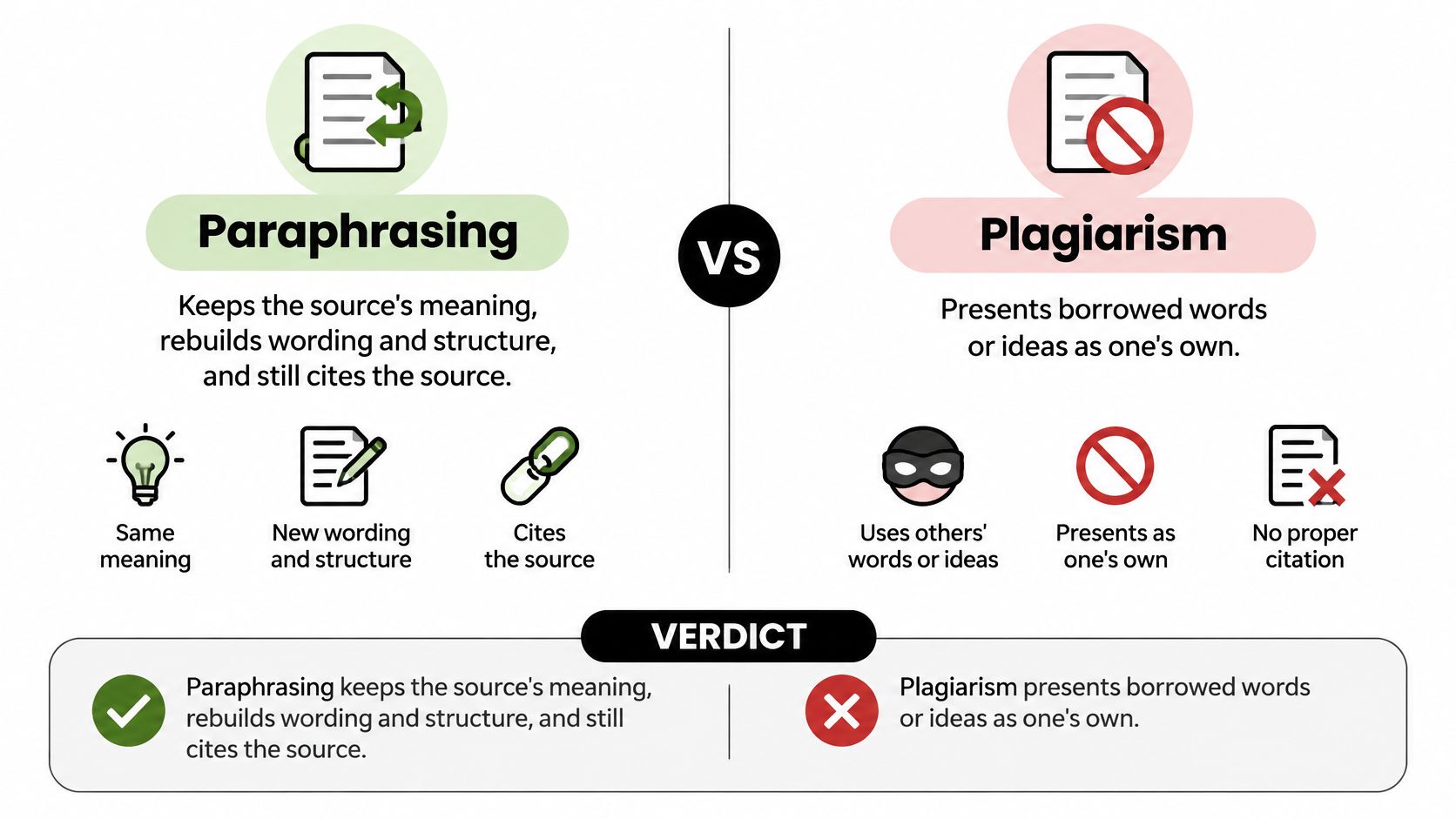
Paraphrasing preserves meaning, rebuilds wording and structure, and credits the source. Plagiarism presents borrowed words or ideas as your own. The difficult cases sit between obvious copying and independent explanation.
In a large European study, approximately 40–50% of participants considered some non-compliant paraphrases acceptable, while 58% of upper-secondary students reported plagiarizing shorter passages, compared with 8% at PhD level, according to the study published in PLOS ONE. These findings don't make advanced researchers immune. They make explicit instruction worth taking seriously.
Paraphrasing versus plagiarism on six tests
| Test | Legitimate paraphrase | Plagiarism or patchwriting |
|---|---|---|
| Credit | In-text citation plus a reference for the borrowed idea | No citation, or credit missing for the idea despite changed wording |
| Wording and syntax | Meaning preserved; sentences and emphasis rebuilt in the writer's voice | Synonym swaps, shuffled clauses, or the source's sentence order retained |
| Ideas, data, methods | Non-common-knowledge claims, results, and methods attributed | Findings, interpretations, images, or data presented as original |
| Closeness | Independent notes followed by a new explanation | Writing that tracks a source line by line |
| Similarity software | Score used to identify passages needing inspection | Low score treated as proof of innocence, or high score as automatic guilt |
| Generative AI | Writer understands the source, verifies the passage, cites, and discloses assistance when required | Source rewriting used to conceal borrowing, or assistance concealed contrary to policy |
Credit answers whose intellectual work you're using. Wording and syntax show whether you've actually explained that work rather than edited someone else's sentences.
The ideas, data, and methods test catches borrowing that word-matching software may overlook. Closeness catches the opposite problem: a citation is present, but the prose remains attached to the original paragraph.
The software row concerns evidence, not permission. The AI row adds a separate policy question about how the submitted writing was produced.
The visual comparison keeps these distinctions together.
Make the distinction visible in your notes
A useful reading note separates the source's claim from your response to it. Label copied language immediately, record its location, and put your interpretation in a separate field.
That small separation matters when you return to the material during chapter drafting. You shouldn't have to guess whether a polished sentence in your notes belongs to you or the author.
Rule of thumb: If your revision still follows the source sentence by sentence, changing synonyms and adding a citation won't make it an independent paraphrase.
What Each Term Actually Covers
Plagiarism concerns both language and intellectual credit. A writer can copy wording, borrow an interpretation, or adopt a research finding without telling the reader where it originated.
Say you read a paper arguing that a particular recruitment method excluded less confident participants. You then develop a fresh explanation of that limitation in your thesis. The sentences may be entirely yours, but the interpretation still needs attribution because you learned it from that paper.
The University of Mary Washington's guidance on understanding plagiarism makes this broader obligation clear: ideas, interpretations, facts, and research findings need acknowledgment when they aren't common knowledge. Its historical account connects plagiarism with the Latin plagiarius, associated with a kidnapper or literary thief, and explains that by the eighteenth century the term meant passing off another person's work as one's own.
Recognize what you're borrowing
- Verbatim language: Exact wording needs quotation formatting and a citation, not merely an entry in the bibliography.
- A source's explanation: A close reconstruction of its sentences can remain patchwriting even when some vocabulary changes.
- Intellectual content: A distinctive interpretation, finding, dataset, image, or adapted method needs an identifiable source.
- Your earlier assessed writing: Check whether reuse requires acknowledgment or permission. Previous authorship doesn't automatically authorize a new submission.
An accidental omission doesn't make attribution complete. Intent may matter when an institution considers a case, but forgetting a citation still leaves the reader unable to distinguish your contribution from borrowed material.
Keep the common-knowledge exception narrow
Common knowledge means information your intended academic audience can reasonably treat as established background. It doesn't mean something you've encountered repeatedly while researching your topic.
A standard method may be familiar within a discipline, but a particular adaptation, dataset, or interpretation still has an origin. Cite that specific contribution rather than assuming the method's familiarity covers everything attached to it.
Your honest options are straightforward: quote when the exact wording matters, using quotation marks or block formatting and a pinpoint citation, or paraphrase substantially and cite the source anyway. A summary also needs attribution, even though it reduces a longer discussion to its main point.
A Good Paraphrase Beside a Failed One
Consider this teaching sentence, created for the example rather than quoted from a publication:
Students should label copied passages in their notes and record source locations so that quotations remain distinguishable from their own explanations.
For the comparison below, Source A means this illustrative note-taking advice. Source B is a hypothetical second study whose stated limitation is that it examined note labels, not the accuracy of students' final paraphrases. These labels demonstrate citation placement; they aren't references to real studies.
Four rewrites of the same source claim
| Rewrite | What changed | Citation | Verdict |
|---|---|---|---|
| Synonym swap: Learners should mark copied extracts in their notes and save source locations so quotations stay distinguishable from their personal explanations. | Selected vocabulary; sentence frame retained | None | Plagiarism |
| Cited patchwrite: To keep quotations distinguishable from their own explanations, students should record source locations and label copied passages in their notes (Source A). | Clauses rearranged; distinctive wording retained | Yes | Still too close; citation isn't enough |
| Full paraphrase: A useful note-taking system makes authorship visible: readers can trace borrowed language to its location and tell it apart from the student's commentary (Source A). | New organization and wording; meaning preserved | Yes | Acceptable paraphrase |
| Multi-source synthesis: Identifying borrowed language supports traceable notes, but evidence about note labels alone cannot establish whether students later paraphrase accurately (Sources A and B). | Advice combined with another source's evidential limit | Both sources | Stronger literature-review practice |
| Exact definition kept: Here, the required distinction is between “quotations” and “their own explanations” (Source A, teaching sentence above). | Exact wording marked explicitly | Pinpoint location | Quotation, not paraphrase |
The synonym swap leaves the original sentence's structure intact and removes credit. The cited patchwrite fixes the attribution problem but retains distinctive language without quotation marks.
The full paraphrase starts with the purpose of the note-taking system rather than the source's sequence of instructions. The synthesis does more: it distinguishes a practical recommendation from what a separate study could establish.
Check independence without sacrificing accuracy
Harvard's guidance on what constitutes plagiarism explains why attribution alone doesn't excuse language that remains too close to its source. Use a read, close, draft, compare routine:
- Read for understanding: Identify the claim, its support, and its limits.
- Close the source: Draft from brief notes rather than replacing words on screen.
- Compare deliberately: Inspect distinctive phrases, sentence order, technical terminology, and borrowed examples.
- Mark exact language: Quote any retained distinctive wording and supply the relevant location.
Don't distort a technical term just to make the passage look different. Your task is to reconstruct the explanation, not rename its subject.
A definition or sharply qualified claim may be better quoted. In a literature review, build paragraphs around questions and comparisons across sources, rather than producing a succession of sentence-level rewrites.
Why a Similarity Score Is Not a Verdict
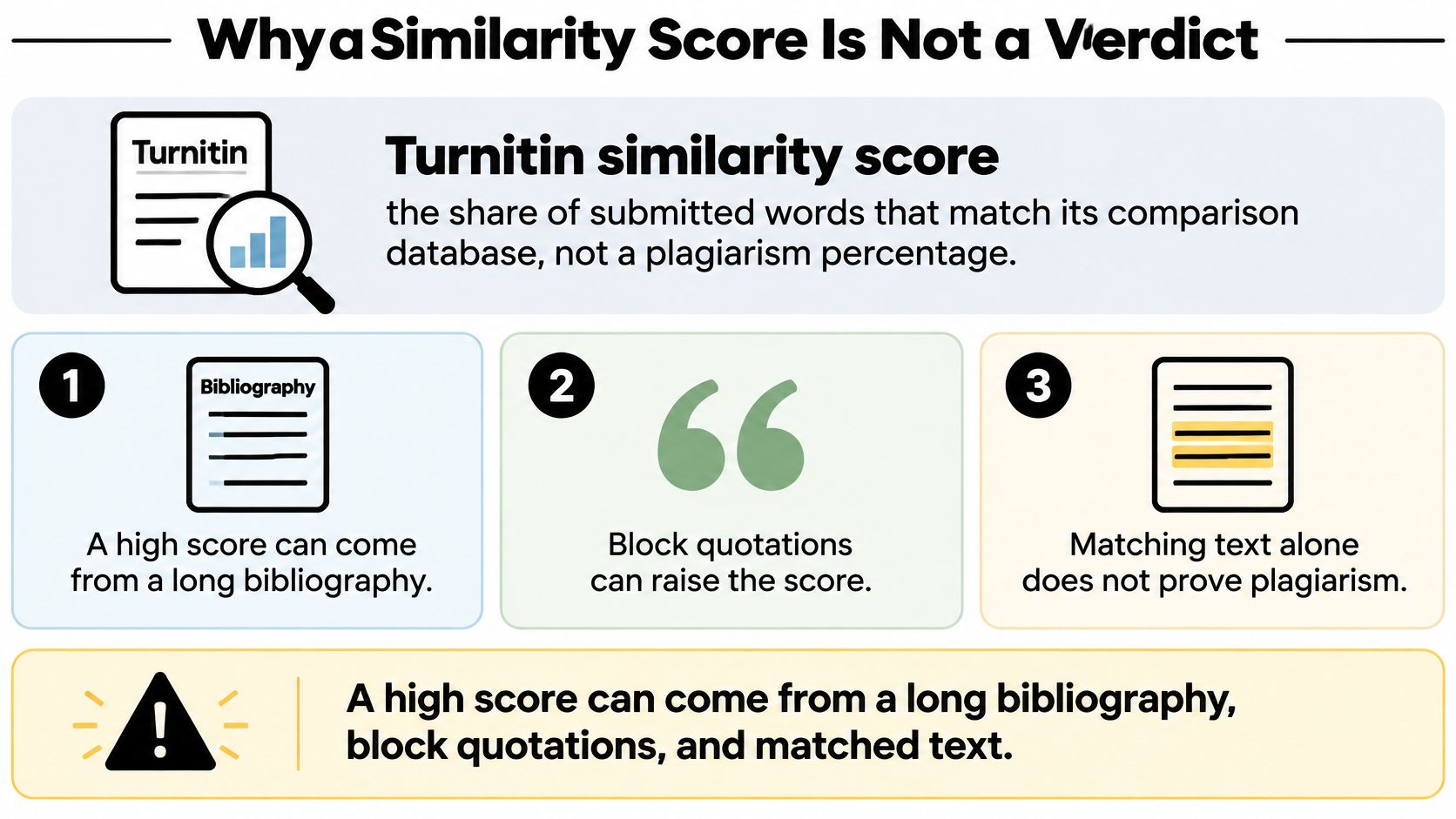
A similarity score measures the proportion of submitted words matching material in a comparison database, not the proportion of a thesis that is plagiarized. Turnitin's explanation of the similarity score explicitly warns that a high score doesn't necessarily indicate plagiarism and a low score doesn't establish its absence.
A bibliography can match other bibliographies. Properly formatted quotations and conventional methodological language can also produce matches without showing improper borrowing.
The infographic highlights why a total requires interpretation.
Read the matches by category
| Matched material | What to inspect |
|---|---|
| Bibliographic entries | Whether the match is simply reference information |
| Standard methodological language | Whether the wording is conventional or a distinctive explanation |
| Quoted passages | Whether quotation formatting, attribution, and location are complete |
| Suspiciously close prose | Whether the passage borrows language or structure without adequate treatment |
A low score can conceal a different problem: a writer may have changed every sentence while leaving a borrowed argument unattributed. A source outside the comparison database may also leave no visible match.
That's why a universal numerical cutoff can't replace reading. Follow your institution's reporting requirements, but don't treat its administrative threshold as a definition of acceptable scholarship.
Inspect the passage, not just the number
For a suspicious match, ask whether the idea has a citation, whether exact language is visibly quoted, and whether the explanation is accurate and independently worded. These checks require the original source, not only the highlighted report.
Software can identify text worth examining. It can't establish a writer's intent, determine authorship, or decide whether an attributed explanation demonstrates sound scholarly judgment.
For a broader submission review, use the academic writing guidelines alongside the report. Keep structure, evidence, and citation quality in view rather than reducing revision to a score.
This video provides another way to approach the distinction between matching text and academic judgment.
Run the check early enough to investigate questionable passages. Fix the actual defect, such as a missing quotation marker or an overly dependent explanation, rather than repeatedly exchanging words until the number falls.
When a Citation Still Leaves the Passage Weak
A citation can coexist with a misleading paraphrase. You might name the author correctly while removing the qualification that made the original claim defensible.
Suppose a paper cautiously suggests that a teaching approach may support participation in a particular classroom setting. A paraphrase claiming that the approach improves student achievement changes the outcome, strengthens the certainty, and broadens the setting. Adding the author's name doesn't repair those changes.
Purdue OWL's plagiarism FAQ identifies recurring difficulties involving citation conventions, accidental retention of source language, and confusion between paraphrasing and quoting. Treat these as problems to detect with a repeatable review, not reasons to avoid using sources.
Compare what the author actually committed to
- Meaning: Did you preserve the relationship the author described, including any distinction between association and causation?
- Emphasis: Did a secondary observation become your version's main finding?
- Certainty: Did cautious language become a promise or an established fact?
- Technical terms: Did an attempted synonym change the concept being discussed?
- Limitations: Did you retain the conditions that matter to the claim you're making?
You don't need to reproduce every limitation from an entire paper in every sentence. You do need to retain any qualification whose removal would materially change the reader's understanding.
Give the paragraph a purpose of your own
Even an accurate paraphrase can be academically weak if it merely repeats a paper's argument without explaining why your reader needs it. State what the evidence contributes to your question, where it agrees with other work, or what it cannot resolve.
Use the guide to citing articles in a research paper to make attribution clear, then evaluate the claim separately. Formatting accuracy and interpretive accuracy are different responsibilities.
Would the source's author recognize both the credit and the caution in your version?
If not, restore the qualifier or quote the sentence carrying the essential qualification. A fluent paraphrase isn't an improvement when it makes the evidence less precise.
Where AI Rewriting Crosses the Line
AI assistance raises separate questions about source credit, intellectual contribution, permitted assistance, and disclosure. Treating every use as plagiarism obscures those distinctions; treating every rewritten sentence as original obscures them too.
Start with what the tool did.
Decide according to the task
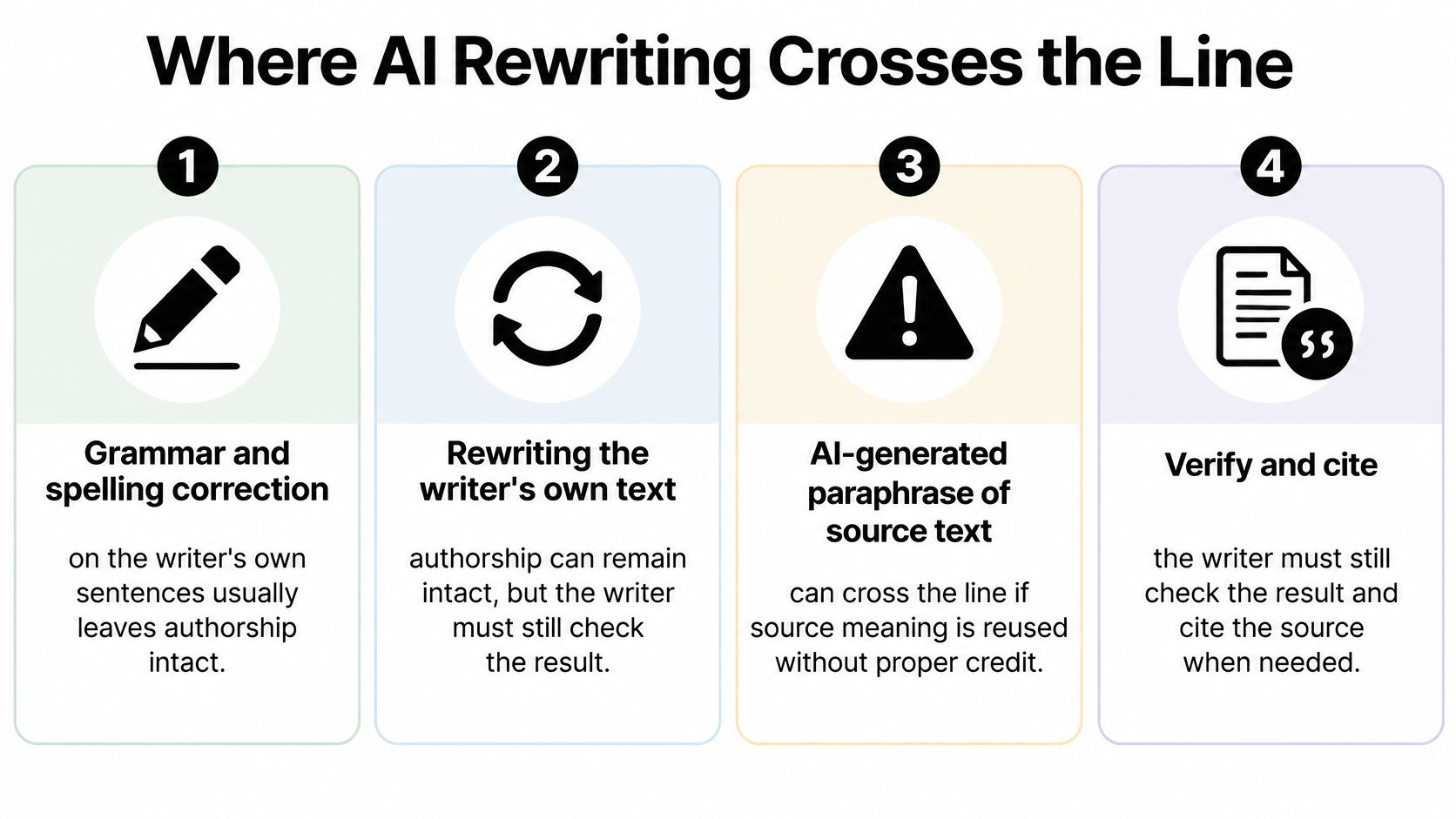
- Grammar and spelling correction: Editing your own sentences usually leaves the underlying authorship intact. Check that corrections haven't changed your meaning, and confirm that the assistance is permitted.
- Translation: Translating your own draft differs from translating someone else's publication. A translated source passage still contains borrowed intellectual work and needs attribution.
- Summarization: A generated summary doesn't replace reading the original. Verify its claims, omissions, and qualifications before using it.
- Full rewriting: New-looking sentences don't establish independent understanding. If the passage retains a source's argument, examples, and sequence, inspect that dependence rather than assuming fluent wording resolves it.
The boundaries are easier to evaluate when the uses remain separate.
Disclosure doesn't replace attribution
A 2025 faculty case study describes a student using AI to paraphrase source text without initially acknowledging that assistance, as discussed in Higher Education Research & Development. The case illustrates why an acceptable citation and an acceptable account of assistance must be assessed separately.
Citing the original paper tells the reader where the ideas came from. Disclosing AI use tells the reader or examiner how you produced the submitted work. Neither statement automatically supplies the other.
Institutional and national policies differ, so there's no global permission that covers every thesis. A department may distinguish language correction from generated drafting, or impose requirements specific to assessed writing.
Before using a rewrite: Identify the source of the idea, the intellectual work you performed, and the assistance your policy permits.
Keep the original source note, relevant prompts or outputs where appropriate, and dated drafts showing your revisions. If a policy is unclear, ask your supervisor or the designated academic-integrity contact about the specific task before submitting it.
A similarity checker can't tell you whether that assistance was authorized. Compliance depends on the actual workflow and the applicable rules, not how different the final prose looks.
What Plagiarism Costs a Thesis
A plagiarism concern can require more than correcting a reference. Depending on the institution's rules and the seriousness of the case, possible outcomes include required revision, a mark penalty, failure of assessed work, or formal misconduct proceedings.
Don't assume that every institution uses the same sanction ladder. Read the rules governing your degree, including any provisions for previously submitted work and AI-assisted writing.
Prepare a clear source trail
A useful record shows how you moved from reading to analysis to drafted prose. Keep annotated sources, labeled notes, dated versions, and any required account of writing assistance together.
These materials don't guarantee a particular outcome, but they help you explain what happened. A supervisor or investigator can assess a documented workflow more clearly than an unsupported assurance that you didn't intend to copy.
| If a passage is questioned | Prepare |
|---|---|
| An apparent text match | The original passage and your submitted version |
| Missing or unclear attribution | The source details and surrounding citation context |
| A disputed paraphrase | Notes showing your understanding and revision history |
| Questions about AI assistance | The applicable policy and an accurate account of your use |
Respond to the concern directly
Read the notification carefully and note the response procedure and deadline. For each questioned passage, write a brief factual explanation of the source used, the borrowing involved, and any error you can identify.
Don't replace files or reconstruct notes as though they were contemporaneous. Preserve the record, distinguish explanation from correction, and seek support through your institution's student advice or academic-integrity process.
If the thesis is also intended for publication or connected to funding, check those requirements separately. A university's decision doesn't automatically resolve a publisher's or funder's obligations, and you shouldn't speculate about consequences before reading the relevant terms.
Paraphrase the Source Before You Submit
Strong paraphrasing is a routine, not a rescue. If the habit only starts at the similarity check, the risky passages are already written. Run the same sequence whether you are handling a short theoretical claim or a detailed methodological explanation.
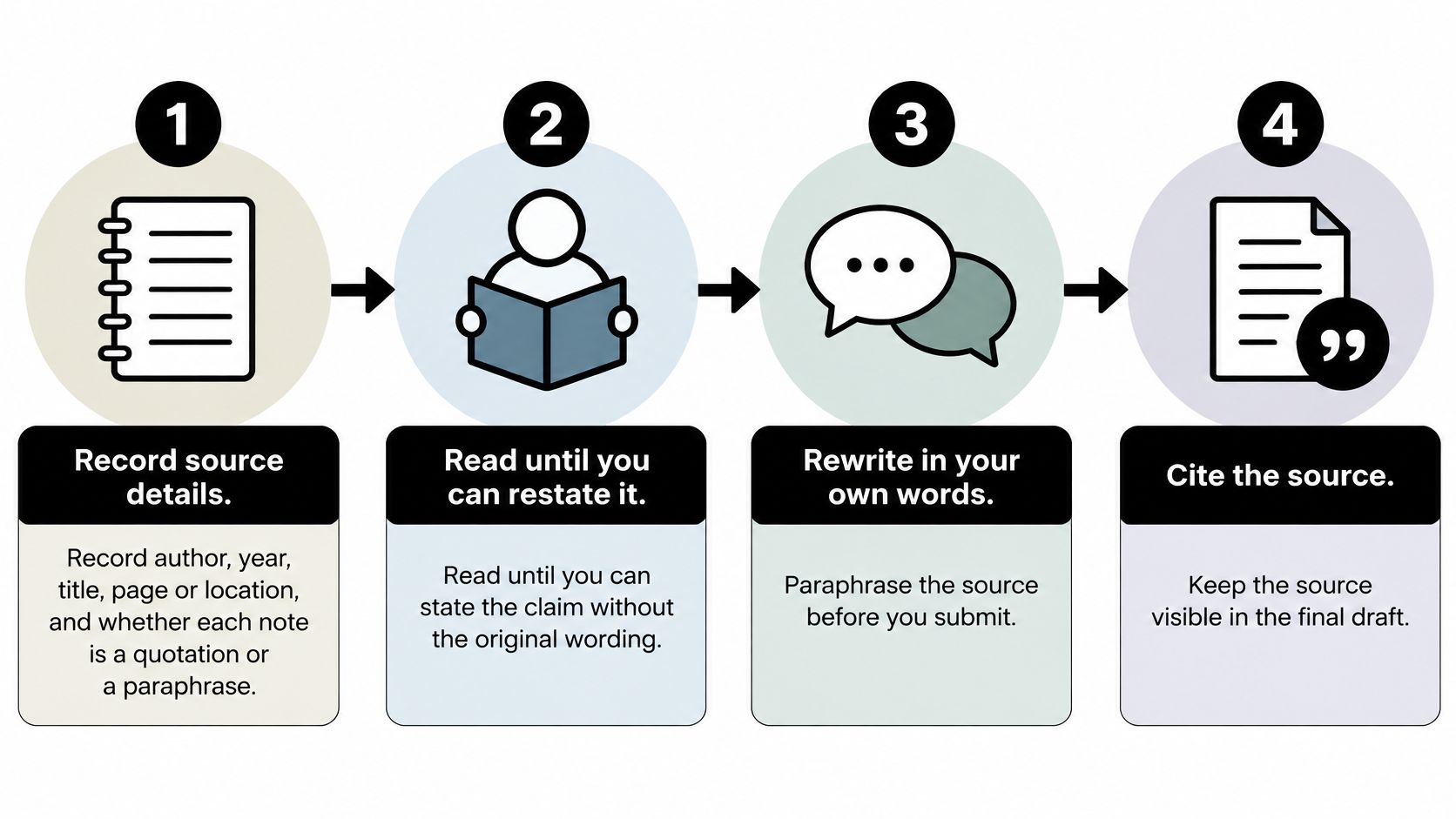
Record the source details. Save the author, year, title, and page or other location. Label every note as quotation, paraphrase, or your own commentary. The guide to source management tools shows how to keep that record organized.
Read until you can explain the claim. Read the surrounding discussion, not just the sentence you hope to use. Identify what the author establishes and what stays open.
Close the source and draft from the note. Order the idea the way your chapter needs it. Reproducing the source's own progression is how borrowed structure slips in.
Insert the citation immediately. Attach it while the borrowed claim is still on screen, then confirm the reference entry exists.
Reopen and compare. Check meaning, certainty, necessary terminology, missing qualifications, and any distinctive phrasing left behind.
Quote when precision requires it. Some definitions and measurements lose accuracy in paraphrase. Preserve exact wording visibly rather than forcing a clumsy or misleading rewrite.
Check the submission rules and preserve the record. Confirm your plagiarism and AI-disclosure requirements, and retain dated drafts and relevant assistance notes.
Reading, drafting, and citation stay connected throughout, so the habit holds under deadline pressure rather than only when you have spare time.
Turn individual paraphrases into a literature review
Accurate paraphrases still need an argument to sit inside. Organize them around agreements, disagreements, and unanswered questions rather than listing sources in the order you read them. For support with that broader synthesis, the Ace Med Boards literature review guide is a supplementary resource for planning how sources fit together.
Before submitting, choose a source-dependent paragraph and explain its central idea aloud without looking at the original. If you can't explain the idea without the source in front of you, you're not ready to paraphrase it.
Our blog publishes original, fact-checked articles answering questions from choosing a topic to final submission, including practical guidance on source use and academic writing. Visit Thesis Book Project to use our thesis roadmap and chapter tracker to schedule a source-attribution review before your final draft.
Related Articles
How to Respond to Supervisor Feedback: A Practical Guide
Your supervisor's comments are open in one window and your draft in the other. Some notes are bl...
Thesis WritingSource One Management Services: Thesis Reference Guide
You search for a way to keep your thesis references straight, and the results talk about supplier ne...
Thesis WritingSubmission Requirements for Theses: A Complete Guide
You've finished the chapters, your supervisor has said the argument holds, and the only task lef...
Comments (0)
No comments yet. Be the first to share your thoughts.