Source Management for Thesis Writers Made Simple
Learn source management for thesis writing, from organizing reading notes to citing accurately. A practical guide for students and supervisors.
Source management is the habit of recording where every idea, quotation, and dataset came from the moment you find it. Get this right, and your literature review, citations, and bibliography stay accurate from the first chapter to final submission.
Table of Contents
- Why Source Management Matters from Day One
- Start Before the Reading Pile Grows
- The Six Stages of the Cycle
- Why Literature Reviews Depend on the Workflow
- Connecting Sources to Chapter Planning
- The Essential Fields Every Record Needs
- Comparing Complete and Incomplete Records
- Complete Versus Incomplete Source Records
- Adding a Personal Note Field
- Recording Datasets, Reports, and Web Pages
- Where Unlabeled Notes Go Wrong
- A Tagging System That Holds Up
- Connecting Each Note to Your Argument
- A Routine for Every Reading Session
- Saving Revision Time and Protecting Your Integrity
- Organizing Sources by Chapter, Theme, or Question
- Tracking Progress with Status Labels
- A Doctoral Student's Three-Year Lesson
- Keeping the System Healthy
- Building a Record Template That Sticks
- Your Starting Plan for This Week
- Software Cannot Check What You Enter
- Errors Are a Systemic Problem
- Waiting Until the End Makes Things Worse
- Verification Is the Missing Step
- Why Supervisors Care Too
- When Should I Start Managing Sources?
- What Should I Do With Sources I Read but Never Cite?
- How Do I Handle a Citation Style Change Near Submission?
- How Should I Record Web Pages and Datasets?
- What Is the Next Step After Reading These Answers?
Why Source Management Matters from Day One
Picture two desks. One has a tidy filing cabinet with labeled folders. The other has a shoebox full of crumpled receipts. Both hold paperwork, but only one lets you pull the right document in seconds when your supervisor asks where a particular claim came from.

The trouble usually shows up near the deadline. You have hundreds of references gathered over three years, and suddenly they all need consistent formatting. Every missing page number turns into an evening of detective work.
A source you cannot trace is a source you cannot cite, and a claim you cannot cite is a claim you cannot defend.
Three habits prevent most of that damage.
| Habit | What It Looks Like | Why It Pays Off |
|---|---|---|
| Capture sources early | Save the title, author, date, and DOI the first time you open the file | Nothing to reconstruct later |
| Keep notes separate | Label each entry as a paraphrase, a quotation with page number, or your own idea | Quotations can't quietly drift into your draft |
| Link sources to chapters | Tag every reference with the section it supports | Gaps in your literature review show up early |
Start Before the Reading Pile Grows
Starting now beats starting during proofreading, and there are two good reasons. Errors pile up quietly, and a bibliography is far easier to keep clean than to rescue. Supervisors also feel more confident in a draft when every claim comes with a clear trail.
Most students already have something that can handle this job, whether that's a reference manager or the built-in source manager inside a thesis planning platform. The tool matters less than the routine. What counts is saving each source on the same day you download the PDF.
Get that routine right, and the final months of your thesis stay focused on writing. You won't be hunting for missing page numbers or reformatting a bibliography you barely recognize anymore.
Every source in your thesis takes a journey, whether you pay attention to it or not. Source management is the habit of guiding each reference along that journey on purpose, in a sensible order, from the first moment you find it to the moment it lands in your bibliography.
Think of a librarian. Books do not simply get shelved. Each one is catalogued with a stable identifier so someone can find it years later. Your source manager does the same job for your thesis.
The infographic below walks through the six stages every source passes through, from the moment you spot it to its final place in your references.
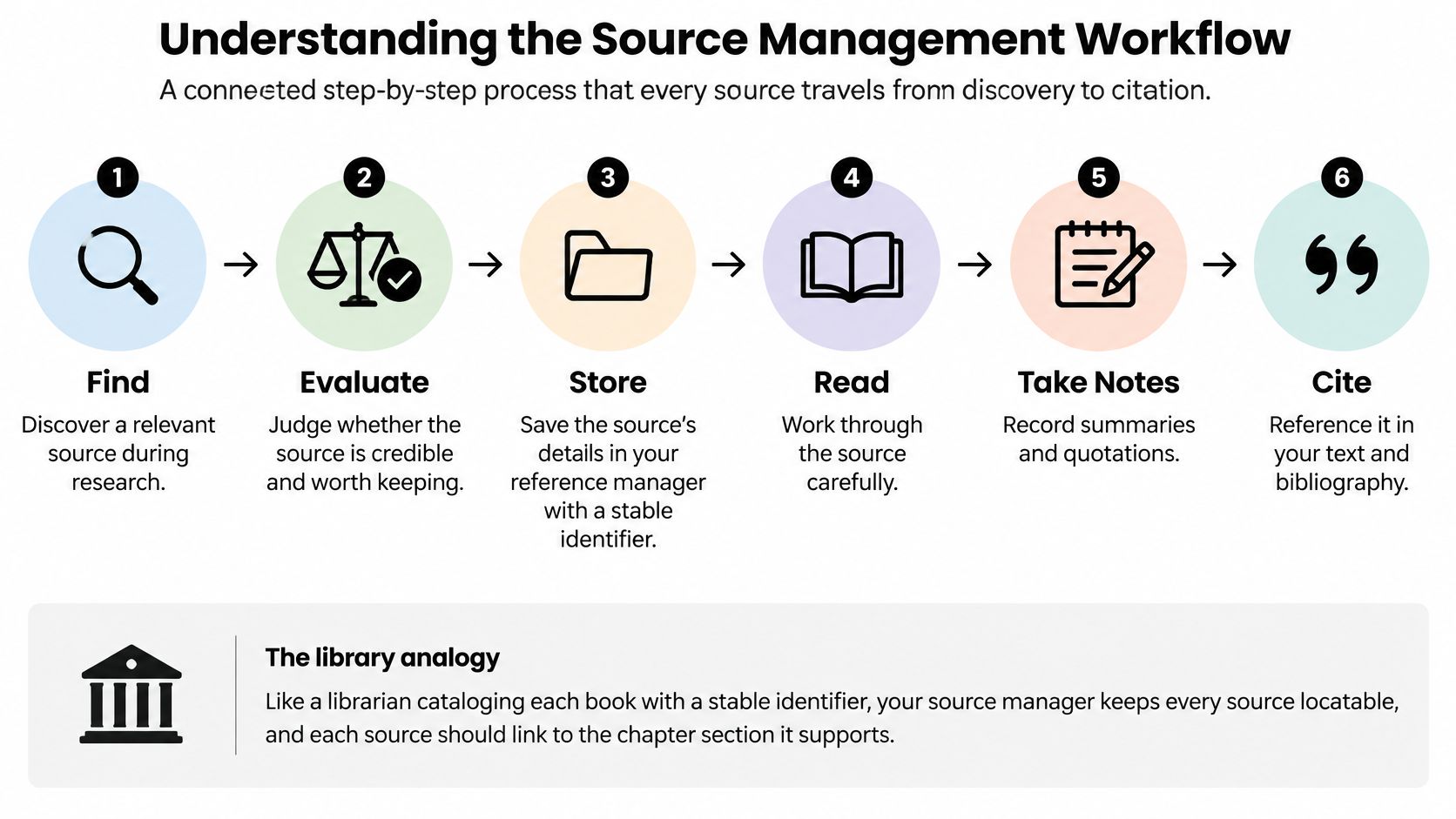
The key point is that this process works more like a loop of decisions than a straight line. Each stage depends on the one before it being recorded properly, so a small slip early on can ripple forward.
The Six Stages of the Cycle
Each stage builds on the last:
- Find relevant sources while you research, and note where you found them.
- Evaluate whether each source is credible and worth keeping.
- Store its details under a stable identifier, such as a DOI.
- Read the source properly, not just the abstract.
- Take notes that keep summaries and quotations clearly separated.
- Cite it in your text and your bibliography.
Why Literature Reviews Depend on the Workflow
A literature review is more than a list of papers. It is a traceable record of how you found and judged the evidence.
When a step gets skipped, that record develops gaps, and a supervisor will usually spot them quickly. A clean system also makes progress meetings more productive, because you can see at a glance which claims rest on which evidence.
Each source should answer two questions: where did I find it, and which chapter does it support?
Connecting Sources to Chapter Planning
Every stored source should point to the section it supports. A paper on survey design, for instance, belongs under your methodology chapter, not in a general pile labelled "to read."
Picture a map showing which chapter each source feeds into. When you tag references this way, gaps surface early and revisions get smaller.
Students who grasp this cycle stop treating citation as a last-minute formatting chore. They see it as part of the research method itself.
Read also: Learn more about building a strong literature review in our dissertation guide.
Plenty of thesis writers only discover citation problems at the worst possible moment, usually when a supervisor asks for a page number they never wrote down. The cause is often small. When they first found the paper, they saved a title or a link and moved on.
Think of a source record as a passport rather than a bookmark. A bookmark tells you where to go back to. A passport tells you who someone is, where they have been, and whether they can prove it.
The Essential Fields Every Record Needs
Every source record should hold a handful of core details. Treat them as the minimum you need to rebuild the reference from scratch:
- Author or organization: the person or body responsible for the work
- Title: the exact wording, including any subtitle
- Publication date: the year at minimum, plus the month when you have it
- Venue: the journal, publisher, or website where it appeared
- Identifier: a DOI or stable link that points to the same work later
- Page range: essential for journal articles and book chapters
- Access date: required for online material that may change
Comparing Complete and Incomplete Records
Filling in these fields takes seconds on the day you find a source. Rebuilding them weeks later can eat up hours, especially when you are hunting for a paper you only half remember.
Here is a realistic journal article recorded both ways.
Complete Versus Incomplete Source Records
| Field | Incomplete Record | Complete Record |
|---|---|---|
| Author | Chen | Chen, L., & Okafor, M. |
| Title | Urban heat study | Urban Heat and Green Space Access in Mid-Sized Cities |
| Date | Not recorded | 2022 |
| Venue | Not recorded | Environmental Planning Review, 14(3) |
| Identifier | Link only | DOI listed |
| Pages | Not recorded | 233–251 |
The incomplete version looks harmless until you need to format a reference list. The complete version gives you everything in one place.
A missing page number takes a minute to add today and an evening to track down next semester.
Adding a Personal Note Field
Citation details tell you what a source is. They do not tell you why you kept it. Add one more field where you write a single sentence explaining how the source fits your argument.
For example: Supports my claim that green space access varies by income level, so I'll cite it in Chapter 2.
That one line will save you from rereading a forty-page paper just to remember why you bookmarked it.
Recording Datasets, Reports, and Web Pages
Non-journal sources rarely fit the neat pattern of a journal article. Each type needs its own extra details:
- Datasets: the version number and the repository where you found it
- Reports: the publisher and the report number
- Web pages: the author, the site name, and the access date
These extra details feel tedious in the moment. Still, they keep your sources retrievable long after the browser tab has closed.
When you record source details, precise naming deserves the same care as the other fields. For a closer look at how exact labels keep records usable, see accurate marine species observation records.
Start with the fields above, and your future self will be grateful. Read also: Learn more about formatting your bibliography in our reference list guide.
Think about a cook with a counter full of unlabeled jars. Salt, sugar, and cornstarch can look alike, and one wrong scoop can wreck the whole dish. Reading notes behave the same way. When you can't tell what's what, the mistake usually shows up at the worst possible moment.
Where Unlabeled Notes Go Wrong
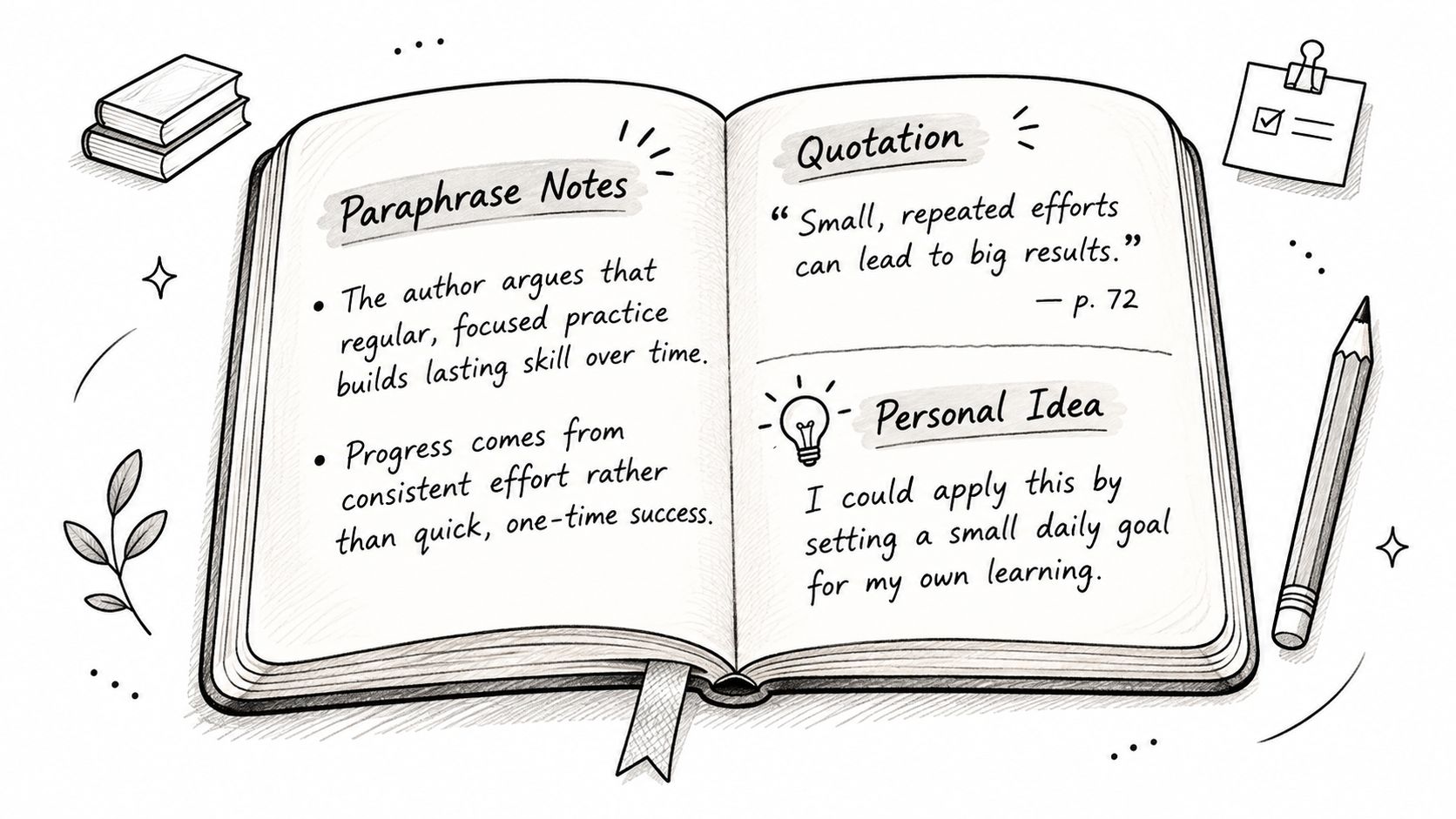
A note with no label is easy to misread later. A quotation can slip into your draft without quotation marks, and when you reread the sentence weeks afterward, it feels like your own wording. That's how accidental plagiarism tends to happen.
Mixing up your summary with the author's exact words is one of the most common ways this occurs. Most of the time, the problem isn't dishonesty. It's a note that never got a label.
A Tagging System That Holds Up
Three tags cover most situations:
- [P] Paraphrase: your own rewording of an idea
- [Q, p. 45] Direct quotation, with its exact page number
- [I] Your own interpretation or reaction
Some people prefer color coding, and that's fine. Still, prefixes survive being pasted into plain text, while colors usually vanish. Whichever system you choose, use it on every entry, including the quick ones you think you'll remember.
Connecting Each Note to Your Argument
Each note should also say which chapter or argument it supports. A quotation about survey bias belongs under your methodology section, not sitting in a general pile where it might get lost.
A note without a label is a quotation waiting to escape.
Before you close any source, write one sentence about why it matters to your project. That small step pushes you to think about the argument instead of just collecting pages.
A Routine for Every Reading Session
Try this sequence each time you finish a source:
- Record the full source details before you start reading.
- Tag every note as P, Q, or I.
- Write a one-sentence summary of why the source matters.
- Link the note to a chapter heading.
At first, five minutes per source can feel like a lot. Compare that to hunting for a missing page three months later, and it becomes clear which option is the real time-saver.
Saving Revision Time and Protecting Your Integrity
Careful notes pay off when you revise. If a supervisor questions a sentence, you can check its tag and find the original wording within minutes.
The same habit protects your integrity. Every quotation has quotation marks and a page number, and every paraphrase has a traceable origin. If you're unsure how close a paraphrase sits to the original, it's worth reading Learn more about avoiding accidental plagiarism in our paraphrasing guide before you write.
Think of the labels as guardrails, not paperwork. They keep you on the right side of the line, even late on a tired Sunday night when the deadline feels uncomfortably close.
Good principles don't do much if they never make it into your daily routine. What you need is a setup you can keep using for months, including the weeks when deadlines pile up.
Organizing Sources by Chapter, Theme, or Question
Choose one organizing logic and stick with it. Most thesis writers end up using one of three approaches:
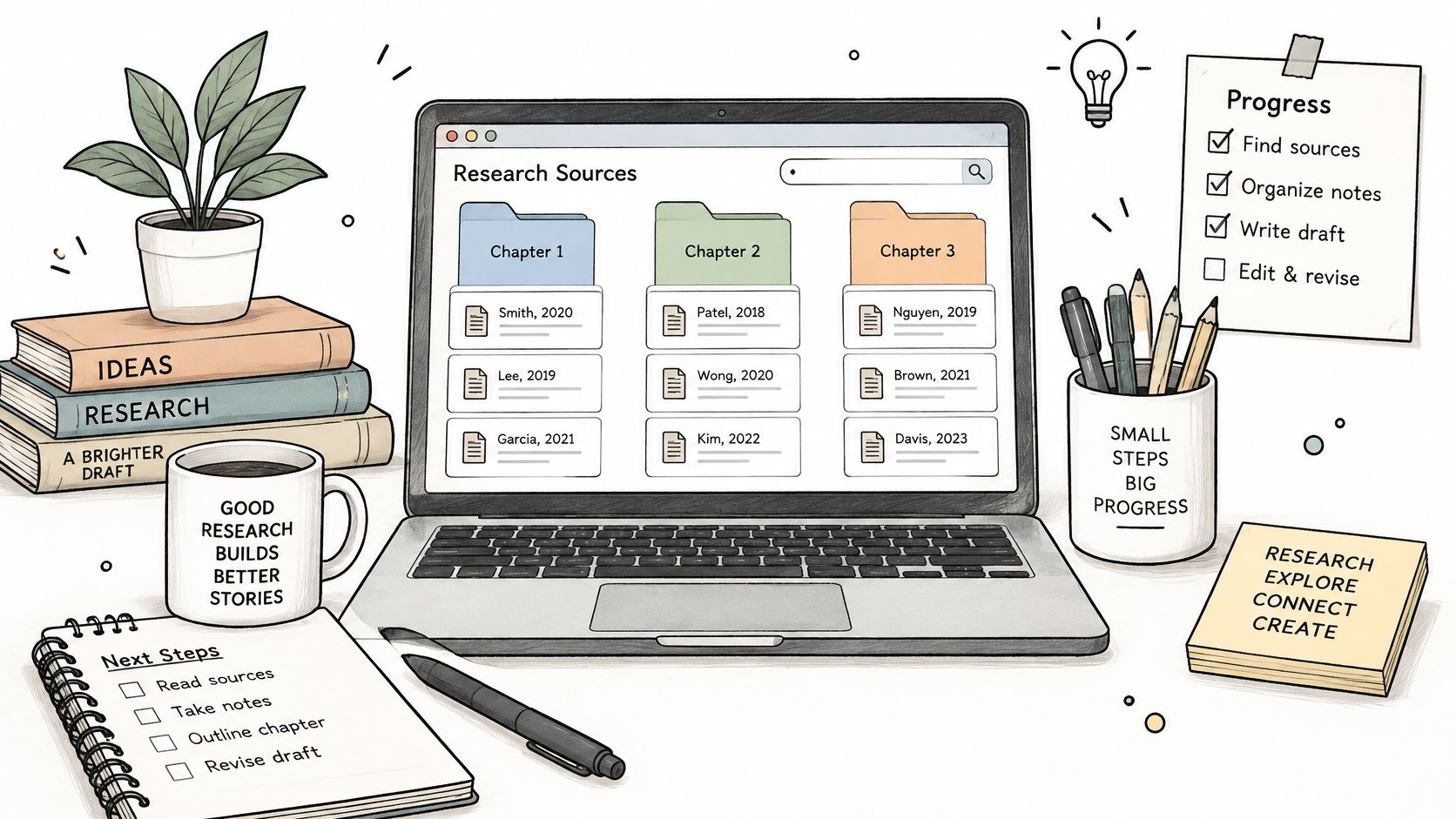
- By chapter: each source sits under the section it supports
- By theme: sources cluster around ideas such as survey bias or income inequality
- By research question: each source is linked to the question it helps answer
Chapter-based sorting suits most projects because it mirrors how your draft grows. Theme-based sorting tends to work better when your literature review runs across several chapters.
Tracking Progress with Status Labels
Status labels turn a messy pile into a visible queue. Four labels are usually enough:
- To read: saved, but not yet opened
- Reading: in progress right now
- Read: finished, with notes complete
- Cited: appears in your draft and bibliography
A quick glance at these labels tells you what still needs attention, which is exactly the question you should be asking every morning.
A Doctoral Student's Three-Year Lesson
Think about a doctoral student who gathered several hundred sources over three years. At first, her bibliography grew with no real structure. Duplicates crept in, and some useful papers never made it into a citation at all.
Things changed once she linked every source to a chapter section. Suddenly she could see that her literature review had almost nothing on sampling methods, a gap she would likely have discovered only during submission.
A system is worth building when it shows you what you have not yet done.
Her fix was not complicated. She added a chapter tag to each new record and spent one afternoon retagging her older sources.
Keeping the System Healthy
Systems decay without maintenance, and they do it quietly. Schedule a check every two weeks and cover three tasks:
- Remove any duplicate entries
- Confirm that metadata such as DOIs and page ranges is complete
- Update status labels for sources you have finished reading
Put the check in your calendar so it happens automatically rather than becoming a decision you have to make each time. Ten minutes is usually enough if you do it regularly, even during a busy month.
Building a Record Template That Sticks
A good template removes guesswork from every new source. Build one once, then copy it each time you save a reference.
Include the required fields, a status label, a chapter tag, and a one-sentence note explaining why the source matters. That note is the part people tend to skip, and it is often the part that pays off most later.
Revisit the template every few months and delete any field you never actually use.
Your Starting Plan for This Week
Start small. Over the next few days:
- Choose one tool, such as a reference manager or the built-in source manager in Thesis Book Project, which keeps references and reading organized alongside your chapter plan.
- Create a template for source records using the fields covered earlier.
- Review your next five sources against the checklist from this guide.
A simple system you actually use beats an elaborate one you abandon. Keep it light enough to survive a genuinely stressful week. Start this week, and by next month the habit will feel completely ordinary.
Plenty of students assume a reference manager will sort out their citation problems for them. It helps, and often a lot, but it has limits. Knowing where those limits sit matters more than the software itself. A tool can speed up the work, but it cannot do your thinking for you.
Software Cannot Check What You Enter
A reference manager stores records and formats citations consistently. What it cannot do is notice when the information going in is wrong. A mistyped year or a missing page range comes out looking just as tidy as a correct entry.
Think of a calculator. Punch in the wrong number and it will still hand you a neat, confident answer. A reference manager behaves the same way. It is very good at organizing and formatting, but the accuracy of the output depends entirely on what the person typed or imported.
Errors Are a Systemic Problem
It is tempting to blame citation mistakes on carelessness. The numbers suggest something larger is going on. Some reviews have reported reference error rates between 25% and 54% across scientific fields, which points to a widespread pattern rather than a handful of unlucky students.
Errors are rarely random. They usually trace back to the same gaps in how sources get recorded in the first place.
Waiting Until the End Makes Things Worse
Many people also believe source management only matters when it is time to submit. In practice, small slips build up as the bibliography grows. An author name spelled wrong in chapter one can quietly carry into every later reference that depends on it.
Fixing these problems at the last minute is far harder than catching them early. Each correction also risks breaking formatting somewhere else, so what looked like a quick fix can turn into an evening of cleanup.
Verification Is the Missing Step
The better approach pairs organized storage with human checking. Software keeps your sources tidy, but you still need to look at the output yourself before submitting. Compare each citation against the final document, and then against the original source.
- Confirm every in-text citation has a matching reference entry
- Check author names, years, and page numbers against the original
- Make sure each source still supports the claim it is attached to
Treat this final pass as part of your method, not an optional extra you do only if there is time.
Why Supervisors Care Too
Supervisors benefit from this clarity as well. When every chapter links clearly to its sources, progress meetings can focus on the substance of the work instead of hunting down where a claim came from. The Thesis Book Project source manager can help keep those links visible as your draft grows.
When Should I Start Managing Sources?
The first source you find is the best time to start. Waiting until the reading pile grows is like leaving dishes in the sink: each one is small, but together they become a chore. Saving the title, author, date, and DOI takes less than a minute. Rebuilding those same details months later can take hours.
My rule is simple. Every time you download a paper, record it that same day.
What Should I Do With Sources I Read but Never Cite?
Keep them. A source you read but later cut from the draft still shaped how you think about the topic, and that history has value.
Give it a status label, such as Read, not cited. That keeps your reading history separate from your final references. You can filter your bibliography cleanly without losing track of what you explored along the way.
How Do I Handle a Citation Style Change Near Submission?
Good metadata is what makes a style change manageable. When every record has complete authors, years, page ranges, and DOIs, moving from APA to Harvard becomes a formatting job. Without that information, it turns into a rebuild.
Incomplete records break during a style change. Complete records simply reflow.
Before you switch, spot-check a sample of entries against the originals. Then regenerate the reference list and read it through once more.
How Should I Record Web Pages and Datasets?
Web pages and datasets change or disappear without warning, so they need extra attention. For each one, note:
- Access date for every web page, since content gets updated
- Stable identifier, such as a DOI or persistent URL, for datasets
- Version number and repository name for datasets
- Site or publisher name for web pages
A bare link is easy to lose. Save a PDF or screenshot of anything important as a backup. Those details, plus the backup, will help you find the source again later.
What Is the Next Step After Reading These Answers?
Choose one question that applies to you right now and act on it. Set up your source records this week, label the unread items, and check the next five entries against the checklist.
If you want help keeping sources, chapters, and deadlines in sync, the source manager in Thesis Book Project keeps your references and reading organized alongside your chapter plan.
Thesis Book Project helps you plan, track, and submit your thesis with confidence. Start free and watch your progress take shape: Start your thesis plan with Thesis Book Project.
Related Articles
How to Track Progress on Your Thesis: A Milestone Guide
It's month seven. You've got forty PDFs open, a folder of half-coded transcripts, and a chap...
Thesis WritingDissertation Timeline Template: How to Plan Backward
You've put a spring submission date on your calendar, and it still looks manageable. Then you co...
Thesis WritingHow to Respond to Supervisor Feedback: A Practical Guide
Your supervisor's comments are open in one window and your draft in the other. Some notes are bl...
Comments (0)
No comments yet. Be the first to share your thoughts.