How to Track Progress on Your Thesis: A Milestone Guide
Learn how to track progress on your thesis with milestones, chapter status, weekly reviews and schedule adjustments that keep you on track.
It's month seven. You've got forty PDFs open, a folder of half-coded transcripts, and a chapter that hasn't gained a paragraph in three weeks. Your supervisor emails to ask how things are going, and you realise you can't answer with anything more convincing than "busy". The work is real. The evidence isn't.
That gap is what a progress system has to close. Completed work and validated work are different things, and a thesis lives or dies on the second one. A month where you wrote nothing can still be a month where you resolved your sampling problem, and a month where you wrote 4,000 words can be a month your supervisor hasn't seen a line of. Knowing how to track progress means recording both, plus the reason for every delay, so a slow stretch reads as a diagnosis you can act on rather than a verdict on your ability.
Table of Contents
- Work Backward From Your Submission Date
- How to Track Chapter Completion Step by Step
- Tracking Progress When Visible Output Drops
- Running a Weekly Progress Review
- Keeping an Auditable Research Trail
- When and How to Adjust Your Thesis Schedule
Work Backward From Your Submission Date
Start at the end. Write your submission date at the top of a blank page, then place the milestones in reverse order until you reach today. Planning forward from today produces a list of hopes. Planning backward from a fixed date produces a schedule with consequences, because every week you lose has to come out of something you've already committed to.
The logic runs like this. Submission is fixed by your institution, not by you. Your full draft goes to your supervisor two to four weeks before that, because reading a complete thesis and returning usable comments takes time you don't control. Methods must be frozen before you gather a single data point, since a design change halfway through collection invalidates what you've already gathered. Each milestone earns its date by what has to happen after it.
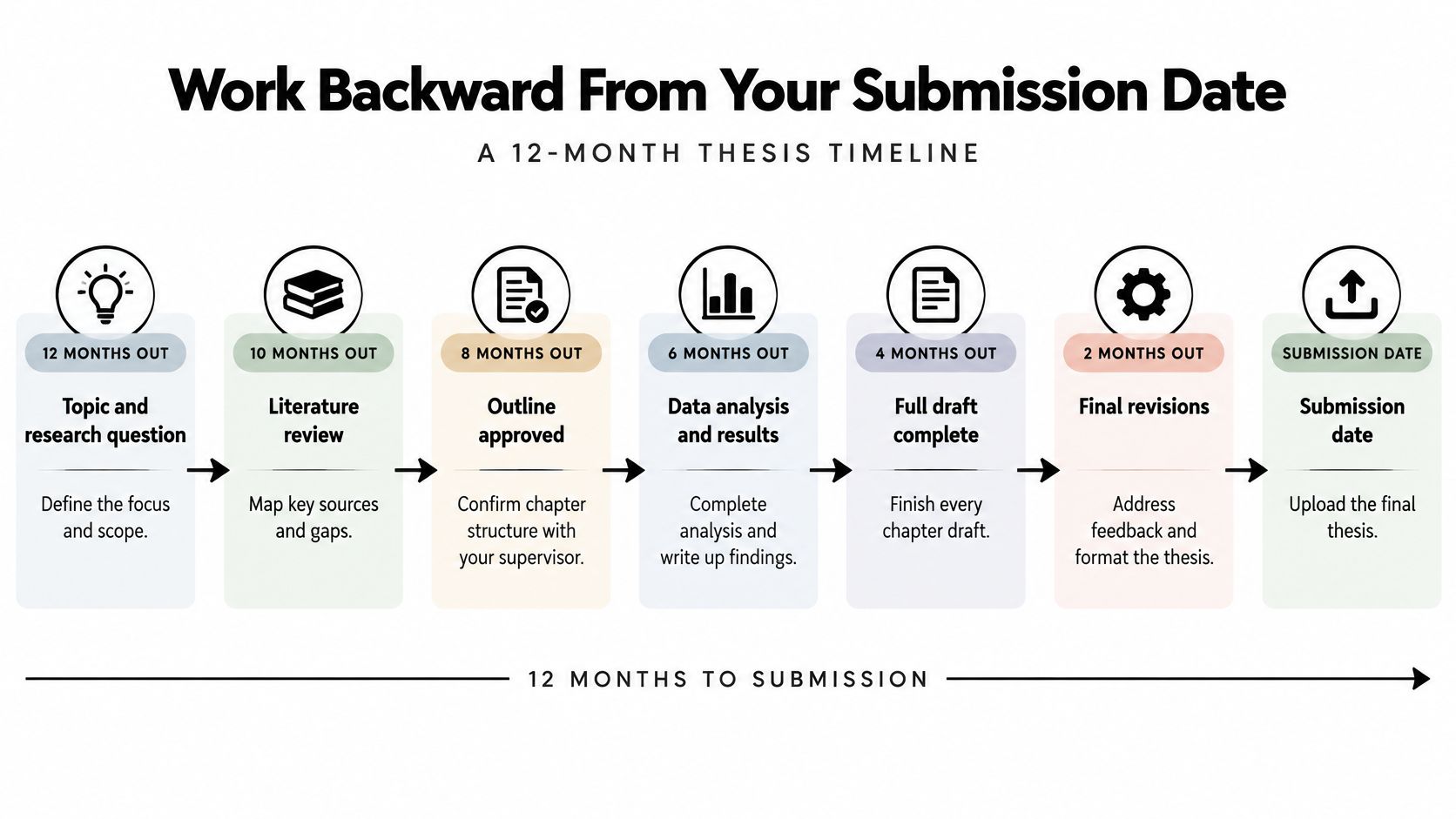
A worked schedule you can copy
Take a hypothetical 12-month thesis. The shares below are planning estimates for that example, not measured averages, and they total 90% so the remaining tenth stays unassigned as buffer. A fieldwork or lab-heavy project will stretch the data-collection row and borrow that time from the reading phase.
| Milestone | Target month | Typical share of time | Evidence of completion |
|---|---|---|---|
| Proposal approved | Month 1 | 10% | Signed proposal and agreed research question |
| Literature review drafted | Month 3 | 10% | Annotated source list mapped to chapters |
| Methods chapter locked | Month 5 | 15% | Supervisor sign-off on design |
| Data collection finished | Month 8 | 25% | Dataset log and consent records |
| Results and analysis drafted | Month 10 | 15% | Tables and figures tied to research questions |
| Full draft to supervisor | Month 11 | 10% | Complete draft with revision notes |
| Submission | Month 12 | 5% | Final file and formatting check |
Notice the last column. Every milestone is defined by an artefact someone else could inspect, not by a feeling of readiness. "Literature review done" means an annotated source list mapped to chapters, which is checkable. "I've read a lot" isn't.
Planning rule: leave roughly a tenth of the timeline unassigned, and expect it to disappear first into ethics approval, participant recruitment and supervisor turnaround. Those three are outside your control, so they eat buffer before your own writing ever does.
Fixed external dates make this easier to accept. Teachers working toward a qualification build their study plan around published exam sittings, and the DELTA dates for experienced teachers on ELTica show how a calendar of immovable assessment points forces every earlier decision. Your submission date and defence booking work the same way. Everything else is negotiable.
If you'd rather not build the grid from scratch, our dissertation timeline template lays out the same backward structure with editable milestone rows. In Thesis Book Project, step 1 is setting your deadline and breaking the whole thesis project into chapters and milestones in minutes, with reminders before a checkpoint slips.
Before your next reading session, do four things:
- Enter the seven dates in your calendar as real events, not a note in a document.
- Create one tracker row per chapter with its current status filled in accurately.
- Book a 20-minute weekly review at the same time each week.
- Send the chapter plan to your supervisor so your next meeting starts from a shared schedule rather than two different mental versions.
How to Track Chapter Completion Step by Step
A tracker earns its keep when it can tell you where work is stuck, not just how much exists. That means building it around status transitions with evidence attached, and updating it while the work is fresh.
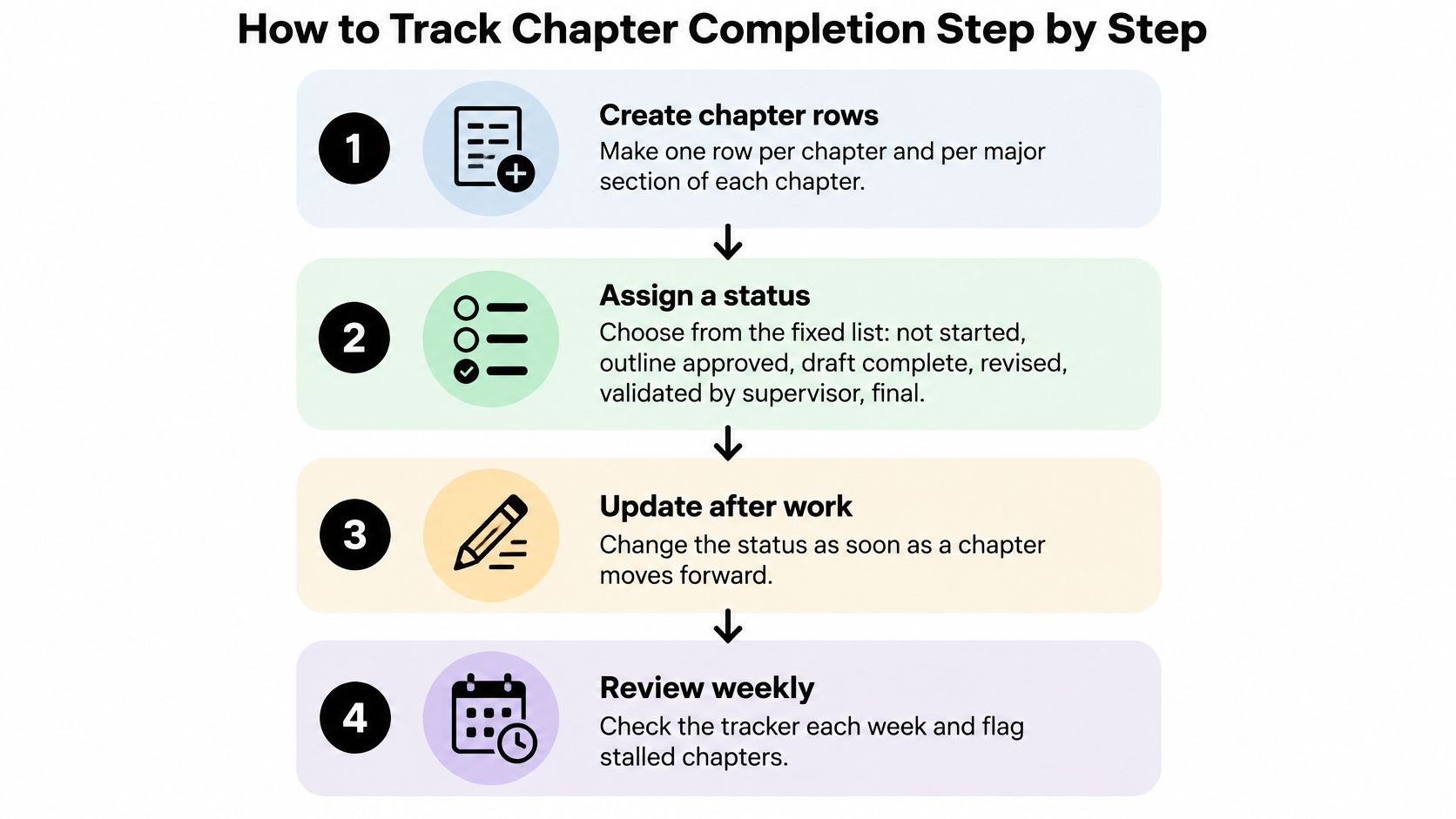
Build the rows and fix the vocabulary
- One row per chapter, and per major section inside each chapter. A chapter-level row hides the fact that your discussion is finished while your limitations section hasn't been started. Section rows surface that in seconds.
- Use a fixed status list: not started, outline approved, draft complete, revised, validated by supervisor, final. Free-text statuses drift. You'll write "nearly there" three weeks running and learn nothing.
- Define each status by its evidence. Draft complete means every planned section has text. Revised means you've acted on your own read-through and logged what changed. Validated means your supervisor has commented on the latest version and those comments are logged, which is a different event entirely.
- Update at the end of each working session. Reconstructing a week from memory on Friday produces optimism, not data. Thirty seconds while the document is still open is enough.
Word counts sit outside this list on purpose. A 6,000-word chapter can be entirely unvalidated, and treating length as progress is how people arrive at month eleven with a large pile of text nobody has read. Keep the count as a secondary signal in its own column, and never let it move a status.
Log the date, not just the state
Add a date stamp every time a status changes. That single column gives you cycle time, and cycle time is what turns a tracker into a diagnostic instrument.
Say a literature review is planned to run five weeks from outline approved to draft complete, and it takes nine. Without dates you'd conclude you write slowly. With dates you can see the outline was approved on schedule, the reading stage swallowed six weeks, and the drafting itself took eight days. The problem isn't your writing. It's that you kept reading past the point of diminishing returns because nothing told you to stop.
Completion and competence get tracked separately in every serious skill domain. TrueFire's lesson completion tracking for guitarists marks lessons as finished so players can see their path through a course, which is useful precisely because it doesn't pretend a ticked box equals a mastered technique.
Here's a short walkthrough of the review habit in practice.
A healthy tracker has a recognisable shape. Most rows move forward at least one status each month, no chapter sits in a single status longer than its planned cycle, and the gap between draft complete and validated stays short. When one row freezes while the others move, you've found your bottleneck without having to feel bad about the whole project.
Tracking Progress When Visible Output Drops
A percentage bar is at its least honest during the four phases that matter most: reading, data collection, analysis, and waiting for feedback. All four consume weeks and produce almost no new prose. If your only metric is completion, those weeks look identical to doing nothing, and you'll start making decisions to fix a number rather than to advance the research.
Supervision frequency compounds this. Nature's 2025 global survey of more than 3,700 doctoral students found that about half received less than one hour of supervisor contact per week. Within that low-contact group, 69% reported being at least moderately satisfied with their PhD, compared with about 82% among students who met supervisors more often. When contact is thin, expectations stay unspoken, and you can spend a month solving a problem your supervisor would have redirected in ten minutes.
So record the cause alongside the delay. Five causes cover most quiet stretches.
| Delay cause | Signal you will see | What to log |
|---|---|---|
| Reading and synthesis | Few words added, many sources open | Sources read and claims extracted |
| Data collection | No draft text for several weeks | Sample count against target |
| Waiting for supervisor feedback | Chapter sits in review | Date sent and questions asked |
| Analysis stuck on one method | Same section restarted repeatedly | Blocker statement and decision needed |
| Wellbeing dip | Missed check-ins and avoidance | Energy note and the support you need |
Write blockers as decisions, not moods
A useful blocker entry is one line plus the decision it requires. "Need to choose between two coding schemes by Friday" is actionable. "Struggling with analysis" isn't, and it will still be sitting there in a month. Pair each blocker with a named owner, because a decision that belongs to your supervisor needs a meeting prompt, while a decision that belongs to you needs a calendar slot.
The same applies to the wellbeing row, which is often left out but shouldn't be. A short energy note and a line about what support would help cost nothing to write and give you something concrete to raise. Research struggles are easy to say out loud. Feeling flattened by the project is harder, and it's the thing that removes whole weeks.
Keep this log private by default. It exists to make your own thinking visible and to sharpen the questions you take into supervision, not to hand anyone a monitoring feed. Share the blocker lines and the decisions you need. Keep the energy notes for yourself unless you choose to raise them.
If a blocker is unchanged after two weeks, it stops being a working note and becomes a supervision agenda item.
That threshold separates a normal quiet period from a warning. Two weeks of slow reading is a phase. Two weeks of the same unresolved methodological question is a project risk, and it's cheaper to raise it early than to defend the resulting gap at submission.
Running a Weekly Progress Review
Twenty minutes, same slot every week, tracker open. The review isn't a report you write for someone else. It's the mechanism that keeps your plan connected to what happened.
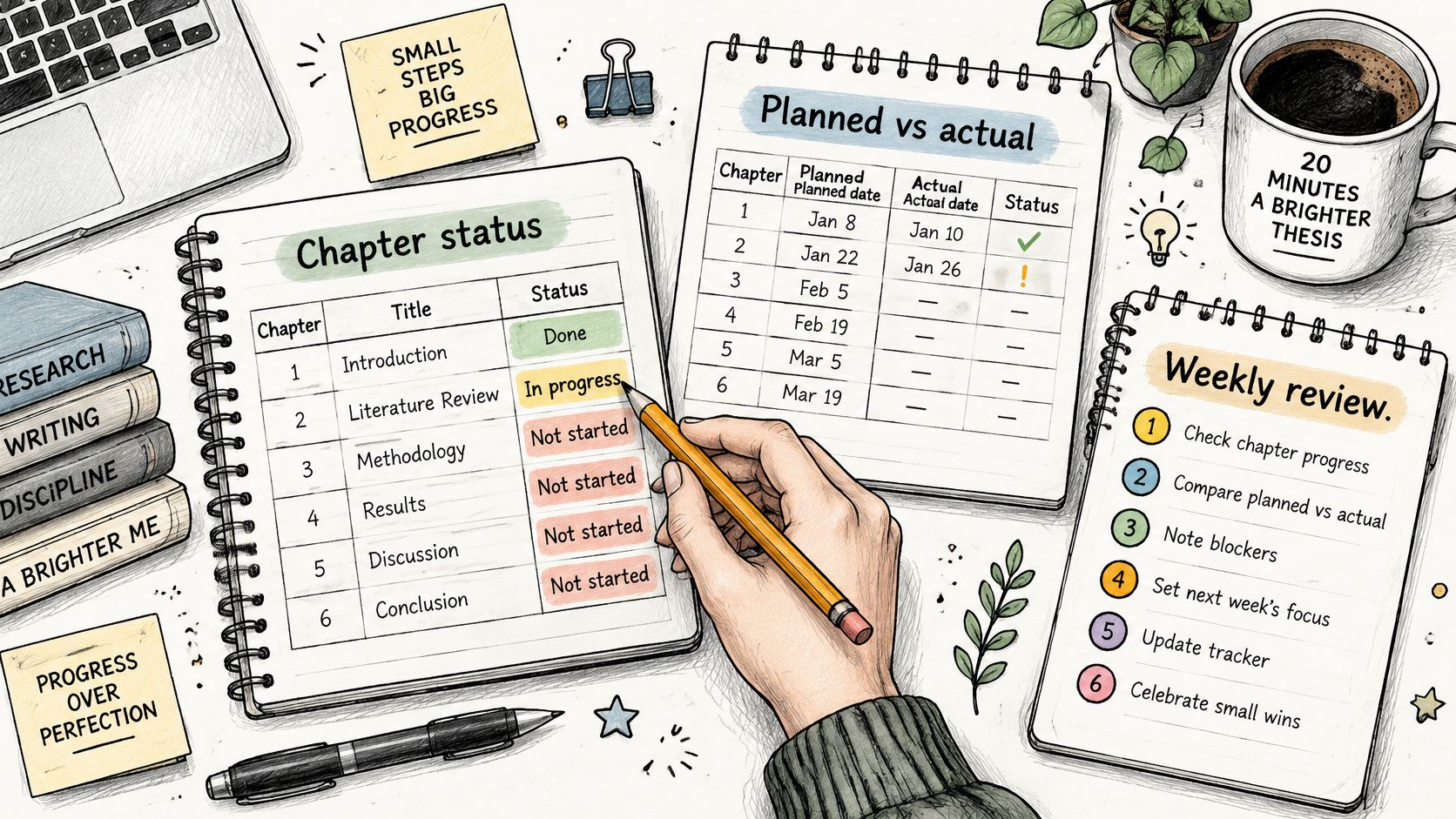
The six-step routine
- Update every status you touched. Anything you worked on this week gets its current state and today's date. Two minutes.
- Compare planned against actual for each open chapter, and write the difference in days. "Results: 9 days behind" is a fact you can act on. "Results: behind" is a mood.
- Label each blocker as technical, unclear expectation, or supervision gap. This is the step people skip, and it's the one that determines your response. A technical blocker needs a method decision or a methods textbook. An unclear expectation needs a question answered in writing. A supervision gap needs a meeting booked, not more hours at the desk.
- Choose three next actions with concrete outputs. "Draft three paragraphs of section 4.2" beats "work on results", because on Friday you'll know unambiguously whether it happened.
- Write one or two meeting prompts naming the blocker and the decision you need. Take these into supervision instead of a general update.
- Book next week's slot before you close the session. A review that depends on remembering to have one won't survive a busy month.
Our weekly plan and progress bar exist so this starts from a visible number rather than a recollection, and so you can share the current state with your supervisor before you meet.
What a corrected week looks like
Say your review shows the results chapter eleven days behind plan, with two consecutive weeks at draft complete and no movement. The blocker line reads "not sure whether to report the full model or the reduced one". That's an unclear expectation, not a technical problem, and no amount of extra analysis will resolve it.
The correction is a two-line email asking which model the supervisor wants reported, plus a decision to draft the tables for both while you wait. The chapter moves within days. Our guide on how to respond to supervisor feedback covers the other half of this loop, turning comments into logged revisions rather than a second round of uncertainty.
Two warning signs justify opening the plan itself:
- A chapter two weeks behind its planned date, with the gap widening rather than holding.
- Two consecutive weeks with no status change anywhere, which usually means the work has become too large to finish in a session.
Everything short of that is steering. A flat week immediately after a data collection push is recovery, not failure, and re-planning around it would cost you more than it saves.
Keeping an Auditable Research Trail
A progress record that only counts chapters is half a record. The other half answers a question you'll face at submission and possibly in a viva: can you show how your argument, your sources and your drafts were produced? Treat that trail as a progress metric in its own right, because retrofitting it in the final month is miserable and sometimes impossible.
AI use makes this urgent rather than optional. HEPI's 2025 survey of 1,041 UK undergraduates found that 92% had used AI in some form, up from 66% in 2024, and 18% reported including AI-generated text directly in their work. Those figures describe undergraduates rather than doctoral researchers, but they tell you what examiners now expect to scrutinise. Students themselves draw sharp lines here: having a model write an entire paper reads as serious misconduct, while narrower forms of help are judged far less harshly. Your record should make clear which side of that line each use fell on.
Three records, kept as you go
- A source-to-claim log. Every substantive claim in a chapter links to a reference and a page number. Three columns: claim, source, page. When an examiner asks where a figure came from, you answer in seconds instead of reopening twelve PDFs. Our guide to source management covers how to keep this aligned with your reading rather than reconstructed afterwards.
- A dated draft history. Save versions with dates in the filename and keep them. Never overwrite. A folder showing chapter four evolving across five dated files is evidence of authorship that no statement can match.
- An AI use log. Four fields: the tool, the task (brainstorming, summarising your own notes, language editing, coding), what you accepted, and whether your supervisor approved it. One row per session takes under a minute.
Assistance versus authorship: assistance changes how you express or find an idea, authorship decides what the idea is and whether it's true. Log the first, own the second.
Attach an integrity check to each chapter milestone rather than to the thesis as a whole. When a chapter reaches validated, confirm three things: every claim has a source row, the draft history is intact, and any AI use is logged and within policy. A chapter that passes its supervisor's read but fails those checks isn't finished, whatever the tracker says.
Check your institution's policy before your first use, not after. Rules differ by programme and sometimes by assessment type, and a permitted use in one department is a disclosure obligation in another. Read the policy, ask your supervisor to confirm your reading in writing, and keep that reply with your log. It's the cheapest insurance you'll ever buy.
When and How to Adjust Your Thesis Schedule
Re-planning every time a date slips is a habit worth breaking. Each rebuild costs an evening, resets your sense of where you are, and trains you to treat dates as suggestions. A plan that changes weekly isn't a plan, it's a diary. Most slippage should be absorbed by buffer and scope decisions, not by a new baseline.
Realistic plans hold more often than people expect. In 2025, 80% of Aalto University doctoral-student survey respondents reported that they had been able to follow their research plan, according to Aalto University's doctoral student yearly follow-up. The lesson isn't that delays are rare. It's that a plan built around genuine dependencies survives them, while an optimistic one collapses at the first obstacle.
Two triggers, not one bad week
Re-baseline when you've missed two consecutive milestones, or when a dependency changes. A delayed ethics approval is a changed dependency: the work that depended on it cannot start, so the sequence itself is wrong. A new supervisor requirement is the same. One chapter running four days late is neither, and it belongs in your weekly review, not in a new schedule.
| Situation | Adjust first | Keep fixed |
|---|---|---|
| Data collection delayed three weeks or more | Move the analysis window and rebuild the buffer | Submission date and defence booking |
| Chapter overruns by two weeks | Cut scope to the research question and note extras as future work | Methods and results order |
| Supervisor changes a requirement | Re-baseline chapter dates and agree the change in writing | Final submission date |
| Ethics or funding approval delayed | Re-sequence chapters that do not depend on it | Chapter order for dependent work |
The right-hand column is the point. Submission and defence stay fixed because they're set by other people. What flexes is scope and sequence.
Cut scope before you cut quality
When a chapter overruns, return to your research question and ask what the answer requires. The extra subgroup analysis, the third comparison case, the additional interview round: these are usually additions you talked yourself into during reading. Move them into a future-work note, which is a legitimate scholarly gesture, and finish the argument you set out to make.
Sequencing beats compression when a dependency stalls. Pilots who relocate for training learn this quickly, and CFII's checklist to plan your move before flight school shows how housing, paperwork and timing have to be ordered around the training start rather than squeezed alongside it. While ethics approval sits in a queue, write your methods chapter, build your analysis scripts against simulated data, and draft the literature review sections that don't depend on findings.
Record every re-baseline: old date, new date, reason, and who agreed.
Four fields, one row. An undocumented change gets absorbed and resurfaces as a dispute about what was promised. A documented one is a decision you and your supervisor made together, which is exactly what a schedule is for.
Build the schedule, the chapter rows and the delay log in one place instead of three. Thesis Book Project turns your submission date into a backward-planned roadmap, tracks every chapter and section from outline to final draft, and gives you a shareable progress view so supervision meetings start from your blockers rather than a vague update. Set your deadline, enter your seven milestones, and run your first 20-minute review this week.
Related Articles
Source Management for Thesis Writers Made Simple
Source management is the habit of recording where every idea, quotation, and dataset came from the m...
Thesis WritingDissertation Timeline Template: How to Plan Backward
You've put a spring submission date on your calendar, and it still looks manageable. Then you co...
Thesis WritingHow to Respond to Supervisor Feedback: A Practical Guide
Your supervisor's comments are open in one window and your draft in the other. Some notes are bl...
Comments (0)
No comments yet. Be the first to share your thoughts.