Dissertation Timeline Template: How to Plan Backward
Build a dissertation timeline template by planning backward from your submission date, with milestones, buffers and supervisor feedback built in.
You've put a spring submission date on your calendar, and it still looks manageable. Then you count backward through committee review, supervisor feedback and proposal approval, and discover that your program's proposal deadline belonged several semesters earlier than you expected. The problem isn't necessarily your writing speed. It's that the calendar included your work but left out the time other people need to read, decide and approve.
A useful dissertation timeline template makes those dependencies visible before they become emergencies. It separates a finished draft from an approved milestone, gives reviewers dated responsibilities, and tells you what to change when something slips.
Table of Contents
- Backward Timeline Template at a Glance
- How to Work Backward From Your Submission Date
- Adjusting the Template for Your Research Design
- Building Supervisor Feedback Into Every Chapter
- Tracking Risk and Replanning When Milestones Slip
- Set Your Submission Date and Start Your Plan
Backward Timeline Template at a Glance
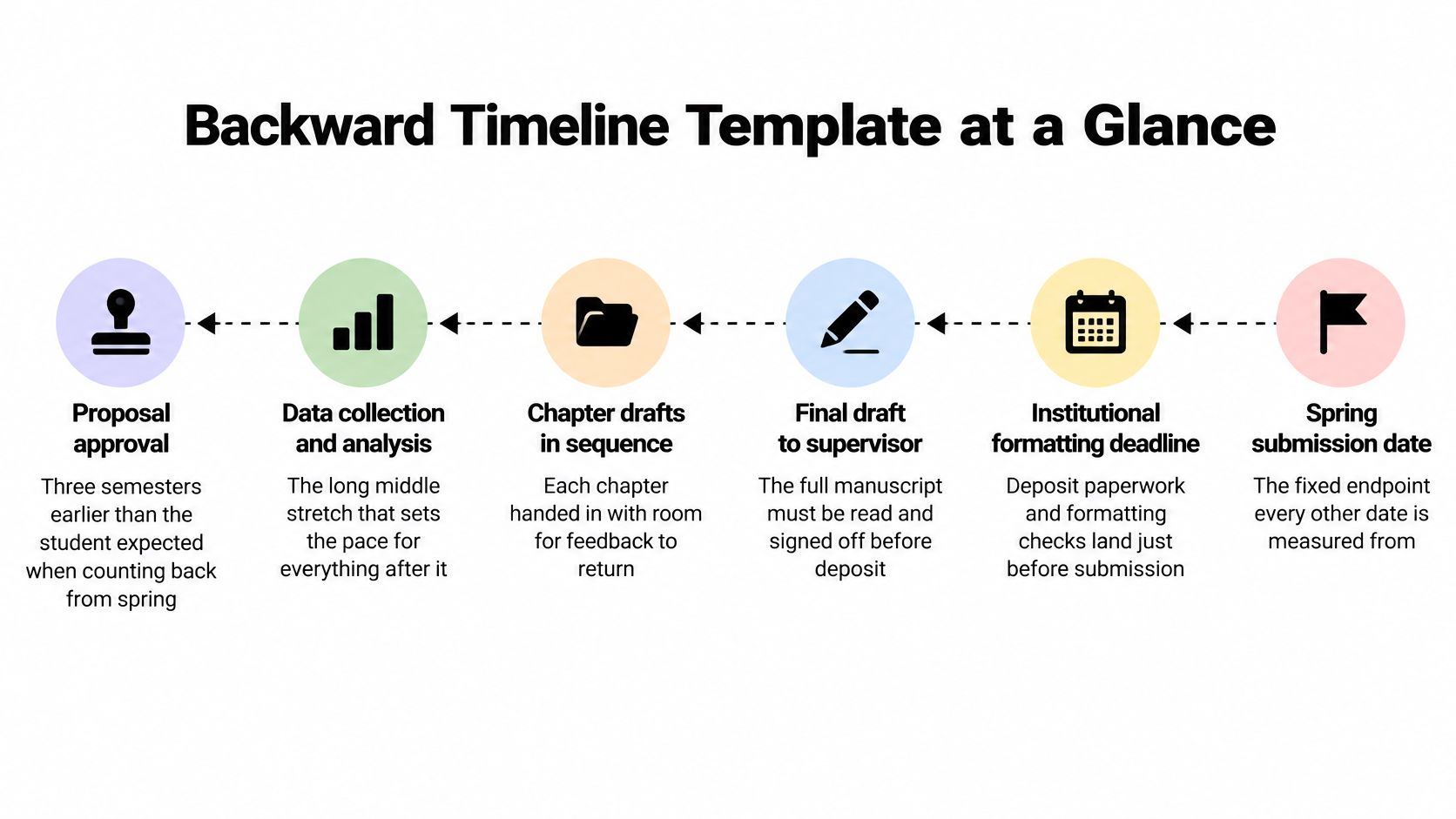
Start at final deposit and read toward the beginning of the project. Each row should answer a practical question: What must already be complete before this can happen? A defense date without an approved manuscript, available committee and completed paperwork is an aspiration, not a booking.
There's no universal doctoral calendar. The OECD's historical comparison of doctorate holders found that U.S. completion, measured from graduate-school entry, took approximately 30 months longer than in other surveyed countries. Your template should therefore follow your institution's sequence rather than assume a standard program length.
Use this visual to orient the schedule before entering individual tasks.
Reference lead times to overwrite
The schedule below combines program-specific reference milestones with suggested planning allowances, not universal requirements. The Emory academic planning template recommends two to four weeks for advisor feedback and four to six weeks for revision and committee review. Confirm every institutional deadline with your graduate office, particularly committee formation, proposal approval and defense authorization.
Backward milestone schedule with typical lead times
| Milestone | Typical lead time | Depends on | Owner | Buffer to add |
|---|---|---|---|---|
| Corrections and final electronic deposit | After the defense, per institution | Defense outcome | Student | Protected margin before deposit |
| Oral defense | Date set after approval | Committee availability | Graduate office | Alternative dates held provisionally |
| Preliminary defense approval | Program's required pre-defense interval | Complete draft | Supervisor | Separate administrative slack |
| Revision and committee review | Institutional review window | Feedback resolution | Student and committee | Protected margin before defense |
| Supervisor feedback on each chapter | Agreed review window per round | Supervisor availability | Supervisor | An additional review cycle |
| First full draft | Before final supervisory and committee review | Required chapters assembled | Student | Time for cross-chapter corrections |
| Data collection complete | Set by research design | Ethics approval and recruitment | Student | Recruitment contingency |
| Proposal approved | Program's required pre-graduation term | Committee sign-off | Committee chair | Clearance before collection begins |
| Committee formed | Program's required pre-graduation term | Program rules | Student and graduate office | Paperwork allowance |
The same distinction between requirements and dates applies earlier in education. Graduation Attire's guide to plan your diploma credits step by step is relevant to school-level credit planning, though doctoral candidates need their own graduate handbook rather than school graduation rules.
Template test: Every milestone needs a date, a named owner and a predecessor. Keep student work complete and milestone approved in separate columns.
Add planned and actual dates beside those columns. That lets you distinguish a drafting delay from an approval delay without guessing who needs to act next.
How to Work Backward From Your Submission Date
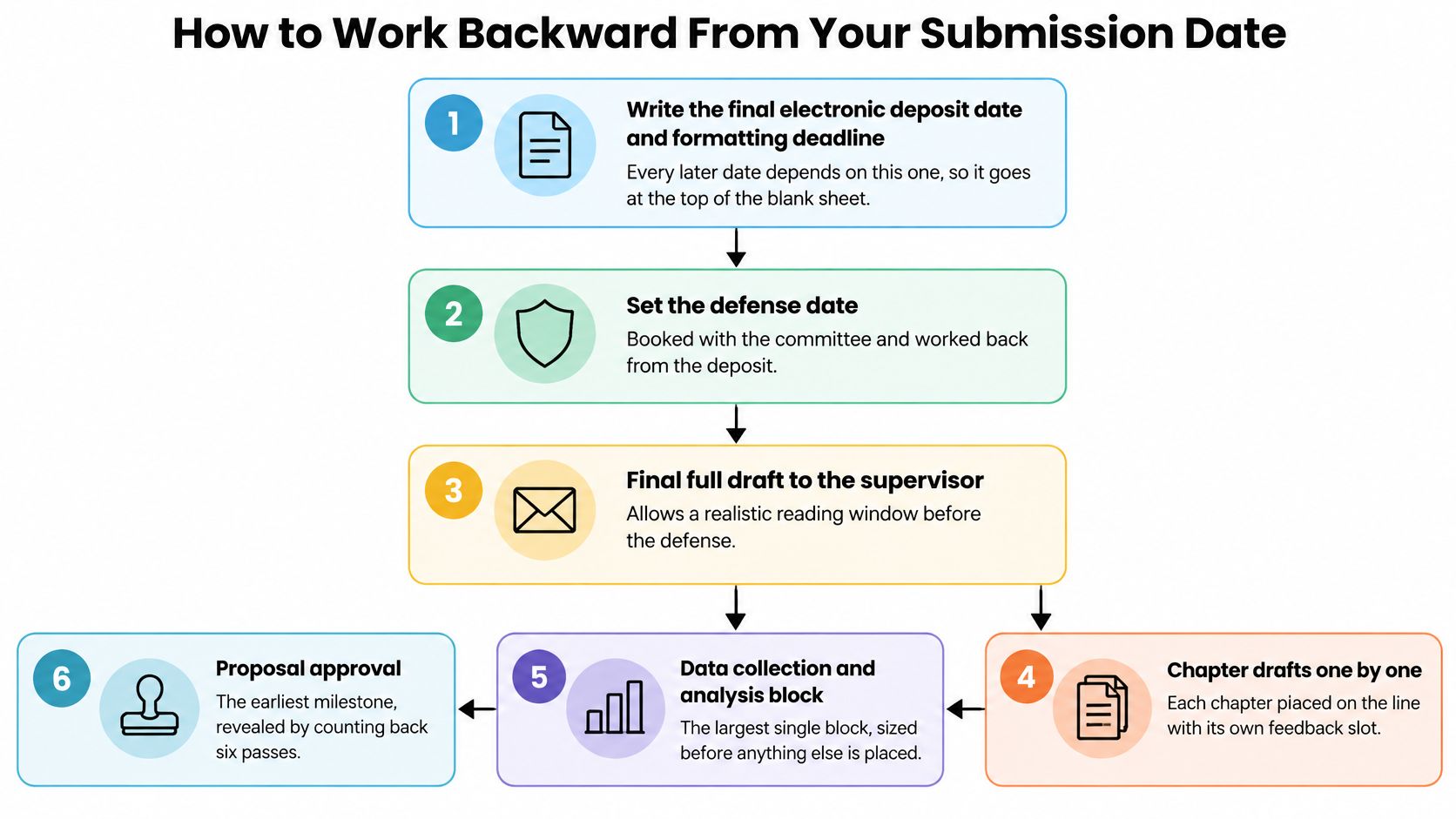
Record the endpoint precisely. Write down the final electronic deposit deadline and the institution's formatting deadline, including the submission portal and required sign-offs. Don't substitute the graduation ceremony date or the date you hope to finish writing. A Council of Graduate Schools policy report describes conventional U.S. doctoral completion estimates of only 40% to 50% of entrants, which supports taking completion planning seriously without treating those historical estimates as your personal odds.
Work backward through post-defense corrections and the defense itself. Ask who authorizes the booking, who must attend, and whether remote participation needs permission. Hold alternative dates while availability is being confirmed. Treat a tentative calendar invitation differently from a formally approved defense, and record the person responsible for converting one into the other.
Place authorization and manuscript review before the defense. Obtain the actual preliminary approval deadline from your department, then position committee review and substantive revision ahead of it. Don't give reviewers a manuscript while assuming you can keep changing its central argument underneath them. Identify the version they'll examine and what changes remain permissible during that review window.
Give each chapter its own draft, feedback and revision dates. Use weekly planning blocks rather than a broad label such as “write results this month.” Beside every chapter, record its current status and next action: finish the coding explanation, resolve a missing comparison, or submit the revised discussion. A percentage-complete estimate won't tell you whether an unresolved methods decision prevents the results chapter from moving forward.
Turn major milestones into approval gates. For proposal approval, ethics clearance, completed data collection and the first full draft, specify the deliverable, predecessor, owner and review date. Define completion in observable terms. “Ethics submitted” isn't “ethics approved,” and “interviews booked” isn't “data ready for analysis.” Include literature-review and analysis checkpoints wherever they control a later decision.
Insert buffer as visible rows before approval, fieldwork and submission. Keep it separate from active work so you can tell when you've consumed it. Then test the dependencies with a hypothetical chapter delay: which later dates move, which can stay, and who must be notified? If nothing changes despite a delayed critical chapter, the schedule doesn't yet describe the project's real constraints.
Use the process diagram as a final check that you've worked from the endpoint toward the earliest approval.
Adjusting the Template for Your Research Design
Say you plan a dozen interviews. Partway through recruitment, participants tell you they can't meet until the following term. If you've scheduled analysis immediately after the final expected interview, you now have a choice between changing the sample, changing the schedule or accepting a methodological compromise.
A buffer gives you time to make that decision deliberately. It doesn't authorize you to replace participants casually or change an approved protocol without permission.
The longest phase isn't always the phase with the most student work. You might spend little active time requesting archive access but wait a substantial portion of the calendar before you can inspect documents. Record active work and elapsed time separately.
Where each research design stretches and where to add buffer
| Research design | Phase that stretches | Where to add buffer |
|---|---|---|
| Interview or focus-group study | Recruitment, scheduling and transcription | Before data collection and after the last interview |
| Survey study | Ethics approval, piloting and response rates | Before launch and during fieldwork |
| Lab or experimental study | Equipment access, participant sessions and repeat runs | Between data collection and analysis |
| Archival or document analysis | Access requests and coding | Before proposal approval, to establish feasibility |
| Mixed-methods study | Separate data phases and integration of results | Between data phases and before integration |
| Secondary data analysis | Data access and cleaning | Before analysis begins |
Protect the method, not just the deadline
For interviews, transcription and early coding can overlap with later collection if your design supports that workflow. For surveys, drafting the analysis plan before launch helps expose missing variables while you can still revise the instrument. Neither approach justifies collecting data before required approval.
Lab schedules need access bookings and repeat-run decisions, not just an experimental start date. Archival schedules need an access feasibility check before you promise a corpus that may be restricted or unavailable. Secondary analysis still requires time to inspect missing values, documentation and incompatible definitions.
Mixed-methods projects need an explicit integration deliverable. Specify what you'll produce when the strands meet, such as a joint display or a structured comparison, rather than assuming integration happens while writing the conclusion.
Use the methodology chapter guide to connect these scheduling choices to the design you must explain and defend.
Choose the row that matches your actual method, then copy its buffer locations into your schedule before estimating chapter-writing dates.
If your design combines rows, preserve both sets of constraints. A survey followed by interviews doesn't become simpler because it fits under a single project title.
Building Supervisor Feedback Into Every Chapter
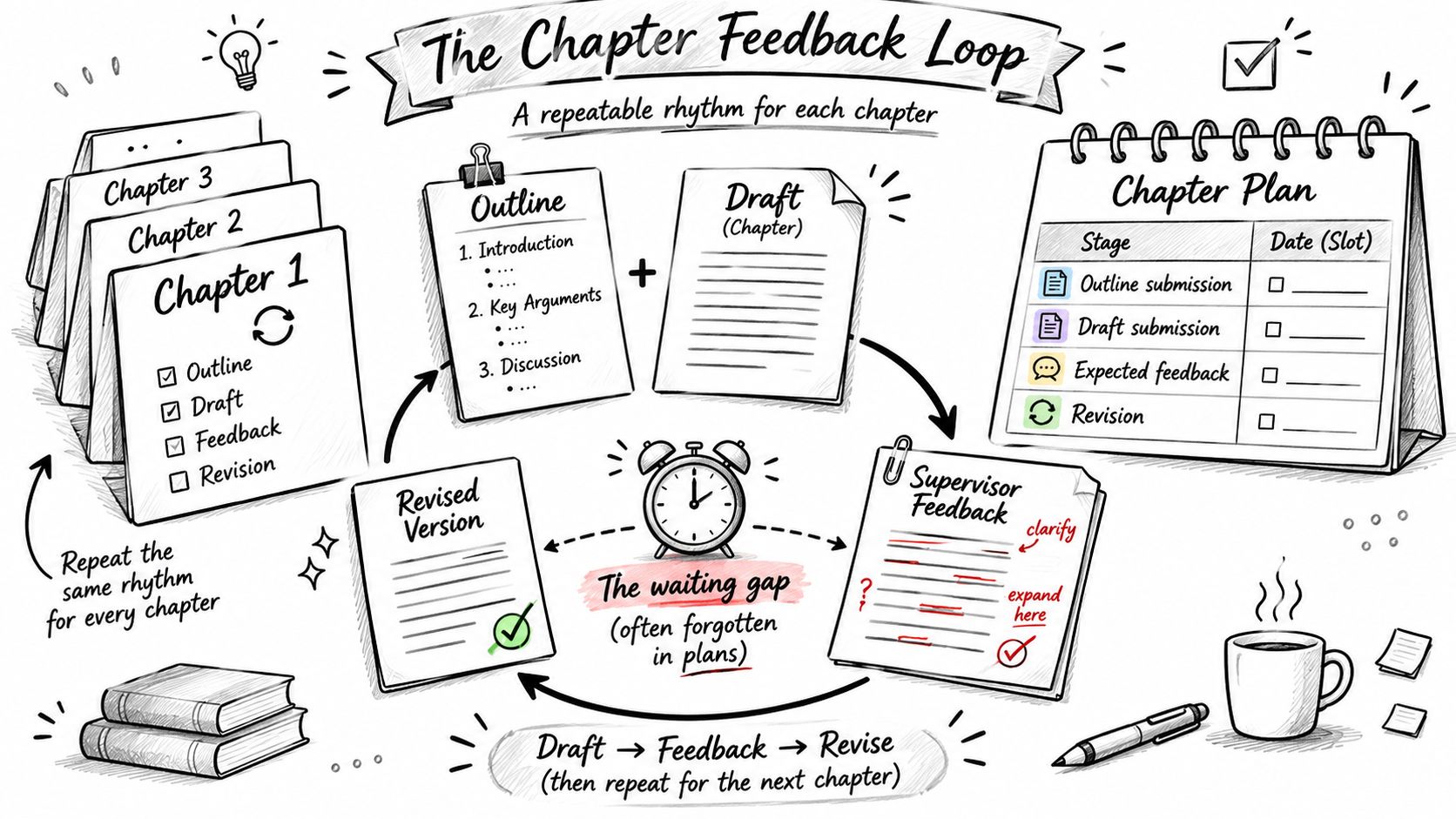
Many schedules assume that feedback arrives as soon as a draft is submitted. That assumption leaves the student accountable for a date the supervisor has never agreed to meet. Replace it with a dated review agreement.
Use a repeatable chapter cycle rather than an open-ended exchange of manuscript versions.
A Frontiers in Education synthesis of doctoral trajectories reports a study in which candidates receiving training assessment, project approval and team supervision had a 70% probability of completing within four years, compared with 49% for those receiving only project approval and team supervision. That association doesn't promise an individual outcome, but it supports treating supervision and monitoring as substantive parts of the plan.
Supervisor feedback cycle for each chapter
| Step | Timing | Owner | Escalation |
|---|---|---|---|
| Outline submitted | Before drafting starts | Student | Agree the outline date at the first meeting |
| Draft submitted | Per chapter schedule | Student | Confirm receipt and review booking |
| Expected feedback | Within the agreed response window | Supervisor | Request comments by the agreed date |
| Feedback-resolution meeting | Promptly after comments arrive | Student and supervisor | Decide accept, revise or defer for each comment |
| Revision and acceptance | Before dependent chapter work proceeds | Student | Log unresolved items by severity |
| Late feedback | At the agreed escalation trigger | Student | Email supervisor, then follow the program's escalation route |
Decide what acceptance means
Add columns for agreed response time, supervisor leave and the chapter's acceptance criteria. A chapter can be ready for committee review without being ready for final deposit. Name that state so nobody mistakes provisional approval for completion.
Classify comments as compliance-critical, argument-critical, evidence-required or editorial. Resolve permission and integrity issues first, then claims and evidence, before sentence-level polish. Our guide to responding to supervisor feedback can help you turn comments into a decision log.
For a complementary explanation, use the video alongside your written review agreement.
Cap each review cycle with a decision meeting, not an arbitrary limit on necessary revision. Agree what happens if comments arrive late, including when the program coordinator should become involved. Keep the institutional formatting check separate from academic acceptance so the final review doesn't overlook deposit requirements.
Tracking Risk and Replanning When Milestones Slip
A dissertation timeline isn't only a productivity chart. Financial pressure, caregiving, illness, isolation and research uncertainty can change what you can reasonably deliver, even when your work habits are sound. Adding more deadlines won't fix an unavailable childcare arrangement or a funding gap.
A systematic review indexed by OpenAlex identifies academic, psychosocial, financial, institutional and workload-related barriers as interacting contributors to prolonged doctoral completion. Treat those conditions as planning inputs rather than private problems you must conceal until a deadline fails.
Red, amber and green triggers for each gate
| Status | Trigger | Required action |
|---|---|---|
| Green | Gate is on its date and the buffer is untouched | Continue the plan |
| Amber | Buffer is being used to absorb a slip | Log the delay and recalculate dependent dates |
| Red | The next gate is at risk | Tell the supervisor promptly, review scope and reissue the plan |
Write the response before the disruption
Run a monthly risk review, and reopen the plan whenever a major assumption changes. Record the problem, the affected gate, the decision owner and the next review date.
- Ethics delayed: Move dependent collection dates. Continue permitted preparation, but don't begin activities requiring clearance.
- Recruitment unsuccessful: Review alternative channels or sampling changes with your supervisor and obtain any required amendment.
- Analysis changes the question: Decide whether the findings require reframing, additional analysis or a formally approved scope change.
- Illness or caregiving interrupts work: Recalculate available capacity, include recovery time and discuss formal support or an extension where necessary.
Move affected downstream dates by the delay that remains after usable buffer. Don't shift unrelated tasks, and don't compress the writing window to preserve an impossible endpoint. If the institutional deadline is fixed, you need a scope decision or formal deadline discussion.
A moved date is a schedule fact to manage, not evidence of personal failure.
Put that principle in the plan itself. Set a workload cap that reflects your employment, health and caring responsibilities, and reduce scope before adding hours. A revised schedule should describe work you can sustain, not work you could complete only by abandoning recovery.
Set Your Submission Date and Start Your Plan
The most useful decision today isn't which color to give the literature review. It's whether your earliest required approval can realistically support the submission date you've chosen. Test that before building a detailed calendar around it.
Use your next planning session to compare the proposal date with committee sign-off arrangements and your institution's ethics review process. Ask about submission cutoffs, meeting calendars, revision requests and supervisor availability. An application deadline isn't an approval guarantee.
Test the earliest gate
Keep the evidence beside the date rather than in an email thread you'll have to rediscover later.
- Requirement confirmed: Record the handbook page or graduate-office instruction that sets the deadline.
- Reviewer available: Get confirmation that the relevant supervisor or committee can review during the proposed window.
- Research feasible: Check that ethics, access and recruitment can follow approval without assuming immediate decisions.
- Fallback agreed: Name the change you'll consider if the gate can't hold, and who can authorize it.
Use the submission requirements guide to organize the questions you need to resolve, then verify the answers against your institution's current rules. Undergraduate and master's projects may have different approval sequences from doctoral projects. Remove irrelevant gates rather than copying a doctoral schedule unchanged.
Book the first supervisor planning meeting with a decision-focused agenda. Agree the chapter review window, acknowledgment expectations, comment-severity labels and escalation route in writing. Bring a proposed schedule for discussion, not a finished plan that assumes the supervisor has already accepted every date.
Choose a place to maintain the decisions
At Thesis Book Project, we let you set your deadline and break the project into chapters and milestones in minutes, then plan milestones backward from submission. Our free Starter plan includes the Thesis roadmap, Chapter tracker, one project and community support; milestone reminders are available through an upgrade. Start with the structure before deciding whether additional features would solve a real problem.
A spreadsheet is also workable if you maintain its dependencies and review dates. The important choice is to keep a single current schedule rather than separate versions for yourself, your supervisor and the committee.
Finish the session by sending the proposal-date question to the person who can answer it. A confirmed early gate is more valuable than a polished schedule built around an untested assumption.
Thesis Book Project offers a proposal-to-submission roadmap and chapter tracking to help you turn a dissertation timeline into manageable work. Visit Thesis Book Project, set your submission deadline, and use the free Starter plan to map your first approval gate before filling in the rest of the calendar.
Related Articles
How to Respond to Supervisor Feedback: A Practical Guide
Your supervisor's comments are open in one window and your draft in the other. Some notes are bl...
Thesis WritingSource One Management Services: Thesis Reference Guide
You search for a way to keep your thesis references straight, and the results talk about supplier ne...
Thesis WritingSubmission Requirements for Theses: A Complete Guide
You've finished the chapters, your supervisor has said the argument holds, and the only task lef...
Comments (0)
No comments yet. Be the first to share your thoughts.