How to Write a Discussion Chapter in a Thesis Step by Step
Learn how to write a discussion chapter in a thesis: structure, length, linking results to literature, handling limitations, and a revision checklist.
The most popular advice about the discussion chapter is to explain your results. That advice isn't wrong, but it leaves out the hardest part: deciding which explanation the evidence supports. A plausible story isn't enough, especially when your findings don't support your hypothesis.
Learning how to write a discussion chapter in a thesis means learning to build an evidential argument. Your task isn't to persuade the examiner that your original prediction was right. It's to show what you can reasonably conclude, which alternatives remain possible, and where you need to change your claim.
Table of Contents
- Discussion Chapter Structure and Length
- How to Draft Each Finding Step by Step
- Explaining Unexpected and Null Results
- Linking Results to Prior Literature
- Common Discussion Pitfalls and Fixes
- Writing Limitations and Implications That Hold Up
- Run This Checklist Before Your Next Supervisor Meeting
Discussion Chapter Structure and Length
A 2024 thesis-writing guide from Researcher.Life states that a discussion chapter commonly represents 15% to 30% of the total thesis length. Treat that as a planning guide, not a requirement that overrides your department's handbook or supervisor's expectations.
Length is useful only when you know what the chapter must accomplish. You need to explain what you found, how it compares with earlier work, why the pattern may have occurred, what it means, and how far your conclusions extend. Adding pages of repeated results won't accomplish those tasks.
Plan around interpretive questions
Compare these hypothetical subsection headings:
- Descriptive heading: Results of the Survey.
- Interpretive heading: Why Weekly Planners Did Not Reduce Procrastination.
The second heading identifies a problem the discussion must resolve. Use a chapter outline example to map the overall sequence, then give each subsection a distinct interpretive purpose.
| Part | Question It Answers | Typical Share of Chapter |
|---|---|---|
| Opening restatement | What did the study set out to answer? | Brief orientation |
| Findings interpretation | What does each result mean, in research-question order? | Largest sustained allocation |
| Literature comparison | Where does each finding converge with or diverge from earlier studies? | Integrated throughout interpretation |
| Limitations | Which claims do the design, sample, or measures weaken? | Enough space to explain consequential constraints |
| Implications and future research | What changes for theory, practice, and subsequent studies? | Focused development after interpretation |
| Closing summary | What answer does the thesis now support? | Concise synthesis |
These are planning priorities, not standardized proportions. Literature comparison usually belongs alongside the finding it helps explain, so you shouldn't budget it as an entirely separate block of discussion.
Arrange subsections by research question, hypothesis, or theme, rather than by the order in which you collected data. A methods-based sequence can hide the relationship between findings that address the same problem.
Heading test: If a subsection heading could appear in the Results chapter unchanged, check whether it identifies an interpretive task or merely labels a dataset.
How to Draft Each Finding Step by Step
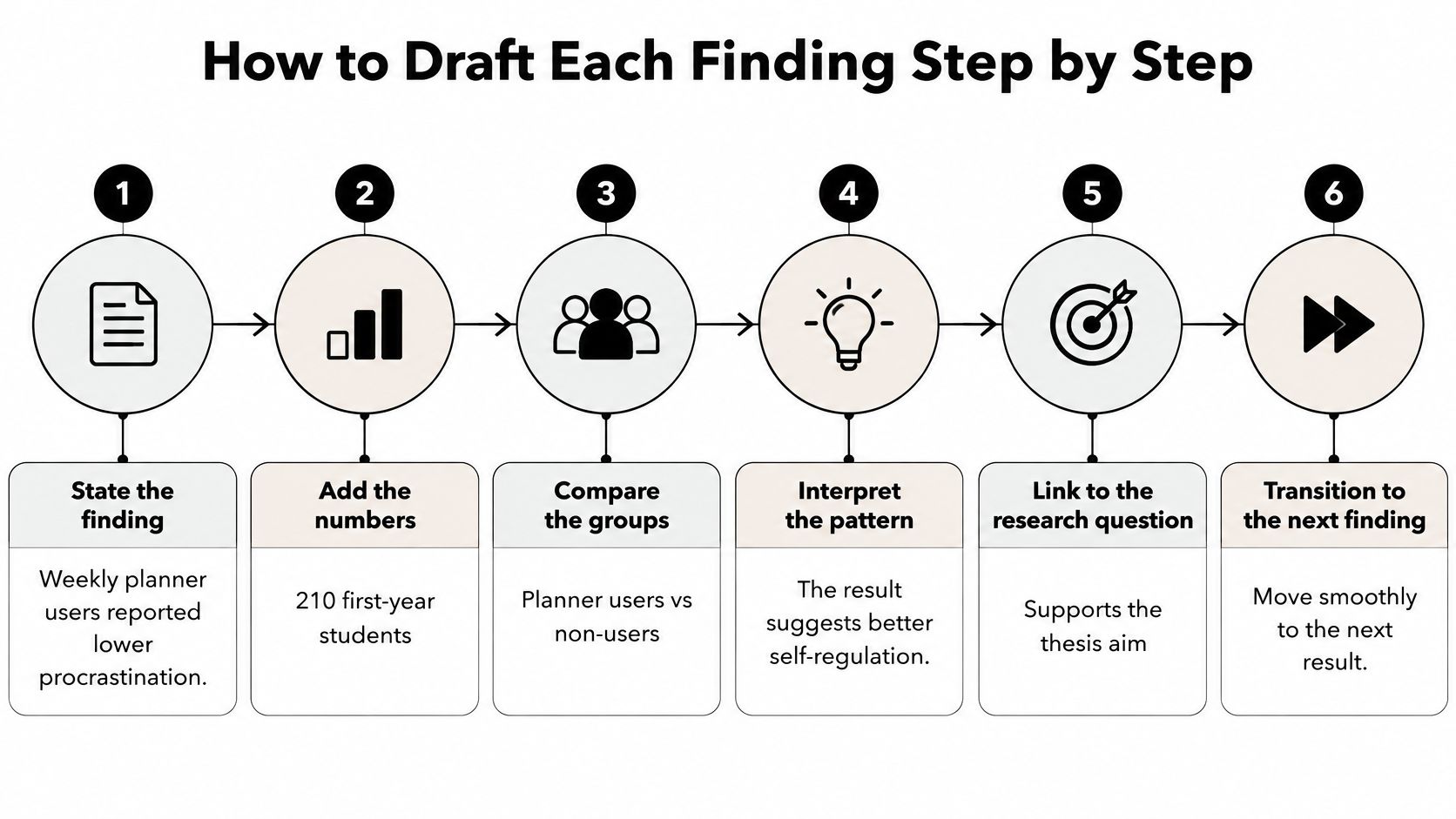
Start with a finding you can state plainly. Say a hypothetical survey finds that first-year students who use weekly planners report less procrastination than students who don't. Keep this example observational: planner use and procrastination were measured, not experimentally assigned.
The University of Southern California discussion guide recommends moving from key findings through comparisons and explanations to their meaning. Turn that sequence into a repeatable drafting routine.
Move from observation to a bounded claim
Restate the question the finding answers.
For the planner survey, ask whether weekly planner use is associated with procrastination among first-year students. If the original hypothesis used causal language, acknowledge that the survey addresses an association rather than treating it as an experiment.Report the relevant result briefly.
State that planner users reported lower procrastination scores, then give the actual effect estimate and confidence interval from your Results chapter. Explain what the difference means on the scale you used instead of reproducing every table entry.Position it against earlier work.
Classify the finding as expected or unexpected relative to your hypothesis, then establish whether it converges with relevant studies. Those are different judgments: an expected finding can still differ from previous evidence.Evaluate plausible explanations.
Planning might help students divide assignments into manageable tasks, but students with stronger self-regulation might also be more likely to use planners. Explain which interpretation your measurements support and which remains speculative.State the contribution.
A defensible contribution might be that the expected relationship also appears during the transition into university. Don't claim novelty just because nobody has surveyed your particular classroom; explain why the setting matters to the argument.Name the boundary.
The survey cannot establish that adopting a planner reduces procrastination. That boundary belongs beside the interpretation, where the reader might otherwise mistake association for an intervention effect.
Keep the drafting sequence visible while you work.
Turn the steps into readable paragraphs
Use the sequence finding → comparison → explanation → implication → boundary. It isn't a rigid paragraph formula, but it prevents you from stopping after the result.
For example, the planner paragraph could begin with the reported difference, compare it with relevant self-regulation literature, and consider whether existing organizational habits explain the pattern. Its final sentences would identify the contribution while withholding a causal conclusion.
Statistical significance doesn't tell the reader whether a difference matters in practice. Interpret magnitude and uncertainty alongside the prespecified threshold, and avoid describing a small, precisely estimated difference as important merely because it meets that threshold.
For qualitative work, connect each claim to a theme, case, quotation, or analytic step. Explain why your interpretation fits the material better than a credible rival reading; a vivid quotation alone doesn't establish the explanation.
Explaining Unexpected and Null Results
A result that doesn't support your hypothesis can feel like a failed study. The danger is that you respond by defending the prediction rather than examining the evidence. An examiner needs to see your reasoning, not reassurance that the original argument survived.
The University of California, Irvine scientific writing guide emphasizes discussing unexpected findings, contradictory evidence, and alternative interpretations rather than ignoring inconvenient results. Begin by stating exactly what happened, without labeling it a disappointment.
Separate an uncertain estimate from an absent effect
A non-significant result isn't automatically evidence that no meaningful effect exists. Check whether the confidence interval excludes effects that would matter or remains compatible with several substantively different outcomes. Then assess the sample, measurement quality, missing observations, and relevant analytic assumptions.
Compare studies reporting similar and different outcomes before choosing an explanation. Use the following sentences only when the corresponding checks justify them.
| Possible Explanation | Evidence to Check | Sentence to Write |
|---|---|---|
| Sampling error | Sample size and width of the confidence interval | The estimate is imprecise, so the result may shift in a larger sample. |
| Insufficient statistical power | Planned sample versus the sample needed for the expected effect | The study may have been too small to detect an effect of this size. |
| Measurement problems | Reliability and validity evidence for the key measures | The instrument may not capture the construct as the theory defines it. |
| Contextual difference | Setting, population, and timing compared with studies that agreed | The effect may depend on conditions that differ in this sample. |
| Genuine theoretical contradiction | Whether the pattern repeats across independent studies after these checks | The result challenges the mechanism the framework assumes. |
Don't diagnose insufficient power merely because a result wasn't significant. Likewise, don't blame measurement unless you can identify a relevant weakness and explain its likely consequences.
Decide whether the claim must change
Change the thesis claim or its scope when the contradictory pattern survives credible methodological checks and recurs across independent evidence. A precise finding that excludes the predicted effect can also warrant revising your own claim, even before replication.
If the evidence is too imprecise or the measure is weak, narrow what you conclude. Treat the result as unresolved, not as confirmation of the hypothesis, and identify what would distinguish the remaining explanations.
Uncertainty isn't a reason to preserve your preferred claim. It's a reason to state a narrower one.
Avoid defensive openings that announce surprise and immediately assert a cause. A neutral alternative is: The predicted relationship was not detected; the available evidence leaves both measurement limitations and contextual differences plausible.
Linking Results to Prior Literature
A summary tells readers what another author found. A comparison explains how that finding changes the interpretation of yours. If you describe earlier papers without returning to your evidence, you're writing another literature review.
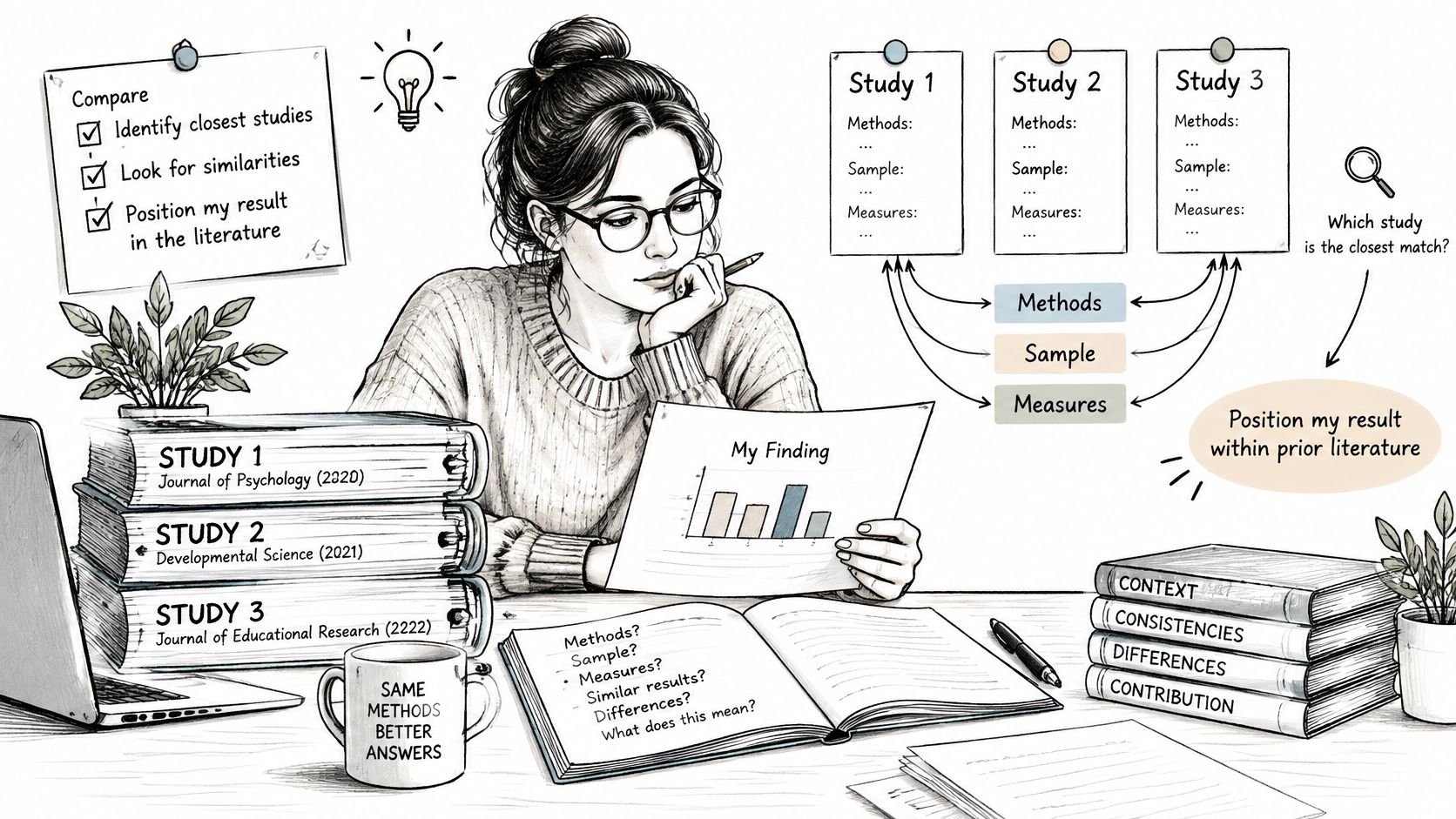
Keep the relevant studies visible while drafting your comparison.
Compare the closest evidence
Select studies because they offer a useful match in design, population, measures, or theoretical mechanism, not just because they mention the same topic. Your literature review process should leave you with enough detail to make those distinctions.
Useful sentence patterns include:
- When findings converge: Describe the shared pattern, then identify what your setting or design adds.
- When findings diverge: Identify the disagreement precisely, then evaluate a relevant difference in methods or context.
- When comparability is limited: Explain which feature prevents a direct comparison and what can still be learned.
For a hypothetical planner study, an intervention involving coached planning may produce a different pattern from a survey of voluntary planner use. Those studies don't test exactly the same proposition, even if both measure procrastination.
Explain disagreement rather than counting agreement
Suppose a study of working students links planning with less procrastination, while another study of residential students finds no clear relationship. Your sample includes students with substantial paid-work commitments, so competing demands offer a plausible contextual explanation for similarity with the former study.
That explanation becomes stronger if you measured work commitments and analyzed their relevance. If you didn't, present it as a testable possibility rather than an established reason.
A writing demonstration can help you hear how the discussion differs from a list of citations.
Avoid deciding an argument by counting supportive papers. A closely matched, well-designed study may be more informative than a collection of loosely related studies.
Place comparisons inside the relevant findings subsection. Readers should encounter the literature at the moment it helps them interpret your evidence, not in a detached catalog at the chapter's end.
Common Discussion Pitfalls and Fixes
The most damaging error is re-reporting results in more elaborate language. Adding terms such as important or interesting doesn't turn description into interpretation. The fix is to identify what the reader can understand from the discussion that they couldn't understand from the results alone.
Replace weak writing moves
| Pitfall | Concrete Fix |
|---|---|
| Repeating table contents | Keep the result needed to orient the reader, then explain its significance. |
| Rebuilding the introduction | Open with the answer your study supports rather than the history of the topic. |
| Using causal verbs for correlational evidence | Replace causal wording with an association statement and identify unresolved direction or confounding. |
| Accepting the first plausible explanation | Write down rival interpretations and compare their evidential support. |
| Omitting null findings | Explain which expectations they constrain and whether uncertainty prevents a firm judgment. |
| Ending with a generic research recommendation | Specify the design, population, or measurement change that would resolve the uncertainty. |
| Treating every limitation alike | Identify the particular conclusion each consequential limitation weakens. |
Sentence-level choices matter. A hypothetical statement that planner use led to better habits makes a stronger claim than a survey can support. Writing that planner use was associated with reported habits is more accurate, but you still need to explain what remains unknown.
Be equally careful with hedging. Piling up may, might, possibly, and perhaps makes a sentence hard to interpret. Choose a calibrated verb, then state the concrete source of uncertainty.
Check whether the problem is unfinished analysis
Some descriptive drafts reflect an analysis that isn't ready for interpretation. If you haven't resolved scoring decisions, checked a surprising pattern, or distinguished primary findings from exploratory ones, polished prose won't fix the underlying problem.
Create a separate analysis query list before you continue drafting. Mark questions about coding, model specification, missing responses, or contradictory cases, and resolve them using your study's documented procedures.
Revision cue: A paragraph containing no comparison, alternative interpretation, implication, or boundary probably needs more than stylistic editing.
Don't force every paragraph to perform every task. The test is whether each passage advances the argument, rather than whether it contains the right academic-sounding vocabulary.
Writing Limitations and Implications That Hold Up
Every important conclusion should pass a practical test: can you identify its supporting evidence, its relationship to relevant literature, and its boundary condition? If you can't, the conclusion needs qualification or further analysis.
The American Psychological Association's Journal Article Reporting Standards describe discussion content as including limitations of conclusions, relationships to other findings, and implications for theory or practice. Limitations therefore belong to interpretation, not to a ritual apology near the end.
Connect each limitation to a claim
Explain what the limitation affects and how. Avoid listing familiar weaknesses without examining whether they matter to your actual research question.
| Limitation | Claim It Weakens | Sentence to Write |
|---|---|---|
| Small or convenience sample | Generalizability to wider populations | Findings apply to this sample; evidence from comparable samples is needed before wider claims. |
| Single site or setting | Transferability to other settings | These results were obtained in this context, and other institutions may differ. |
| Self-reported measures | Accuracy of the behavior measured | Responses may reflect perception rather than observed behavior. |
| Cross-sectional design | Direction of the relationship | The association is consistent with the proposed mechanism but cannot establish temporal order. |
| Short follow-up period | Durability of the effect | Whether the effect persists beyond the measured period remains open. |
Consider a hypothetical study of nurses recruited from a single hospital unit. Their accounts can support an interpretation of experiences among those participants, but not an unrestricted claim about hospital staff generally. Even claims about the whole unit require attention to who participated and whose experience may be missing.
Separate the forward-looking claims
- Practical implications: Name who could act, in which setting, and with what caution. A local finding might justify a monitored pilot rather than immediate institution-wide adoption.
- Theoretical implications: State whether the evidence supports, refines, or challenges a mechanism. An adjustment to a model's scope is more defensible than announcing that the model has been proved.
- Future research: Propose work that distinguishes unresolved explanations. If self-report and observed behavior may differ, recommend a design that measures both rather than requesting a larger sample.
Recommendations should be proportionate to both the finding and the consequences of acting on it. A low-risk local trial and a major policy change require different levels of justification.
Keep the discussion's implications distinct from the final synthesis developed in a dissertation conclusion. Your discussion establishes the reasoning; the conclusion delivers the thesis-level answer without reopening every interpretive debate.
Run This Checklist Before Your Next Supervisor Meeting
Review the chapter in a focused sitting, with your research questions, Results chapter, and reference list open beside it. Don't begin by polishing commas. First check whether a reader can follow the path from evidence to conclusion.
Check the argument before the wording
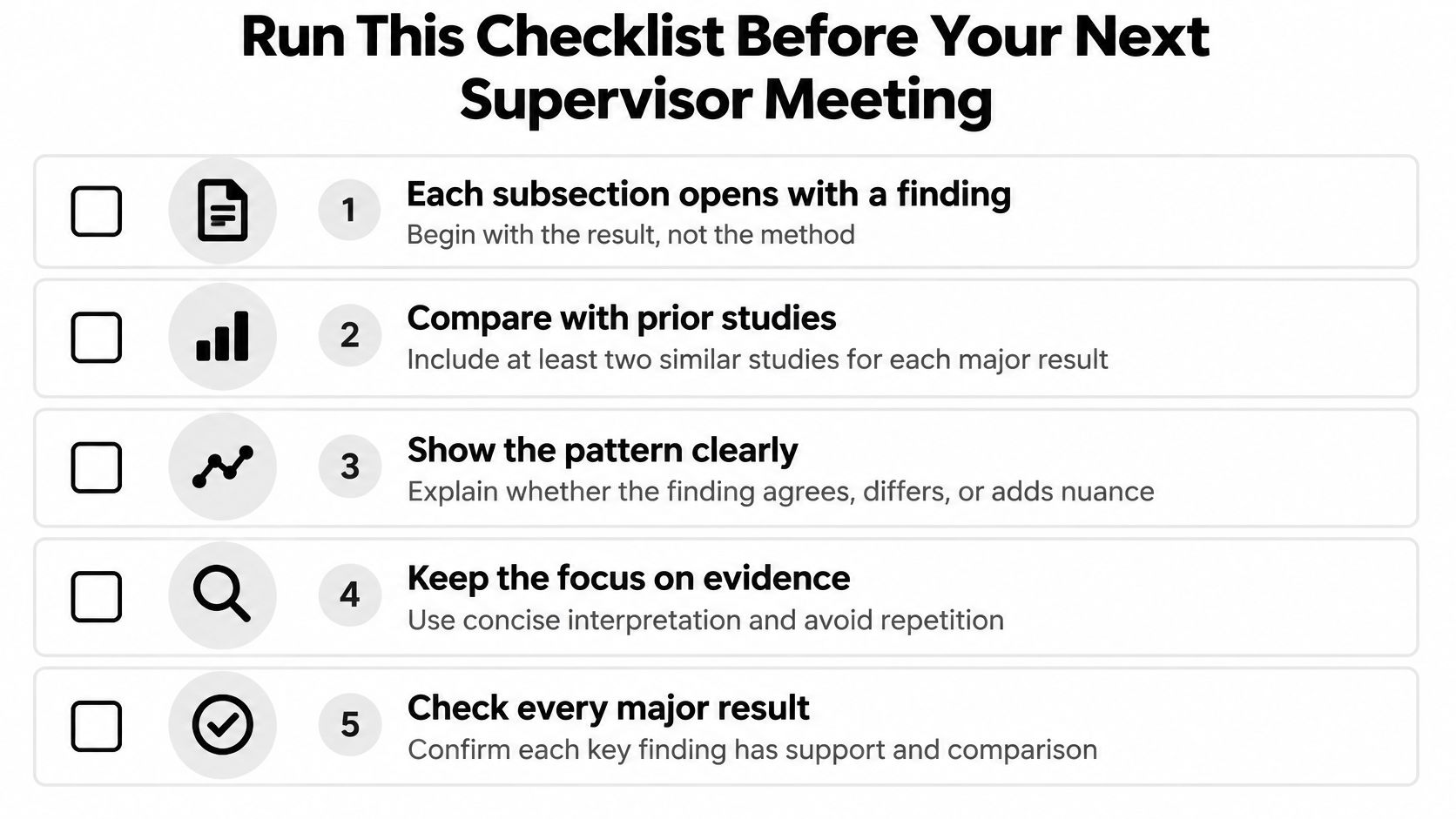
- Opening answer: Underline the sentence that directly answers the research question. If it isn't there, write it before revising the opening.
- Subsection purpose: Read each subsection's opening sentence. Check that it identifies a finding or interpretive issue rather than reminding readers how you collected the data.
- Evidence coverage: Match every major result to its discussion passage. Investigate omissions, especially findings that complicate the preferred interpretation.
- Literature fit: Check that comparisons use relevant studies. Where comparable evidence doesn't exist, explain the gap rather than filling it with distant citations.
- Claim strength: Search for causal language, absolute assertions, and claims of proof. Confirm that each is justified by the design.
- Uncertainty handling: Highlight unexpected and null findings. Check that the explanation distinguishes evidence-supported judgments from possibilities.
- Specific limitations: Draw a line from each limitation to the conclusion it affects. Remove generic weaknesses that have no explained consequence.
- Actionable implications: Separate recommendations for practice, adjustments to theory, and proposals for further investigation.
Use a visual checklist to keep the review focused.
Check the document and prepare a decision
Complete a separate document pass. Confirm that cited authors and publication details match the reference list, terminology remains consistent with the introduction, and the chapter fits your agreed word budget.
Check references to tables, figures, themes, and appendices against their actual labels. An examiner shouldn't have to search for the evidence supporting your central interpretation.
Before sending the draft, log the discussion as its own item in a chapter tracker. A spreadsheet, a Trello board, or the chapter tracker in Thesis Book Project can record subsection status, unresolved questions, and the next review milestone.
Choose a calendar date with your supervisor and record both the draft-delivery date and the meeting date. Name the milestone by its deliverable, such as interpretation draft ready for review, rather than a vague instruction to work on the discussion.
Send the requested chapter, but bring flagged paragraphs and specific decisions to the meeting. Ask whether a claim exceeds the design, whether a rival explanation deserves more weight, or whether a contradictory finding requires a narrower conclusion.
Finally, read aloud the opening sentence of every subsection. You should hear a coherent answer developing, not a sequence of disconnected observations. Then read the flagged paragraphs in full and check whether your reasoning remains clear without relying on emphasis or apologetic language.
Thesis Book Project offers a guided thesis roadmap, chapter tracking, and milestone scheduling to help you manage drafting and revision. Visit Thesis Book Project to organize your discussion subsections, record unresolved interpretation questions, and plan your next supervisor review.
Related Articles
Corporate Profile Examples: 8 Formats Worth Copying
An examiner flips to the appendix for the company background and finds three vague paragraphs. The f...
Thesis WritingFootnotes Examples MLA: Formatting Rules and Templates
You're halfway through a literature chapter, the sentence is already crowded, and your cursor is...
Thesis WritingHow to Prepare for a Dissertation Defense: Full Roadmap
You've polished the slides, practiced the opening, and can explain your main finding. Then you c...
Comments (0)
No comments yet. Be the first to share your thoughts.