Thesis Strategy and Roadmap: A Practical Guide for Students
Build a thesis strategy and roadmap that actually works. Learn to define scope, break work into phases, and plan backward from your submission deadline.
Your submission deadline is approaching, your reading folder keeps growing, and you've worked hard enough to feel exhausted. Yet when your supervisor asks what must happen before you can submit, you can't give a clear answer. You don't need another list of things to do. You need a thesis strategy and roadmap that connects your research decisions, your supervisor's feedback, and your institution's requirements.
Table of Contents
- When Planning Becomes the Bottleneck
- What a Thesis Strategy and Roadmap Actually Mean
- The Standard Phases from Proposal to Submission
- Backward Scheduling from Your Submission Date
- Aligning Supervisors and Institutions at Each Phase
- Embedding AI Governance into the Roadmap
- Running Supervisor Meetings That Move the Work
- Putting It Together and Your One-Page Plan
When Planning Becomes the Bottleneck
A busy thesis student can still be a drifting thesis student. You might spend the morning collecting articles, the afternoon revising an introduction, and the evening testing software without resolving the question that determines whether any of that work belongs in the project.
The problem isn't necessarily motivation. It may be that you haven't separated productive activity from progress toward submission. Reading becomes progress when it helps you justify a research question, choose a method, or strengthen an argument. Otherwise, it can become a comfortable way to postpone a difficult decision.
Diagnose the next unresolved decision
Start with the work you can't yet proceed with confidently. Perhaps you're unsure whether the available data can answer your question, whether recruitment needs approval, or whether your supervisor expects a different kind of contribution.
Write down the decision, who must help resolve it, and what evidence they need. That gives you a practical starting point instead of a general instruction to work harder.
Practical rule: When you feel stuck, identify the decision you're avoiding before adding another task.
Build your planning around these working artifacts:
- A scope decision that states the question, intended contribution, evidence, and exclusions.
- A phase map that shows what must be completed before dependent work begins.
- A dated milestone grid that includes feedback and approval, not just your own writing time.
- A coordination record that captures decisions, responsibilities, and unresolved requirements.
You can compare your current habits with these common mistakes that delay thesis submission. Use the comparison to diagnose your workflow, not to produce another anxiety-inducing checklist.
Choose tools after identifying the work
A document and spreadsheet may be enough to begin. If your research also involves a funding application, Grantlas's guide to the best grant writing tools by use case offers a relevant resource for that separate workflow.
Keep the distinction clear: grant preparation, reference management, and thesis planning involve different decisions. Don't spend your planning time assembling software before you've established what you need it to help you do.
What a Thesis Strategy and Roadmap Actually Mean
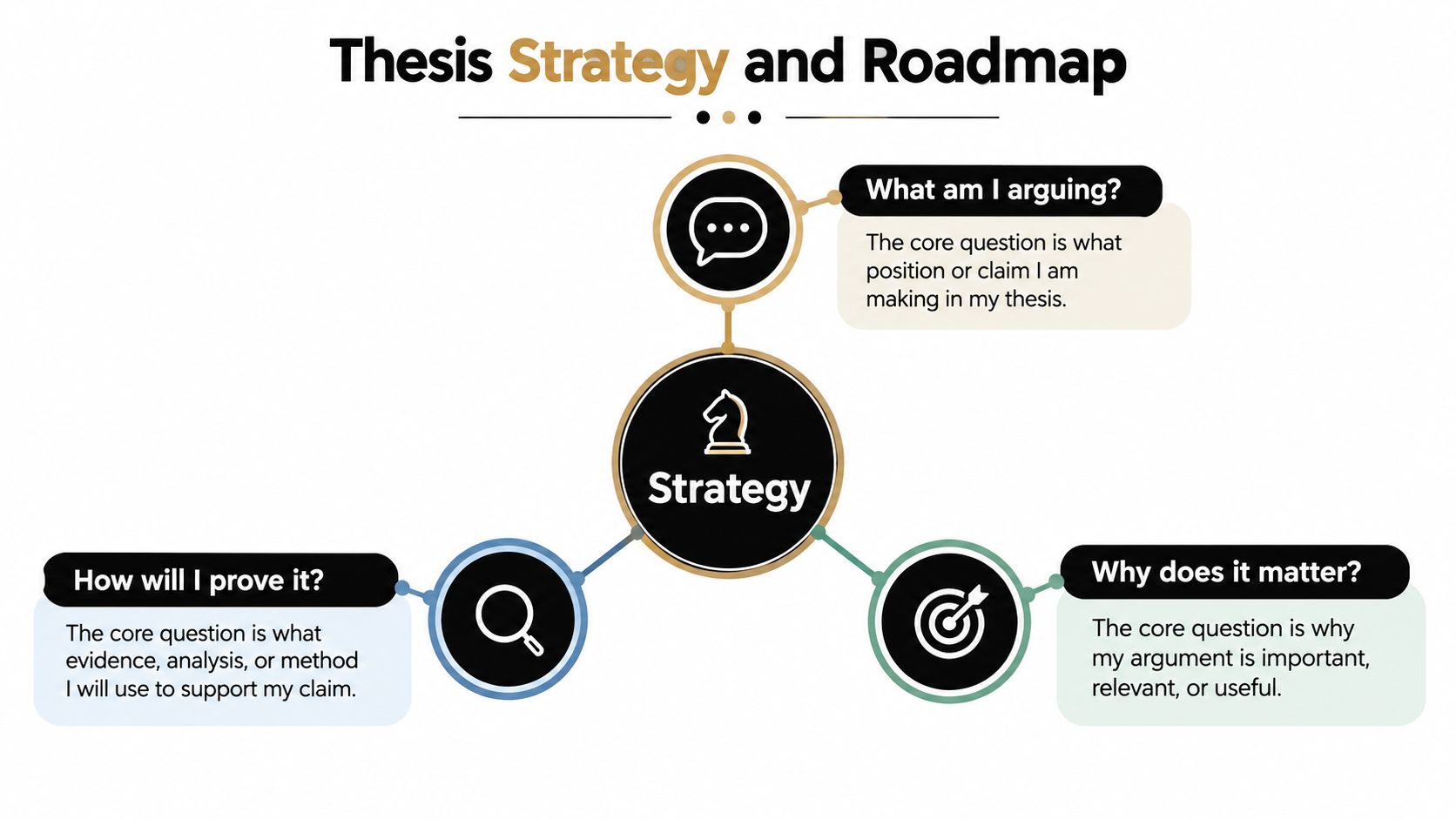
A thesis strategy explains what you're trying to establish, why the inquiry matters, and what you'll include or exclude. A thesis roadmap translates that approach into a dated route from your current position to submission.
Think of planning a journey. Strategy means choosing the destination and explaining why you're going there. The roadmap contains the route and timetable, while milestones are the places where you check your position before continuing. Your daily task list is smaller still: the immediate actions needed to reach the next checkpoint.
The concept map below highlights the questions behind the research direction.
Make the strategy specific without predetermining findings
Consider a hypothetical student interested in digital feedback in higher education. Studying digital feedback generally is a topic, not yet a workable strategy. Examining how students interpret written feedback in a selected course provides a more focused inquiry, subject to suitable evidence and approval.
You don't need to know the findings in advance. In empirical research, the strategic question is often what you intend to investigate and how that investigation could contribute to understanding. An intended contribution isn't a predetermined conclusion.
Capture the direction in a brief scope document:
- Research question: State the question your evidence must help answer.
- Contribution: Explain what understanding the project aims to add.
- Evidence and approach: Identify the material you expect to examine and why it fits.
- Boundaries: Specify the population, setting, concepts, or comparisons you won't investigate.
Use scope to evaluate new ideas
Scope isn't a promise never to change anything. It's a shared basis for deciding whether a proposed addition belongs in the thesis.
If someone suggests comparing another institution, ask whether that comparison is necessary to answer the question, whether access is feasible, and what existing work would need to change. Record the answer with your supervisor rather than expanding the project without authorization.
A task such as revising the research question describes an action. A milestone such as agreeing the revised question and evidence requirements describes a completed decision. That distinction gives you more precise language for supervision.
The Standard Phases from Proposal to Submission
Don't put the entire remaining thesis under a calendar entry called writing. Research design, approval, evidence gathering, interpretation, and revision require different kinds of work. Treating them as interchangeable makes it difficult to see what's preventing progress.
Use the following sequence as a planning framework, then adapt it to your discipline. A theoretical thesis, an archival project, and an interview study won't require identical artifacts or approval processes.
Thesis Phases at a Glance
| Phase | Core Work | Completion Artifact |
|---|---|---|
| Proposal and scope decision | Define the problem, contribution, boundaries, and feasibility | Agreed proposal and scope record |
| Literature review and question refinement | Search, evaluate, synthesize, and refine the inquiry | Search log, synthesis map, and justified question |
| Methodology and ethics | Design the approach and resolve applicable ethical requirements | Method rationale, risk register, and required approval |
| Data collection or evidence assembly | Gather and organize approved research material | Documented evidence set and collection record |
| Analysis | Apply the chosen approach and examine alternative interpretations | Analysis record and supported findings outline |
| Chapter drafting | Develop connected arguments using the evidence | Reviewable chapters and argument map |
| Revision | Address feedback and improve coherence across the thesis | Revised manuscript and feedback-response record |
| Submission | Check institutional requirements and prepare final files | Compliance checklist and submission confirmation |
If your proposal is still unsettled, use this guide to writing a dissertation proposal to develop a document your supervisor can evaluate. A polished title won't compensate for an unclear relationship between the question and the evidence.
Put a decision gate between dependent phases
At the end of each phase, ask whether you have enough evidence to proceed responsibly. After the literature review, can you justify the refined question? Before collection, are the method, access arrangements, and applicable approvals ready? Before drafting findings, can you trace interpretations back to the material analyzed?
- Proceed when the completion artifact supports the next phase.
- Revise when a material weakness remains unresolved.
- Pause dependent work when approval or access is still pending.
These aren't equally sized blocks. Some activities can overlap, such as drafting background material while preparing a method proposal. Others shouldn't proceed until a prerequisite is cleared.
A chapter file marked complete tells you little if the underlying research decision remains unsettled. Use the phase map to distinguish work you can safely advance from work that would create avoidable rework.
Backward Scheduling from Your Submission Date
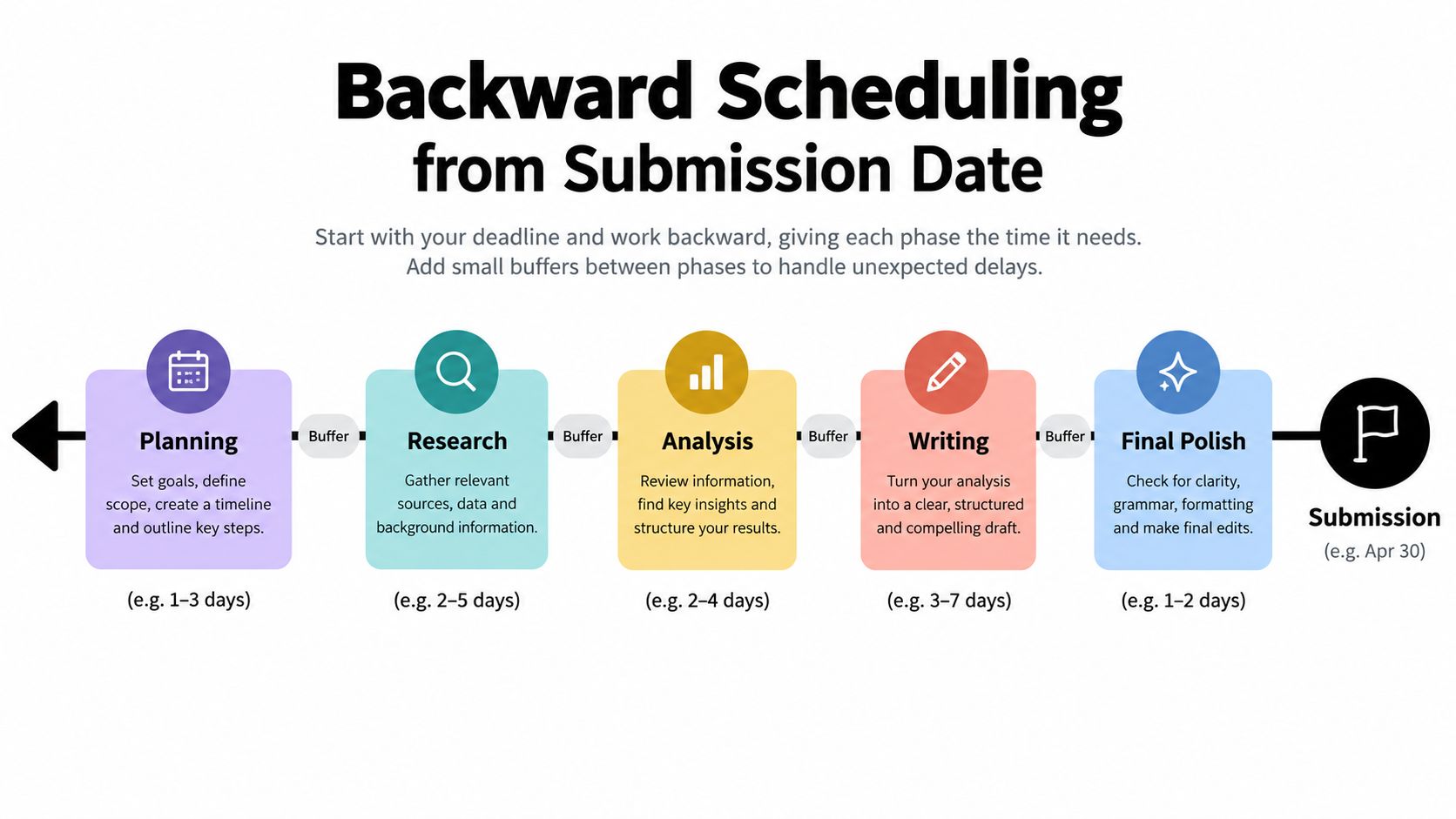
Begin with the submission requirement you must meet, then work backward. First reserve the final checks and submission process, then revision, then the supervisor's review of a complete draft. Continue backward through drafting, analysis, evidence gathering, and the decisions required to begin.
This diagram shows the direction of planning. Your discipline-specific stages may need different labels.
Schedule elapsed time rather than effort alone
Writing effort and calendar duration aren't the same thing. You may finish preparing a chapter while your supervisor is unavailable. An approval process may remain pending even though you've completed your part.
Discuss review availability, institutional queues, holidays, and likely revision needs before assigning dates. The guide to how long it takes to write a dissertation is a useful companion when examining the activities your schedule must accommodate.
For uncertain phases, express contingency relative to the estimated phase length rather than attaching the same flat allowance everywhere. The calculation is estimated phase duration × agreed contingency proportion. Choose the proportion from the uncertainty of your project, not an unsupported universal rule.
For another presentation of the scheduling process, use the video below.
Give each date a purpose
A usable milestone grid includes more than a deadline:
| Checkpoint | Deliverable | Decision Owner | Scheduling Requirement |
|---|---|---|---|
| Method review | Method proposal and identified risks | Supervisor, with relevant institutional review | Before dependent evidence gathering |
| Analysis review | Evidence-linked findings outline | Student and supervisor | Before findings chapters are finalized |
| Full-draft review | Integrated manuscript | Supervisor | Before the protected revision period |
| Submission readiness | Final files and compliance record | Student and relevant program contact | Before the formal deadline |
Enter actual calendar dates after confirming these requirements. Place the feedback window between sending the deliverable and needing the decision, rather than assuming feedback arrives on the sending date.
If the backward schedule reaches today with more work than available time, don't compress every phase. Revisit scope, evidence access, and feasible alternatives with your supervisor before committing to dates you can't defend.
Aligning Supervisors and Institutions at Each Phase
A technically sound plan can still fail to resolve conflicting expectations. Your supervisor may be satisfied with the academic approach while your program requires a separate approval, disclosure, or submission procedure.
Changing AI expectations make this distinction particularly important. In the HEPI Student Generative AI Survey 2025, 59% of respondents believed assessment practices had changed substantially in response to generative AI, while the share saying university staff were well equipped to work with AI rose from 18% in 2024 to 42% in 2025. These are student perceptions, not a statement about your institution's current rules.
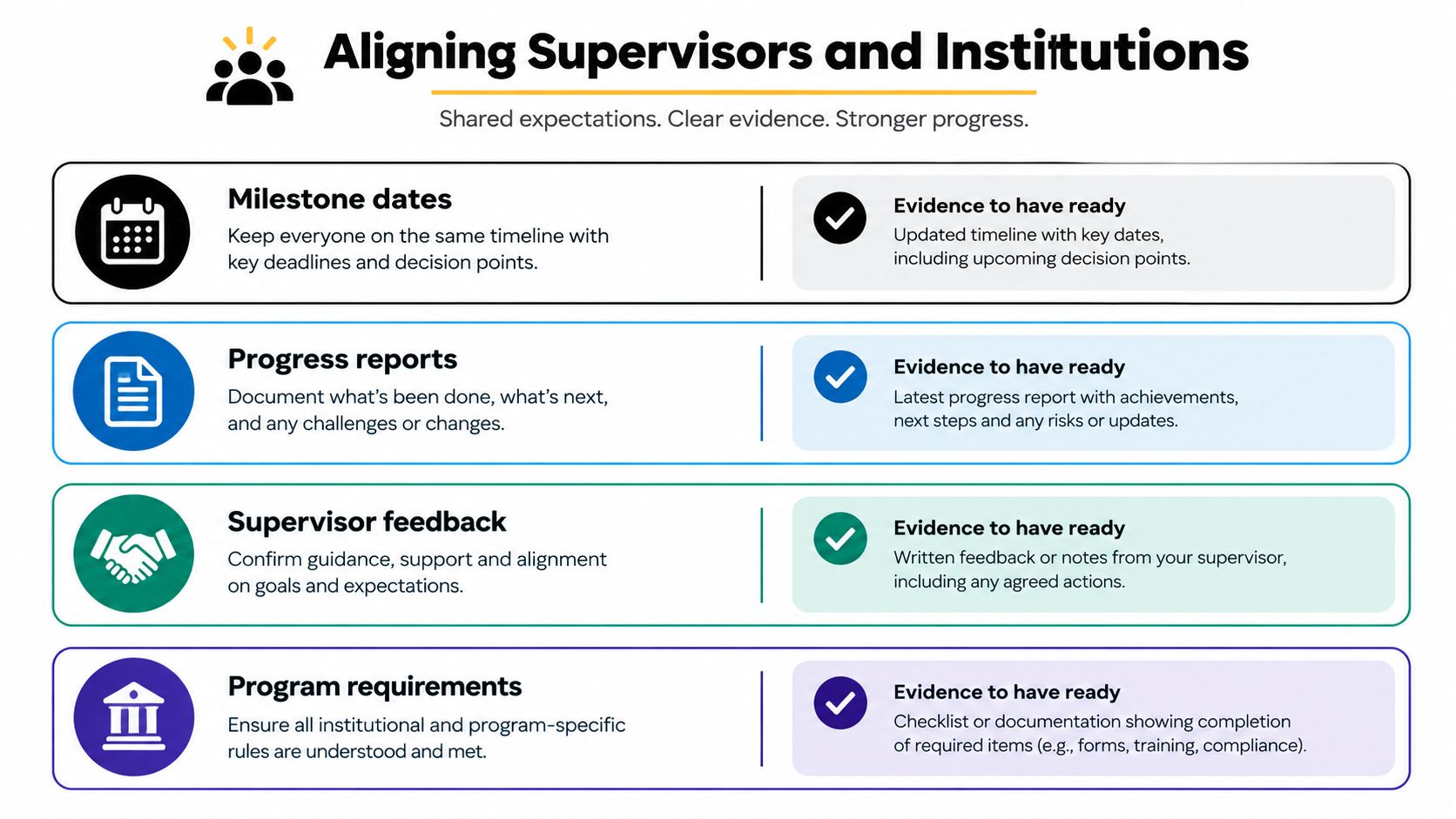
Use the alignment checklist below to make expectations visible before a handoff.
Prepare evidence that someone can review
The practical question is what your supervisor or program needs to see before agreeing that you can proceed. Prepare artifacts that expose assumptions rather than merely demonstrate effort.
- Scope decision and search log: Show the agreed boundaries and how you located and selected literature.
- Method-risk register and data-management plan: Identify access problems, sensitive material, storage arrangements, and unresolved permissions.
- Chapter argument map: Connect each central claim to evidence and show how chapters contribute to the overall inquiry.
- Final compliance checklist: Record the applicable formatting, authorship, disclosure, and submission requirements.
For the shared-tracking aspect, Pretty Progress's guide to track team progress effectively is a supplementary resource. In academic work, keep responsibility explicit: shared visibility doesn't replace the student's authorship or the institution's approval authority.
Protect costly commitments
Topic wording, search terms, and chapter order are often relatively reversible. Recruitment commitments, access windows, collected data, and approved procedures can be costly to change.
A decision deserves more scrutiny when changing it later would require repeating work or seeking new permission.
Place earlier review and stronger contingency around those commitments. Also distinguish academic advice from formal authorization: a supervisor's encouragement doesn't necessarily replace an institutional decision.
Record where each requirement came from, who can confirm it, and when you last checked it. If expectations conflict, request written clarification before proceeding with the affected work.
Embedding AI Governance into the Roadmap
AI assistance doesn't automatically shorten a thesis. Generated material may create additional work through source checking, disclosure, bias review, code testing, and policy compliance. Treat those activities as part of the project rather than invisible cleanup.
A 2025 survey of 1,041 full-time undergraduates found that 92% reported using AI in some form, up from 66% in 2024, and 88% had used generative AI for assessments, up from 53%, yet only 36% said their institution had supported them in developing AI skills. The survey concerns undergraduates, so it shouldn't be treated as a direct measure of postgraduate practice.
The illustration below captures the planning mistake: adding an assistant without accounting for the paperwork and verification that may follow.

Establish permitted uses before relying on outputs
Depending on institutional policy, approved tools may assist with brainstorming, search-term generation, transcription, accessibility, editing, or code scaffolding. Permission for one use doesn't imply permission for another, especially when research data or participant information is involved.
Keep an AI-governance log containing the tool, purpose, relevant prompts and outputs, material supplied, checks performed, and disclosure requirements. Avoid uploading confidential or identifiable material without appropriate authorization.
Place checks where errors would matter
- During literature review: Verify AI-assisted claims and references against the original publications. Don't cite a generated summary as though you've read the underlying research.
- Before data collection: Review ethics, tool permissions, confidentiality, and disclosure with the appropriate supervisor or institutional contact.
- During analysis and drafting: Test generated code, inspect suggested categories, and retain responsibility for interpretation and argument.
- Before submission: Audit originality, source traceability, and required declarations against the policy that applies to your work.
Human judgment remains necessary for deciding what evidence supports a claim and what a finding means. If you can't explain how an output was checked, it isn't ready to support your thesis.
Running Supervisor Meetings That Move the Work
A status meeting can end with encouragement and no change to your next action. A decision meeting ends with an agreed route past a specific obstacle.
Compare an update about continued reading with a request to choose between competing definitions using a synthesis of the relevant literature. Both communicate activity, but only the latter gives your supervisor a clear decision to help make.
Send a pre-read with a precise request
Use a short pre-read rather than a collection of unexplained attachments:
- Current checkpoint: Identify the milestone under review.
- Evidence prepared: Attach the relevant artifact and point to the parts needing attention.
- Decision requested: State the question and your recommended answer.
- Consequences: Explain which dependent activity can't proceed without resolution.
- Next action: Propose what you'll do after the meeting.
Agree how far in advance your supervisor needs materials. Don't assume that sending a document means they've accepted a review deadline.
Discuss blockers before general updates
Open with the issue most likely to prevent the next milestone. Explain what you've already tried, what options remain, and where you need guidance. Use the remaining time for substantive feedback rather than reading aloud a list of completed tasks.
A progress view can support this discussion if it distinguishes prepared, awaiting review, approved, and blocked work. A draft awaiting a major methodological decision shouldn't look equivalent to a draft ready for final editing.
Meeting test: Can you name the decision that changed what you'll do next?
Afterward, record the agreement, action owner, expected completion date, and any unresolved qualification. Send a concise summary so misunderstandings can be corrected before you act on them.
If delayed feedback threatens recruitment or another costly commitment, flag the consequence early. Ask whether a narrower decision can be made sooner, whether another authorized reviewer is available, or whether dependent work should pause. Follow your program's escalation process rather than proceeding without required approval.
Putting It Together and Your One-Page Plan
Your thesis strategy and roadmap should give you a way to decide what matters, what comes next, and what evidence another person needs before you proceed. The value lies in using it, not in making the document elaborate.
Keep a compact overview and link to supporting records. You shouldn't need to fit every reading note, risk, or approval document onto the planning page itself.
Build the overview tomorrow
Use these headings as your starting checklist:
- Research direction: Write the question, intended contribution, evidence, and exclusions in a scope decision.
- Phase and completion artifact: Identify your current stage and the evidence needed to finish it.
- Dated checkpoints: Enter the backward-scheduled milestones, review windows, and dependencies.
- Supervisor coordination: Prepare the next pre-read, including a clear decision request.
- AI governance: Link to your usage log and mark any verification or disclosure check still pending.
Arrange the milestone grid around the next unresolved decisions, not every possible future task. For immediate work, make the deliverable specific enough that you'll recognize when it's ready for review.
Revise deliberately when circumstances change
When feedback, access, or findings alter the plan, record the change and its reason. Identify which later checkpoints are affected, then discuss whether to revise the approach, reduce scope, or change dates where your program permits.
Don't conceal a missed milestone by moving its date without explanation. An accurate record helps you and your supervisor distinguish an unrealistic estimate from an unresolved research problem.
A useful plan isn't one you follow unchanged. It's one that helps you respond to evidence without losing sight of submission.
Thesis Book Project offers a guided thesis roadmap, chapter tracking, milestone scheduling, and shareable progress views as one option for organizing this work. Visit the platform to turn your scope decision and backward schedule into a working project plan, then use that plan to prepare your next supervisor check-in.
Related Articles
Literature Review Process: From Search to Synthesis
You're staring at a folder full of PDFs, half-finished notes, and a supervisor who wants a “clea...
Research MethodsHow to Write a Research Question: A Practical Guide
You may be staring at a topic that feels promising and impossible at the same time. The idea is inte...
Research MethodsHow to Create an Annotated Bibliography: A Practical Guide
You're staring at a stack of PDFs, half-finished notes, and a citation manager that's doing...
Comments (0)
No comments yet. Be the first to share your thoughts.