Corporate Profile Examples: 8 Formats Worth Copying
Explore 8 corporate profile examples across sectors, with structure, tone, and key elements annotated, plus how to adapt one for a dissertation appendix.
An examiner flips to the appendix for the company background and finds three vague paragraphs. The firm is called forward-thinking. The market is called large. Nobody can tell the year, the headcount, or who owns the business. You already have the argument in the chapters. What you don't have is a page a marker can check in two minutes.
That gap is a format problem, not a writing problem. A well-chosen corporate profile turns the appendix into a scannable reference: identity, period, scale, and the decision the reader is making. These eight corporate profile examples are worth copying because each one maps to a different decision. A supervisor checking fit needs a different file from an investor checking traction, and a procurement officer needs a different file again.
I wouldn't collect every brochure the company publishes. Pick the format that matches the question in your methods chapter, then steal its section order. Below, each format comes with a replicable outline and one tactic you can apply this week. The set runs from the standard overview and the one-page snapshot through capability statements, investor fact sheets, leadership profiles, public About pages, institutional disclosures, and supplier registration files. Use one or two. Date the master. Define the metrics before they enter a table.
Table of Contents
- 1. Standard Company Profile (Corporate Overview Document)
- 2. One-Page Company Profile (Company Snapshot or Sales Sheet)
- 3. Capability Statement (Capabilities Brochure)
- 4. Investor Profile (Investor Fact Sheet or Investor Overview)
- 5. Founder and Team Profile (Leadership Profile)
- 6. About Us Page with Mission and Values (Web Corporate Profile)
- 7. Institutional Profile (Common Data Set Style Disclosure)
- 8. Vendor and Supplier Registration Profile
- How the eight corporate profile formats compare
- Turning a Profile Into a Credible Appendix
1. Standard Company Profile (Corporate Overview Document)
A multi-page corporate overview is the default file. It holds history, mission, leadership, products or services, markets, financial highlights, and locations. Partners, journalists, and prospective customers treat it as the primary reference. In a thesis appendix it does the same job before a licence or partnership review: purpose, team, and track record in one place.
What belongs on the page
Say you are profiling a listed manufacturer for a strategy case. You don't need the brand film. You need a dated fact block. In fiscal year 2025, Henkel's corporate profile reported approximately €20.5 billion in sales and around €3.0 billion in adjusted operating profit. Copy that habit. Name the fiscal year, the measure, and the unit in the same sentence as the figure.
A replicable outline:
- Identity: legal name, form, headquarters, and listing status.
- Summary: one paragraph a reader can use without going further.
- History: three to six dated beats, not a narrative essay.
- Offer and markets: what is sold, and to whom.
- People and money: leadership roles plus financial highlights with definitions.
- Foot: locations, sources, and an as-of date.
One tactic: keep a version under two pages beside the full file, and refresh metrics and leadership on a fixed schedule.
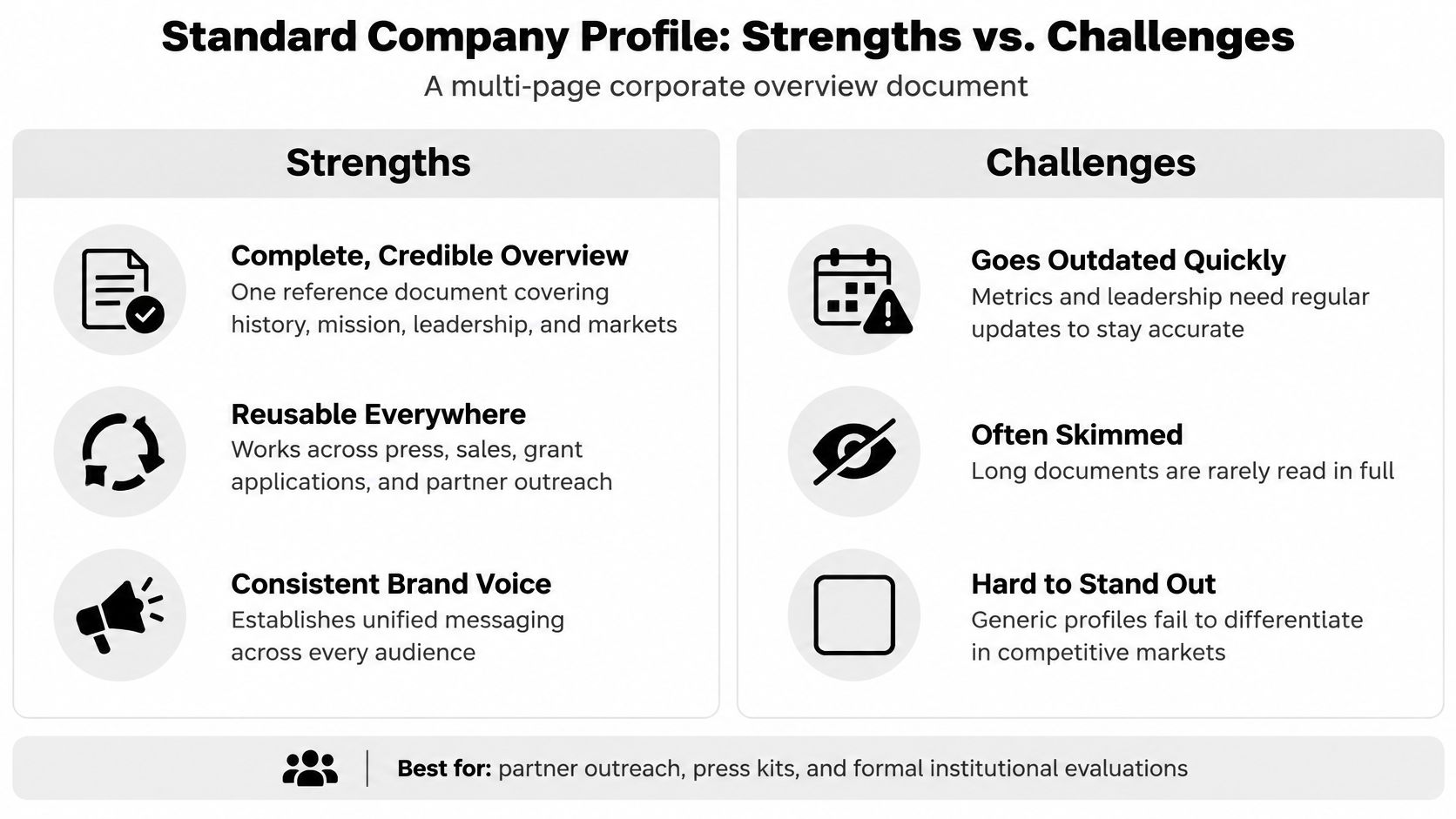
Completeness helps a marker who wants context. Length hurts you when a CFO leaves and the PDF still names them. Microsoft's About pages and Patagonia's mission pages mix facts with values. For the appendix, lead with the problem the company exists to solve, then the numbers.
2. One-Page Company Profile (Company Snapshot or Sales Sheet)
A one-page snapshot is built for a meeting, an email, or a conference handout. It answers what the firm does, who it serves, what it offers, and how to reach it. Department heads and graduate administrators often decide from that page alone, then ask for the long file only if the fit looks real.
The World Bank's SME publication reports that SMEs account for approximately 90% of businesses globally and provide more than 50% of total employment, and that in emerging economies they can contribute as much as 40% of gross domestic product. A modest firm can still be the right case. Your one-pager should say so with ownership, employee scale, market role, financing, and growth stage, not with a slogan.
Practical rule: If a figure needs a footnote longer than the claim, it doesn't belong on the one-pager. Link out instead.
Outline and the single tactic
Use one layout with clear headings so the page scans in under a minute.
- Problem: the pain the audience already has, such as missed thesis deadlines or a stalled case timeline.
- Offer: the product or service in one sentence.
- Proof: two or three facts with years.
- Audience: who it is for, and who it isn't.
- Next step: a QR code or link to the full profile.
One tactic: write three cuts of the same page, one for students, one for supervisors, and one for administrators. Don't change the facts. Change the problem line. A two-page overview template for B2B companies is a useful layout check when one page starts to sprawl. Many B2B software vendors and trade-show handouts already work this way.

What fails is a shrunk brochure. Tiny type, three logos, and no contact path waste the only page the reader will open.
3. Capability Statement (Capabilities Brochure)
Procurement doesn't ask who you are. It asks what you can deliver, on what evidence, and by what process. A capability statement is that answer. Government contractors keep one beside a SAM.gov registration. University research offices ask software vendors for the same pack during onboarding.
For an appendix, treat it as a qualifications exhibit. Say a methods chapter claims a platform can support a cohort of graduate researchers. The capability file should show features, the support model, data handling, and prior work with academic institutions. Leave the vision statement out.
In 2025, Amadeus's 2025 Global Report reported revenue of €6.5 billion, representing 6.1% growth, and investment of more than €1.4 billion in research and development. You will rarely have a number that large. The lesson still transfers. A capability claim needs a measurable input, not an adjective.
Replicable sections
- Scope: services you will perform in practice.
- Qualifications: years, certifications, and institution types served.
- Process: onboarding timeline, support hours, and escalation.
- Controls: privacy, accessibility, and security practices, written before a bid asks for them.
- Proof: references a reviewer can call.
One tactic: keep a master statement, then cut a customized excerpt for each request. Don't rewrite the facts per buyer.
Unverified claims are how capability files die. Procurement reviewers check references, and a dissertation examiner will too.
Specific beats impressive. "Support on weekdays, 09:00 to 17:00, with onboarding inside ten working days" can be coded. "World-class support" cannot.
4. Investor Profile (Investor Fact Sheet or Investor Overview)
An investor profile is a corporate profile aimed at capital. It covers the business model, the market, traction, the team, funding history, and the risks. Public firms publish fact sheets on investor-relations sites. Apple's investor pages are the familiar version. Early-stage firms circulate a shorter overview with a pitch deck during seed and Series A work.
The Fortune Global 500 ranking for 2025, based on 2024 fiscal-year revenue, reported aggregate revenue of $41.7 trillion, up 1.8% from the prior year, and 70.1 million people employed worldwide, with headquarters in 243 cities across 36 countries and territories. Use that only as a scale fence. Your case firm is not that group. Say so, then show the firm's own revenue, workforce, and listing status against a named peer, not against the whole list.
What a marker can reuse
- Model: how money is earned, in one sentence.
- Traction: customers, revenue, or usage, each with a definition that stays fixed across updates.
- Unit economics: acquisition cost and lifetime value only after you have the data.
- Path: funding to date and the next use of funds.
- Risks: adoption, competition, and churn, written in plain sentences.
One tactic: cite a source for every market-size figure and label every projection as a projection. I would rather see a short risk section than a clean hockey stick. A profile that hides churn looks polished and fails the first question in a viva.
5. Founder and Team Profile (Leadership Profile)
Some cases turn on whether the people can do the work. Education technology is one of them. A leadership profile covers backgrounds, roles, and the specific contribution each person makes to the product or the content. Basecamp publishes its team and philosophy in public. Academic publishers often list editorial boards for the same reason. The signal is scholarly fit, not charisma.
A McKinsey-reported pilot shows why people facts belong next to operating facts. Leaders tied the work to revenue growth per store, customer satisfaction, and speed of service. After four months in the first market, McKinsey's people-analytics case study reported customer satisfaction up by more than 100%, service speed improved by 30 seconds, a substantial drop in new-joiner attrition, and sales up by 5%. Your appendix can copy the design even when the firm is smaller. Name the unit, the period, the baseline, and the mechanism.

Outline
- Role: what the person owns now.
- Fit: the experience that matches that ownership.
- Contribution: one concrete piece of the product, method, or editorial policy.
- Advisors: names and institutions only with permission.
- Refresh rule: update the file when roles change.
One tactic: put a human-written editorial policy beside the bios. A bio that says "passionate about students" doesn't tell a reader who reviews the text. A short policy does. If you need a model of a named personal page done with restraint, meet Mansoor and notice what is specific and what is left out.
6. About Us Page with Mission and Values (Web Corporate Profile)
A visitor opens a company's About page to understand what it does and what guides its decisions. Patagonia centers its pages on a clear purpose. Basecamp describes operating principles around calm software and sustainable work. These examples show how to connect values to practices readers can observe, rather than leaving them as slogans.
Sustainability claims need a clear evidence trail. Instead of listing recycling efforts, diversity goals, or a net-zero ambition without context, show the baseline, target, period, responsible executive, method, and assurance status. The OECD Global Corporate Sustainability Report 2025 reports that companies representing 91% of global market capitalization disclosed sustainability-related information in 2024, compared with 86% in 2022. It also reports that limited assurance was more common than reasonable assurance, at 56% versus 17%. Use those distinctions to label what a company has promised, measured, or independently checked.
Keep the page concise and checkable. A small or private firm does not need to copy the disclosure volume of a listed multinational. For a dissertation or company case-study appendix, record the page's claims and evidence in a stable outline: purpose, values, observable practices, sustainability measures, and assurance status. That makes the public narrative easier to compare with the company's documented policies.
The short film below shows how an About page can present a company through story. In the appendix, pair that narrative with the evidence behind its claims.
What to copy into the appendix
- Value: identify one observable practice, such as an editorial review step.
- Policy line: state plainly whether automated content is used.
- Claim type: label each item as policy, activity, output, or verified outcome.
- Links: include the full profile and a press kit, and check that neither leads to a dead end.
One tactic: distinguish unaudited claims from assured metrics. Use cautious language for the former and quantified wording only for the latter. Link the About page to a dated master document so its web claims stay aligned with the appendix.
7. Institutional Profile (Common Data Set Style Disclosure)
Universities publish standardized profiles so readers can compare institutions using the same categories and order. The Common Data Set, a joint effort of higher-education data groups and publishers in the United States, covers enrollment, programs, faculty, admissions, and finances. Stanford and many other universities post it on institutional research or admissions sites. Graduate programs use similar disclosures for completion and time to degree. The format describes a university, not a vendor, but its consistent structure is useful for a company case study appendix.
The U.S. Census Bureau's Annual Business Survey provides a company-side model. It publishes company profiles by industry, ownership characteristics, years in business, receipts, and employment size. Its 2024 Annual Business Survey company summary covers the most recent reference year.
A company version of the same idea
- Reporting period: State the period covered and the date the file was closed.
- Scale: Define employment and receipt or revenue bands, then report the company within them.
- Activity: Identify the industry and years in operation.
- Ownership: Use defined terms such as founder-owned, family-owned, or listed.
- Glossary: Define each metric in one place so its meaning stays consistent across the dissertation or case study.
- Cycle: Set an annual publication schedule and state it.
One tactic: define terms before reporting figures. “Active user” and “completed thesis” are useful only when the glossary states who counts and over what period.
For a dissertation or company case study appendix, copy the stable sequence of categories, not the university's labels without context. Use the outline above, give every value a definition and reporting period, and keep the source data separate from interpretation. Marketing copy in a data field makes comparisons unreliable. A clear glossary takes more space, but prevents readers from mistaking different measures for the same one.
8. Vendor and Supplier Registration Profile
A university buyer may need a vendor's legal identity, tax and registration numbers, insurance, security and privacy responses, and references before approving a purchase. U.S. federal suppliers maintain a public entity profile in SAM.gov with a unique entity identifier. University portals commonly request tax forms, insurance certificates, and security questionnaires. For a case study on selling a team or institutional plan to a university, this registration file can reveal more about procurement readiness than an About page.
AI use in reporting belongs in the trust materials, not in a technical manual. PwC's 2025 global sustainability reporting survey found that AI use in sustainability reporting nearly tripled from 11% to 28% in one year. Common uses included drafting disclosures, identifying risks, and collecting, integrating, and validating data. The practical issue is how the work is disclosed: readers need to know whether AI assisted drafting or analysis, who reviewed the final claims, and what method was used.
Registration outline
- Legal identity: company name, address, registration details, and tax identifiers.
- Cover: insurance and certificates, with expiry dates tracked in a log.
- Controls: prepared security and privacy responses, written before a university requests them.
- Trust layer: distinguish company-reported information from assured information. State whether AI assisted drafting or analysis, identify the human reviewer, and describe the method in plain language.
- References: contacts who have agreed to be called.
One tactic: keep current certificates, insurance, and policies together in a shared folder. Check each institution's procurement rules early, because a late questionnaire can stall a deal. If bid responses are part of the work, use a clear brief when choosing bid writing software, so recurring answers can be managed consistently instead of rebuilt in a blank document.
Reporting frameworks vary by region. Write the trust layer in plain language that both a procurement officer and a dissertation reader can follow. For a dissertation or company case study appendix, reproduce the outline and note which fields are required, which are reported by the company, and which have independent assurance. That distinction makes the profile easier to compare without treating every disclosure as equivalent.
How the eight corporate profile formats compare
| Item | Best For | Popularized By | Main Advantage |
|---|---|---|---|
| Standard Company Profile (Corporate Overview Document) | Partner outreach, press kits, and institutional evaluations | Corporate communications, investor relations, and B2B business development teams | Provides a complete, credible overview in one reusable document |
| One-Page Company Profile (Company Snapshot or Sales Sheet) | Initial meetings, conference handouts, and quick email attachments | B2B software sales teams and higher education conference exhibitors | Easy to scan, share, and forward |
| Capability Statement (Capabilities Brochure) | Institutional procurement, RFP responses, and vendor qualification | Government contracting offices and university procurement departments | Directly addresses buyer qualifications and due diligence |
| Investor Profile (Investor Fact Sheet or Investor Overview) | Fundraising, grant applications, and strategic partner discussions | Venture capital, startup accelerators, and public company investor relations teams | Concentrates key financial and strategic information for investors |
| Founder and Team Profile (Leadership Profile) | Academic credibility and recruitment | Founder-led startups, academic publishers, and research organizations | Builds trust by showcasing relevant expertise |
| About Us Page with Mission and Values (Web Corporate Profile) | Brand storytelling, public trust, and inbound discovery | Mission-driven brands such as Patagonia and values-led software companies | Communicates purpose and brand personality to a broad audience |
| Institutional Profile (Common Data Set Style Disclosure) | Transparent reporting and academic partner due diligence | Common Data Set Initiative and university institutional research offices | Enables consistent, trusted comparison |
| Vendor and Supplier Registration Profile | Selling licenses to universities, research institutes, and program buyers | University procurement offices and government contracting systems such as SAM.gov | Enables access to institutional procurement pathways |
Turning a Profile Into a Credible Appendix
The pattern across these eight formats is simple. Start from the reader's decision, then pick one or two formats that match it. A marker checking background wants the standard overview or the one-page snapshot. A buyer checking qualification wants the capability statement or the supplier file. A finance chapter wants the investor fact sheet. A people chapter wants the leadership profile, tied to a baseline. A public claim about purpose wants the About page, with practices instead of adjectives. A comparison across institutions wants a disclosure laid out like a common data set, with a glossary and a reporting year.
Don't paste all eight into the appendix. That looks thorough and reads as a document dump. I recommend a dated master, kept in one folder, with metrics defined once and reused everywhere else. Web pages, sales sheets, and bid excerpts should point back to that master so a figure can't mean two things.
McKinsey's look at transformations is a good test of whether your profile is decision-useful. The analysis covered 82 publicly listed companies with observable 18-month transformation periods and compared total returns to shareholders with sector and geographic indexes. McKinsey's transformation analysis identified four factors tied to top-quartile excess returns: transformation scope, execution speed and renewal, explicit measurement of enterprise-wide behavioral change, and bold aspirations or targets. Companies setting targets equivalent to at least 75% of trailing earnings were more likely to see outsized shareholder-return gains. You can lift the structure without claiming those returns for your firm. State the baseline, the scope, the period, the behavioral or operational metric, and an external benchmark. Internal praise isn't a result.
This week, draft two things only. Write the one-paragraph summary a reader can use without the rest of the file. Then build a metrics table with the measure, the definition, the period, the source, and the as-of date. Link that master from the appendix and from any public page. If a later chapter needs a different audience, cut an excerpt. Don't start a second set of facts.
Thesis Book Project helps you turn that profile work into a thesis you can finish. The roadmap, chapter tracker, milestones, and source manager keep the company case, the metrics table, and the appendix on one plan from proposal to submission, with shareable progress for supervisor check-ins. If you are structuring a dissertation around a real firm, visit Thesis Book Project and map the next chapter before the deadline moves.
Related Articles
Footnotes Examples MLA: Formatting Rules and Templates
You're halfway through a literature chapter, the sentence is already crowded, and your cursor is...
Thesis WritingHow to Prepare for a Dissertation Defense: Full Roadmap
You've polished the slides, practiced the opening, and can explain your main finding. Then you c...
Thesis Writing7 Chapter Outline Example Templates for Theses
Why does a template that works perfectly for a nursing doctorate fail a history PhD or a software en...
Comments (0)
No comments yet. Be the first to share your thoughts.