Footnotes Examples MLA: Formatting Rules and Templates
Clear footnotes examples MLA students can copy: rules for content and bibliographic notes, placement, punctuation, endnotes, and ready-to-use templates.
You're halfway through a literature chapter, the sentence is already crowded, and your cursor is sitting on the footnote command. A superscript would let you tuck in a qualification, but you're not sure MLA still wants notes at all.
It does, with a limit. Ordinary evidence stays in a parenthetical author-page citation tied to your Works Cited list. A note is for material that helps the reader and would clutter the sentence. These footnotes examples MLA writers can reuse start from that choice, not from a pile of punctuation.
Table of Contents
- What MLA Footnotes Are and When to Use Them
- The Two Categories of MLA Notes
- Placement Numbering and Punctuation Rules
- MLA Footnote Examples for Books
- MLA Footnote Examples for Articles Websites and Archival Items
- Citing Notes Inside Sources and Special Cases
- Choosing Footnotes or Endnotes for a Long Thesis
- Copy Ready MLA Footnote Templates
- Quick Reference Lookup and Common Fixes
- Final Audit and Next Step
What MLA Footnotes Are and When to Use Them
An MLA footnote is a supporting note, not the default record of every source you used. The Modern Language Association's guidance on notes treats notes as optional. Content notes add explanation that would interrupt the argument. Bibliographic notes point readers toward additional or related sources. Either kind can sit at the bottom of the page or gather in an endnote section.
That split answers the hesitation in the paragraph above. If the sentence needs a source for a claim you just made, keep the author and page in parentheses. If the reader needs a brief aside, a qualification, or a trail of further reading, a note can carry it. A footnote in MLA is not an automatic substitute for the author-page citation.
When a superscript earns its place
Use a note when one of these is true:
- The aside would break the sentence. A definition, a translation, or a caveat belongs beside the claim, not inside it.
- Several related works matter at once. A bibliographic note can gather them without turning one sentence into a reading list.
- The detail is helpful, not required. MLA's own guidance says notes should generally appear only when clarification or amplification is especially useful.
Practical rule: If the reader can follow the argument without the extra sentence, leave the note out.
Microsoft Word will insert a numbered footnote or endnote for you. The software doesn't decide whether the note is justified. You still match ordinary documentation to parenthetical citations, and you still keep each cited work in Works Cited.
Think of the rest of this guide as a lookup, not a lecture. First you'll sort a note into its category. Then you'll place the marker, the punctuation, and the note text. After that come adaptable patterns for books, articles, websites, and archival items, plus the harder case of citing a note that already lives inside a source. A later comparison covers when endnotes behave better in a long thesis, followed by copy-ready templates and a one-minute fix list.
The Two Categories of MLA Notes
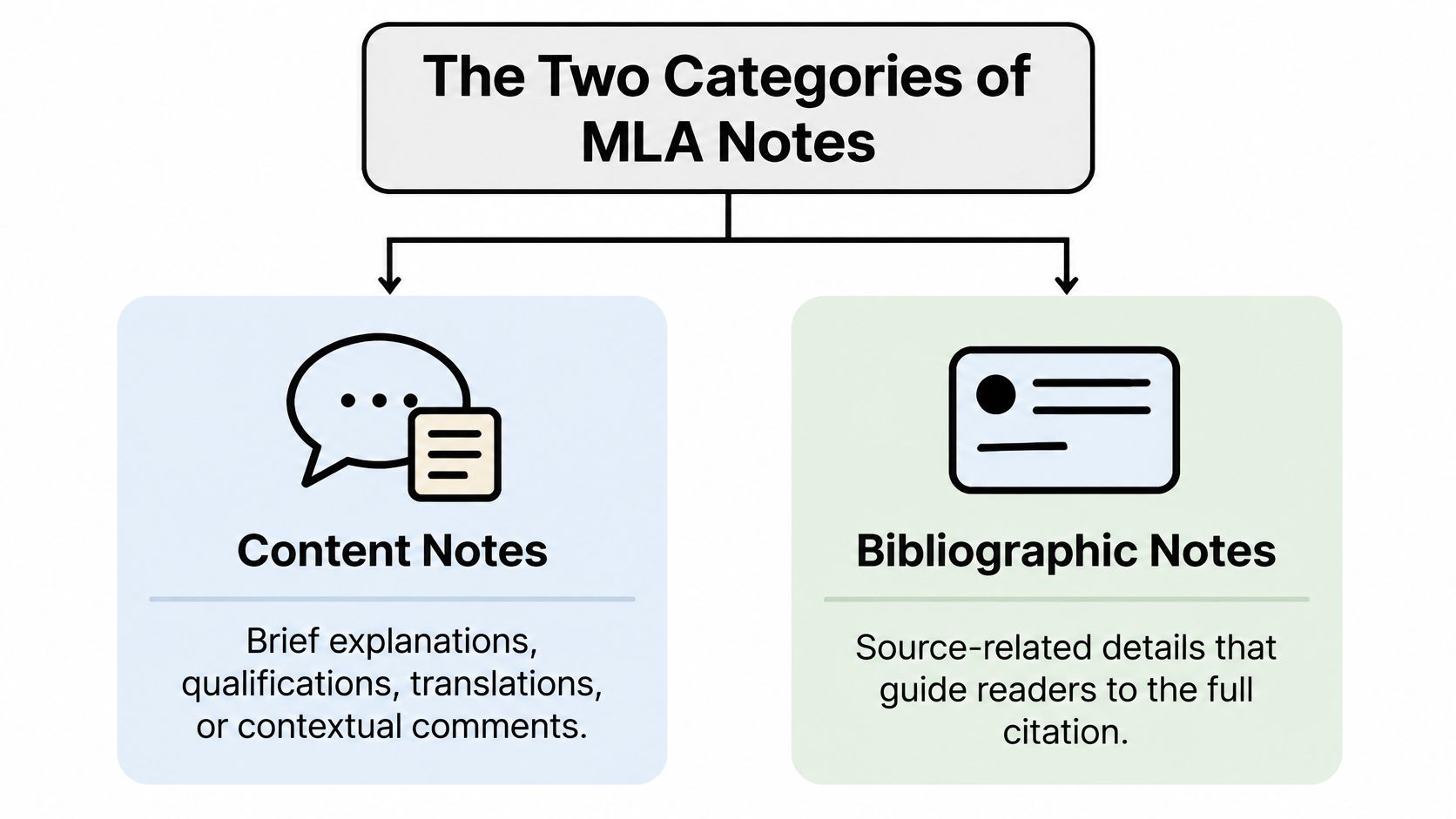
MLA recognizes two jobs for a note. The number looks the same either way. The function decides the category.
Content notes
A content note holds a brief explanation, qualification, translation, or piece of context that would disrupt the paragraph. It doesn't document the sentence you just wrote. It keeps that sentence readable.
A thesis sentence might read: Jane Austen's Mansfield Park treats courtship as a social script rather than a private feeling.¹ The note can send readers to Katherine Sobba Green's discussion of the courtship novel, or it can add one qualification about how you're using the term. The paragraph stays on your argument. The note carries the extra load.
Bibliographic notes
A bibliographic note points to a cluster of related, additional, or contrasting sources. It isn't the citation for one specific claim in the sentence above it. Purdue's MLA endnotes and footnotes guide gives a compact model: "For a contrasting interpretation, see Pyle 43; Johnson, Hull, and Snyder 21–35."
That note does three things at once. It names a disagreement, it gives locations, and it spares the body paragraph from a stack of parentheses. MLA also lets a note identify publications readers may consult even when those works aren't quoted in the prose. If you name them as sources you relied on, they still belong in Works Cited.
Same marker, different job. Classification follows what the note does, not how the superscript looks.
- Ask what the reader needs that the sentence can't hold.
- If the answer is explanation or qualification, write a content note.
- If the answer is a trail of extra sources, write a bibliographic note.
- If the answer is "which page supports this claim," use a parenthetical citation instead.
Placement Numbering and Punctuation Rules
Once you know the note's job, the mechanics are a short checklist. Miss one item and the note looks informal even when the content is right.
Where the marker goes
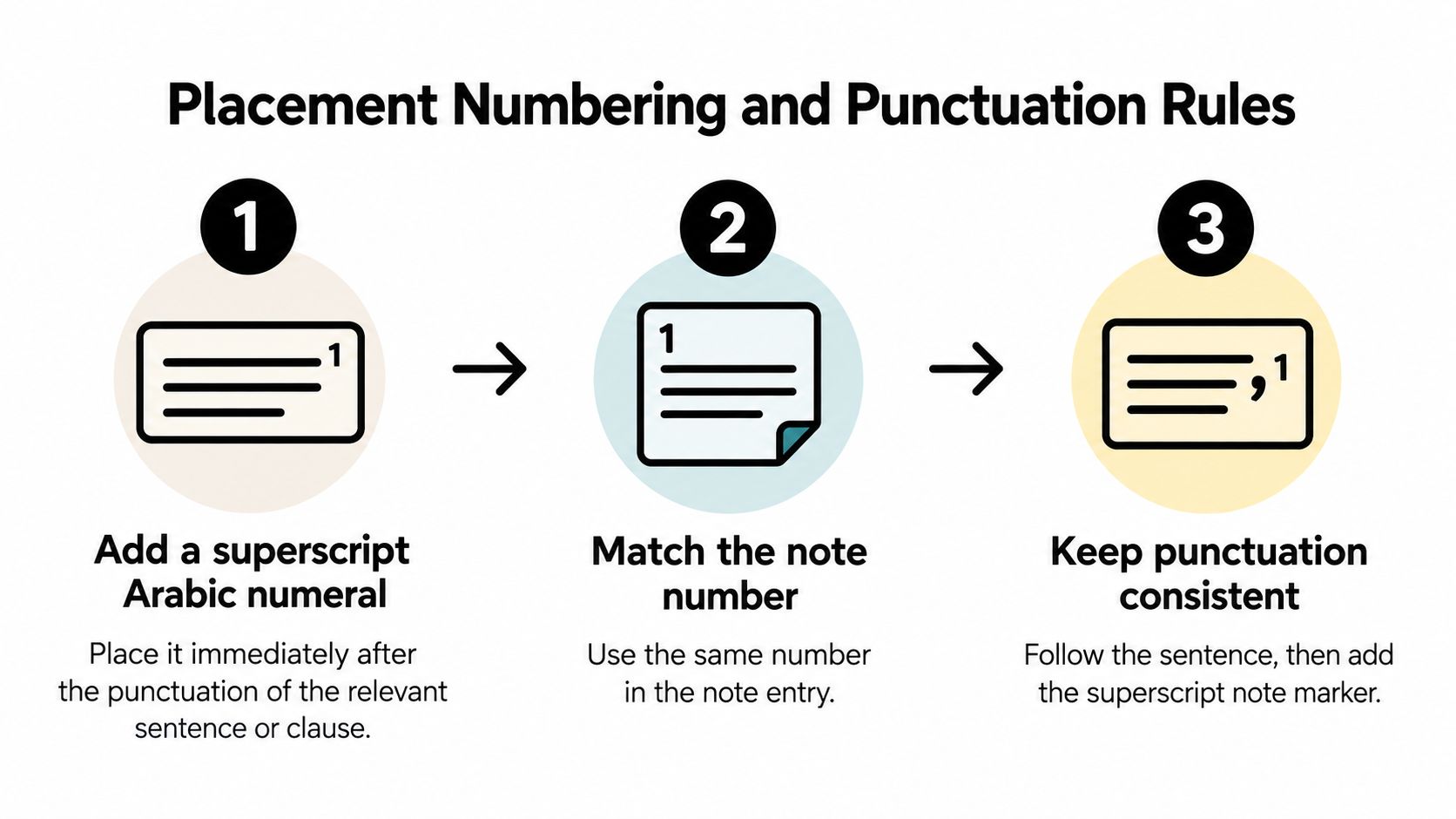
Place a superscript Arabic numeral immediately after the punctuation of the sentence or clause it serves. Purdue's model is easy to copy: "The terminology remained contested throughout the period.¹" The number follows the period. It doesn't sit before the period, and it doesn't land in the middle of a word.
If the note belongs to a clause inside a longer sentence, put the numeral after that clause's punctuation, still outside any closing quotation mark. Readers should be able to see which unit the note comments on.
How the note text is set
Number notes consecutively through the paper. Don't restart at each chapter unless an instructor explicitly requires it. Footnote text begins at the bottom of the page. Endnote text collects in its own notes section. In either case, double-space the notes and indent the first line of each one, the way you indent a paragraph.
Collected endnotes come before the Works Cited page. The note supplements documentation. It doesn't delete it. A parenthetical citation can still sit in the sentence, and the work it names still appears in Works Cited.
A clean insertion in Word
Word's built-in footnote and endnote commands handle the numbering. After you insert the note, check three things the software won't judge for you: the marker follows punctuation, the note is double-spaced with a first-line indent, and an endnote section, if you used one, sits before Works Cited. MLA's note on formatting in Microsoft Word is the place to confirm that placement, consecutive numbering, and spacing still apply after the program drops the note in.
Marker, note text, and Works Cited are three separate duties. Fixing one doesn't finish the other two.
MLA Footnote Examples for Books
Book notes are easier to trust when you start from a sentence you might write. The superscript stays small. The note does one job.
A qualification that would clog the paragraph. Your sentence might say that the 1814 novel frames marriage as an economic arrangement.¹ The note can add that you're using "economic" for household property and settlement, not for wage labor. That's a content note. The edition you quoted still gets a normal parenthetical citation and a Works Cited entry.
A cluster of related studies. Another sentence might claim that recent criticism treats the heroine's silence as strategy rather than passivity.² The note can read: For related readings, see [Author] [pages]; [Author] [pages]; [Author] [pages]. You're gathering a trail, not hiding three citations inside the note so the paragraph looks cleaner. Each work you depend on still goes in Works Cited.
Front matter that changes the argument. Sometimes the introduction, the translator, or the edition is the point. A sentence might argue that the translator's preface narrows the political reading of the novel.³ The note can say that the preface, not the main text, supplies this framing, and that quotations from the novel itself follow the [Year] [Translator] edition. Discussing front matter is different from citing a page of the novel in parentheses. Name the element you're using, then keep the book in Works Cited with the contributors your template requires.
What changes from pattern to pattern is the note's verb. One qualifies a term. One points onward. One flags which part of the book you're using. The superscript doesn't change, and neither does the rule that a book cited as evidence still needs an author-page citation in the prose when that evidence is doing the work.
MLA Footnote Examples for Articles Websites and Archival Items
The note's job stays stable when the source changes. MLA's element template, author, title, date, and the rest, flexes across formats. Your footnote still isn't a parking spot for a full Works Cited entry. If article citation itself is the snag, the walkthrough on how to cite articles in a research paper covers the parenthetical side. The patterns below cover the note.
Journal articles
A bibliographic note works well when one claim sits against a split in the scholarship. Sentence: Later articles reject that dating of the manuscript.¹ Note: For the opposing cluster, see [Author] [pages]; [Author] [pages]. You're signaling a disagreement and giving locations. The article that supports your own sentence still appears in parentheses and in Works Cited.
Websites
A content note is the better fit when access context matters. Sentence: The project site defines the term more narrowly than the print scholarship.² Note: The page uses "edition" for a digital release, not for a new critical text, and it was consulted for terminology rather than for the primary quotation. You explain why the site is in the conversation. You don't paste a full web citation into the note and drop it from Works Cited.
Archival items
Archival notes earn their place when provenance or uncertainty would derail the paragraph. Sentence: The letter's date is secure, but the hand that added the postscript isn't.³ Note: The postscript sits on a separate slip in the same folder. The catalog attributes it to the recipient. That uncertainty belongs beside the claim. Identification of the collection, box, and folder stays in your regular citation.
A footnote isn't where an ordinary Works Cited entry goes to hide clutter. It's where reader-helpful context goes.
When the article, site, or archival document already contains notes of its own, you'll need a different move than these three. That's the next problem, and it shows up constantly in annotated editions.
Citing Notes Inside Sources and Special Cases
Advanced sources break beginner examples. A scholarly edition, a legal text, a historical monograph, or an archival transcription may carry notes that are themselves evidence. You then have three different actions, and mixing them up is how citations go wrong. The Purdue MLA FAQ is the reference for the specialized form.

Citing the author's main text. This is the ordinary case. You quote or paraphrase the body of the work and use an author-page citation. The author's own footnotes aren't part of that citation unless you are using them.
Citing the author's note. Here the note is the evidence. Purdue's form uses the author, the page, the letter "n," and the note number: (Smith 123n6). Several of that author's notes take "nn" plus the numbers, as in (Smith 123nn6–7) when you mean more than one. You're telling the reader to look at note 6 on page 123, not at the main text alone.
Adding your own explanatory note. You might need to say that Smith's note 6 relies on an edition you don't accept, or that the archival note and the catalog disagree. That explanation is your content note. Your superscript still follows the punctuation of your sentence. Smith's note number stays inside the parenthetical citation. Both can appear in the same sentence without becoming the same thing.
The work you cite this way still belongs in Works Cited. Pointing at someone else's footnote doesn't remove that duty. It also doesn't replace a plagiarism check on whether the idea came from the main text, the author's note, or your own paraphrase. A careful pass on how to avoid plagiarism belongs next to this kind of citation, because annotated editions make it easy to borrow a note's argument without noticing.
The letter n marks their note. Your superscript marks yours. Don't swap them.
Choosing Footnotes or Endnotes for a Long Thesis
MLA permits either placement. Footnotes sit at the bottom of the page. Endnotes collect in one section before Works Cited. Both are numbered consecutively and double-spaced. The citation logic doesn't change. The reading experience does, and in a dissertation that difference is operational.
Footnotes keep the aside on the same page. A reader checking a qualification doesn't leave the argument. The cost shows up in layout. Frequent or long notes push body text around, split across pages, and make a PDF feel uneven, especially when a chapter is already dense with quotations.
Endnotes leave the page clean. The argument reads as continuous prose, which helps when you have dozens of asides. The cost is navigation. A reader who wants the qualification has to jump to the back, then find the sentence again. In print that's a thumb in two places. On screen it's a scroll.
What should decide it
- Document length: A seminar paper with four notes can carry footnotes without strain. A 200-page thesis with a note on every other page usually reads better with endnotes.
- Note frequency: Occasional content notes favor footnotes. A running bibliographic apparatus favors endnotes.
- Supervisor preference: Ask before you convert. Switching late means rechecking every marker.
- Accessibility: Footnotes can help readers who use a screen reader to stay with the sentence. Endnotes can help readers who want the body free of interruptions. Neither is universally better.
- PDF or print conversion: Footnotes sometimes collide with margins when a file is exported. Endnotes move as a block and are easier to proof in one pass.
Institutional or instructor rules override general MLA advice. If the department wants footnotes, the cleaner-page argument doesn't win.
Choose the placement a reader can live with for the whole document, not the placement that looks neat on page one.
Whichever you pick, do it once. Mixed footnotes and endnotes in the same thesis force readers to hunt, and they make a final formatting pass much harder than a single consecutive sequence.
Copy Ready MLA Footnote Templates
Templates save keystrokes. They don't choose the note's job. Match the pattern to the category, swap the brackets for your details, and keep every cited source in Works Cited.
Qualification. The term here is narrower than it first appears.¹
- In this chapter, "[term]" means [brief limit], not [broader sense].
Context or definition. The document uses a label that later readers may not recognize.² 2. "[Term]" refers to [short context]. The quotation in the sentence follows [Author] [page].
Additional readings. Several studies take up the same question from another angle.³ 3. For additional reading, see [Author] [pages]; [Author] [pages].
A contrasting interpretation. The claim above isn't the only reading.⁴ 4. For a contrasting interpretation, see [Author] [pages]; [Author] [pages].
Provenance. The date is clear, but the filing isn't.⁵ 5. The item is filed in [collection, box, folder]. The catalog dates the postscript separately.
Another author's note. Smith's caveat changes the dating.⁶ You still cite the note in the sentence as (Smith 123n6). Your own superscript, if you need one, only adds your comment: 6. Smith's note 6 depends on an edition that omits the cancelled passage.
Paste the shape, then edit the words until they sound like your chapter. A template that doesn't match the job, explanation versus source trail versus someone else's note, will format a mistake more quickly than it will fix one.
Quick Reference Lookup and Common Fixes
Use this when you already have a draft and one note looks wrong. The history behind the table is short. MLA's first style sheet in 1951 ran 34 pages, the 1970 revision 48, and the 1977 handbook 163, according to EBSCO's account of the Modern Language Association. The 1984 second edition, at 220 pages, recommended Works Cited pages rather than footnotes as the way to identify research materials. Later handbooks, through the ninth edition in 2021, kept a core element template across books, articles, websites, and other formats. That's why a modern note supplements a citation instead of replacing it.
MLA Note Lookup
| Situation | Best Choice | Format Check |
|---|---|---|
| Ordinary evidence for a claim | Parenthetical author-page citation | Matching Works Cited entry |
| Extra explanation or a qualification | Content note | Superscript after punctuation |
| A cluster of related or opposing sources | Bibliographic note | Sources you rely on still in Works Cited |
| You are citing the author's own note | Parenthetical n or nn form | (Smith 123n6), not a second system |
| Notes are crowding a long thesis | Footnote versus endnote decision | One consecutive, double-spaced sequence |
Fixes that show up in almost every draft
- Superscript before the period: Move it after the punctuation, including after a closing quotation mark.
- Numbering restarted each chapter: Renumber consecutively unless your instructor has required a reset.
- A full citation hiding in the note: Put identification in Works Cited and leave the note for context or a source trail.
- Single spacing or a missing indent: Double-space notes and indent the first line.
- Endnotes after Works Cited: Move the notes section in front of it.
A reference manager can hold the Works Cited side of this table while you edit. A practical comparison of software for references is worth a look before you renumber by hand, because a clean note sequence still depends on a clean source list.
Final Audit and Next Step
Run this pass before you submit, in this order, with the file in the format your reader will open.
- List every superscript and label it content or bibliographic.
- Confirm each marker sits after the punctuation of the right sentence or clause.
- Check consecutive numbering, double spacing, and a first-line indent.
- If you used endnotes, confirm they appear before Works Cited.
- Match every cited source, including works named only in a bibliographic note you depended on, to a Works Cited entry.
Instructor, department, or publisher rules can override general MLA practice. If a handbook and a supervisor disagree, follow the supervisor and keep a note of that choice in your formatting checklist so you don't "correct" it later.
Schedule the audit as its own task, attached to the chapters that carry the heaviest annotation, with enough time to renumber and re-export a PDF. A notes pass done the night before submission is how clean chapters pick up stray markers.
Thesis Book Project gives you a thesis roadmap, a chapter tracker, milestone reminders, a source manager, and supervisor sharing so a notes cleanup doesn't get lost in the last week. You can attach a citation-audit milestone to the chapters that use these footnotes examples MLA patterns, then keep references lined up with the draft. Visit Thesis Book Project and set that checkpoint before your submission date.
Related Articles
How to Prepare for a Dissertation Defense: Full Roadmap
You've polished the slides, practiced the opening, and can explain your main finding. Then you c...
Thesis Writing7 Chapter Outline Example Templates for Theses
Why does a template that works perfectly for a nursing doctorate fail a history PhD or a software en...
Thesis Writing10 Best Progress Tracker Online Tools for Theses
A thesis can look well underway and still be difficult to manage. You've finished the research,...
Comments (0)
No comments yet. Be the first to share your thoughts.