7 Chapter Outline Example Templates for Theses
Explore 7 chapter outline examples for thesis and dissertation projects, with annotated sections, suggested word counts, and practical planning tactics.
Why does a template that works perfectly for a nursing doctorate fail a history PhD or a software engineering thesis? Because a good chapter outline example isn't a universal list of titles. It's a structure matched to your evidence, your argument, and your department's expectations. Copy the wrong one and you'll force interview themes into a results table, split a single historical argument across artificial chapters, or mix reporting with interpretation until examiners can't tell what you found from what you think it means.
The strongest outlines assign one clear job to every chapter, separate methods from results and results from discussion, and show where each piece of evidence will come from. Start by identifying which of the seven structures below fits your study, then adapt its section purposes and word counts. Don't copy headings mechanically. Even fields outside thesis writing, such as mastery-based ministry training explained, make the same basic point in a different context. Progression works when each stage has a defined purpose and builds on the last.
Table of Contents
- 1. Standard Five-Chapter Thesis Outline
- 2. IMRaD (Introduction, Methods, Results, and Discussion)
- 3. Compilation (Article-Based or Manuscript-Style) Thesis Outline
- 4. Design Science Research (DSR) Thesis Outline
- 5. Systematic Review or Meta-Analysis Thesis Outline (PRISMA-Aligned)
- 6. Qualitative Case Study Thesis Outline
- 7. Monograph-Style Humanities Dissertation Outline
- 7 Thesis Chapter Outline Examples Compared
- Build an Outline That Guides the Whole Project
1. Standard Five-Chapter Thesis Outline
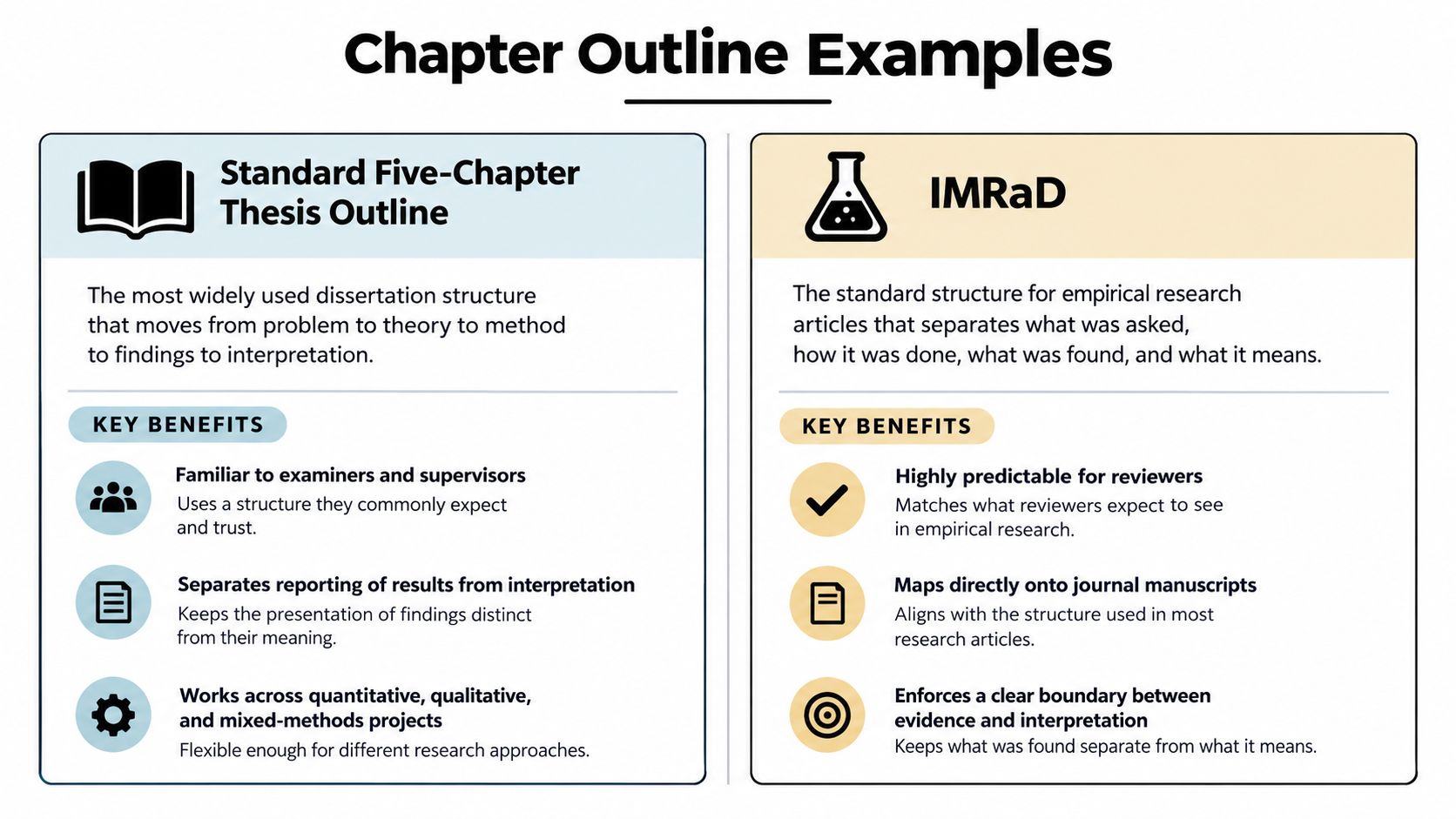
Use this structure if you're doing a conventional empirical study in education, psychology, nursing, or the social sciences. It's the default in many US doctoral programs and is widely used in UK and Australian research degrees. The sequence is direct. Chapter 1 defines the problem, purpose, research questions, and significance. Chapter 2 synthesizes literature and sets your framework. Chapter 3 specifies design, sampling, data collection, and analysis. Chapter 4 reports findings. Chapter 5 interprets them, addresses limitations, and makes recommendations.
That logic can be extended to six chapters when discussion and conclusion are separated, as in Oregon State University's six-chapter thesis format. The core test stays the same. Every research question should map to an analysis in Chapter 3, a results subsection in Chapter 4, and an explicit answer in Chapter 5.
How to Make It Work
For word budgets, University of Malta dissertation guidance on chapter lengths suggests roughly 1,500 to 2,000 words for the introduction, 3,000 to 5,000 for the literature review, 1,500 to 2,500 for methodology, 2,000 to 3,000 for results, and 2,000 to 2,500 for the conclusion. Treat those as planning ranges, not rules.
- Draft Chapters 1 and 3 first: They lock your questions and design before the rest depends on them.
- Write a one-sentence purpose for each chapter: If you can't, the outline isn't ready.
- Keep Chapter 4 clean: Move every "this suggests" sentence into Chapter 5.
Follow the logic in this chapter-by-chapter dissertation structure guide, then log each chapter as outline, draft, and revised in your tracker. You'll see immediately when Chapter 2 is stalled because a methods decision hasn't been made.
2. IMRaD (Introduction, Methods, Results, and Discussion)
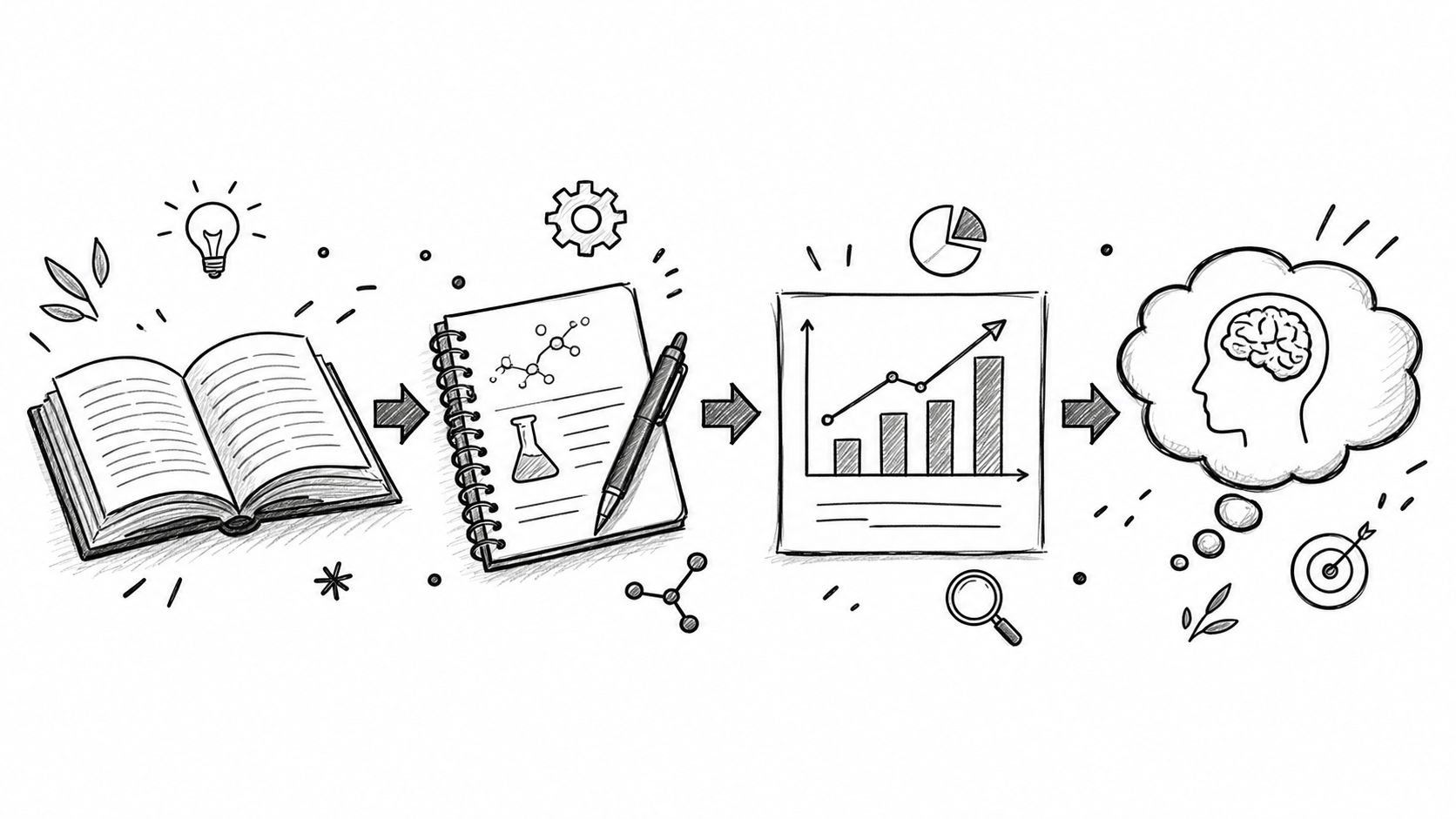
Choose IMRaD when your thesis reports one experiment or one clearly bounded empirical study. It's the standard structure for research articles in most scientific and health disciplines, and many biology, chemistry, medicine, and psychology theses use an IMRaD chapter for each study they report. The four parts answer four different questions. Introduction asks what's the problem. Methods asks what you did. Results asks what you found. Discussion asks what it means.
That separation is the whole point. Readers can audit your procedure before they meet your claims, and they can check your data before they accept your interpretation. It also makes publication conversion faster, since journal articles derived from theses usually keep this same structure.
Practical Moves Before You Draft
Write Methods before the Introduction. You'll record exactly what you did while the details are fresh, and you won't promise in the Introduction something your procedure can't deliver. Next, build a figure and table plan inside your outline. Give every planned finding a visual home before you write a single Results paragraph.
Use a source manager to tie each Introduction claim to a cited source, so literature support stays visible instead of scattered across notes. In the Discussion, limit each paragraph to one finding and its comparison with the literature. That single constraint prevents the most common IMRaD failure, a Discussion that drifts into a second literature review.
Practical rule: If a Discussion paragraph doesn't name a specific result from your Results section, cut it or move it.
Plan the sequence using this thesis strategy and roadmap, and don't let the Introduction expand into a full literature review. IMRaD works because it's lean. Protect that leanness.
3. Compilation (Article-Based or Manuscript-Style) Thesis Outline
Pick the compilation thesis if your goal is publication during the doctorate and your university permits it. Swedish universities widely use the sammanläggningsavhandling format, and Canadian institutions such as McGill and Concordia allow manuscript-based theses under specific rules on co-authorship and originality. The structure is simple to state and hard to execute. A general introduction frames the whole project, several article chapters form the center, and a general discussion and conclusion synthesize what the papers together prove.
This model matches one of two broad patterns universities recognize, chapters as papers, where publishable studies sit between a global introduction and conclusion. The alternative, chapters as sections, treats the thesis as one long paper. Don't drift between them. Decide which model you're in before you outline anything.
Non-Negotiable Checks
- Confirm the rules first: Check requirements on published versus submitted papers, co-authorship statements, and how much of each paper must be your own work.
- Assign each paper a target journal and submission date: Then schedule backward from your defense date.
- Use one citation style and cross-reference system: Examiners shouldn't have to relearn navigation at every chapter boundary.
- Write the General Discussion around the thesis question: A stack of paper summaries is the fastest route to a weak synthesis chapter.
The risk with this format isn't quality. It's coherence. Each article answers its own narrow question well, but the thesis must answer one larger question. Build the framing chapters to do that job explicitly, and state in the introduction how the papers connect before a reader has to guess.
4. Design Science Research (DSR) Thesis Outline
If you're building something to solve a problem, a five-chapter template will mislead you. Design Science Research theses in information systems, software engineering, and health informatics build and evaluate an artifact, such as a system, model, method, or framework. Peffers et al.'s Design Science Research Methodology gives you the chapter logic, moving through problem identification, objectives of a solution, design and development, demonstration, evaluation, and communication. Theses that build decision-support or data-management tools often follow Hevner et al.'s DSR guidelines for the same reason.

Where DSR Outlines Usually Break
The break point is evaluation. Students build first and invent success criteria afterward. Don't. Define your evaluation criteria in Chapter 1 or Chapter 3, before the artifact exists, so the design is tested against goals you stated in advance. This methodology chapter explanation for beginners covers how to justify those choices in writing.
Set a milestone for each DSRM stage so building and evaluation don't compete for the same final weeks. Track the artifact's version history alongside your chapter drafts, so Chapter 4 describes the version you evaluated, not an earlier prototype.
State your knowledge contribution as design principles or a tested framework, not just "I built software." Examiners award the degree for transferable knowledge.
Your outline should name the artifact, its intended users, the demonstration setting, and the evaluation method in one place. If any of those four items is vague, your methodology chapter will inherit that vagueness.
5. Systematic Review or Meta-Analysis Thesis Outline (PRISMA-Aligned)
A systematic review thesis doesn't collect new data from participants. It collects studies, and your outline must make that collection process auditable. The PRISMA 2020 reporting guideline standardizes how studies are identified, screened, included, and synthesized, which is why health and social science theses increasingly use PRISMA-compliant reviews as stand-alone chapters. The typical structure runs Introduction, Methods, Results, Discussion, and Conclusion, but the Methods chapter carries unusual weight here. It must cover your protocol, eligibility criteria, search strategy, selection process, data extraction, and risk of bias assessment.
Watch the walkthrough below before you start screening, since the reporting logic shapes decisions you'll make from day one.
Build the Audit Trail Into the Outline
Register or document your protocol before screening begins, and keep the date stamped in your records. In your source manager, log every database search string and export date, because the PRISMA flow diagram requires those numbers later and you can't reconstruct them reliably from memory.
- Treat screening, extraction, and quality appraisal as separate milestones: Each stage has its own output and its own way of going wrong.
- Draft the PRISMA flow diagram early: Update it as counts change instead of building it under deadline pressure.
- Separate study characteristics from synthesis in Results: Readers need to see what you included before you tell them what it means.
The outline discipline matters because reviewers judge this thesis type on reproducibility. If another researcher can't repeat your search from your Methods chapter, the structure has failed regardless of how well written the Discussion is.
6. Qualitative Case Study Thesis Outline
Use this outline when you're investigating a bounded case, such as an organization, program, community, or event, through interviews, documents, observation, or artifacts. Robert Yin's case study method is widely used in doctoral research in education and public administration. The chapters look familiar, running Introduction, Literature Review, Methodology, Findings, Discussion, and Conclusion, but the Findings chapter works differently from a quantitative Results chapter. It's organized by themes or cases, not by data source, and qualitative doctoral studies in nursing and education frequently structure Chapter 4 that way with cross-case comparison.
Outline quality matters most, because the internal work is hard. Research reports that 36% of surveyed M.Phil. and MS scholars struggle with the literature review and 40% find research methods challenging, in survey research on thesis writing difficulties. A heading list won't fix that. Your outline must specify what reasoning each section has to accomplish.
Controls That Keep a Case Study Defensible
Define the case boundary in one sentence in Chapter 1, then repeat it consistently in Chapter 3. Keep a codebook and decision log from the start and cite them in your methodology, since they support dependability when an examiner asks how themes were derived.
Organize Chapter 4 around your research questions or themes, not your interview guide. An interview guide is a collection tool, not an argument. Track data collection and transcription status in your chapter tracker so analysis doesn't lag months behind fieldwork, and include a trustworthiness section covering how you'll handle credibility and confirmability. If your findings later contradict your original expectations, document that shift in the outline rather than rewriting your questions. Examiners respect a documented change. They penalize a hidden one.
7. Monograph-Style Humanities Dissertation Outline
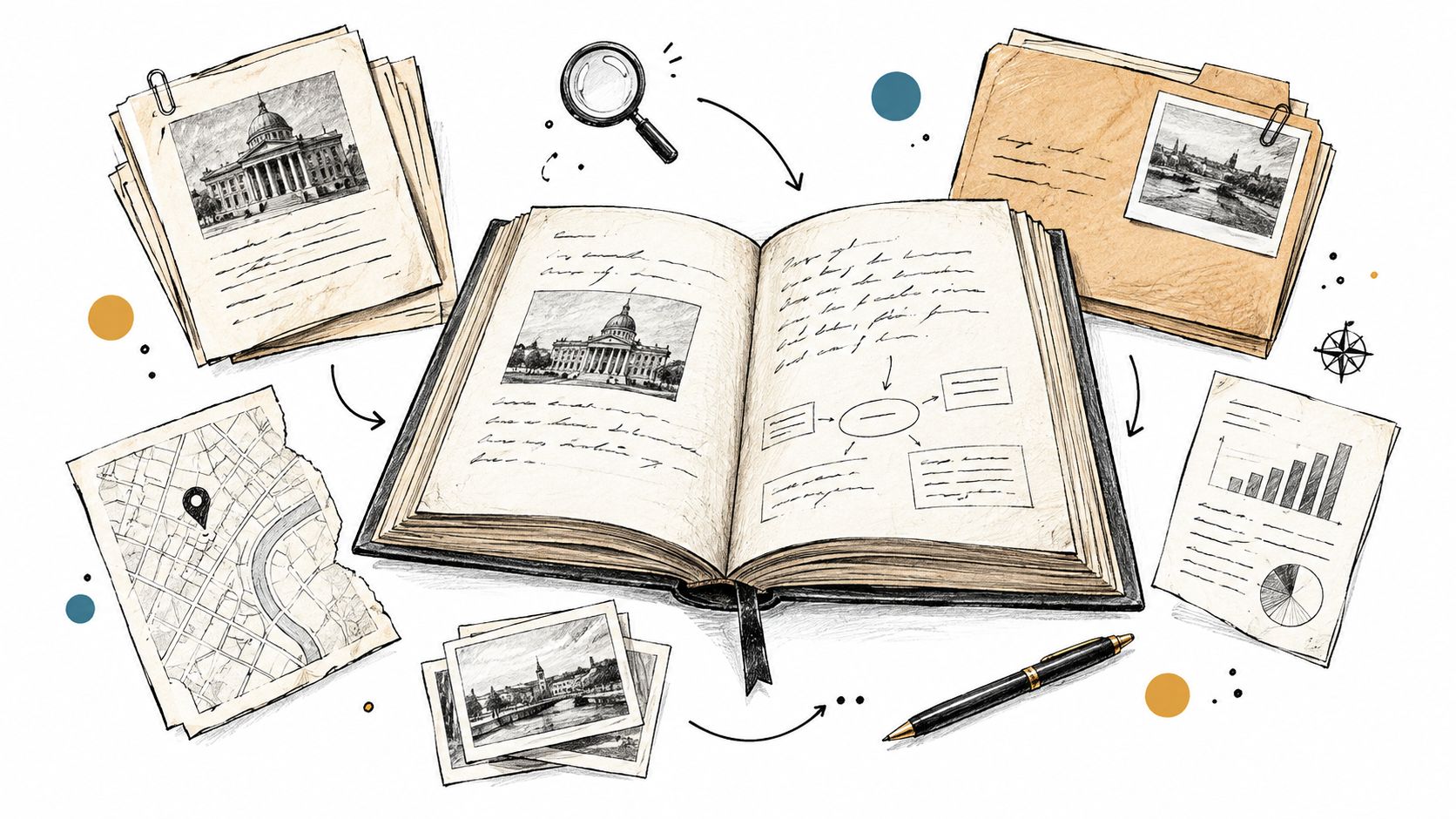
In history, literature, philosophy, and cultural studies, the five-chapter empirical template doesn't fit. A monograph-style dissertation builds one central thesis through a series of distinct arguments, each anchored in primary sources. Many US and UK history dissertations use thematic or chronological chapters built on archival evidence. Literature PhDs often present chapters as close readings, each contributing to a single claim. There's no separate literature review chapter, because the introduction establishes the historiographical or theoretical debate you're intervening in, and each chapter keeps engaging it.
How to Outline an Argument, Not a Procedure
Write a one-paragraph argument statement for each chapter, then test it. Does this chapter advance the overall thesis, or is it just interesting material you've collected? If it doesn't advance the thesis, cut it or fold it into another chapter. That test is your main defense against scope creep in a format with no methods chapter to constrain you.
Map each chapter to its archives and primary source sets in your source manager, so research trips and writing stay aligned. Discuss chapter order with your supervisor early, because sequence shapes argument here in a way it doesn't in an empirical thesis. Putting your strongest case first versus building chronologically produces two different dissertations.
Scheduling reality: Your introduction and conclusion will be rewritten last, after you know what the chapters actually argue. Put a specific revision milestone for both in your plan now.
7 Thesis Chapter Outline Examples Compared
| Thesis outline | 🔄 Structure and complexity | ⚡ Resource requirements | 📊 Expected outcome | ⭐ Ideal use case and key advantage |
|---|---|---|---|---|
| Standard Five-Chapter | Introduction, literature review, methods, findings, discussion; clear, familiar sequence | Moderate; varies by study design | A conventional thesis with findings separated from interpretation | Broad range of disciplines and methods; familiar to many examiners |
| IMRaD | Introduction, methods, results, discussion; concise, predictable structure | Moderate; detailed methods and evidence needed | A clearly reported empirical study, readily adapted for publication | Experimental or empirical research; supports quick reader comprehension |
| Compilation (Article-Based) | General introduction, article chapters, general discussion; coordination across papers required | High; writing, co-author coordination, and journal requirements | Several publication-ready papers unified as a thesis | Research projects producing multiple papers; supports publication progress |
| Design Science Research (DSR) | Problem, objectives, artifact design, demonstration, evaluation, communication; build-and-test cycle | High; requires artifact development and rigorous evaluation | An evaluated artifact plus a stated research contribution | Information systems, software engineering, or informatics projects that develop solutions |
| Systematic Review or Meta-Analysis (PRISMA-Aligned) | Review question, protocol and methods, results, discussion; checklist-driven | High; extensive searching, screening, extraction, and appraisal | A transparent, reproducible evidence synthesis | Research synthesizing existing studies; emphasizes traceable review methods |
| Qualitative Case Study | Case context, methods, thematic or cross-case findings, discussion; flexible structure | High; data collection, transcription, and analysis can be time-intensive | Context-rich findings and analytic insights | Bounded organizations, programs, communities, or events; captures complexity |
| Monograph-Style Humanities | Introduction and connected argument-led chapters; flexible, less standardized structure | Variable; often depends on archives, primary sources, and chapter scope | A sustained interpretation or central scholarly argument | History, literature, philosophy, and related fields; supports nuanced, source-based analysis |
Build an Outline That Guides the Whole Project
Choose the structure that matches your discipline and evidence, not the one that looks most familiar. As CASRAI guidance on thesis structure and example outlines notes, the standard sequence is a general or illustrative outline rather than a mandatory structure, and chapters may vary. That's your permission and your responsibility. You can't blame the template if it doesn't fit your study.
Give every chapter one primary purpose, a target length, and a clear dependency. A useful outline attaches a short purpose statement to each section, identifies the evidence it requires, and defines a completion test, such as "all research questions have corresponding findings" or "each methodological choice is justified." Then check the boundaries. Does your outline distinguish background from original analysis, methods from results, and findings from discussion? If two chapters could swap paragraphs without anyone noticing, their purposes overlap and one of them needs redefining.
Make the outline a control document, not a preliminary list. University formatting rules reflect this, including requirements that table-of-contents entries match the text exactly, as described in University of Salford dissertation formatting guidance. Record your sequence in a chapter tracker, assign milestones backward from your submission deadline, and give evidence-heavy sections more time than framing sections. Alignment is the technical core of the whole exercise, since your title, problem, purpose, method, and research questions must point at the same study, a principle set out in this dissertation planning and writing guide.
Expect the outline to change. A more detailed outline isn't automatically better, and excessive predetermined headings can force your study into logic that doesn't suit your evidence. Build in decision points where the structure may shift after data collection, and document those changes for your supervisor. If you want support managing that process, Thesis Book Project offers a chapter tracker, backward milestone planning, and a source manager designed around the thesis lifecycle.
Revise the plan whenever your evidence or scope changes. A strong outline isn't a promise to write everything you imagined at the start. It's a decision system that keeps your thesis coherent, manageable, and submission-ready.
Turn the outline you choose into a tracked, scheduled plan instead of a document you'll lose in a folder. Thesis Book Project gives you a chapter tracker that follows each chapter from outline to final draft, milestone reminders planned backward from your submission date, and a source manager that keeps your literature aligned with your chapters. Start with the free tier, enter your deadline and chapter structure today, and give your next supervisor meeting a concrete progress view to work from.
Related Articles
Footnotes Examples MLA: Formatting Rules and Templates
You're halfway through a literature chapter, the sentence is already crowded, and your cursor is...
Thesis WritingHow to Prepare for a Dissertation Defense: Full Roadmap
You've polished the slides, practiced the opening, and can explain your main finding. Then you c...
Thesis Writing10 Best Progress Tracker Online Tools for Theses
A thesis can look well underway and still be difficult to manage. You've finished the research,...
Comments (0)
No comments yet. Be the first to share your thoughts.