What Is Progress Monitoring in a Thesis Project
What is progress monitoring? Learn how it works, which indicators to track and how to use it to keep your thesis on schedule.
Progress monitoring is a repeated, structured measurement of whether work is moving toward a goal, used to decide whether to continue or change course.
If you've spent the week reading and writing, but still can't explain what's ready for your supervisor, have you made progress or stayed busy? That's the gap a useful monitoring system helps you examine.
For a thesis, you need more than reassurance that you're working hard. You need evidence of what's finished, what's ready for the next stage, and what support would help you move forward.
Table of Contents
- Progress Monitoring Explained in Plain Terms
- Why Early Signals Beat End-of-Project Surprises
- Three Dimensions That Separate Activity From Progress
- Thesis Indicators to Track and the Warning Signs
- Run One Monitoring Cycle and Set Up Your First Review
- Common Monitoring Mistakes and How to Fix Them
- Monitoring Without Turning Into Surveillance
Progress Monitoring Explained in Plain Terms
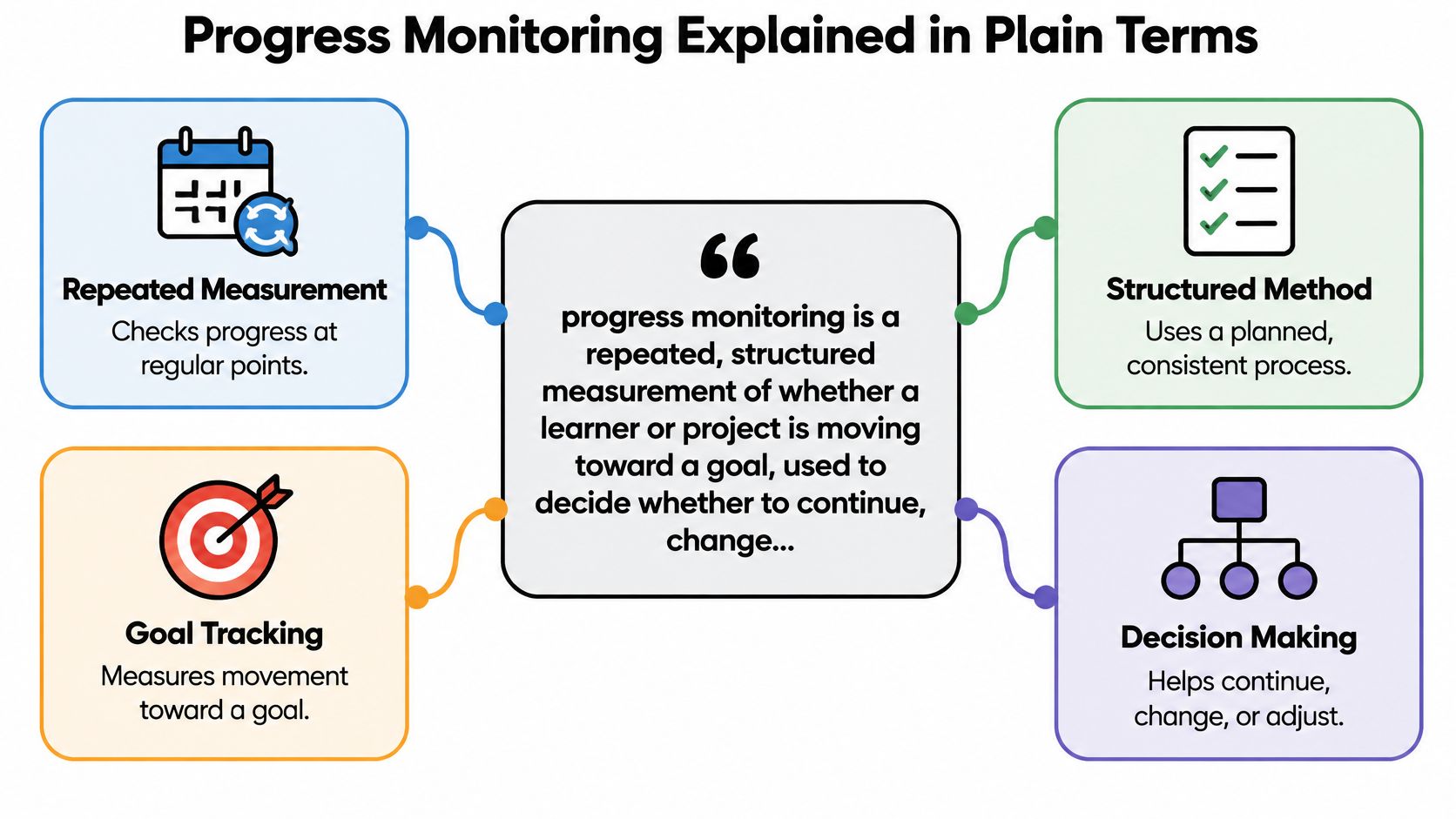
Progress monitoring is a repeated, structured measurement of whether a learner or project is moving toward a goal, used to decide whether to continue, change course or add support.
Think of checking a car's fuel gauge throughout a journey rather than discovering an empty tank before reaching your destination. Or consider regular blood pressure readings rather than relying on an isolated check-up. The useful part isn't collecting readings. It's deciding what to do with them.
In education, teachers use repeated checks to establish whether students are learning and whether teaching needs to change. The Institute of Education Sciences' description of data-based individualization connects monitoring with gathering additional information and adapting or intensifying support when needed.
The diagram shows how measurement connects to a decision.
Make the measure observable
Suppose you're preparing a literature review. Instead of recording that you've been reading, record whether relevant sources have been entered into a literature matrix, a table connecting each source to your research question.
You'll need some shared language:
- Benchmark: The target you're comparing work against, such as a completed synthesis of the relevant literature.
- Trend: The direction of progress across several checks, rather than the result of an isolated review.
- Decision rule: The action an agreed warning sign triggers, such as asking your supervisor to resolve an unclear boundary.
Use the same definitions at each check. Otherwise, completed might mean notes collected today and supervisor-approved tomorrow.
For collaborative laboratory work, Verbal Experiment's resource on how to track research lab progress offers a related context for making research work visible.
Monitoring isn't a grade, a decorative progress bar or a diary of hours worked. It connects evidence to a response. For this month, choose something you can show another person, such as a reviewed section or a completed source matrix, rather than something you can only describe as effort.
Why Early Signals Beat End-of-Project Surprises
The Classroom Learning Screening system, developed by Kunzelmann and Koenig in 1981, called for 10 days of brief, curriculum-aligned probes in reading, mathematics and spelling to identify persistent difficulty early; the Institute of Education Sciences account also describes the later development of early-warning monitoring systems. In that account, a 2017 evaluation covering 24,949 students during the 2014–15 school year found no statistically significant first-year difference in sufficient credits between intervention and comparison groups.
Those findings illustrate different sides of the method. Repeated observations can help distinguish a temporary fluctuation from continuing difficulty. But making difficulty visible doesn't guarantee that the response will work.
For a thesis student, the practical advantage is time to respond. Discovering that your proposed method can't answer your question while you're still designing the study leaves options open. Discovering it after collecting the data may require substantial rework.
Look for a pattern, then name a response
Say your literature matrix grows steadily, but the entries connected to your central question remain incomplete. An isolated update might reflect a difficult source. Repeated updates with the same gap suggest that you need to reconsider your search terms, inclusion criteria or question.
A resource on analyzing trends with PlotStudio AI can help you think about patterns across observations. For thesis planning, however, a clear record of comparable evidence matters more than a complex chart.
Keep the broader sequence visible too. A thesis roadmap helps you identify which unfinished task prevents the next stage from starting.
Practical rule: Before collecting a measure, ask what you'd change if it showed that the work was off track.
A useful review might end with a narrower search strategy, a methods consultation or an agreed feedback date. It might also confirm that the current approach should continue.
Monitoring cannot resolve an argument, secure laboratory access or provide missing supervision by itself. A person has to take the next action. If nobody can name that action or accept responsibility for it, you have a reporting routine rather than a working support system.
Three Dimensions That Separate Activity From Progress
Three dimensions of progress and what each one shows
| Dimension | What It Measures | Thesis Example | Why It Misleads Alone |
|---|---|---|---|
| Activity | Time, edits, pages written, sources collected | Reading articles and adding notes to a reference manager | Output can rise while the argument stays unchanged |
| Deliverable completion | Whether a defined output exists and is finished | Chapter 3 draft submitted with all tables and citations | A complete draft can still fail to address the research question |
| Readiness and quality | Whether the work meets the standard the next stage needs | Supervisor agrees the methods can answer the research question | Needs a reviewer, so it is slower to confirm |
A single count rarely answers the question you care about. Pages written can indicate productive drafting, repeated rewriting or material that won't survive revision.
Activity matters because it helps explain how you're working. Deliverable completion establishes whether an agreed output exists. Readiness asks whether you can safely build the next stage on that output.
A draft can grow without becoming ready
Suppose you expand your literature review substantially, but the research question changes at every supervision meeting. You've produced more text, yet you still can't decide which literature belongs in the chapter.
The response isn't necessarily to write faster. You may need to agree the question's boundaries before adding more material.
Activity tells you the work is happening; evidence tells you whether it is working.
Use evidence appropriate to the claim. A document demonstrates that a draft exists; dated feedback demonstrates that someone reviewed it. Neither automatically proves that the argument is ready for examination.
The University of Reading's guidance on monitoring research-student progress frames monitoring as a means of ensuring appropriate supervision, training and support, and includes attention to supervisory arrangements. That matters when interpreting these dimensions: a draft awaiting feedback shouldn't be treated as evidence that the student has stopped working.
Record the dependency as well as the status
Write draft submitted, awaiting methods feedback rather than unfinished. The former identifies both the completed contribution and the dependency, meaning the task or decision that must happen before work can proceed.
Likewise, a source matrix may be complete as a document but not ready for synthesis because important studies haven't been evaluated. Keep those judgments separate instead of averaging them into a reassuring percentage.
For every entry, ask what dimension does this measure, and what evidence would a supervisor accept? If an entry demonstrates effort but not completion or readiness, keep it in the activity record. Don't use it to claim that a milestone has been achieved.
Thesis Indicators to Track and the Warning Signs
Choose a manageable set of indicators that covers both major milestones and the conditions affecting everyday work. The following is a suggested starting template, not a university policy or a set of validated thesis thresholds. Agree the warning signs and review intervals with your supervisor.
Thesis progress indicators, evidence and warning signs
| Indicator | Evidence of Completion | Check Frequency | Warning Sign |
|---|---|---|---|
| Proposal approved | Signed-off proposal with a stated research question | At approval, then at milestone reviews | No approval by the planned date |
| Literature matrix | Sources coded against each research question | Weekly | Source count rises while the matrix stays unchanged |
| Methods drafted and approved | Methods chapter with sampling and required ethics approval documented | At scheduled methods reviews | Ethics approval pending past its planned date |
| Chapter drafts reviewed | Supervisor-reviewed draft with dated comments | Every supervision meeting | The same unresolved comments return |
| Open supervisor decisions | Decisions logged with an owner and an agreed date | Weekly | Unresolved decisions prevent scheduled work |
| Distance from schedule | Completed milestones compared with the backward-planned schedule | Weekly | Missed milestones affect dependent tasks |
| Submission-ready manuscript | Format and citation check passed | Monthly, then weekly near submission | Citations remain incomplete as submission approaches |
The warning sign should lead to a specific response. An unchanged literature matrix might trigger a supervised coding exercise, where you agree how to classify sources. Delayed ethics approval might require a revised sequence of work, not pressure to begin collecting data prematurely.
Why pair frequent checks with guidance?
A 2025 meta-analysis published through the Leibniz Institute for Science and Mathematics Education covered 87 effect sizes from 25 studies involving 7,379 students and found a small positive effect on reading, writing and mathematics outcomes, g = 0.30, with stronger effects when teachers received ongoing consultation and data-specific instructional guidance. The evidence also indicated that monitoring should happen at least weekly to be effective.
An effect size expresses the magnitude of a difference in a standardized form. These findings concern school learning, not thesis completion, so treat weekly thesis reviews as a practical adaptation rather than a proven doctoral success formula.
A research timeline gives your indicators a schedule to compare against. Without planned dates and dependencies, a completed task tells you little about whether submission remains feasible.
Context also matters when converting measurements into judgments. A tool designed to turn practice results into SAT estimates, from Makon AI, addresses a different measurement task from assessing thesis readiness. Don't assume every dashboard needs a predicted score; research work often needs a documented review decision instead.
Run One Monitoring Cycle and Set Up Your First Review
Start with a simple record containing the milestone, planned date, current evidence, blocker and next action. You can use a spreadsheet or an online progress tracker, provided you can find the evidence behind each status.
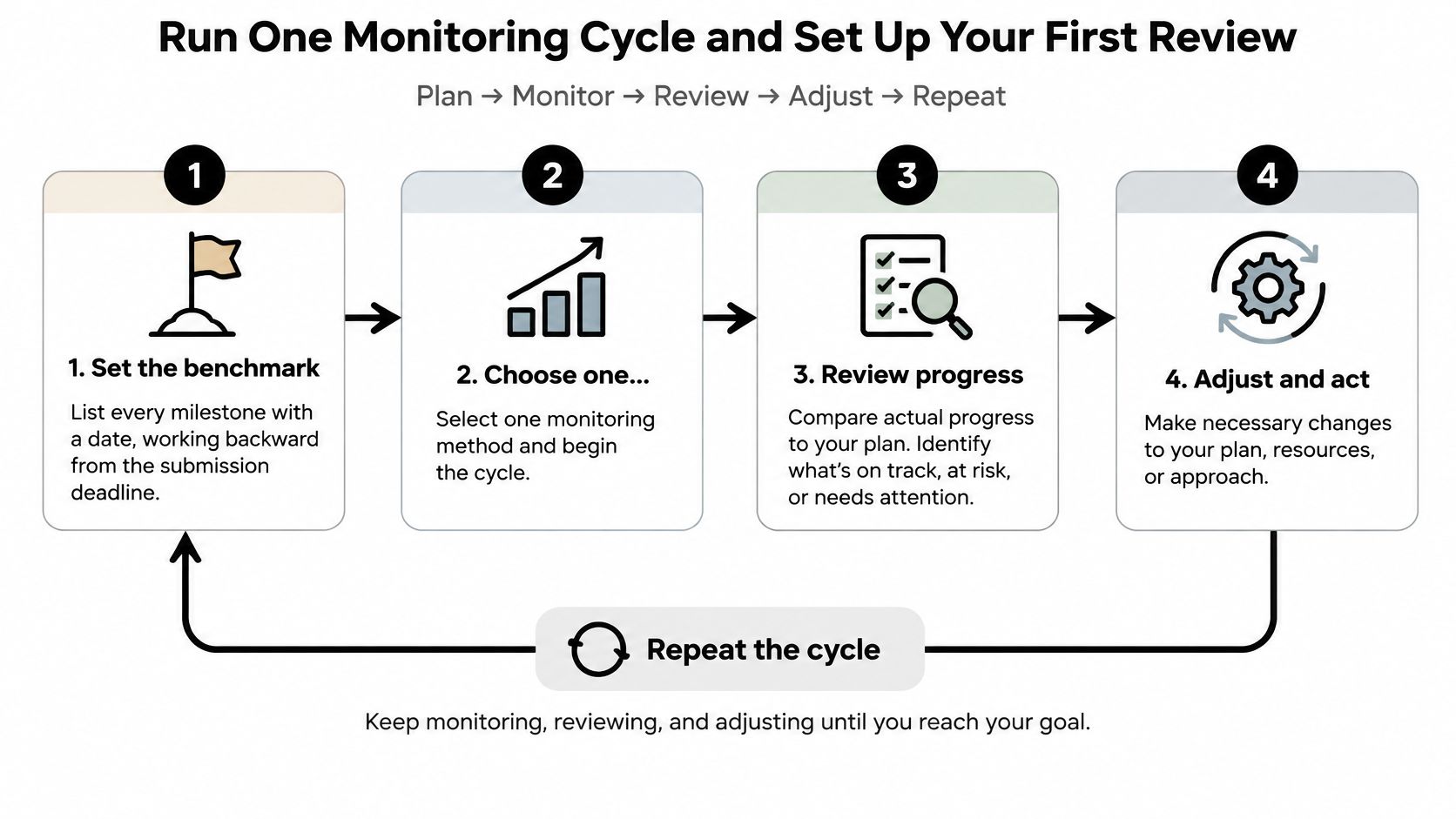
The diagram summarizes the review-and-adjust loop.
Put the cycle into practice
Set the benchmark. Work backward from submission, dating the major milestones and allowing space for feedback, revision and administrative requirements. A deadline without review time is an incomplete plan.
Choose an observable indicator for each milestone. Use approved, reviewed or completed only when you've defined what those words require. Attach the relevant document, feedback or approval record.
Collect evidence at a fixed interval. Schedule a brief weekly review and update the same fields each time. Consistency makes comparisons easier and reduces the temptation to report only when things are going well.
Compare actual progress with the plan. Examine the sequence of updates, not just the latest status. Check whether unfinished work blocks later tasks before assuming you can absorb a delay.
Apply an agreed decision rule. Decide beforehand when you'll request help, reduce scope or revise the schedule. Don't wait until a missed deadline to negotiate what counts as a problem.
Act and record responsibility. Write the next action, its owner and its due date. If you need feedback, name who will provide it and what decision it must enable.
Repeat the cycle. At the next review, check whether the agreed action happened and whether it helped. Change the response if the obstacle remains.
The District of Columbia Office of the State Superintendent of Education's monitoring guidance describes progress monitoring as formative assessment, meaning assessment used during learning to decide whether support should change. For thesis work, the equivalent is using the review to improve the next stage rather than merely judge the last one.
This accompanying video provides another resource for considering the monitoring process.
Turn a delayed chapter into a decision
Suppose your methods chapter misses its agreed review date because you haven't resolved the sampling approach. Your decision rule calls for a supervision meeting when a methodological uncertainty prevents drafting.
Record the actual obstacle, not just a red status. The meeting should end with an agreed sampling approach, a referral for specialist advice or a narrower study, followed by a revised chapter date.
In Thesis Book Project, users begin by setting their deadline and breaking the thesis into chapters and milestones in minutes. Our milestones work backward from submission, with reminders before checkpoints slip, while progress tracking shows how much remains and whether you're on track.
Before your next supervision meeting, date your milestones, write the response rule and book the first review. Share the evidence beforehand so you can spend the meeting resolving decisions rather than reconstructing what happened.
Common Monitoring Mistakes and How to Fix Them
A detailed tracker can still produce poor decisions. The problem is often not missing information, but asking an indicator to prove something it cannot establish.
When the record looks better than the work
Counting hours or pages as completion. Keep effort visible, but attach milestone completion to an accepted output. If a chapter needs conceptual revision, more pages don't settle that problem.
Using feelings as status labels. Nearly finished doesn't tell your supervisor what remains. Replace it with a concrete statement such as draft submitted, references checked, argument awaiting review.
Optimizing the visible metric. If you start collecting easy sources to improve the source count, stop treating that count as evidence of advancement. Assess whether the sources address the question and contribute to the synthesis.
A useful test: Could someone inspect the evidence and understand why you assigned this status?
When the review changes nothing
- Overreacting to a slow update: Check the surrounding pattern and the consequences for dependent work before changing direction. A genuine missed approval needs attention even when other tasks are progressing.
- Inventing the rule after the problem: Agree the response while the plan is still workable. Otherwise, every delay becomes another negotiation about whether action is necessary.
- Leaving too long between checks: Use brief, regular updates rather than reconstructing progress from memory. Save formal meetings for interpretation and decisions.
- Assigning an action without an owner: Replace get feedback with a named request and an agreed response date. A task nobody owns is not a dependable next step.
Don't assume that every review must produce a new intervention. Continuing the current approach can be a sound decision when the evidence supports it.
But inspect your recent entries: can you identify what they helped you decide? If they contain only retrospective descriptions, simplify the record and strengthen the link between each warning sign and its response.
Monitoring Without Turning Into Surveillance
A fair monitoring conversation asks what does this student need to move forward? It doesn't begin by assuming that a delay reflects poor commitment.
Paid work, caregiving, disability, part-time study, language barriers and limited laboratory access can affect what a student can produce. So can unavailable supervision. Treating every delay as a personal failure prevents an honest discussion about what must change.
Make the record useful to both people
- Record context beside the work. Note an access problem or an agreed adjustment alongside the milestone it affects. Share only the personal information needed to arrange support.
- Accept appropriate alternative evidence. Field notes, offline analysis or a revised deliverable agreed in advance may demonstrate advancement that a chapter count misses.
- Make supervisory commitments visible. Record meeting arrangements, promised feedback and decisions awaiting a supervisor's response. Accountability should not run in only one direction.
Students should also be able to explain whether the supervisory arrangements are helping them progress. Where a formal assessment involves independent assessors, distinguish their assessment role from the everyday support conversation.
Ask who can view the record, why they need access and how the information will be used. A shared milestone view may be appropriate for supervision; a detailed account of personal circumstances may not be.
The dashboard should be a conversation tool, not a ranking mechanism. A useful meeting leaves both student and supervisor clear about the barrier, the support required and the next achievable commitment. That clarity matters more than making every status look green.
Thesis Book Project offers a guided roadmap, chapter tracking, backward-planned milestones and progress visibility to help you connect daily work with submission. Visit Thesis Book Project to organize your next milestone, define the evidence of completion and prepare a focused progress conversation with your supervisor.
Related Articles
8 Literature Review Best Practices for Thesis Writers
You've collected forty PDFs, your literature review chapter is due in six weeks, and you still c...
Research MethodsTimeline for Research: A Step-by-Step Backward Plan
A peer-reviewed study found that doctoral projects planned for three to five years took an average o...
Research Methods8 Types of Conflicts in Academic Research and Thesis Work
A supervisor meeting can stall for weeks when you and your supervisor are arguing about different pr...
Comments (0)
No comments yet. Be the first to share your thoughts.