Literature Review vs Research Paper: Key Differences
Literature review vs research paper explained with clear differences in purpose, structure, audience, and evaluation criteria to help you choose the right
You're halfway through a thesis when your supervisor writes, “Add a stronger literature review.” You already have pages of cited sources, so you're unsure what the request means. Should you create a separate paper, expand an existing section, or begin collecting evidence for a study you haven't designed yet?
That confusion is common because literature review and research paper can appear together in the same assignment, article, thesis, or dissertation. The difference isn't mainly about length, citation count, or how formal the document looks. It's about what the writing is meant to do for its reader.
The clearest way to separate them is to examine four things: purpose, structure, audience, and evaluation. Once you know which function your task requires, the correct format becomes much easier to choose.
Table of Contents
- Why Students Mix Up Literature Reviews and Research Papers
- What Each Genre Actually Does
- Four Criteria That Separate the Two
- How Structure Signals Genre
- When Each Format Is the Right Output
- The Real Distinction Is Rhetorical Function
- Choosing the Right Format for Your Thesis
Why Students Mix Up Literature Reviews and Research Papers
Students often use the terms interchangeably because both genres rely on academic sources and both may discuss the same topic. A literature review can be substantial, carefully argued, and full of citations. A research paper can also devote many pages to earlier scholarship before presenting its own argument. From the outside, the documents may look remarkably similar.
The problem usually begins with an instruction such as “write a literature review.” That phrase might refer to a standalone coursework assignment, a thesis chapter, or a section inside an empirical article. Meanwhile, “research paper” may describe the entire document, including the literature review that helps establish its foundation.
The question behind the label
Instead of asking only, “What is this document called?” ask:
What must this document produce for the reader?
If the expected result is an organized account of what scholars already know, where they disagree, and what remains unresolved, you're writing a literature review. If the expected result is a new argument, analysis, method, or finding, you're writing a research paper. The literature review may support that paper, but it isn't automatically the paper itself.
Four practical tests make the distinction clearer:
- Purpose: Are you synthesizing existing scholarship or advancing a new contribution?
- Structure: Does the document revolve around themes and debates, or around a study's methods and results?
- Audience: Does the reader need a map of the field or an answer to a research question?
- Evaluation: Will your work be judged mainly on synthesis and gap identification, or on evidence, methodology, and originality?
The rest of the decision follows from these tests. A standalone review can be a legitimate scholarly output. A thesis can contain a literature review chapter and a research paper in the same overall project. A research article can include a literature review without becoming a literature review as a genre.
What Each Genre Actually Does
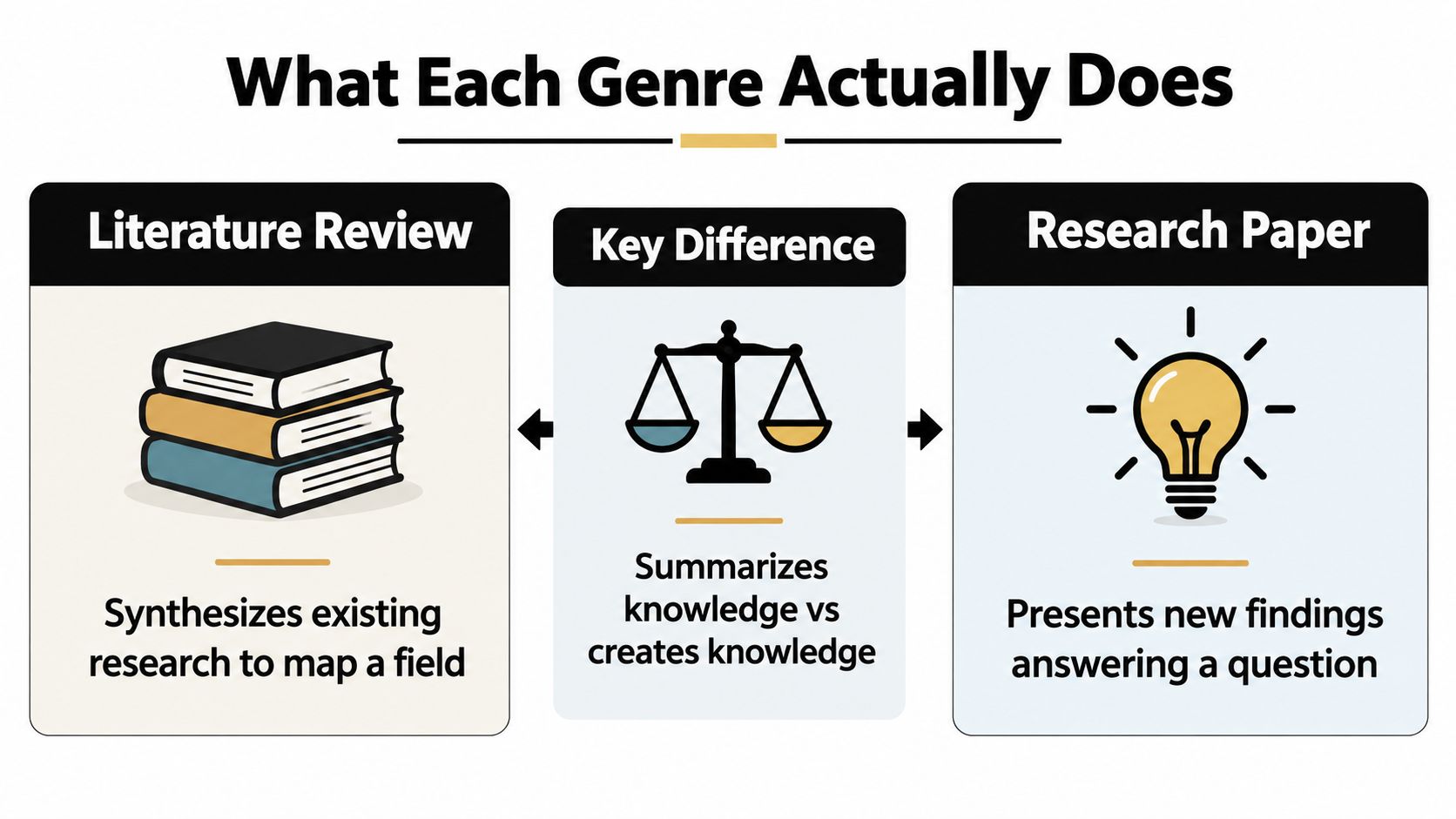
A literature review synthesizes existing scholarship. It collects relevant sources, compares their arguments, evaluates their strengths and limitations, and organizes them into a meaningful account of a field. It normally works with secondary material rather than reporting new data. Its contribution is an evidence map, not an original empirical result.
Purdue OWL describes a literature review as work that “collects key sources and discusses them in conversation with each other.” That wording matters. A review does not merely tell the reader what each author said. It shows how the sources relate, where they agree, where they conflict, and what their combined record reveals.
A research paper, by contrast, develops a new argument or contribution. It may use primary research, original analysis, a new interpretation, or a theoretical claim. Existing literature remains important, but it serves the paper's central argument rather than being the final product. Purdue OWL distinguishes this function by explaining that an academic research paper develops a new argument and uses the literature as support. You can also consult this overview of types of academic research explained if you need to distinguish empirical, theoretical, and other research approaches.
The simplest distinction
A useful one-sentence test is:
A literature review explains and evaluates what is already known. A research paper uses evidence to make a new claim.
Consider a topic such as remote work and employee wellbeing. A literature review might group prior studies by measurement approach, population, or theoretical explanation. It could show that researchers have reached different conclusions and identify an unresolved question.
A research paper might investigate that unresolved question using interviews, survey data, archival records, or a new theoretical analysis. Its literature review would establish the context, but the paper's main achievement would be the argument or findings it adds.
The two genres therefore overlap in subject matter and source use. They differ in scholarly function. One maps the conversation. The other enters that conversation with a claim of its own.
Four Criteria That Separate the Two
The literature review vs research paper distinction becomes practical when you compare how each genre handles the same four criteria. These criteria help you diagnose an assignment even when the instructions use an unclear label.
Purpose
A literature review answers questions such as: What has been studied? Which explanations dominate? Where do findings conflict? Which gaps deserve attention? Its purpose is synthesis and evaluation.
A research paper answers a more forward-facing question: What does this study argue, test, demonstrate, or contribute? It uses prior scholarship to establish the problem and support the paper's own position.
Structure
A full literature review commonly follows an introduction, body, and discussion or conclusion. The body may be organized by theme, method, chronology, or theoretical debate, but the organizing principle is the relationship among sources.
An empirical research paper often follows an Introduction, Methods, Results, Discussion pattern. That structure makes room for procedures, analysis, findings, and interpretation. A theoretical or humanities paper may use another structure, but it still revolves around a central original argument rather than a complete map of prior work.
Primary audience
A literature review serves readers who need to understand the state of knowledge. That might include a student entering a field, a supervisor assessing whether the source base is adequate, or a researcher identifying an unresolved problem.
A research paper serves readers who want to understand and assess a specific contribution. They'll ask whether the question matters, whether the evidence supports the claim, and whether the interpretation advances knowledge.
Evaluation criteria
Reviewers assess a literature review by looking for coverage, organization, critical judgment, synthesis, and gap identification. A source-by-source list may be accurate, but it doesn't demonstrate enough analysis.
Reviewers assess a research paper by examining the quality of the argument, methodology, evidence, analysis, and significance of the contribution. A paper can cite excellent sources and still fail if its own claim is unclear or unsupported.
| Criterion | Literature Review | Research Paper |
|---|---|---|
| Central purpose | Maps and synthesizes existing scholarship | Advances a new argument or contribution |
| Main evidence | Published sources and their relationships | Literature plus primary evidence, analysis, or original interpretation |
| Typical organization | Themes, methods, debates, or chronology | Research question, method, results, argument, and implications |
| Main reader expectation | A defensible account of what is known and missing | A supported answer or claim that moves beyond summarization |
| Main evaluation | Synthesis, critical comparison, and gap mapping | Methodology, evidence, originality, and significance |
The table is a decision aid, not a rigid template. Some fields combine sections, and some research papers are theoretical rather than empirical. The underlying question remains stable: is the document primarily organizing existing knowledge, or producing a new scholarly contribution?
How Structure Signals Genre
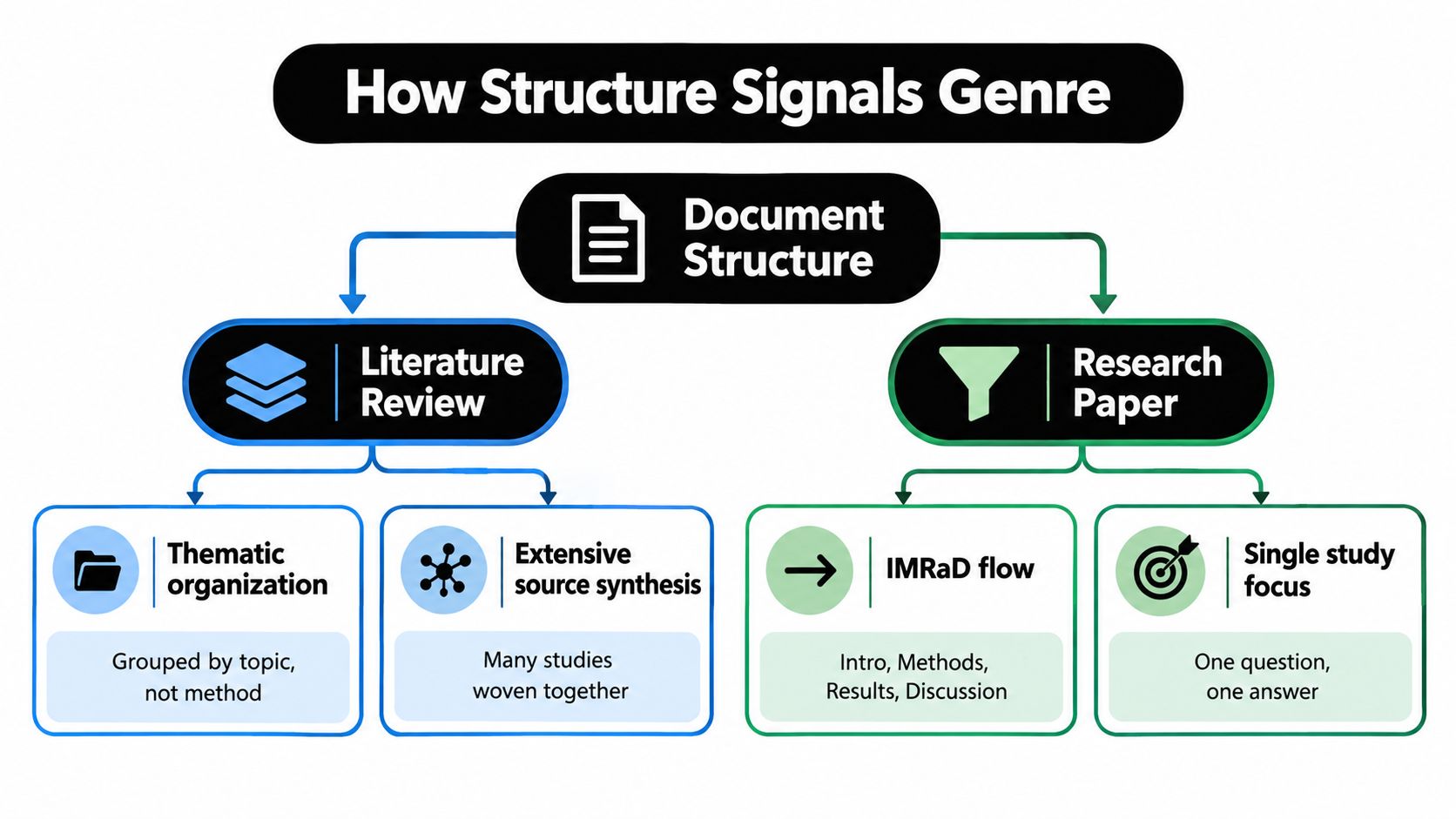
Structure gives readers an early signal about the kind of work they're about to encounter. A literature review usually leads the reader through a field. A research paper leads the reader through a study or argument.
A full-length literature review commonly has three broad parts:
- Introduction: Defines the topic, scope, search boundaries, and organizing approach.
- Body: Synthesizes sources around themes, methods, theories, or debates.
- Discussion or conclusion: Summarizes the state of knowledge, identifies limitations, and clarifies gaps.
The body is where many students go wrong. They create one paragraph for each source, moving from author to author. That produces an annotated list, not a strong synthesis. A thematic paragraph might instead compare several studies that address the same concept, then explain why their methods or conclusions lead to different interpretations. For practical guidance on arranging themes and source groups, see this guide to literature review organization.
The research paper's different signal
An empirical research paper commonly uses the Introduction, Methods, Results, Discussion sequence. The introduction frames the question and contribution. Methods explains how the study was conducted. Results reports the analysis, and discussion interprets what those results mean.
That sequence tells the reader to expect a reproducible study design and observed outcomes. A literature review doesn't have a methods section in that empirical sense, though it should still explain how sources were selected and evaluated when the assignment or publication requires a systematic approach.
Practical rule: If the document's central evidence comes from procedures you carried out and results you analyzed, you're likely writing a research paper. If its central evidence comes from comparing existing studies, you're likely writing a literature review.
The format also affects paragraph-level decisions. In a review, each paragraph should help explain a relationship among sources. In a research paper, each paragraph should help develop the paper's own question, method, finding, or interpretation.
When Each Format Is the Right Output
A standalone literature review is appropriate when the assignment asks you to synthesize a defined body of scholarship. It can also be a valid final scholarly output when the purpose is to benchmark knowledge, compare theoretical positions, or identify gaps. The document doesn't become a research paper merely because it's long or because it contains a strong conclusion.

A literature review chapter inside a thesis or dissertation serves a different workflow. It establishes the conceptual and evidentiary context for the study that follows. University guidance commonly places the review before methods, results, and discussion because it frames the research question and helps justify the study design, as explained by the University of North Carolina Writing Center.
Three boundary cases
A standalone review assignment asks you to produce a structured account of existing work. Your conclusion should clarify what the literature supports, where it remains divided, and which gaps are meaningful. You aren't expected to collect new data unless the instructions explicitly add that requirement.
An embedded review chapter appears inside a larger thesis project. It may be a complete chapter, but it functions as support for the dissertation's original research. Its final pages should lead toward the research problem, framework, or method that the later chapters will address.
A review section inside a research article is often shorter and more selective. It provides enough context to establish the question and position the paper's contribution. The review supports the article, but the article's main output remains its new argument, analysis, or findings.
A simple decision sequence can prevent category errors:
- If the brief asks what the field knows, write a literature review.
- If it asks you to answer a question with your own analysis, write a research paper.
- If it asks you to design a study, prepare a review that justifies the study, then develop the research paper around the design and evidence.
- If the institution provides a required structure, follow that structure even when local terminology differs.
The label matters less than the assignment's intended output. Read the assessment criteria carefully, because they usually reveal whether your reader wants synthesis, contribution, or both.
The Real Distinction Is Rhetorical Function
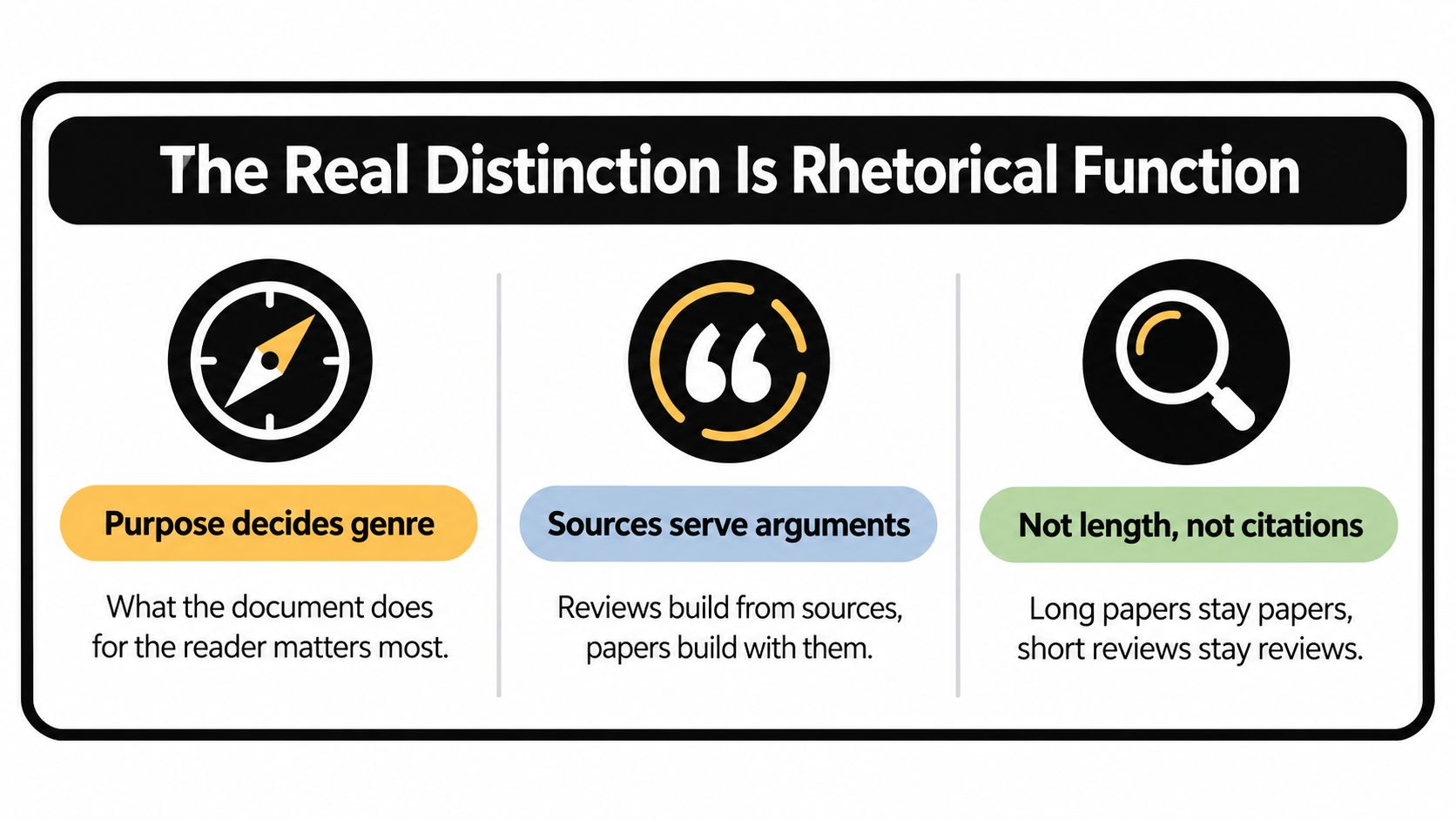
The most useful distinction isn't document length. A long literature review remains a literature review if its primary function is to synthesize existing scholarship. A short research paper remains a research paper if it makes and supports a new claim.
Citation density doesn't decide the genre either. A paper may cite many sources because its argument depends on a detailed scholarly context. A review may cite fewer sources if its scope is narrow. Sources are present in both formats, but they play different rhetorical roles.
In a literature review, sources are the material being organized and evaluated. In a research paper, sources help establish the problem, position the argument, justify the method, and interpret the results. The same article can therefore appear in both genres while serving a different purpose in each.
Why AI raises the standard
Generative AI can accelerate summary, thematic clustering, and draft organization. That makes it easier to produce text that resembles a literature review, but resemblance isn't the same as synthesis. A list of automated summaries may contain accurate-looking sentences without showing how studies relate or why a gap matters.
Recent discussion has therefore shifted the value of review writing from information collection toward defensible synthesis and gap mapping. That shift increases the importance of provenance, citation accuracy, and visible human judgment, as discussed in recent analysis of the future of literature reviews.
Before using any tool, verify every source against the original publication. Check that the cited study supports the sentence, preserve distinctions among methods and populations, and record why you grouped sources together. A review earns its value through defensible decisions, not through the speed at which paragraphs appear. Once you've identified the evidence gap, you can use this guide to understand what a research gap is.
Choosing the Right Format for Your Thesis
Start with the output, not the heading. Write one sentence describing what your current chapter or assignment must deliver. If the sentence says, “This chapter will synthesize what research has established and identify what remains unresolved,” you need a literature review. If it says, “This paper will test, analyze, or argue something new,” you need a research paper.
For thesis planning, the distinction is especially useful. A literature review produces a structured evidence map through problem formulation, searching, evaluation, synthesis, and gap identification. A research paper produces a claim-backed contribution that moves beyond summarization, as explained in the University of Southern California guide to literature reviews.
Use the review as a foundation
A strong review doesn't compete with the research paper. It gives the paper a justified starting point. Your review can establish the major concepts, compare relevant theories, expose methodological limitations, and show why your research question deserves attention. Your research paper then explains how you addressed that question and what your contribution means.
A practical workflow looks like this:
- Define the review's scope. Decide which literature belongs and which material falls outside the question.
- Build source relationships. Group studies by themes, methods, arguments, or disagreements instead of summarizing them in isolation.
- Record the unresolved issue. State precisely what existing scholarship hasn't settled.
- Connect the gap to your study. Explain how your method, evidence, or argument responds to that issue.
- Track the two outputs separately. Mark review tasks such as reading and synthesis separately from research tasks such as data collection, analysis, and drafting.
This separation prevents a common problem: expanding the literature review indefinitely because the research paper's own contribution hasn't been stated clearly. For broader planning, a guide to writing a dissertation proposal can help connect the review, research question, method, and project rationale.
When you're unsure which format to choose, return to the reader's expected takeaway. If the reader should leave with a reliable map of existing knowledge, write a literature review. If the reader should leave with a new answer, interpretation, or argument, write a research paper. If your thesis requires both, treat them as connected outputs with different jobs.
Thesis Book Project helps you manage that distinction with a thesis roadmap, chapter tracker, source manager, milestones, and progress visibility. Use Thesis Book Project to organize your literature review, connect it to the research paper it supports, and keep both moving toward submission.
Related Articles
Literature Review Organization Methods
Most advice about literature review organization starts in the wrong place. It tells students to pic...
Research MethodsWhat Is a Research Problem Statement: A Practical Guide
A research problem statement is a structured explanation of a specific gap or issue in existing know...
Research MethodsHow to Write a Dissertation Proposal Guide
You're staring at a blank document, a deadline, and a supervisor who wants something “focused” b...
Comments (0)
No comments yet. Be the first to share your thoughts.