How to Write a Dissertation Proposal Guide
Learn how to write a dissertation proposal that gets approved. This guide covers research questions, literature reviews, methods, and realistic timelines.
You're staring at a blank document, a deadline, and a supervisor who wants something “focused” before you go any further. That combination is normal, and it's also why so many students start writing the proposal like it's chapter one of the dissertation itself. It isn't. A strong proposal is a feasibility document, a compact case for what you plan to study, why it matters, and how you'll complete it.
Table of Contents
- Understanding the Purpose and Scope of a Proposal
- Defining a Defensible Research Question and Gap
- Structuring the Literature Review and Framework
- Designing a Feasible and Robust Methodology
- Building a Realistic Timeline and Budget
- Avoiding Common Methodological and Structural Errors
Understanding the Purpose and Scope of a Proposal
A dissertation proposal lives under real length constraints. Across institutions, the format is often capped at 3,000 to 4,000 words with at least 15 sources, or at no more than 5 pages, or at up to 15 double-spaced pages excluding references and appendices URI dissertation proposal guidance. Those limits are not bureaucratic trivia. They force you to make choices, because the proposal has to prove that the project is focused, workable, and ready for approval.
What the document is actually doing
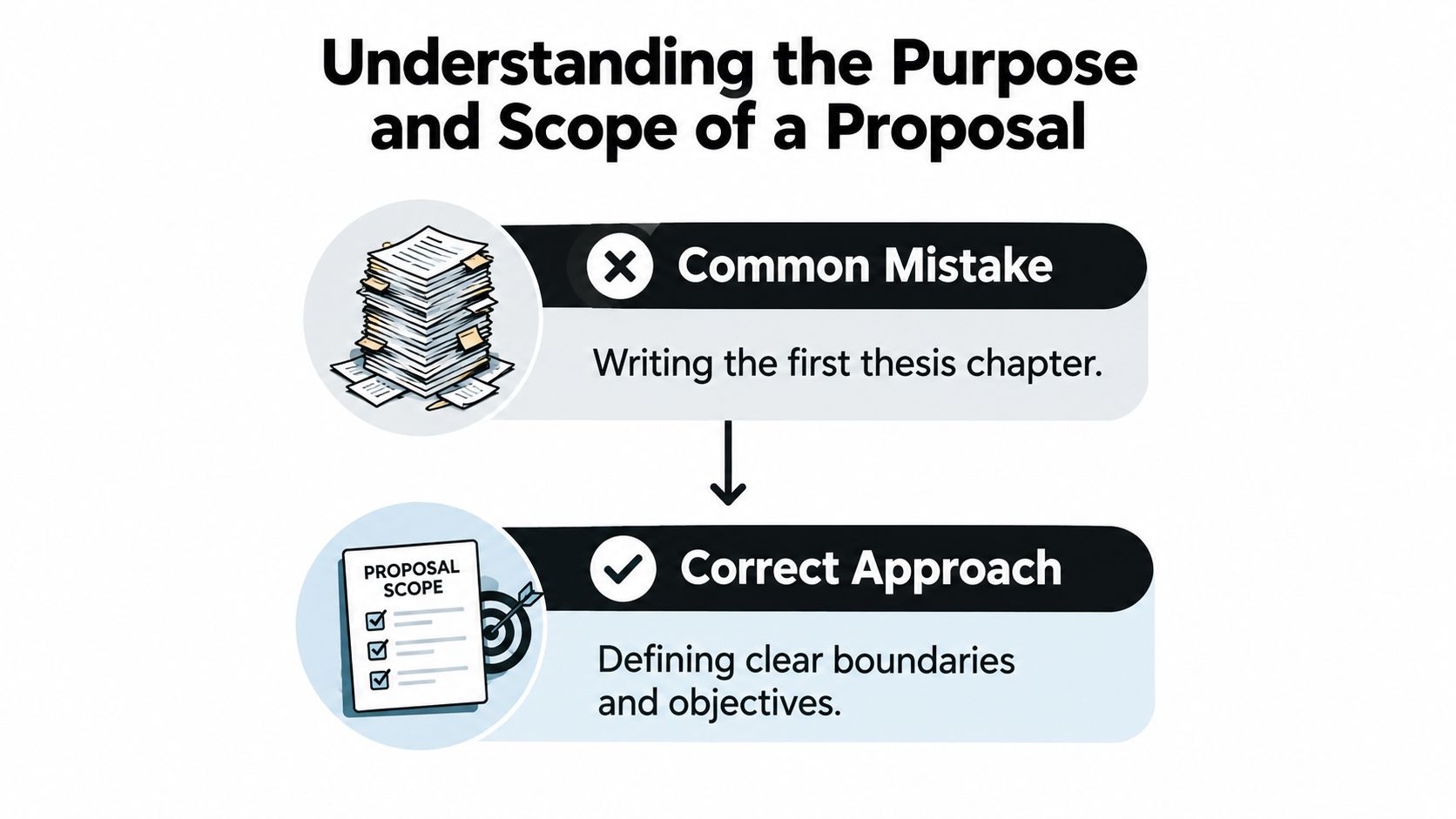
The smartest way to approach how to write a dissertation proposal is to treat it as a test of readiness, not a draft thesis chapter. The proposal traditionally exists to show that the research question is narrow enough, the literature base is relevant, and the method can be executed within the available time. In practice, that usually means building around 4 to 6 essential components, including background, research questions, literature review or framework, methodology, significance, and a time plan.
Practical rule: if a paragraph would still make sense in the final dissertation chapter, it's probably too broad for the proposal.
The historical purpose matters here. Graduate programs use the proposal as a gatekeeping document, which is why the same basic structure keeps showing up across institutions. That consistency reflects a shared expectation that you've already moved from “topic interest” to “research design.” If the document can't show that shift, reviewers usually send it back.
The scope choices that matter most
Your first job is to define what the project is not. That means cutting away broad subtopics, unrelated theory, and everything you hope to “maybe include later.” A proposal gets stronger when the research question, literature review, and methods all point to the same small target.
The other trap is confusion between a proposal and a chapter draft. A chapter can be expansive and interpretive. A proposal has to be selective, because reviewers need to see feasibility, originality, and preparedness before they approve full research.
Defining a Defensible Research Question and Gap
Most proposal failures start here, even when the writing looks polished. Students often identify a broad theme, then mistake that for a research gap. A real gap is narrower than “not enough research exists,” and far more defensible than “no one has done this before,” which a GWU handout explicitly warns against GWU dissertation gap FAQ.
From topic area to researchable problem
Start with a problem, a population, a context, or a method. That specificity matters because it gives your gap a boundary. For example, “digital learning” is not a gap. “How first-generation graduate students use short-form audio tools to revise technical vocabulary in English-medium courses” is closer to a testable question because it has a population and a setting.
A defensible gap has three qualities. It is specific, researchable, and tied to a problem that matters in the literature or practice. If you can't explain what is missing, for whom it is missing, and why that absence affects the field, your proposal will read like a topic note rather than a research plan.
The weakest proposals are usually the ones that confuse novelty with scope. Reviewers want evidence that the question is worth asking, not proof that nobody in the world has ever touched the topic.
How to pressure-test the gap
Use a simple filter before you commit to the question:
- Is the gap visible in the literature? If you can only describe it as “something interesting to explore,” it's probably too vague.
- Can the gap be investigated with available data? If the answer depends on ideal access you don't have, the question is too ambitious.
- Does the question connect to a concrete problem or context? A gap without context is usually a reading summary in disguise.
- Can the question be answered within the degree timeline? If not, you need a smaller unit of inquiry.
The point is not to make the question tiny for its own sake. The point is to make it answerable. A proposal passes review when the committee can see the line between the question, the evidence base, and the method. That line has to be visible on the page.
Structuring the Literature Review and Framework
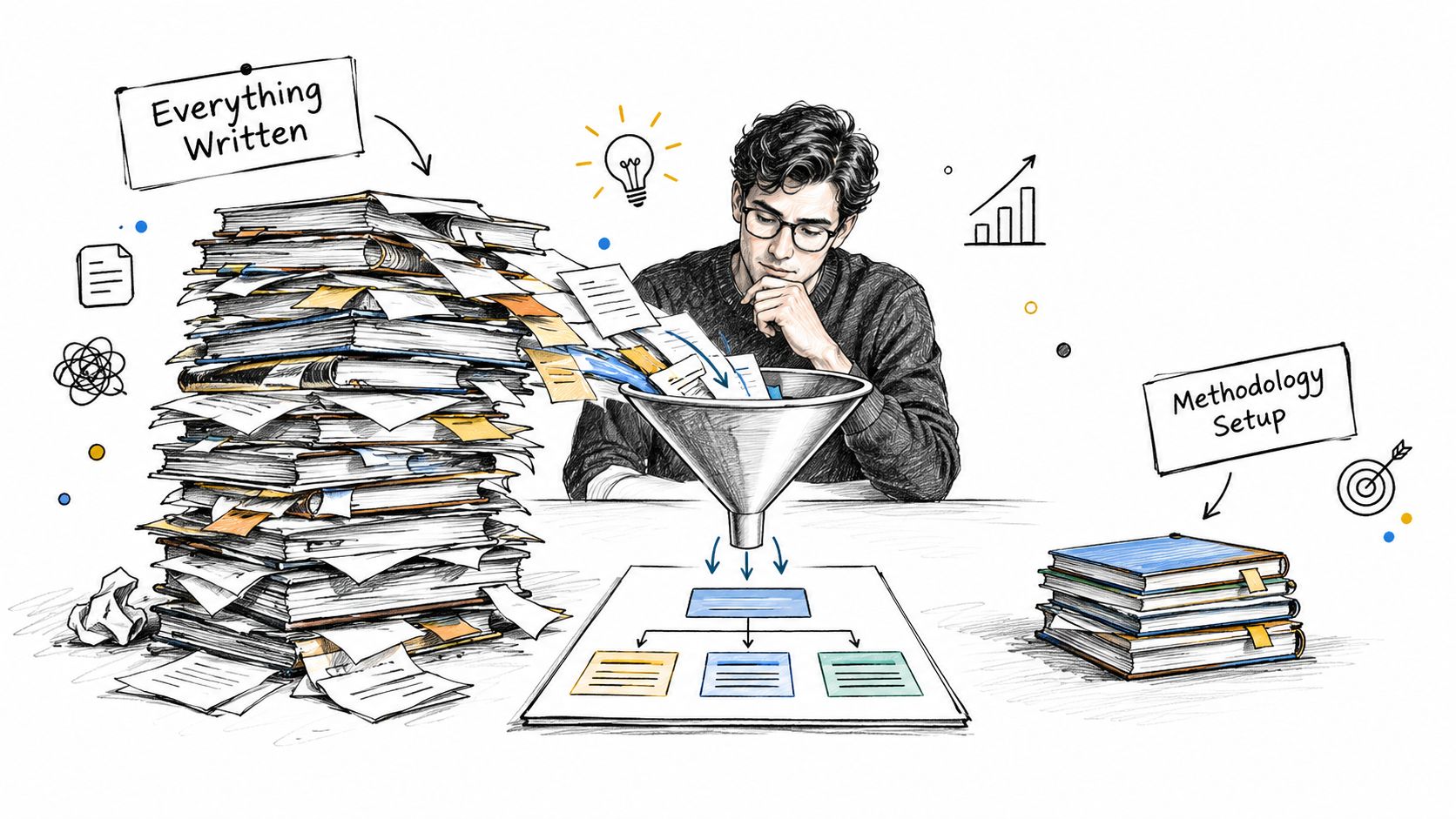
A proposal literature review should behave like an argument, not an archive. The mistake I see most often is a student summarizing sources one by one until the section becomes a reading list with no direction. A stronger review selects only the studies that help justify the question, the framework, and the method.
Build the review thematically
Thematic structure usually works better than chronology because it shows how ideas relate. Group the literature by concepts, debates, populations, methods, or findings, then show what each cluster contributes to your question. That approach helps you move from “what has been studied” to “what this project will examine next.”
If you need a practical way to organize source notes, a literature matrix can save time and reduce repetition. A useful starting point is this literature review table, because it encourages you to compare study purpose, method, findings, and relevance instead of copying abstract language into your draft.
Use the review to justify the framework
A conceptual framework is not decoration. It tells the reader what lens you'll use and why that lens fits the problem. In a proposal, that matters because the framework should connect directly to the data you want, the way you'll gather it, and the way you'll interpret it.
If you're drafting notes quickly, tools like Italian dictation software can help when you need to capture a long reading response before you lose the thread. The point isn't speed alone, it's preserving your reasoning so you can turn it into a structured synthesis later.
The final paragraph of the review should bridge cleanly into the method. It should not sound like the literature ended and the method began by accident. Instead, it should show that the evidence base points to a specific design choice, which is what makes the proposal feel coherent.
Designing a Feasible and Robust Methodology
The methodology section is where reviewers decide whether your idea can survive contact with reality. A vague method makes the whole proposal look theoretical in the wrong way. A strong one gives enough detail for someone else to understand what data you need, how you'll get them, and what has to happen before collection can begin Brandeis dissertation proposal guidance.
State the design, data, and access needs
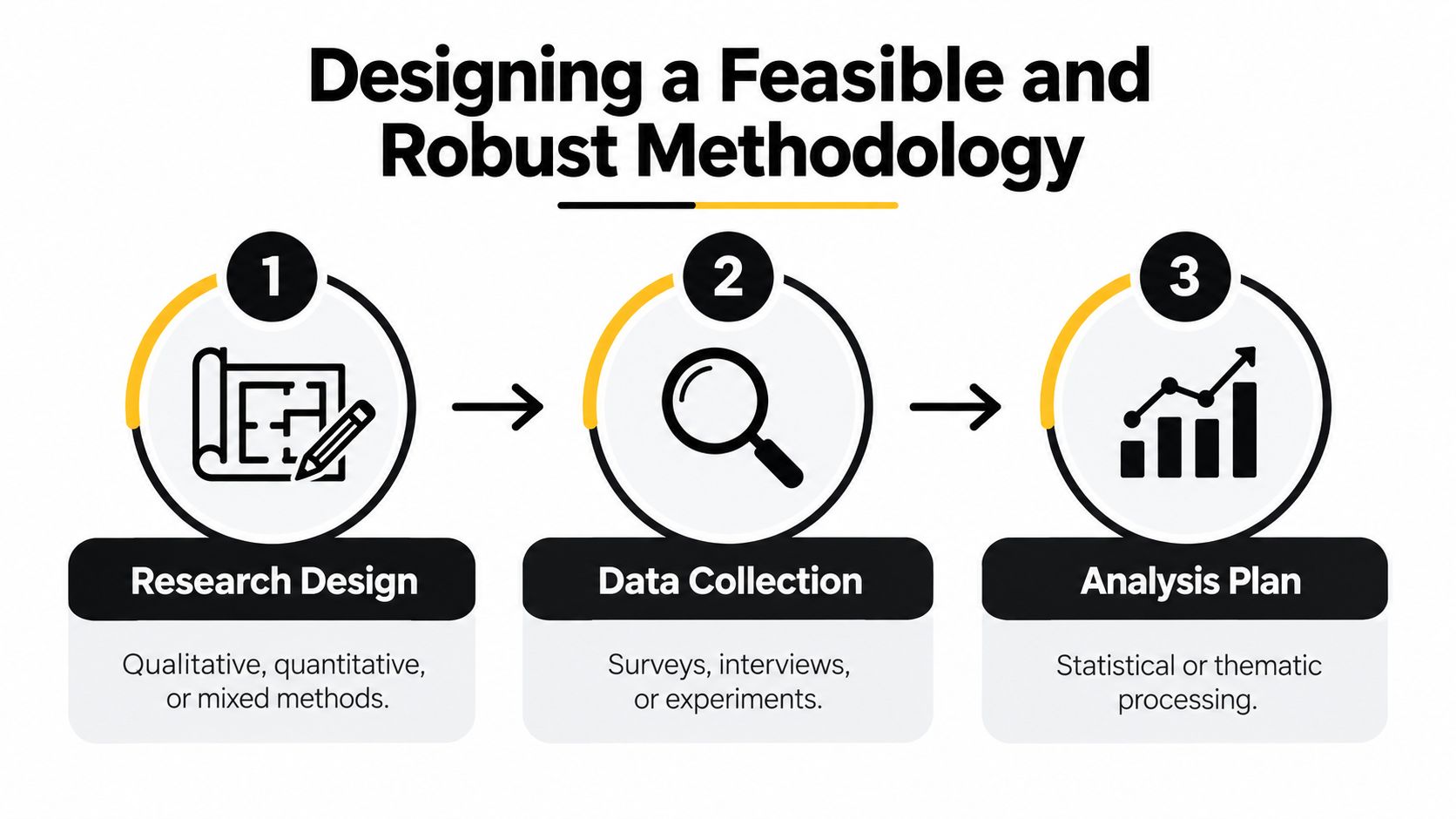
The core of the method should be easy to audit. Say whether the study is qualitative, quantitative, or mixed-methods, then specify the data source, the collection procedure, and the analysis plan as separate steps. That separation matters because each step has different feasibility risks.
A committee wants to know more than your topic and your method label. It wants to know whether you need ethics approval, permissions, language preparation, local affiliations, or access to a site, archive, dataset, or participant group. If those dependencies are invisible in the proposal, reviewers may assume you haven't thought the project through.
Practical rule: if the method cannot be explained in terms of what gets collected, how it gets collected, and how it gets analyzed, it's not ready.
Match the method to the question
The strongest proposals justify method choice instead of treating it as a default. If the question asks about meaning, experience, or process, qualitative work may fit. If it asks about patterns, measurement, or comparison, a quantitative design may fit better. Mixed-methods can work when the question needs both, but only if you can explain why one method alone would leave a gap.
A technical proposal should also spell out the sequence of operations. For example, a review team should be able to see whether you'll recruit first, collect data second, and analyze afterward, or whether the design involves iterative collection and analysis. That level of detail shows that the project is executable, not just interesting.
For a deeper walkthrough of method sections, this explanation of the methodology chapter explained for beginners is useful because it keeps the logic of design, access, and analysis visible. The proposal should already contain that logic in condensed form. The chapter can expand it later.
Building a Realistic Timeline and Budget
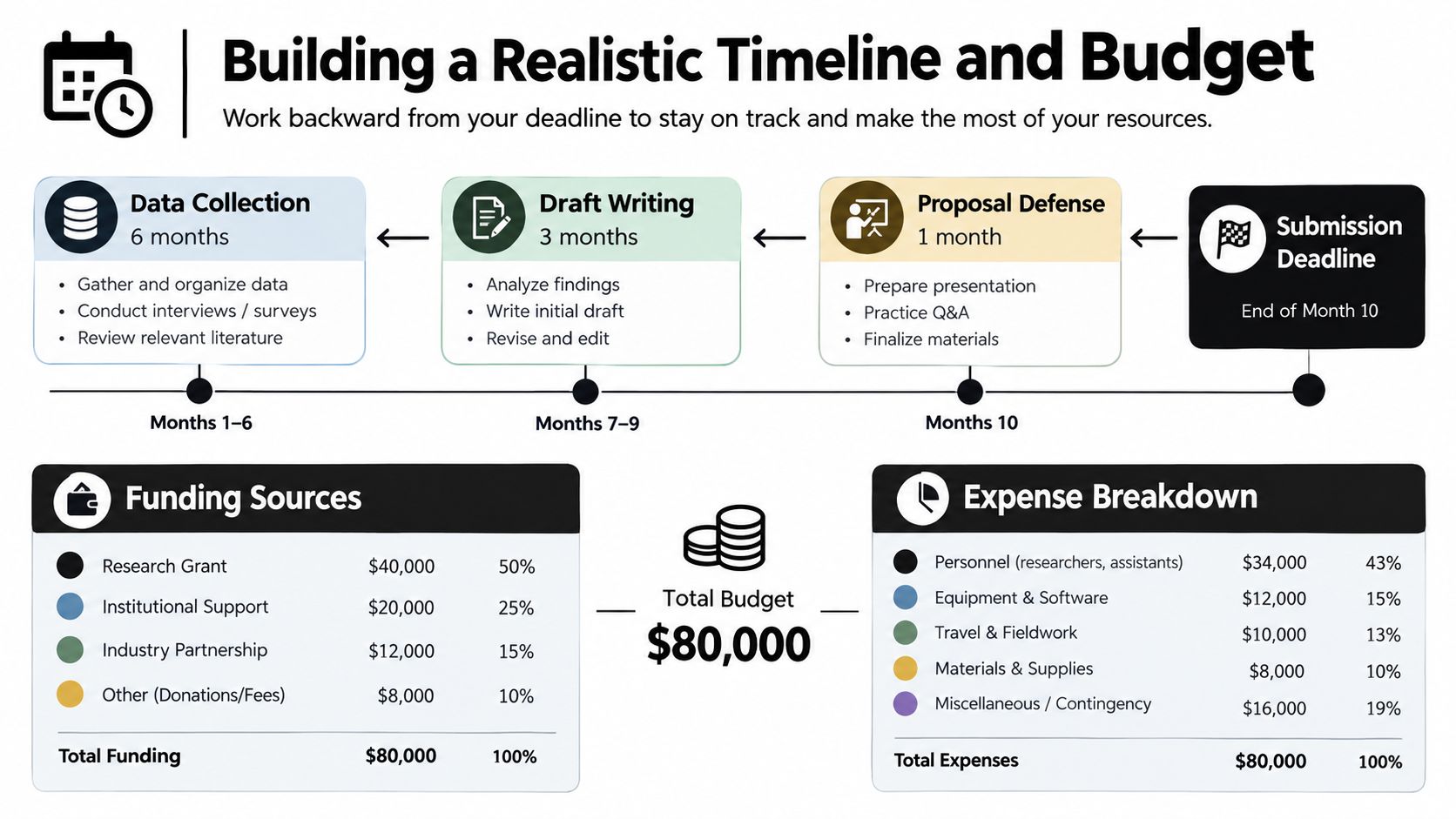
A strong question can still fail on execution if the timeline is vague. Graduate committees know that research slips because of access delays, analysis, revisions, and normal interruptions. Proposal guidance therefore asks for a dated work plan that shows the sequence from project design through data collection, analysis, and write-up, with clear milestones tied to each stage Ohio University thesis guide.
Work backward from the submission date
Backward planning is the clearest way to show operational readiness. Start with the submission date, then map every task that must finish before the next one can begin. If data collection runs late, analysis and writing move with it.
A timeline table usually works better than a general paragraph. It lets the committee see whether the project is staged in a way that matches the method. If the design depends on recruitment, instrument preparation, field access, transcription, coding, or verification, those steps should be visible on the page.
Budget for friction, not just the ideal plan
The budget is part of feasibility, even when no formal funding sheet is required. Travel, transcription, software, copying, archive access, participant incentives, translation, and ethics-related costs belong in the plan if they affect how the study will run. A proposal that leaves these out looks optimistic in the wrong place.
The best project plans also name likely hurdles before they become crises. For a concise discussion of overcoming project management hurdles, the practical lesson is that delays usually come from missing dependencies, not from lack of effort. Dissertation projects face the same problem. A realistic budget and schedule show that you have already accounted for likely friction points.
Avoiding Common Methodological and Structural Errors
Most proposal rejections are preventable. The usual problems are structural, vague topics, unclear questions, weak alignment between the question and the method, and missing justification for how the data will be gathered and analysed Coventry dissertation proposal guidance. Proposals often fail on clarity and specification before they fail on topic novelty.
The most common breakdowns
Misalignment is the first breakdown. A student asks one question, then describes a method that cannot answer it. The second is overreach, where the topic is so broad that no realistic dataset can cover it well. The third is an under-justified method choice, where the proposal says what will be done but not why that approach fits the problem.
Feasibility controls matter just as much. Reviewers look for ethics issues, reliability or validity checks, anticipated costs, and a contingency plan for problems before the project starts. If those elements are missing, the proposal can seem complete on the surface while still failing as a workable plan.
How to self-edit like a reviewer
Read the proposal in this order, not the order you wrote it:
- Question first: Does the question sound narrow, answerable, and specific?
- Gap second: Is the gap clear, or just a broad complaint about the literature?
- Method third: Can the evidence gathered answer the question?
- Timeline fourth: Does the schedule reflect the pace of the method?
- Risk fifth: Have you named access, ethics, and analysis problems?
If a reviewer has to guess how the project will work, the proposal is not ready.
The strongest sign of readiness is alignment. The question defines the gap, the literature narrows the framework, the methodology explains execution, and the timeline shows the work can happen on schedule. A proposal that does this reads like a project plan, not a wish list. It shows the committee that the study is feasible, that the method fits the question, and that the student has already thought through where the project can slow down.
Related Articles
10 Literature Review Sample PDFs to Use
A literature review sample PDF is most useful when you ignore its sentences. The underlying lesson s...
Research MethodsHow to Write a Dissertation Conclusion: A Practical Guide
You're down to the last chapter, the argument is already built, and the deadline is uncomfortabl...
Research MethodsWhat Is a Research Gap and How to Find It Fast
A research gap is a defensible absence in prior scholarship where evidence is missing, insufficient,...
Comments (0)
No comments yet. Be the first to share your thoughts.