7 Literature Review Research Proposal Examples
Compare 7 literature review research proposal example structures, with strategic analysis, practical tactics, and takeaways for stronger proposals.

A literature review can be the part of a proposal that proves a study is necessary, not merely the part that proves you've read widely. University proposal guidance positions it as a foundational chapter, often placed as Chapter 2, where researchers evaluate prior work, identify gaps, and show how a proposed study fits existing scholarship (University of Wisconsin–Madison research proposal guidance). That makes the structure you choose a research decision, not a formatting preference.
The seven examples below use the same reading method. First, identify the organizing logic. Then trace how sources support the research question, theoretical position, or method. Finally, note the structure's limits and turn the example into a drafting decision. Source organization, chapter tracking, and deadline planning can also make the process more manageable. Thesis Book Project, for example, combines a research roadmap with source organization, chapter progress, and milestone planning without replacing the analytical work of writing.
Table of Contents
- 1. Problem-Statement-Led Literature Review Structure
- 2. Thematic or Conceptual Clustering Approach
- 3. Chronological or Historical Development Model
- 4. Methodological or Evidence-Type Synthesis Model
- 5. Geographic, Sectoral, or Population-Specific Scaffold
- 6. Critical or Evaluative Review Model
- 7. Theory-Building and Conceptual Framework Development Model
- 7-Point Comparison: Literature Review Models
- Turn the Structure Into a Proposal Argument
1. Problem-Statement-Led Literature Review Structure
A problem-statement-led review begins with the issue your proposal must resolve. Instead of opening with a broad history of the topic, you state the research problem, define its boundaries, and select sources according to how they explain, address, or leave that problem unresolved.
Consider a Master's thesis on remote work productivity. The review might begin by arguing that existing research uses different meanings of productivity, making comparisons across distributed teams difficult. The sections could then examine productivity measures, the assumptions behind each measure, and the contexts in which each measure has been applied. The review's final movement would establish why the proposed study needs a clearer measurement framework.
A PhD proposal on climate adaptation in agriculture could use the same logic differently. Its central problem might concern the limited availability of decision-support tools for small-holder farmers in sub-Saharan Africa. Sources could be grouped around seasonal forecasting methods, barriers to farmer adoption, and regional conditions. Each section would answer a practical question: what is already available, why hasn't it solved the problem, and what should the proposed study investigate?
Strengths and limits
This structure keeps the review closely aligned with the proposal. It helps supervisors see why each source belongs and makes the transition from literature to research design more direct. The risk is premature narrowing. If you define the problem too tightly before reading broadly, you may overlook competing explanations or evidence that challenges your assumptions.
Use a source tag such as gap-measurement, context-Africa, or intervention-algorithm. A chapter tracker can then show whether each proposal objective has supporting literature, a drafted section, and a clear connection to the research question. Write the problem statement at the start of the review, revisit it after drafting, and remove sources that don't help explain the study's necessity.
2. Thematic or Conceptual Clustering Approach
A thematic review groups sources by ideas rather than by author or publication date. The themes should represent the conceptual parts of your research question, not just the topics that happen to appear in your reading notes.
A PhD proposal on educational technology might use sections on learning theories in digital environments, student outcomes, teacher readiness, equity and access, and implementation in resource-constrained settings. Each section would bring several sources into conversation. The student-outcomes section, for example, could compare how different studies define and assess learning, while the teacher-readiness section could show how training and institutional support shape implementation.
A Master's thesis on organizational change might define change resistance, examine psychological and cultural drivers, evaluate leadership interventions, and then consider measurement and sectoral differences. An undergraduate dissertation on climate fiction could move from genre definition and history to narrative strategies, audience reception, and criticism of fiction as advocacy. In each case, the themes create a conceptual map that leads toward a gap.
How to make themes carry an argument
Start by annotating every source in one sentence. Assign each source a primary theme, then create a separate conceptual outline before writing paragraphs. The guide to organizing a literature review can support this planning stage, but your supervisor should still confirm that the themes are distinct and appropriately weighted.
Use a short opening sentence to explain why each theme matters. Within the section, place foundational work before later empirical studies or critiques when that order clarifies the argument. End with a transition that shows what the theme reveals about the research question.
Practical rule: A theme earns its place when it changes how the reader understands the problem, the evidence, or the proposed study.
The strength of this model is flexibility. Its weakness is that broad themes can become containers for unrelated summaries. If two sources share a keyword but answer different questions, they may not belong in the same section.
3. Chronological or Historical Development Model
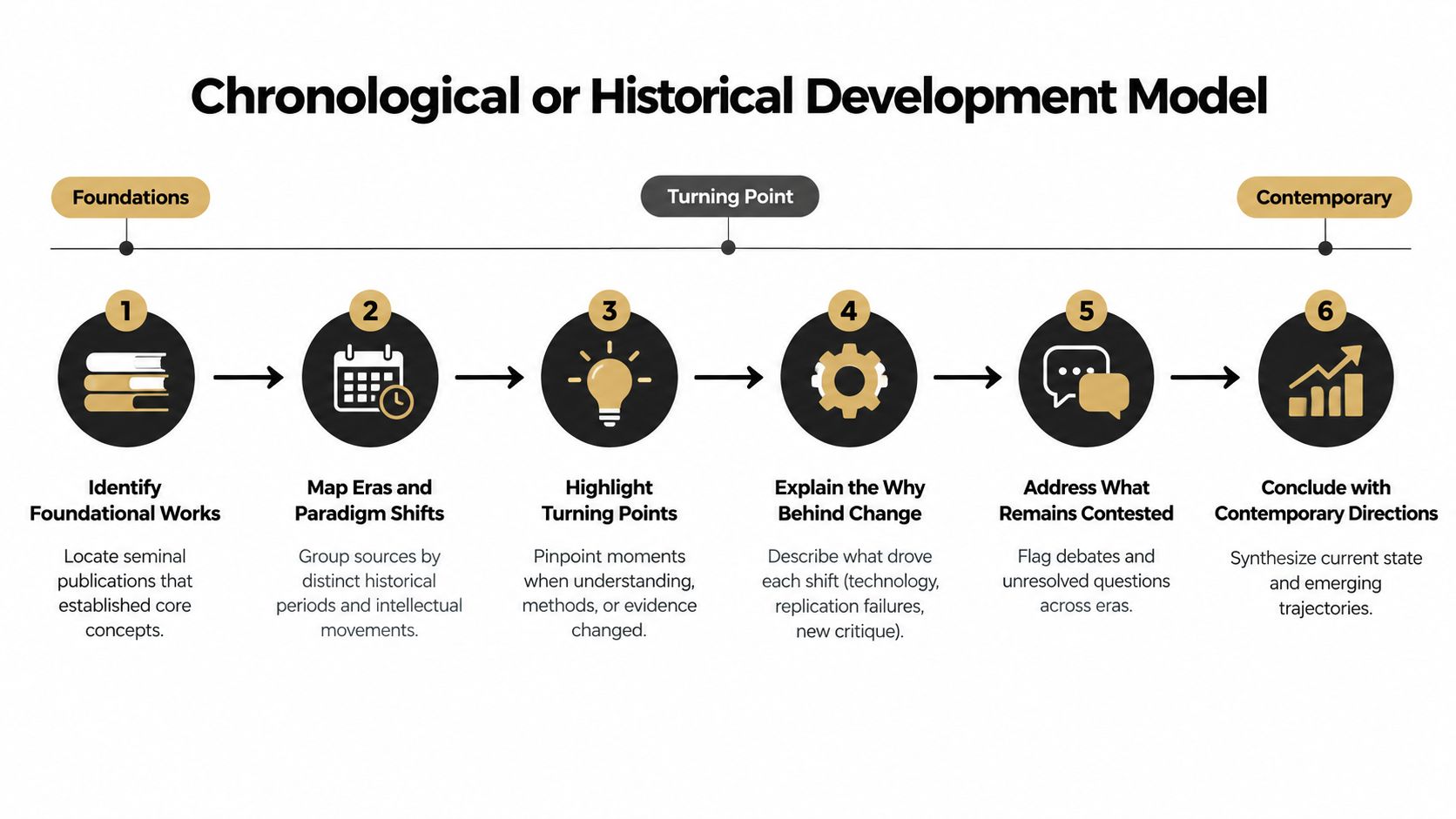
Some proposals need to explain how a field arrived at its current assumptions. A chronological review traces changes in concepts, theories, methods, and debates. It should explain not only what came first, but why later researchers revised or rejected earlier approaches.
A PhD proposal on memory in cognitive psychology could move from early work on forgetting, through information-processing models, encoding specificity, distributed practice, and current debates about consolidation and sleep. The value lies in showing how the field's questions changed. A proposal about memory that treats every period as equally settled would hide the reasoning behind current research.
The same model can suit organizational leadership. A review might trace the movement from Great Man theory to trait approaches, behavioral theories, contingency models, transformational leadership, and critiques of Western-centric frameworks. An undergraduate dissertation on mental health stigma could follow changes from asylum-era practices and the medical model to deinstitutionalization, the recovery model, and digital-era disclosure.
What to record for each period
Create a timeline that records major publications, theoretical shifts, and methodological innovations. Give foundational sources enough explanation for the reader to understand their influence, then distinguish between ideas that became widely accepted and questions that remained contested.
Mark turning points with milestones in your planning system. You must also explain the cause of each shift. Did new data challenge an assumption? Did a new technology enable a different method? Did researchers critique the theory from an underrepresented perspective? These questions turn a timeline into analysis.
The model works best when history shapes the present research problem. It's less effective when dates are incidental and the proposal only needs a focused synthesis of current evidence. In that case, use a short historical opening and organize the main review around themes, methods, or theory.
4. Methodological or Evidence-Type Synthesis Model
A methodological review organizes studies by how researchers produced knowledge. It compares what experiments, surveys, interviews, case studies, reviews, or other designs reveal about the same question. This structure is especially useful when your proposed method responds to a limitation in the existing evidence.
A Master's proposal on workplace mental health interventions could begin with randomized trials, then examine quasi-experimental designs, qualitative employee interviews, organizational case studies, and systematic reviews. The point isn't to rank methods automatically. Randomized studies may help examine intervention effects, while interviews can reveal how employees experience implementation. Case studies may expose organizational conditions that controlled designs overlook.
A PhD proposal on climate change communication could compare experiments on message framing, surveys of public attitudes, interviews about how people process information, media content analysis, and social network analysis of information diffusion. The conclusion could justify a digital ethnography because existing designs have answered different parts of the question without explaining how communication unfolds across platforms.
Connect method to the proposed design
Build a simple planning matrix with three columns: research question, methods used in prior studies, and what remains unclear. Tag sources by methodology in your source manager. This makes it easier to see whether the literature is methodologically diverse or whether one design dominates.
For each method, explain its contribution and trade-offs. Don't write that interviews are “better” than surveys without specifying the question being answered. A survey may describe patterns across a population, while an interview may clarify meanings, experiences, or mechanisms.
The literature review methods guide can help you distinguish organizational approaches, but the proposal must make the final methodological connection explicit. For example, you might write that prior work has described attitudes through surveys but has not followed how those attitudes change over time, so your study uses longitudinal interviews. That sentence turns organization into justification.
5. Geographic, Sectoral, or Population-Specific Scaffold
A context-specific review makes boundaries visible. It organizes evidence by region, industry, institution, demographic group, or another population characteristic, then asks whether findings travel across those boundaries.
A Master's proposal on remote work adoption could compare North America and Western Europe, East and Southeast Asia, sub-Saharan Africa, and Latin America. The purpose isn't to create a tour of regions. It's to examine how infrastructure, regulation, organizational practice, and social expectations shape adoption differently.
A PhD thesis on mental health service access might distinguish wealthy Western nations, middle-income countries, low-income settings, and refugee or displaced populations. An undergraduate dissertation on women in technology could compare large technology companies, startups, academia, and technology hubs in the Global South. Each division should help explain why a result applies in one setting and may not apply in another.
Treat context as part of the explanation
Create a matrix showing which contexts your sources represent and which are absent. Then write a boundary statement for every major finding. Ask whether it applies broadly, only to a particular sector, or only to a specific population. This discipline prevents a study based in one setting from making universal claims.
A context-based structure is strong when the research question explicitly concerns comparison, transferability, or underrepresented settings. It becomes weak when regions or groups are treated as isolated boxes with no analytical connection. End each section by explaining what the context changes in your understanding of the problem.
Don't invent precision to make a gap sound stronger. If your search indicates that one region dominates, say that the literature is concentrated there unless you have verified evidence to quantify the imbalance. A proposal can make a persuasive case through careful boundaries and reasoning, without unsupported percentages.
6. Critical or Evaluative Review Model
A critical review evaluates the quality and assumptions of existing work. It asks whether studies define concepts consistently, use suitable evidence, represent the relevant population, and support the conclusions they draw. Criticism should clarify the state of the field, not perform superiority over individual authors.
A PhD proposal on AI ethics might review research on algorithmic bias and then examine how studies construct representative data, define bias, identify whose values are reflected, and assess whether proposed interventions are feasible. A Master's thesis on online education could question whether studies compare different online approaches or merely compare online learning with classroom teaching. It could also ask which outcomes researchers measure and which populations appear in the evidence.
An undergraduate proposal on peer-support interventions might evaluate whether studies measure participant satisfaction instead of substantive outcomes, whether cost considerations receive attention, and whether qualitative evidence explains how support works in practice. Those observations would then lead to a specific proposed design.
Keep criticism precise and fair
Maintain a limitations log with fields for methodological strength, theoretical assumptions, population representation, outcome validity, and ethical considerations. When drafting, acknowledge what a study does well before identifying what it doesn't address. “The study does not examine transfer beyond the immediate setting” is more useful than an unsupported statement that the study is weak.
Organize the critique by recurring issue, such as measurement, generalizability, theory, or ethics. This shifts the focus from attacking papers to evaluating patterns across the literature. A final synthesis should combine those patterns into a defensible gap statement.
“The literature is not inadequate because it has limitations. The proposal becomes stronger when it shows which limitations matter for its particular question.”
The model's strength is analytical depth. Its limit is the risk of excessive fault-finding. If every study is treated as deficient, readers may doubt whether the field offers a foundation at all. Evaluate limitations in relation to the proposed research, and avoid claiming that your study solves problems it cannot realistically address.
7. Theory-Building and Conceptual Framework Development Model
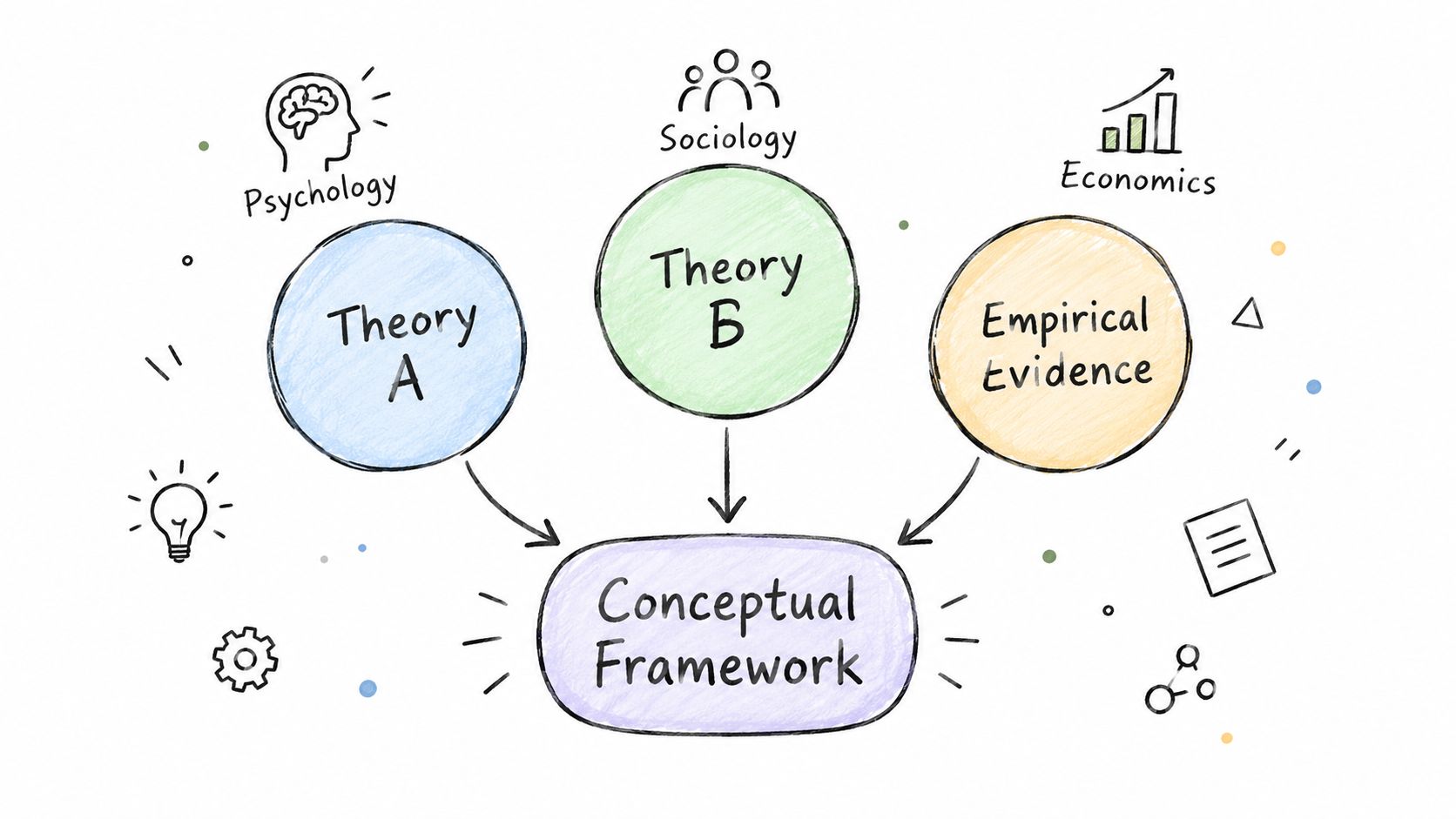
A theory-building review uses sources to construct or refine a framework. It compares concepts across traditions, identifies tensions, and proposes an organized explanation for the phenomenon under study. The framework should be built to answer a research question, not displayed as an abstract intellectual exercise.
A PhD proposal on organizational resilience could bring together engineering ideas about bouncing back, ecological ideas about adaptive capacity, psychological ideas about individual coping, and sociological ideas about community solidarity. The proposed framework might connect these levels and guide a mixed-methods study. Its contribution would come from explaining relationships that separate theories leave disconnected.
A Master's thesis on health behavior change could combine behavioral economics, social psychology, and public health. The resulting framework might explain why an individual intervention can struggle when social norms, identity, or environmental conditions work against it. An undergraduate dissertation on digital belonging could connect classical sociology, network theory, and psychology to examine how online spaces create or fail to create meaningful connection.
Make the framework testable and useful
Start a theoretical mapping document. For each theory, record what it explains, what it leaves out, where it overlaps with other theories, and where it conflicts with them. Then show how the proposed framework responds to those differences.
A diagram can make the framework concrete, but it isn't a substitute for explanation. State why each concept belongs, how the concepts relate, and what the arrangement reveals that existing frameworks miss. The guide to theoretical frameworks in research offers a useful planning reference for this stage.
The image above can support a visual explanation of how theoretical concepts connect with empirical evidence. Later, a short video can help you present the framework during a planning or supervisor discussion.
The model works best when your proposal needs to explain relationships, mechanisms, or levels of analysis. Its risk is theoretical accumulation. More theories don't automatically create a stronger framework. Select the concepts that help answer the question and connect them to the study's data and analysis.
7-Point Comparison: Literature Review Models
| Approach | 🔄 Implementation complexity | ⚡ Resource requirements & efficiency | 📊 Expected outcomes / impact | ⭐ Key advantages | 💡 Ideal use cases / tips |
|---|---|---|---|---|---|
| Problem-Statement-Led Literature Review Structure | 🔄 Medium, needs a clear, stable problem statement | ⚡ Moderate, focused searching and tagging reduces waste | 📊 High alignment with proposal objectives; clear justification (⭐⭐⭐) | ⭐ Direct linkage from gap → design; supervisor-friendly | 💡 Best for PhD/Master's; write problem first and tag sources to gaps |
| Thematic or Conceptual Clustering Approach | 🔄 Medium–High, requires upfront theme analysis | ⚡ Scalable, efficient for 40+ sources with good tagging | 📊 Strong synthesis and readable conceptual architecture (⭐⭐⭐) | ⭐ Encourages integration across studies; maps to chapters | 💡 Ideal for multifaceted topics; prepare a conceptual outline for review |
| Chronological or Historical Development Model | 🔄 High, map eras, turning points, and causation | ⚡ Resource-intensive, broad reading across time periods | 📊 Demonstrates field evolution and intellectual positioning (⭐⭐⭐) | ⭐ Shows disciplinary depth and context for current practice | 💡 Use for established-disciplines (psychology, history); build a timeline |
| Methodological or Evidence-Type Synthesis Model | 🔄 Medium, organize and compare methods clearly | ⚡ Moderate–High, requires methodological tagging and expertise | 📊 Clarifies methodological gaps and justifies methods (⭐⭐⭐) | ⭐ Makes methodological diversity explicit; supports mixed‑methods design | 💡 Best for intervention/method-justification proposals; map Qs → methods |
| Geographic, Sectoral, or Population-Specific Scaffold | 🔄 Medium, sectional organization by context | ⚡ High, needs sources across regions/sectors for balance | 📊 Reveals geographic/sectoral biases and boundary conditions (⭐⭐⭐) | ⭐ Highlights representation and generalizability limits | 💡 Use for comparative or context-dependent studies; create context matrix |
| Critical or Evaluative Review Model | 🔄 High, requires rigorous appraisal skills | ⚡ High, time-consuming quality assessment per source | 📊 Strong critical positioning; identifies concrete weaknesses to address (⭐⭐⭐) | ⭐ Demonstrates independent critical thinking and research integrity | 💡 Ideal for PhD or contested fields; keep a limitations log and balance critique with contributions |
| Theory-Building and Conceptual Framework Development Model | 🔄 High, synthesizes multiple theoretical traditions | ⚡ High, deep theoretical engagement and iterative drafting | 📊 Produces original conceptual framework guiding research (⭐⭐⭐⭐) | ⭐ Shows theoretical sophistication and guides coherent design | 💡 Best for theory-focused PhDs or interdisciplinary work; build visual frameworks and a theoretical mapping document |
Turn the Structure Into a Proposal Argument
The best literature review research proposal example isn't the one with the most sections. It's the one whose structure makes the proposal's central reasoning easy to follow. Choose the model according to the dominant need of your study.
Use a problem-led structure when you need to establish why a clearly defined issue requires investigation. Choose a thematic structure when the literature divides naturally into concepts or recurring debates. Use a chronological structure when the development of ideas explains the current research problem. A methodological structure is appropriate when different designs reveal different parts of the evidence or when you need to defend your chosen method.
Choose a context-specific scaffold when geography, sector, or population determines how findings should be interpreted. Use a critical review when the quality, assumptions, or limitations of existing work are central to your rationale. Select a theory-building model when the proposal must integrate concepts or develop a framework that guides analysis.
You don't need to force every model into one review. A thematic review can include a short chronology within a theme. A problem-led review can use methodological comparison to justify the design. A theory-building review can evaluate competing frameworks before proposing its own. Keep one structure primary, then use secondary lenses only when they clarify the argument.
Work through the proposal in a deliberate sequence:
- Map the sources: Record each source's question, evidence, method, context, theoretical contribution, and limitation.
- Assign sections: Place sources under the structure that best explains their relevance, not merely under the section where their keywords appear.
- Connect evidence to the question: End each section by stating what the evidence establishes, complicates, or leaves unresolved.
- Review the gap: Test whether the gap is an unanswered question, mixed evidence, an overlooked context, a methodological limitation, or a theoretical tension. Proposal guidance emphasizes that the gap should connect directly to the proposed research questions and methods (NJIT research proposal guidance).
- Track the draft: Move each chapter and section from outline to draft to revision, while using milestones and supervisor check-ins to identify alignment problems early.
A strong review demonstrates command of relevant scholarship while narrowing attention to the work that directly supports the project. Historical guidance also cautions against trying to cover every publication when only a focused selection significantly addresses the topic (University of Wisconsin–Madison proposal guide). Your task is not to create a catalogue. It's to build a defensible path from what researchers know to what your study needs to find out.
Thesis Book Project can support that path with a thesis roadmap, chapter tracker, source manager, backward-planned milestones, progress visibility, and supervisor sharing. Use those tools to manage the workflow, then reserve your academic judgment for selecting evidence, weighing limitations, and explaining why the proposed research belongs.
Thesis Book Project helps you organize sources alongside chapters, milestones, and proposal tasks, so your literature review stays connected to the wider thesis plan. Create a project roadmap, assign sources to your chosen review structure, and track each section through drafting and supervisor feedback by visiting Thesis Book Project.
Related Articles
Literature Review Methods: A Clear Guide for Researchers
You've opened so many papers that your browser has become a second desktop. One article defines...
Research MethodsWhat Is a Theoretical Framework in Research
You've read the definitions, highlighted the key theories, and still can't explain what your...
Research Methods7 Literature Review Paper Example Sources
The most useful literature review paper example isn't a polished document to imitate. It should...
Comments (0)
No comments yet. Be the first to share your thoughts.