Literature Review Methods: A Clear Guide for Researchers
Understand the core literature review methods, compare systematic, scoping, narrative, and meta-analysis approaches, and choose the right method
You've opened so many papers that your browser has become a second desktop. One article defines the topic one way, another uses a different population, and a third appears to contradict both. The more you read, the less certain you feel about what belongs in your thesis.
That confusion usually doesn't come from a lack of effort. It comes from choosing sources before choosing a method. Literature review methods are different lenses, not interchangeable checklists. A narrative review builds understanding, a scoping review maps a field, a systematic review answers a tightly defined question, and a meta-analysis combines compatible numerical findings. Your research goal should determine which lens you use, how far you search, and when you stop collecting sources and begin writing.
Table of Contents
- Choosing Your Literature Review Path
- The Four Stages of Any Literature Review
- Systematic and Scoping Reviews Compared
- Narrative Reviews and Meta-Analysis Contrasted
- Matching Method to Your Thesis Workflow
- Decision Matrix for Selecting Your Review Method
- Why Method Alignment Matters Early
- Frequently Asked Questions
Choosing Your Literature Review Path
A student researching digital learning in rural schools might begin with a broad interest in “what the literature says.” That question is too open to guide a disciplined search. The student first needs to decide whether the project should map concepts, answer a focused question, explain a debate, or calculate an overall effect.
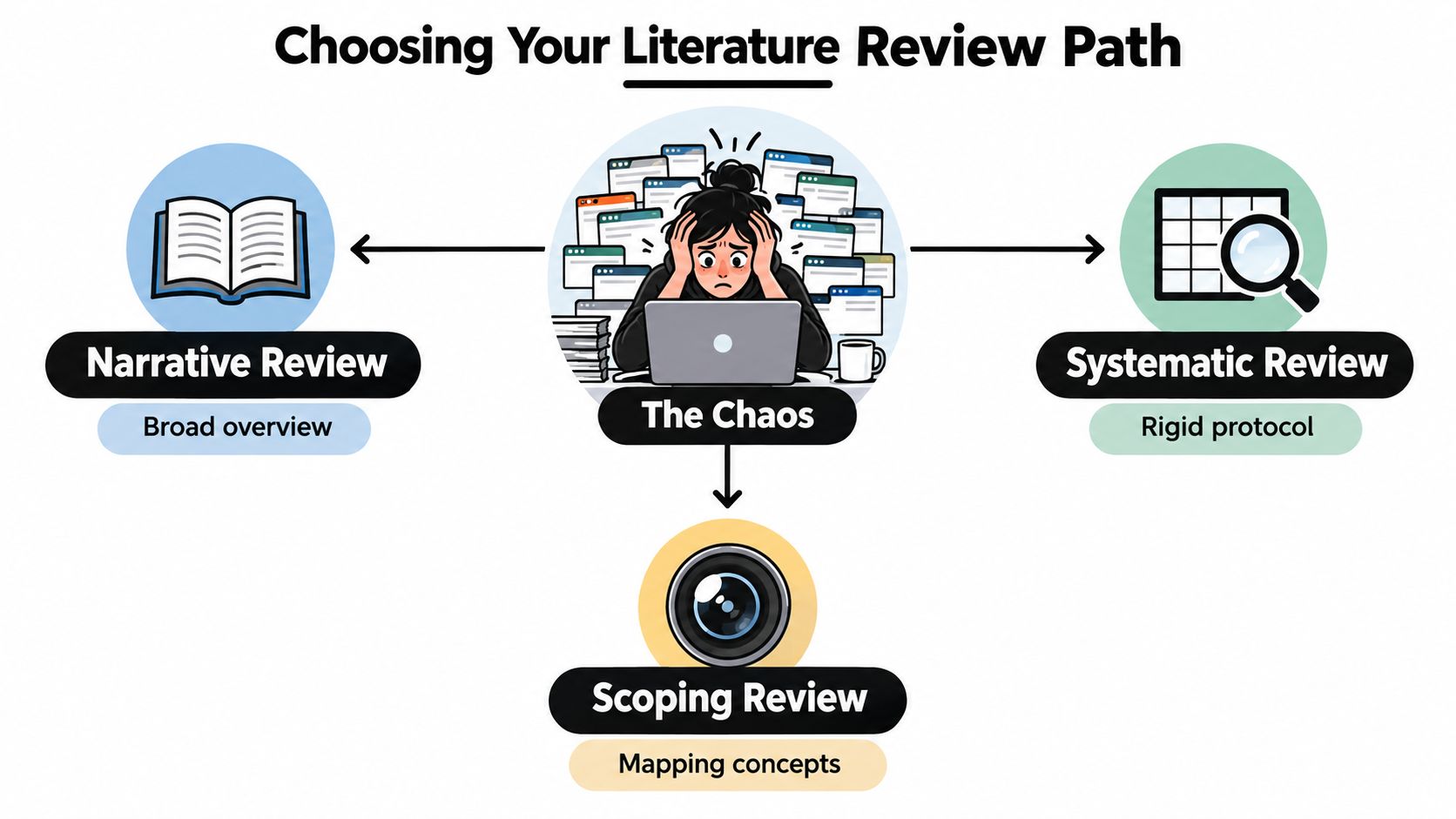
Think of the four core approaches as routes from the same starting point:
- Narrative review: Use this when readers need context, theory, definitions, or an interpretive account of a topic.
- Scoping review: Use this when the field is broad, terminology varies, and you need to map concepts, populations, study types, or gaps.
- Systematic review: Use this when you have a focused question and need a transparent, reproducible process for identifying and evaluating evidence.
- Meta-analysis: Use this when several sufficiently comparable quantitative studies provide data that can be statistically combined.
These methods can overlap in a thesis, but they don't have the same endpoint. A scoping review may show that a topic is too conceptually varied for statistical pooling. A narrative review may explain the theoretical background before a systematic review addresses a narrower empirical question. The important decision isn't which method sounds most rigorous. It's which method can answer your actual question without creating obligations your project cannot support.
Practical rule: Choose the method by asking what your final conclusion must do. Will it map, explain, test, or calculate?
Before searching thoroughly, write one sentence beginning with “This review will…” If the sentence says “map the available concepts and evidence,” explore a scoping design. If it says “estimate whether one intervention is more effective,” investigate a systematic review and possibly a meta-analysis. A detailed literature review methodology guide can help you compare the required stages before you commit.
The Four Stages of Any Literature Review
Every review moves through four connected stages: problem formulation, literature search, data evaluation, and analysis or interpretation. These stages apply whether you're writing a flexible narrative review or following a tightly specified systematic protocol, although the documentation and level of control differ.
Formulate the problem
Start by defining the question, the key concepts, the population or context, and the purpose of the review. “Digital learning in rural education” is a topic. “How have researchers defined and measured digital learning access in rural secondary schools?” is closer to a reviewable question.
Search deliberately
Your search should identify where relevant evidence is likely to exist and how you'll find it. A planned protocol should specify the question, eligibility rules, databases or registries, and keywords before retrieval begins, which improves reproducibility and helps reduce selection bias, as explained in this practical guide to systematic literature searches.
Evaluate what you find
Evaluation asks whether each source is relevant, credible, and useful for the question. Keep screening decisions separate from casual reading notes. Otherwise, an interesting paper can enter the review just because it confirms your preferred argument.
Analyse and interpret
Analysis turns individual studies into patterns, contrasts, categories, or a statistical synthesis. A guide to literature review organization can help you arrange sources by themes, methods, populations, theories, or findings rather than producing one paragraph per author.
Treat each stage as a checkpoint. If your search keeps expanding, the problem may be an unfocused question. If you have many papers but no argument, evaluation or synthesis may be underdeveloped. If you can't explain why a source is included, return to the eligibility rules before drafting further.
Systematic and Scoping Reviews Compared
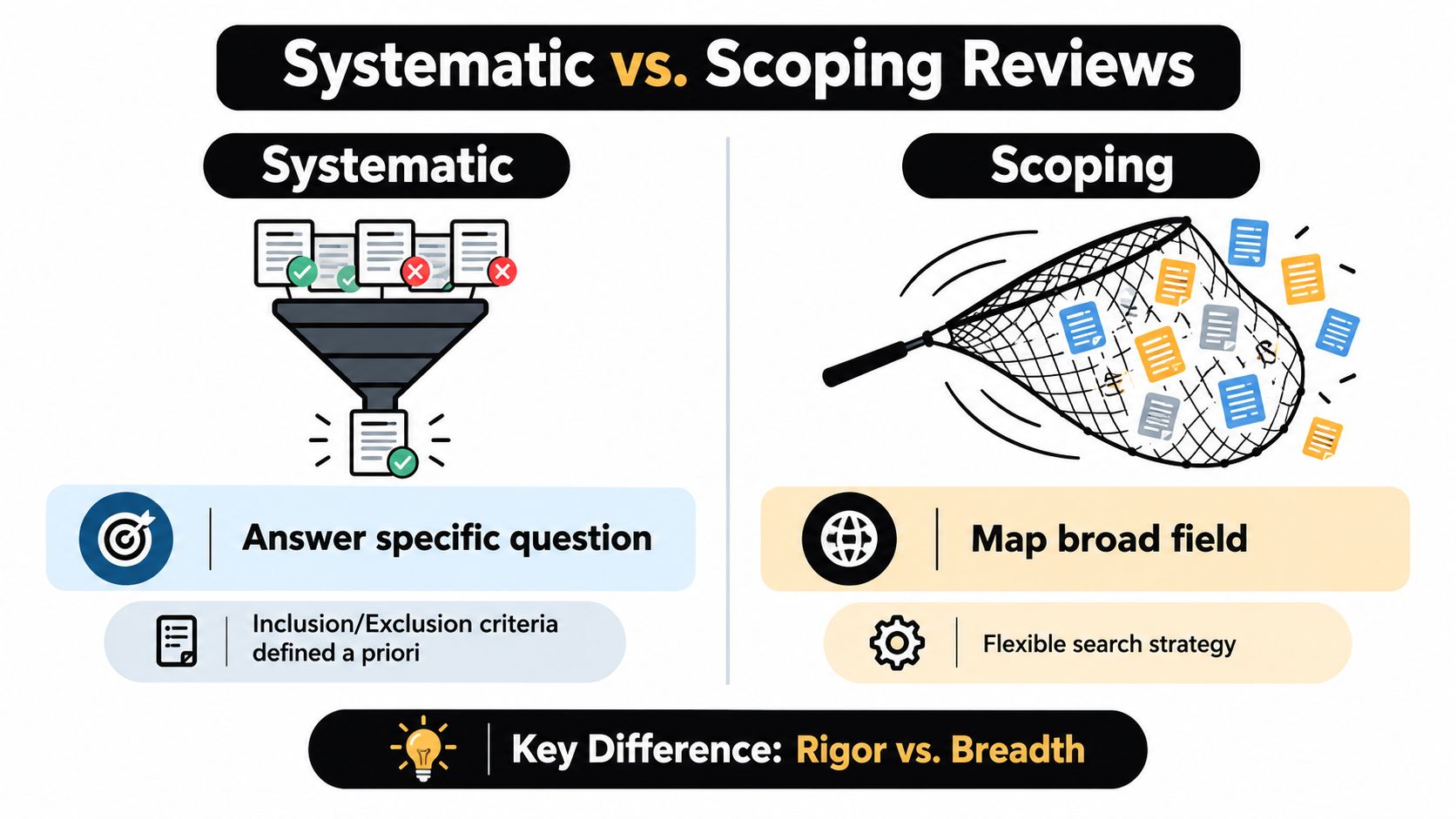
Systematic and scoping reviews are often confused because both use an organized search and selection process. Their purposes differ, however. A systematic review answers a focused question, while a scoping review maps the shape of a broader field.
| Feature | Systematic review | Scoping review |
|---|---|---|
| Main purpose | Answer a precise question | Map the extent, range, or nature of evidence |
| Question shape | Narrow and specific | Broad and exploratory |
| Eligibility rules | Defined before searching | Defined in advance, but often designed for wider coverage |
| Search style | Comprehensive and reproducible | Broad, exploratory, and sensitive to terminology |
| Typical output | Critical synthesis of evidence | Map of concepts, study types, and research gaps |
A systematic review might ask whether a particular intervention improves a defined outcome in a specified population. Its protocol should establish the inclusion and exclusion criteria, databases, trial registries, and search terms before searching begins. High-rigor reviews commonly use multiple sources, structured extraction forms, and screening by at least two reviewers. These safeguards make selection and interpretation more auditable, as described in the NCBI overview of systematic review methods.
A scoping review suits a question such as, “What frameworks have researchers used to study digital learning access in rural education?” At that stage, you may not know which terms, populations, study designs, or outcomes dominate the field. Flexible searching helps you discover that vocabulary and identify where evidence is concentrated or missing.
Neither approach is automatically better. A systematic review can be inappropriate when the literature uses inconsistent definitions or examines highly varied outcomes. A scoping review can be insufficient when your thesis needs a defensible answer to a narrow effectiveness question. Your choice should follow the conclusion you need, not the prestige attached to a label.
For examples of how review writing differs by purpose and structure, consult this literature review paper example.
Narrative Reviews and Meta-Analysis Contrasted
A narrative review interprets literature, while a meta-analysis calculates a combined statistical result. These approaches sit at different points on the methodological spectrum, but neither is universally superior.
Suppose your thesis examines how scholars understand student engagement in online learning. A narrative review could compare definitions, explain competing theories, and show how researchers have described engagement across different contexts. Its value lies in interpretation and conceptual organization. You might group sources by theoretical tradition, measurement approach, or population, then use those groups to establish the gap your study will address.
A meta-analysis requires a different foundation. The included studies must report sufficiently comparable quantitative results, and you must extract numerical information consistently. The analysis then combines those results into an estimated overall effect, alongside an assessment of variation and study quality. If one study measures engagement through attendance, another through self-reported motivation, and another through discussion-board activity, statistical pooling may not produce a meaningful answer.
When narrative synthesis fits
Choose a narrative approach when your project needs to:
- Build theoretical context: Explain concepts and relationships before presenting your own research.
- Compare interpretations: Examine how different scholars define or debate an idea.
- Explore an emerging topic: Organize a field where terminology and study designs remain varied.
- Develop a research gap: Show what is missing in a population, context, theory, or method.
A narrative review still needs critical reading. It shouldn't become a sequence of summaries such as “Smith found this, Jones found that.” Strong synthesis compares sources and explains why their findings or assumptions converge, diverge, or leave a question unresolved.
When meta-analysis fits
Meta-analysis is appropriate only when the available studies support a defensible numerical combination. You'll need a clearly specified question, systematic searching, quality appraisal, and a transparent extraction process. If the data don't align, a structured narrative or scoping synthesis is not a failure. It's the more honest method.
Matching Method to Your Thesis Workflow
Method selection becomes practical when you connect it to the work you must complete. A broad scoping review may require vocabulary development, database searches, citation management, screening, and a map of evidence. A systematic review adds stricter eligibility rules, auditable forms, and coordinated screening. A narrative review may involve fewer procedural controls, but it still demands a defensible structure and critical synthesis.
Begin with the submission date and work backward. Assign time for the question, protocol or outline, search, screening, extraction, synthesis, supervisor feedback, and revision. Don't treat writing as something that begins only after every source has been found. A review is usually ready to move into drafting when your search is sufficiently aligned with the question, new sources are no longer changing your categories, and you can explain the gap your study will address.
Build a source workflow
Use a source manager to record more than citation details. For each important paper, note the research question, population, method, key finding, limitation, and relevance to your chapter. A matrix can reveal repeated methods, missing contexts, contradictory findings, and concepts that authors use inconsistently.
A chapter tracker can then connect those sources to the parts of the thesis where they belong. Mark sections as outlined, drafted, under review, or revised so that reading doesn't expand indefinitely while the actual chapter remains untouched.

Backward planning also improves supervision. Instead of sending a vague update that you're “still reading,” you can ask whether your eligibility criteria are defensible, whether the search is broad enough for your stated purpose, or whether the synthesis supports your proposed gap.
A clear method tells you what to do next. A managed workflow makes sure the next task actually gets done.
Decision Matrix for Selecting Your Review Method
Use the matrix as a starting point, not as a substitute for discussing your design with a supervisor or methods specialist. The decisive factor is the type of conclusion your research question requires.
| Research question type | Recommended method | Key requirement |
|---|---|---|
| Does intervention A produce a better outcome than intervention B for a defined population? | Systematic review | A focused question, predefined eligibility criteria, comprehensive searching, and structured appraisal |
| What concepts, frameworks, populations, and methods exist in a broad field? | Scoping review | A broad question and a search designed to map varied evidence |
| How have scholars explained a theory, debate, or emerging topic? | Narrative review | Critical interpretation, thematic organization, and a clearly developed argument |
| What is the combined effect across sufficiently comparable quantitative studies? | Meta-analysis | Extractable numerical results, compatible study designs, and rigorous statistical and quality procedures |
A narrow clinical or intervention question usually points toward a systematic review because the reader needs a controlled answer. A broad question about frameworks in digital learning points toward scoping because you first need to map the existing evidence. A theoretical thesis may need a narrative review because its central task is explaining concepts and debates rather than estimating an effect.
If you're unsure whether your topic is ready for a full review, conduct a limited preliminary search. This can show whether relevant evidence exists, how authors describe the topic, and whether the field is already covered by a recent synthesis. It also helps you estimate the workload before you set detailed milestones.
For help presenting comparisons and source patterns clearly, see this literature review table resource. Then write a one-paragraph rationale for your chosen method. If you can't defend the method in plain language, you probably haven't finished defining the question.
Why Method Alignment Matters Early
Choosing a method late creates rework because each approach sets different expectations for searching, screening, appraisal, and synthesis. A student who starts with a loose narrative search and later decides to claim a systematic review may need to reconstruct the search strategy, document decisions that were never recorded, and reassess sources under new eligibility rules.
The same problem appears in the opposite direction. A student may impose systematic procedures on a broad conceptual topic, then discover that the literature cannot be compared consistently. The resulting tables look precise, but the underlying categories don't support a reliable answer.

Make three decisions before deep searching:
- Define the conclusion: Decide whether you need a map, explanation, critical answer, or numerical estimate.
- Set the boundary: Specify the population, context, concepts, outcomes, study types, or theories that matter.
- Record the rationale: Write why the selected method fits and what it will not attempt to do.
Early alignment also makes conversations with your supervisor more productive. You can ask targeted questions about the review question, criteria, databases, or synthesis plan rather than asking for general reassurance about a growing pile of papers.
A method chosen early is a boundary around your project, not a restriction on your curiosity.
The history of review practice shows why these boundaries matter. Methods became more formalized as researchers moved from loosely described narrative summaries toward planned questions, explicit criteria, search strategies, extraction, and appraisal. This development is discussed in the review of literature review methods.
When your question, method, and workflow agree, you'll know when to stop searching. The stopping point isn't “I've read everything.” It's the point at which additional reading no longer changes your eligibility decisions, categories, argument, or explanation of the gap.
Frequently Asked Questions
Can I combine literature review methods?
Yes, but each method must have a clear role. A scoping review can map a broad field before a later systematic review addresses a focused question. A narrative review can establish theoretical context alongside a meta-analysis. Don't blend labels casually. State which method applies to each part, explain the purpose of that part, and keep its procedures consistent.
How broad should my search be?
Begin with a preliminary search before committing to a full screening process. This helps you learn the field's terminology, see whether an existing review already answers your question, and understand the volume and type of evidence. After that, set a boundary that matches your question and resources. A broad topic doesn't automatically require an exhaustive review if your thesis asks a focused question.
Should I include grey literature?
A thorough review should consider evidence beyond journal databases, including theses, reports, reference lists, citation lists, and unpublished material where relevant. Database-only searching can miss useful studies and may tilt the evidence toward what has been formally published. Explain which supplementary sources you searched and why, even if they produced no eligible studies.
What if the evidence can't support a meta-analysis?
Don't force statistical pooling. Studies may use different outcomes, populations, interventions, measures, or designs, making a combined estimate misleading. A narrative synthesis can compare findings and explain variation, while a scoping review can map the evidence and show why a focused quantitative synthesis isn't yet appropriate.
When should I stop researching and start writing?
Start drafting once your question and method are stable, your inclusion boundaries are clear, and your main themes or comparisons have begun to repeat. You can continue targeted searching while writing, but don't use “one more paper” to postpone analysis. Drafting exposes weak definitions and missing evidence faster than unstructured reading does.
How can I show a genuine research gap?
Avoid ending with the unsupported statement that “more research is needed.” Specify what is missing: a population, context, theoretical perspective, measurement approach, method, or explanation for conflicting findings. Then show how your research question responds to that specific limitation.
Thesis Book Project provides a roadmap, chapter tracker, milestone scheduling, source manager, progress visibility, and supervisor sharing for thesis and dissertation work. Use Thesis Book Project to connect your chosen literature review method with concrete search, synthesis, drafting, and submission tasks.
Related Articles
What Is a Theoretical Framework in Research
You've read the definitions, highlighted the key theories, and still can't explain what your...
Research Methods7 Literature Review Paper Example Sources
The most useful literature review paper example isn't a polished document to imitate. It should...
Research MethodsHow to Write a Dissertation Abstract That Gets Read
You've finished the dissertation, and now the last page is staring back at you. The abstract fee...
Comments (0)
No comments yet. Be the first to share your thoughts.