7 Literature Review Paper Example Sources
Compare 7 literature review paper example sources, with notes on structure, synthesis, formatting, strengths, limits, and practical takeaways.
The most useful literature review paper example isn't a polished document to imitate. It should reveal how the writer organizes sources, builds synthesis, controls scope, and matches the review's structure to its purpose. Major academic guidance defines a literature review as a structured critical evaluation of prior research, not a string of summaries, and historical reviews should show how a topic developed over time rather than merely list publications (USC Libraries' literature review guide).
The seven sources below solve different writing problems. Some present complete standalone reviews, others annotate rhetorical decisions, compare disciplines, demonstrate APA formatting, or help you plan a thesis-scale project. You'll see what each model does well, where it falls short, and how to adapt its method without copying its wording or argument. If your review belongs to a larger dissertation, a source manager and chapter plan in Thesis Book Project can connect reading decisions to the literature review section, milestones, supervisor feedback, and submission planning.
Table of Contents
- 1. Thesis Book Project for connecting sources to a thesis plan
- 2. UC San Diego Psychology for a complete APA review
- 3. University of Toronto OISE for seeing synthesis in action
- 4. UW Madison for comparing disciplines and purposes
- 5. Excelsior OWL for APA 7 execution
- 6. University of Vermont for a realistic undergraduate model
- 7. Scribbr for choosing an organizing pattern
- Comparison of 7 Literature Review Examples
- Turn an Example Into Your Own Review Plan
1. Thesis Book Project for connecting sources to a thesis plan
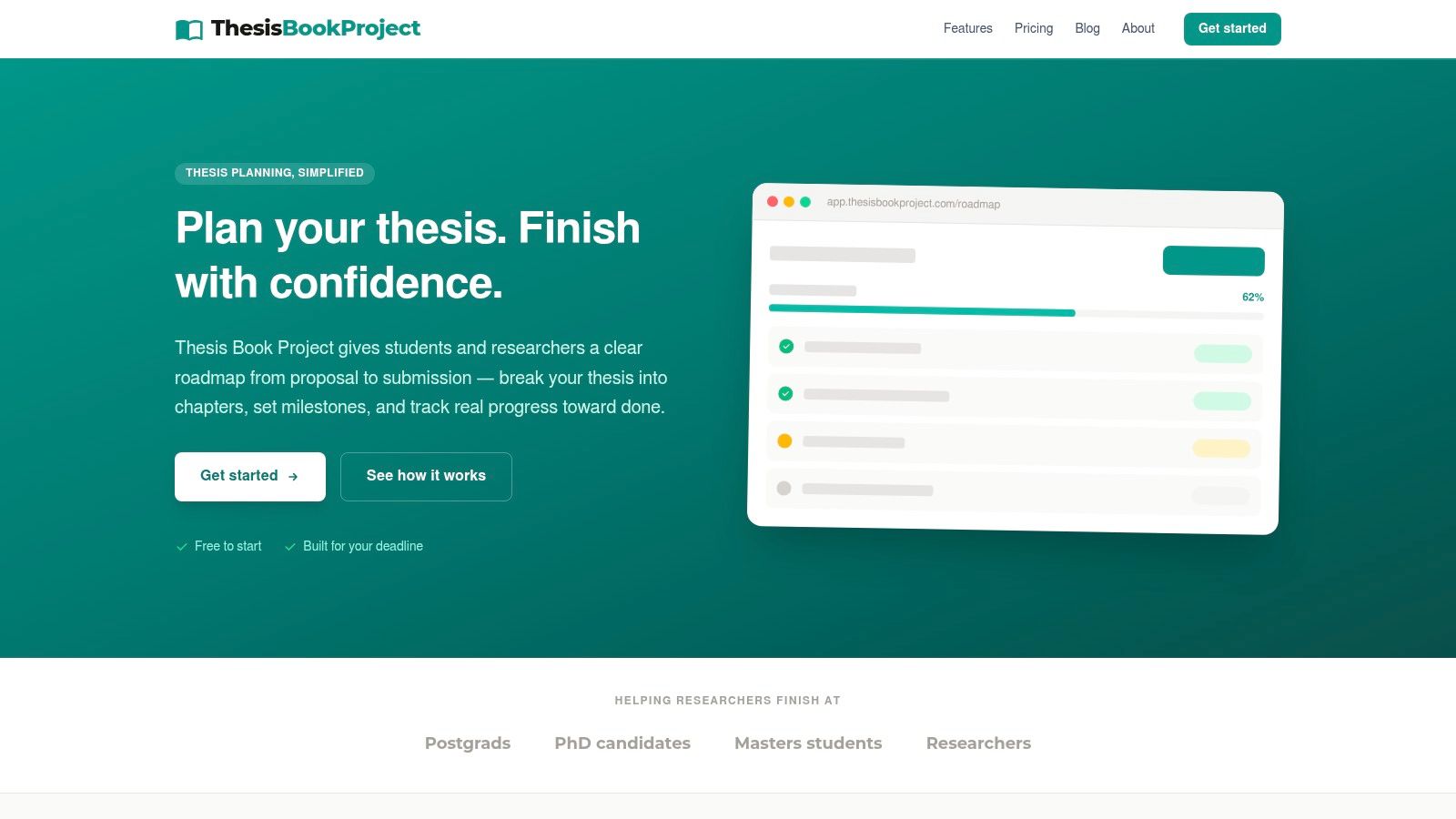
A literature review becomes useful to a thesis when every source has a planned role. A study about theory may belong in the conceptual framework, while research grouped by method may support a later discussion of evidence limits. Thesis Book Project provides a worked example of this planning decision by helping students and researchers connect reading, chapter sections, deadlines, and supervisor feedback.
Its central model is a deadline-anchored thesis roadmap. Set the submission date, work backward to create milestones, divide the project into chapters and sections, and track each component from outline to draft to final version. The platform therefore addresses a planning problem: how to fit reading, synthesis, drafting, meetings, and revision into one sequence. It does not show the prose or argument of a conventional literature review paper.
The platform groups several planning tasks that researchers often keep in separate documents:
- Chapter tracking: Record the status of each chapter and section.
- Milestone scheduling: Set checkpoints and reminders around the submission date.
- Progress insights: Identify completed work, remaining tasks, and possible delays.
- Source management: Keep reading notes and references connected to chapter development.
- Supervisor sharing: Show advisors current blockers and next actions.
- Editorial guidance: Access articles on thesis planning, research methods, and academic writing.
What this example teaches
The useful model here is the planning decision. Before adding a source to a reference list, decide what work it will do. A theoretical source might define a concept, an empirical study might show how that concept has been tested, and a methodological paper might help explain why findings differ. Assigning those roles prevents the review from becoming a sequence of summaries.
A source manager can support a literature matrix organized by theme, method, population, theory, or finding. Link each group to a planned section, then check whether the section contains comparison and interpretation rather than only descriptions.
Practical rule: Every source should have a reason for appearing in a particular section, not merely a place in your reference list.
The trade-off is scope. The free Starter tier supports one project and community support. Paid tiers add source management and supervisor sharing, but the platform does not replace a dedicated citation manager such as Zotero or EndNote. The prices are listed by Thesis Book Project, and researchers with established desktop reference workflows may still need a separate citation tool.
Use this model when your review forms part of a dissertation, thesis, or broader research program. Create one source group for each major concept or debate, assign each group to a chapter section, and set a milestone for the first complete synthesis draft. This turns an example of project planning into a practical test: if a source has no clear section, role, or next action, reassess its place in the review.
2. UC San Diego Psychology for a complete APA review
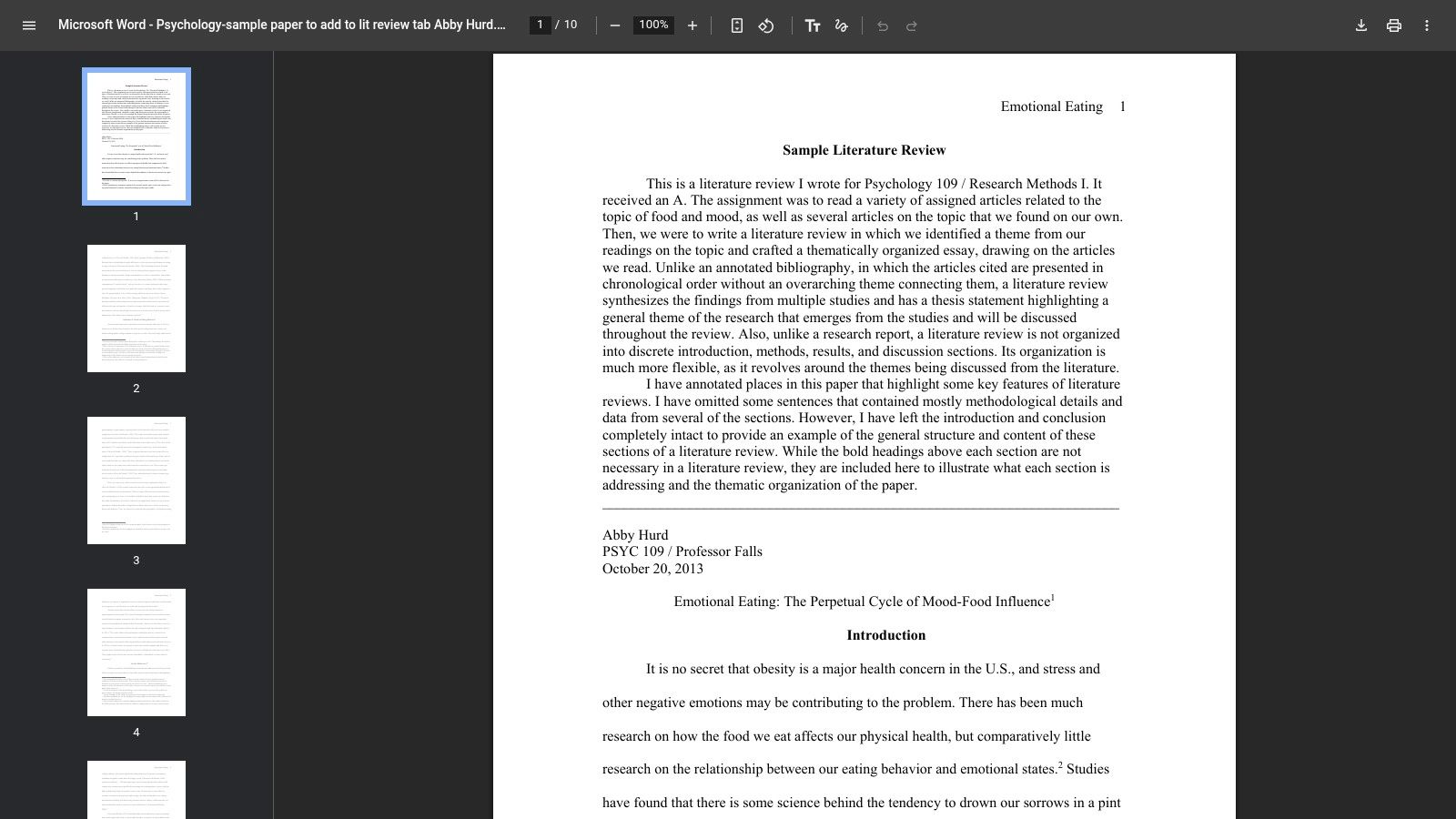
The UC San Diego Psychology resource is a strong choice when you need to see what a standalone literature review looks like in an undergraduate psychology context. Its linked student research paper treats the entire assignment as a literature review, rather than showing only the review section of a larger empirical article.
That distinction matters. A standalone review needs to establish its own topic, explain why the topic matters, organize the relevant research, and end with a coherent synthesis. A review section inside a research paper can rely more heavily on the surrounding introduction, methods, and results. Students often borrow the structure of a journal article without realizing that their assignment requires the review itself to carry the full explanatory burden.
The UC San Diego page combines the paper with step-by-step writing guidance and downloadable resources. That pairing makes it easier to study both the finished product and the decisions that produced it. Pay attention to the relationship between the introduction, body sections, transitions, and conclusion. The paper's value isn't that every heading will suit your subject. Its value is that it gives you a realistic sense of scope, tone, paragraph development, and APA-oriented presentation.
Adapt the structure, not the topic
Psychology is a limitation here. The model won't directly answer questions about citation conventions in history, literary studies, engineering, or law. It also won't replace your instructor's requirements if your course uses MLA or Chicago style instead of APA.
Use it to answer four practical questions:
- How does the introduction frame the problem? Identify the background information the reader needs before the sources appear.
- How are sources grouped? Look for themes, concepts, or stages of an argument rather than assuming every paragraph should cover one article.
- How does the writer synthesize evidence? Mark places where studies are compared or connected.
- How does the conclusion return to the purpose? Note whether it identifies an unresolved issue or clarifies the review's significance.
The best adaptation tactic is to create a parallel outline. Keep the functional labels, such as context, research themes, disagreement, and implication, but replace the topic and evidence with your own. Don't copy the sample's sentence patterns or use its organization if your research question points to a methodological or chronological structure.
Visit the UC San Diego Psychology literature review resource when you need a complete, discipline-based model. It's particularly useful before drafting your first section because it shows how a review can function as a complete assignment rather than a supporting component.
3. University of Toronto OISE for seeing synthesis in action
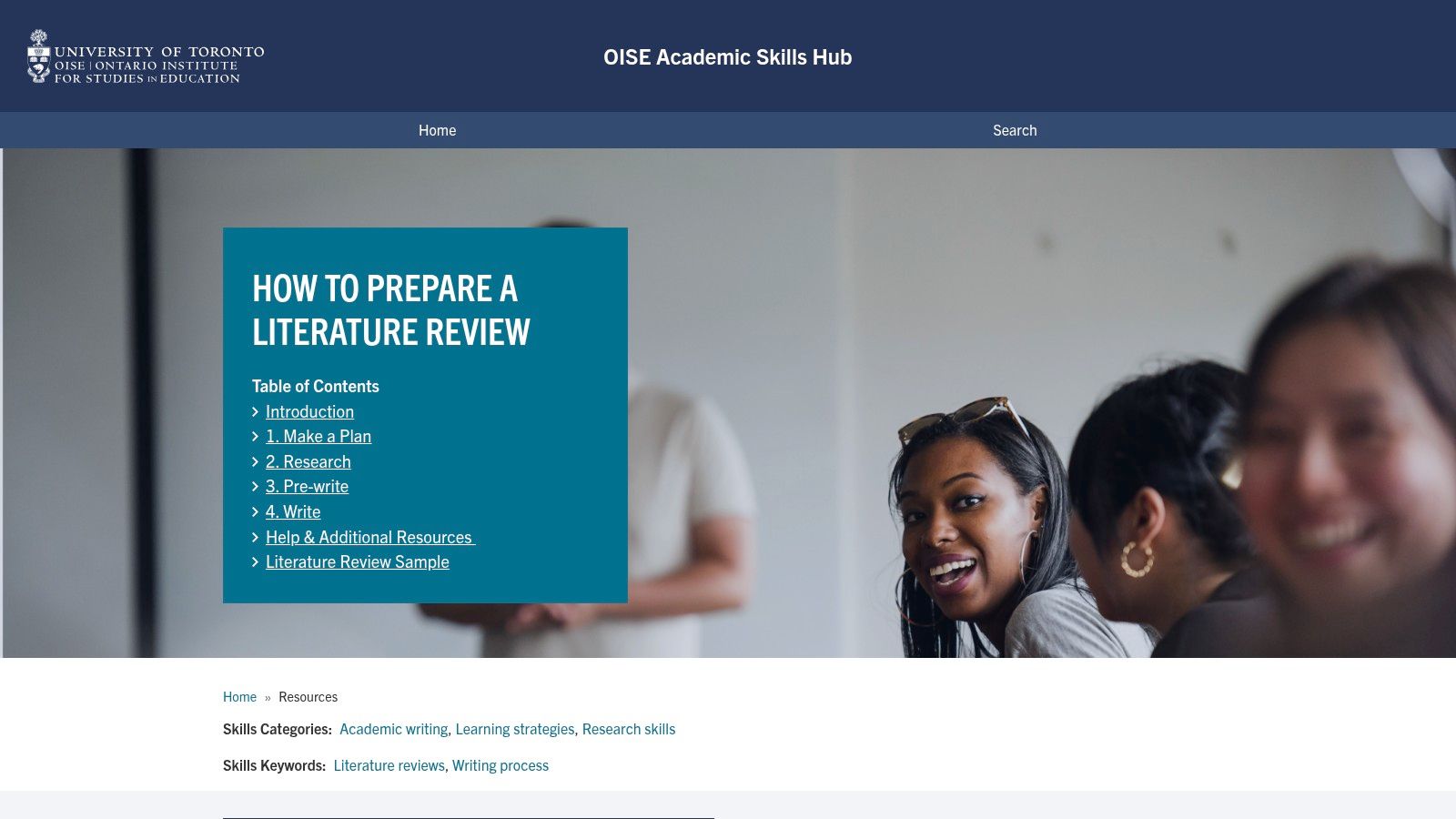
Many students understand the definition of synthesis but can't recognize it in their own paragraphs. The University of Toronto's OISE Academic Skills Hub addresses that problem with a complete student literature review on computer-mediated communication and written corrective feedback, presented with annotations that explain structural and language choices.
The annotations are the main reason to study this resource. A normal paper shows the result, but an annotated sample exposes the rhetorical moves behind the result. You can examine where the writer introduces a theme, narrows the discussion, compares studies, signals a limitation, or transitions to a related issue. That makes the example more useful than a clean PDF when you're trying to understand why a paragraph works.
The surrounding process guidance also follows a practical sequence: plan, research, pre-write, and write. This reinforces an important point. Strong literature reviews don't emerge from placing citations into paragraphs one at a time. Writers first identify relationships among sources, then build an organizing logic that allows those relationships to become visible.
Turn annotations into a paragraph method
Study one annotated body paragraph and reduce it to a repeatable pattern:
- Introduce the shared concept or debate.
- Bring together more than one relevant source.
- Compare the sources' methods, findings, assumptions, or limitations.
- Explain what the comparison means for the research question.
- Transition toward the next related idea.
That sequence doesn't mean every paragraph must contain the same number of studies. It gives you a way to test whether a paragraph is doing analytical work or merely reporting what one author wrote.
The sample's single-topic focus is also its main limitation. You'll need to abstract the method rather than copy the content. The Canadian university context may also include terminology or support pathways that don't match your institution, but the annotated writing decisions transfer well across fields.
For help organizing evidence before drafting, use this literature review table guide alongside the OISE sample. Build columns for concepts, methods, findings, contradictions, and limitations, then use the table to identify groups of sources that can support a synthesis paragraph.
Read the University of Toronto OISE annotated literature review sample when your main difficulty is moving from summary to analysis. It's the strongest option in this list for understanding what the writer is doing at paragraph level.
4. UW Madison for comparing disciplines and purposes
One literature review paper example can teach structure, but it can also mislead you if you assume its format is universal. The UW Madison Writing Center provides access to multiple literature review samples from different fields and document contexts. That variety makes the resource especially useful for understanding how the same broad task changes across disciplines and purposes.
Some examples function as standalone reviews, while others appear as sections or introductions within larger documents. Some are connected to fellowship applications, journal articles, or disciplinary assignments. Comparing them helps you distinguish essential review functions from features that belong only to a particular venue.
Look for differences in:
- Opening strategy: Some writers establish a broad intellectual problem, while others move quickly into a focused research context.
- Organizing principle: A review may use themes, chronology, theories, methods, or a combination of approaches.
- Evidence density: A journal introduction may compress the literature more tightly than a course assignment.
- Reader expectations: A fellowship panel, specialist audience, and undergraduate instructor may need different levels of explanation.
- Ending move: One review may justify a research project, while another may establish a conceptual background.
Make the comparison concrete
Choose two samples that serve different purposes. Write a short note beside each major section answering, “What decision is this structure helping the writer make?” You may find that one sample is excellent for opening a research problem but weak as a model for a full standalone review. Another may show clear thematic organization but offer little help with citation formatting.
That's why a collection is more valuable than a single supposedly perfect paper. It lets you separate structure, audience, discipline, and document type instead of treating them as one package.
The limitation is that not every linked document is a complete literature review paper. Some are shorter models or sections, and formatting conventions vary. Don't copy the visual appearance until you know which style your assignment requires.
Use the UW Madison sample literature reviews to compare models before choosing your own organizing logic. If you're saving several PDFs while deciding how to arrange your sources, this literature review sample PDF guide can help you record what each sample demonstrates and where it belongs in your planning process.
5. Excelsior OWL for APA 7 execution
Sometimes your structure is sound, but your draft still looks uncertain because the formatting and paragraph-level decisions don't work together. Excelsior University's Online Writing Lab offers a commented literature review sample formatted in APA 7. The comments explain choices related to structure, synthesis, and references while showing how those choices appear in a finished document.
This makes the sample a model for execution. You can inspect how headings, citations, paragraphs, and the reference list operate together instead of treating APA as a final layer applied after the writing is complete. The comments also help distinguish formatting compliance from analytical quality. A correctly formatted paragraph can still summarize sources without synthesizing them.
Use the sample for targeted checks:
- Paragraph construction: Identify whether each paragraph develops a claim or moves only from one citation to another.
- Citation placement: Observe how citations support specific statements rather than appearing as decorative clusters.
- Section movement: Study how headings divide the review into meaningful units.
- Reference consistency: Compare in-text citations with the reference entries.
- Synthesis language: Mark verbs and transitions that show agreement, contrast, qualification, or development.
Know what this model cannot show
Excelsior OWL is primarily an APA-oriented resource. It won't give you much disciplinary diversity, and one sample can't demonstrate every kind of literature review. It also won't decide whether your own review should be chronological, thematic, theoretical, or methodological.
Use it after you've chosen your argument and structure. If you begin with formatting, you may produce a tidy paper whose sections don't answer the research question. A better sequence is to establish the evidence groups first, draft the analytical relationships, and then use the sample to check presentation.
The Excelsior OWL APA 7 literature review sample suits students who need an in-context formatting reference rather than a broad survey of review types. Keep it open while revising, but don't mistake APA compliance for synthesis.
6. University of Vermont for a realistic undergraduate model
The University of Vermont psychology sample is useful because it's straightforward. It presents a complete student literature review from a Research Methods I context, with clear sectioning, an accessible tone, and practical integration of sources. For a first-time writer, that realism can be more helpful than a highly advanced journal article that operates at a level far beyond the assignment.
This is a model for calibrating scope and level. Students often search for published literature reviews and then assume their course paper should match the density, terminology, and breadth of professional scholarship. The Vermont sample gives you a more grounded reference point for how an undergraduate review can introduce a topic, organize evidence, and develop a conclusion.
Read it with three questions in mind:
- How broad is the topic? Does the review stay within a manageable research problem?
- How much context does the writer provide? Note what a reader needs before the evidence becomes meaningful.
- How are sources integrated? Look for places where the writer uses research to develop a point instead of producing isolated source summaries.
The psychology and APA focus limit direct transfer to other fields. A graduate thesis also requires more independent judgment, deeper engagement with methodological and theoretical disagreements, and a more carefully justified research gap. Treat this sample as a foundation, not a ceiling.
A beginner-friendly sample should clarify the task. It shouldn't dictate the final standard for every academic level.
The University of Vermont psychology literature review sample is a good starting point if you're unsure what a complete review looks like in practice. After reading it, create a version of its outline for your own topic, then add sections for the contradictions, limitations, or gap that your research needs to address.
7. Scribbr for choosing an organizing pattern
Scribbr's literature review guide is most useful before you've committed to a structure. It brings together examples and templates associated with methodological, theoretical, thematic, and chronological reviews, with downloadable formats for Word and Google Docs. Rather than presenting one ideal paper, it helps readers compare possible ways to arrange a body of research.
That's important because structure should follow the pattern you find in the literature. A chronological arrangement works when theories, debates, or findings clearly change over time. A methodological structure makes sense when researchers reach different conclusions because they use different methods. A thematic or theoretical structure may be stronger when several studies address the same concepts from different perspectives.
Modern systematic reviews require a more formal process. Guidance distinguishes them from ordinary literature reviews through features such as a pre-specified protocol, explicit search methods, structured study selection, data extraction, and quality appraisal (systematic review methods guidance). If your project is systematic, use examples that show transparent methods rather than relying on a general template.
Use templates as decision tools
Scribbr's templates can speed up early planning, but they can also encourage formulaic writing. Before selecting one, write a sentence explaining the relationship that your review must make visible. For example, you might need to show how a theory changed, why findings conflict, or which populations remain underrepresented.
Then compare the available patterns against that sentence. Choose the structure that makes the relationship easiest for a reader to follow.
For systematic reporting, PRISMA 2020 provides a 27-item checklist and revised flow diagrams designed to make the reasons, methods, and findings of a review transparent and complete (PRISMA 2020 explanation and checklist). That reporting benchmark is different from a general student template, so don't use a chronological or thematic outline as a substitute for documenting systematic procedures.
The Scribbr literature review examples and templates are best for early-stage organization. Pair them with this guide to literature review organization, then adapt the selected pattern to your question, discipline, evidence, and assignment requirements.
Comparison of 7 Literature Review Examples
| Example | 🔄 Implementation Complexity | ⚡ Resource Requirements | 📊 Expected Outcomes | 💡 Ideal Use Cases | ⭐ Key Advantages |
|---|---|---|---|---|---|
| Thesis Book Project | Moderate, web onboarding, feature learning | Low–Moderate, internet, subscription (free/Pro/Team) | Clear, deadline‑anchored thesis roadmap and measurable progress | Planning and managing end‑to‑end theses; supervisor coordination | High for thesis workflows, integrated trackers, source manager, editorial guides |
| UC San Diego – APA Literature Review | Low, read/download example | Very low, PDF and guidance | Concrete APA-format example showing structure and tone | Undergraduate psychology students learning APA literature reviews | Good discipline-specific model and stepwise guidance |
| University of Toronto (OISE) – Annotated Sample | Low, review annotations | Very low, annotated PDF + skills pages | Visible rhetorical moves; clearer synthesis and structure understanding | Learning why structural/linguistic choices work across topics | Strong pedagogical value via color-coded annotations |
| UW–Madison Writing Center – Multiple Samples | Low, browse samples | Very low, multiple PDFs across fields | Comparative view of styles, scopes, and expectations | Comparing disciplinary differences and document contexts | Wide variety of real examples for cross-discipline comparison |
| Excelsior OWL – APA 7 Sample (commented) | Low, read commented PDF | Very low, APA 7 sample with margin notes | APA 7 formatting and paragraph-level composition checks | Students needing current APA formatting in-context | Clear APA7-compliant example with instructor annotations |
| University of Vermont – Sample (Psychology) | Low, read sample PDF | Very low, single student exemplar | Realistic undergraduate scope, tone, and source integration | First-time literature-review writers in psychology | Readable, practical exemplar for undergraduate expectations |
| Scribbr – Guide with Examples & Templates | Moderate, select template and adapt | Low–Moderate, downloadable templates, curated examples | Faster drafting and clearer organizational choices | Choosing review types; starting outlines quickly | Useful templates and curated examples across review types |
Turn an Example Into Your Own Review Plan
The right literature review paper example depends on the decision you need to make. Choose a complete standalone sample if you need to understand the overall shape of an assignment. Choose an annotated paper if your paragraphs summarize instead of synthesize. Use a multi-sample collection if you're unsure how disciplinary or document expectations change. For thesis-scale work, choose a planning system that keeps sources, chapters, milestones, supervisor meetings, and the submission date connected.
Check each model against five requirements:
- Assignment type: Is your review standalone, part of a research paper, or part of a thesis?
- Discipline: Does the sample use the theories, evidence, and conventions expected in your field?
- Academic level: Does its depth match an undergraduate assignment, master's dissertation, or doctoral project?
- Citation style: Does it use APA, MLA, Chicago, or another required system?
- Scope: Is the sample's research question narrow enough to guide your own review?
Once you've chosen a model, mark its introduction, organizing logic, synthesis paragraphs, transitions, and conclusion. Don't just highlight sentences that sound polished. Label the function of each section. You're looking for the decisions that control the reader's movement through the evidence.
Create a parallel outline without copying the sample's wording or argument. Write your own research question at the top, list the concepts or debates that your sources reveal, and assign each group to a planned section. If you're unsure whether a thematic, chronological, methodological, or theoretical structure fits, compare at least two models before deciding. A contrast often reveals which arrangement will make your own evidence easiest to understand.
Use this workflow:
- Collect sources: Save complete reference details and record the question each source addresses.
- Group evidence: Sort studies by concept, debate, population, method, theory, or finding.
- Test the structure: Ask whether the groups support a clear line of reasoning.
- Assign sections: Place each group in a chapter or review section before drafting full paragraphs.
- Draft synthesis first: Explain relationships among sources before polishing individual sentences.
- Check every citation: Confirm that each claim is supported by the source you cite and that every reference appears consistently.
A strong review should also make its methods transparent when the project requires systematic procedures. High-quality guidance recommends stating the structured question, search terms, databases and dates, inclusion and exclusion criteria, quality-assessment instrument, data-extraction method, and process for resolving reviewer disagreements. A screening flow diagram can make selection decisions easier to audit and repeat (transparent literature review methods guidance).
For a thesis, Thesis Book Project can connect your review plan to chapter sections, milestones, source organization, supervisor check-ins, and the final submission deadline. Build the literature review as a tracked chapter rather than an isolated reading task. That approach helps you see whether your source collection is supporting the argument you intend to make and whether the next step is searching, grouping, drafting, or revising.
Examples are maps, not templates. Borrow the decision-making method, then adapt the structure to your research question, evidence, discipline, and audience. The strongest review won't look identical to the sample that inspired it. It'll make the logic of your own research easier for a reader to follow.
Use Thesis Book Project to organize sources, connect them to literature review sections, and track chapter milestones from outline to submission. Visit Thesis Book Project to build a structured thesis roadmap and keep your reading, drafting, supervisor check-ins, and deadlines in one place.
Related Articles
How to Write a Dissertation Abstract That Gets Read
You've finished the dissertation, and now the last page is staring back at you. The abstract fee...
Research MethodsLiterature Review vs Research Paper: Key Differences
You're halfway through a thesis when your supervisor writes, “Add a stronger literature review.”...
Research MethodsLiterature Review Organization Methods
Most advice about literature review organization starts in the wrong place. It tells students to pic...
Comments (0)
No comments yet. Be the first to share your thoughts.