10 Literature Review Sample PDFs to Use
Find 10 literature review sample pdf resources, compare their strengths and limits, and learn how to adapt each model to your own research.
A literature review sample PDF is most useful when you ignore its sentences. The underlying lesson sits in the architecture: how the writer narrows a topic, groups studies, signals comparison, evaluates evidence, and leads the reader toward a research question. University guidance commonly presents a literature review as a structured synthesis with an introduction, body, and conclusion, rather than a source-by-source summary, as shown in the San José State University literature review guide.
This list evaluates each resource by the writing problem it solves: scope, synthesis, structure, citation, or methodology. The selection favors annotation quality, genre relevance, disciplinary usefulness, methodological detail, and how easily you can transfer the writing move to your own project. A short handout can clarify paragraph logic, while a full thesis chapter demonstrates sustained organization. A systematic review report is different again, because it must make its search and selection decisions visible.
Use the list actively. Pick the sample closest to your assignment, mark its rhetorical moves, compare them with your department's requirements, and rebuild the structure around your own research question. Don't copy the topic, wording, sources, or disciplinary conventions. Study the decisions instead.
Table of Contents
- 1. University of Wisconsin–Madison Writing Center
- 2. University of Wollongong
- 3. OISE, University of Toronto
- 4. Westcliff University Writing Center
- 5. SAGE Sample Literature Reviews
- 6. CU Denver Writing Center
- 7. OSF HealthCare Literature Review Sample
- 8. Government of Canada Systematic Literature Review
- 9. Penn State Writing a Literature Review
- 10. Thomas Jefferson University Writing a Literature Review
- 10 Literature-Review Sample PDFs Compared
- Turn the Example Into Your Own Review
1. University of Wisconsin–Madison Writing Center
The University of Wisconsin–Madison Writing Center samples solve a common problem: understanding how a literature review changes with genre. The collection presents three annotated reviews drawn from real academic contexts, including a grant proposal and published articles. That range makes the resource more useful than a single student paper when you're trying to understand why one review foregrounds urgency while another foregrounds scholarly debate.
Read the annotations before reading for content. Mark where the writer establishes the topic, defines the review's boundaries, groups related studies, identifies disagreement, and explains why the evidence matters. The accompanying writing-center guidance helps you name those moves rather than treating the PDF as a finished product to imitate.
What to study
- Scope: Notice how each review decides what belongs and what stays outside the discussion.
- Synthesis: Underline paragraphs that connect several studies around one claim instead of summarizing papers separately.
- Tone: Compare the cautious language of research synthesis with the persuasive pressure of a grant context.
- Organization: Track whether the review develops chronologically, thematically, or through another logic.
Its limitation is important. These are brief examples, not complete thesis chapters, so they won't show how an extended literature review sustains a framework across many sections. The collection also contains only a small set of models. Use it to identify rhetorical moves, then pair it with a longer chapter sample if your assignment requires a substantial thesis review.
Practical rule: Copy the annotation question, not the paragraph. Ask, “What job is this paragraph doing?” before asking how it sounds.
2. University of Wollongong
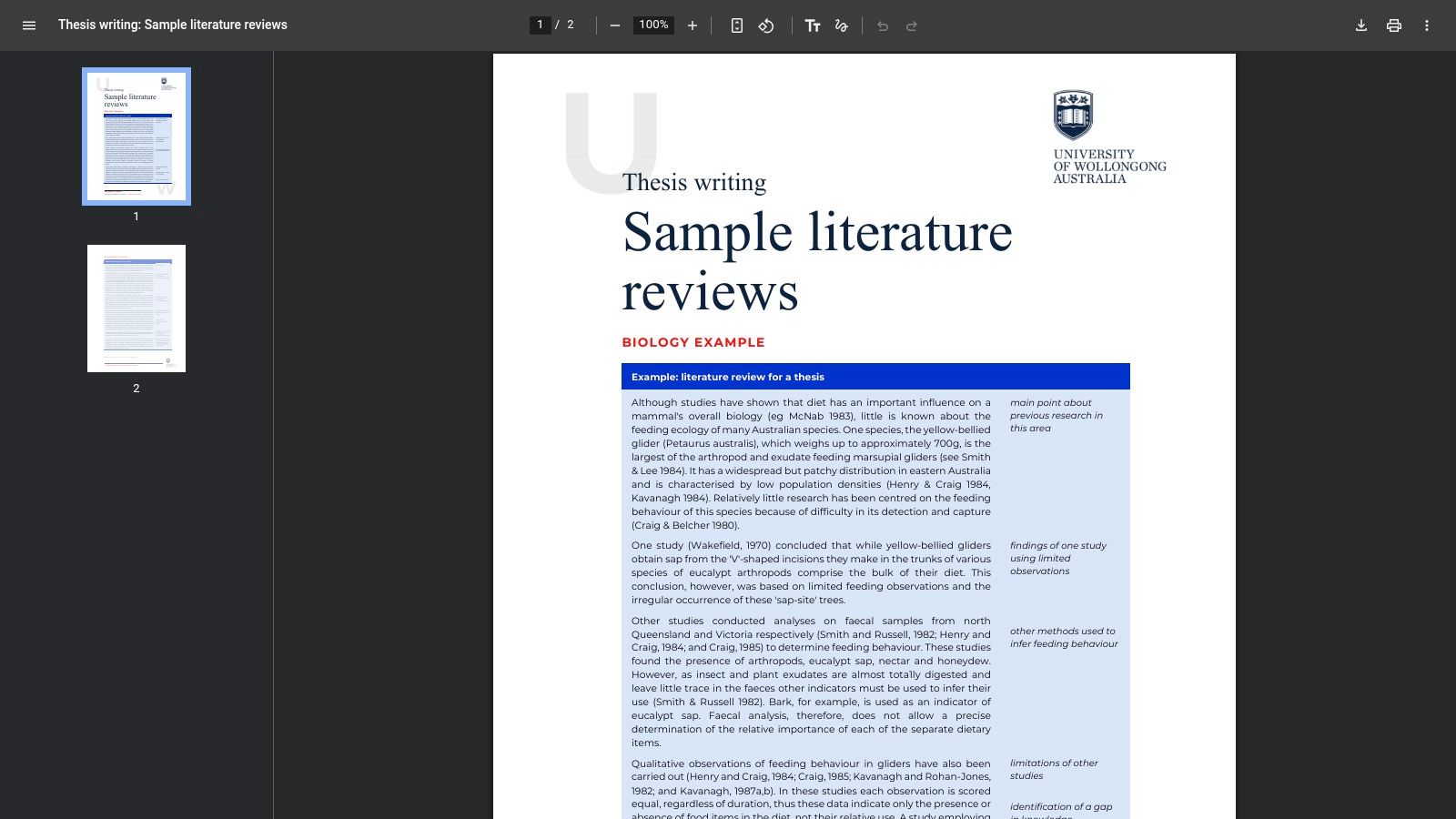
The University of Wollongong literature review PDF addresses the gap between knowing that synthesis matters and knowing how to revise summary-heavy prose. Its before-and-after examples, drawn from thesis and dissertation contexts, let you compare a weaker passage with a more developed version and then examine the commentary explaining the change.
That makes it particularly useful when your draft contains a sequence such as “Author A found,” “Author B argued,” and “Author C reported.” Don't read the revised passage as a script. Identify what changed in the relationship among sources. The stronger version may group studies, qualify a claim, introduce a contrast, or make the writer's analytical position more visible.
A revision exercise
Take one paragraph from your own review and label every sentence as summary, comparison, evaluation, or synthesis. If nearly every sentence is summary, use the Wollongong comparison to revise the paragraph around a controlling idea. For example, instead of giving three separate study descriptions, begin with the pattern those studies reveal, then use each source as evidence for or against that pattern.
The PDF is most helpful for students shaping a full thesis chapter because it focuses on chapter-level conventions. Its dated layout may feel less polished, and the examples are relatively generic rather than tightly tied to one discipline. That generic quality is also a safeguard. You'll need to supply the terminology, evidence standards, and citation rules expected in your own field.
3. OISE, University of Toronto
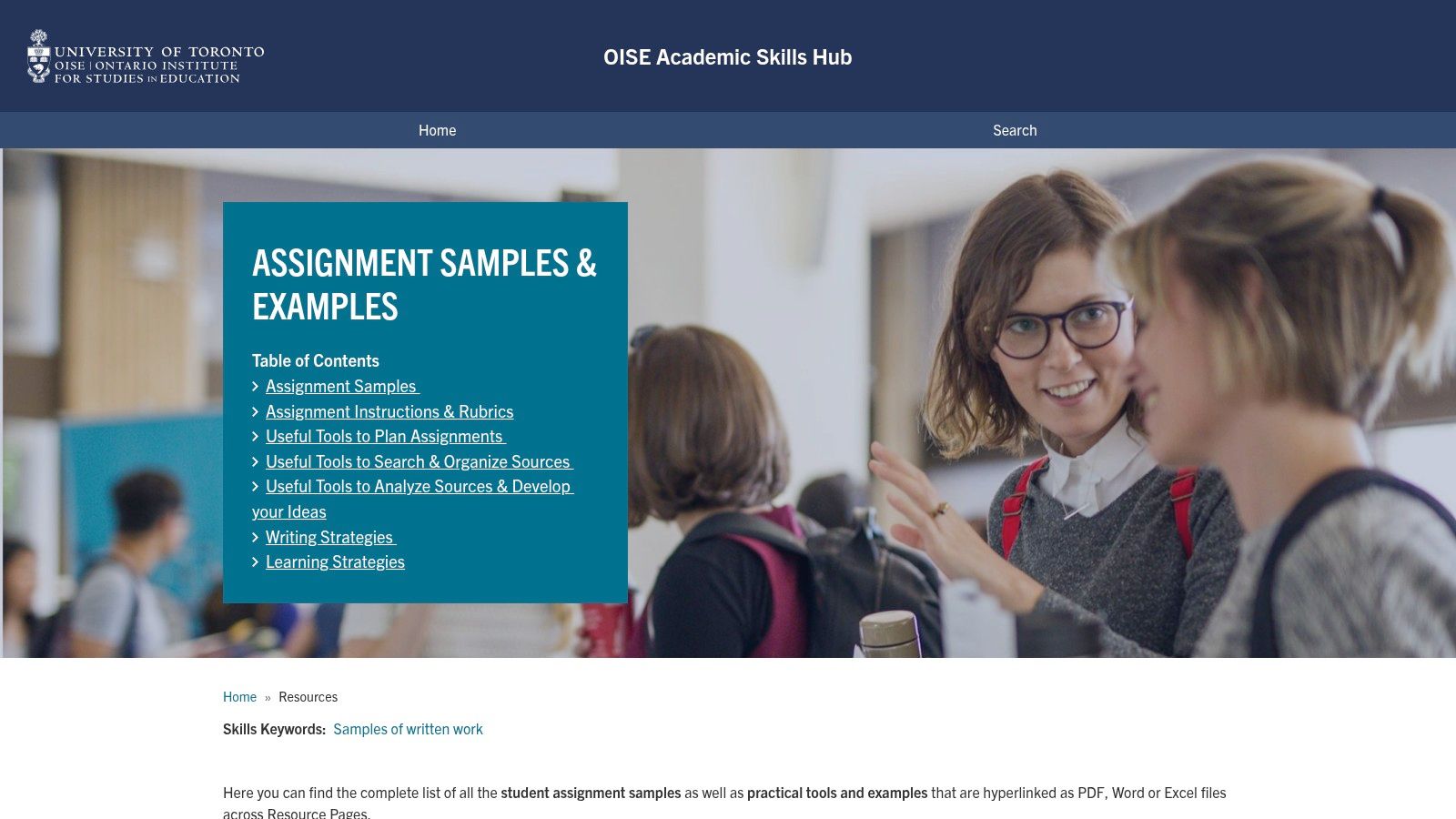
The OISE student literature review sample from the University of Toronto solves a different problem: seeing sustained reasoning across a complete review. Instead of offering only an isolated paragraph, it presents a full-length student review with margin annotations that discuss structure, paragraphing, paraphrase, language, and authorial voice.
Read the document twice. On the first pass, follow the argument without taking notes on individual sources. On the second, write a short label beside each paragraph, such as “defines the debate,” “compares findings,” “limits a conclusion,” or “connects the theme to the question.” This reveals how the writer moves from a broad educational or social-science issue toward a focused research problem.
Where transfer requires care
The annotations are pedagogically rich, especially if you're learning how to paraphrase without losing your own voice. The sample also demonstrates how a focused question can emerge from grouped literature rather than appearing as an unsupported statement at the end.
Its main limit is disciplinary transfer. A model rooted in education and social science may organize concepts, arguments, and evidence differently from a literature review in engineering, history, or laboratory science. Borrow the paragraph functions and progression, but check whether your field expects theoretical, chronological, methodological, or evidence-based organization. Your supervisor's preferred chapter logic takes priority over the sample's surface format.
4. Westcliff University Writing Center
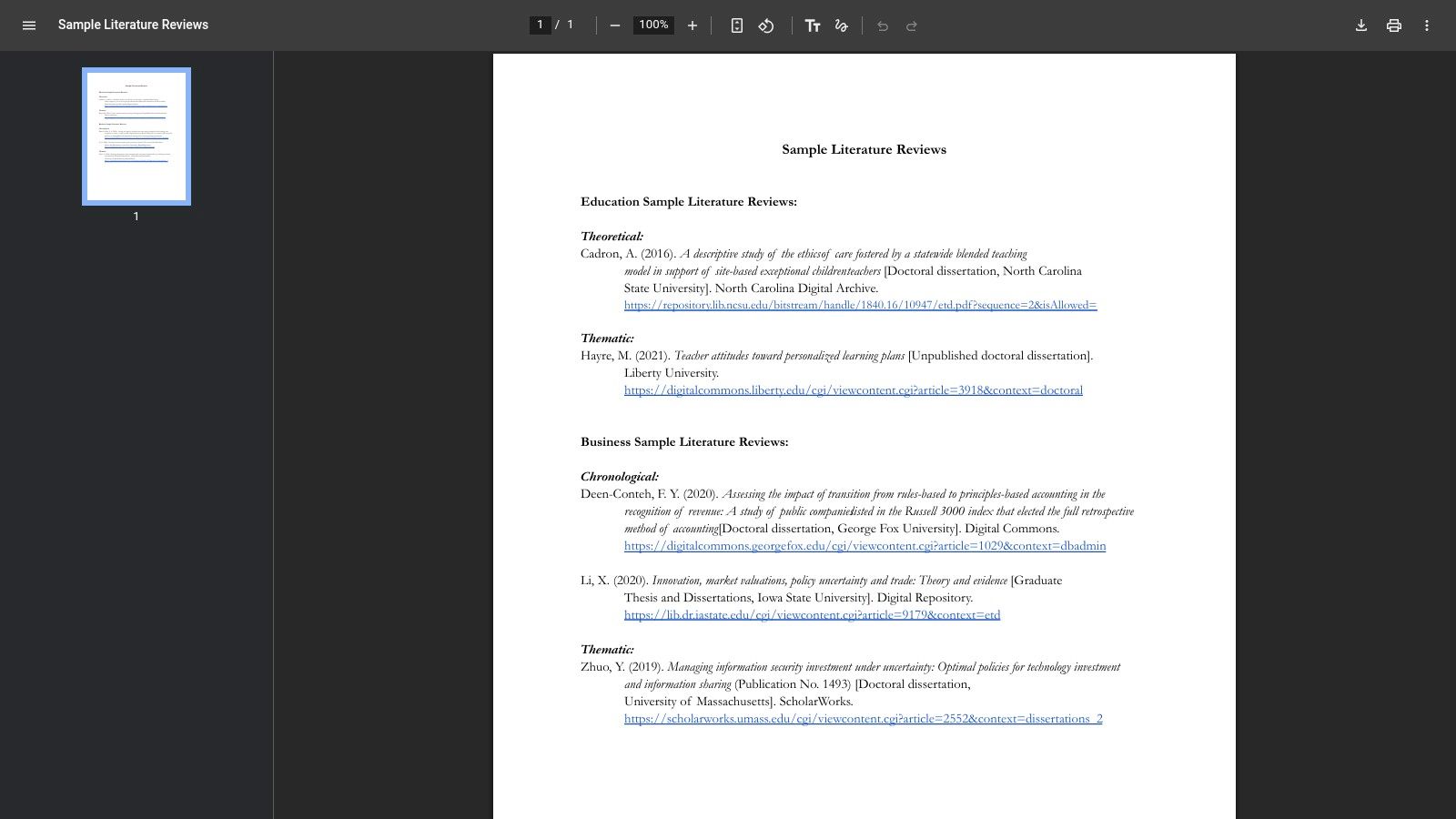
The Westcliff University Writing Center sample collection is useful for a practical classroom problem: recognizing citation and synthesis patterns quickly. It gathers several student literature reviews in one PDF, so you can compare how writers integrate sources, use APA-style citations, create transitions, and divide a review into sections.
Don't select the most polished-looking sample and assume it's the best model. Compare multiple passages and ask which choices remain consistent across them. Look at how writers introduce a source, whether citations support a sentence or an entire paragraph, and whether a paragraph makes a claim before presenting evidence.
A fast comparison method
Choose one theme from your assignment and find how each sample handles a similar transition. Then record:
- Source placement: Does the writer name the researcher in the sentence or place the citation at the end?
- Claim strength: Does the language distinguish evidence from interpretation?
- Paragraph focus: Can you summarize the paragraph's point without listing its sources?
- Reference consistency: Do in-text citations and reference entries follow the same style?
The collection's advantage is accessibility. Student-authored models often resemble the type of assignment you're expected to submit more closely than a published article does. Its limitation is equally clear: quality and rigor vary. Treat the PDF as a pattern-recognition tool, not as an authority on what a strong argument must contain. Verify every citation convention against your institution's current style guide and assignment brief.
5. SAGE Sample Literature Reviews
The SAGE sample literature reviews accompanying Zina O'Leary's research-methods resources target the problem of tight synthesis. These professionally edited examples are concise, clearly signposted, and useful when your writing feels overloaded with background or when each paragraph tries to cover too many ideas.
Study the topic sentences first. A strong topic sentence tells you the analytical direction of the paragraph, while the following sources support, complicate, or qualify that direction. Then inspect the transitions. Words such as “however,” “similarly,” and “in contrast” matter only when the underlying relationship is real, so identify the actual comparison each transition introduces.
Turn the model into an outline
Create a two-column note. In the first column, write the paragraph's function. In the second, write the evidence relationship, such as agreement, tension, development, or limitation. This transforms a polished sample into an outline you can reuse without copying its language.
If you're building a reading system alongside the writing, a literature review table can help you record each source's question, method, finding, limitation, and relevance to your emerging themes. The SAGE resource may require access through a student-resources sign-in, which makes availability a practical limitation. It also demonstrates concise academic prose rather than the full demands of a long thesis chapter. Use it for sentence and paragraph control, then test those moves in a larger structure.
6. CU Denver Writing Center
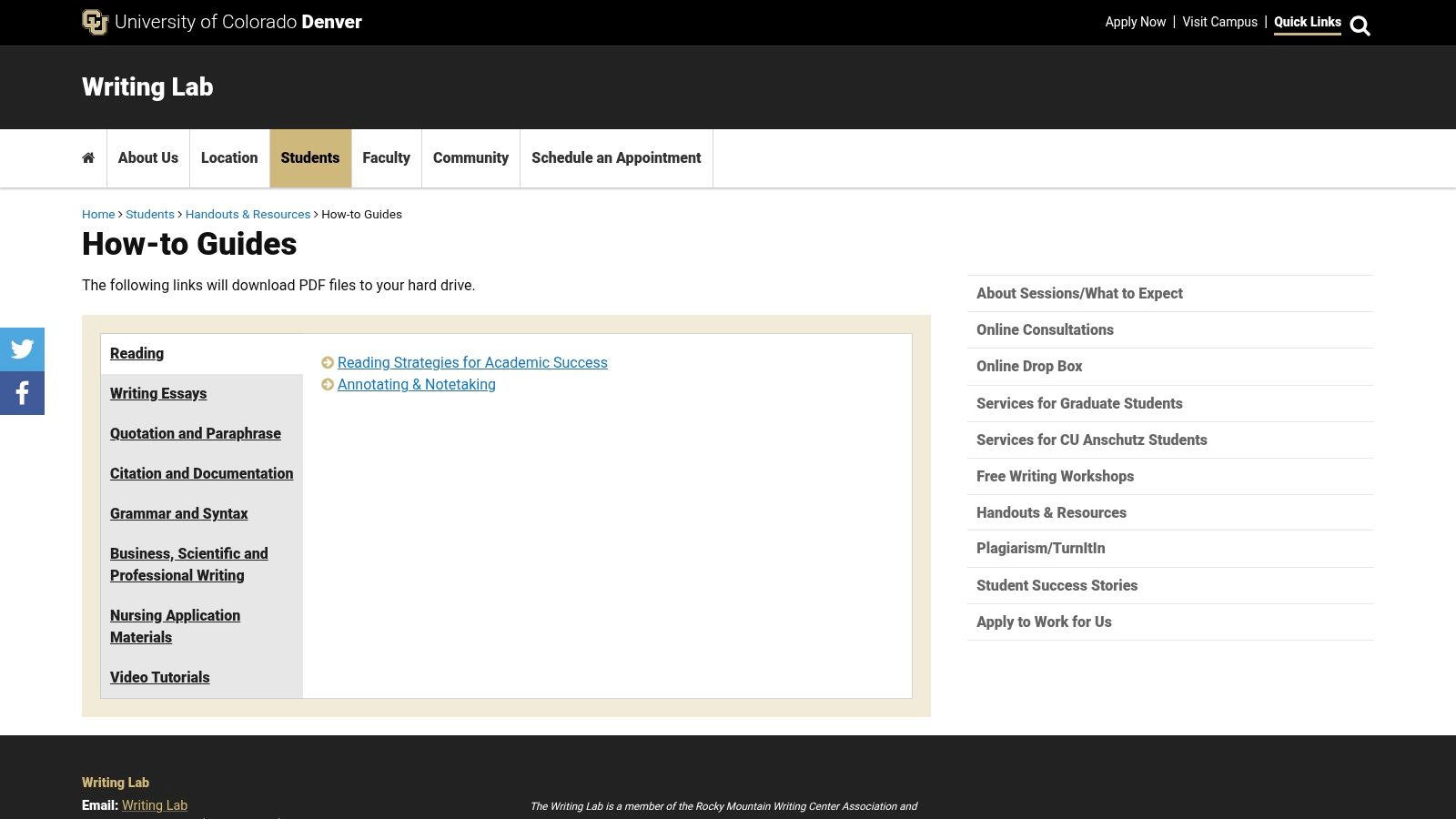
The CU Denver Writing Center resources solve the problem of disciplinary entry. The collection includes sample literature reviews focused on nursing and Latino youth topics, paired with practical guidance on writing a review. Those field anchors help students see how headings, transitions, source integration, and synthesis work when the literature has a recognizable professional context.
Start by identifying the review's organizing principle. Does it move from broad context to a population, intervention, or problem? Does each section answer part of an implied research question? Then compare that sequence with your own assignment. A nursing review may foreground clinical evidence and practice implications, while a social-science review may devote more space to concepts, context, or competing interpretations.
Use the guide with the sample
Read the instructional handout before drafting. Keep a running list of the moves you can transfer:
- Section logic: Give every heading a reason for existing.
- Transitions: Explain why the discussion moves from one theme to the next.
- Synthesis: Place studies in conversation instead of treating each as an isolated entry.
- Relevance: Connect the reviewed evidence to the question your project will address.
The resource offers only a limited range of topics, so it won't represent every discipline. That's not a reason to reject it. Use the examples to learn how disciplinary language shapes emphasis, then replace field-specific assumptions with the standards of your department.
7. OSF HealthCare Literature Review Sample
The OSF HealthCare literature review sample is a strong choice when your writing problem is narrowing a practical topic into an evidence-based discussion. Its healthcare focus, structured headings, and integration of empirical studies show how a review can keep a clinical question visible while comparing research findings.
Read the headings as decisions, not decoration. A useful heading tells the reader what relationship or theme the next group of studies will establish. Under each heading, examine whether the writer explains what the evidence means, where studies differ, and what remains uncertain.
What healthcare students can borrow
The sample's clinical voice can help you avoid two common extremes. You don't need to write a source catalogue, and you don't need to make claims broader than the evidence permits. Instead, introduce the issue, group studies by a meaningful theme, and qualify conclusions when populations, methods, or outcomes differ.
Students outside healthcare should be selective. The evidence conventions and professional tone may not fit a humanities dissertation or an engineering thesis. Borrow the narrowing process and heading discipline, not the clinical assumptions. Check whether your course expects a narrative chapter, a formal evidence synthesis, or another review type before adopting the sample's structure.
8. Government of Canada Systematic Literature Review
The Government of Canada systematic literature review example addresses the most overlooked writing problem: methodological transparency. It shows a review process that makes the search strategy, inclusion and exclusion decisions, evidence tables, and narrative synthesis visible to the reader.
That makes it unsuitable as a default model for every literature review. A traditional narrative review may be organized around a broad argument or conceptual framework, while a systematic review must explain how the evidence was found and selected. The systematic review guide from the Australasian Professional Society on Alcohol and other Drugs likewise emphasizes protocol-led planning, saved searches, screening records, and quality appraisal.
Study the audit trail
Look beyond the polished prose. Find the places where the review records what was searched, which studies qualified, how evidence was extracted, and how the synthesis was built. If your project requires a systematic approach, create parallel working documents while you search. Save the exact search strings, record why sources were excluded, and preserve the reasoning behind your categories.
A common mistake is to copy the report's headings into a narrative thesis chapter. Instead, first decide whether your assignment requires a systematic method. If it does, the sample can help you plan a traceable process. If it doesn't, use the evidence tables as inspiration for a private synthesis matrix, not as a reporting burden you haven't been asked to meet. For guidance on locating the unresolved issue your review should establish, see what a research gap is.
9. Penn State Writing a Literature Review
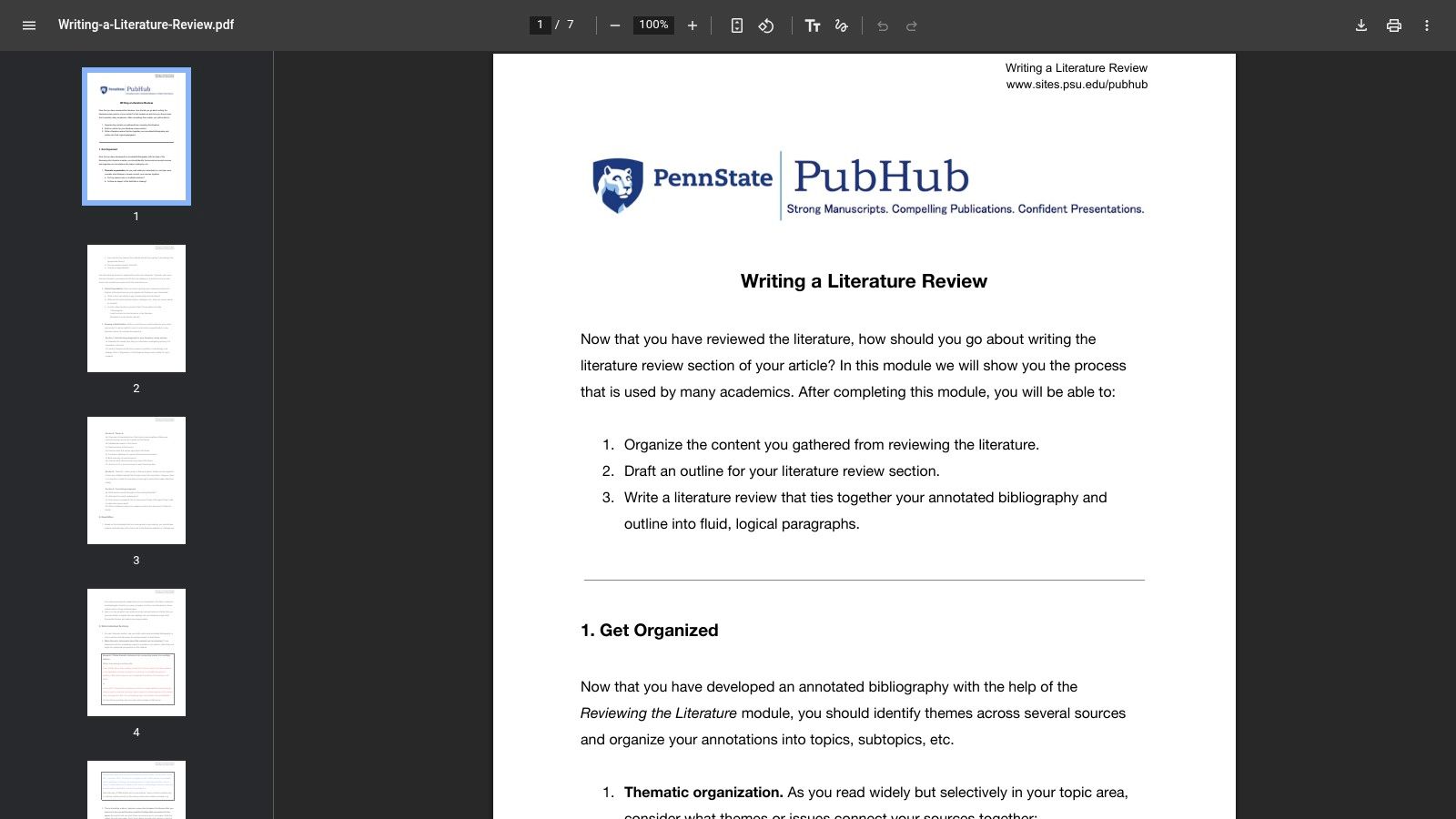
The Penn State literature review handout is designed for the first decision a beginner faces: what does synthesis look like at sentence level? It's compact and printable, with a short sample passage that demonstrates signaling, transitions, structure, and authorial voice.
Use it before opening a long thesis sample. Read the example once, then cover the text and reconstruct its logic from memory. What claim appears first? Which sources are grouped together? Where does the writer compare or qualify evidence? This exercise helps you see that synthesis is not a special type of vocabulary. It's the arrangement of claims and sources.
Pair it with a longer model
The handout isn't a full standalone review, so it can't show how an argument develops across a complete chapter. Pair it with The Complete Guide to Writing a Literature Review, then use the Penn State passage as a sentence-level reference while you draft.
For your own paragraph, write the analytical point before inserting citations. If you start with a source, you'll often drift into summary. If you start with the relationship among sources, you're more likely to produce a paragraph that compares, evaluates, or synthesizes evidence.
10. Thomas Jefferson University Writing a Literature Review
The Thomas Jefferson University writing guide solves the planning problem: turning an assignment prompt into a workable outline. It summarizes the purpose, process, and structure of a literature review and includes a pre-writing checklist you can use before searching or drafting.
It isn't a full sample literature review. That limitation is also its value. Use it as a control document while studying one of the longer examples in this list. Check whether you've defined the topic, decided what belongs in the review, grouped the literature logically, and identified how the discussion connects with your research question.
Build your own structure
Write your proposed headings in a separate document and add one sentence under each heading explaining its job. If you can't explain the job, the heading may be too broad, too narrow, or disconnected from the question. Then assign your sources to headings provisionally. A source should support a section's analytical purpose, not merely fit the general topic.
The guide works well as a quick reference when you're outlining, but it can't teach sustained synthesis on its own. Don't mistake a clean checklist for a finished argument. After planning, return to a complete sample and inspect how the writer develops each section through comparison, evaluation, and explicit connections among studies.
10 Literature-Review Sample PDFs Compared
| Resource | Sample type & scope | Quality (★) | Best for (👥) | Unique strength (✨ / 🏆) | Access / Price (💰) |
|---|---|---|---|---|---|
| University of Wisconsin–Madison Writing Center | Three annotated literature reviews (grant + 2 articles); short genre examples | ★★★★ | 👥 Undergraduate & grad writers exploring genre differences | ✨ Annotations that expose rhetorical moves 🏆 university credibility | 💰 Free |
| University of Wollongong | Consolidated PDF with before/after thesis‑chapter samples and commentary | ★★★★ | 👥 Students revising full thesis chapters | ✨ Side‑by‑side edits showing synthesis vs summary | 💰 Free (dated layout) |
| OISE, University of Toronto (Student Sample) | Full, annotated chapter with margin notes; strong education/social‑science focus | ★★★★★ | 👥 Education & social‑science graduate students | ✨ Pedagogical annotations on voice & structure 🏆 exemplary full chapter | 💰 Free |
| Westcliff University Writing Center | Multi‑page PDF of multiple student literature reviews across topics | ★★★ | 👥 Students wanting many examples quickly | ✨ One‑stop set for pattern recognition | 💰 Free (variable sample quality) |
| SAGE (Zina O'Leary), Sample Literature Reviews | Two professionally edited, concise exemplars tied to textbook | ★★★★★ | 👥 Researchers across disciplines seeking tight synthesis | ✨ Publisher‑vetted, clear signposting 🏆 high editorial quality | 💰 Free / account may be required |
| CU Denver Writing Center | Two field‑specific samples (nursing, Latino youth) + how‑to guide | ★★★★ | 👥 Health & social‑science students | ✨ Discipline‑anchored models with practical guidance | 💰 Free |
| OSF HealthCare, Literature Review Sample | Standalone clinical literature review with structured headings | ★★★★ | 👥 Clinical / evidence‑based practice students | ✨ Strong example of integrating empirical studies | 💰 Free |
| Government of Canada (Health Canada), Systematic Review | Full systematic review: search strategy, inclusion/exclusion, evidence tables | ★★★★★ | 👥 Public‑health & policy researchers needing rigorous methods | ✨ Protocol‑style transparency & PRISMA‑level detail 🏆 methodological gold‑standard | 💰 Free |
| Penn State, Writing a Literature Review (PDF) | Concise printable handout with short sample passage | ★★★ | 👥 Beginners seeking a quick on‑ramp | ✨ Compact, printable guidance for first‑time writers | 💰 Free |
| Thomas Jefferson University, Writing a Literature Review | Two‑page summary + actionable pre‑writing checklist | ★★★ | 👥 Students outlining their review quickly | ✨ Fast checklist template for planning | 💰 Free |
Turn the Example Into Your Own Review
A sample PDF becomes useful only when it changes a decision in your own project. Start by choosing the closest model by genre and discipline. A short handout can teach paragraph movement, an annotated article can show rhetorical choices, a thesis sample can demonstrate chapter-level development, and a systematic review can model transparent searching and screening. Don't ask which PDF looks most impressive. Ask which one matches the work your assignment requires.
Next, identify the sample's research question and organizing principle. Write the question in your notes, then describe the structure in plain language. It might move by theme, chronology, method, theory, population, or intervention. If you can't explain the organizing principle, you're not ready to adapt the model.
Read the sample with paragraph labels. Mark each paragraph as primarily summary, comparison, evaluation, or synthesis. Summary reports what a source says. Comparison places sources beside one another. Evaluation considers the strength, limitation, or relevance of evidence. Synthesis explains the larger pattern created by multiple sources. Strong reviews use all four, but they don't let summary dominate the chapter.
Extract the transition and citation patterns separately from the wording. Note how the writer signals agreement, disagreement, qualification, development, and uncertainty. Then inspect whether citations appear after individual claims or support a broader synthesis. Rebuild those patterns around your own sources. Don't transplant the sample's sentences or paragraph order without understanding the evidence relationship that made them appropriate.
Your outline should serve your question, not the PDF. Replace the model's headings with headings that group your literature around the concepts, debates, methods, or gaps relevant to your study. Check each section by asking, “What does this section establish, and why does my reader need it before the next section?” Delete material that only repeats background or decorates the chapter with loosely related sources.
Keep a source manager and chapter tracker beside your reading notes. A source manager helps you preserve accurate bibliographic details and connect each article with themes, methods, limitations, and quotations. A chapter tracker helps you see whether a source belongs in the literature review, theoretical framework, methodology discussion, or another section. Those tools reduce the chance that useful reading remains disconnected from the chapter you're writing.
Finally, verify every borrowed convention. Citation style, heading levels, terminology, evidence standards, and review methodology can differ by department, supervisor, and assignment. Don't copy a sample's claims, source selections, wording, or field-specific expectations. Use it to learn how writers make decisions, then produce an independent synthesis that represents your own question, your own evidence base, and your own accurate citations.
Thesis Book Project helps students and researchers turn a literature review from scattered reading into a planned chapter through its thesis roadmap, chapter tracker, milestones, source manager, and progress visibility. Visit Thesis Book Project to connect your sources with the right chapter sections and keep your review aligned with the wider thesis deadline.
Related Articles
How to Write a Dissertation Conclusion: A Practical Guide
You're down to the last chapter, the argument is already built, and the deadline is uncomfortabl...
Research MethodsWhat Is a Research Gap and How to Find It Fast
A research gap is a defensible absence in prior scholarship where evidence is missing, insufficient,...
Research MethodsHow to Write a Problem Statement for Research That Works
You've probably seen this supervisor comment already: “Interesting topic, but the problem isn...
Comments (0)
No comments yet. Be the first to share your thoughts.