Literature Review Table: Templates and Examples
Build a clear literature review table with templates and examples. Learn what columns to include, how to populate cells, and how to spot gaps and patterns.
You can have a folder full of PDFs, a half-finished chapter, and still not know what the literature is actually saying. The problem usually isn't access to sources, it's that the notes are trapped inside source-by-source summaries, so the argument never forms.
A literature review table fixes that by forcing the same questions across every source. Once each row follows the same columns, the patterns stop hiding in prose and start showing up in the structure.
Table of Contents
- When the Reading Pile Stops Making Sense
- What a Literature Review Table Actually Does
- Main Table Variants and When to Use Each
- Choosing Columns That Match Your Study
- Populating Cells With Comparable Entries
- Distinguishing Real Gaps From Empty Cells
- Reading the Table for Trends and Bias
- Common Mistakes That Undermine the Table
- Keeping the Table Updated Across the Thesis
- Quick Reference Checklist and Decision Aid
When the Reading Pile Stops Making Sense
The usual failure point is familiar. A student downloads 40 or 60 papers, highlights them in different colors, and then tries to write from memory by opening one PDF at a time. The draft ends up sounding like a stitched bibliography, not a review.
That happens because source-by-source note taking encourages isolated summaries. One article gets a paragraph on sample and method, the next gets a paragraph on findings, and the next gets a paragraph on limitations, but the links between them never get made explicit.
A literature review table changes the task. Instead of asking, “What did Author X say?”, you ask, “What does the same column show across all authors?” That shift matters in thesis work because it makes comparison visible before the writing starts, which is exactly what the review matrix format was built to do in synthesis-oriented work TheReviewProtocol guide on the literature review matrix.
Practical rule: if a source can't be placed in a row without breaking your column logic, the column design is wrong, not the paper.
The main payoff is not neatness. It's that the table makes gaps, clusters, and contradictions easier to see, so the chapter becomes an argument about the field rather than a stack of notes. That's why thesis writers who keep the review table updated usually spend less time rewriting entire sections later and more time refining the actual synthesis.
What a Literature Review Table Actually Does
A literature review table is a matrix. The rows represent sources, and the columns represent the analytic dimensions you want to compare, such as method, population, theme, theory, or finding. It is not a bibliography with extra decoration, and it is not a place to paste abstract summaries.
The matrix approach has a long academic lineage. In evidence-synthesis traditions, reviewers moved away from summarizing one paper at a time and toward extracting comparable details across studies, so the synthesis happened by concept instead of by source. That same logic later became embedded in formal review systems, including the structured summary-of-findings tables used in Cochrane's RevMan 5, which present effect estimates, study counts, participant counts, and evidence quality in a single view EPPI-Centre history of systematic reviews.
That's also why a good table behaves like an audit trail. A supervisor should be able to trace a claim in your chapter back to a row, and a row back to a source. If a claim can't be traced, the table isn't doing its job.
For a useful companion on the broader organization problem, Kohru's organization method is worth reading alongside the table approach because it reinforces the same principle, structure first, prose second.
The best way to think about the table is by function:
- Organizing reading: it collects what you have already screened and extracted.
- Forcing comparability: it makes unlike studies line up on shared dimensions.
- Supporting synthesis: it helps you see convergence, divergence, and absence without rereading every paper from scratch.
For a broader chapter-level view, the internal guide on writing a literature review fits neatly with this table logic because the table is the working draft behind the chapter narrative.
Main Table Variants and When to Use Each
The biggest mistake is treating every literature review table as if it should look the same. It shouldn't. The right variant depends on what your review needs to prove, compare, or map.
The four practical variants
| Variant | Best For | Typical Columns | Watch Out For |
|---|---|---|---|
| Descriptive | Broad background, narrative reviews, scoping work | Citation, aim, context, method, key finding | Turning into a list of summaries |
| Methodological | Mixed-methods or replication-focused projects | Design, sample, instrument, analysis, limitations | Overloading the table with irrelevant narrative detail |
| Thematic | Questions like “what do we know about X?” | Theme, evidence from source, pattern, contradiction | Forcing unrelated themes into one column set |
| Conceptual | Theory-heavy, grounded-theory, or meta-synthesis work | Construct, definition, framework, relationship to theory | Treating concepts as if they were empirical variables |
A descriptive table is the safest starting point when you're still mapping a field. It works when breadth matters more than depth, but it can become thin if you leave the synthesis at the level of “this paper said that paper said.” A methodological table is better when rigor is part of the argument, because it makes design and analysis visible across studies.
A thematic table is usually the best fit when the chapter needs to answer a substantive question, not just describe the literature. It helps you compare recurring ideas across sources, which is what thesis examiners usually want to see in a serious review chapter. A conceptual table becomes the right choice when the dissertation is about constructs, definitions, or theory development rather than simple evidence collection.
The decision cue is simple. If your argument is about coverage, use descriptive. If it is about rigor, use methodological. If it is about patterns of meaning, use thematic. If it is about how a field defines ideas, use conceptual.
Choosing Columns That Match Your Study
The most useful columns are the ones your chapter will rely on later. Generic fields such as title, author, and year are not enough by themselves, because they don't force comparison. The columns have to reflect the logic of the study design.
Match the columns to the evidence type
| Study design | Column set that tends to work |
|---|---|
| Qualitative study | Citation, research aim, participants and setting, data collection, analytical approach, key themes |
| Quantitative study | Citation, sample size, variables and measures, statistical technique, main result, limitations |
| Systematic review | Citation, databases searched, search dates, inclusion criteria, risk-of-bias judgment, outcome definitions |
For qualitative work, the table should expose how the study generated meaning. That means the method column matters as much as the finding column, because interviews, focus groups, and observations do not produce the same kind of evidence. If you leave out the analytical approach, you lose part of the comparison.
For quantitative work, the table needs to support a different kind of comparison. Sample size, variables, and statistical technique matter because you're often comparing the strength and shape of evidence rather than just the content of findings. If the chapter is about outcomes, then the table should make it obvious which studies measured what, and how.
Systematic reviews need a more disciplined schema. The data extraction logic from systematic review practice emphasizes standardized forms and consistent coding, because the point is reproducibility as much as summary Dalhousie guide to data extraction in systematic reviews. That's why a systematic-review table usually needs search dates, inclusion criteria, and outcome definitions, not just author and conclusion.
Practical rule: choose columns from the question backward. If a column won't help you write a comparison paragraph later, leave it out.
Column design should answer a thesis question
A good column set makes your chapter easier to write because it pre-builds the comparison logic. A poor one makes you keep re-reading papers to find details that should already be organized. The difference shows up fast when you start drafting, because the table either becomes your map or your storage bin.
Populating Cells With Comparable Entries
A table only works if the cells speak the same language. If one row contains a 40-word abstract summary and the next row contains a three-word note, the comparison breaks. The discipline is to extract the same type of information in the same level of detail every time.
Start with the PDF, not the abstract alone. Read enough of the paper to identify the study aim, the population or setting, the method, and the main finding you actually need for your chapter. Then write the cell in your own wording, using the column definition as the limit.
A useful habit is to keep each cell compact. One sentence is usually enough for the finding column, and the wording should reflect the comparison you want to make later, not the article's original order of presentation. If the study is quantitative, note the measure or result; if it is qualitative, note the theme or interpretive point; if it is a review, note the scope and the pattern it reports.
Here's the difference between messy and usable extraction:
- Messy cell: “This article discusses several issues related to student engagement, mentions that online participation can vary depending on course design, and suggests that tutors should think carefully about structure.”
- Usable cell: “Online participation rose when course design used structured prompts and regular tutor feedback.”
The second version is shorter, more comparable, and easier to read against other rows. It also stays closer to the logic of the table column instead of reproducing the article's rhetoric.
If a claim depends on a specific detail, keep the page number in your notes so you can trace it later. That matters when a supervisor asks where a statement came from, because a strong table is not just readable, it's checkable.
Distinguishing Real Gaps From Empty Cells
A blank cell is not a gap by itself. It might mean the literature is thin, or it might mean the search was narrow, the column schema was wrong, or the paper didn't report the detail you wanted. Treating every blank as a research gap is one of the easiest ways to overclaim novelty.
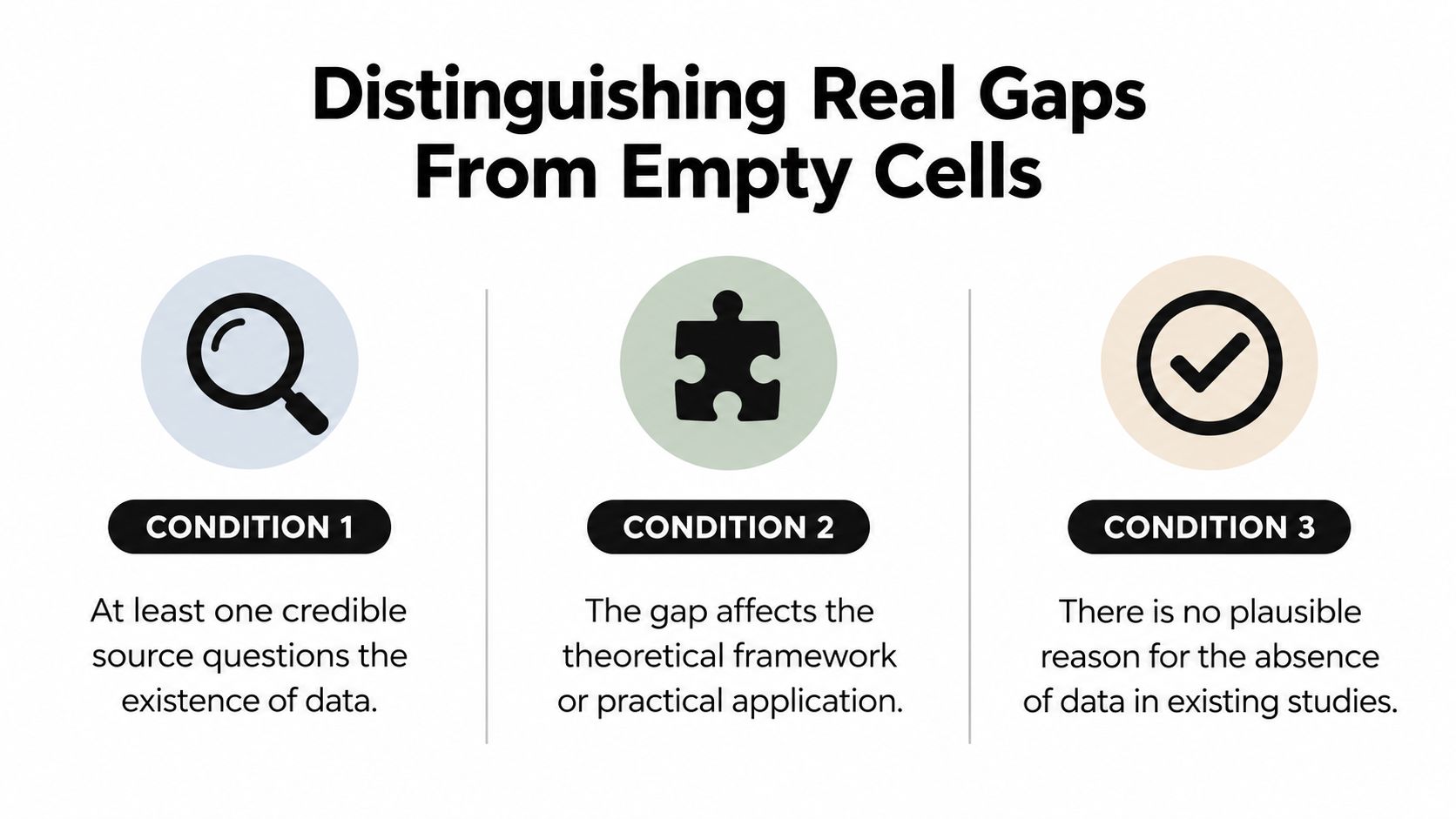
The defensible test is stricter than most student drafts allow. A true gap should satisfy three conditions at once: the missing evidence must matter to an important question, current studies must not be able to answer it because of a clear limitation, and new evidence would change how the field interprets, designs, or applies the topic. If one of those pieces is missing, call it a limitation in the evidence base, not a publishable gap.
The language matters because many tables reveal missing reporting rather than missing knowledge. A row can look empty because the paper didn't give you a variable, not because the field has never studied it. That's why the table has to be read against your actual question and not against the appearance of emptiness.
For a more direct breakdown of how to find content gaps in your niche, the same logic applies outside academic writing too, though thesis work needs a stricter test of relevance and design.
What Is a Research Gap is useful as a companion read because it reinforces the same distinction between absence, limitation, and genuine opportunity.
The video below reinforces the same idea from a different angle, especially if you're trying to separate a real opening in the field from a row that just wasn't populated well.
Reading the Table for Trends and Bias
Once the table is full, stop reading it row by row. That's how you make notes. Start reading it column by column. That's how you do synthesis.
The fastest patterns appear when you scan for concentration. If the method column keeps showing the same design, the field may be narrow in approach even if it looks large in volume. If the setting column keeps pointing to one region, institution type, or population, your chapter can say that the evidence base is skewed without needing to invent drama around it.
A sorted year column is equally revealing. It shows whether the field still relies on older foundational work or whether newer studies have shifted the conversation. That matters because outdated coverage is a real weakness when the table still leans on work that no longer represents the state of the field.
The scan below turns the table into an instrument rather than a storage sheet.
| Pattern to scan | Column to sort or filter | What it reveals | Example finding | Action for the chapter |
|---|---|---|---|---|
| Method cluster | Method/design | Whether one approach dominates | Most studies are qualitative case studies | Note methodological concentration |
| Geographic skew | Setting/country | Whether the evidence base is localized | Sources come from one region | Limit claims to that context |
| Theoretical monoculture | Framework/theory | Whether one lens dominates the literature | Same framework appears repeatedly | Name the missing alternative lenses |
| Outdated coverage | Year | Whether newer work is missing | Recent updates are absent | Re-run searches and revise the paragraph |
| Weak traceability | Claim-to-source link | Whether chapter claims map to cells | A paragraph has no matching row | Rewrite or delete the claim |
A clean table also supports auditability. If a reader can trace every major claim in your literature chapter back to a specific cell, the chapter becomes easier to defend and easier to revise. If that trace breaks, the synthesis has drifted from the evidence.
Common Mistakes That Undermine the Table
The most common mistake is treating the table like a decorative appendix. A huge matrix dumped into the chapter is not impressive if the prose never uses it. Committees notice that immediately, because an unused table is just a sign that the student extracted data without converting it into analysis.
The second mistake is copying a generic template and forcing your study into it. That usually creates awkward empty cells, useless columns, or categories that don't help the chapter argument. A schema should follow the research question, not the other way around.
The third mistake is building the table once and never returning to it. By the time the literature chapter changes, the table is already stale, and then the two stop matching. That makes the chapter harder to defend because the evidence map and the narrative no longer line up.
Practical rule: if you can't point to a paragraph that uses a specific cell, the cell probably doesn't belong in the table.
A quick self-audit works better than perfectionism:
- Check the prose link: every important row should support at least one paragraph.
- Check the schema: every column should answer a comparison question.
- Check the clutter: delete rows you can't cite within two paragraphs of analysis.
- Check the drift: if the chapter changed, the table should change too.
A literature review table earns its place when it keeps the chapter honest. If it doesn't shape the writing, it's just a spreadsheet with academic formatting.
Keeping the Table Updated Across the Thesis
A literature review table should live as long as the thesis does. New searches, advisor comments, and revision rounds all change the evidence map, so the table has to change with them. If it doesn't, the chapter becomes a snapshot of an older version of the project.
Build a maintenance rhythm around three moments. Update the table after each database search, after each substantial supervisor meeting, and after each draft revision. That keeps the review synchronized with the argument instead of lagging behind it.
Version control doesn't need to be fancy. A simple filename suffix or a change-log column is enough to show what changed and when. The point is to avoid the “Which file is current?” problem that wastes time right before submission.
A practical update workflow looks like this:
- Pull new sources from the latest search.
- Screen them against inclusion criteria before touching the table.
- Add or revise the row using the same column definitions.
- Rescan for patterns to see whether the synthesis changed.
- Rewrite the affected paragraph so the chapter and table still match.
Reference managers help here because they reduce friction between reading and extraction. If your source list and your table sit in separate places with no routine link between them, the odds of omissions rise quickly. Keep the organization system simple enough that you'll use it when deadlines get tight.
Quick Reference Checklist and Decision Aid
Before you start, use the table as a planning tool, not just a reporting tool. Before you write, use it as a synthesis map, not just a source log. That habit prevents rework later because it forces the chapter structure to grow out of the evidence structure.
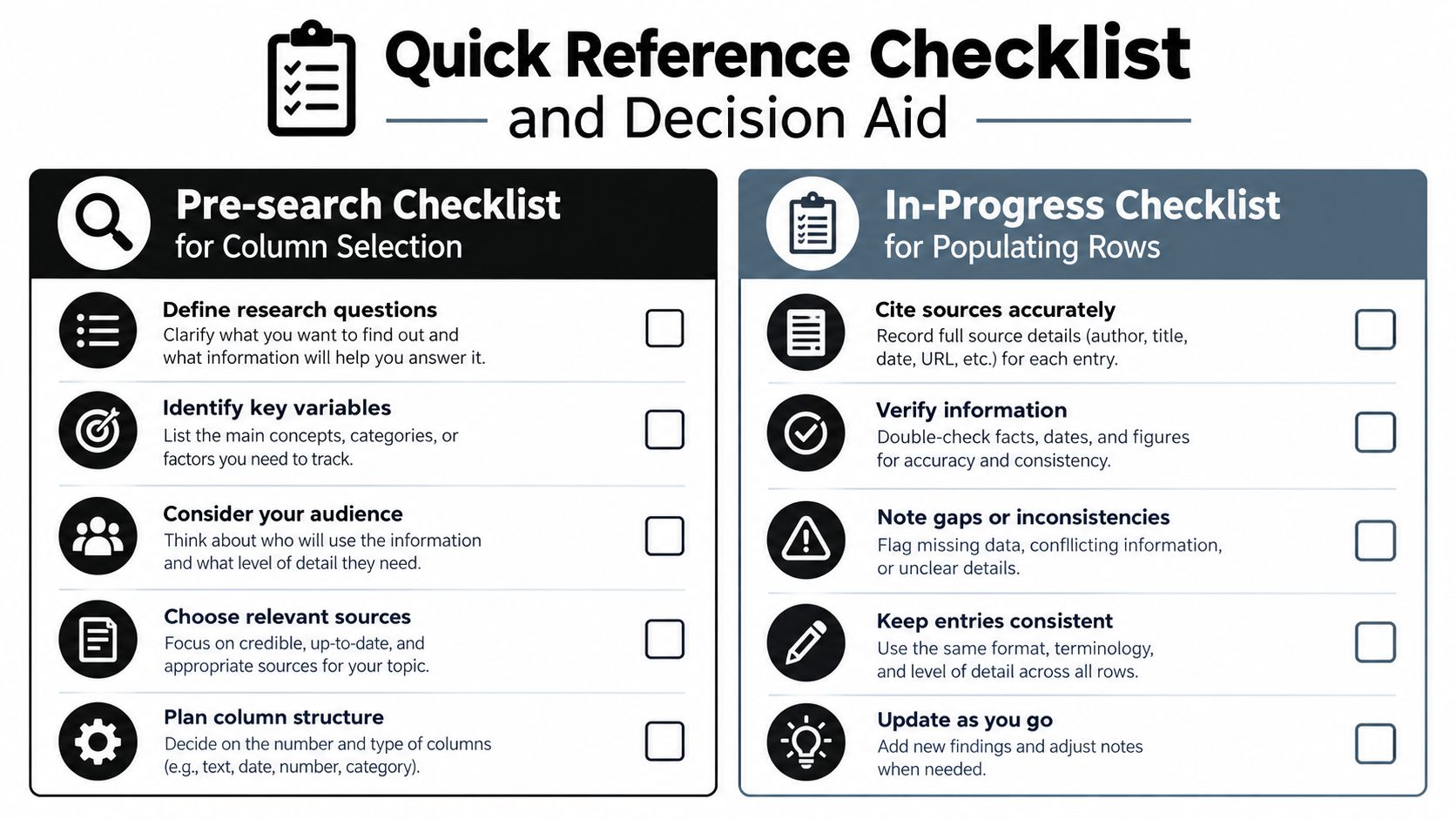
Pre-search checklist
- Define the question clearly.
- Choose the table variant that fits the aim.
- List the columns that will drive comparison.
- Decide what counts as a real gap.
In-progress checklist
- Keep each cell comparable in length and content.
- Link every row to a traceable source.
- Flag contradictions instead of smoothing them out.
- Revisit the table after every new batch of sources.
Pre-write checklist
- Sort the year column and check for outdated coverage.
- Scan the method column for clustering or bias.
- Test any gap against the three-condition rule.
- Write only the claims the table can support.
Simple decision aid
- If your chapter is broad and descriptive, choose a descriptive table.
- If method and rigor matter most, choose a methodological table.
- If the argument turns on recurring ideas, choose a thematic table.
- If your thesis is theory-heavy, choose a conceptual table.
How to Write a Problem Statement for Research pairs well with this checklist because the table works best when the problem statement already tells you what the comparison has to prove.
If you want a stronger system for keeping your review table, chapter plan, and source tracking aligned, visit Thesis Book Project. It's built for thesis workflows that need structure, not just storage, and it helps you keep literature, milestones, and chapter drafts moving together instead of drifting apart.
Related Articles
Writing a Strong Thesis Statement: A Practical Guide
A strong thesis statement is the backbone of academic writing. It compresses your entire argument in...
Thesis WritingThe Complete Guide to Writing a Literature Review
The literature review is where many theses are won or lost. Done well, it positions your research wi...
Comments (0)
No comments yet. Be the first to share your thoughts.