How to Create an Annotated Bibliography: A Practical Guide
Learn how to create an annotated bibliography with this step-by-step guide. Includes formatting examples, the 3-part annotation method, and common mistakes

You're staring at a stack of PDFs, half-finished notes, and a citation manager that's doing what citation managers do, which is very little to save you from a bad draft. The sources are there, but the bibliography still reads like a dump of reading history instead of a tool you can use. That's the point where how to create an annotated bibliography stops being a formatting question and becomes a workflow question.
Table of Contents
- Why Your Annotated Bibliography Needs Structure
- The Three-Part Annotation Protocol
- Descriptive Versus Evaluative Annotations
- Citation Control and Quality Assurance
- From Summaries to Synthesis
- Handling AI Generated Sources
Why Your Annotated Bibliography Needs Structure
A weak annotated bibliography usually fails for one simple reason, it treats each source as a standalone summary and nothing more. The result is a list that looks busy but doesn't help you judge what belongs in the thesis, what needs more reading, or where the argument is still thin. A structured bibliography does the opposite, because an annotated bibliography is not merely a list of references, it combines a complete bibliographic citation with a concise paragraph that describes, evaluates, or reflects on the cited work as Umpqua Community College explains.
The first thing students get wrong is assuming the annotation can be written from memory after skimming an abstract. It can't. The source has to be read with a purpose, and the note has to answer a specific question: what does this source say, can I trust it, and why does it matter to my project?
That's why citation style comes first. If the assignment wants MLA, APA, or another format, that choice controls the citation format, the placement of the annotation, and the consistency of every entry. Once the style is fixed, the bibliography becomes a governed document instead of a pile of loosely related notes.

The practical difference is obvious in a thesis meeting. A supervisor can read a structured entry and immediately see whether you understand the source's purpose and whether you've already thought about its role in the larger argument. A source dump forces the same conversation every time, which is a waste of both of your time.
For students trying to keep reading, note-taking, and chapter planning aligned, a project-organizing tool such as Thesis Book Project's literature review organization guide can help keep source work connected to the shape of the thesis. The point isn't automation, it's discipline.
Practical rule: if the citation and the annotation don't help you make a decision, the entry isn't finished yet.
The Three-Part Annotation Protocol
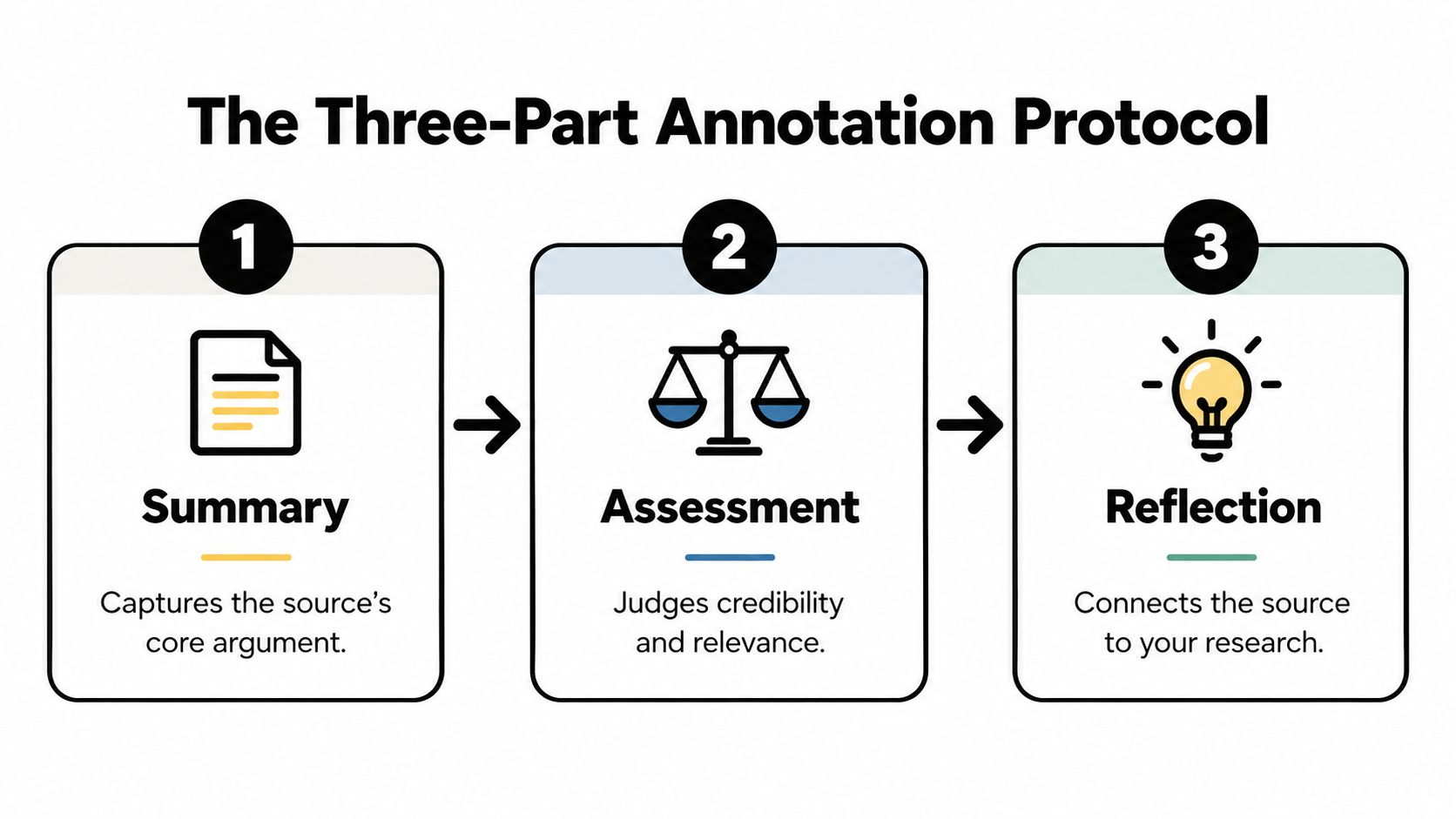
A solid annotation does three jobs, and it should do them in the same order every time. First, it summarizes the source's main idea. Second, it assesses credibility and limits. Third, it reflects on how the source will function in your research. That sequence is why the task works as a research tool instead of a note-taking exercise.
Summary first
The summary should capture the source's central idea, scope, method, evidence, or conclusion, depending on what matters for your project. Don't copy the abstract and don't try to recreate the whole argument. Select the claims that will matter later when you compare this source with others.
Then assessment
Assessment is where the annotation earns its keep. You're checking the author's expertise, the credibility of the publisher or journal, the soundness of the method, the quality of the evidence, and any visible bias or limitation. The University of North Alabama's writing guidance frames this as judging authority, perspective, reliability, validity, and bias in its annotated bibliography guide.
Then reflection
Reflection links the source to the project. A source might define a concept, support a claim, provide a counterexample, suggest a method, or expose a research gap. If you can't say what role the source plays, it probably doesn't belong in the first cut of the bibliography.
Don't write what the source says and stop there. Write what the source does for your argument.
A good workflow is simple enough to repeat. Read with the research question in mind, write notes in your own words, and build the annotation from those notes, not from memory. Purdue's annotated bibliography guidance recommends exactly this summarize, assess, reflect pattern and treats those three functions as the core of the task.
Descriptive Versus Evaluative Annotations
The biggest formatting mistake I see is students answering the wrong assignment. A descriptive annotation is not the same as an evaluative one, and the difference changes how much analysis you need. If the prompt asks you to describe, a compact overview may be enough. If it asks you to evaluate, you need to judge quality, relevance, and usefulness.
A descriptive annotation tells the reader what the source covers. It stays close to the source's content and leaves out most judgment. That's useful when an instructor wants a neutral map of the reading, especially early in a project.
An evaluative annotation does more. It asks whether the source is strong, trustworthy, and worth using. That means discussing strengths, limitations, and fit with the research question. It also means noticing when the source is biased, thin on evidence, or too narrow for the task.
| Assignment cue | Best response |
|---|---|
| “Describe” | Keep the note mostly informational |
| “Evaluate” | Add critical judgment and relevance |
| “Critique” | Go further on strengths and weaknesses |
| “Reflect” | Explain the source's role in your project |
If the instructions are vague, look at the verbs. Words like describe, evaluate, critique, and reflect aren't decorative, they tell you where to spend your word count. That's why two entries on the same source can look very different in different classes.
One practical test saves a lot of rewrites. If you remove every sentence that expresses judgment and the annotation still satisfies the brief, the assignment is probably descriptive. If the entry feels incomplete without a verdict, it's evaluative.
Citation Control and Quality Assurance
Citation problems don't usually come from ignorance alone. They come from drift. A student starts with one citation style, switches sources, copies metadata from memory, and ends up with a bibliography that looks consistent only at a glance. Treating citation control as quality assurance prevents that drift from turning into a grading problem.
Before you draft, lock the required style and build a single source record for each entry. Keep the author, year, title, container, pages, DOI or URL when needed, and the exact claim you're using. That habit matters because the annotation is only as reliable as the metadata underneath it.
The audit should happen after the draft, not after submission. Check the author name against the original publication, verify the date, confirm that the formatting rules match the required style, and make sure each entry is cited where the assignment expects it. If you're managing a larger project, a structured reference workflow such as Thesis Book Project's software for references guide can keep source records from getting scattered across tabs and notebooks.
A recent reported study found low citation literacy in 41.7% of its sample, while incorrect in-text citation accounted for 52% of identified citation errors and incorrect paraphrasing attribution represented 26.7% in the cited study. Those figures aren't universal, but they do point to the same failure points I see in student work all the time, incomplete metadata, inconsistent style, and paraphrases that aren't clearly tied back to the source.
Use a final checklist before you hand anything in:
- Style consistency: Every entry follows the same citation system without exceptions.
- Metadata accuracy: Author, date, title, and publication details match the source record.
- Quotation discipline: Direct quotations are clearly marked and limited to cases where the wording matters.
- Paraphrase control: Ideas are rewritten cleanly, not copied with a few words swapped out.
- Entry alignment: The citation and annotation refer to the same source.
Checklist rule: if you can't verify an entry against the original source, you don't have a bibliography, you have a guess.
From Summaries to Synthesis
Most annotated bibliographies stay too small at this stage. Students write one clean note after another, but the result still behaves like separate index cards. The stronger move is to compare entries against each other so the bibliography starts revealing patterns, disagreements, and gaps.
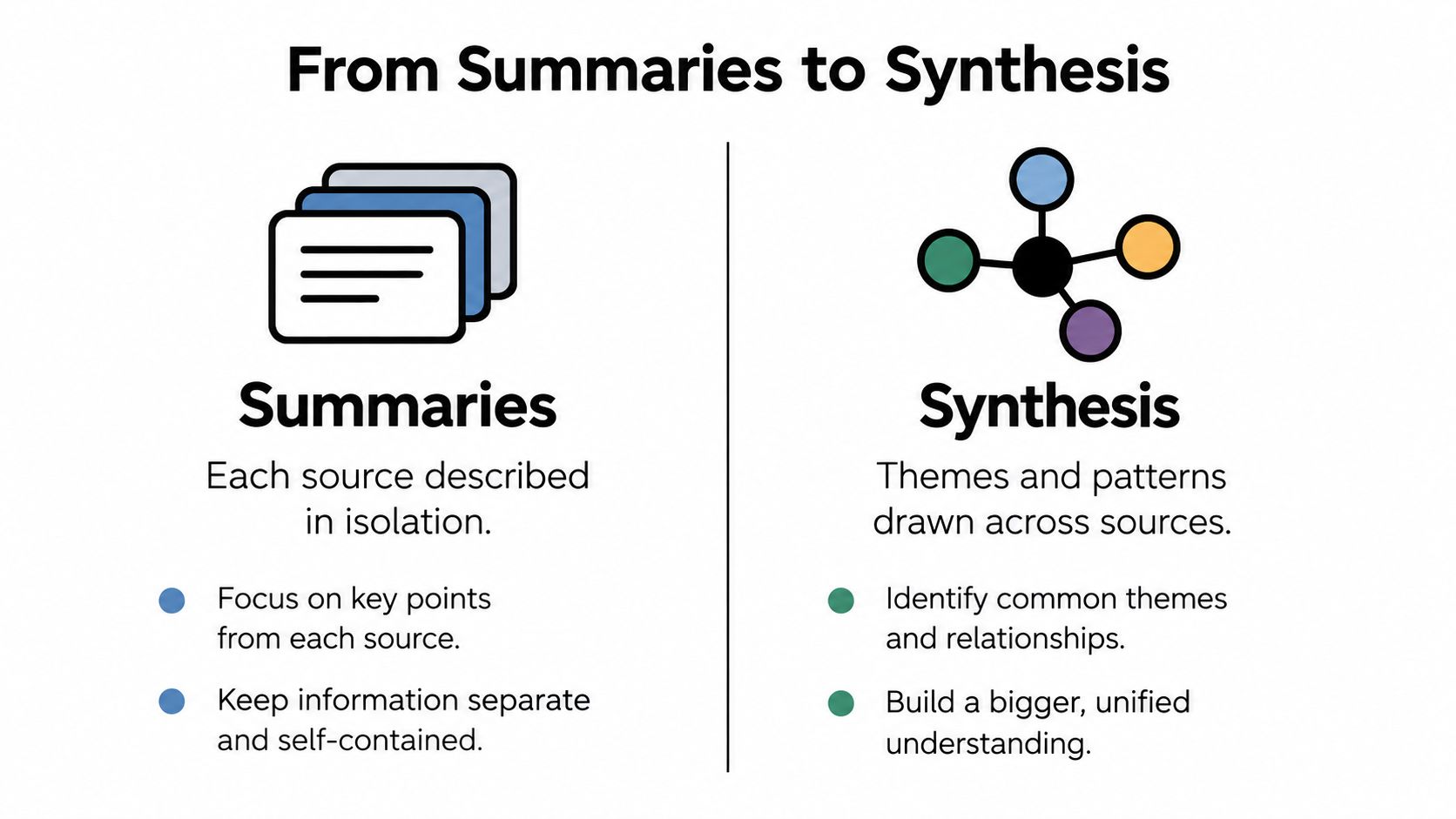
A comparison matrix is the fastest way to do that. Track the research question, method, population or sample, evidence quality, finding, limitation, and relevance for each source. Once those details sit side by side, the bibliography stops reading like a stack of mini book reports and starts showing you where the literature agrees, where it splits, and where the thesis can still make a useful intervention.
What the matrix reveals
One source may use a narrow sample. Another may reach a similar conclusion with a different method. A third may disagree because it studies another context or uses a later publication date. Those differences matter, because they tell you whether the disagreement is a flaw, a context issue, or a clue that the topic itself is more unsettled than it first looked.
How synthesis changes the annotation
Instead of writing, “This article discusses X,” write notes that show relationship. For example, two studies may both support a claim, but one does so with stronger evidence, while another exposes a limitation the first ignores. That comparison tells you which source leads the discussion and which one serves as a caution.
A bibliography becomes useful when it helps you decide what the literature is doing, not just what each source says.
That also means you can use the annotated bibliography as a draft of your literature review logic. The University of Southern Illinois guide notes that university instructions often mention summary, evaluation, and connection to the project, but they rarely show how to compare sources and build a literature-review argument from them which is exactly the missing step. A literature review outline resource becomes much easier to write once the annotations already point to clusters, contrasts, and gaps.
Handling AI Generated Sources
AI changes the source-checking problem, but it doesn't remove your responsibility to judge evidence. The mistake is assuming that anything with a clean citation-looking output is ready to use. It isn't. You still need to verify the original source, the publication record, and the role the AI system played.
The cleanest rule is simple. Cite the original scholarly work when that's what you used. Don't confuse that with citing an AI system's output as if it were a peer-reviewed source. If the source is AI-assisted, copied, rephrased, or difficult to verify, your annotation should say so plainly and should note the limitation.
That caution matters even more when students lean on tools to generate reference leads. An AI tool can suggest a plausible title or author, but the annotation should only be built from a source you've checked in a publisher or library record. If the record doesn't match, the source stays out.
The legal side is worth understanding too, because ownership and attribution questions around machine-generated material are still developing. For a concise discussion of that issue, the legal side of AI-generated content offers useful context for students who are trying to separate academic honesty from platform hype.
Your annotation can also function as an audit trail. If you used AI to help locate a source, note that the bibliographic details were verified independently. If the source itself is unusual, explain that limitation. Transparency won't weaken the bibliography, it will make it defensible.
If you're building source lists for a thesis, Thesis Book Project gives you a way to organize references alongside milestones, so your reading list doesn't drift away from the chapter plan. That kind of structure matters when your bibliography is meant to support synthesis, not just submission.
If you're turning a reading list into an actual research tool, Thesis Book Project can help you keep sources organized alongside chapter planning and thesis milestones. Visit Thesis Book Project to see how its source manager and project workflow can support the same synthesis-minded process you're building in your annotated bibliography.
Related Articles
What Is a Systematic Literature Review: A Student Guide
You're staring at a pile of papers, each using different terms, methods, and conclusions. Your s...
Research MethodsWhat Is a Thesis Proposal: A Complete Guide for 2026
A thesis proposal is a formal planning document that argues a proposed study is intellectually worth...
Research MethodsHow to Choose a Thesis Topic: A Practical Guide
The best thesis topics are the ones you can finish, and feasibility beats originality when the clock...
Comments (0)
No comments yet. Be the first to share your thoughts.