What Is a Systematic Literature Review: A Student Guide
Learn what is a systematic literature review, the exact steps, reporting standards like PRISMA, and how to complete one without getting lost in the process.

You're staring at a pile of papers, each using different terms, methods, and conclusions. Your supervisor has asked for a systematic literature review, but “read everything and summarize it” doesn't feel like a method. The difficulty often begins before the first database search: you need to decide exactly what question your review can answer and which evidence belongs inside its boundaries.
Table of Contents
- Understanding the Systematic Literature Review
- Historical Roots and the Need for Rigor
- The Step-by-Step Methodology
- Systematic Review vs Narrative Review
- Reporting Standards and Transparency
- Scoping Your Review Question
- Conducting the Search and Selection
- Synthesizing and Reporting Findings
Understanding the Systematic Literature Review
A systematic literature review is a structured method for answering a focused research question by finding, evaluating, and synthesizing all relevant evidence that meets criteria defined in advance. It is not just a longer reading list or a summary of papers you happened to discover first. It's an auditable research process, where another researcher can understand how you searched, why you included particular studies, and how you reached your conclusions.
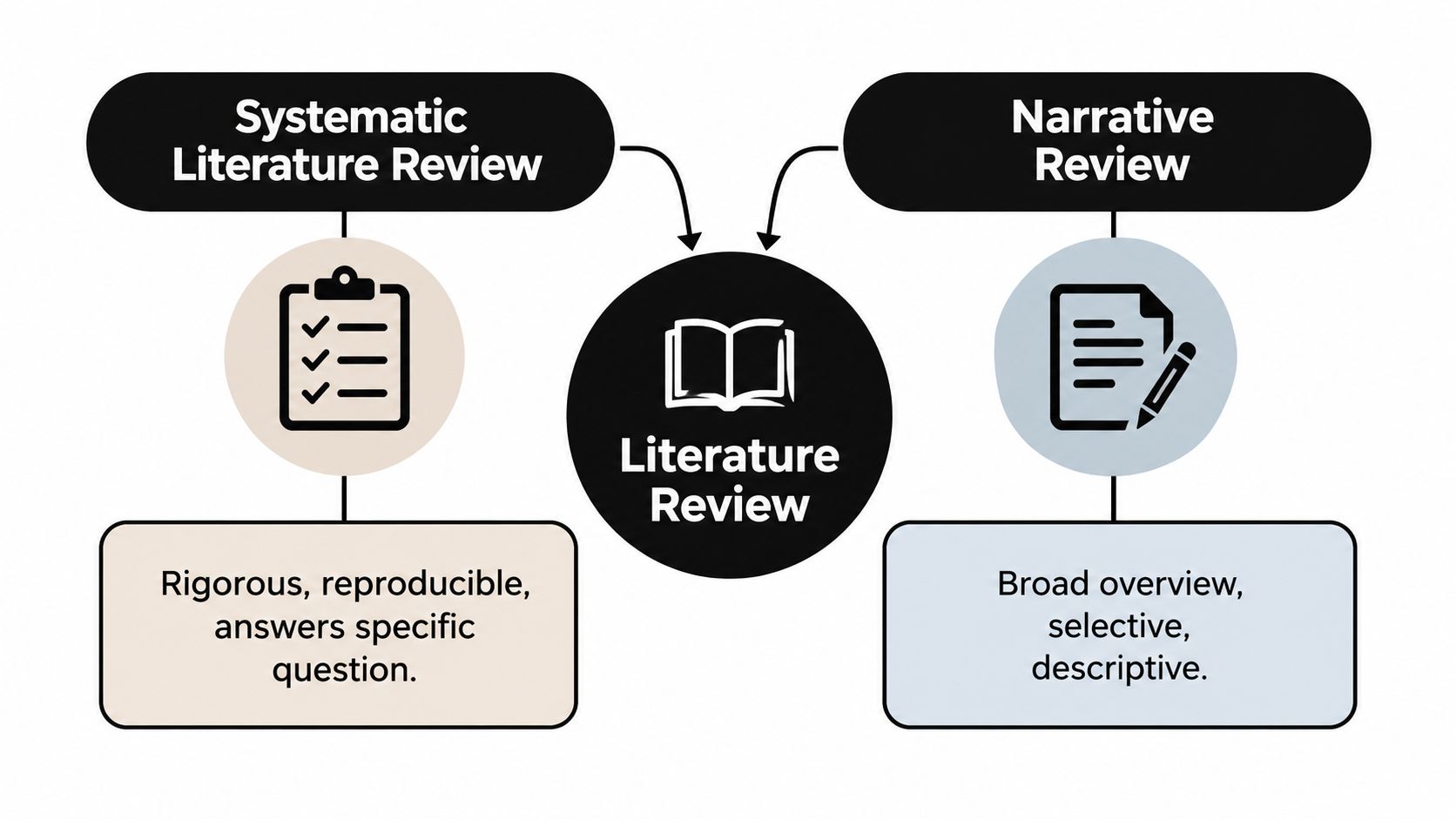
Suppose your topic is artificial intelligence in education. A narrative review might discuss influential papers, explain major debates, and organize the discussion around themes chosen by the author. A systematic review would narrow the question, define eligible studies, search multiple sources, remove duplicates, screen records, assess quality, extract comparable information, and synthesize the findings using a stated approach.
A method, not a paper collection
The defining feature is preplanning. Before the main search begins, you establish the question, inclusion and exclusion criteria, information sources, screening process, extraction fields, quality appraisal method, and synthesis plan. This reduces the chance that you'll select studies because they support an argument you formed after reading them.
The word “systematic” doesn't mean every review must produce a statistical calculation. If studies are sufficiently comparable, researchers may use meta-analysis. If they differ substantially in populations, interventions, outcomes, or designs, a transparent qualitative or thematic synthesis may be more appropriate. A systematic review can therefore produce a combined statistical estimate, a structured explanation of patterns, or a carefully documented conclusion that the evidence remains uncertain.
Practical rule: Treat every decision as something you may need to explain to a reader, supervisor, or future reviewer.
The value of the method comes from the chain connecting the question to the evidence. A well-designed review doesn't promise a convenient answer. It shows how the answer was built and where uncertainty remains.
Historical Roots and the Need for Rigor
Systematic reviews developed partly because researchers and professionals recognized the weaknesses of relying on isolated studies or informal expert summaries. An expert may know a field well, but a personal selection of studies can still omit relevant evidence, emphasize memorable findings, or reflect assumptions that aren't visible to readers.
The historical foundation is closely associated with evidence-based health research. In 1979, Archie Cochrane criticized the medical profession for failing to maintain regularly updated critical summaries of randomized controlled trials, a concern that highlighted the need for organized and continually reviewed evidence. The idea contributed to the creation of the Cochrane Collaboration in 1993, following an inaugural meeting attended by 77 people from 9 countries. These historical details are documented in the literature on the development of systematic review methodology (systematic review history and methods).
The problem the method addresses
Imagine two researchers reviewing the same topic. One searches only familiar journals and includes studies that appear persuasive. The other records search terms, examines several information sources, applies the same eligibility rules to every record, and documents reasons for exclusion. Their conclusions might differ, not because one researcher is careless, but because the first process leaves more room for invisible choices.
A protocol helps make those choices visible before results influence judgment. It also creates a reference point when unexpected findings appear. Instead of changing the question or selection rules midstream, you can explain whether the original plan remains suitable and document any justified amendments.
The approach now extends beyond medicine into education, social science, policy, business research, and other disciplines. Its central lesson remains consistent: evidence becomes more useful when researchers show how they found it, judged it, and combined it.
The Step-by-Step Methodology
A systematic review follows a connected workflow. Each stage protects the next one, so rushing the opening stages usually creates problems during screening, extraction, and writing.
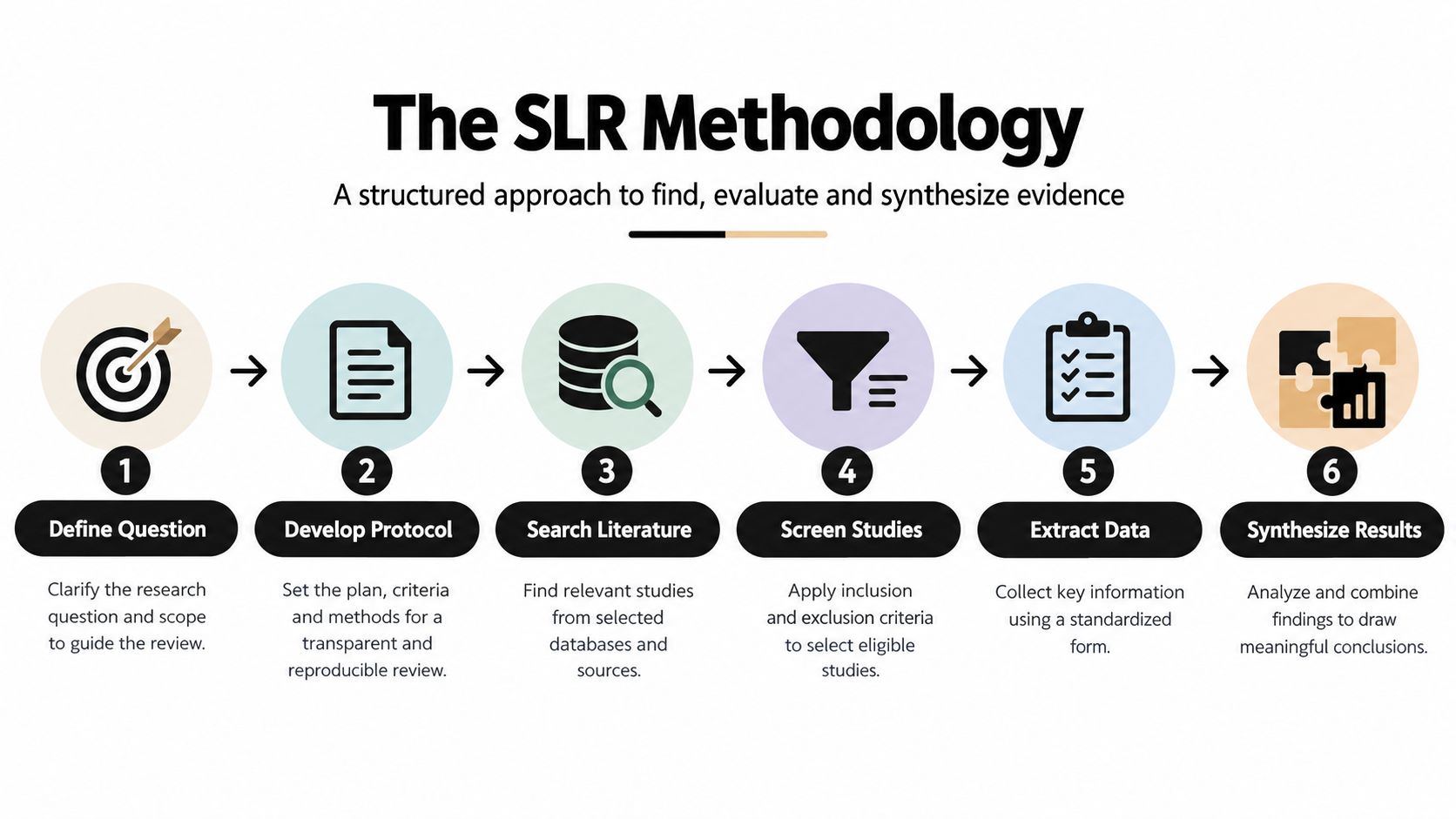
Define the question. Start with a question narrow enough to answer and meaningful enough to justify investigation. Identify the population or context, intervention or phenomenon, comparator where relevant, outcomes, and eligible study designs.
Develop the protocol. Write down the planned search sources, search concepts, eligibility criteria, extraction fields, risk-of-bias approach, and synthesis method. The protocol is your guardrail against changing the rules just because the results are inconvenient.
Search the literature. Build database-specific search strings using keywords, synonyms, subject headings, and Boolean operators. Search multiple information sources where appropriate, and record the date, platform, exact query, and results returned.
Screen studies. First examine titles and abstracts, then assess potentially relevant full texts. Apply the same criteria consistently, remove duplicates, and record a reason for each full-text exclusion.
Extract data. Use a standardized table rather than relying on memory or scattered notes. Fields might include study design, population, intervention or exposure, context, outcomes, limitations, and findings relevant to the question.
Synthesize results. Compare studies rather than describing them one by one. Use meta-analysis only when the evidence is sufficiently comparable. Otherwise, organize a transparent narrative or thematic synthesis.
A useful companion is a repeatable process for finding research, especially when you're turning a broad topic into documented search decisions. You can also organize the writing phase with a literature review outline that keeps methods, findings, and interpretation distinct.
The workflow may look linear, but you'll often refine the question after a preliminary search. If you make a change, record what changed, why it changed, and whether the protocol or eligibility criteria need updating. Transparency doesn't require pretending that research decisions are never revised. It requires showing readers how and why revisions occurred.
Systematic Review vs Narrative Review
Both review types can be academically valuable, but they answer different needs. A narrative review gives an author room to explain a field broadly and develop an interpretive argument. A systematic review prioritizes a predefined, reproducible route from question to evidence.
| Feature | Systematic literature review | Narrative review |
|---|---|---|
| Purpose | Answers a focused research question | Provides a broad or interpretive overview |
| Search strategy | Planned, documented, and designed to identify relevant evidence comprehensively | Often flexible and guided by the author's knowledge or argument |
| Eligibility | Inclusion and exclusion criteria are defined in advance | Selection rules may be implicit or less formal |
| Bias control | Uses explicit screening, appraisal, and extraction procedures | More dependent on the author's judgment |
| Synthesis | Statistical pooling or structured qualitative synthesis may be used | Usually descriptive or thematic discussion |
| Reproducibility | Another researcher can inspect and repeat the process | Repeating the exact process may be difficult |
Choosing a systematic approach doesn't mean narrative reviews are weak. A narrative review may be the better format when the purpose is conceptual orientation, historical interpretation, or discussion across a wide and evolving field. The important question is whether your research problem requires a thorough, rule-governed search and selection process.
Your supervisor's wording matters, too. “Review the literature systematically” may refer to a systematic literature review, a systematized review, or a broader review using selected systematic techniques. Clarify the expected design before investing heavily in searches, and use a guide to literature review methods to compare possible approaches.
Reporting Standards and Transparency
A credible systematic review should let readers reconstruct the evidence-selection process. They should be able to see what you searched, which records you screened, why full texts were excluded, what data you extracted, how study quality was judged, and how you selected the synthesis method.
The most influential reporting framework is PRISMA, the Preferred Reporting Items for Systematic Reviews and Meta-Analyses statement. PRISMA was first published in 2009, and the PRISMA 2020 update retained a 27-item checklist organized into 7 sections (PRISMA 2020 explanation and checklist). The framework also provides an abstract checklist and flow-diagram templates.
What transparent reporting shows
A flow diagram records how evidence moved through identification, screening, eligibility assessment, inclusion, and synthesis. Those counts are useful because they show the scale of the search and where records were removed. A methods section should add the reasoning behind the numbers, including databases searched, complete search strings, date limits, language restrictions, and eligibility rules.
PRISMA is a reporting guideline, not a guarantee that the underlying review is sound. A review can follow the checklist and still use a vague question, an incomplete search, unsuitable eligibility criteria, or a weak appraisal method. Reporting makes the work inspectable, but methodological quality still depends on the choices themselves.
A clear flow diagram can reveal a hidden weakness, but it can't repair an incomplete search.
Keep an audit trail as you work. Save search histories, export files, deduplication decisions, screening records, extraction tables, risk-of-bias judgments, and reasons for exclusion. These materials reduce confusion during writing and make an update easier if new evidence appears later.
Scoping Your Review Question
The hidden bottleneck in many student reviews is scope, not searching. A question that sounds interesting can still be impossible to answer because it covers too many populations, settings, outcomes, methods, or years. A question that is too narrow may produce little useful evidence and leave you unable to draw a meaningful conclusion.
Start with the topic you care about, then add boundaries deliberately. Ask:
- Who or what is being studied? Define the population, organization, technology, policy, or phenomenon.
- What is the setting? Specify education level, country group, workplace, clinical context, or other relevant environment.
- Which outcome matters? Choose outcomes that can be identified consistently across eligible studies.
- Which designs belong? Decide whether you'll include experiments, surveys, qualitative studies, mixed methods, or other designs.
- What will you exclude? State boundaries that protect feasibility without removing relevant evidence arbitrarily.

From vague topic to answerable question
“AI and education” is a topic. “What effects do AI-based tutoring systems have on student learning outcomes in higher education?” is closer to a review question because it identifies a technology, population, setting, and outcome.
The same logic works elsewhere:
- In health research, examine a defined intervention, population, comparison, and health outcome rather than “technology in healthcare.”
- In education, focus on a teaching practice, learner group, educational level, and measurable learning or engagement outcome.
- In social science, define a policy or social phenomenon, affected population, context, and outcome of interest.
A librarian survey found that 8 of 17 reported challenges were common among more than 40% of respondents, with leading difficulties involving overly broad or narrow questions, unclear questions, inadequate eligibility criteria, and failure to follow established methods (survey of librarians supporting systematic reviews). The lesson is practical: don't postpone scoping until after the search. Every boundary changes the workload, credibility, and transferability of your review.
Conducting the Search and Selection
A systematic search is more than entering a few keywords into Google Scholar. You need a search strategy that reflects the language researchers use in the field, including synonyms, spelling variants, abbreviations, controlled vocabulary where databases provide it, and Boolean relationships between concepts.
Build the search around concept groups. For a review of AI tutoring and higher education, one group might cover artificial intelligence, another tutoring systems, and another university students or higher education. Combine synonyms within a group with OR, then connect the groups with AND. Test the strategy against known relevant papers, but don't add studies just because the original query missed them. Revise and document the search string instead.
Screening requires consistent judgment
After exporting results, remove duplicates and begin title and abstract screening. At this stage, exclude records that clearly fail the criteria. Retrieve full texts for uncertain records, then apply every eligibility rule carefully and record a specific exclusion reason.
A study may be relevant to the topic but still fail because it uses the wrong population, examines a different intervention, reports no relevant outcome, or uses an ineligible design. Don't delete such records without explanation. Your exclusion log is part of the evidence trail.
Reference managers can help with deduplication and tagging, while structured tools can support screening. If your workflow involves collecting article pages or preserving page-level details, tools that extract images and metadata can support organized evidence capture, provided you follow database terms, copyright rules, and institutional policies.
The effort is worthwhile for a thesis because it turns “I read a lot” into a defensible method. A reader may disagree with your interpretation, but they can inspect the decisions that produced your evidence base.
Synthesizing and Reporting Findings
Extraction gives you organized information, but synthesis turns that information into an answer. Begin by asking what the studies can reasonably be compared on. Look across populations, contexts, interventions or exposures, outcomes, study designs, and risk-of-bias judgments.
A meta-analysis may be suitable when studies are sufficiently comparable and report compatible data. Before pooling, define the effect measure, consider heterogeneity, and choose an appropriate statistical model. The Cochrane Handbook guidance on planning synthesis emphasizes planning analytical choices in advance because decisions made after seeing results can influence conclusions.
When statistical pooling would create a misleading impression of precision, use a structured narrative synthesis. Group findings by theme, intervention type, population, outcome, or methodological pattern. Explain agreements and disagreements, distinguish stronger from weaker evidence, and identify gaps without treating “no evidence” as proof that an intervention has no effect.
A useful extraction table can help you compare studies without slipping into paper-by-paper summaries. The literature review table resource offers a practical structure for recording study characteristics, methods, findings, and appraisal decisions.
A starting checklist
Before you begin, confirm that you can:
- State the question: Explain the population, phenomenon or intervention, context, outcomes, and designs.
- Write the rules: Define inclusion and exclusion criteria before the main search.
- Record the search: Save databases, queries, dates, filters, and retrieved records.
- Track decisions: Keep duplicate records, screening outcomes, full-text exclusions, and reasons.
- Standardize extraction: Use the same fields for every included study.
- Match synthesis to evidence: Pool only comparable studies, and use transparent qualitative synthesis when they aren't.
- Report limitations: Discuss search boundaries, unavailable evidence, study-level bias, and uncertainty.
A systematic literature review isn't defined by the number of articles you collect. It's defined by the discipline of making your question, decisions, evidence, and reasoning visible.
Thesis Book Project helps students plan and track thesis work from proposal to submission, including chapter progress, milestones, source organization, and supervisor check-ins. If you're building a systematic review, visit Thesis Book Project to organize the research workflow alongside the writing.
Related Articles
What Is a Thesis Proposal: A Complete Guide for 2026
A thesis proposal is a formal planning document that argues a proposed study is intellectually worth...
Research MethodsHow to Choose a Thesis Topic: A Practical Guide
The best thesis topics are the ones you can finish, and feasibility beats originality when the clock...
Research MethodsLiterature Review Outline: Template and Annotated Structure
What does your literature review outline prove? If it only lists authors, topics, or publication dat...
Comments (0)
No comments yet. Be the first to share your thoughts.