How to Write a Dissertation Conclusion: A Practical Guide
Learn how to write a dissertation conclusion that actually closes the argument. Practical moves, examples, and pitfalls for your final chapter.
You're down to the last chapter, the argument is already built, and the deadline is uncomfortably close, yet the conclusion still feels harder than the literature review. That's normal. The final chapter asks you to do something many writers haven't practiced enough, to stop proving the thesis and start closing it with purpose.
A good dissertation conclusion isn't a rushed recap. It's the place where the examiner sees whether you can answer your own research question cleanly, show what the study adds, and end with confidence instead of drift. If you later turn the dissertation into a book, the same discipline matters in a different form, and guides like from thesis to print book formatting show how structure and final polish shape the reader's last impression.
Table of Contents
- The Final Chapter Problem Every Dissertation Writer Faces
- What a Dissertation Conclusion Is Actually For
- The Core Moves Your Conclusion Has to Make
- Drafting the Opening Answer and the Final Take-Home
- How Long Your Conclusion Should Really Be
- Mistakes That Make Conclusions Feel Weak in the Viva
- A Short Checklist for Writing Your Conclusion
The Final Chapter Problem Every Dissertation Writer Faces
The hard part usually starts at the end. By the time you reach the final chapter, the discussion has already done the heavy interpretive work, so the conclusion can feel like a room that has been cleared before you arrived. You know the findings. You know the literature. What remains is deciding what belongs in the ending and what should stay in the main argument.
Students often stall here because the conclusion has a different job from the discussion chapter. University guidance on thesis endings treats the final chapter as a formal move from problem to answer, with a restated aim, a clear answer, key findings, implications, limitations, and future work all serving closure rather than repetition (University of Southampton guidance). Related writing guidance describes the conclusion as a synthesis that moves from narrow to broader ideas, not a place for a new argument, and notes that long-paper conclusions can stretch across several pages while still needing to stay proportional to the work (Waterloo conclusion guidance).
Practical rule: if a sentence still belongs in the evidence trail, it belongs earlier in the dissertation.
The confusion is simple enough. Writers can usually tell when a sentence is interesting, but not always when it is final. A conclusion has to sound decisive without sounding inflated, and it has to feel complete without replaying the discussion.
Treat the chapter like the closing argument in a case, not a recap sheet. That shift matters even more if the dissertation may later become a book, because the ending has to read like a finished piece rather than a stack of notes, which is why from thesis to print book formatting depends so much on clean final structure. Examiners notice the same thing in a viva. They can hear whether the thesis closes with intent or stops.
What a Dissertation Conclusion Is Actually For
A dissertation usually moves through a simple arc, question, investigation, resolution. The conclusion is the resolution beat. It does not reopen the case, and it does not rerun the evidence point by point. It tells the reader what the investigation now allows you to claim, and it does so in a way that leaves no doubt about the answer.
Conclusion versus discussion
The discussion chapter is the place for interpretation. That's where you weigh alternatives, compare findings with prior work, explain surprises, and work through the meaning of the results in detail. The conclusion consolidates all of that into a final position. It is shorter in intent even when it needs several pages, because every paragraph should earn its place by advancing closure.
A quick test helps when you're unsure where a sentence belongs. Ask, does this sentence interpret the result, or does it close the argument? If it explains a pattern in detail, it probably belongs in the discussion. If it states what the whole study now shows, it belongs in the conclusion.
The distinction matters because examiners notice duplication fast. A conclusion that repeats the discussion feels as if the writer never made the final move. A conclusion that overreaches, by contrast, feels as if the writer forgot the limits of the evidence. The best final chapters do neither, they compress the work into one clear answer, then step back far enough to show the significance.
The University of Southern California's writing guidance points out a practical gap here, many students know they should “summarize” and “reflect,” but they still struggle with how much interpretation belongs in the final chapter and how to avoid duplicating the discussion (USC conclusion guidance). That confusion is exactly why the conclusion needs a distinct purpose statement in your own mind before you draft a line.
The conclusion should feel like the thesis landing, not the thesis replaying itself.
The Core Moves Your Conclusion Has to Make
A dissertation conclusion has one job above all others, it closes the argument. That sounds simple, but many writers get stuck because they keep treating the final chapter like a second discussion chapter. The conclusion needs a different shape. It should answer the research question, draw the findings together, show what they mean, and leave the examiner with a clear sense of closure.
Start with the aim, then answer it. Restate the research aim in fresh language, then give the main answer in one or two sentences. The reader is not looking for a rehearsal of the chapter history. They want the verdict.
A study on remote onboarding in small software firms makes the difference clear. A weak opening says, “This dissertation examined onboarding practices and explored several themes related to employee adjustment.” That reports activity, not outcome. A stronger version says, “This dissertation shows that structured early support, especially from managers and peers, made remote onboarding smoother in small software firms.”
The next move is synthesis. Bring the findings into one message instead of listing them again. If documentation, feedback, and social contact all mattered, do not set them out like minutes from a meeting. Show how they work together to support the same conclusion about what effective onboarding requires.
A useful check is simple. If a paragraph could be lifted almost unchanged from the results summary, it is too flat for the conclusion.
Then state the significance. Depending on the dissertation, that may be theoretical, practical, or policy-related. In the onboarding example, the point is not that small firms need more tools. It is that they need a clearer sequence of support in the first weeks. That is a claim about meaning, not just data. If you are still working out how the final answer should connect to the original gap, the guide on what is a research gap helps line that up.
Finish by pointing forward with care. The University of Oxford's writing guidance recommends that recommendations be specific enough to name the design, population, mechanism, or setting, rather than stopping at “more research is needed” (Oxford conclusion guidance). For the onboarding example, a vague ending says, “More research is needed.” A better one says, “Future studies could test whether the same support pattern holds in non-software professional services firms.” That gives the next researcher a direction, not a shrug.
If you need the final sentence to feel complete, use it to state the contribution plainly and stop. For help with phrasing that keeps the ending sharp, you can find conclusion transition words, but the test is whether the chapter sounds finished, not merely wrapped up.
Drafting the Opening Answer and the Final Take-Home
The opening answer and the final sentence do the heaviest lifting in a dissertation conclusion. They are the bookends. If they are sharp, the chapter feels complete. If they drift, the reader senses that the argument has not quite landed.
Start by answering the research question directly. That is the point where many students slip into discussion-chapter habits. The discussion chapter interprets patterns, weighs limits, and opens out the implications. The conclusion should do something narrower and firmer, it should state what the dissertation now shows.
Use a simple drafting sequence. Identify the exact question. Write one sentence that answers it in plain language. Remove hedges that blur the claim. Check that the tense reflects completed work.
A weak opener says, “This dissertation has examined whether remote onboarding is effective in small software firms.” That sounds like a recap of the method, not a conclusion. A stronger opener says, “This dissertation finds that remote onboarding becomes effective when early support is structured, visible, and social rather than left to individual managers' improvisation.” The difference is directness. One circles the topic. The other states the result.
A second weak version says, “The study tried to show that onboarding matters.” That is too cautious to carry the final chapter. A better version says, “The study shows that onboarding quality shaped how quickly new hires settled into remote work.” That sentence gives the reader a clear answer before any broader reflection begins.
The final sentence should close the dissertation, not dissolve into vagueness. It should name the contribution and leave the reader with the final take-home point.
A weak ending says, “Further research will be useful in this area.” That could fit almost any thesis. A better ending says, “This study gives small software firms a clearer way to think about remote onboarding as a managed process rather than an informal adjustment period.” It tells the reader what the work adds and why that addition matters.
Another weak close says, “In conclusion, the findings are interesting and worth considering.” That sounds careful, but it sounds unfinished too. A stronger line says, “Taken together, these findings show that remote onboarding succeeds when firms treat the first weeks as a structured transition, not a passive wait-and-see period.”
If you want help with the final turn of phrase, transition words can make the move from synthesis to closure feel cleaner. find conclusion transition words is useful when problem is not the argument itself, but the sentence that brings it to a stop.
How Long Your Conclusion Should Really Be
Students often ask for a rule, but judgment does the work. A conclusion should be long enough to gather the argument into one final shape, yet short enough that every sentence still earns its place. The right length changes with the kind of dissertation you are writing.
| Discipline / Project Type | Recommended Length | Why This Range Works |
|---|---|---|
| Humanities monograph-style dissertations | Longer, often several pages | These projects often need space to bring together a sustained argument and show how the final claim fits the whole intellectual arc. |
| Social science empirical studies | Moderate length | The final chapter usually needs room for synthesis, implications, and limits, without redoing the discussion. |
| Science and engineering theses | Shorter and tighter | The main interpretive work often sits earlier, so the conclusion can stay focused on findings, contribution, and next steps. |
| Professional doctorates | Flexible, but practical | Applied work often needs a clear bridge from evidence to use, so the ending should reflect the setting and audience. |
Guidance for long papers makes the same point, conclusions can run to several pages if the extra space is used to synthesize rather than repeat. That principle fits dissertations too, because length should follow function, not habit.
Your best benchmark is usually the discussion chapter. If the conclusion is almost as long and just as detailed, it is probably carrying too much explanatory weight. If it is so short that it barely answers the research question, it has not done its final job. A clean chapter plan helps here, and this dissertation structure guide is useful when you are checking where synthesis ends and closure begins.
A useful test is simple. Read the conclusion aloud and ask whether it sounds like a closing statement or a second discussion chapter. The first should leave the reader with one clear takeaway, not a new round of analysis.
Mistakes That Make Conclusions Feel Weak in the Viva
Examiners notice more than content. They also notice when the final chapter still looks unfinished, as if the writer is trying to keep the argument open instead of bringing it to a close. A strong conclusion works like the last move in a chess game, it does not start a new line of play.
The failures that stand out
New material is the clearest warning sign. If fresh evidence or citations appear in the conclusion, the reader can tell that part of the argument belongs earlier, usually in the discussion or results chapter. Move that material back, then let the conclusion do its job.
Repetition causes a different kind of weakness. If the final chapter says the same things as the discussion in slightly different words, it feels like a summary reset rather than an ending. The better move is to compress the argument into one clear position, so the reader leaves with a single takeaway.
Overstatement is another common slip. Evidence from one setting does not prove a universal rule, so broad claims need to be narrowed to fit the dissertation's scope. A conclusion should sound confident, but only as far as the findings allow.
Limitations need to be named plainly. Examiners do not expect a defence speech, but they do expect to see that you know where the claim stops. That shows control of the argument, especially in a viva, and preparing for your viva or thesis defense is where that confidence starts to matter.
Before and after revisions
- New evidence
- Before, “A recent survey from another region supports this view.”
- After, “The study's own findings are enough to show that the pattern is credible within this setting.”
- Duplicate discussion
- Before, “Chapter 4 showed X, Chapter 5 showed Y, and both matter.”
- After, “Taken together, the findings point to one central pattern in how the process works.”
- Overstatement
- Before, “This proves remote onboarding is always more effective when structured.”
- After, “This suggests structured support is especially helpful in the firms studied.”
- Generic future work
- Before, “More research is needed.”
- After, “Future work should test whether the same pattern appears in larger firms with dedicated HR teams.”
A final chapter feels weak when it keeps reopening the case. A strong one closes it.
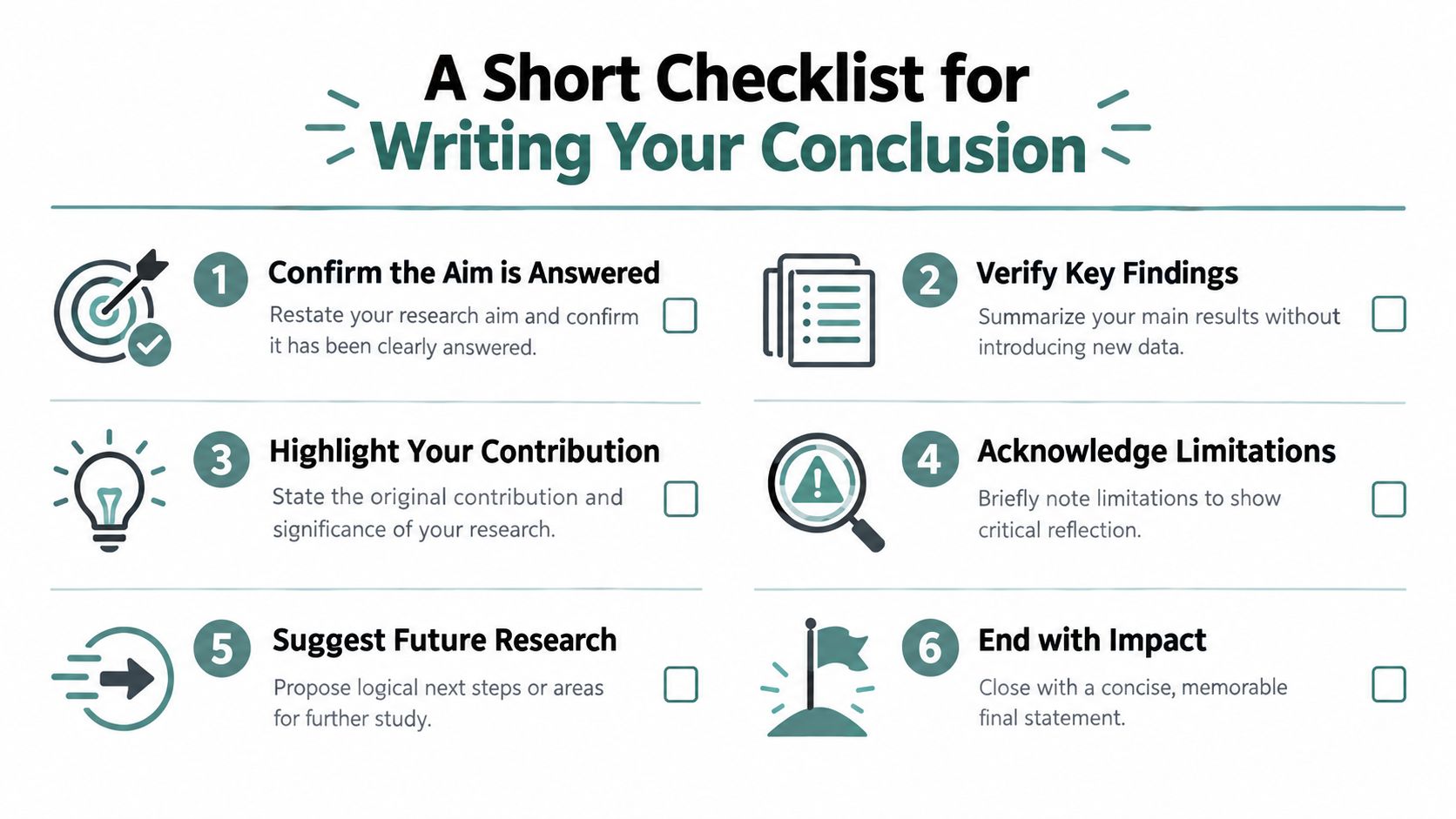
A Short Checklist for Writing Your Conclusion
A conclusion works best when it feels like the last move in the argument, not a reset of the discussion chapter. Read the final chapter once as a supervisor would: does it answer the research question, or does it start retelling the evidence from the beginning?
Drafting checks
- Answer the aim first. The opening lines should state the dissertation's answer, clearly and directly.
- Synthesize, don't list. Bring the findings together into one message, instead of replaying each chapter in turn.
- State the contribution. Say what the dissertation adds, clarifies, or changes.
- Name the limits. Keep limitations brief and honest, so the claim stays inside the evidence.
- Point to what comes next. Future work should be specific, because vague lines like “more research is needed” sound unfinished.
- End like you mean it. The last sentence should close the chapter, not reopen the case.
Two checks matter just as much as the content. No new citations should appear here, and the discussion should not be repeated in another voice. If both are true, the chapter is behaving like a conclusion rather than a summary reset.
A strong ending is usually built before the final draft. Decide what the chapter must do, cut the rest, and leave the reader with a clear finish.
Related Articles
What Is a Research Gap and How to Find It Fast
A research gap is a defensible absence in prior scholarship where evidence is missing, insufficient,...
Research MethodsHow to Write a Problem Statement for Research That Works
You've probably seen this supervisor comment already: “Interesting topic, but the problem isn...
Research MethodsQualitative vs Quantitative Research: Which Is Right for Your Thesis
Few decisions shape your thesis more than the choice between qualitative and quantitative research....
Comments (0)
No comments yet. Be the first to share your thoughts.