Literature Review Process: From Search to Synthesis
Master the literature review process with a step-by-step guide covering searching, screening, synthesis, and writing, plus tools and timeline tips
You're staring at a folder full of PDFs, half-finished notes, and a supervisor who wants a “clear method” before the next meeting. That's where the literature review process stops being a reading pile and becomes a defensible workflow, one you can explain, audit, and repeat.
A strong review doesn't start with summaries. It starts with a question, a search plan, a screening trail, and a synthesis that shows why each source belongs in the argument. That shift is what makes the review feel like research instead of homework.
Table of Contents
- What the Literature Review Process Actually Is
- Defining Your Research Question and Eligibility Rules
- Building a Reproducible Search Strategy
- Screening Studies and Recording Decisions
- Moving From Source Summary to Defensible Synthesis
- Using AI in Searching and Screening Without Quietly Breaking It
- Timeline, Milestones, and Tools for a Thesis Literature Review
What the Literature Review Process Actually Is
The easiest way to get stuck is to treat the literature review process as a big reading marathon. That approach produces notes, but not a defensible academic document. A proper review is a documented research procedure, with rules for what you searched, what you kept, what you excluded, and how you turned the evidence into a conclusion.
The reporting culture around reviews grew because scholars wanted more transparent and reproducible evidence synthesis. The QUOROM statement in 1999, later updated as PRISMA in 2009 and then PRISMA 2020, helped turn reviews into auditable methods rather than loose summaries of reading. PRISMA 2009 included a 27-item checklist, and PRISMA 2020 kept that structure while adding updated guidance, an abstract checklist, and revised flow diagrams for original and updated reviews (BMJ on PRISMA's evolution).
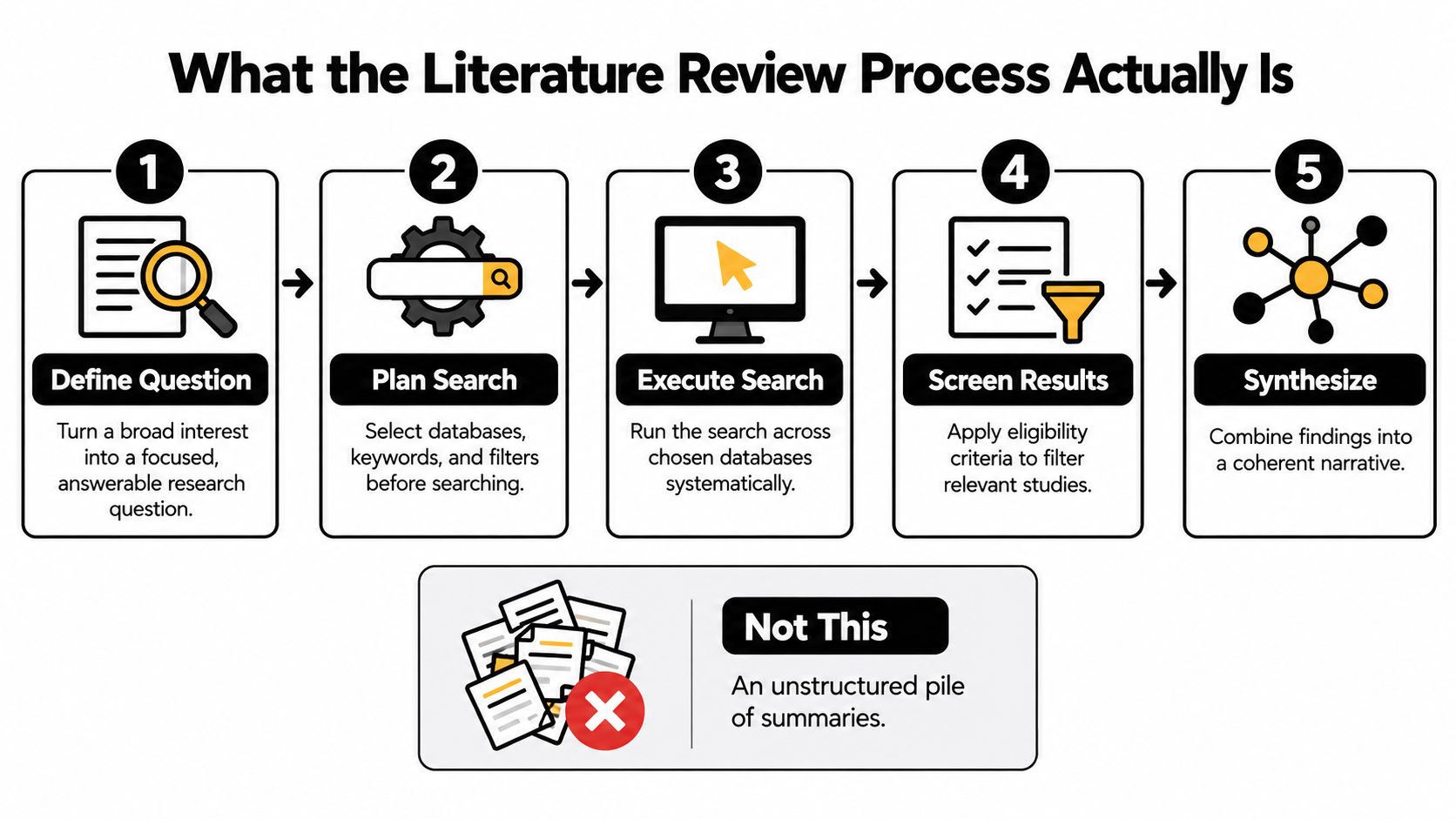
That matters because an examiner isn't looking for a reading diary. They want to see a question that was defined up front, a search that can be repeated, exclusions that make sense, evidence that was appraised, and synthesis that leads somewhere. In practice, the literature review process is a pipeline, not a pile.
Practical rule: if you can't show how a source entered the review, you haven't finished the review yet.
For a thesis writer, that pipeline is easier to manage when the review is tied to the rest of the project. A structured workflow such as the one described in this guide to literature review methods helps you keep the search, notes, and chapter plan aligned instead of scattered across separate files.
Defining Your Research Question and Eligibility Rules
A review becomes searchable when a broad interest turns into a focused question. “Remote work and productivity” is a topic. A question about how remote work affects productivity for a defined group, under a defined set of study types, is something you can search, screen, and defend.
From broad interest to focused question
The point of the question is not to sound impressive. It's to tell you what belongs in the review and what doesn't. If you're writing a thesis, the question should be narrow enough that you can explain why every included source matters, but broad enough that you can find a body of literature to compare.
A useful way to test the question is to separate the concepts you need to search later. For a thesis-style project, you might start with “How does social media affect students?” and end with something closer to “What effect does social media use have on academic performance among undergraduate students in higher education?” The second version gives you a population, a phenomenon, and an outcome. It's searchable, and it gives you criteria for inclusion.
Eligibility rules before you search
Eligibility rules should be written before screening starts. That keeps you from changing the scope when a study looks convenient. It also gives your supervisor a clean paper trail showing why one source stayed in and another one didn't.
Good review logic: decide what counts as relevant before you see which papers are easiest to like.
A simple worksheet can keep the scope honest.
| Question to Eligibility Criteria Worksheet | |
|---|---|
| Question Element | Search Concept |
| Include If | Exclude If |
| Population | Define the group you actually want |
| Phenomenon or intervention | Name the core topic or exposure |
| Outcome | State what the review is trying to understand |
| Study type | Specify what kind of evidence you'll accept |
The same logic applies to exclusions. If you only want full-text studies in English, state that early. If your project only uses peer-reviewed empirical work, say so. You're not narrowing the field to be fussy, you're making the review defensible.
Building a Reproducible Search Strategy
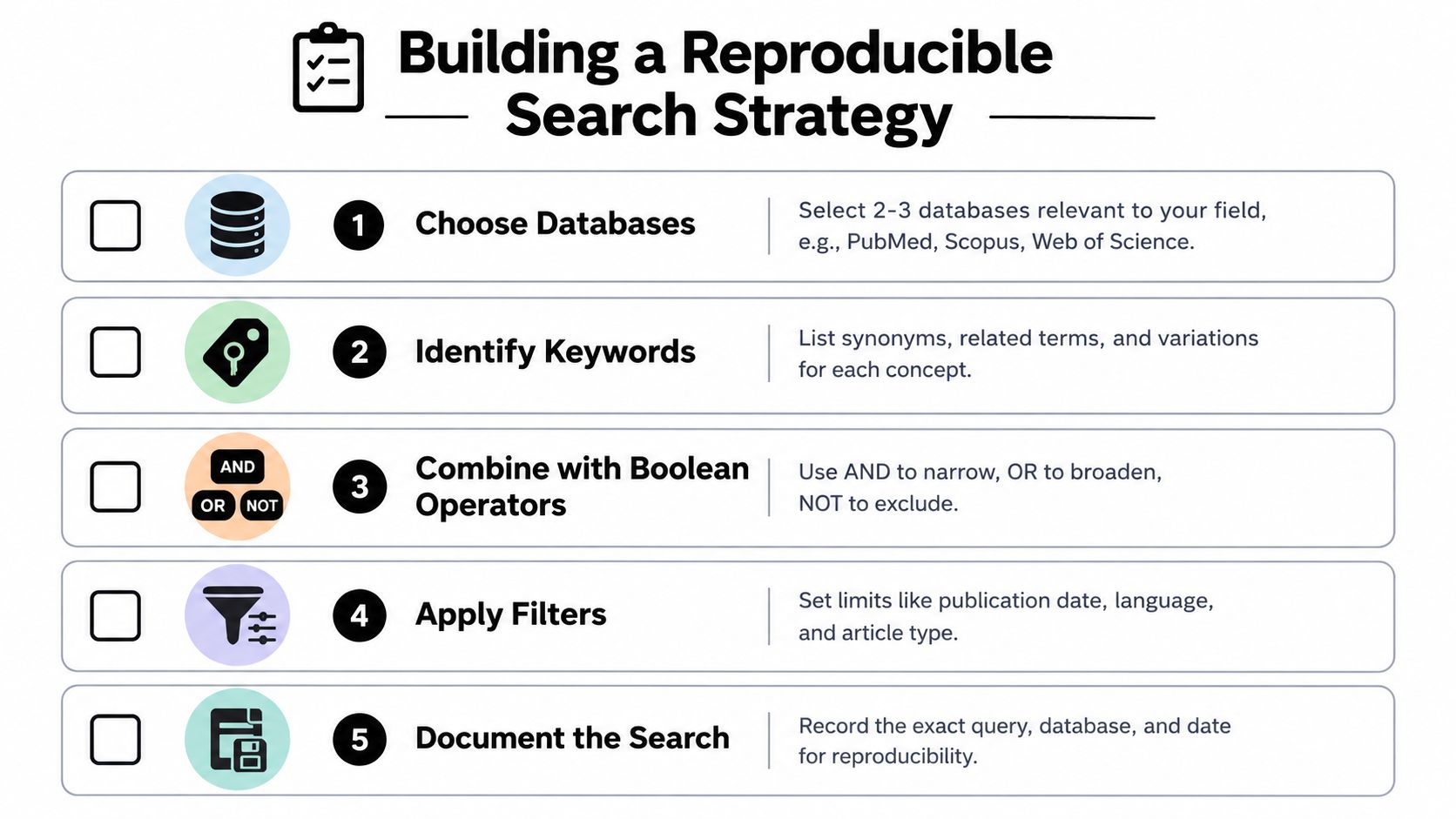
A strong search strategy starts with the idea that one database is never enough. Keywords alone miss studies that use different terminology, older vocabulary, or subject-language that doesn't match your first draft. That's why the search has to be planned database by database, not improvised in a single box.
Search where the literature actually lives
Choose databases that fit your field. A health topic won't be searched the same way as an education or sociology topic, because the indexing systems and vocabulary differ. The important thing is not the brand name of the database, it's whether it covers the journals and disciplines where your topic is discussed.
Translate concepts into search language
Once the question is set, break it into concepts and list synonyms, spelling variants, and related terms. Then combine those terms with Boolean operators so the search is sensitive enough to catch relevant work without becoming a noisy mess. The same idea applies whether you're searching a thesis topic or a systematic review.
Supplementary citation searching matters too. Backward citation chasing starts from relevant seed papers and checks their reference lists. Forward citation chasing looks for newer papers that cite those seeds. That sequence helps you catch studies that keyword searches miss because they use unexpected wording or older terminology, and the citation-search logic is part of modern review guidance (BMJ on citation searching).
Record the search like a method, not a memory
Every search run should leave a trail. Save the exact string, the database name, the interface, the date, the filters, and the number of hits. If you ever need to justify why a source wasn't found earlier, that log is the evidence.
The same habit is useful when you're building your chapter plan. A structured source manager such as the one described in this overview of systematic literature review workflows can keep your search history, source notes, and chapter links together instead of separated across notebooks and browser tabs.
Screening Studies and Recording Decisions
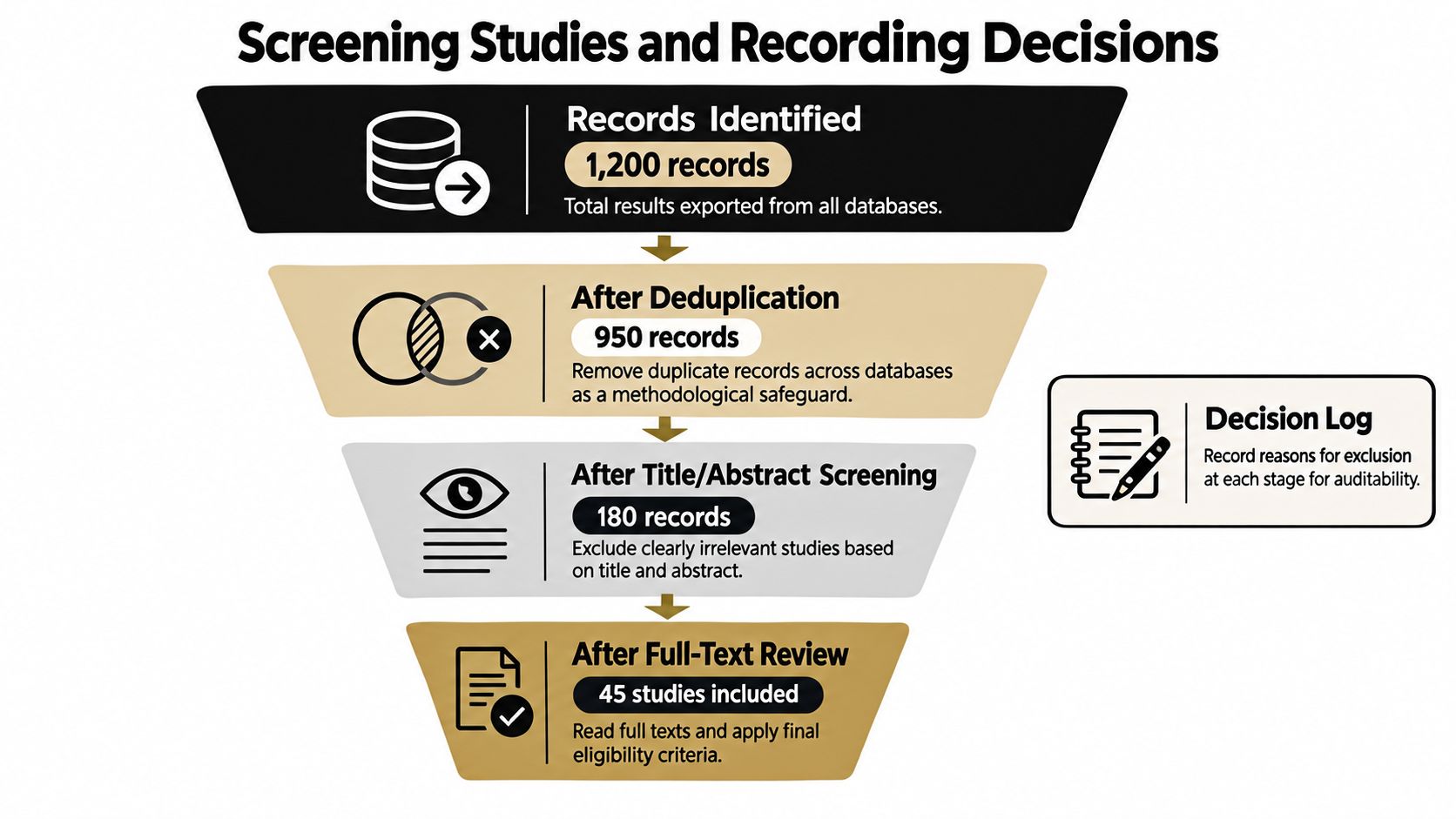
Once the records are exported, the work turns from searching to deciding. Many students get sloppy here, because screening feels like reading, but it's really an audit trail of inclusion and exclusion decisions. The more visible those decisions are, the easier it is to trust the final set of sources.
Start with deduplication, then screen in layers
Duplicates need to be removed before screening gets serious. If the same study appears more than once, you can end up counting one underlying piece of evidence as if it were two. That distorts the record and makes the later synthesis less trustworthy.
Screening works best in layers. At title and abstract stage, the criteria are broad enough to avoid throwing away a paper too early. At full-text stage, the criteria become stricter, because now you can judge whether the source really fits the review question. Cochrane's standards call for at least two independent reviewers and a pre-specified way to settle disagreements, such as discussion or a third reviewer.
Log every exclusion clearly
A reason for every full-text exclusion should be recorded. That's not busywork, it's what allows the final flow of the review to be explained transparently. If a supervisor asks why a study was removed, the answer should already be in the log.
For auditability, a practical review trail should include the following:
- Deduplication rule: note how duplicate records were identified and removed.
- Screening decision: record who excluded or retained each source.
- Exclusion reason: capture the specific reason for every full-text rejection.
- Study linkage: connect multiple reports that belong to the same study.
A review log becomes even more useful when you need to show the process to someone else. A straightforward audit-trail checklist from VideoLearningAI is a useful reminder of how much detail a defensible workflow needs, even if you adapt the format to your own thesis system.
This is also where the project management side matters. A chapter-aware source table, like the one described in this literature review table resource, helps you keep the decision trail connected to the draft rather than buried in a separate spreadsheet.
Moving From Source Summary to Defensible Synthesis
This is the point where many reviews collapse into annotated bibliography mode. The fix is to stop asking, “What does this paper say?” and start asking, “What do these papers do together?” That shift is the difference between a list of summaries and an argument.
Use an evidence matrix, not a stack of notes
An evidence matrix lets you compare studies on the same terms. Each row is a study, and each column is a shared dimension, such as method, population, key finding, limitation, or theoretical angle. Once the matrix is filled in, patterns become easier to see, and gaps become easier to defend.
A useful way to think about the matrix is that it forces alignment. If one paper studies a different population, another uses a different method, and a third asks a different question, the matrix makes those differences visible instead of letting them blur together. That's the material of synthesis.
Test the gap before you claim it
Not every absence is a real gap. Sometimes a topic feels missing because you searched with the wrong term, or because the literature names the relationship in a different way. Before writing “little research exists,” test the claim with alternate terminology and citation chasing.
The harder task is distinguishing between a missing topic, a missing relationship, and a missing method. A missing topic means no one has looked at the phenomenon in that setting. A missing relationship means the pieces exist but haven't been connected. A missing method means the field has studied the question, but not with the approach your project needs.
A defensible gap survives a second search.
That's also why synthesis has to be relational. If two studies agree on the broad pattern but disagree on the explanation, that disagreement is not a problem to hide. It's the raw material for a more precise argument. The same logic appears in technical systems that depend on grounding and traceability, including AletheionAGI's discussion of securing multi-tenant AI data, where the point is not just storing information, but keeping it anchored to something verifiable.
Using AI in Searching and Screening Without Quietly Breaking It
AI can save time, but only if you treat it like a helper, not a decision-maker. The danger is assuming that faster screening automatically means better screening. In review work, speed without traceability is a liability.
A 2025 evaluation of ChatGPT in published systematic reviews found high specificity but low sensitivity in title-and-abstract screening, which means relevant studies can be missed. The same evaluation reported inconsistent prompting, incomplete extraction, and only fair agreement on risk-of-bias assessment, and a 2025 preprint described algorithmic bias in automated screening as a major challenge (BMJ on AI-assisted screening risks).
The practical response is simple: keep the human in control of the decision trail. Lock the protocol before you start, use dual checks for borderline records, and test the search with known seed papers and citation chaining. If AI helps sort, summarize, or rank records, its role should be stated plainly in the method section.
Non-negotiable rule: if a tool touches screening or extraction, the review still needs a human-readable audit trail.
That means you should be able to answer three questions without hesitation. What was automated, what was checked manually, and what would happen if the tool missed a relevant study? If you can't explain that clearly, the workflow is too opaque for a thesis.
Timeline, Milestones, and Tools for a Thesis Literature Review
The pipeline becomes much easier to manage when each stage has a deliverable and a checkpoint. Thesis work fails most often when every task feels equally urgent, because then nothing is finished cleanly. A better plan sets a finish line for each stage before the next one begins.
| Stage | Deliverable | Checkpoint Before Moving On | Tool-Supported Step |
|---|---|---|---|
| Question and scope | Written research question and eligibility rules | Scope is narrow enough to search and defend | Draft the question in a planning tool and tie it to the chapter outline |
| Search | Logged database strategies and citation-chasing notes | Search strings and dates are recorded for every database | Save the exact queries in a source manager or spreadsheet |
| Screening | Included and excluded records with reasons | Duplicates removed and exclusions documented | Use a screening log that tracks reviewer decisions |
| Synthesis | Evidence matrix and thematic draft | Sources are linked to claims, themes, and limitations | Organize sources by chapter or theme before writing |
The quality-control problem is real. In one assessment of systematic reviews that claimed to use PRISMA 2020, only 1,200 of 2,814 checklist items were adequately addressed, average adherence was 42.64%, individual reviews ranged from 14.29% to 76.19%, and none fully complied (systematic review quality assessment). That's a reminder that method reporting isn't a cleanup task, it's part of the work itself.
A thesis platform can help here if it connects chapter tracking, source organization, and milestone reminders. Thesis Book Project is one option that links sources to chapters, keeps project stages visible, and supports backward planning from a submission date. The point is not the tool itself, but whether it makes your audit trail easier to maintain.
Keep your supervisor-facing review materials simple: search strings, exclusion reasons, and source-to-claim links. If those three things are easy to show, the review is usually much easier to defend.
If you want a structured way to keep the question, search history, source table, and chapter plan connected, explore Thesis Book Project. It's built to help thesis writers track sources, chapters, and milestones in one workflow, which makes a literature review easier to defend when your supervisor starts asking for the method behind the reading.
Related Articles
How to Write a Research Question: A Practical Guide
You may be staring at a topic that feels promising and impossible at the same time. The idea is inte...
Research MethodsHow to Create an Annotated Bibliography: A Practical Guide
You're staring at a stack of PDFs, half-finished notes, and a citation manager that's doing...
Research MethodsWhat Is a Systematic Literature Review: A Student Guide
You're staring at a pile of papers, each using different terms, methods, and conclusions. Your s...
Comments (0)
No comments yet. Be the first to share your thoughts.