How to Choose a Thesis Topic: A Practical Guide
Learn how to choose a thesis topic that is feasible, original, and supervisor-aligned. Follow this practical framework to avoid common mistakes and pick

The best thesis topics are the ones you can finish, and feasibility beats originality when the clock is running. If a project depends on data you can't access, participants you can't reach, or a method you can't defend, it's the wrong topic for now.
You're probably at the stage where several ideas feel possible, but none of them feels safe yet. That's normal. The job isn't to find the most impressive-sounding topic, it's to find a bounded, answerable research problem you can support with real evidence, enough time, and the right supervision.
Table of Contents
- The Reality of Choosing a Thesis Topic
- Narrowing Your Research Problem
- The Feasibility Stress Test
- Evaluating Topics with the FINER Framework
- Balancing Novelty with Supervision and Resources
- Structuring Your Topic for Success
The Reality of Choosing a Thesis Topic
You can have three promising ideas and still choose the wrong one if you start with instinct alone. One topic sounds elegant in a seminar, another feels personally meaningful, and a third looks current because everyone is talking about it. Then the practical problems show up, often late, when you discover the archive is closed, the dataset is locked behind permissions, or the question is too wide to answer well.

Passion is useful, but it won't open a locked archive
A thesis topic has to survive contact with the real world. University guidance points you toward a staged process: start broad, read introductory and scholarly literature, identify what evidence exists, narrow the scope, and then turn the idea into an open-ended question that can be answered. The University of Connecticut also advises checking whether enough peer-reviewed secondary literature exists and whether primary sources are accessible in a language you can read, through a library, interlibrary loan, or open-access collection University of Connecticut research topic guidance.
That sounds procedural, but it's the difference between a project and a dead end. A student can be highly interested in postwar urban planning, for example, yet still fail if the needed municipal records are missing or the time period is too expansive for one thesis. In practice, interest should pull you in, but access and scope decide whether the topic lives.
Choose the idea you can defend with evidence, not the one that only sounds exciting in week one.
The University of Basel frames a research question as something developed in relation to existing scholarship and appropriate source material, then revised during the research and writing process University of Basel research question guidance. That's the mindset worth adopting early. A thesis topic is not a slogan. It's a working research problem with limits, constraints, and a realistic path to completion.
The hidden cost of a bad topic choice
The most painful part of a weak topic is that the failure often arrives after you've already invested effort. You may spend weeks refining wording, reading widely, and imagining the project, only to learn that the evidence base won't support the question. Historical guidance on thesis selection repeatedly stresses that the topic should be specific enough to answer within the deadline, argumentative rather than answerable by “yes” or “no,” and capable of producing a defensible conclusion.
That's why topic choice behaves more like project management than inspiration. You're not only choosing what you care about, you're choosing what you can gather, analyze, and finish. The right question is usually smaller than the one you first imagined, but stronger because it can be completed well.
Narrowing Your Research Problem
A broad interest becomes a thesis topic only after you put it through a set of limits. University research guidance treats that narrowing process as sequential, not instantaneous: start with a general area, review the literature, identify the evidence base, narrow the geography, time frame, and theme, then form an open-ended question that begins with “how” or “why” research topic guidance.
Turn a subject into a question
Start by searching the major terms, synonyms, and debates around your area. Note which concepts recur and which ones remain contested. Once you can name the main theories, populations, methods, and disagreements, you can set inclusion and exclusion criteria for your reading, such as date range, region, language, and study type.
That matters because a thesis topic becomes manageable only when its boundaries are visible. A topic like “migration and identity” is too loose to guide a proposal. A stronger version names one population, one setting, and one relationship, then asks a question that a literature review or dataset can directly answer.
This explanation of a research problem statement helps because it separates a theme from a question. A theme is where you begin. A research problem is what you can investigate.
Use the literature to reveal the gap
Good narrowing does not mean chasing novelty at any cost. It means looking for what is unresolved, under-studied, or debated in the literature you already have. Screen the results, remove duplicates, identify the seminal studies, and compare how the methods differ. If the evidence clusters around one context, one time period, or one population, that is where the gap may be.
A useful gap is not just “nobody has studied this.” It is “this question remains open in a context I can realistically study.”
The final form should include explicit delimitations. State what you will study, what you will not study, and why that boundary makes sense. In history, that might mean one city rather than a country. In the social sciences, it might mean one group, one policy, or one period rather than an entire system. The point is not to make the topic tiny. The point is to make it answerable.
The Feasibility Stress Test
A thesis topic can feel promising and still fail at the first practical hurdle: access. Interest matters, but if the archive is closed, the participants are unreachable, or the method depends on tools you do not have, the project slows down fast. That is one reason doctoral completion data deserves attention. A 2024 study hosted by Walden University reports that doctoral-program completion rates in the United States can be as low as 40% Walden University dissertation study. A separate discussion of dissertation persistence also points to substantial non-completion among U.S. Doctor of Education candidates. Those figures do not prove that topic choice alone drives attrition, but they do show why feasibility has to come before enthusiasm.
Recent evidence from postgraduate students shows how often topic selection itself becomes a sticking point. One study reported that 58.2% of 91 MSc and PhD respondents had difficulty selecting a topic and formulating a research problem Nature Humanities and Social Sciences study. The lesson is practical: students often mistake a difficult idea for a worthwhile one, when the true test is whether the idea can survive the constraints of a thesis.
Use a stress test before you commit:
- Data Access: Can you reach the archive, dataset, or participants you need?
- Methods Fit: Can you analyze the material with the tools you already know how to use?
- Ethics and Permissions: Will approval be realistic for this kind of study?
- Timeline: Can you recruit, collect, analyze, and revise before your submission date?
If one answer is only “probably,” keep probing. “Probably” is how projects drift.
The ENCePP methodological guide treats feasibility as a preparatory check on data availability, statistical power, and timeline compatibility ENCePP methodological guide. That logic works beyond health research. You are checking whether the project has a route to completion, not just whether the question sounds meaningful. The same discipline belongs in a dissertation proposal checklist, because proposal writing forces you to confront access, scope, and timing before the project hardens into a deadline.
Build the smallest defensible version
A strong thesis is often the smallest version of a meaningful problem. If a topic depends on unavailable participants, denied permissions, or a method you cannot defend from the question, redesign it. Choose a version you can support with the evidence you can obtain, not the evidence you wish existed. That is the difference between a topic that sounds impressive and one that can be finished with care.
Evaluating Topics with the FINER Framework
FINER gives you a disciplined way to compare candidate topics: Feasible, Interesting, Novel, Ethical, Relevant. The key is not to treat those words as slogans. Each one has to be tested against evidence, access, and supervision, or they stay abstract.
Score the topic against evidence, not enthusiasm
For feasibility, verify whether the dataset exists, participants can be reached, and the method is realistic within your timetable. For novelty, look at recent reviews and citation trails. A familiar topic in a new setting can be worthwhile, but only if the setting substantially changes the contribution.
For ethical viability, ask whether the design is likely to clear review without major redesign. For relevance, check whether the project speaks to a live scholarly debate or practical need. A thesis can be interesting and still fail if it lacks a clear reason to exist in your field.
Rank three options side by side
A simple comparison table helps cut through bias:
| Candidate topic | Main strength | Main risk | Decision |
|---|---|---|---|
| Topic A | Strong personal interest | Data access uncertain | Rework or reject |
| Topic B | Clear literature gap | Too broad for the deadline | Narrow scope |
| Topic C | Accessible evidence | Less flashy, but manageable | Strong contender |
Temple's guide notes that an evidence base with fewer than 10 or more than 100 highly relevant studies may signal that the question is respectively underdeveloped or too broad, requiring refinement rather than immediate commitment Temple University capstone question guide. That doesn't give you a magic number to chase. It gives you a warning that topic scope and evidence base have to match.
Rank the options, document your assumptions, and choose the one with the strongest combined contribution, access, analytical fit, and completion probability.
If a topic looks exciting but depends on fragile assumptions, it's not ready. If another topic looks less glamorous but has clear evidence, acceptable methods, and a timeline you can defend, that's usually the smarter choice.
Balancing Novelty with Supervision and Resources
A topic can look fresh and still fail in practice if no one can support it. Supervisor-topic fit matters because a strong question is not enough on its own. If your supervisor lacks time, method expertise, or institutional backing, the project slows down fast. Recent postgraduate evidence shows that 73% reported difficulty selecting a research topic, 66% agreed that supervisors had too little time to assist with thesis writing, and 35% said an approved topic had inadequate literature University of Nebraska-Lincoln postgraduate study.
Supervision is part of feasibility
A gap on its own does not make a thesis workable. You also need supervision that covers method, scope, ethics, and the practical limits of the project. If your supervisor works far outside your topic's methods or literature, you carry more of the burden yourself, and that can slow every decision.
Use this guide to identifying a research gap to separate a real gap from a topic that only looks current. A real gap has a clear academic reason to matter. A fashionable topic may only sit close to current buzz, including new methods and tools, without giving you a solid thesis base.
New doesn't automatically mean thesis worthy
Generative AI has widened the range of possible thesis directions, but it has also created a lot of weak options. Some questions are hard to govern, hard to validate, or hard to access ethically. Others are less flashy but far more practical because the data, supervision, and methods line up cleanly.
The test is whether the topic can survive the constraints around it. Ask who will supervise it, what data you can reach, which method fits your timeline, and what happens if one part falls through. If the answer depends on unstable tools or inaccessible data, the topic is not ready.
A smaller, defensible claim is often the better choice. Define the narrowest contribution your thesis can make, then check whether it can be completed with the guidance and resources you have. A durable topic with clear supervision and workable methods will usually get finished, while a more ambitious one can stall before the writing begins.
Structuring Your Topic for Success
Once the topic is validated, treat it like a live project, not a static idea. Backward planning from the submission date helps you turn a question into milestones, chapters, and weekly actions. Thesis Book Project supports that kind of thesis workflow with a roadmap, chapter tracking, milestone scheduling, and source organization that keeps the project visible from proposal to submission.
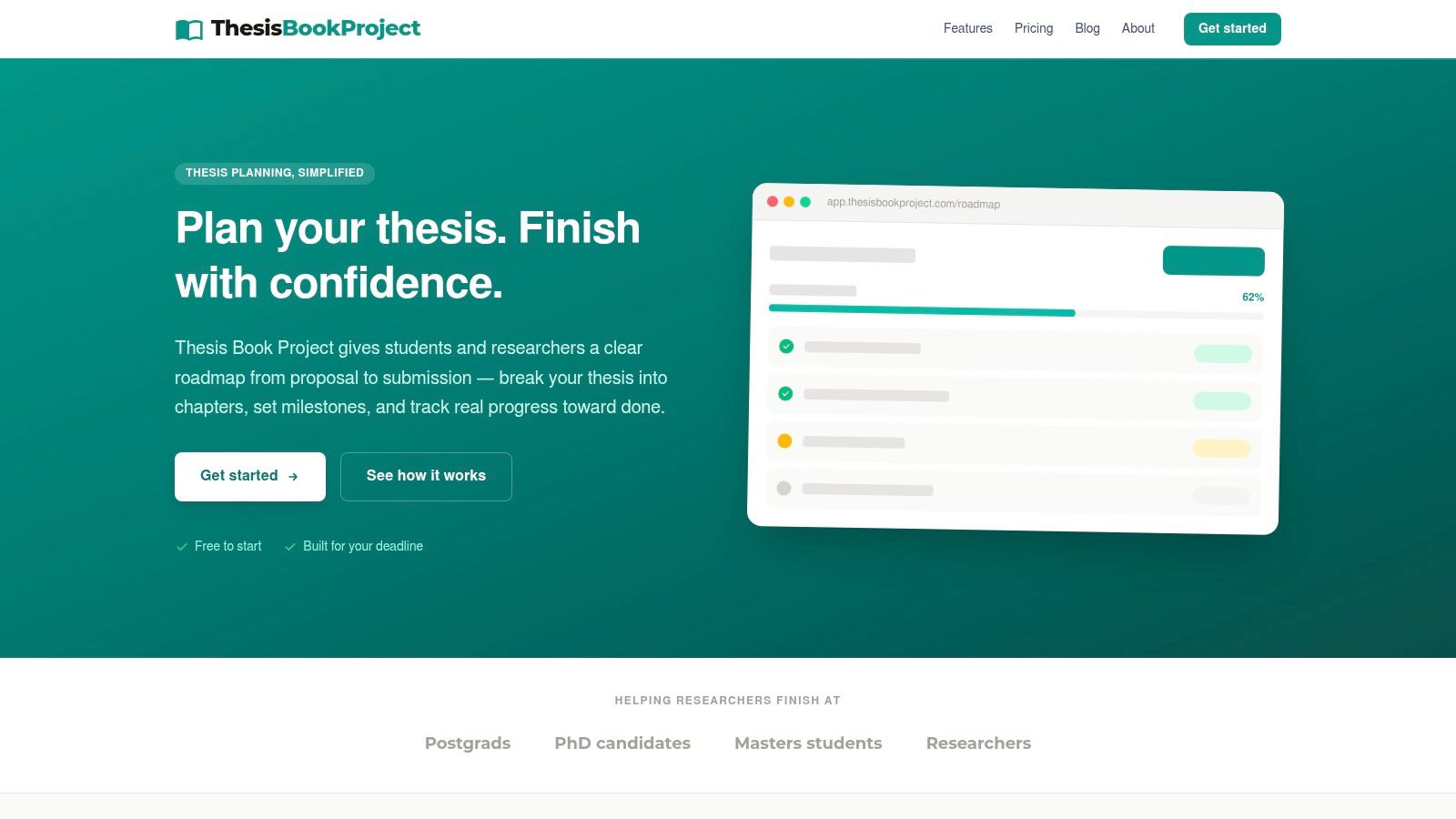
A topic that looked viable on paper can still drift if you don't track its moving parts. If you're managing chapters, deadlines, and references separately, the work fragments quickly. A structured system keeps the topic aligned with the actual writing process, which is where feasibility gets tested again and again.
Thesis Book Project is one option for that kind of planning, especially if you want a single place to map the thesis from proposal through final submission. If you're ready to turn your chosen topic into a workable plan, visit Thesis Book Project and start organizing the next steps before the project starts pulling you off course.
Related Articles
Literature Review Outline: Template and Annotated Structure
What does your literature review outline prove? If it only lists authors, topics, or publication dat...
Research Methods10 Software for References Compared in 2026
The most feature-rich reference manager isn't automatically the best one. A thesis writer who sp...
Research MethodsHow to Write a Thesis Introduction That Works
You're staring at a blank document with a dozen tabs open, a working title that keeps changing,...
Comments (0)
No comments yet. Be the first to share your thoughts.