How to Avoiding Plagiarism in Your Thesis the Right Way
Learn how to avoiding plagiarism in academic writing with practical paraphrasing, citation, and note-taking strategies that actually work for thesis writers.
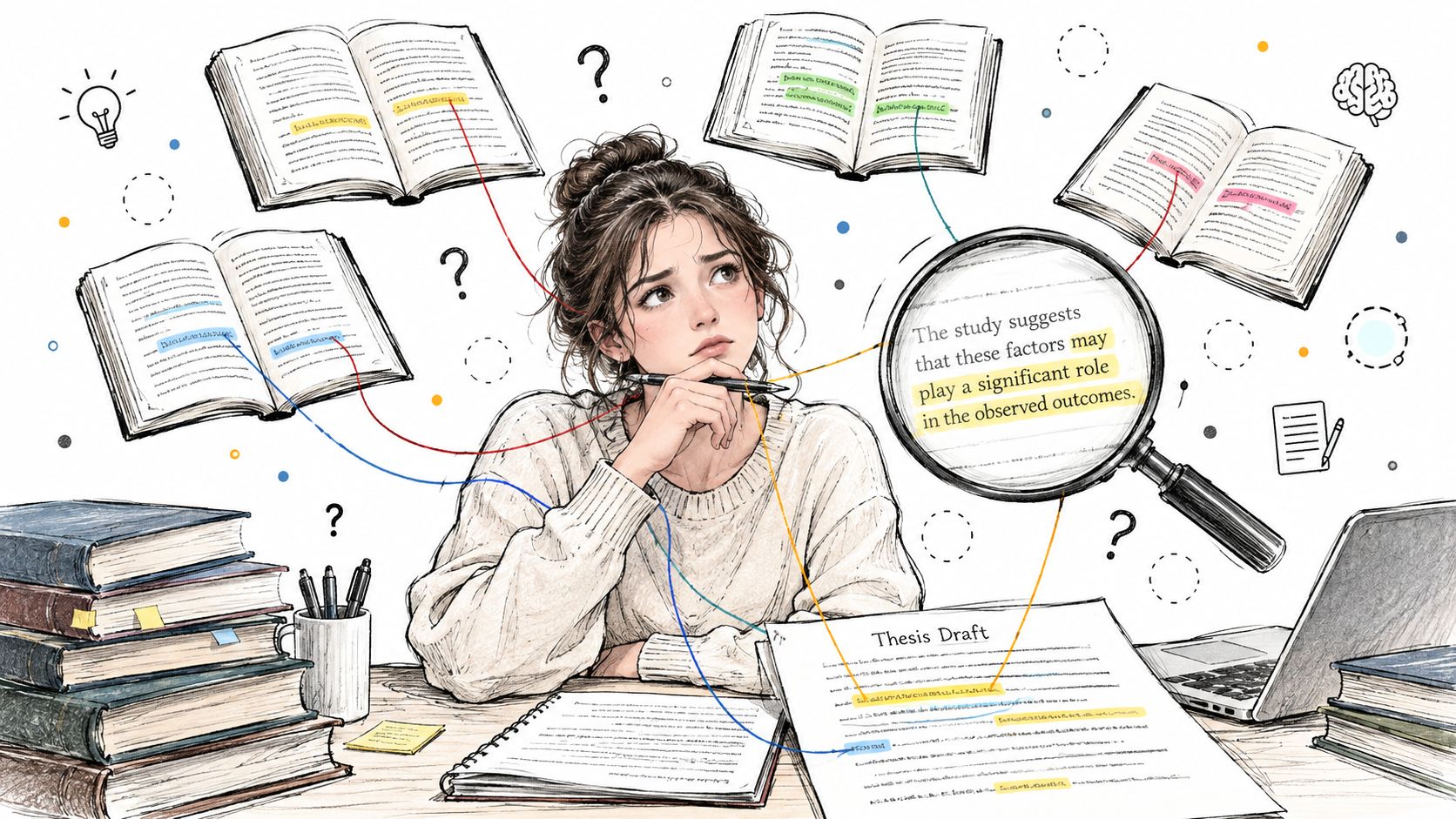
You've got a source open beside your draft, a sentence that captures the point perfectly, and a deadline getting closer. You change a few words, add a citation, and move on. That small edit can still leave the sentence too close to the original, even though you cited it.
Avoiding plagiarism in a thesis isn't a last-minute search for matching phrases. It's a writing workflow: record where ideas come from, separate source language from your own notes, and check attribution as you draft. That protects your work and makes it easier for readers to see what you contribute.
Table of Contents
- What Plagiarism Actually Means in a Thesis
- Quoting, Paraphrasing, and the Patchwriting Trap
- A Source-Controlled Workflow for Notes and Drafts
- Citation Rules That Travel Across Styles
- Generative AI and the New Attribution Problem
- Reading a Similarity Report Without Misleading Yourself
- Your Final-Check Checklist and Lasting Habits
What Plagiarism Actually Means in a Thesis
Plagiarism isn't limited to copying a paragraph and presenting it as your own. In a thesis, the less obvious risks are often more familiar: an uncited argument carried into a literature review, a paraphrase that preserves the source's sentence structure, or data and images used without acknowledgment.
The U.S. Office of Research Integrity defines plagiarism as taking another person's ideas, processes, results, or words without appropriate credit. Its research-misconduct guidance also distinguishes common methodological phrases, which can be legitimate to reuse, from substantial unattributed copying that misleads readers about an author's contribution (ORI's definition of research misconduct). The key question isn't only whether you copied exact wording. It's whether you've made the origin of borrowed intellectual work clear.
Credit the contribution, not just the wording
A thesis draws on other people's ideas and evidence. Attribution tells readers which claims came from your research and which came from the sources you consulted. A citation doesn't have to accompany every sentence if several sentences clearly summarize one source, but the reader must still be able to tell where the borrowed material begins and ends.
Direct quotations need quotation marks and a citation that identifies their origin. Paraphrases need citations too, because new wording doesn't make the underlying idea yours. Data, images, translated material, and distinctive organizational choices can also require acknowledgment.
Intent doesn't solve an attribution gap. A writer may forget a source while reorganizing notes, or may believe that replacing words is enough to make a passage original. The result can still misrepresent who contributed the idea. That's why the practical answer to how to avoiding plagiarism starts before drafting: record each source when you use it, and keep your own analysis visibly separate from borrowed material.
Quoting, Paraphrasing, and the Patchwriting Trap
Consider a typical literature-review sentence: “Students who receive timely feedback are more likely to revise their work in response to instructor comments.” The sentence below is an illustrative example, not a research finding. If a source makes this point, you have three possible moves, and each has a different purpose.
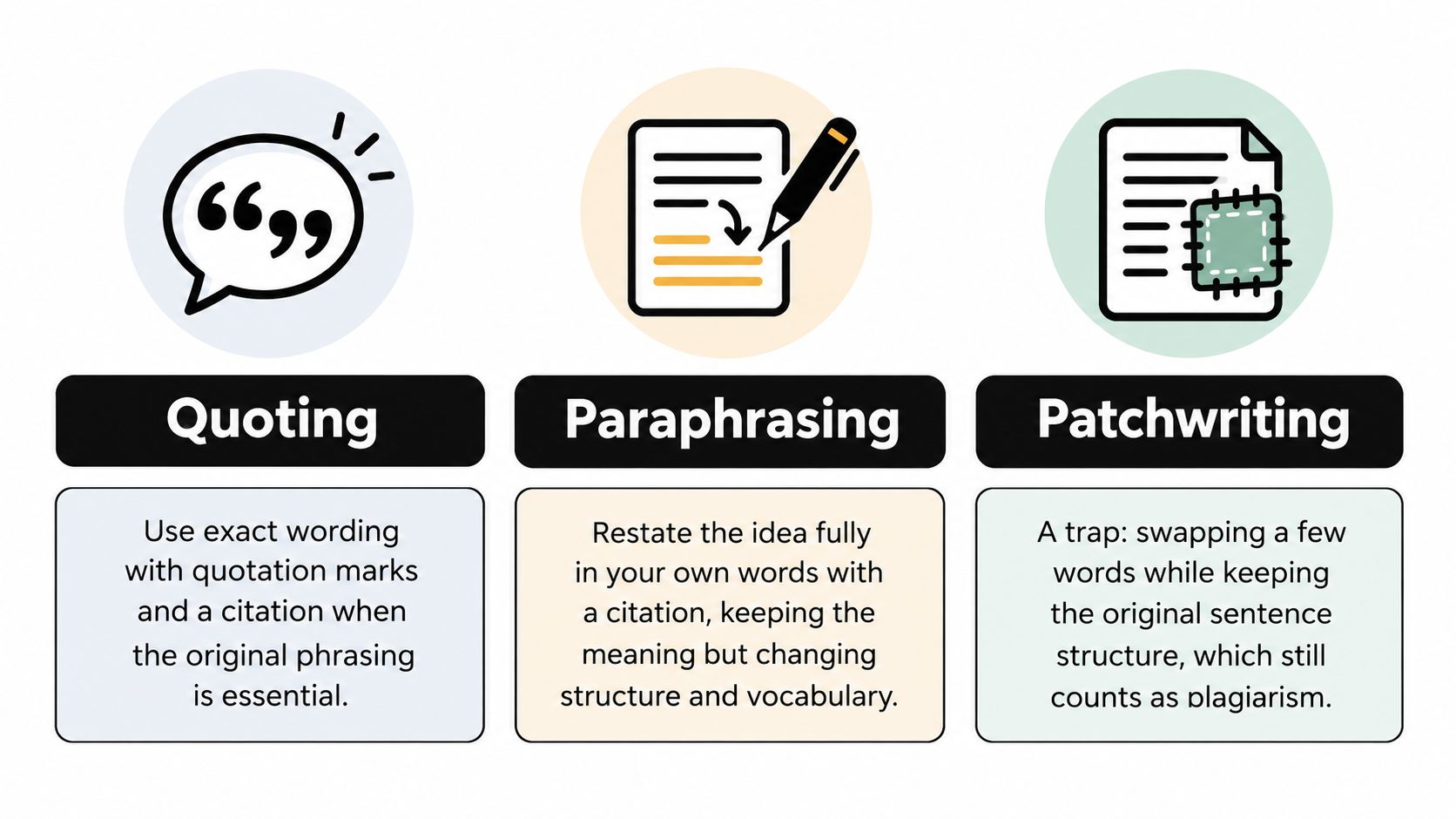
Quoting preserves the source's exact wording. Use quotation marks and cite the source, with a page number when the style or context calls for one. Choose this when the phrasing itself matters, such as when you're examining an author's definition. A thesis that relies heavily on quotations, however, can leave too little room for your own synthesis and interpretation.
Paraphrasing restates the source's idea using different wording and sentence structure. For example: Students may be more willing to revise when instructors return feedback promptly. This version changes the sentence's structure and phrasing while keeping the same central idea. It still needs a citation.
Patchwriting replaces a few words but keeps the original sentence pattern: Students receiving prompt feedback are more likely to revise their work based on instructor comments. That version is too close to the example sentence. A citation acknowledges the source, but it doesn't turn lightly edited wording into a genuine paraphrase.
Test your paraphrase before keeping it
Close the source, write the idea from your notes, then compare your draft with the original. Look beyond individual words: if the clause order, sentence shape, and distinctive phrasing still track the source, rewrite it from your understanding. Check that you haven't changed the author's meaning, and add the citation.
Practical rule: A citation credits the idea. Quotation marks identify exact wording. A paraphrase needs both your own sentence construction and a citation.
If you want help reworking wording and structure, these synonym and structural change tips can support the revision process, but synonym swaps alone won't fix patchwriting. For a broader approach to combining and organizing sources, see this guide to the literature review process.
A Source-Controlled Workflow for Notes and Drafts
A missing citation often starts well before the final draft. A writer copies a sentence into a notes file, loses its source, and later treats the wording as original. A source-controlled workflow prevents that confusion by keeping each claim connected to its origin.
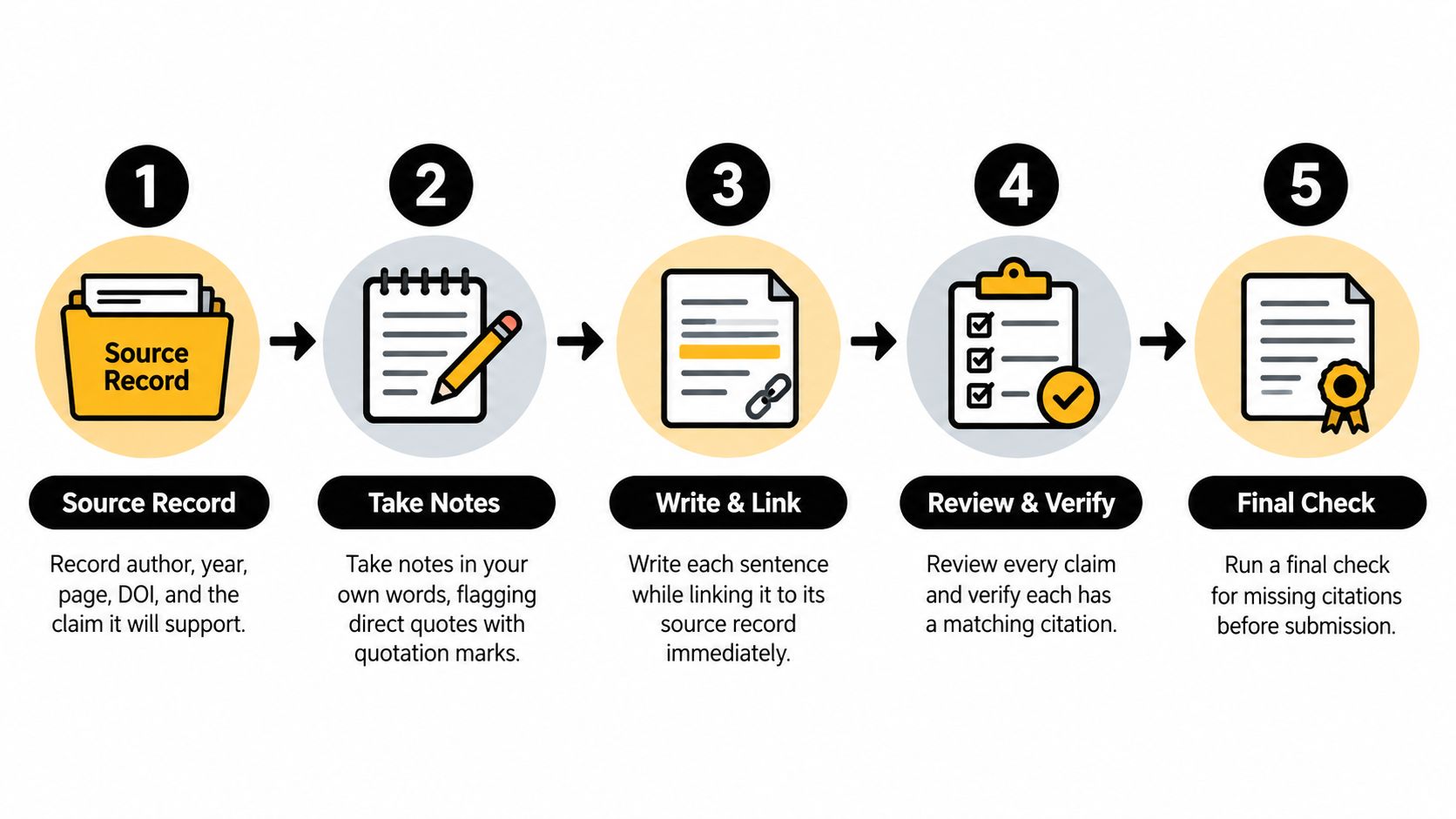
Start a source record before drafting from a source. Record who wrote it, when it was published, where the relevant passage appears, and which claim or chapter it may support. Then take notes in your own words. If you need to preserve exact wording, put it in quotation marks immediately and identify the page or section.
| Field | Why It Matters |
|---|---|
| Author and year | Identifies the source for your citation and bibliography |
| Title and publication details | Helps you distinguish the source from similar works |
| Page or section | Lets you return to the passage and locate quotations |
| DOI or URL | Makes the source traceable |
| Claim or chapter | Connects the reference to the part of your thesis it supports |
| Note type | Separates your analysis, paraphrase, summary, and exact quotation |
Draft from notes, then audit against sources
When you write, work from your notes rather than keeping the original passage beside the draft. This makes it easier to form your own sentence instead of unconsciously reproducing the source's syntax. Once the paragraph is drafted, check each claim against the source record and add the citation where the borrowed idea appears.
A useful sequence is to record the source, take and label notes, draft from those notes, and then verify each sourced claim. At the end, reconcile the bibliography with the citations in the text. This catches missing attribution and incomplete references that a similarity report can't reliably identify.
An annotated bibliography guide can help you organize both reference details and notes about how each source supports your argument. The important habit is to preserve that connection while you work, rather than trying to reconstruct it under deadline pressure.
Citation Rules That Travel Across Styles
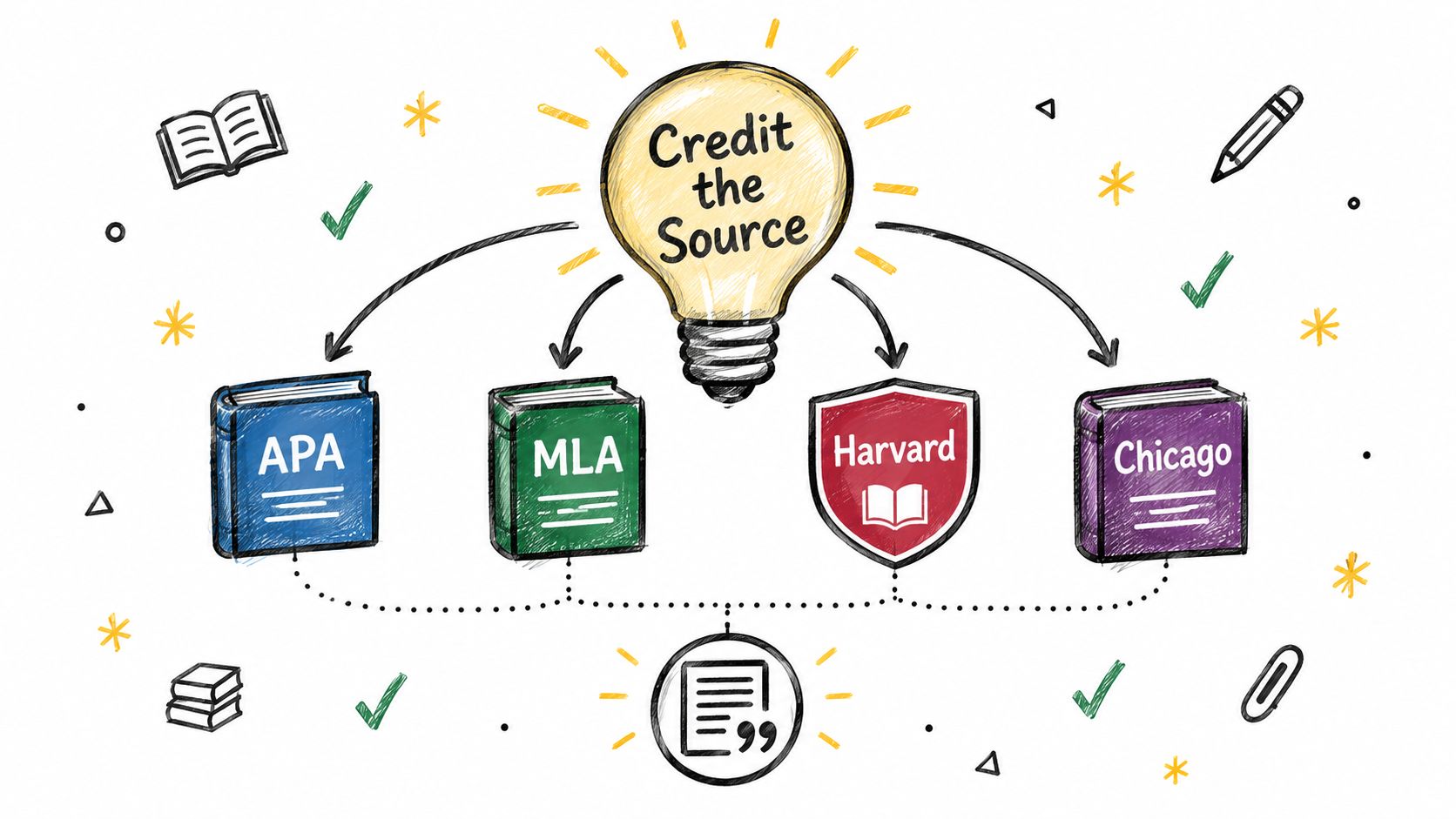
APA, Harvard, MLA, and Chicago format citations differently, but the underlying rule is consistent: acknowledge a source when you use its ideas, data, methods, or wording. Learn that principle first, then follow the style your department requires.
For a paraphrase, identify the source in the text using the format your style guide prescribes. For a direct quotation, make the wording visibly exact and give enough information to locate it. Page numbers are especially useful for quotations and specific passages, though requirements vary by style. Your reference list or bibliography should also match the sources cited in the thesis.
Check the borderline material
Some source use is easy to overlook because it doesn't look like a quotation. A summary of another author's argument still needs attribution. So can adaptations of a diagram or table, material shared in oral communication, translated passages, and factual data that readers can't reasonably be expected to know already.
Common knowledge is the exception, but the boundary depends on the subject and audience. If a claim is specific, disputed, or central to your argument, cite it rather than assuming every reader will recognize it as familiar. For images and adapted material, check both your institution's rules and the source's reuse conditions.
Citation tools can format references, but they can't decide whether a claim belongs to a source or whether the citation supports the sentence as written. A reference manager or software for organizing references can help keep details consistent. You'll still need to confirm that the source is real, complete, and cited in the right place.
Generative AI and the New Attribution Problem
AI assistance doesn't make attribution simpler. A tool may help you brainstorm, edit, translate, paraphrase, or draft, but those activities raise different questions. Keep three obligations distinct: authorship, meaning whose work and analysis the thesis represents; source attribution, meaning where factual claims and ideas come from; and institutional disclosure, meaning whether your department requires you to describe AI assistance.
Those obligations can overlap, but they aren't interchangeable. Disclosing that you used an AI tool doesn't verify its claims or supply citations for its sources. Likewise, changing the wording of AI-generated prose doesn't prove that the ideas are yours or that the text meets your institution's expectations. Verify factual statements and every suggested reference against the original publication before relying on them.
Follow your department's rules
AI policies differ across institutions and departments, so check the rules that apply to your thesis before using a tool. If transparency is required, retain prompts, drafts, or other records that the policy asks you to provide. Make clear which analysis is yours and don't rely on generated citations until you've confirmed that the sources exist and support the claims.
Tools designed for AI chat research for small business may help users explore questions, but an academic thesis still needs traceable evidence and student-led judgment. AI detection isn't a substitute for that process. A detector can't take responsibility for a misleading claim, missing citation, or unacknowledged contribution. The student remains accountable for the submitted work.
Reading a Similarity Report Without Misleading Yourself
A similarity report flags matching text. It doesn't decide whether the match is plagiarism. Run the report when citations, quotations, references, and appendices are substantially complete, then inspect the matched passages individually rather than treating the overall score as a verdict.
Classify each match before you act:
- Attributed quotation: The exact wording appears in quotation marks and has a citation.
- Cited paraphrase: The wording and structure are your own, and the borrowed idea is credited.
- Expected technical wording: The match is a common phrase, institutional name, or standard language that can't reasonably be rewritten.
- Potentially unattributed borrowing: The passage may reproduce source wording or an idea without appropriate credit.
The last category needs attention. Return to the source, rewrite from your understanding rather than swapping synonyms, and cite the underlying idea even if the final wording no longer matches closely.
Treat the report as a screening tool
Neither a low nor a high similarity score, on its own, establishes whether a thesis is original. Published analysis reports that leading systems may reach only about 60–70% accuracy under rigorous standards, and that common phrases, institution names, and reference details can generate false positives (analysis of plagiarism-detection systems). The same systems may miss translated copying, heavily edited material, ideas expressed in different words, or sources they don't index.
Use process compliance as your benchmark instead: unexplained matches are resolved, exact wording is marked as a quotation, sourced claims have citations, and the bibliography matches the sources cited in the text. Ask your supervisor to review ambiguous cases. Software can help you find passages to inspect, but it can't determine authorship or replace careful source tracking.
Your Final-Check Checklist and Lasting Habits
A good final check doesn't ask only, “Does this chapter have a low similarity score?” It asks whether readers can trace every borrowed contribution and distinguish it from your own analysis. Use the same check on each chapter before you submit it.
- Trace borrowed claims: Every non-common-knowledge idea, argument, result, data point, image, and adaptation has an identifiable source.
- Mark exact language: Every verbatim phrase is enclosed in quotation marks and cited, with a page number where available and required.
- Compare citations and references: Every in-text citation has a matching bibliography entry, and every listed source is used in the text.
- Check AI disclosure: AI-assisted work follows your department's rules, and its claims and references have been verified.
- Review matches individually: Each similarity-report match has been classified and resolved, not dismissed because the overall score seems acceptable.
The checklist works best as part of your regular writing rhythm. Backward scheduling helps you reserve time for source checks before the deadline. A chapter tracker can show whether a chapter is still an outline, a draft, or ready for review, while a source manager keeps references connected to the chapters they support. Thesis Book Project combines a thesis roadmap, chapter tracking, milestone scheduling, progress visibility, and source management in one web-based platform.
You don't need perfect recall or a special instinct for academic integrity. You need a repeatable way to label notes, cite sources as you draft, and check your work before submission. Start with the chapter you're writing now, and keep the source record beside your notes.
Thesis Book Project helps students plan a thesis from proposal to submission with a guided roadmap, chapter tracking, milestone reminders, and a source manager. Use Thesis Book Project to connect your references to your chapters and build attribution checks into your writing schedule.
Related Articles
How Long Does It Take to Write a Dissertation
Dissertation writing itself usually takes 9 to 18 months of focused work for a full-time PhD candida...
Thesis WritingLiterature Review Introduction Example: 6 Annotated Models
A weak literature review introduction does more than look unpolished. It changes how examiners read...
Thesis WritingWhat Is a Dissertation Abstract? a Simple Guide
A dissertation abstract is a 200 to 300 word self-contained summary that compresses your problem, me...
Comments (0)
No comments yet. Be the first to share your thoughts.