APA Multiple Citations: Formats, Order and Examples
Learn how to format APA multiple citations correctly: alphabetical order, same-author years, narrative use and thesis examples.
You're revising a literature review, and the sentence finally says what you mean. Then you reach the citations: several authors, different publication years, and a pair of papers that look identical once shortened. Should the newest source come first? Does each work need its own parentheses?
APA multiple citations become easier when you treat them as a checking routine rather than a punctuation puzzle. Identify which works support the claim, arrange their author groups, and check that every shortened citation points to one identifiable reference. The examples below use illustrative sources and claims to demonstrate formatting, not to report research findings.
Table of Contents
- Multiple Citation Formats at a Glance
- How to Order Sources Inside One Parenthesis
- Same-Author and Same-Year Citations Explained
- Narrative Citations With Several Sources
- A Thesis Literature Review Worked Through
- Recurring Errors and the Final Chapter Check
Multiple Citation Formats at a Glance
Suppose your dissertation sentence reads like this:
Clear project boundaries can help writers make revision decisions (Adams et al., 2019) (Shumway & Shulman, 2015) (Taylor, 2018) (Westinghouse, 2017).
If all those works support the same claim, combine them:
Clear project boundaries can help writers make revision decisions (Adams et al., 2019; Shumway & Shulman, 2015; Taylor, 2018; Westinghouse, 2017).
The grouped version keeps the evidence attached to the claim without repeatedly interrupting the sentence. It also gives readers a predictable sequence to follow when they consult your reference list.
Multiple citation formats by case
| Case | Parenthetical format | Governing rule |
|---|---|---|
| Two or more different sources | (Adams et al., 2019; Shumway & Shulman, 2015) | Alphabetical by first author, separated by semicolons |
| Three or more authors | (Adams et al., 2019; Westinghouse, 2017) | Use et al. for three or more authors, unless clarification is needed |
| One author, several years | (Taylor, 2018, 2021, 2024) | Author written once, years separated by commas |
| One author, same year | (Patel, 2020a, 2020b) | Lowercase letters follow reference-list title order |
| Undated and dated works by one author | (Taylor, n.d., 2018, 2021) | Undated first, then dated oldest to newest |
| In press work by one author | (Taylor, 2018, 2021, in press) | In press works come last |
Semicolons separate different author groups. When the author or complete author group stays the same, write that name once and separate the publication years with commas. Don't treat sources as the same author group just because they share a first author.
Also distinguish multiple sources from multiple authors. Adams et al. represents a work with several authors; adding Westinghouse introduces another source. The punctuation between sources and the abbreviation within a source solve different problems.
If you're still working out which publication details belong in an in-text citation, use this guide to citing articles in a research paper alongside your reference entries.
For a quick punctuation test, ask: Does the complete author group repeat? If it doesn't, separate the groups with a semicolon. If it does, retain the author name once and list its years with commas.
How to Order Sources Inside One Parenthesis
Sorting sources by publication year feels reasonable, especially when your paragraph describes how a field developed. But for an ordinary parenthetical group, author order controls the sequence, not chronology or the order in which you discovered the papers.
The APA Style guidance on citing multiple works requires alphabetical ordering for different authors and semicolons between entries, illustrated by (Adams et al., 2019; Shumway & Shulman, 2015; Westinghouse, 2017).
Use this visual as a reminder before editing a crowded citation.
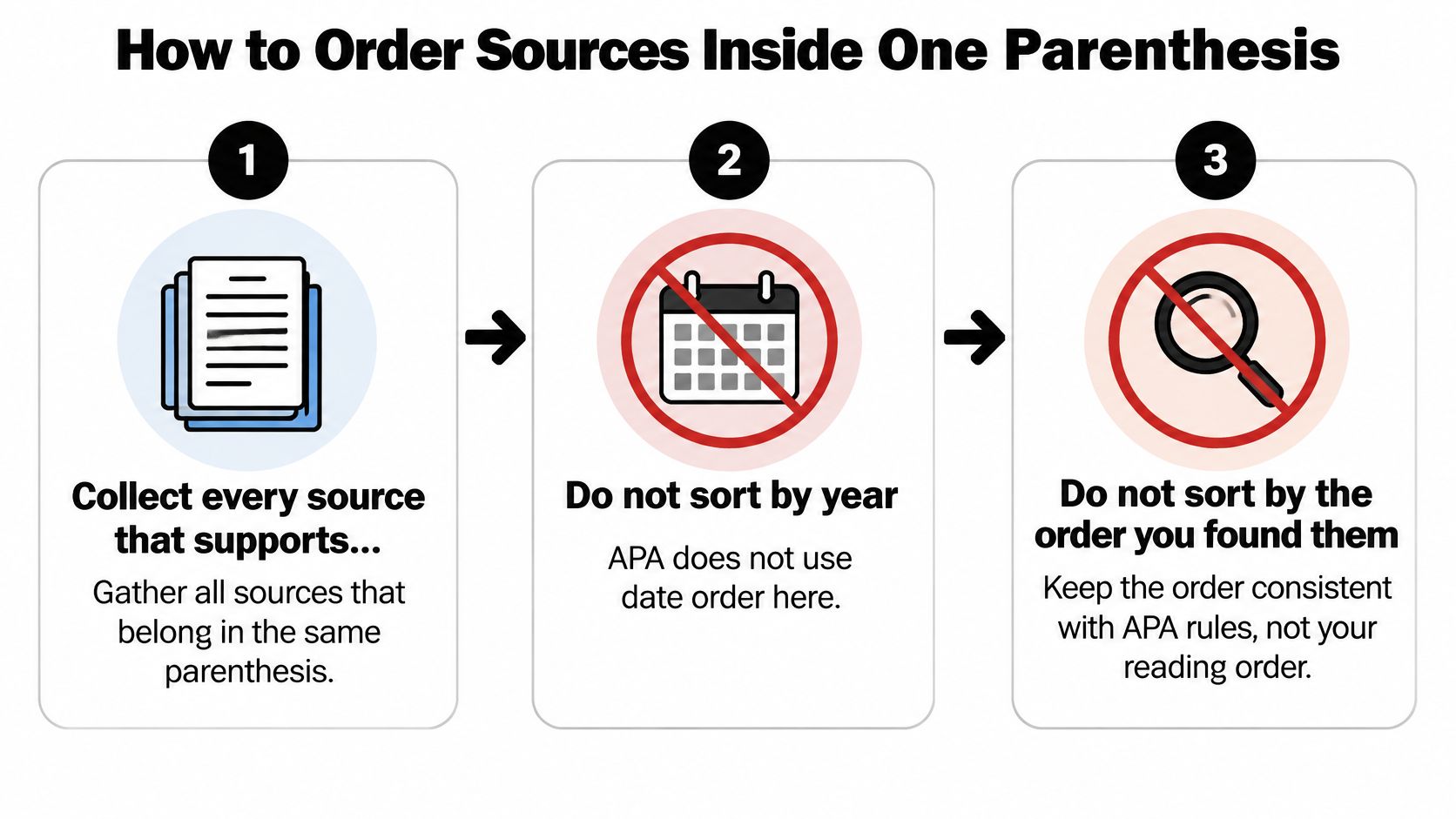
A repeatable ordering procedure
Collect the relevant support. Gather the works that support the sentence's claim. Don't omit a relevant source merely because its conclusion is less emphatic, but don't include a paper that only discusses the surrounding topic.
Sort by the first author's surname. Ignore publication year and journal name while arranging different author groups. A frequent slip is preserving the sequence from your reading notes rather than alphabetizing the citations.
Insert a semicolon and a space between groups. The sequence Adams, Shumway, Westinghouse remains correct even though the dates don't run from oldest to newest. Putting the latest paper first changes the required ordering.
Check the author format within each entry. Use an ampersand between the names of a two-author work inside parentheses, and normally use et al. for a work with three or more authors. Don't substitute the word and inside a parenthetical author pair.
Keep single authors and organizational authors in alphabetical position. A prominent organization doesn't automatically belong first. Its importance to your argument isn't the same thing as its position in an ordinary citation group.
Ordering check: Read only the first-author names inside the parentheses, then compare that sequence with your reference list.
APA also permits a deliberate exception: place the most directly relevant work first, followed by a semicolon and see also, with the remaining works alphabetized. Use that construction to distinguish primary support from additional reading, not to promote a favorite source.
For a video companion to citation formatting, use the embedded resource below.
Same-Author and Same-Year Citations Explained
You've cited Patel's paper, then discover another Patel paper from the same year. Without an extra identifier, your reader can't tell which reference you mean. Year letters distinguish the works, so Patel (2020a) and Patel (2020b) remain separate, traceable citations.
The APA Style author-date guidance requires matching lowercase year letters in text and references for works by the same author or author group in the same year, as in (Patel, 2020a, 2020b). Assign those letters from reference-list ordering, generally the alphabetical order of titles after applying APA's ordering rules, not from the order in which you cite the sources.
Assign letters from the references, not the draft
Suppose the hypothetical Patel works have the titles Planning a dissertation and Revising a dissertation. Once the reference ordering is settled, the title beginning with Planning precedes the title beginning with Revising. The earlier-sorting entry receives a; the other receives b.
If you discuss the revision paper first, its letter doesn't change. First mentioned is not the same as first alphabetically. Moving a paragraph elsewhere in your thesis should therefore leave the identifiers intact.
This distinction matters when you add a source late in revision. Don't attach a letter only to the new citation and leave the existing one unchanged. Check the entire same-author, same-year group, then update every affected occurrence in the manuscript.
Handle mixed publication dates separately
A same-author group can also contain different publication statuses:
(Taylor, n.d., 2018, 2021, in press)
Here, n.d. identifies an undated work. It precedes dated works, which run from oldest to newest; an in press work follows them. Don't invent a publication year to make an undated or in-press source fit a chronological list.
Use this preparation routine before your final citation pass:
- Normalize names. Check that spelling and author order match the actual publications.
- Group by author and year. Bring potentially conflicting records together.
- Inspect distinct works. Separate genuine same-year publications from duplicate records of the same work.
- Set reference order. Assign letters only after the relevant entries are sorted.
- Search the manuscript. Confirm that each year-letter combination identifies the intended reference everywhere it appears.
That last search should include narrative citations, tables, and figure notes, not just parentheses in the main prose. A corrected bibliography won't fix an outdated identifier elsewhere in the chapter.
Narrative Citations With Several Sources
Use and when author names form part of your sentence, but use & between a two-author pair inside parentheses. Thus, Shumway and Shulman belong in narrative prose, while Shumway & Shulman belong in a parenthetical citation.
A narrative citation makes the author part of the sentence's grammar. In an illustrative draft, you might write:
Taylor (2018) and Patel (2020a) argued that thesis delays reflected changes in scope rather than task difficulty.
You can coordinate a longer list in the same way:
Adams et al. (2019), Shumway and Shulman (2015), and Westinghouse (2017) reported similar patterns.
Choose the format that serves the sentence
Narrative citations work well when readers need to know who made an argument, who used a method, or how authors differed. They're less helpful when a long list of names delays the point you want readers to understand.
Compare these hypothetical versions:
| Version | Illustrative sentence |
|---|---|
| Author-heavy | Adams et al. (2019), Shumway and Shulman (2015), Taylor (2018), and Westinghouse (2017) suggested that explicit boundaries could guide revision decisions. |
| Claim-focused | Explicit boundaries could guide revision decisions (Adams et al., 2019; Shumway & Shulman, 2015; Taylor, 2018; Westinghouse, 2017). |
Neither construction is automatically better. Choose the narrative version when authorship contributes to your analysis; choose the parenthetical version when the shared claim deserves emphasis.
Don't make readers work through a list of researchers before they can discover what the sentence says.
Keep each year attached to the author it identifies. When several authors appear in prose, don't collect all their years into an unexplained parenthesis at the sentence's end.
For a specific study's actions or findings, past tense is usually a clear choice: the researchers examined, compared, or reported. Use present tense when explaining established knowledge or presenting a claim as currently applicable, while following your discipline's conventions.
Year letters remain part of narrative citations too. Patel (2020a) and Patel (2020b) must stay distinct even when you discuss them in separate sentences. Changing the sentence structure doesn't change the source's identifier.
A Thesis Literature Review Worked Through
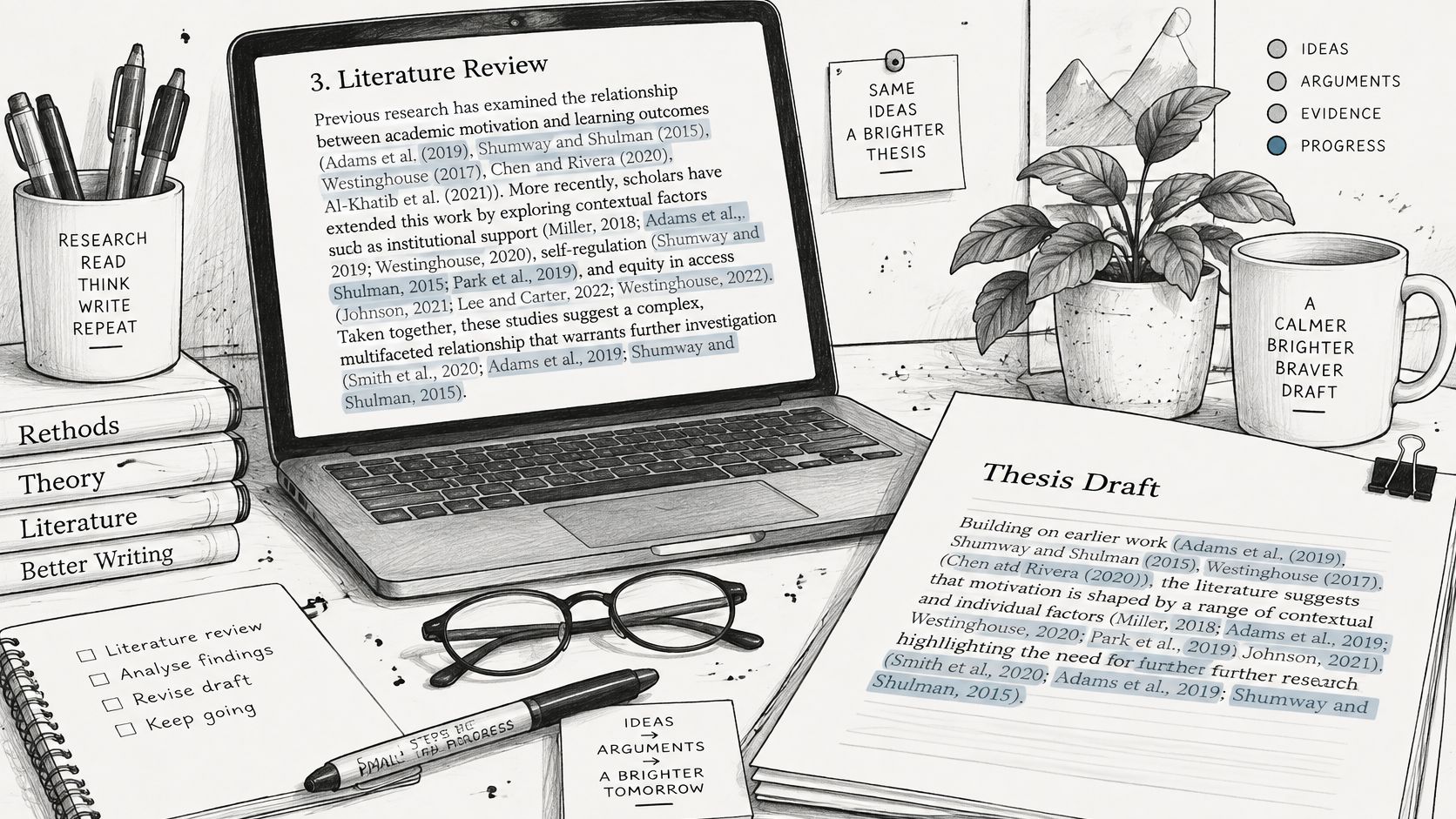
Suppose a supervisor flags a literature-review paragraph where every citation looks plausible on its own, but the combined group is inconsistent. You've repeated an author, placed sources in reading order, and made a comparison difficult to follow. Left until supervisor review, those small problems can turn into another revision exchange.
Keep the paragraph beside its reference entries while you edit, rather than trying to reconstruct source details from memory.
Compare the draft and revision
The following paragraph is hypothetical. Its purpose is to demonstrate citation decisions, not to attribute actual findings to these example authors.
| Draft | Corrected version |
|---|---|
| Explicit project boundaries can guide revision decisions (Westinghouse, 2017; Taylor, 2021; Adams et al., 2019; Taylor, 2018; Shumway & Shulman, 2015). A distinction between initial planning and later adjustment was emphasized (Taylor, 2021). | Explicit project boundaries can guide revision decisions (Adams et al., 2019; Shumway & Shulman, 2015; Taylor, 2018, 2021; Westinghouse, 2017). Taylor (2021) distinguished initial planning from later adjustment. |
The first decision concerns the shared claim. Every source in the opening parenthesis is presented as support for the statement about project boundaries. Alphabetizing the author groups makes the citation consistent without changing that statement's meaning.
The next decision concerns Taylor's entries. Because the example assumes the same author wrote both works, their years sit together under one name. You haven't removed evidence; you've removed unnecessary repetition.
The final decision concerns sentence emphasis. Taylor becomes the grammatical subject where the paragraph attributes a particular distinction to that author. This also replaces a passive construction with a clearer statement of who made the distinction.
Check the argument as well as the format
Before accepting the revision, open the actual sources. Would each support the full claim, or does one address only planning while another addresses revision? If the evidence supports different propositions, split the sentence rather than hiding those differences inside a correctly punctuated group.
For broader paragraph-level decisions, apply these literature review best practices while checking your synthesis.
- Search for semicolons. Inspect the surrounding parentheses rather than assuming every match is a citation.
- Compare with references. Check the author sequence and source identity.
- Flag repeated names. Confirm whether repetition reflects the same author group or different coauthors.
Recurring Errors and the Final Chapter Check
| Error | Why It Fails | Fix |
|---|---|---|
| (Westinghouse, 2017; Adams et al., 2019) | Not in first-author alphabetical order | Sort by surname: (Adams et al., 2019; Westinghouse, 2017) |
| (Taylor, 2018; Taylor, 2021) | Author name repeated for each year | Write the name once: (Taylor, 2018, 2021) |
| (Patel, 2020; Patel, 2020) | Two same-year works look identical | Add letters: (Patel, 2020a, 2020b) |
| (Garcia et al., 2020) for two different works | Shortened form points to two sources | Add surnames until the works differ |
| (Adams and Shulman, 2015) | Parenthetical citations use an ampersand | (Adams & Shulman, 2015) |
| Adams & Shulman (2015) found | Narrative citations use and in the sentence | Adams and Shulman (2015) found |
An out-of-order citation is easy to notice once you read the names without the dates. An ambiguous et al. citation needs a closer comparison with the reference list.
The APA beginner student paper checklist illustrates the standard separation of multiple sources with semicolons and same-author years with commas, alongside author-count and same-year identification requirements. These conventions help readers distinguish works, not merely recognize familiar formatting.
When et al. conceals the difference
Suppose different publications shorten to the same form: Garcia et al. with the same year. Readers can't identify the intended source just by looking up the first surname.
Expand the author lists only as far as needed to distinguish the works, then retain et al. where appropriate. If the works differ only in the final author, spell out all the authors instead. Otherwise, the abbreviation would hide the very name readers need.
Don't automatically solve this by adding year letters. First determine whether you have the same author group publishing different works or different author groups collapsing into the same abbreviation. Those are different identification problems.
Verification standard: A reader should be able to move from any in-text citation to one intended reference without guessing.
Run a final chapter pass
Collect the citations. Pull parenthetical and narrative citations into a checking document, or inspect them systematically using your word processor's Find function. Include citations outside the main body text.
Check each parenthetical sequence. Compare author groups with the reference list. Treat deliberate see also constructions separately from ordinary alphabetical groups.
Match every year letter. Confirm that each lettered citation has a matching reference entry and that each lettered reference is cited in the manuscript. If you've changed reference ordering, recheck affected citations.
Test shortened author forms. Search for et al. and inspect possible collisions. A citation can look perfectly formatted while still identifying more than one work.
Check and against ampersands. Read author pairs in their grammatical context. Narrative names belong to the sentence; parenthetical names belong inside the citation.
Use a reference-list creation routine to keep the bibliography aligned with those checks. Our Source manager keeps references and reading organised, but it supports this verification rather than replacing it.
An unverifiable bibliography can weaken an examiner's confidence in the claims it supports. Run this pass on your most citation-heavy chapter this week, before sending the draft to your supervisor.
Thesis Book Project offers a Source manager to keep your references and reading organised while you work through citation checks. Visit Thesis Book Project and use it to organise the sources for the chapter you're revising, then check each citation against its reference entry before sharing your draft.
Related Articles
How Long Should a Thesis Proposal Be? Word Count Guide
Most doctoral admissions proposals run about 1,500 to 2,000 words, while internal thesis proposals o...
Thesis WritingDissertation Title Page: Required Elements and Layout Rules
Your dissertation title page is already being counted before anyone reads it. At many universities i...
Thesis WritingThesis and Roadmap: Plan Your Path to Submission
You've got a submission date somewhere in a programme handbook, a folder of half read papers, an...
Comments (0)
No comments yet. Be the first to share your thoughts.