How Long Should a Thesis Proposal Be? Word Count Guide
Asking how long should a thesis proposal be? Typical ranges by program, section word targets, and how to adjust for your supervisor.
Most doctoral admissions proposals run about 1,500 to 2,000 words, while internal thesis proposals often require 4,000 words or more, usually excluding references. Your department's controlling rule overrides either range.
The popular advice to aim for a standard number of pages misses the core issue. An admissions reader needs enough detail to judge your research potential; a committee approving fieldwork needs enough detail to evaluate what you'll do. Those are different documents, even when both are called a thesis proposal.
The useful answer to how long should a thesis proposal be is therefore a word budget tied to a decision, not a universal total. Establish what the reviewer must be able to verify, then give each part of that argument enough space.
Table of Contents
- Typical Thesis Proposal Lengths by Program
- Find the Rule That Sets Your Length
- Word Budget for a 2,000-Word Proposal
- When Your Proposal Needs 4,000 Words or More
- Spotting a Proposal That Is Too Short or Too Long
- Confirm Your Length With Your Supervisor Before You Draft
Typical Thesis Proposal Lengths by Program
There's no single required length. As a planning distinction, separate short admissions proposals from developed proposals submitted for internal approval. Don't assume that a master's proposal must be shorter than a doctoral one, because the submission's purpose matters more than the degree label.
For education doctoral applications, the University of Warwick's research proposal guidance specifies approximately 2,000 words, excluding references, and explicitly says the proposal shouldn't be longer. That's a ceiling to work within, not an invitation to attach extra background.
Typical proposal length by program and level
The published examples below show why you need both the length requirement and the counting instructions. Where the available guidance doesn't establish an inclusion rule, the final column identifies the specific point to confirm rather than guessing.
| Context | Typical length | What counts |
|---|---|---|
| Doctoral admissions concept, Warwick | About 2,000 words | Excludes reference list |
| Doctoral admissions, Harvard and Cambridge | 1,500 words | Confirm reference and supplementary-material rules in the application instructions |
| Doctoral admissions, general guide, De Montfort | About 3,000 words | Confirm what the receiving department includes |
| MIT MEng or SM proposal | 1,500–2,500 words or 8–12 pages | Follow the department's word or page specification |
| MIT PhD proposal | 10–20 pages | Confirm committee requirements for supplementary material |
| PhD internal proposal, Lethbridge | At least 4,000 words | Excludes references |
| MA full thesis proposal, Lethbridge | At least 20 pages, about 6,000 words | Bibliography required; confirm its treatment in the minimum |
| Dissertation proposal, University of Rhode Island | Up to 15 double-spaced pages | Excludes references and appendices |
| Thesis proposal, St. Francis Xavier | 40–60 double-spaced pages | Includes references and appendices |
| Life-sciences doctoral proposal, Tel Aviv | Maximum 10 pages at 1.5 spacing | Excludes cover page, references, and diagrams; abstract counts |
| Doctoral proposal, Ljubljana | 5–7 pages | Confirm reference-list inclusion; about 25 references expected |
The contrast is especially clear in the St. Francis Xavier thesis and project guidelines, which describe proposals normally running 40–60 double-spaced pages including references and appendices, compared with Rhode Island's 15 numbered, double-spaced pages excluding those materials. Transferring a page target between institutions would give you the wrong writing brief.
Use the matching submission, not the nearest degree
Choose the row that matches the assessment you're preparing for. A doctoral applicant shouldn't borrow the space available for an enrolled candidate's proposal defence, and an undergraduate shouldn't infer a target from doctoral examples.
Length also affects what you can reasonably promise. A concise application can establish a credible approach without presenting every instrument or procedural detail; a full approval document may need those details before a committee can assess the project.
Treat the table as a comparison, not permission. Before drafting, obtain the actual instructions for your submission and mark the distinction between a maximum, a minimum, and a suggested target.
Find the Rule That Sets Your Length
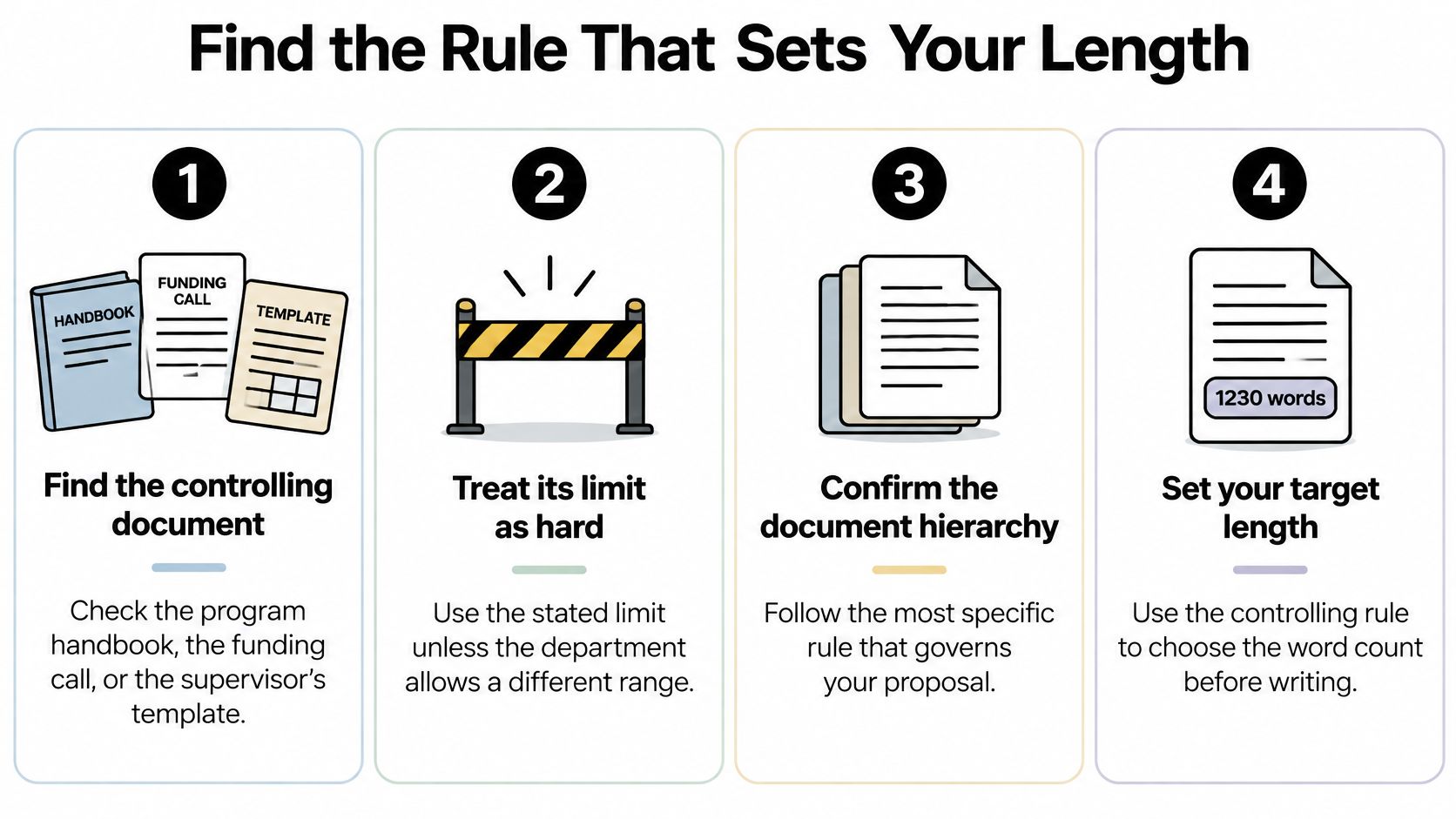
Start with the document that governs the submission, not a search result about average proposal length. Save that document alongside your outline so you can check the wording when questions arise.
Find the controlling document. Check the program handbook, application instructions, funding call, or required departmental template. Use the most specific applicable instruction, and ask the coordinator to resolve conflicting documents rather than choosing the more generous allowance.
Confirm the unit and exclusions. Record whether the requirement uses words or pages and whether references, footnotes, tables, appendices, and the abstract count. Page limits also require you to preserve the specified font, margins, and spacing, so don't casually convert them into a word target.
Identify the decision. Establish whether the reader is assessing admission, funding, ethics, or permission to proceed with the study. The document must supply the evidence needed for that decision, rather than reproduce the same generic proposal for every audience.
Check the development stage. Ask whether you're submitting an initial concept or a developed research plan. If no requirement is published, request a written target from the program coordinator before investing in a full draft.
Use this checklist when you collect your submission instructions.
Set a provisional target without inventing a rule
If the department hasn't answered yet, Salford's research proposal guide describes most research proposals as 1,500–2,000 words. Use that as a provisional drafting scale, not as evidence that your own program accepts it.
For a hypothetical handbook that excludes the bibliography, count the body separately and retain the complete reference list. Don't remove necessary references to make the document look shorter, and don't relocate essential methodological explanations to an appendix unless supplementary material is permitted.
Our guide to how to write a dissertation proposal can help you identify the components your outline needs. The department's instructions still determine which components belong in the submitted body.
Practical rule: Set the target by asking what the reviewer must be able to verify, then check that the required evidence fits within the permitted document.
Word Budget for a 2,000-Word Proposal
Allocate space by function before writing polished paragraphs. Otherwise, it's easy to spend the allowance explaining the topic and leave the study itself underdeveloped.
The functional allocation associated with the Cambridge doctoral research proposal guidance provides a useful planning framework: 10–20% for context and contribution, 30–40% each for the literature gap and questions and for study design, and 5–10% for feasibility and related planning. The word ranges below are calculated from those shares, not separate institutional section limits.
Word budget for a 2,000-word proposal
| Proposal block | Share of total words | Words in a 2,000-word proposal |
|---|---|---|
| Problem context and contribution | 10–20% | 200–400 |
| Literature gap and research questions | 30–40% | 600–800 |
| Study design and methods | 30–40% | 600–800 |
| Feasibility, timeline, ethics, and resources | 5–10% | 100–200 |
Choose allocations that add up to your total. These are flexible ranges, so selecting the top of every range won't produce a compliant draft. If your template requires a separate abstract or conclusion within the count, reserve space for it before distributing the remainder.
Context should identify the problem, its significance, and your intended contribution. The literature block should establish what existing work leaves unresolved, not provide a reading diary. Methods need enough detail to explain your data, selection criteria, collection procedure, and analysis.
Rebalance around the reviewer's unanswered questions
Consider a hypothetical draft in which background dominates while the methods occupy only a short paragraph. The fix isn't just to shorten sentences: remove broad field history and use the recovered space to explain how evidence will answer the research questions.
For example, replace a general account of interview research with your intended participant group, recruitment route, selection rationale, interview focus, and analysis procedure. Where access remains uncertain, state the dependency and a credible alternative. Those details let a reviewer evaluate a design instead of merely recognizing a method's name.
A chapter outline example can help you separate the proposal's argument from material intended for the eventual thesis. Don't force the full future literature chapter into the proposal because you've already drafted it.
Keep reading notes outside the submission document. Tintd's guide to Mac apps for notes and citations is useful when choosing a workflow for storing source summaries and citation details without letting them swell the proposal.
Give each paragraph a job: establish the gap, justify a question, explain a method, or demonstrate feasibility. Reading effort alone doesn't earn a paragraph space.
When Your Proposal Needs 4,000 Words or More
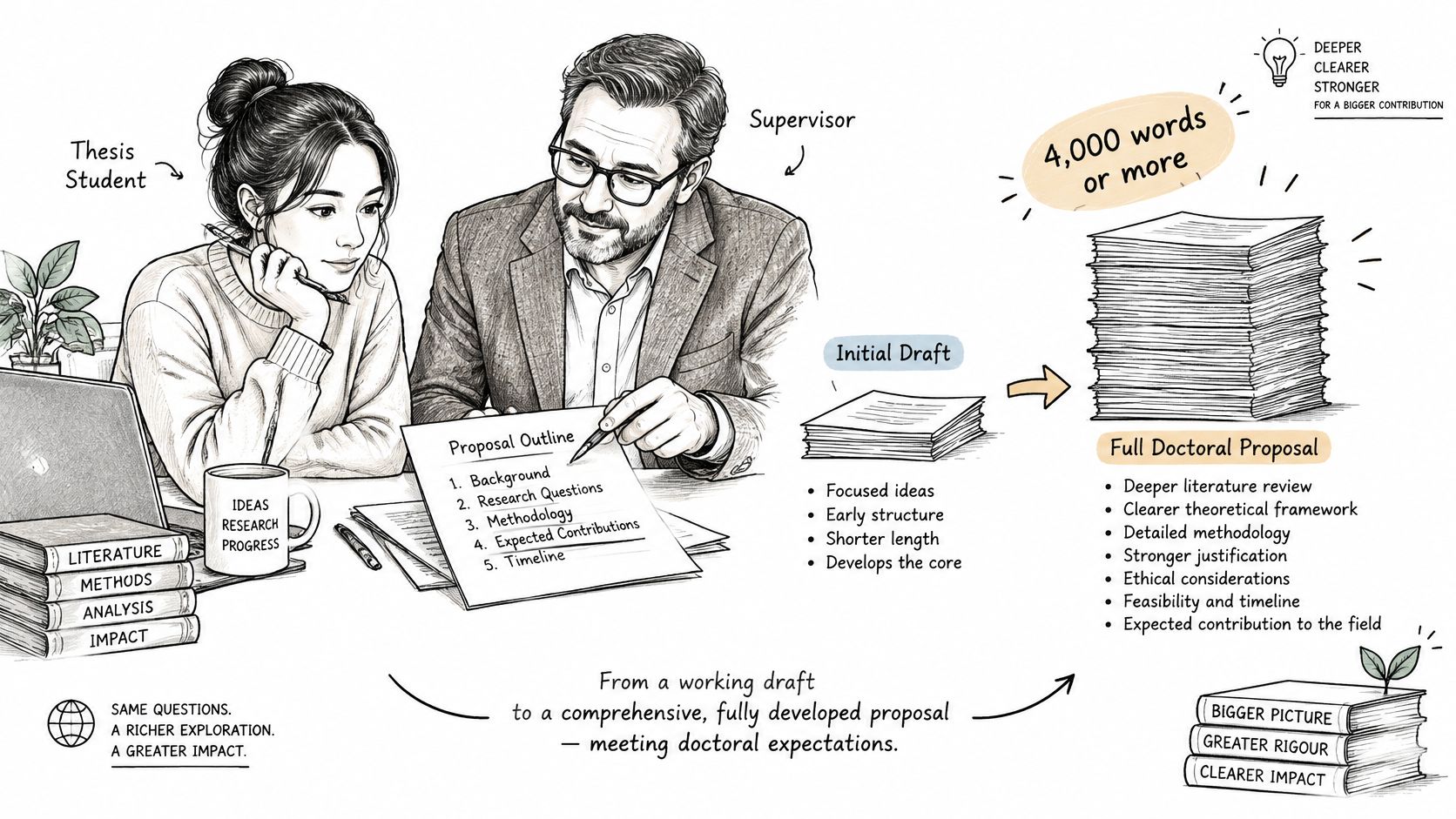
The University of Lethbridge's thesis and project proposal requirements specify a minimum of 4,000 words excluding references for the PhD in Education proposal and at least 20 pages, approximately 6,000 words, for the MA full thesis proposal. These are developed approval documents, not expanded application statements.
The doctoral requirements include a literature review, research questions or a hypothesis, methodology, feasibility assessment, and a detailed timeline with milestones. The MA requirements also include a theoretical statement, thesis positioning, bibliography, and a chapter-by-chapter outline.
Use the outline discussion to identify what the committee needs to inspect before you expand the prose.
Expand the operational detail, not the opening history
A longer allowance should make the project easier to evaluate. Explain why the theoretical framework fits the question, how you'll gain access to evidence, and what you'll do if recruitment, equipment, or permissions become obstacles.
Complexity can justify more space, but only when you explain its consequences. Naming specialist equipment isn't enough: establish its availability and role in the procedure. Identifying sensitive participants isn't enough either: explain the implications for consent, confidentiality, and recruitment.
Build the schedule backward rather than listing optimistic completion dates.
- Fix the submission point. Include the required review or defence process, not just the date you hope to finish writing.
- Place the main outputs. Identify when the literature synthesis, instruments, analysis plan, and complete proposal must be ready.
- Add dependencies. Put access agreements, ethics review, recruitment, and data collection in the sequence each step requires.
- Protect revision time. Leave room to respond to substantive comments before formal submission.
In our initial setup step, users set their deadline and break the whole thesis project into chapters and milestones in minutes. The important planning judgement remains yours: a milestone is credible only when its prerequisites can be completed.
Use the video alongside your outline review if you need another way to approach proposal development.
For a page-based submission, develop the draft in the prescribed layout from the start. Don't solve an overlength document by reducing type size or compressing spacing. Remove low-value exposition and preserve the information the committee needs to assess the study.
Spotting a Proposal That Is Too Short or Too Long
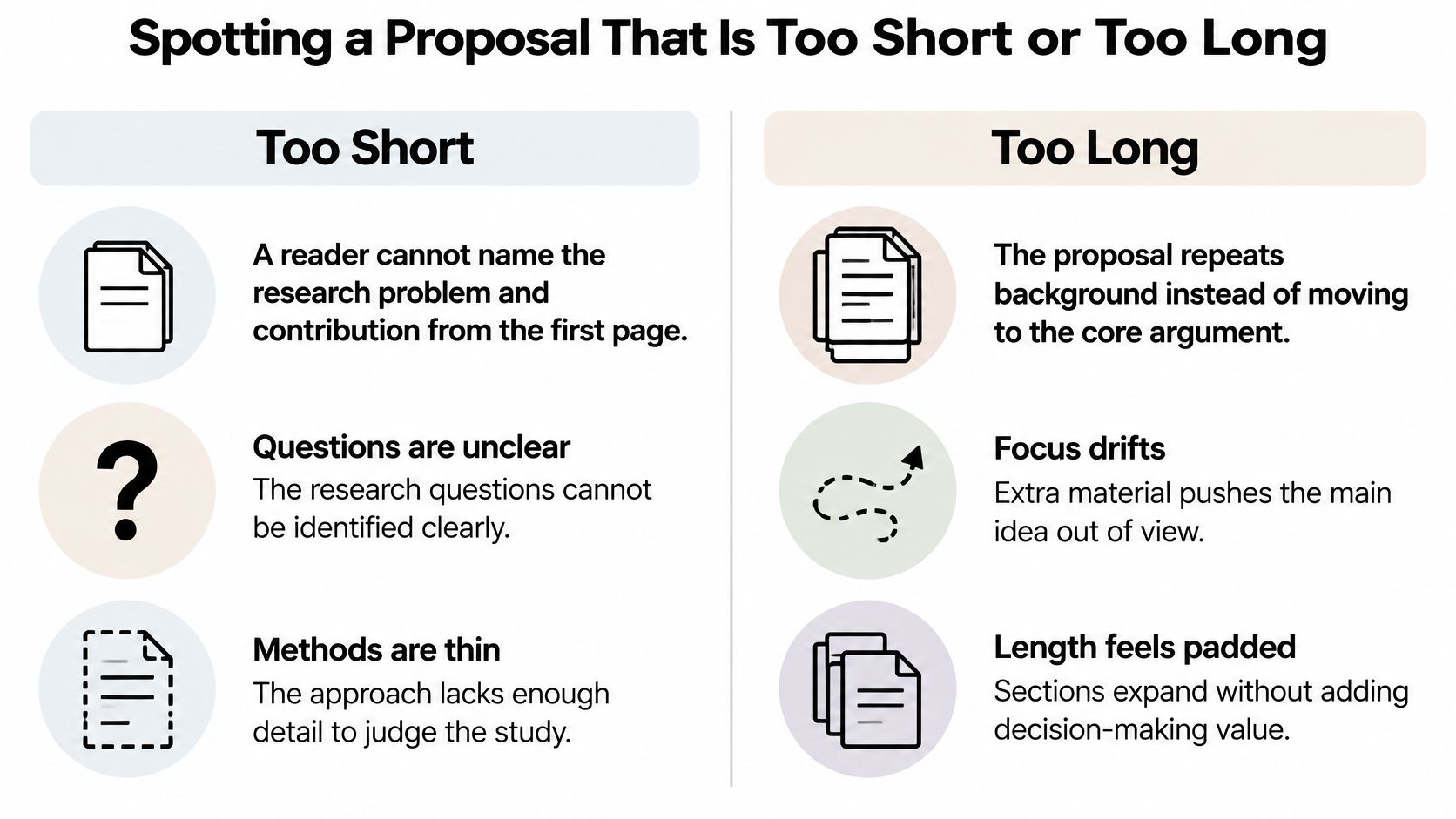
Underdevelopment and padding are different problems. A short document can contain a complete research argument, while a long one can leave the design impossible to evaluate.
The MIT Communication Lab's thesis proposal guide frames effective length around communicating the argument and recognizes department-specific expectations. Its attention to practical needs, including equipment and facilities, supports a better diagnostic than counting pages: can the reader judge whether the proposed work is possible?
Check what the reader still has to guess
An underdeveloped proposal makes reviewers supply missing reasoning. They may understand your topic but still be unable to identify your contribution or determine whether your data will answer your questions.
- Problem and contribution. Can a reader state what remains unresolved and what your study will add?
- Question-to-data alignment. Does each research question have an identifiable evidence source and analysis procedure?
- Execution. Have you explained sampling or selection, access, practical risks, and relevant safeguards?
- Literature relevance. Does the review justify the gap, framework, or design rather than merely summarize publications?
- Schedule completeness. Does the plan include permissions, recruitment where applicable, analysis, and revision?
Use the visual comparison to distinguish missing substance from unnecessary volume.
Check whether additional text changes a decision
Padding usually appears as repeated explanations, extended background before the gap, or literature summaries that never influence the proposed study. Another warning sign is describing the same method in several places without adding a new justification or procedural detail.
Cut repetition before cutting specificity. Removing a duplicated explanation of the topic preserves your argument; removing the account of participant selection may make the design unevaluable.
Don't mistake concise writing for incomplete thinking. A focused proposal can use fewer words because the questions, evidence, and methods fit together cleanly. A project with difficult access arrangements may well require a fuller explanation.
The decisive test is not whether a paragraph sounds academic. It's whether the reviewer would lose information needed to approve, question, or assess the work if that paragraph disappeared.
The cut test: Delete the paragraph temporarily. If no research question, methodological choice, contribution, or milestone loses necessary support, cut it or keep it in your working notes.
Confirm Your Length With Your Supervisor Before You Draft
Get agreement on the expected document before polishing it. A supervisor can respond more usefully to an outline showing your proposed balance than to a broad question about whether the proposal should be long or short.
Make the request easy to answer. Send a compact outline with the submission requirement, section headings, proposed allocations, and unresolved issues. Attach or identify the governing instructions so your supervisor can distinguish a formal requirement from your own drafting preference.
Ask for decisions, not general reassurance
Use a short preparation sequence.
- Record the governing requirement. Note the unit, limit, exclusions, required formatting, and where the instruction appears.
- Allocate the available space. Assign a target to each required component and check that the allocations fit the total.
- Expose the uncertainties. Ask whether the expected methods detail includes instruments, sampling justification, analysis procedures, or supporting appendices.
- Request explicit confirmation. Ask whether the proposed length and level of detail are suitable for this submission.
- Schedule review and revision. Agree when your supervisor needs the outline and draft, then work backward from the formal deadline.
A useful question is whether the methods allocation gives enough room to evaluate recruitment and analysis, not whether the proposal feels sufficiently substantial. Specific questions let the supervisor identify a mismatch before you build the whole draft around it.
If your supervisor says a published limit is flexible, clarify who authorizes that flexibility. Informal preference shouldn't replace an application portal's maximum or a committee's written submission rule.
Turn the agreed scope into a writing plan
Record the response in your outline and keep it with the submission instructions. If the project changes, revise the affected allocations rather than adding new material without removing anything.
Use a thesis roadmap to connect the agreed scope with drafting, feedback, and submission milestones. Allow separate time for resolving design problems and editing prose, because a clear sentence won't repair an unanswerable research question.
The result should be a workable writing specification, not a promise to reach an arbitrary page count. You should know what belongs in the body, what may sit outside it, and which decisions the supervisor expects the proposal to justify.
Keep the controlling limit, the counting rule, and the section budget together at the top of your working outline. Those are your drafting constraints.
Our free Starter plan includes the Thesis roadmap, the Chapter tracker, one project, and community support to help you turn an agreed proposal scope into manageable work. Visit Thesis Book Project to set your submission deadline, organize your chapters and milestones, and track the proposal from outline to final draft.
Related Articles
APA Multiple Citations: Formats, Order and Examples
You're revising a literature review, and the sentence finally says what you mean. Then you reach...
Thesis WritingDissertation Title Page: Required Elements and Layout Rules
Your dissertation title page is already being counted before anyone reads it. At many universities i...
Thesis WritingThesis and Roadmap: Plan Your Path to Submission
You've got a submission date somewhere in a programme handbook, a folder of half read papers, an...
Comments (0)
No comments yet. Be the first to share your thoughts.